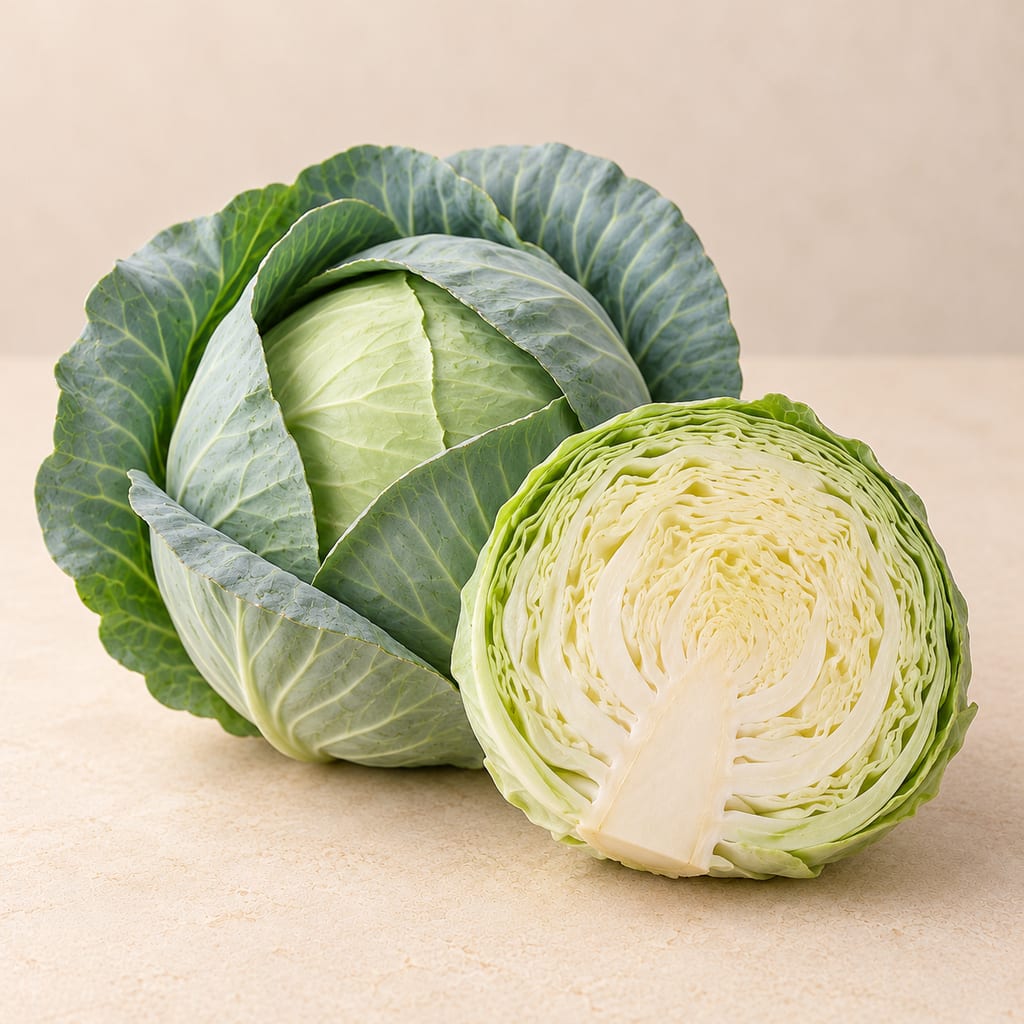
Cabbage
Cabbage is the dense leafy head of Brassica oleracea, a European vegetable that keeps for months and is the classic raw material for sauerkraut, with napa cabbage the base of kimchi.
 FermenteaWhere food goes to change
Traditional method
백김치 (baek-kimchi)
Napa cabbage is brined and filled with pear, radish, alliums, chives and fruit; this Korean kimchi omits red pepper flakes.
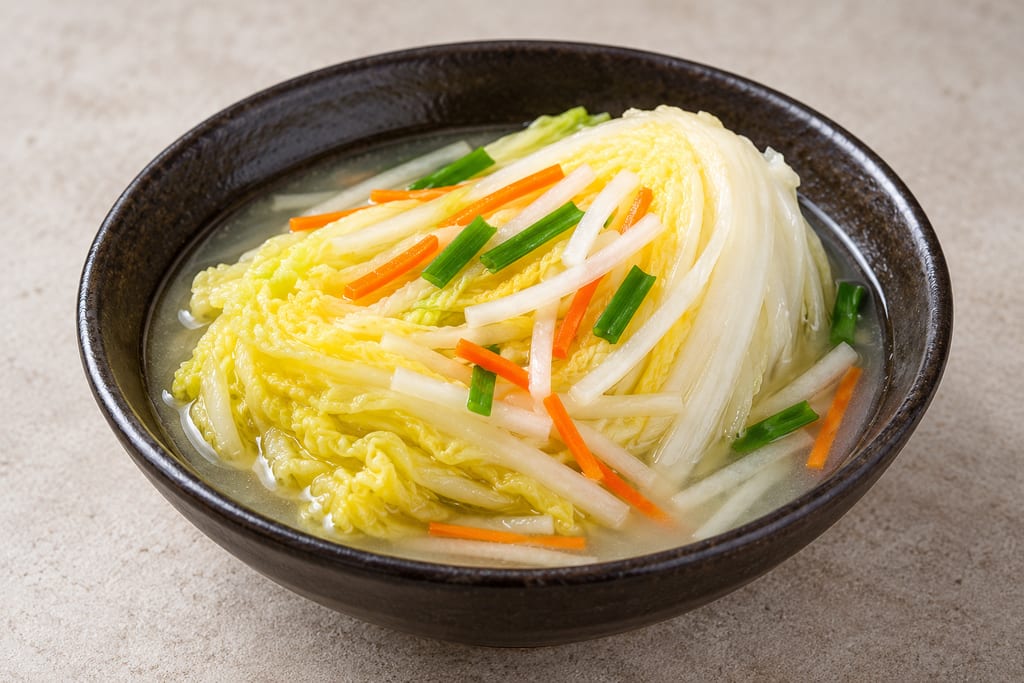
Baek-kimchi is a Korean white kimchi made from salted napa cabbage with a delicate vegetable and fruit filling.
The name literally means white kimchi.
Its defining feature is the absence of the large quantities of gochugaru, Korean red pepper flakes, used in many familiar red kimchi preparations.
This does not mean the dish is bland.
It can contain Korean pear, radish, chives, garlic, ginger, jujubes, chestnuts and pine nuts.
These ingredients produce a layered flavour combining sweetness, acidity, delicate allium notes and a subtle nuttiness.
The finished cabbage is commonly served cold, with some of the surrounding brine.
Unlike a chopped salad-style kimchi, this recipe uses cabbage quarters filled between their leaves.
The technique keeps the structure of the cabbage visible and produces an attractive dish suitable for a formal or celebratory table.
Kimchi is a broad category of Korean salted and fermented vegetable preparations.
Baek-kimchi represents a style that does not require a heavily red, spicy paste.
It is therefore particularly useful for people who prefer mild food or want a refreshing contrast alongside more strongly seasoned dishes.
White kimchi belongs to Korean culinary tradition, but the precise recipe in this record is a modern documented version.
It would be misleading to assign the use of this exact quantity of chestnuts or pine nuts to an ancient royal recipe without supporting historical documentation.
The dish's ingredients do, however, illustrate a more elaborate style of preparation than a simple salted vegetable pickle.
The careful filling and attractive arrangement of vegetable strips, fruit and nuts are important parts of its identity.
Large napa cabbage — 1, approximately 3 lb
Kosher salt for initial salting — ⅓ cup
Korean radish or daikon — ½ lb
Carrot — ¼ cup, matchsticks
Asian chives / buchu — ¾ cup
Jujubes — 3
Fresh chestnuts — 2
Pine nuts — 2 tablespoons
Silgochu, fine dried red pepper threads — Several strands, optional
Korean pear — 1 medium, approximately 2 cups
Garlic — 4 cloves
Onion — ½ cup
Ginger — 1 teaspoon
Water — 4 cups
Kosher salt — 2 tablespoons plus 2 teaspoons
Correction to the imported record: The brine salt was listed twice in the source data. It is one quantity of 2 tablespoons plus 2 teaspoons, not two separate additions.
The verified version of this recipe is also vegetarian and does not contain fish sauce. Some other white kimchi recipes may use fermented shrimp or seafood seasoning, but that is not part of this version.
Napa cabbage provides tender leaves and thick, crisp ribs capable of holding the filling.
Korean radish adds texture and a clean peppery flavour.
Carrot contributes colour and sweetness.
Asian chives provide fresh allium aroma.
Jujubes bring sweet, fruity notes and visual contrast.
Chestnuts contribute a firmer, slightly starchy texture.
Pine nuts supply richness and a delicate nutty flavour.
Red bell pepper adds colour without the heat of chilli powder.
Pear contributes sugar, juice and fragrance to the broth.
Garlic, onion and ginger provide aromatic complexity.
Salt prepares the cabbage and helps establish the conditions under which lactic-acid fermentation can proceed.
Cut the cabbage lengthwise in half.
Make a slit in the core so the leaves loosen while remaining attached.
Rinse or briefly immerse the cabbage to wet the leaves.
Sprinkle ⅓ cup kosher salt evenly between them.
The objective is to distribute salt through the thick ribs and leafy portions rather than only across the outside.
Leave the cabbage to salt for 1½–2 hours.
Turn every 20 minutes.
The salt draws moisture from the leaves and ribs, making the cabbage more flexible.
This helps the leaves accommodate the filling without tearing excessively.
The initial brining is also important for seasoning and fermentation.
Rinse the cabbage thoroughly in cold water.
Divide into quarters.
Remove the remaining hard core as appropriate.
Drain.
This removes excess surface salt and produces cabbage quarters suitable for stuffing.
Cut the radish and carrot into matchsticks.
Cut the chives into approximately 1-inch pieces.
Seed and slice the jujubes.
Peel and cut the chestnuts into strips.
Cut the red bell pepper into thin strips.
Combine these filling ingredients in a bowl.
Keep the pine nuts and optional pepper threads available for final placement.
Blend the Korean pear, garlic, onion and ginger until smooth.
The pear helps create a fragrant liquid without requiring visible pieces of fruit pulp in the final broth.
Dissolve 2 tablespoons plus 2 teaspoons kosher salt in 4 cups water.
Place the blended aromatic mixture in a clean cotton or cheesecloth pouch.
Immerse the pouch in the brine.
Press and squeeze gently to transfer flavour into the liquid.
Remove the pouch.
This produces a broth containing aromatic soluble compounds without retaining all the blended fibre.
Take one cabbage quarter.
Spread the prepared vegetable mixture between its leaves.
Place pine nuts and optional silgochu among the filling.
Fold the quarter together carefully.
Repeat with the remaining cabbage.
The quarters should remain recognisable rather than being chopped into loose pieces.
Arrange the cabbage quarters in a suitable fermentation container.
Pour over the prepared brine.
Ensure the cabbage is submerged.
Cover appropriately for fermentation.
The original method gives 1½–3 days at room temperature.
No numeric ambient temperature is supplied.
The broth may become slightly sour and effervescent.
The cabbage may gradually lose some of its initial raw stiffness.
After appropriate fermentation and safety assessment, refrigerate.
Serve cold.
The original recipe suggests a refrigerated period of approximately one month, but this is a culinary storage estimate, not an independently validated shelf life.
Baek-kimchi is a lactic-acid fermented vegetable preparation.
Research on kimchi shows that fermentation commonly involves Leuconostoc, Weissella and several groups historically placed in Lactobacillus.
Their activity depends on the raw ingredients, salt concentration and temperature.
The cabbage, garlic and other vegetables contribute microorganisms from their surfaces.
As fermentation progresses, organisms better suited to the increasingly acidic environment tend to become more competitive.
The mixture's carbohydrates are converted into lactic acid and other products.
Some organisms generate carbon dioxide, which can produce a lightly sparkling broth.
Research has identified metabolic products including lactate, acetate, mannitol and small amounts of ethanol in kimchi fermentations.
The relative quantities differ by recipe and conditions.
Red kimchi often contains a substantial quantity of gochugaru and may include fermented seafood.
This version uses a much lighter, fruit-infused seasoning.
The absence of chilli powder changes colour, aroma, mouthfeel and the compounds available to microorganisms.
However, the difference is not simply the absence of heat.
Chestnuts and pine nuts contribute richer and more rounded notes.
Pear and jujubes introduce fruity sweetness.
The liquid is less heavily loaded with solid seasoning paste.
The final effect is refreshing and aromatic rather than densely spicy.
The visible strips of radish, carrot and pepper are also part of the presentation.
Napa cabbage contains tender green or yellow leaves attached to thicker white ribs.
These parts respond differently to salt and fermentation.
Leaves become pliable relatively quickly.
The ribs retain a firmer, crisp texture.
Stuffing the cabbage distributes flavour between the leaves, while leaving the quarters intact.
This arrangement differs from mixing finely chopped cabbage with seasoning.
It also means that brine and flavour movement may vary between the exposed exterior and the folded interior.
A recipe must therefore preserve the salting and packing stages rather than treating the dish as a simple mixed salad.
White kimchi recipes differ in their fruit, vegetable and seafood additions.
Some use pear; others may use apple or alternative sweet fruits.
Some include chestnuts, jujubes and pine nuts as decorative and flavourful ingredients.
Other households simplify the filling.
Seafood seasoning is present in some white kimchi methods but absent from this particular version.
The presence or absence of fish sauce changes both flavour and dietary suitability.
A recipe that adds salted shrimp cannot be labelled vegetarian.
The principal documented version here is vegetarian, and any seafood variation should be clearly identified separately.
Serve the cabbage cold, with a little broth.
A stuffed quarter can be cut into serving portions before placing it on the table.
The attractive arrangement of vegetable strips makes careful slicing worthwhile.
Baek-kimchi accompanies rice and a wide variety of Korean dishes.
It is particularly useful when the rest of the meal is strongly seasoned.
Its acidity provides contrast while the cabbage adds moisture and crunch.
The refreshing broth can also be served with the vegetable rather than discarded.
A more mature white kimchi develops stronger acidity and softer texture.
Some cooks prefer it relatively young, while others enjoy a more pronounced fermented flavour.
The cabbage remains very stiff after salting: The ribs may not have softened sufficiently for comfortable folding.
The filling falls out: The quarters may have been filled too heavily or folded loosely.
The broth is cloudy: Mild cloudiness can develop during fermentation. This is not proof of safety.
The cabbage becomes very soft: Further fermentation changes texture. Excessive breakdown or sliminess is undesirable.
The dish lacks sourness: Fermentation may be incomplete. Check measured acidity and conditions rather than relying solely on a published time.
Mould appears: Discard the batch.
The broth is too salty: Salt crystal size, measuring and drainage can affect perceived saltiness. Do not arbitrarily dilute an active ferment as a corrective safety measure.
Use clean equipment, maintain submersion and assess acidification appropriately.
The general extension threshold of pH 4.60 or below remains relevant, but no laboratory-validated endpoint specific to this exact formulation is supplied.
Refrigerate after fermentation.
The recipe identifies baek-kimchi as Korean white kimchi made without Korean red-pepper flakes; this is a modern recipe presentation.
Scaling: source batch only
Poor brine coverage or contaminated equipment can compromise vegetable fermentation; this recipe has not been professionally validated.
Hazard sourceUse clean food-grade equipment, keep produce submerged where the method uses brine, and follow established acidity-monitoring guidance. No recipe-specific validated endpoint is supplied.
Control sourceThe author gives the Korean name and presents a contemporary recipe for this Korean style.
Cabbage is the dense leafy head of Brassica oleracea, a European vegetable that keeps for months and is the classic raw material for sauerkraut, with napa cabbage the base of kimchi.
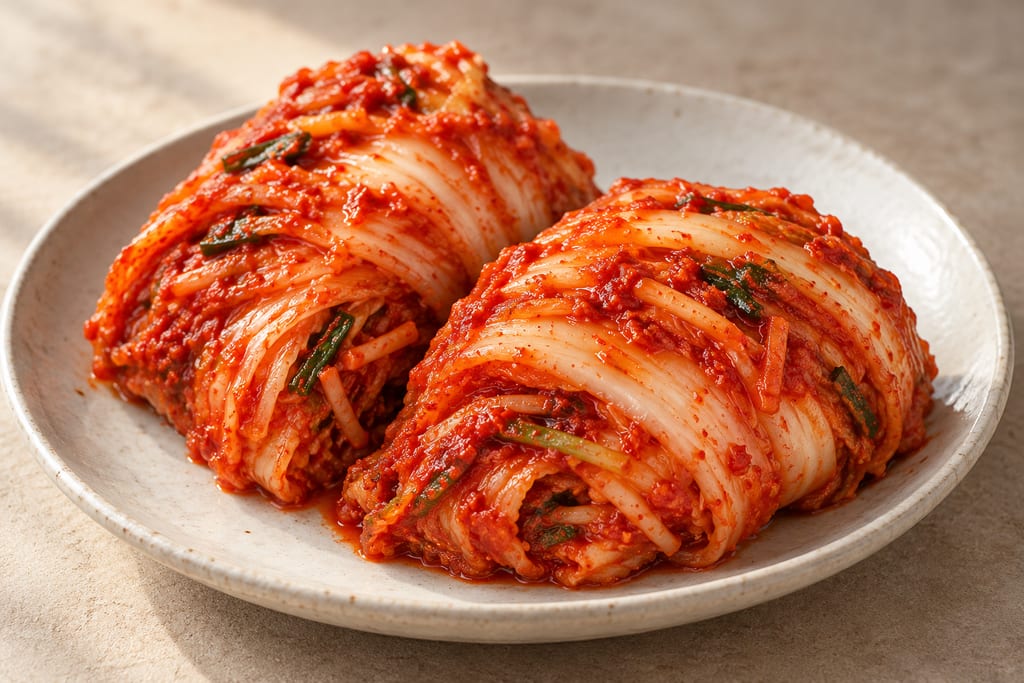
Napa cabbage salted, seasoned with a paste of gochugaru, garlic, ginger and salted seafood, and left to sour through lactic fermentation; Korea's everyday winter preserve.
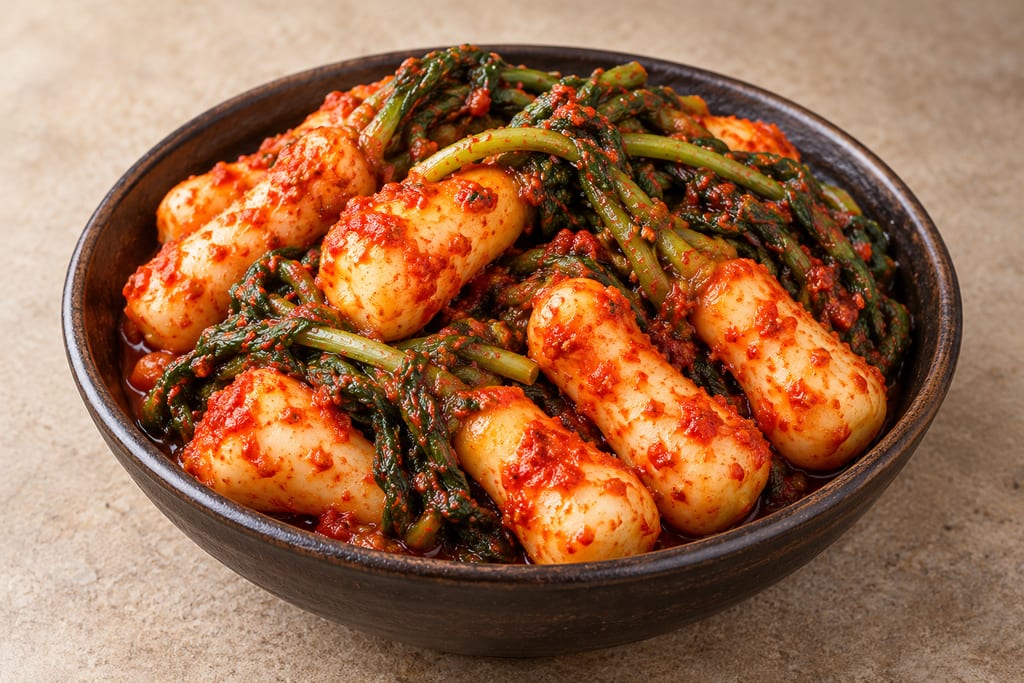
Small ponytail radishes keep their greens attached and ferment in a flour-and-chile seasoning paste.
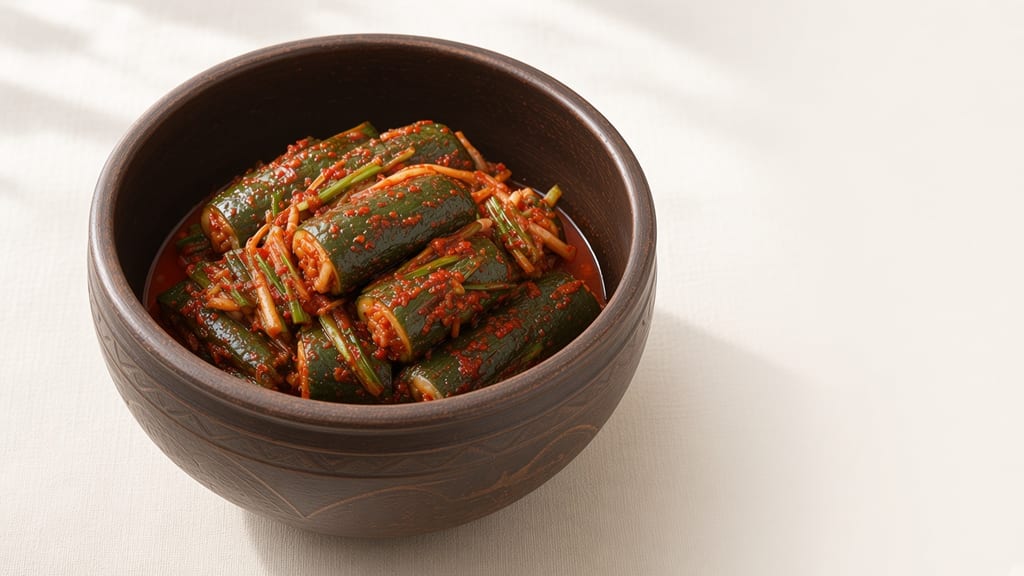
Hwanggwa damjeo is a cucumber kimchi from Yu Jung-rim's Jeungbo sallim gyeongje of 1766. Slit cucumbers are packed with chilli powder and garlic, scalded with hot salted water and sealed overnight.
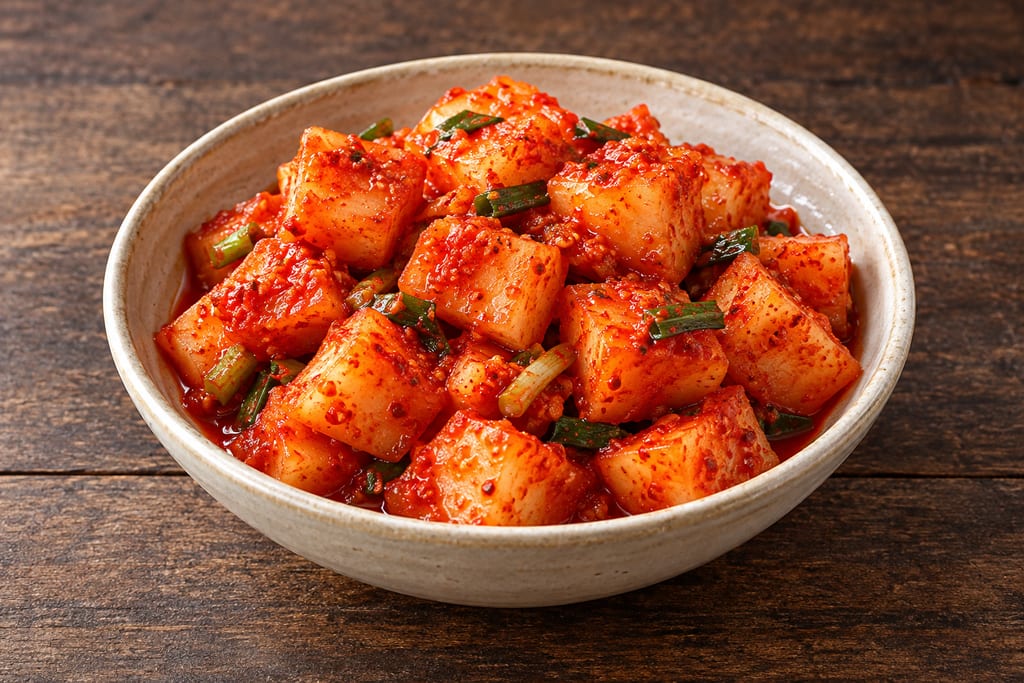
A radish kimchi cut into cubes and seasoned with gochugaru, fish sauce, garlic and ginger, eaten fresh or fermented a few days at room temperature.
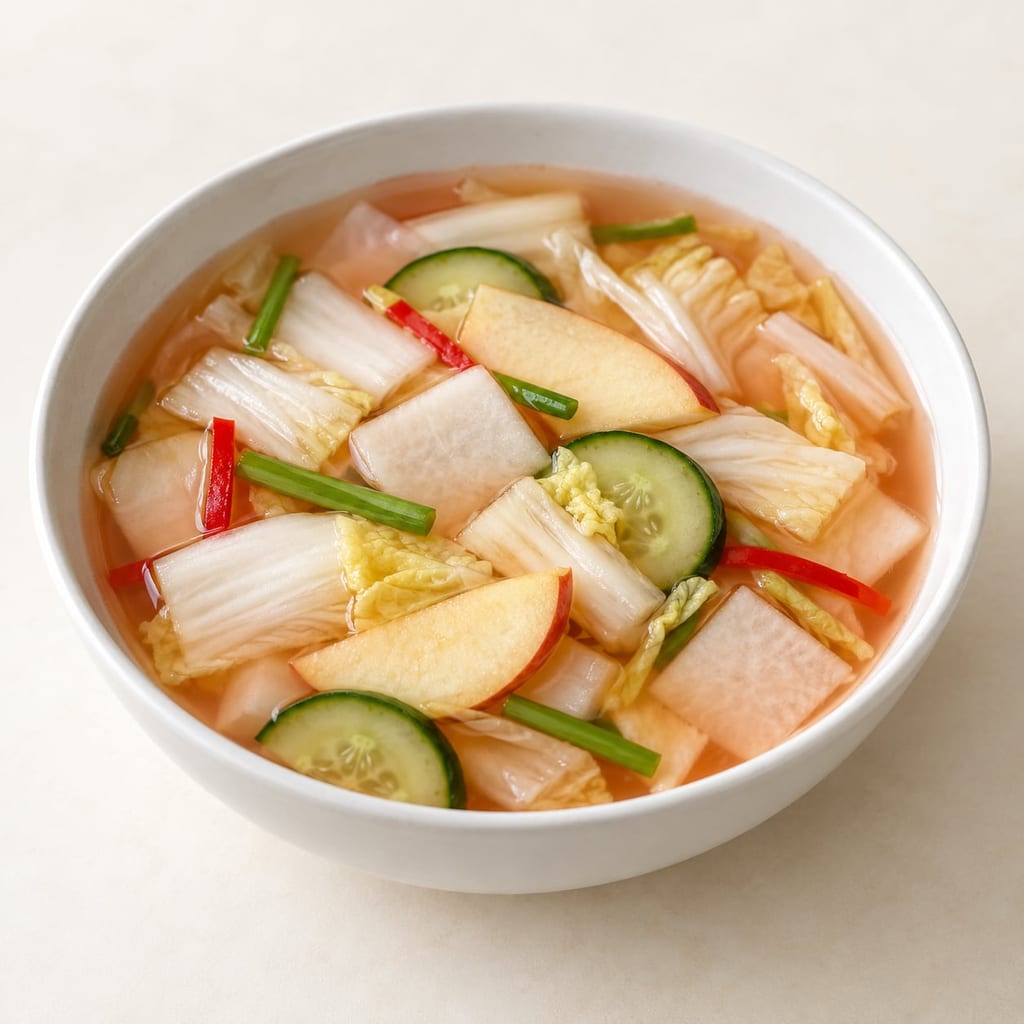
Napa cabbage and radish ferment in a rose-coloured broth with cucumber, apple, pear, alliums and chile.
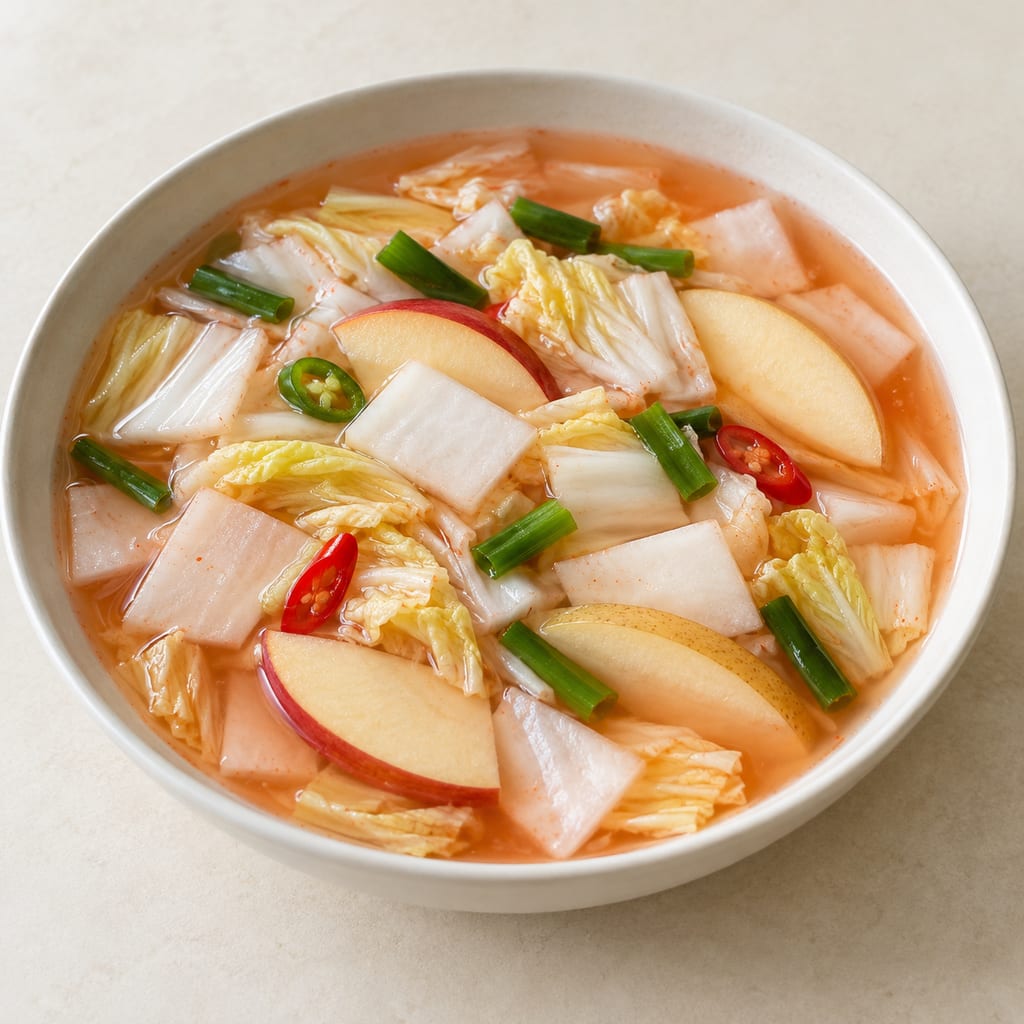
Cabbage-and-radish water kimchi with pear, apple and strained chili broth, following one Korean creator’s batch.
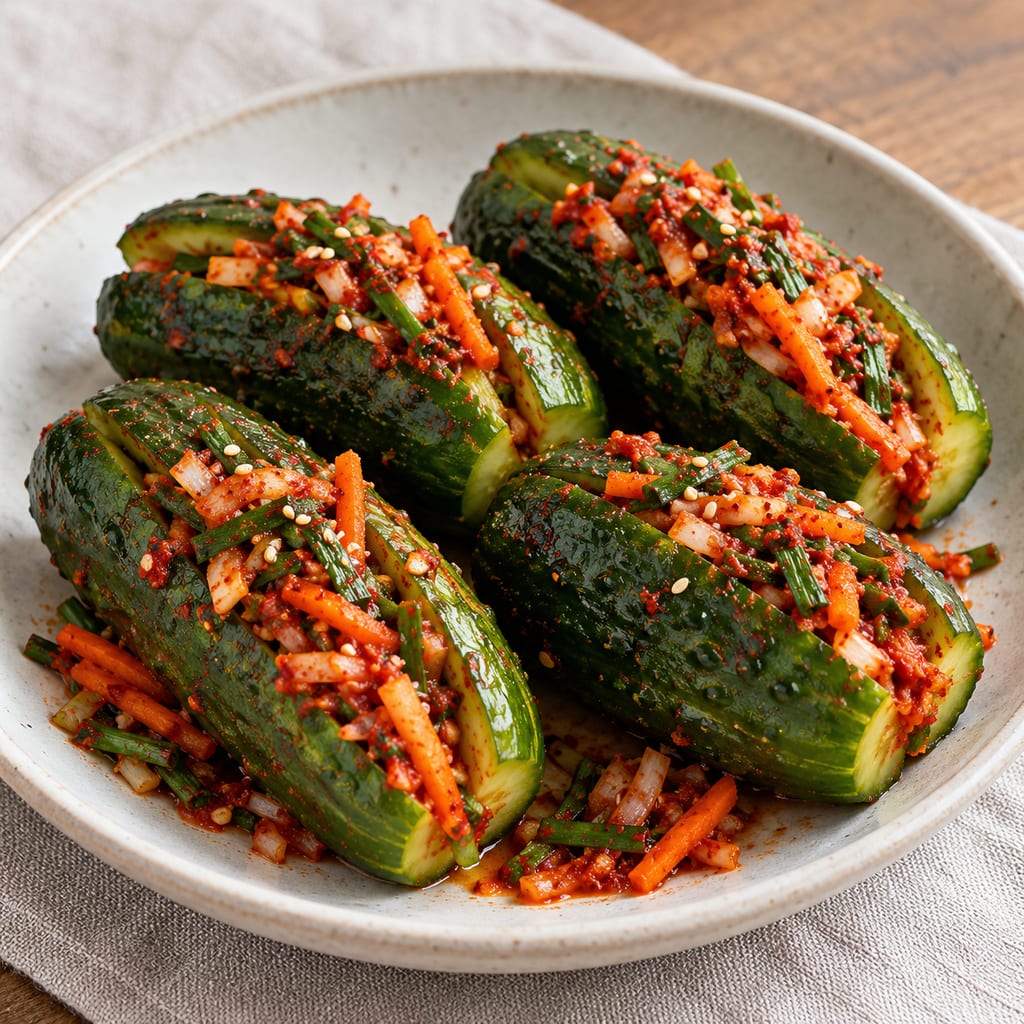
Oi-sobagi is a Korean stuffed cucumber kimchi: salted cucumbers slit and filled with a chive-and-chilli seasoning, eaten fresh or left to ferment.
Kimchi of salted napa cabbage and daikon with garlic, green onion and red pepper, kept at room temperature one to four days, then refrigerated.
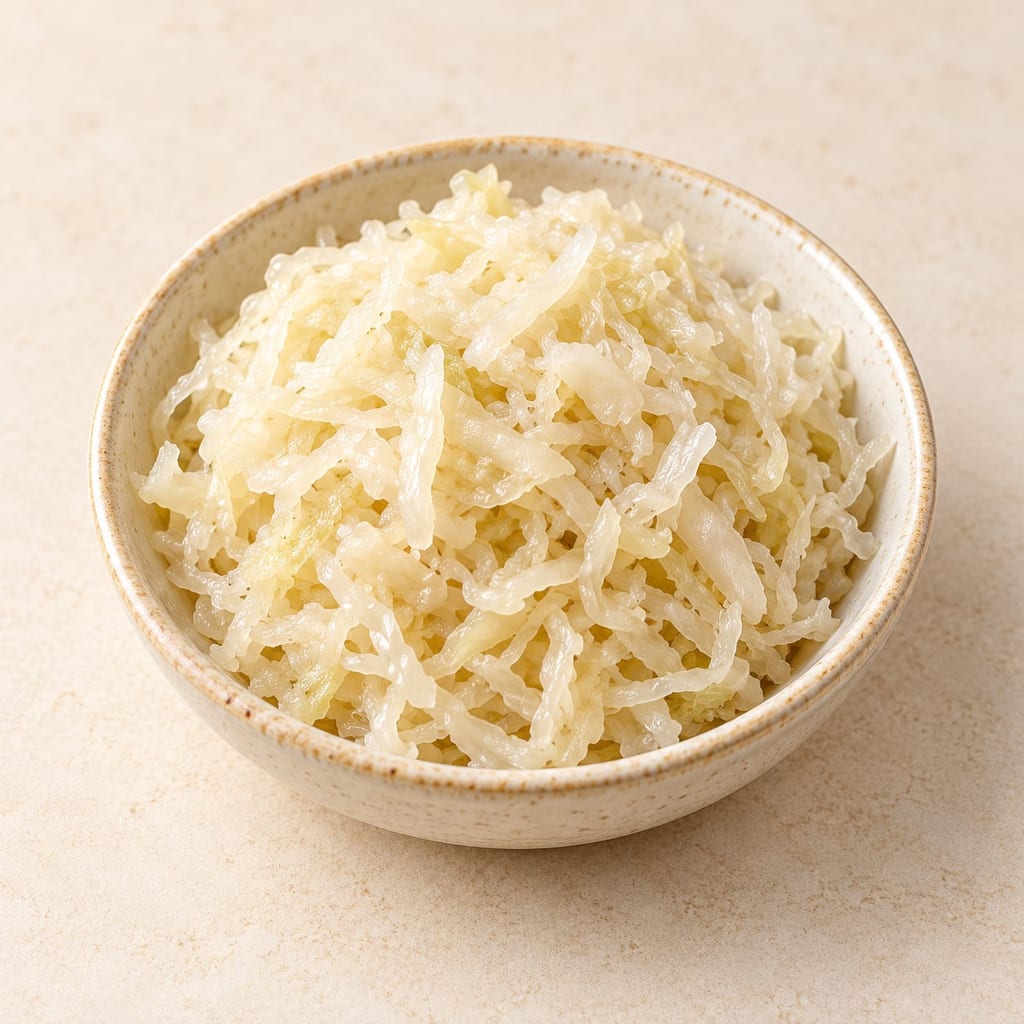
Finely cut cabbage fermented with salt in vats by natural lactic fermentation, a protected Alsatian product sold raw or cooked after fermentation.
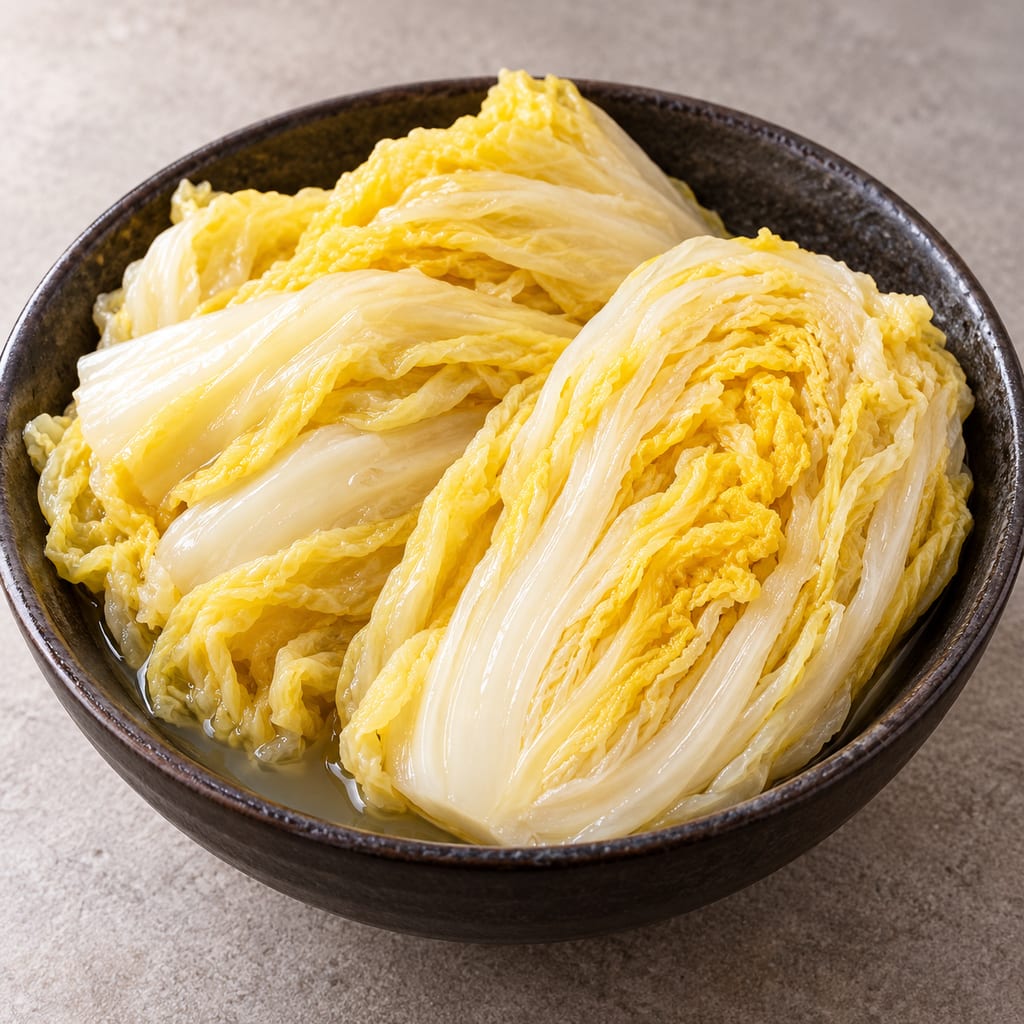
Napa cabbage fermented in a salt brine in Northeast China, traditionally in large ceramic or glass jars, until it turns sour.
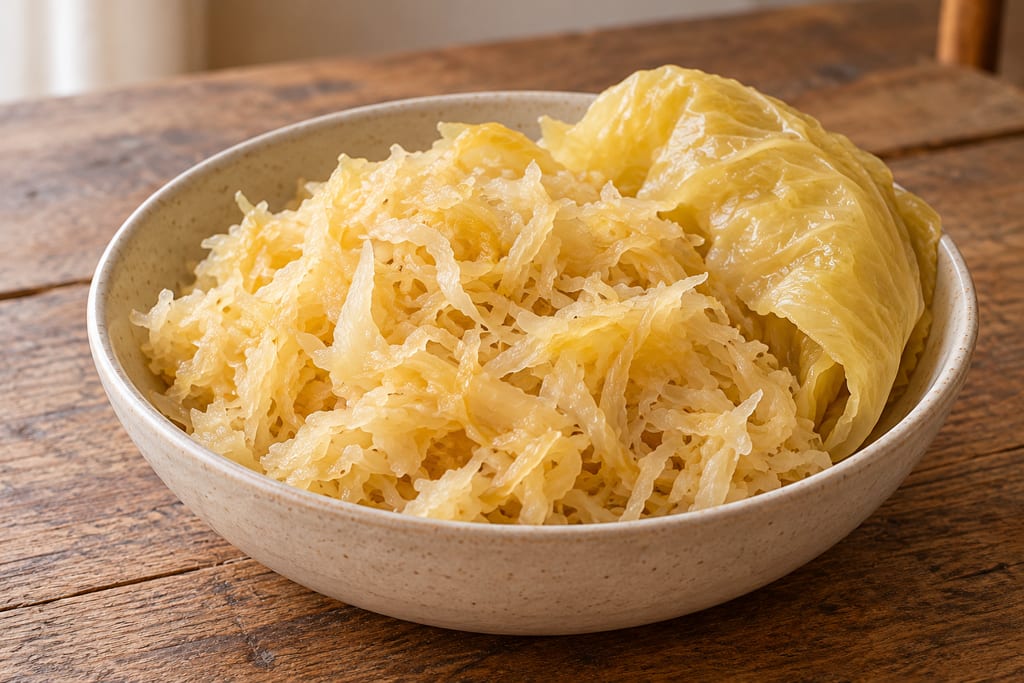
Serbian sour cabbage from the Futog area, made from the autochthonous Futoški cabbage population and registered as a protected product in 2008. It is a subset of general Serbian kiseli kupus.
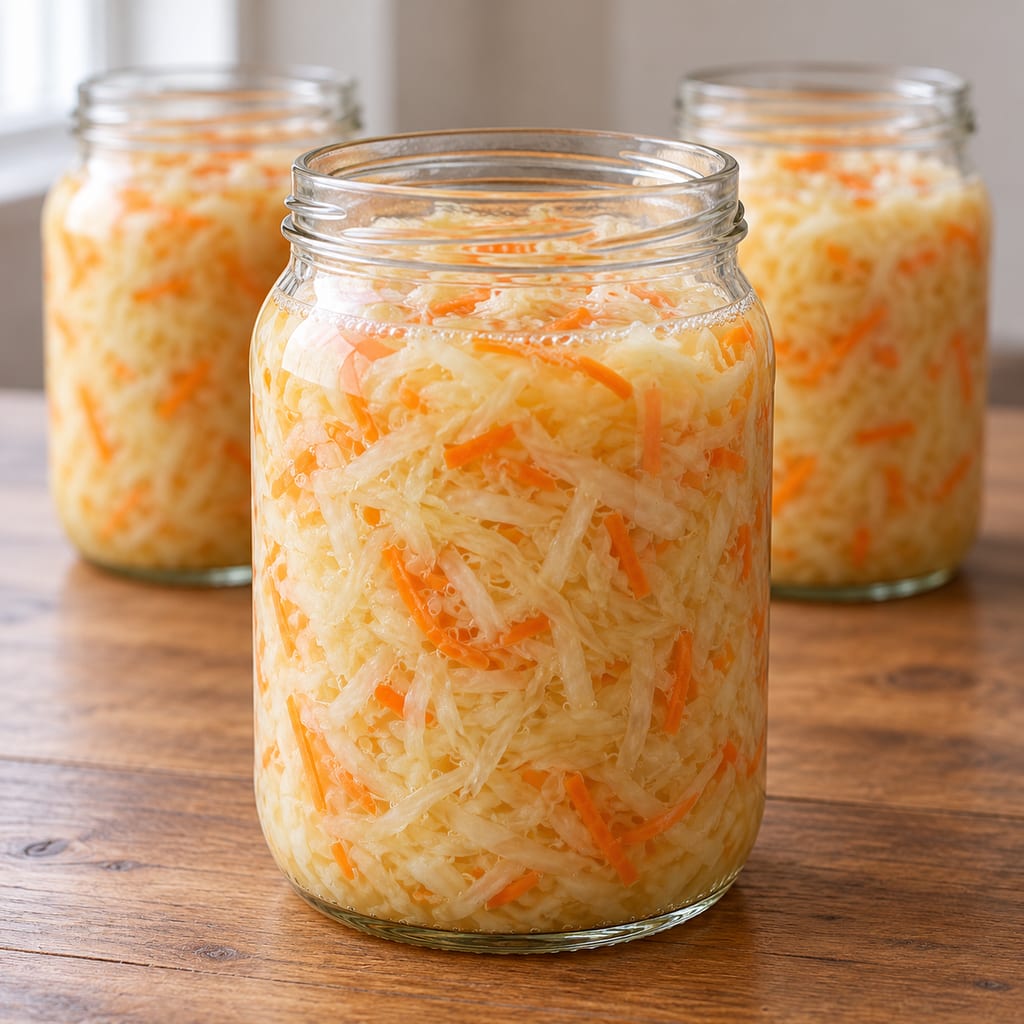
Shredded cabbage and grated carrot are salted to 20 g/kg, rested, packed into three jars and monitored during a creator-reported eight-day fermentation; measured temperature is not given.
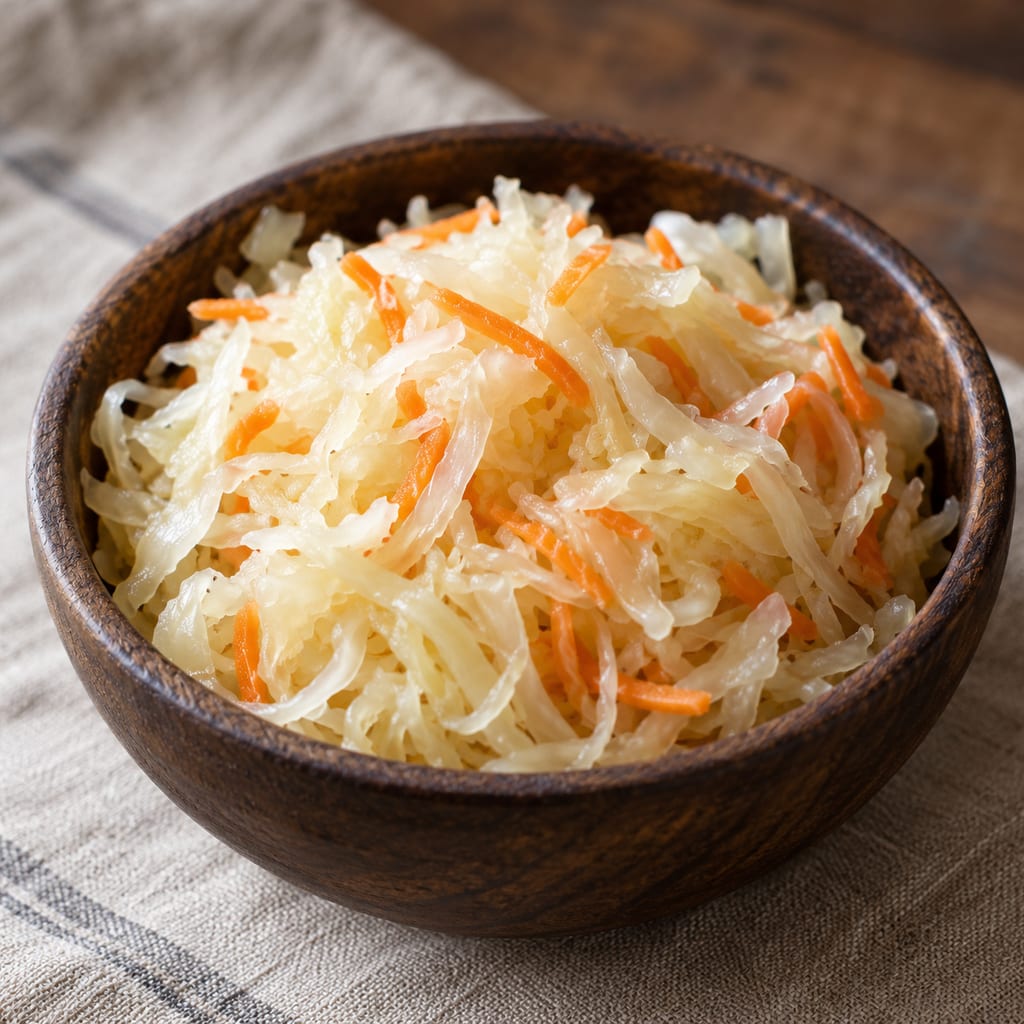
Kapusta kiszona z beczki is barrel-fermented cabbage from the Kołobrzeg area, entered on Poland’s List of Traditional Products in 2008. It is salted and fermented, with raw grated carrot added after souring.
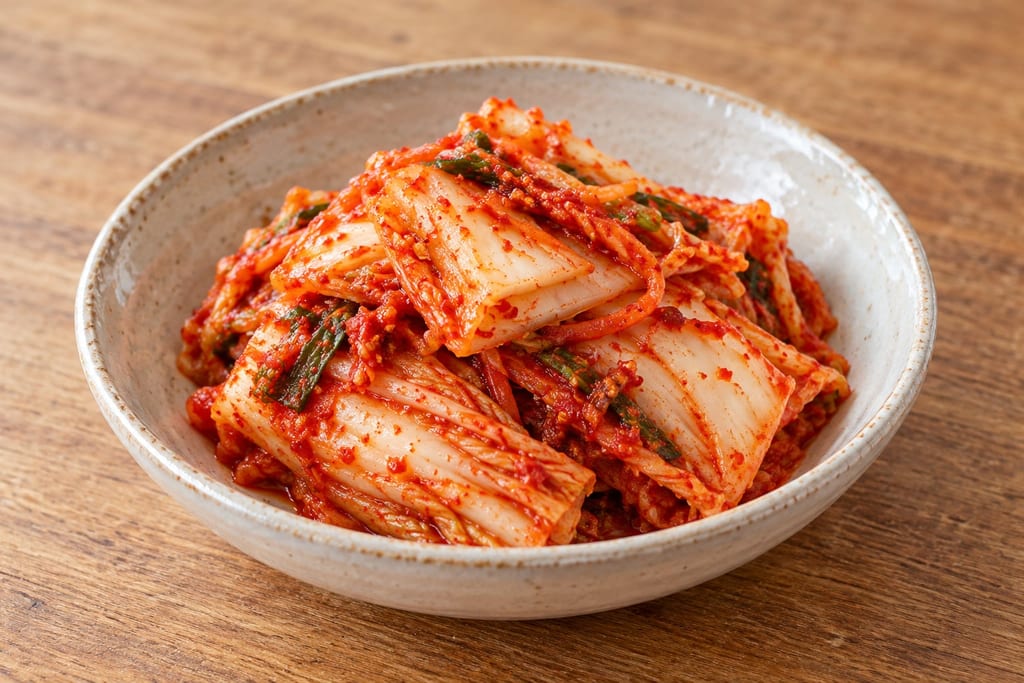
Kimchi is a Korean preserved vegetable food, most often cabbage, salted and seasoned, then fermented by the lactic acid bacteria that arrive with the vegetables. Some studies test added starter cultures, but a home jar is usually spontaneous.
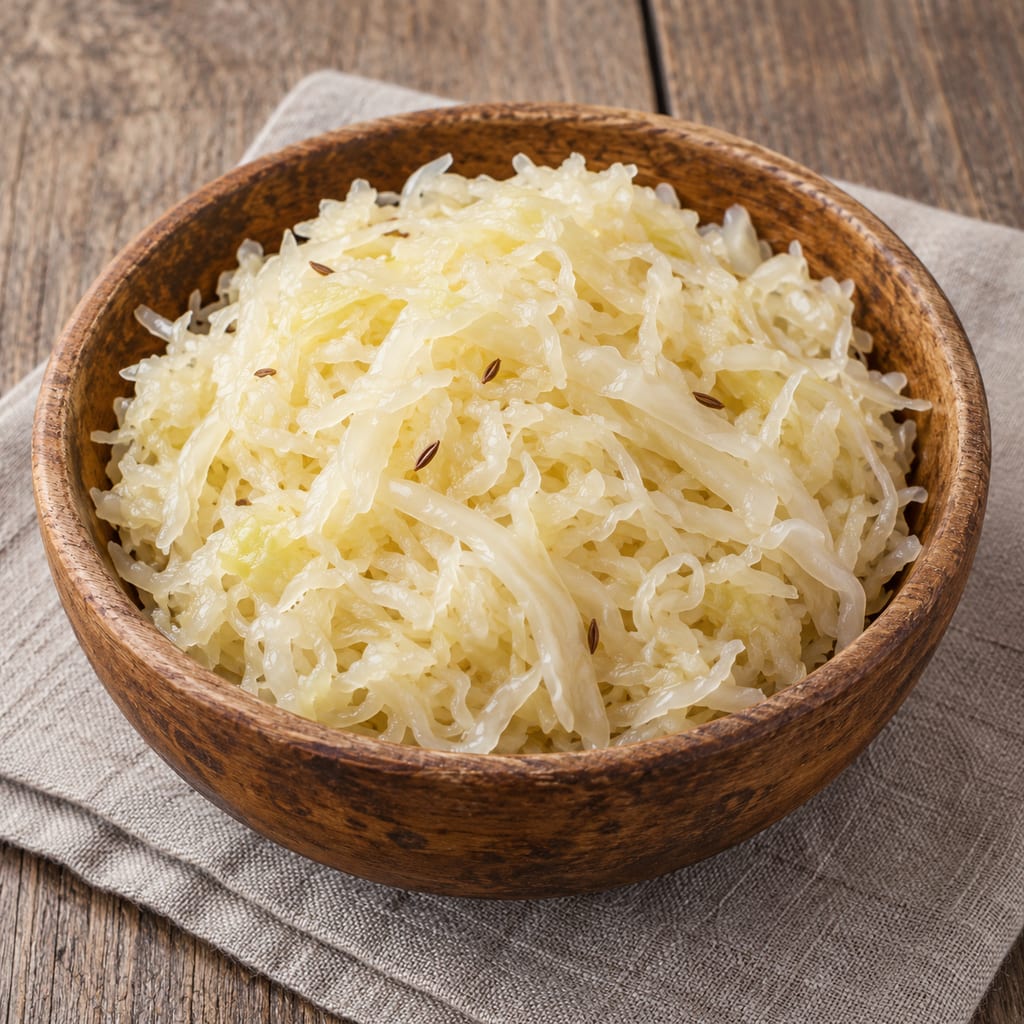
Kysané zeľí is Czech sour cabbage: shredded cabbage layered with salt and caraway and pressed in a wooden barrel. The regional account is descriptive and gives no validated salt ratio or endpoint.
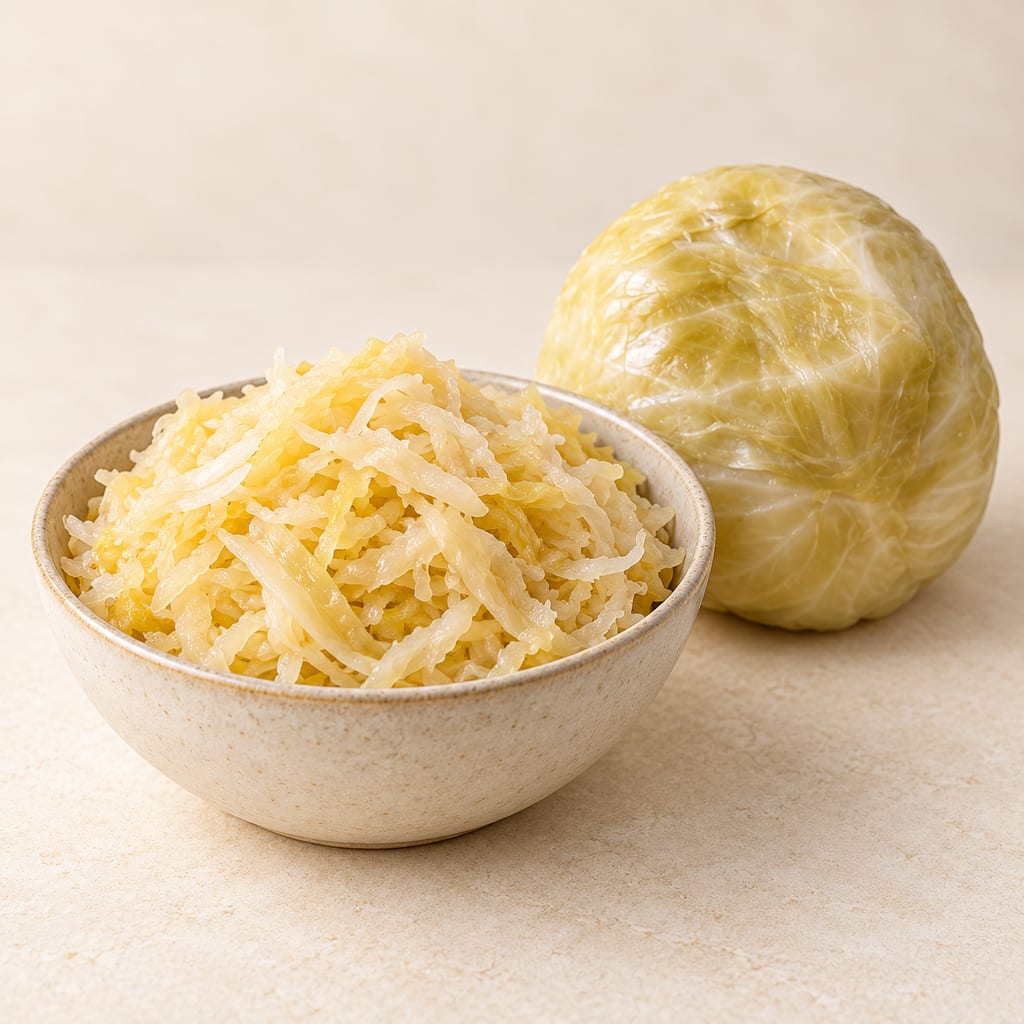
Protected Croatian sauerkraut from the Ogulin area: fresh white cabbage naturally lactic-fermented without preservatives, sold whole or shredded, from registered establishments.
No community contributions have been published for this entry yet.
Sign in to contribute. Published comments and photos are free to read.
MaangchiInspiration · Geography
White Kimchi (Baek-kimchi)Korean name and style; measured ingredients, brine, salting schedule and 1½–3 day room-temperature stage.
Cited in: What is baek-kimchi?; The cultural setting; Cabbage and salting; Filling; Aromatic broth; Why each ingredient is included; Stage 1 — Prepare the cabbage; Stage 2 — Salt for 1½–2 hours; Stage 3 — Rinse and drain; Stage 4 — Prepare the filling; Stage 5 — Prepare the aromatic mixture; Stage 6 — Make the brine; Stage 7 — Fill the cabbage; Stage 8 — Pack and add brine; Stage 9 — Ferment and refrigerate; Texture and the purpose of filling the leaves; Regional and household variations; Serving baek-kimchi; Safety and storage
University of Minnesota ExtensionSafety
Preserving food at home: FermentationGeneral guidance for vegetable fermentation, submersion and acidity monitoring; not validation of this recipe.
Cited in: Cabbage and salting; Filling; Aromatic broth; Why each ingredient is included; Stage 1 — Prepare the cabbage; Stage 2 — Salt for 1½–2 hours; Stage 3 — Rinse and drain; Stage 4 — Prepare the filling; Stage 5 — Prepare the aromatic mixture; Stage 6 — Make the brine; Stage 7 — Fill the cabbage; Stage 8 — Pack and add brine; Stage 9 — Ferment and refrigerate; Texture and the purpose of filling the leaves; Regional and household variations; Serving baek-kimchi; Troubleshooting; Safety and storage
MaangchiReference
Maangchi — White Kimchi / Baek-KimchiCited by the written account of this record.
Cited in: Cabbage and salting; Filling; Aromatic broth; Why each ingredient is included; Stage 1 — Prepare the cabbage; Stage 2 — Salt for 1½–2 hours; Stage 3 — Rinse and drain; Stage 4 — Prepare the filling; Stage 5 — Prepare the aromatic mixture; Stage 6 — Make the brine; Stage 7 — Fill the cabbage; Stage 8 — Pack and add brine; Stage 9 — Ferment and refrigerate; Texture and the purpose of filling the leaves; Regional and household variations; Serving baek-kimchi; Safety and storage
pmc.ncbi.nlm.nih.govReference
Kimchi Fermentation Microbiome StudyPMC
Cited in: Why each ingredient is included; The microbiology of white kimchi; Why baek-kimchi tastes different from red kimchi; Texture and the purpose of filling the leaves
pubmed.ncbi.nlm.nih.govReference
Kimchi Microbiology ReviewPubMed
Cited in: Why each ingredient is included; The microbiology of white kimchi; Why baek-kimchi tastes different from red kimchi; Texture and the purpose of filling the leaves