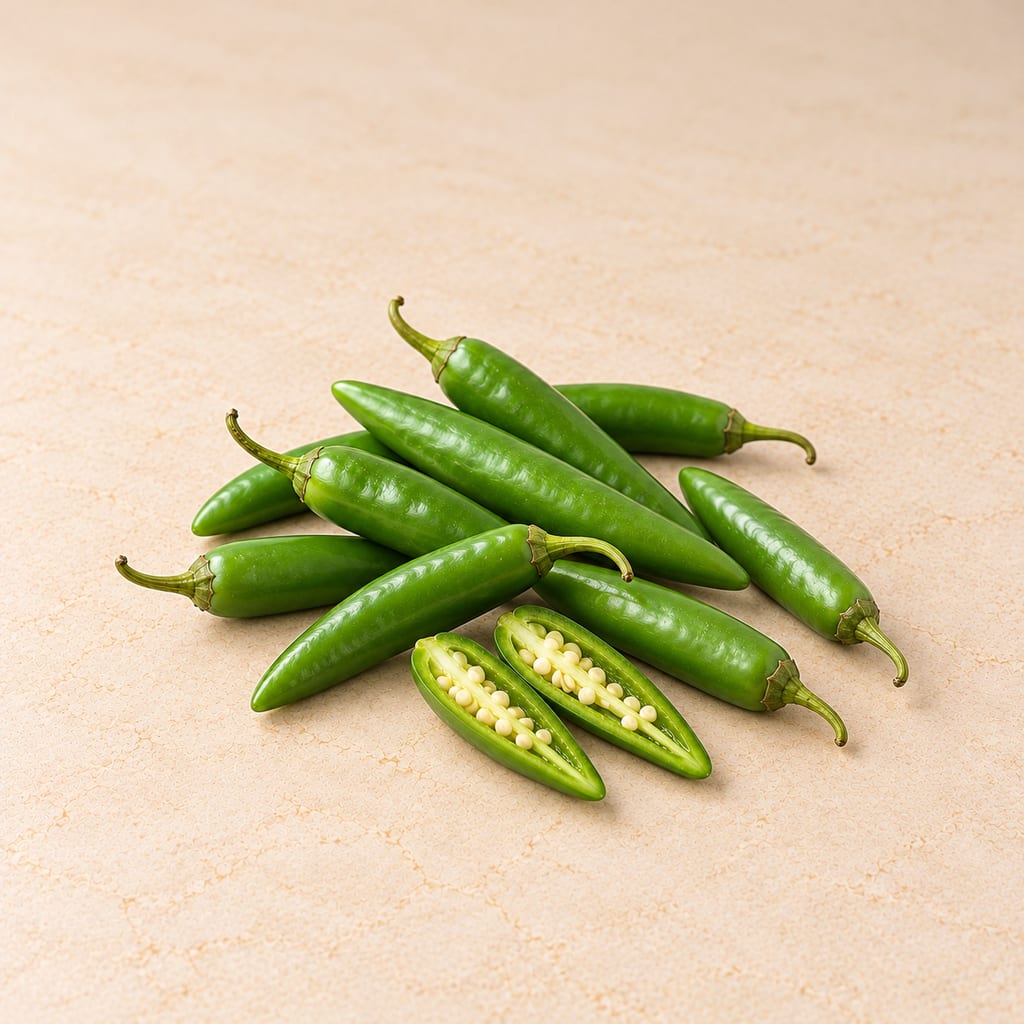
Chilli
Chilli is the pungent fruit of Capsicum plants, native to the Americas and eaten fresh, dried, ground or fermented in cuisines around the world.
 FermenteaWhere food goes to change
Traditional method
Kimchi
Oi-sobagi is a Korean stuffed cucumber kimchi: salted cucumbers slit and filled with a chive-and-chilli seasoning, eaten fresh or left to ferment.
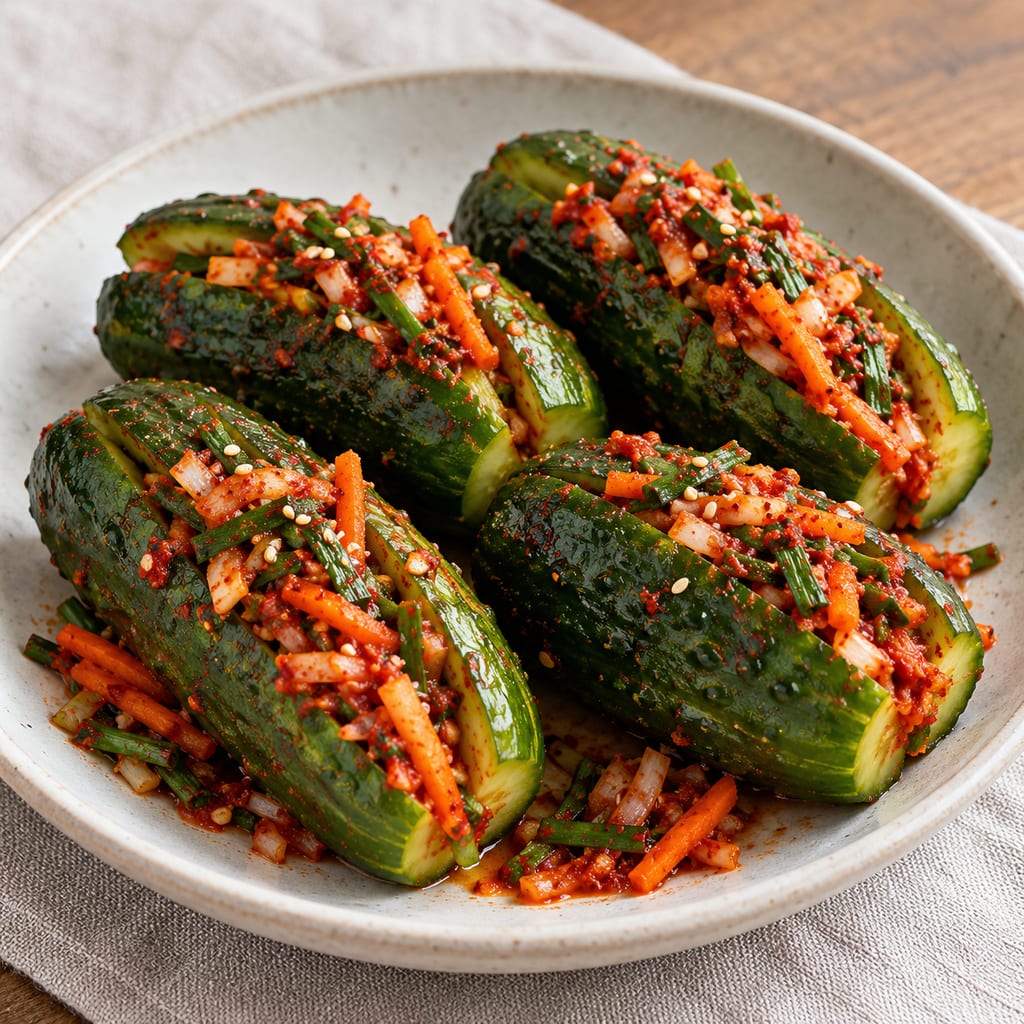
Oi-sobagi is Korean cucumber kimchi made by cutting pockets into small cucumbers and filling them with a spicy mixture of vegetables and seasonings.
The name combines oi, cucumber, with sobagi, a term associated with stuffing a vegetable.
Unlike chopped cucumber salads, oi-sobagi preserves the basic shape of the cucumber. The vegetable is cut lengthwise in a cross pattern but left attached at one end, forming sections that can be opened and filled.
The main ingredient is cucumber, Cucumis sativus L.
Short, firm Korean or Kirby-type cucumbers are particularly suitable. Persian cucumbers are another practical option.
The filling commonly includes Korean garlic chives, buchu, carrot, onion, garlic, red-pepper flakes and fish sauce.
The result combines crunchy cucumber, aromatic vegetables, chili heat, salt and a modest amount of sweetness.
A defining characteristic of this kimchi is that it is often eaten fresh.
It may subsequently ferment, but fermentation is not compulsory for the dish to be recognizable as oi-sobagi.
This matters because the intended texture differs from long-fermented cabbage kimchi. Extended fermentation can soften cucumber flesh and diminish the crisp quality for which the dish is valued.
Cucumber dishes are widespread in Korean cuisine, and stuffed cucumber kimchi forms part of the country's broader tradition of seasonal vegetable preparation.
The cucumber is associated particularly with warmer months, when it is plentiful and valued for its water content and refreshing texture.
The exact date at which cooks began making the modern chili-seasoned stuffed form is not established.
Older references to preserved cucumber or vegetable stuffing cannot automatically be equated with today's oi-sobagi.
The contemporary dish is well documented in Korean household cookery, published recipe collections and modern culinary teaching.
Its preparation demonstrates a practical way to turn small cucumbers into individual portions of kimchi without cutting them entirely into separate pieces.
The preserved shape makes the stuffing visible at the table.
Several household techniques coexist. Some salt the cucumber surfaces directly, while others use hot salted water to make the vegetable more flexible before stuffing.
Different versions include Korean radish, carrot, onion or other vegetables.
They share the distinctive cross-cut construction but not necessarily identical ingredient proportions.
Cucumbers — 2 lb
Preliminary salting — 20 minutes
Turning — After the first 10 minutes
Main seasoning — Gochugaru, buchu, vegetables and fish sauce
Fresh serving — Immediately after stuffing
Optional fermentation — A couple of days at room temperature
Numerical fermentation temperature — Not given
Finished yield — Not specified
Small cucumbers — 2 lb — Washed, cross-slit
Kosher salt — 2 tbsp — Used for preliminary salting
Garlic — 4 cloves — Minced
Carrot — 1 medium — Thin matchsticks
Onion — 1 cup — Thinly sliced
Gochugaru — ½ cup — Korean chili flakes
Fish sauce — 3 tbsp — For seasoning
Sugar — 1 tbsp — For balance
Water — ¼ cup — Included in the original ingredient list
Toasted sesame seeds — 1 tbsp — For seasoning
The original recipe's ingredient list includes garlic, onion and water, although its abbreviated filling instructions omit explicit additions of all three. Incorporating them into the seasoning mixture is a reasonable editorial reconstruction, but that omission should remain documented rather than being silently treated as a fully specified source instruction.
Cucumbers contain a large proportion of water. Their flesh has a relatively delicate cellular structure compared with cabbage stems or mature radish.
They can lose firmness rapidly during prolonged fermentation.
The best results therefore begin with fresh, firm cucumbers rather than soft or aging ones.
Salt draws moisture from the surfaces, seasons the vegetable and changes tissue firmness.
Because the salted cucumbers are rinsed, the two-tablespoon quantity does not equal the salt ultimately retained in the dish.
Buchu is commonly identified botanically as Allium tuberosum, Chinese or garlic chives. It has a flat-leaved appearance and a garlic-like aroma distinct from ordinary European chives.
The filling gains both texture and pungency from it.
Carrot contributes crispness and natural sweetness. Its narrow strips fit into the cucumber pockets.
Onion and garlic provide sulfur-containing aromatics. They also affect the microbial environment if the dish is allowed to ferment.
Gochugaru supplies color, aroma and chili heat. The amount is substantial because the paste must season the interior of every cucumber rather than merely dress an external surface.
Fish sauce provides salt and savory compounds.
Sugar balances the sharpness of raw cucumber and alliums. In a fermented version, it can also provide carbohydrate for microbial metabolism.
Sesame seeds offer nutty flavor and texture. Their role is culinary rather than a requirement for lactic-acid fermentation.
Use a small sharp knife, a cutting board, a large bowl, a colander and a clean food-grade storage container.
A narrow-bladed knife is especially useful for making controlled cuts without accidentally separating the cucumber into quarters.
Clean food-safe gloves can make stuffing more comfortable when handling chili paste.
The preparation does not require specialized fermentation equipment when it is made for immediate refrigerated consumption.
1. Choose suitable cucumbers.
Select firm cucumbers with intact skins and no soft or decayed areas.
Wash thoroughly and remove visible dirt. The cucumbers should be small enough to serve individually or as short sections.
2. Make the stuffing pockets.
Rotate the cucumber and make a second lengthwise cut at right angles.
The resulting cross-shaped opening creates four connected sections.
The uncut end holds the cucumber together.
3. Salt the cucumber.
Distribute 2 tablespoons kosher salt over the 2 lb cucumbers, including the cut interior.
Let them stand for 10 minutes.
Turn them and leave for another 10 minutes, giving 20 minutes total.
The salting stage alters texture and makes the opened pockets easier to handle.
4. Rinse and drain.
Rinse the cucumbers several times in cold water to remove excess surface salt.
Drain well.
The interiors should be free of large salt deposits before filling.
5. Prepare the vegetables.
Cut the carrot into thin matchsticks, slice 1 cup onion and mince 4 garlic cloves.
The stuffing pieces should be narrow enough to enter the cucumber pockets without tearing them.
6. Make the seasoning.
Combine the prepared vegetables with ½ cup gochugaru, 3 tablespoons fish sauce, 1 tablespoon sugar and 1 tablespoon toasted sesame seeds.
The original ingredient list also provides ¼ cup water.
Mix until the vegetables are coated. Add the listed water as part of the seasoning mixture rather than leaving it unaccounted for; this is the editorial reconstruction noted above.
7. Stuff the cucumbers.
Gently spread each cucumber pocket with your fingers.
Push small portions of the seasoning mixture into the cross-shaped cuts.
Distribute the vegetables through the openings rather than concentrating everything at the top.
Avoid forcing in so much filling that the attached end splits.
8. Arrange for serving or storage.
Place the stuffed cucumbers in a clean container.
Any remaining seasoning may be distributed over the surface.
The cucumbers can be served immediately, when they retain their freshest crunch and sharpest vegetable flavor.
9. Optional fermentation.
For a more developed sour flavor, the original method describes leaving the prepared cucumber kimchi at room temperature for a couple of days before refrigeration.
The temperature is not numerically specified and the duration is sensory-led. It is not a validated safety schedule.
Fermented versions should be made under appropriate temperature and acidity controls.
10. Serve chilled.
Refrigerate and serve as a cold side dish with rice and other Korean foods.
The cucumber's fresh texture is an essential feature, so it is best treated as a relatively short-keeping preparation rather than a long-term preserved vegetable.
Salt creates an osmotic difference between the cucumber tissues and their surroundings.
Some water moves out of the cells, changing the texture.
The effect is not simply that salt makes the cucumber “crunchier.” Excessive salting, long storage or aggressive handling can also make cucumber flesh limp.
The objective of this short salting stage is to season and alter the cut surfaces without destroying their structure.
Rinsing stops the direct exposure to concentrated surface salt and removes an unknown portion of the original addition.
This makes it impossible to calculate a final salt percentage accurately from the original two-tablespoon measure alone.
In a commercial process, the actual finished salt level would need to be measured or established through validated formulation.
The fresh version is principally a salted, seasoned vegetable preparation.
When allowed to ferment, microorganisms present on the vegetables and seasonings can metabolize available carbohydrates.
Lactic acid bacteria are important in the wider kimchi family.
Their acid production changes flavor and contributes to microbial control when appropriate acidity is achieved.
Some fermentation organisms also produce carbon dioxide and compounds that alter aroma.
However, cucumber kimchi may become soft more quickly than cabbage kimchi.
Cucumber flesh contains substantial water and has a relatively delicate structural network.
As fermentation proceeds, acid, endogenous enzymes and microbial enzymes can change cell-wall materials, including pectin-associated structures.
These changes may reduce crispness.
The progression depends on temperature, ingredients, salt and microbial activity.
There is no guarantee that a fermented cucumber will retain the same satisfying bite as a newly stuffed one.
Another established oi-sobagi approach pours hot saltwater over prepared cucumbers.
The warm treatment can make the cucumber flexible enough to open and stuff without immediately breaking.
One documented Korean household recipe leaves cucumbers in hot salted water until bendable, approximately 1–2 hours, depending on the cucumber.
This differs substantially from the short dry-salting method in the main recipe.
The two should not be combined indiscriminately.
A separate community teaching recipe specifies 20 g Korean coarse sea salt for two large or six small cucumbers, a 15–20 minute preliminary salting period, followed by a distinct fermentation schedule.
These are genuine recipe variants rather than evidence that one universally correct salting period exists.
Korean radish can replace or supplement carrot.
Some formulations use salted shrimp, or saeujeot, as well as fish sauce.
Others use ginger in addition to garlic.
Different makers may cut cucumbers into short portions rather than stuffing an entire longer cucumber.
What defines oi-sobagi is the cucumber pocket and its seasoned filling, not a requirement that every household use the same number of vegetables.
A vegetarian version requires replacing the fish-based ingredients with a separately designed seasoning rather than simply claiming identical results.
Oi-sobagi is served as banchan.
It works particularly well with rice, soups and rich meat dishes because its cold, crisp vegetable character provides contrast.
Beef and radish soup is one documented accompaniment.
Fresh oi-sobagi also pairs naturally with hot rice and mild dishes that allow its chili and garlic flavor to remain prominent.
At the table, the stuffed cucumber may be eaten whole if small enough, or divided into smaller pieces.
The filling is an essential part of each bite.
The red seasoning should not be separated automatically from the cucumber and discarded.
A freshly prepared cucumber should remain firm and retain the recognizable cross-cut shape.
The filling should sit within the pockets without completely splitting the vegetable.
The surface may release some moisture after seasoning.
This is normal because salt continues to affect the vegetable.
For a fermented version, developing acidity and aroma can be expected.
However, strong gas production is not required for freshly served oi-sobagi, and it should not be used as the sole indicator of successful fermentation.
Excessive softening, decay odor, fuzzy mold or unexplained sliminess are undesirable.
The original recipe permits immediate service, which avoids the need to rely on spontaneous fermentation for the initial product.
Keep fresh stuffed cucumber kimchi refrigerated.
The original source does not provide a validated final pH, finished salt percentage or microbiological shelf life.
The optional room-temperature fermentation is not a substitute for a measured acidification process.
Cucumbers are high-moisture vegetables, and the filling contains additional raw ingredients.
Prepared food can therefore spoil if handled or stored improperly.
Do not treat this as a shelf-stable pickle or canned product.
The fish sauce contains fish allergens. Sesame is also a declared allergen in many jurisdictions.
The recorded preparation presents oi-sobagi as eaten fresh, with fermentation optional.
Scaling: source batch only
Poor brine coverage or inadequate acidity monitoring can allow spoilage; recipe-specific validated limits are not established.
Hazard sourceUse clean food-grade equipment, keep produce submerged and monitor acidity; no universal endpoint is supplied for this recipe.
Control sourceThe source supports this broad area and no precise location.
Chilli is the pungent fruit of Capsicum plants, native to the Americas and eaten fresh, dried, ground or fermented in cuisines around the world.
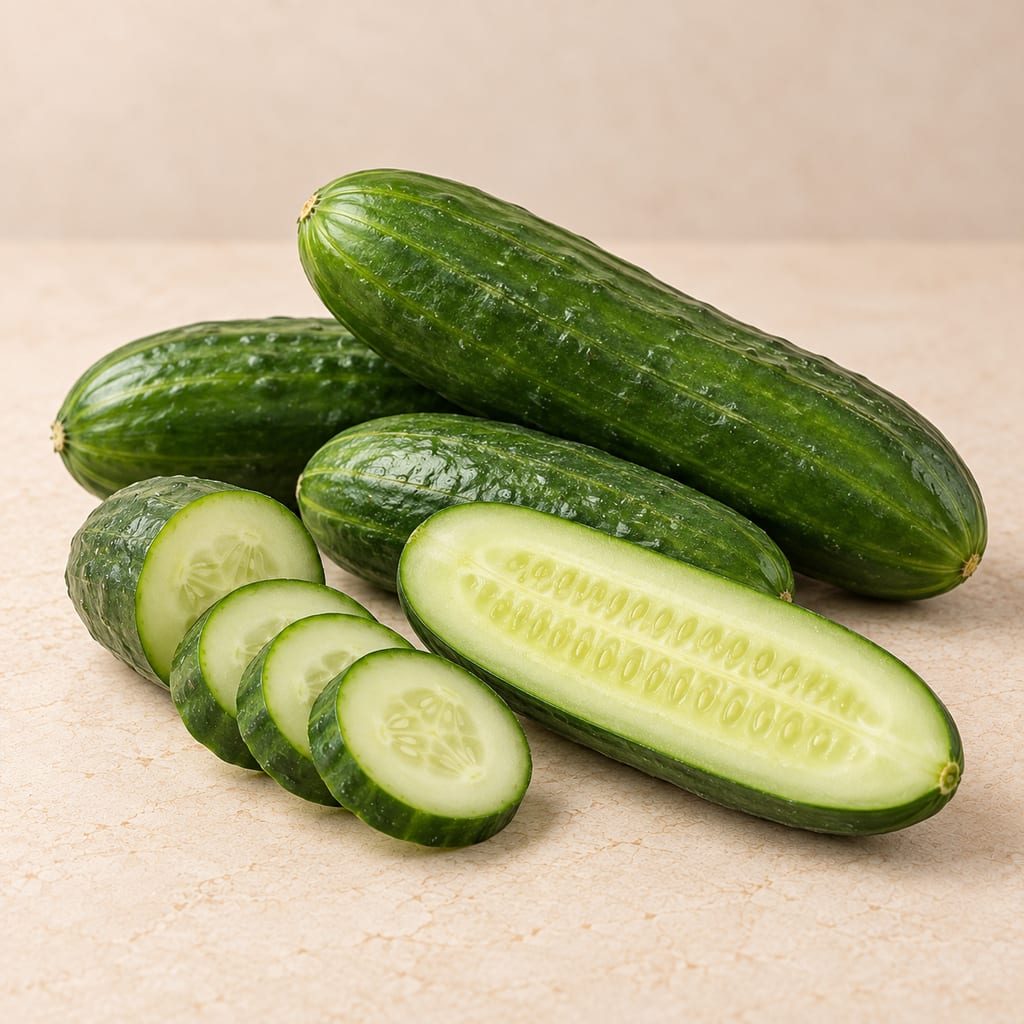
Cucumber is the watery fruit of Cucumis sativus, domesticated in India, and the classic raw material of brine pickles from New York dills to Nepali khalpi and Korean oi-sobagi.
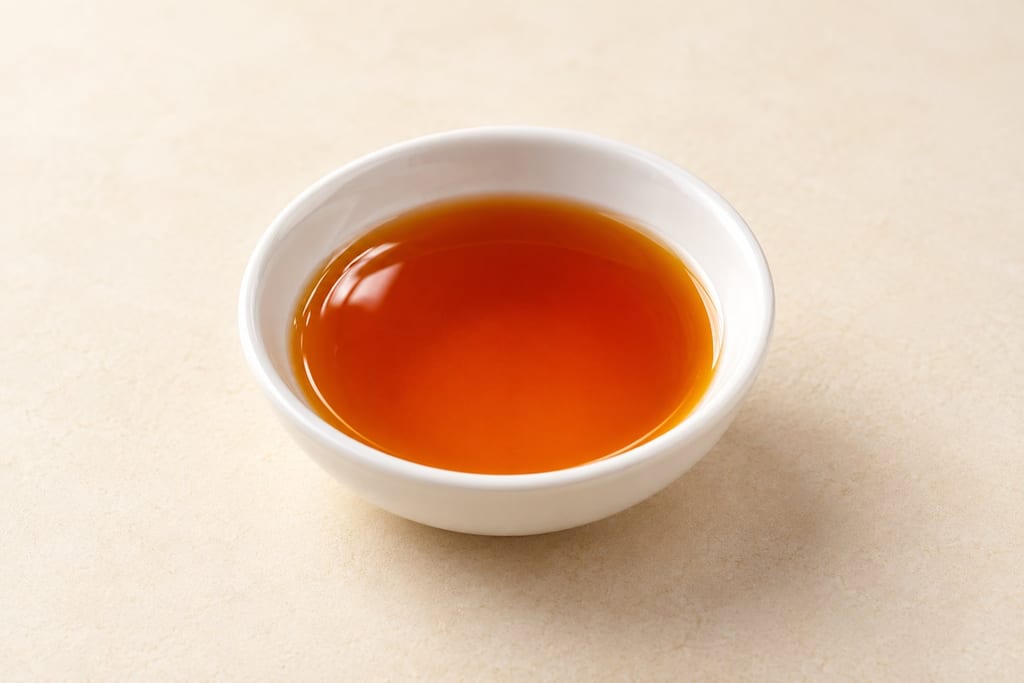
Fish sauce is a clear, salty seasoning made by maturing fish with salt and drawing off the liquid. The broad family includes distinct regional sauces rather than one interchangeable method.
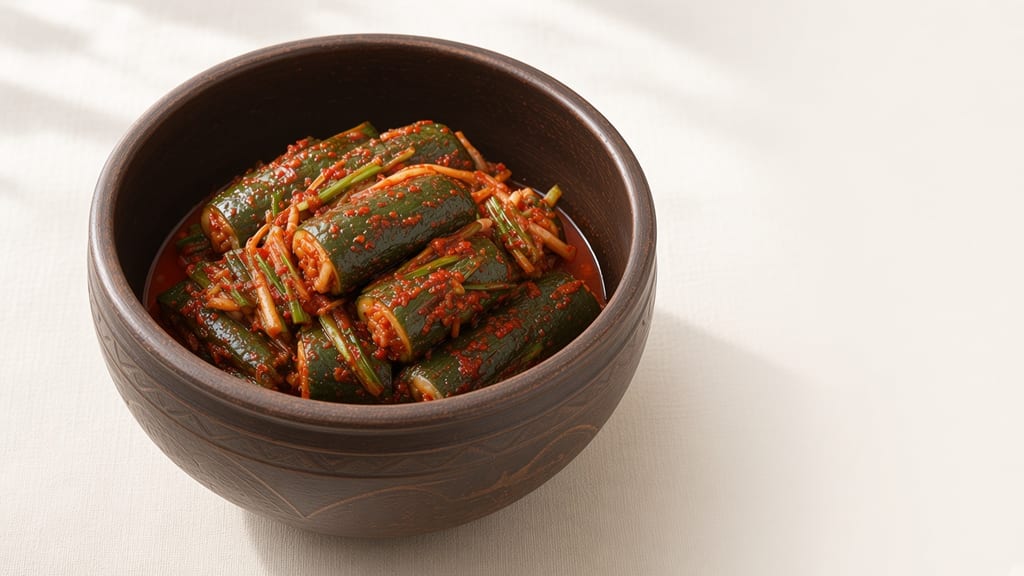
Hwanggwa damjeo is a cucumber kimchi from Yu Jung-rim's Jeungbo sallim gyeongje of 1766. Slit cucumbers are packed with chilli powder and garlic, scalded with hot salted water and sealed overnight.
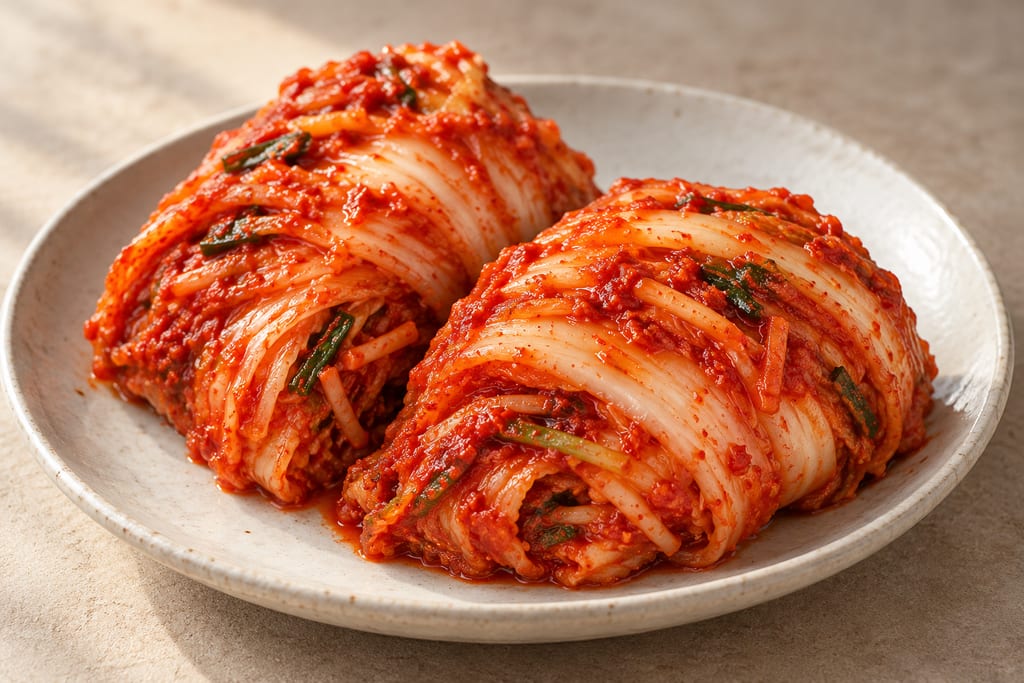
Napa cabbage salted, seasoned with a paste of gochugaru, garlic, ginger and salted seafood, and left to sour through lactic fermentation; Korea's everyday winter preserve.
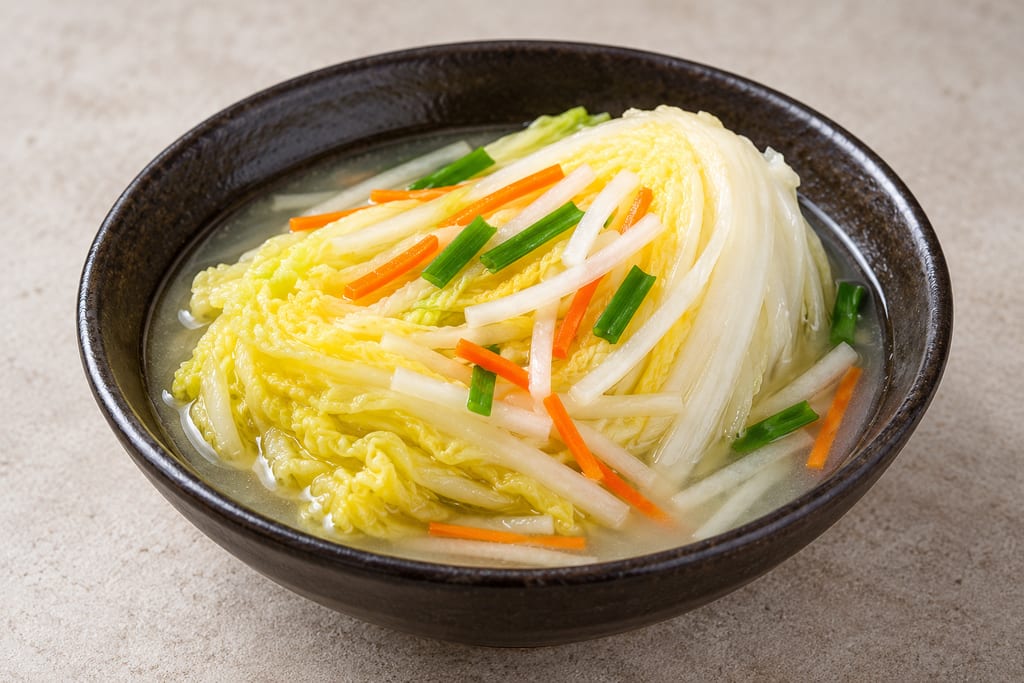
Napa cabbage is brined and filled with pear, radish, alliums, chives and fruit; this Korean kimchi omits red pepper flakes.
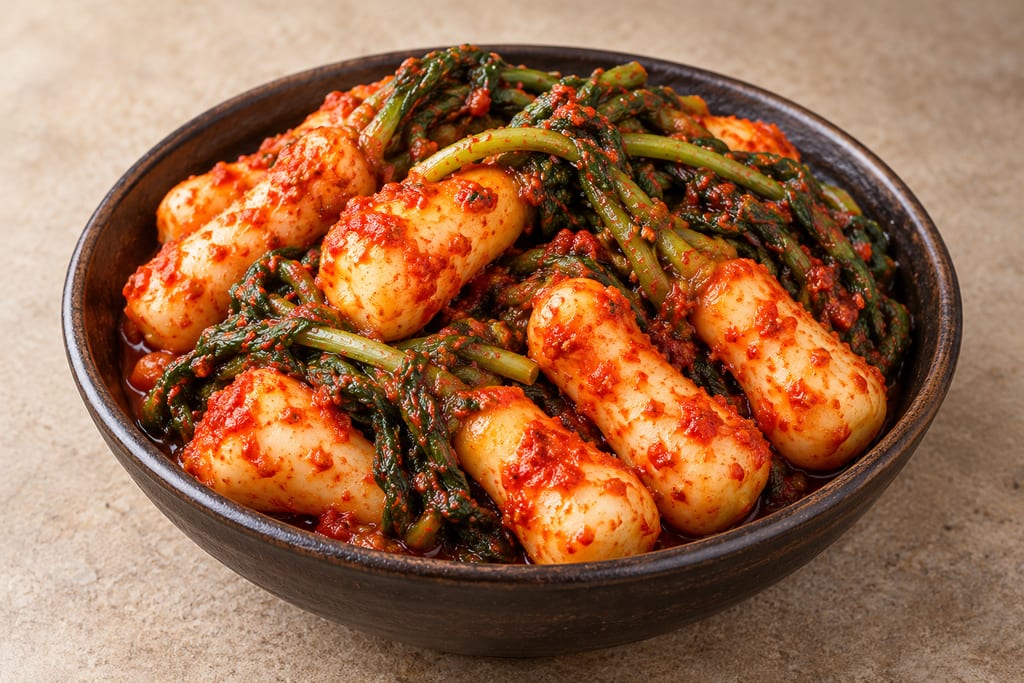
Small ponytail radishes keep their greens attached and ferment in a flour-and-chile seasoning paste.
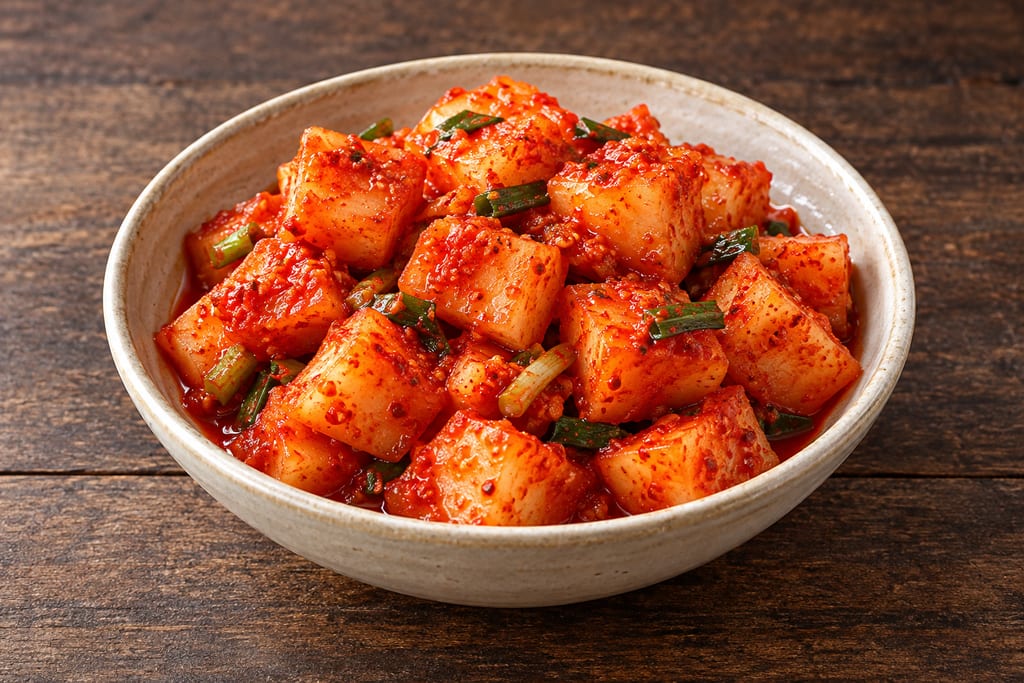
A radish kimchi cut into cubes and seasoned with gochugaru, fish sauce, garlic and ginger, eaten fresh or fermented a few days at room temperature.
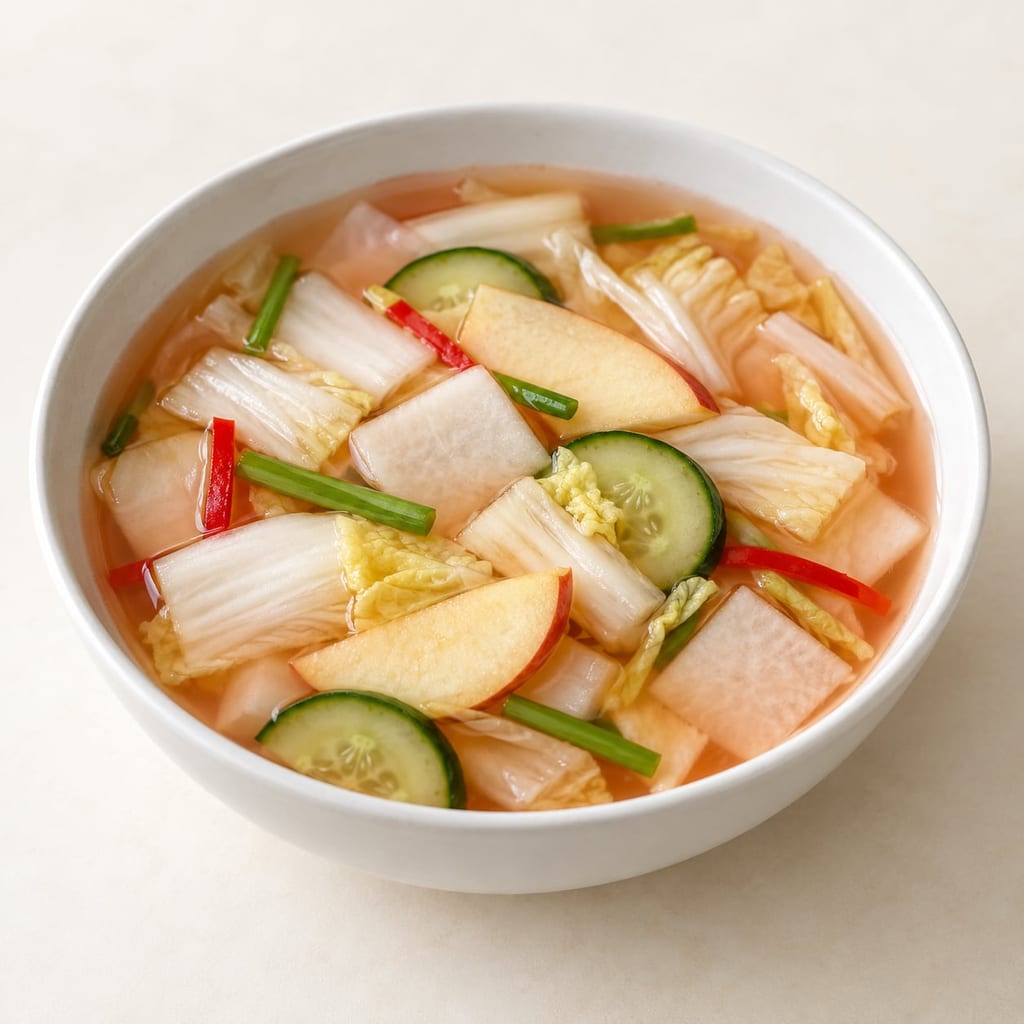
Napa cabbage and radish ferment in a rose-coloured broth with cucumber, apple, pear, alliums and chile.
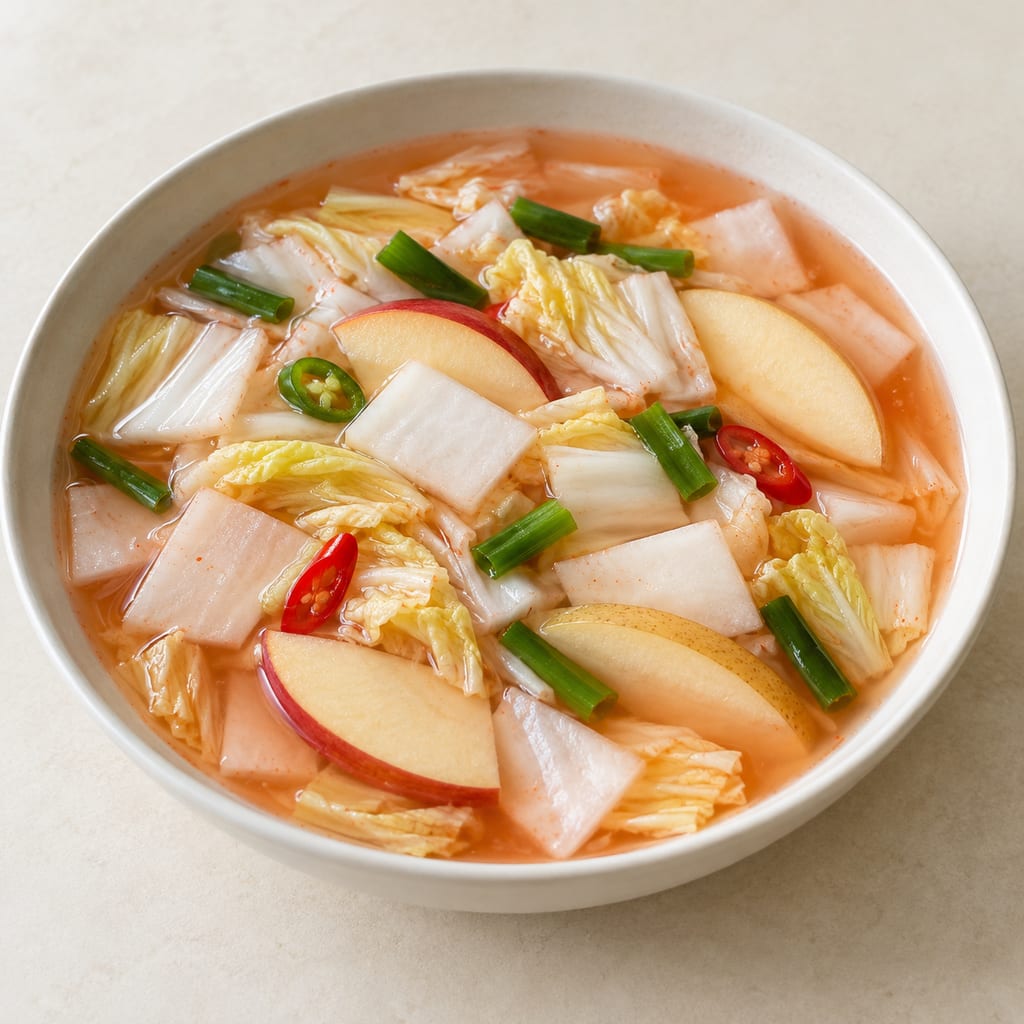
Cabbage-and-radish water kimchi with pear, apple and strained chili broth, following one Korean creator’s batch.
Kimchi of salted napa cabbage and daikon with garlic, green onion and red pepper, kept at room temperature one to four days, then refrigerated.
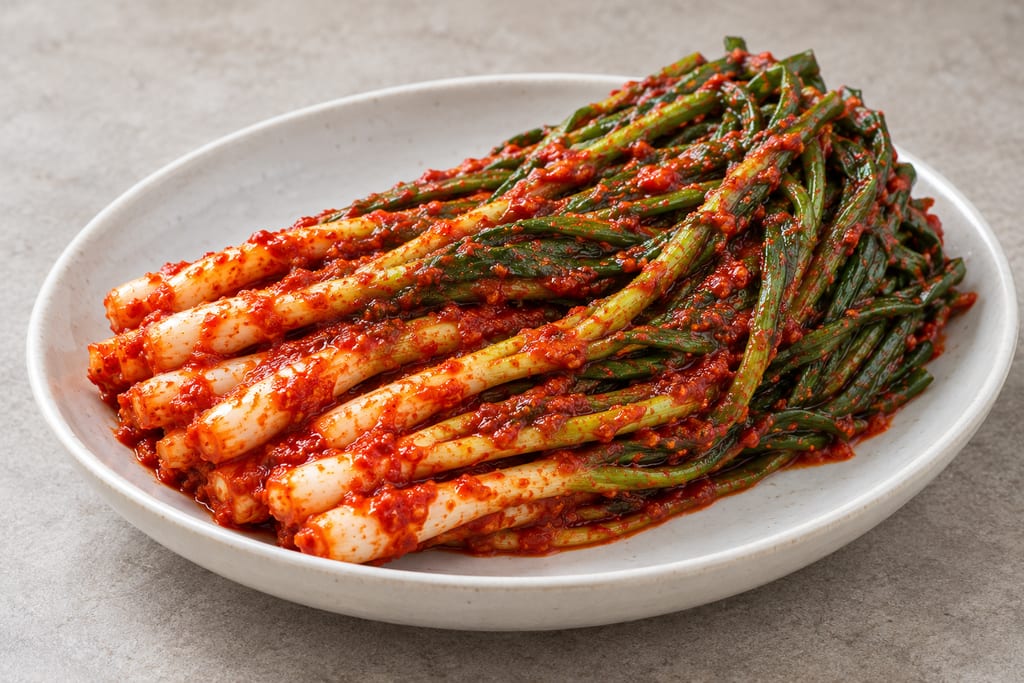
Pa-kimchi is a Korean kimchi of whole green onions salted, dressed with chilli and fish sauce, and fermented until pungent and sour.
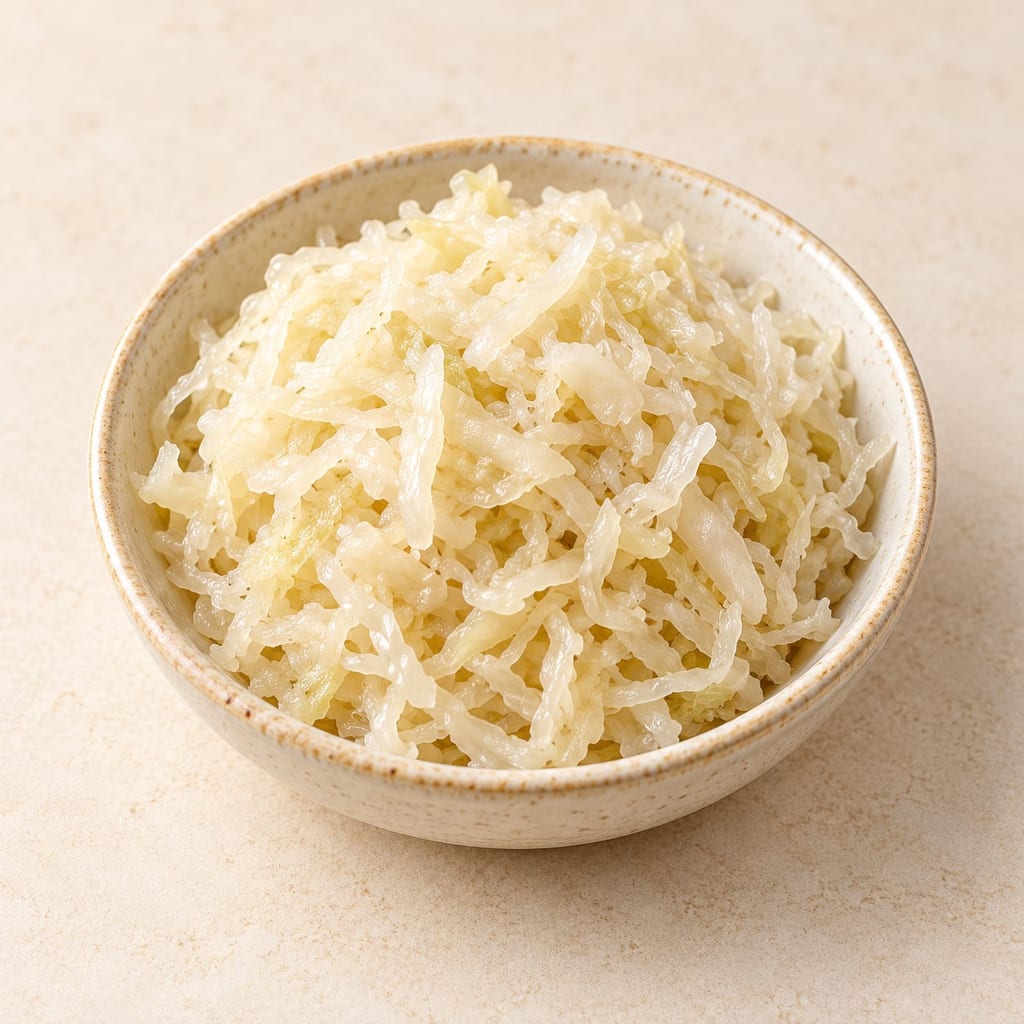
Finely cut cabbage fermented with salt in vats by natural lactic fermentation, a protected Alsatian product sold raw or cooked after fermentation.
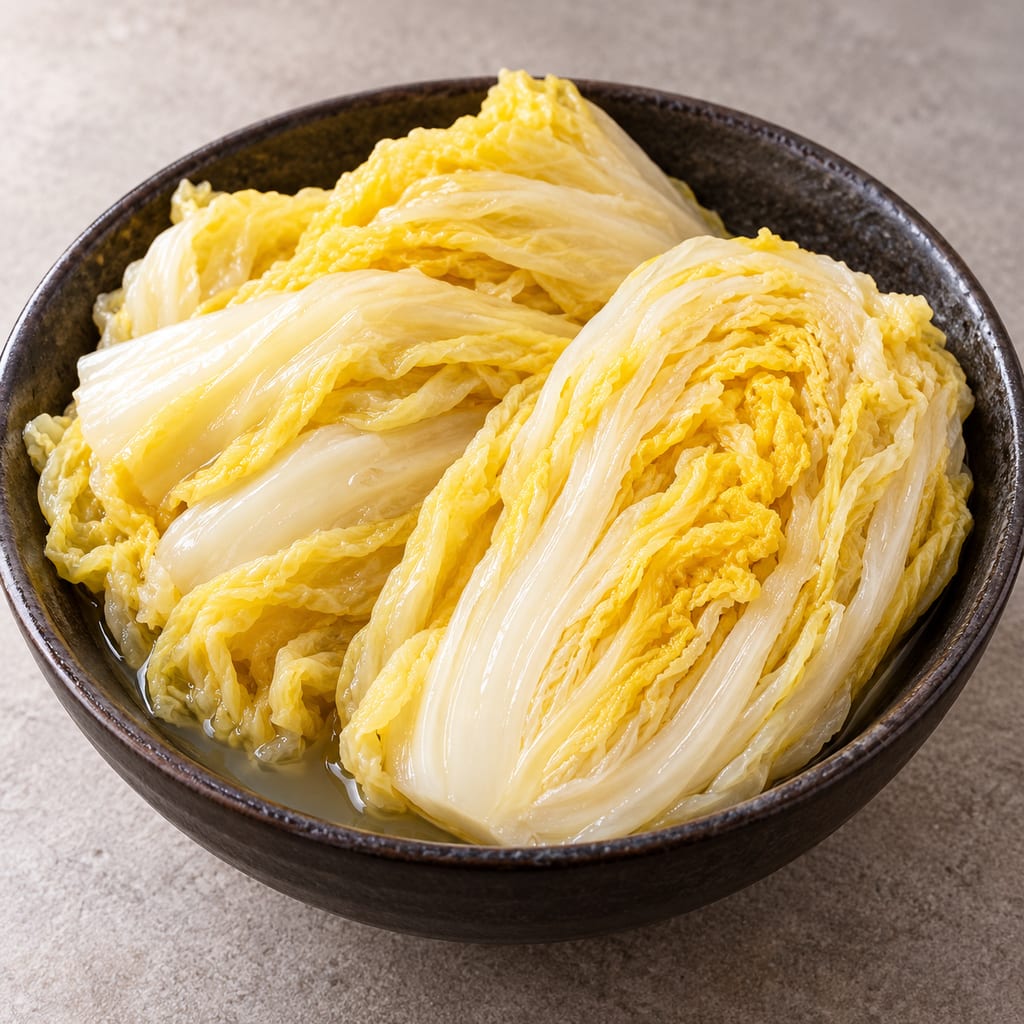
Napa cabbage fermented in a salt brine in Northeast China, traditionally in large ceramic or glass jars, until it turns sour.
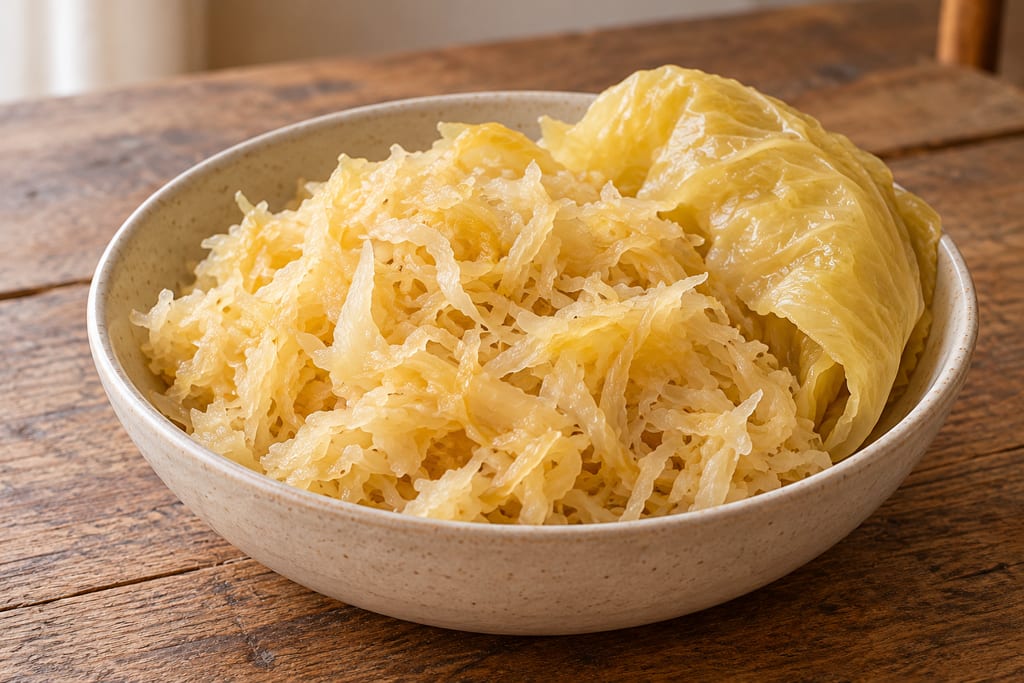
Serbian sour cabbage from the Futog area, made from the autochthonous Futoški cabbage population and registered as a protected product in 2008. It is a subset of general Serbian kiseli kupus.
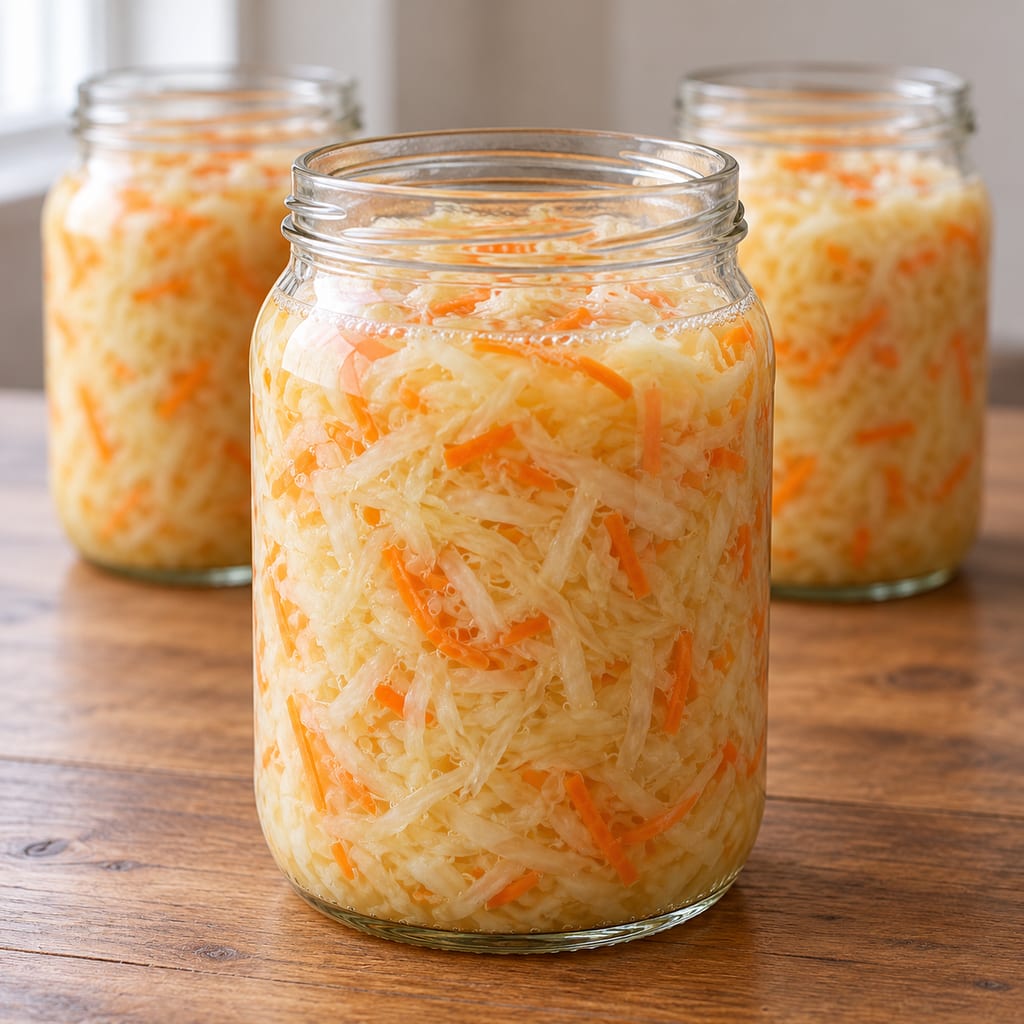
Shredded cabbage and grated carrot are salted to 20 g/kg, rested, packed into three jars and monitored during a creator-reported eight-day fermentation; measured temperature is not given.
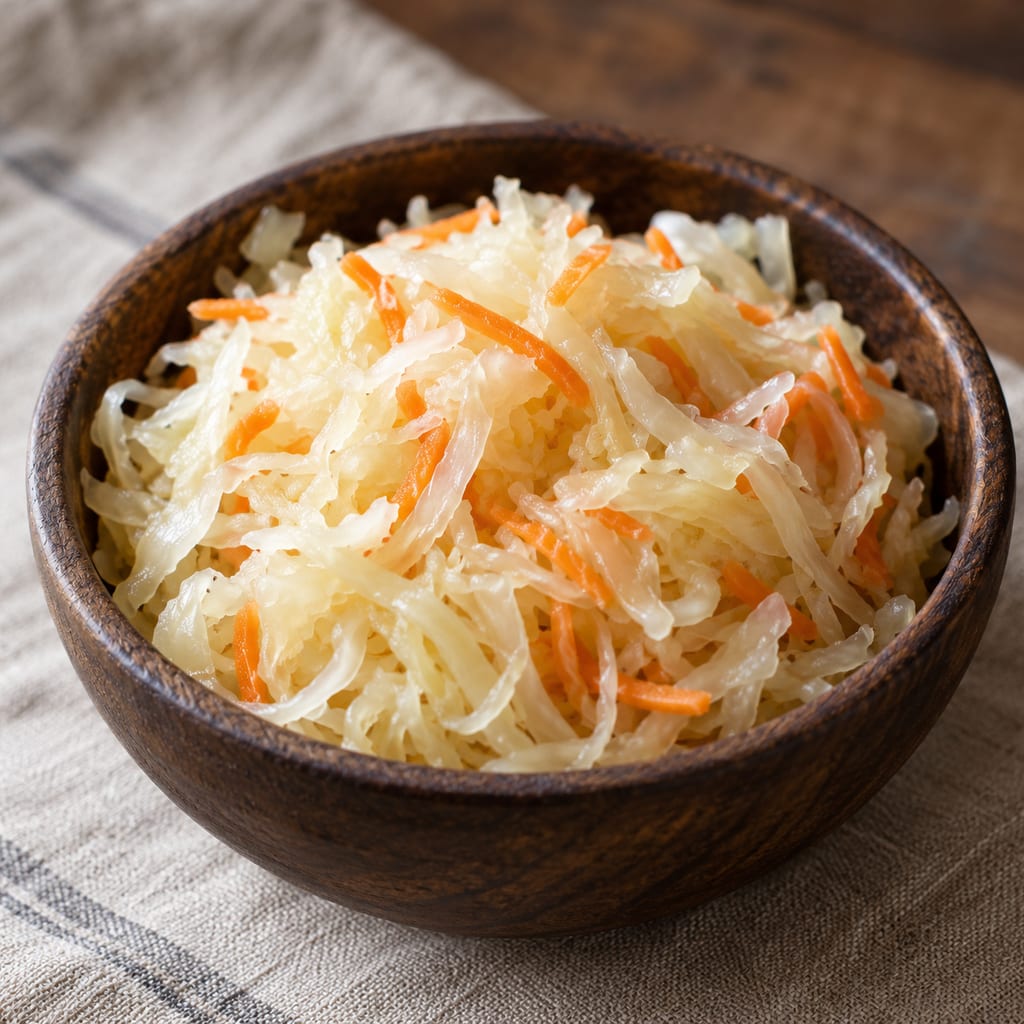
Kapusta kiszona z beczki is barrel-fermented cabbage from the Kołobrzeg area, entered on Poland’s List of Traditional Products in 2008. It is salted and fermented, with raw grated carrot added after souring.
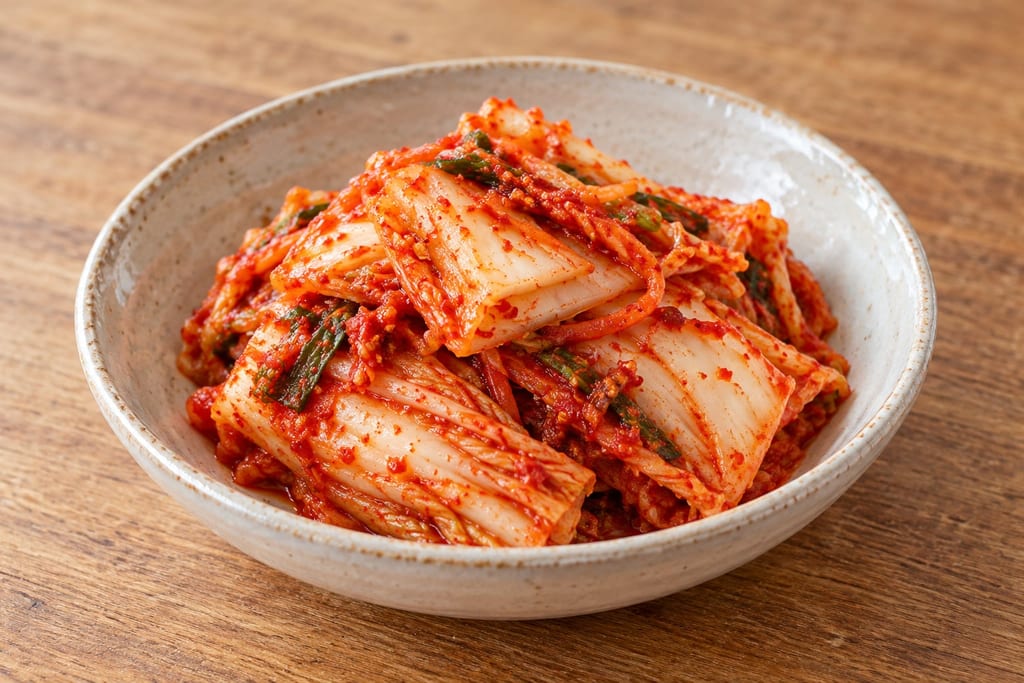
Kimchi is a Korean preserved vegetable food, most often cabbage, salted and seasoned, then fermented by the lactic acid bacteria that arrive with the vegetables. Some studies test added starter cultures, but a home jar is usually spontaneous.
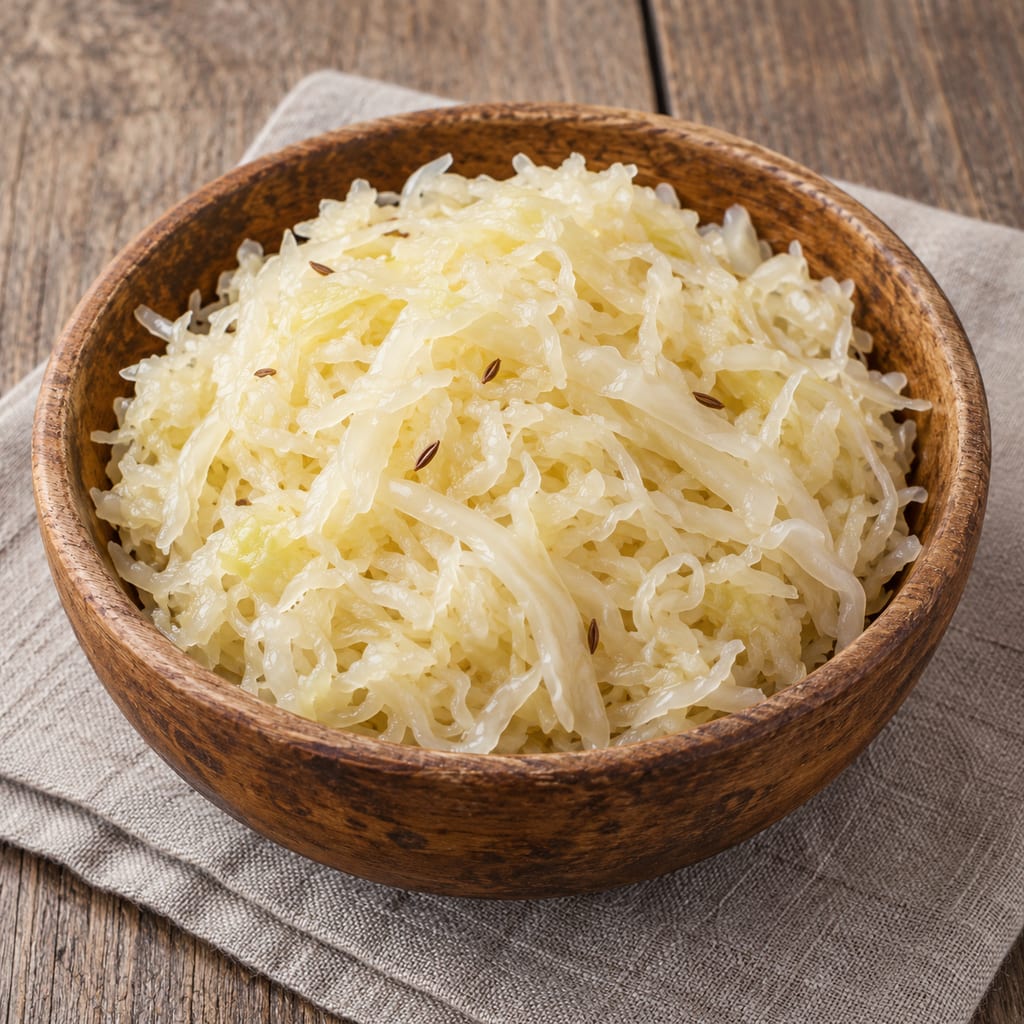
Kysané zeľí is Czech sour cabbage: shredded cabbage layered with salt and caraway and pressed in a wooden barrel. The regional account is descriptive and gives no validated salt ratio or endpoint.
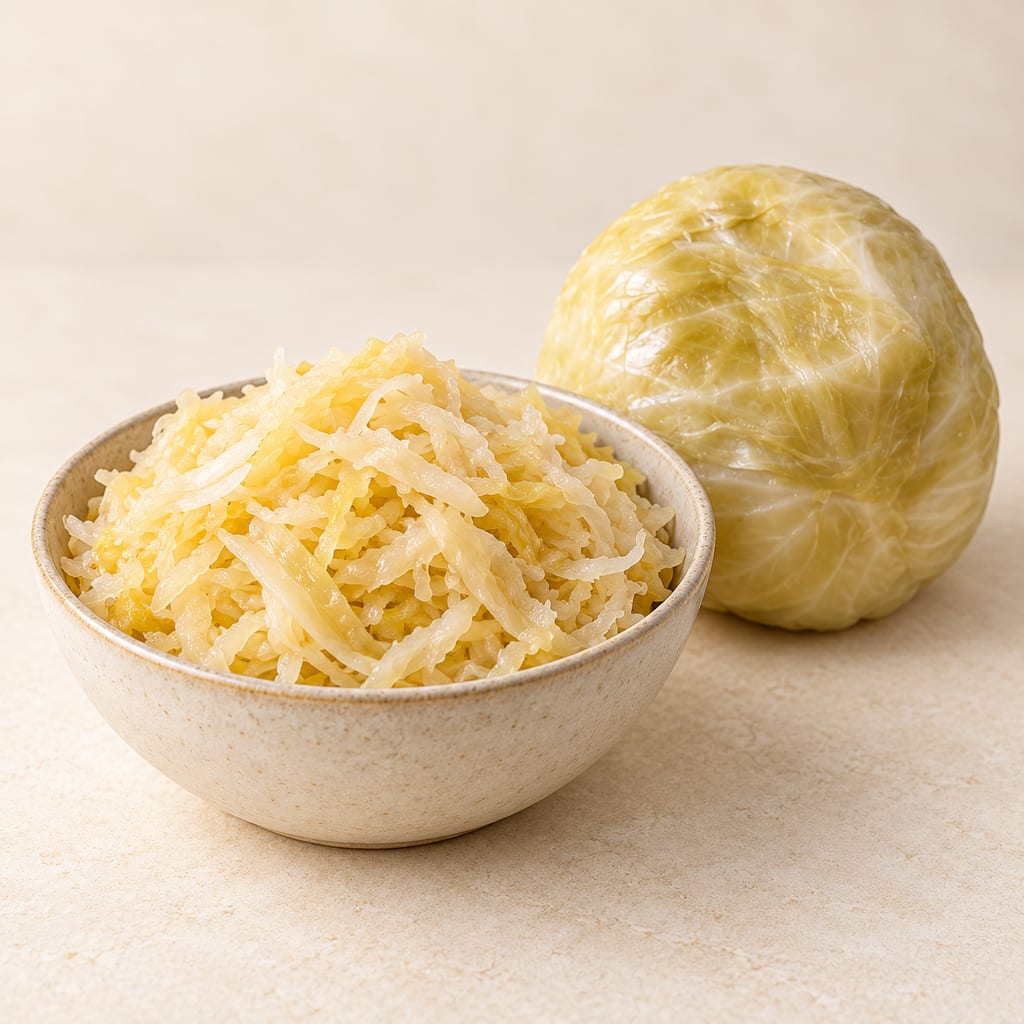
Protected Croatian sauerkraut from the Ogulin area: fresh white cabbage naturally lactic-fermented without preservatives, sold whole or shredded, from registered establishments.
No community contributions have been published for this entry yet.
Sign in to contribute. Published comments and photos are free to read.
MaangchiInspiration
Oi-sobagistuffed cucumber kimchi recipe
Cited in: What is oi-sobagi?; Recipe overview; Ingredients; Why the ingredients matter; Equipment; Method; How the salting stage works; Alternative brining methods; Other filling variations; Eating and serving; What successful preparation looks like; Food safety and storage
University of Minnesota ExtensionSafety
Preserving food at home: FermentationProduce fermentation equipment, acidity monitoring and submersion controls.
Cited in: Recipe overview; Ingredients; Why the ingredients matter; Equipment; Method; How the salting stage works; Alternative brining methods; Other filling variations; Eating and serving; What successful preparation looks like; Food safety and storage
Korean BapsangReference
Korean Bapsang — Oi SobagiAlternative hot-brine preparation. Korean Bapsang
Cited in: Recipe overview; Ingredients; Why the ingredients matter; Equipment; Method; How the salting stage works; Alternative brining methods; Other filling variations; Eating and serving; What successful preparation looks like; Food safety and storage
Kimjang ProjectReference
Kimjang Project — Stuffed Cucumber KimchiCommunity teaching formulation
Cited in: Historical and regional background; Recipe overview; Ingredients; Why the ingredients matter; Equipment; Method; How the salting stage works; What happens if oi-sobagi ferments?; Alternative brining methods; Other filling variations; Eating and serving; What successful preparation looks like; Food safety and storage
Kimchi MicrofloraReference
Kimchi Microflora: History, Current Status, and PerspectivesFermentation science. PubMed
Cited in: Historical and regional background; Why the ingredients matter; How the salting stage works; What happens if oi-sobagi ferments?