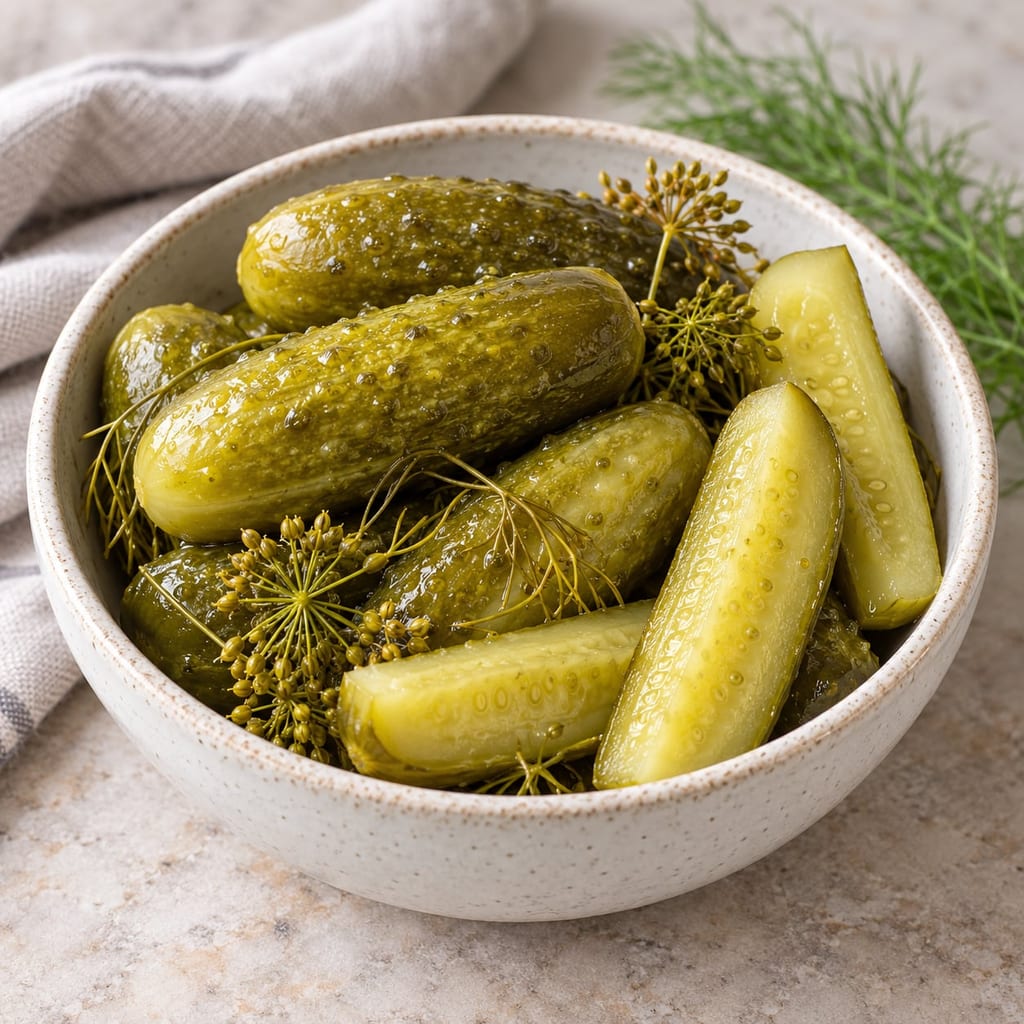
Fermented dill pickles
Trimmed cucumbers layered with dill and covered with a salt brine containing 5% vinegar, weighted and fermented three to six weeks.
 FermenteaWhere food goes to change
Substrates
Cucumber is the watery fruit of Cucumis sativus, domesticated in India, and the classic raw material of brine pickles from New York dills to Nepali khalpi and Korean oi-sobagi.
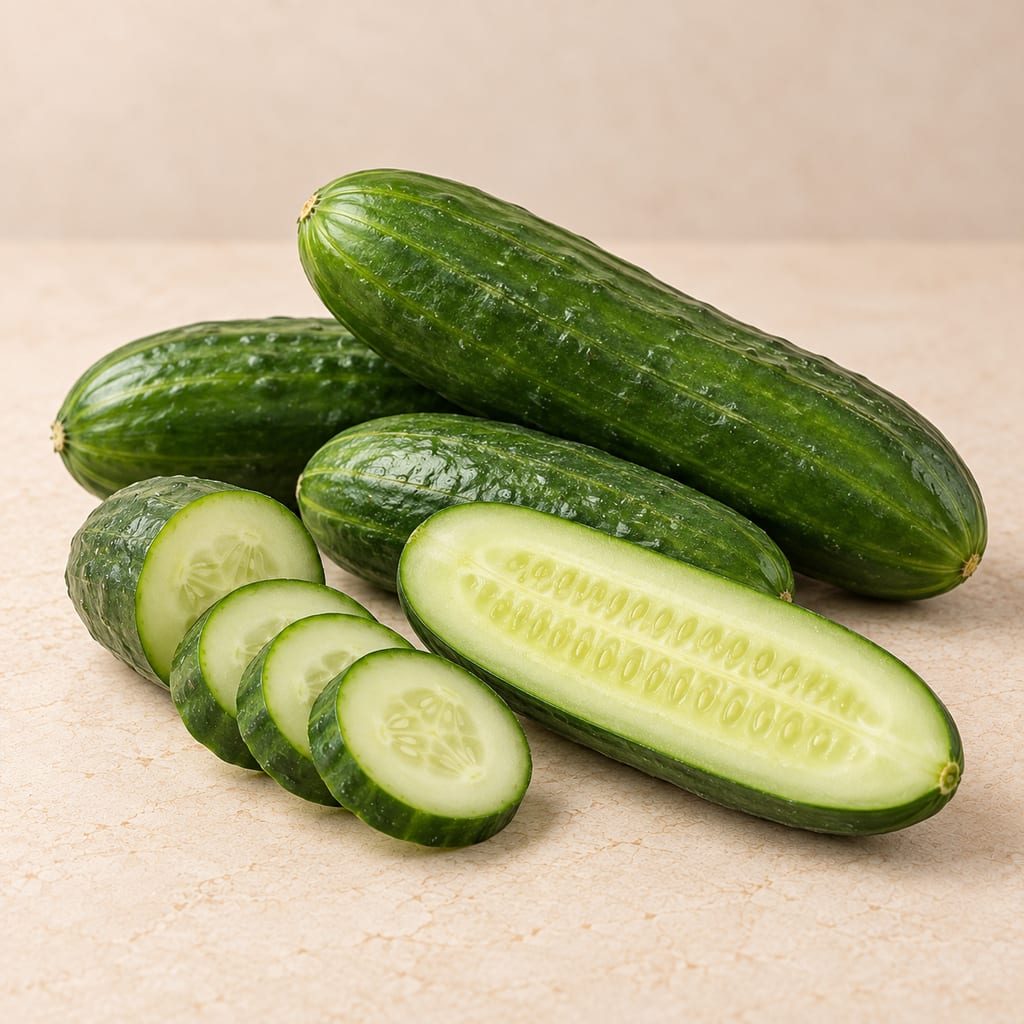
The cucumber is the fruit of Cucumis sativus, a creeping annual vine of the gourd family Cucurbitaceae. Botanically the fruit is a pepo, a berry with a rind and seeds, though cooks treat it as a vegetable. Fruit can reach 62 centimetres in length and 10 centimetres in diameter and is about 95 percent water. Raw with its peel it provides only about 16 kilocalories per 100 grams, 3.63 grams of carbohydrate of which 1.67 grams is sugar, 0.5 grams of fibre and 0.65 grams of protein, and its most notable micronutrient is vitamin K at about 14 percent of the daily value. Carl Linnaeus described the species in 1753; it is the only member of its genus with 14 chromosomes, and its genome was sequenced in 2009.
Its taste and smell come from a few compounds. The characteristic aroma is partly due to unsaturated aldehydes, including trans,cis-2,6-nonadienal, known as cucumber aldehyde. Bitterness in some varieties comes from cucurbitacin C, which may deter herbivores, and bitterness in the rind is also due to cucurbitacins. Unpeeled cucumbers have a higher polyphenol content than peeled ones.
Cultivated cucumbers fall into three main types. Slicing cucumbers are eaten fresh: North American slicers are longer and tougher-skinned, while European or telegraph cucumbers are smaller and thinner-skinned. Pickling cucumbers are shorter and thicker. Gherkins and cornichons are small pickling varieties, usually 2.5 to 12.5 centimetres long, with bumpy skin; the English word comes from the early modern Dutch gurken or augurken, meaning small pickled cucumber, and cornichons are French baby pickles made from gherkins pickled in vinegar and tarragon. Burpless or seedless cucumbers are sweeter, thin-skinned and nearly seedless, and are often sold shrink-wrapped.
The way the plant flowers explains some of the types. Most seeded cultivars are self-incompatible and need pollen from another plant, usually brought by honeybees, bumblebees or other wild bees. Parthenocarpic cultivars produce seedless fruit without pollination and are often grown in greenhouses. Traditional cultivars carry male flowers first, while newer gynoecious hybrids produce almost entirely female flowers. Cucumber shoots are also eaten in rural areas.
The cucumber is native to a region of Asia that stretches from India, Nepal and Bangladesh through southern China and northern Thailand. It was domesticated in India from the wild Cucumis sativus var. hardwickii and has been cultivated for at least 3,000 years. Pliny the Elder reported that the Emperor Tiberius ate cucumbers all year round, grown in winter in frames glazed with a mirror-stone, probably mica. Charlemagne had them grown in his gardens in the eighth or ninth century; they were cultivated in France in the ninth century and in England in the fourteenth. Spanish explorers brought them to Haiti in 1494, and they were growing in North America by the middle of the sixteenth century.
Pickling is older than any record of the cucumber's travels, and the vocabulary shows how the practice moved. The English word pickle appears around 1400, from the Middle Dutch or Middle Low German pekel, meaning brine, and gherkin comes from the early modern Dutch gurken or augurken, small pickled cucumbers. Fermented salt pickling is reported from China, with the earliest documented reference in a poem of about the seventh century BC, and salting and pickling were practised in the Greek and Roman world. During the Age of Exploration pickling preserved food for long sea voyages, and Victorian pickles were a luxury, served in silver-holdered glass castors with silver tongs.
World production of cucumbers was about 88 million tonnes in 2024. China alone grew 68.6 million tonnes, roughly 78 percent of the total, far ahead of Turkey and Russia at 1.7 million tonnes each, Uzbekistan at 1.0 million and Mexico at 0.96 million.
A cucumber suits a brine because it is nearly all water and because its skin carries the right bacteria. Fermentation in a brined pickle depends on Lactobacillus bacteria that naturally live on the growing cucumber skin; harvesting and packing can remove them, which is why cultures are sometimes reintroduced with yogurt, sourdough or sauerkraut. Cucumbers undergo a typical lactic acid fermentation: salt added to the vessel draws out liquid, the brine forms within 24 hours by osmosis, and as soon as it forms fermentation starts and bubbles of carbon dioxide appear. The brine turns cloudy for the first few days from the growth of bacteria, and if left uncovered a filmy yeast often forms on the surface. Fermentation takes between one and four weeks depending on the ambient temperature and is complete when no more bubbles appear. Because of the high acid level of the finished product the risk of food poisoning is low.
Salt strength changes the result. Brines for cucumber pickles range from 20 to 40 grams of salt per litre, and a saltier brine tends to give sourer cucumbers. A traditional ratio is 1 kilogram of salt for every 20 kilograms of small cucumbers or every 15 kilograms of large ones, with a 40-degree salometer brine added if the liquid does not cover the fruit. Salt purity matters: anti-caking agents cloud the brine, lime impurities reduce acidity and shelf life, iron causes blackening, magnesium adds bitterness and carbonates soften the pickle. A tested brine for fermented pickles is half a cup of canning or pickling salt, a quarter cup of 5 percent vinegar and 8 cups of water per gallon, fermented for 3 to 4 weeks at 70 to 75 degrees Fahrenheit or 5 to 6 weeks at 55 to 65; above 80 degrees the pickle becomes too soft.
A good pickle is crisp, and the usual enemy of crispness is the set of enzymes in the blossom end, the end opposite the stem. Cutting 1/16 inch off the blossom end removes them. Fermenting above 80 degrees Fahrenheit makes pickles too soft, and processing above 185 degrees Fahrenheit can also soften them. Lime soaking with pickling lime mainly crisps the texture instead of preserving, and calcium chloride is a safer, neutral alternative that needs no rinsing; alum also promotes crispness and is approved by the Food and Drug Administration as an additive but not recommended. Pickles that become soft, slimy or smell bad are discarded.
Brined pickles do not keep as long as vinegar pickles and usually need refrigeration. A film of bacteria that may form on the brine is not a sign of spoilage and can be removed, and keeping the cucumbers submerged prevents mould, with scum removed promptly. Fermented pickles in the original container keep about four to six months if refrigerated and skimmed regularly, and canning is the better option for longer storage.
Pickling preserves food by anaerobic fermentation in brine or by immersion in vinegar, and it does not require the food to be sterile, unlike canning. Pickling solutions are typically highly acidic, with a pH of 4.6 or lower, and high salt levels inhibit enzymes and microbial growth. In a fermented pickle, lactic acid bacteria, mainly Lactobacillus, produce lactic acid as the main preservative. At low salt and low temperature Leuconostoc mesenteroides tends to dominate, producing acids, alcohol and aroma compounds, while at higher temperatures Lactobacillus plantarum takes over; many pickles start with Leuconostoc and shift to Lactobacillus as the acidity rises. Salt concentration, temperature and the exclusion of oxygen determine which microbes dominate and the final flavour. Alum promotes crisp texture, and the United States Food and Drug Administration approves it as an additive but does not recommend it; calcium chloride is another crisping agent, which evolved from the use of pickling lime.
Cucumber is only one member of a wide family. Torshi, from the Persian torsh, sour, is the name for pickled vegetables across Middle Eastern, Caucasian, Slavic and Balkan cooking, with cucumbers, turnips, onions, carrots and olives among its vegetables. Many torshi are made in vinegar, and Iran has hundreds of varieties. Traditional brining holds the vegetables underwater with stones, and pre-soaking in brine before moving to vinegar reduces the food's water content, which would otherwise dilute the vinegar.
Pickled foods are not free of concern. The World Health Organization's cancer agency listed traditional Asian pickled vegetables in 1993 as possibly carcinogenic, a 2009 meta-analysis linked pickled vegetable consumption to a potential twofold increased risk of oesophageal cancer with high heterogeneity among studies, and brined foods can be very high in sodium. Those studies concern particular salted vegetable products and not every cucumber pickle.
Brined pickles are naturally fermented in a salt brine without vinegar and become sour through fermentation. Vinegar pickles are steeped in an acidic solution such as vinegar and are not fermented; bread-and-butter pickles, marinated in vinegar, sugar and spices, are the standard example, first sold in the 1920s by the Illinois farmers Omar and Cora Fanning, who filed a trademark in 1923. The two kinds differ in method, in risk and in keeping time, and a recipe for one cannot be swapped for the other: refrigerator pickles, for example, are unfermented, marinated in seasoned vinegar, and must be refrigerated or canned for long-term storage.
New York's kosher dills show how a style forms. Kosher in this sense means the traditional style of Jewish New York City pickle makers, a natural salt brine with plenty of garlic and dill, and not necessarily compliance with Jewish dietary law. Full-sour pickles are fully fermented, while half-sours spend less time in brine and stay crisp and bright green. Dill pickles have been served in New York since at least 1899.
In Poland ogórek kiszony is fermented in lactic-acid brine without vinegar, ogórek małosolny is lightly salted and less sour, and ogórek konserwowy, the korniszon, is pickled in vinegar. German-style salt pickles, Salzgurken, were developed in northern central and eastern Europe, and Spreewald gherkins are a German example. In Hungary the summer kovászos uborka uses no vinegar; bread slices and sun exposure help start the fermentation. In Russia and Ukraine pickles flavour rassolnik, a soup that dates back at least to the fifteenth century, when it was called kalya. In Japan asazuke are lightly pickled cucumbers sold as street food, and stick pickles, ippon-tsuke, are served at festivals. In southern England large vinegar gherkins accompany fish and chips, and in the southern United States there are even Kool-Aid pickles.
Two Asian preparations sit closest to fermentation. Oi-sobagi is Korean cucumber kimchi, and oiji in Korea and torshi khiar in Egypt are among the brine-pickled cucumber products made around the world. Khalpi is a cucumber pickle popular in the summer months in Nepal. Only fully ripe, unbruised cucumbers are used. They are washed, sliced and cut into pieces 5 to 8 centimetres long, salted with oil added, and fermented until the pale fruit changes to a darker green and more transparent product. The pickle is usually stored in clean capped jars and keeps well in a cool place.
For fermenting, choose firm, unbruised fruit of a pickling type, and wash it in cold potable water. Size matters to the recipe, because salt ratios differ for small and large cucumbers. Cut a thin slice off the blossom end. Keep the cucumbers under the brine, avoid copper, iron, galvanised or lead-glazed containers, and discard any product that is slimy, mouldy or smells bad. Bitterness in an occasional fruit is due to cucurbitacins in the rind.
Domesticated in India from the wild var. hardwickii; a region, not a precise birthplace.
Khalpi is a summer cucumber pickle of Nepal; the row does not date it.
Ogórek kiszony is a lactic brine pickle; chosen as one of several European brine-pickle traditions.
Kosher dills as a style of Jewish pickle makers; the row dates only the first mention.
Trimmed cucumbers layered with dill and covered with a salt brine containing 5% vinegar, weighted and fermented three to six weeks.
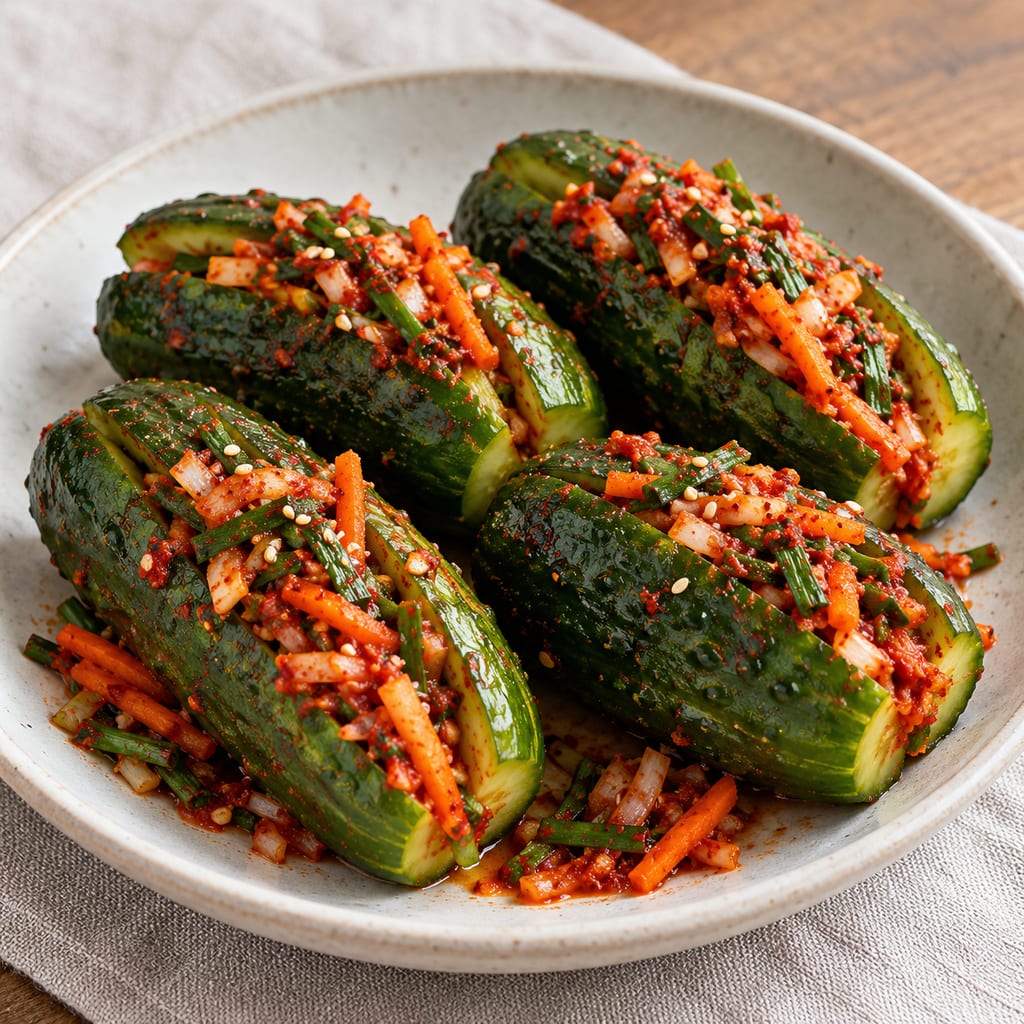
Oi-sobagi is a Korean stuffed cucumber kimchi: salted cucumbers slit and filled with a chive-and-chilli seasoning, eaten fresh or left to ferment.
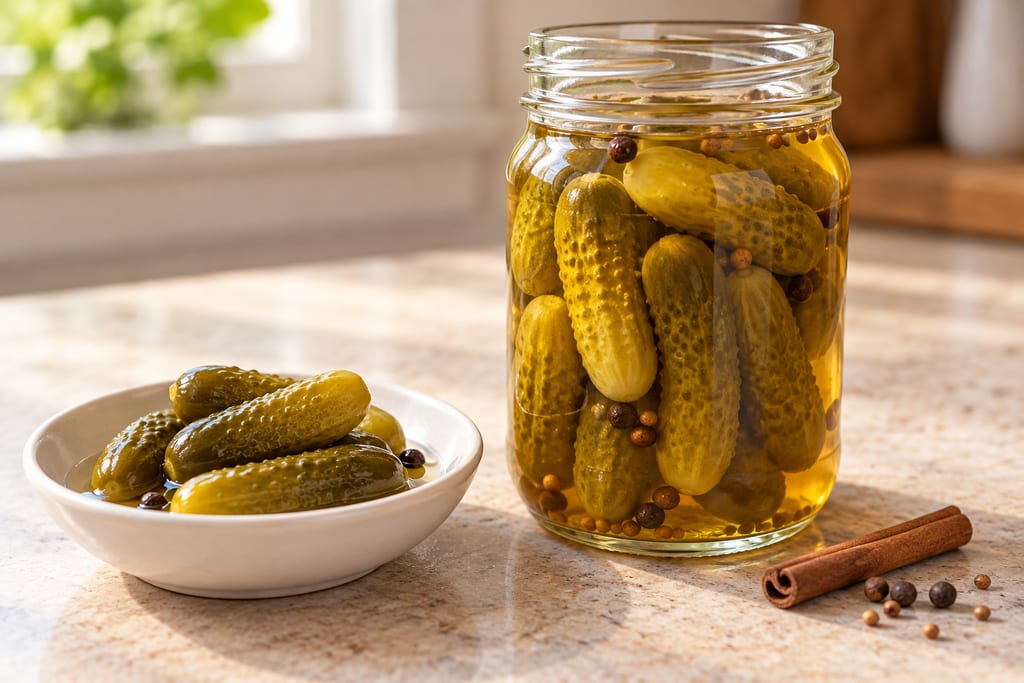
Sweet gherkin pickles are small whole cucumbers preserved in a spiced, sweet vinegar syrup. This four-day U.S. canning method uses repeated hot-water soaks, staged syrup additions, and a boiling-water process.
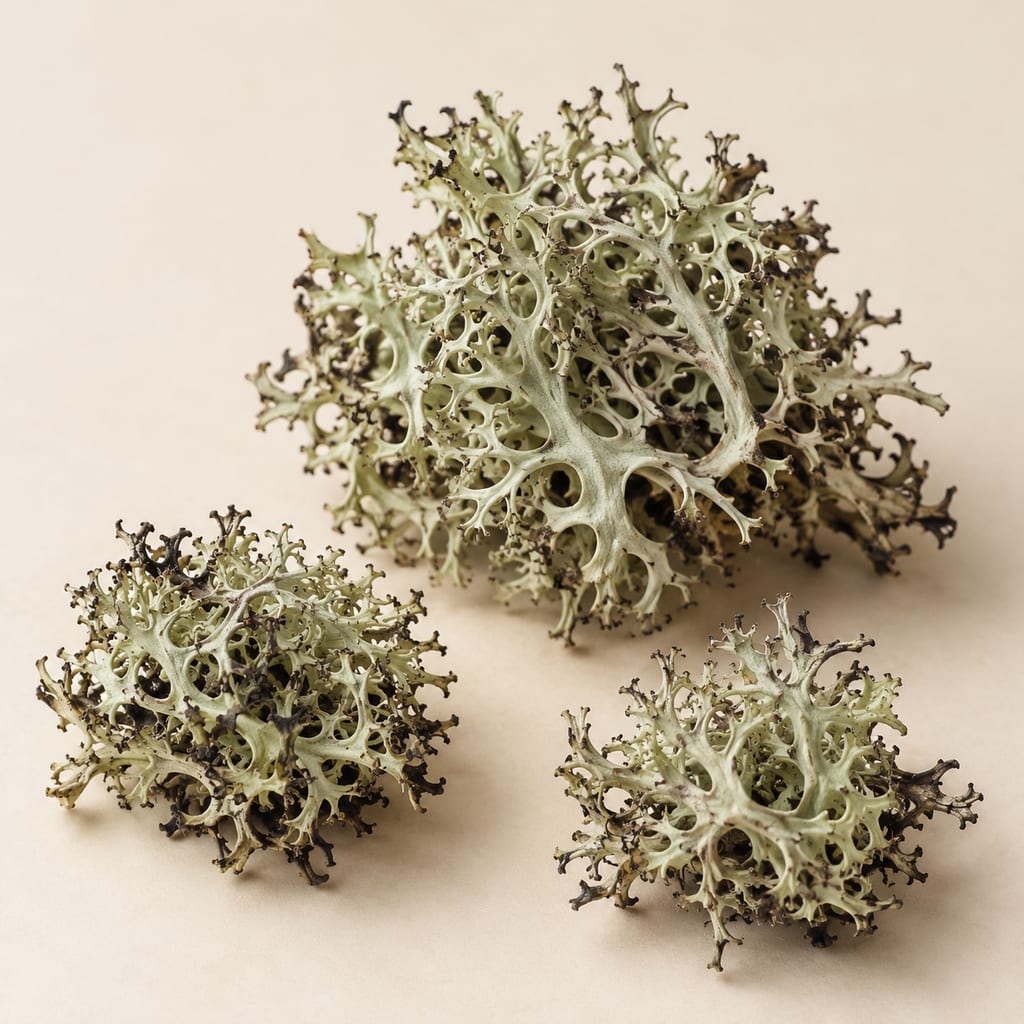
Everniastrum cirrhatum, a tree-dwelling lichen of the Nepal Himalaya, gathered wild and used in soups, pickles and sausages by the Limbu and Rai communities of the north-east hills.
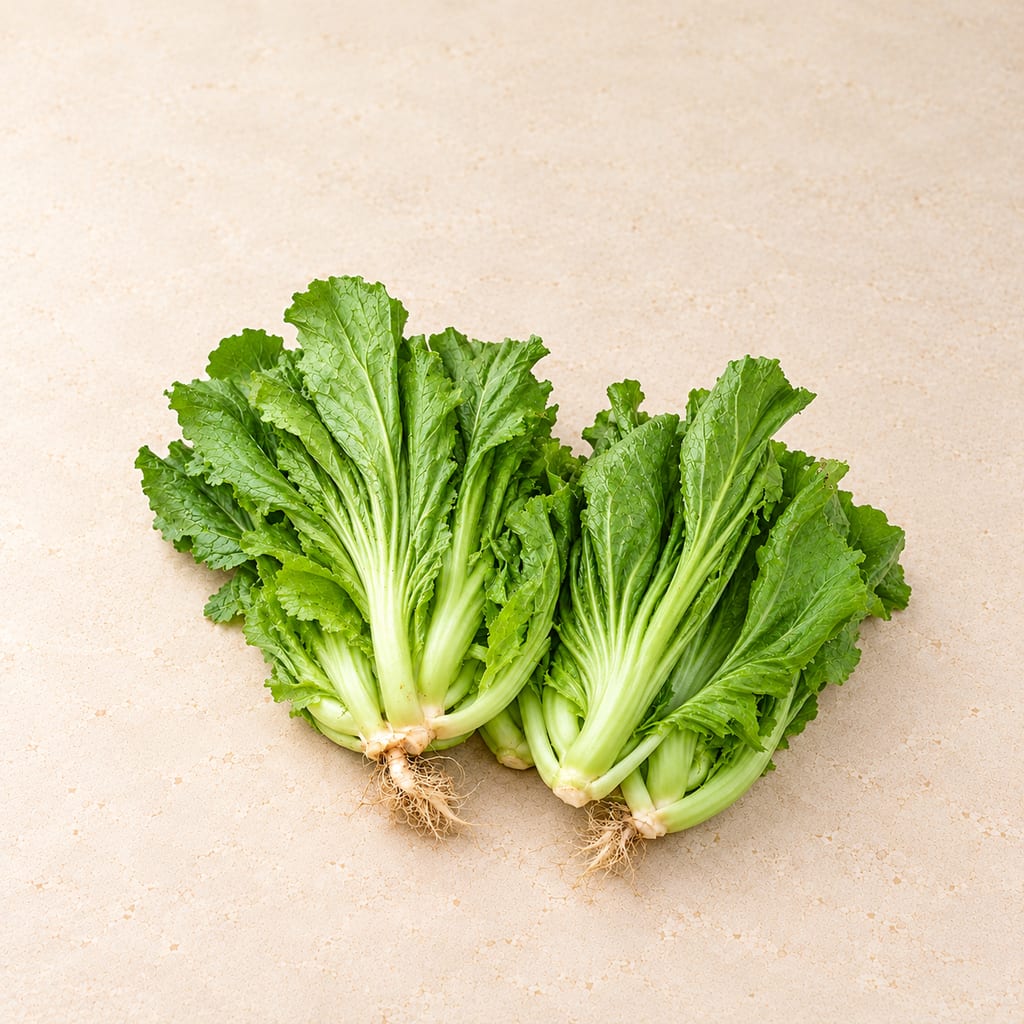
The leaves of Brassica juncea, a hardy cool-season crop with a sharp, sulfurous bite, eaten fresh and cooked and fermented across Asia as pickled greens, kimchi and gundruk.
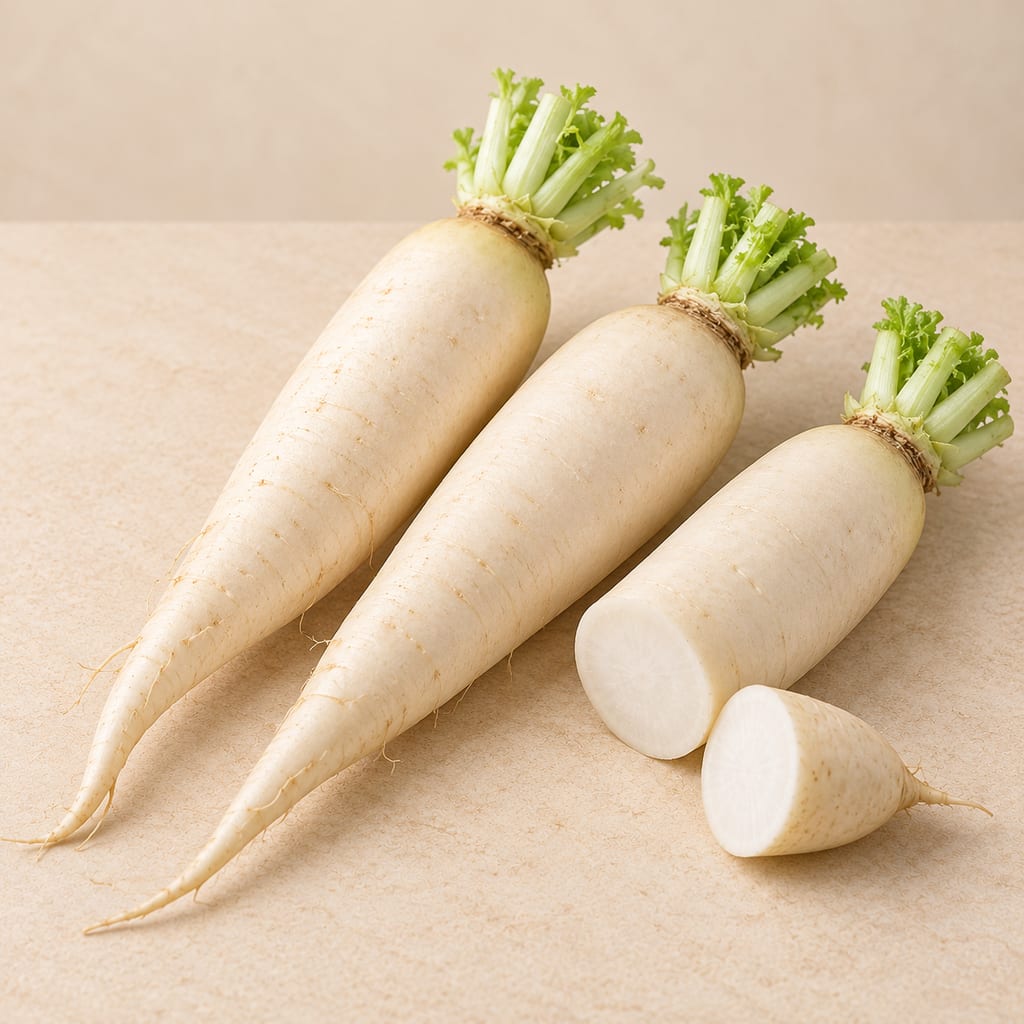
Radish and daikon are the crisp, peppery roots, leaves and seed pods of Raphanus sativus, fermented as kimchi, takuan and sinki and eaten raw across Asia and Europe.

At North Abydos in Egypt, a fixed early Dynastic brewery comprised parallel semi-subterranean installations with rows of ceramic mash vats; excavation reports revise their number, scale and estimated batch capacity.

Ají amarillo is the orange-yellow Peruvian chilli cultivar group of Capsicum baccatum, used to colour and season huancaína sauce and ají de gallina. Published heat estimates do not establish one range for the named cultivar.

Toasted almonds are whole sweet almond kernels dry-roasted until golden to brown. Heat replaces their marzipan note with a roasted, nutty one; they thicken and flavour romesco.

Kodiak salmon, halibut and cod cut as seg'aq and hung on an initaq rack to become tamuuq, with kac'amaasaq and kupcuunaq named as different results.

Aniseed is the dried ripe fruit of Pimpinella anisum, an aromatic Apiaceae spice commonly called a seed. It adds a sweet, warm aroma to breads such as Moroccan krachel and South African mosbolletjies, and is distinct from star anise.

A fixed Late Chalcolithic installation in Areni-1 cave combined a shallow clay pressing basin with a large jar set into the cave floor and storage vessels nearby.

Ripe avocado flesh is the soft, buttery, fat-rich pulp of Persea americana, eaten raw. It is low in acid, so it is a fresh ingredient that needs care in chilled dishes.

A portable dome and pan used over a hearth, with embers on the lid and heat from below. Regional peka and saç forms share this principle while differing in materials, pan shape and how the food is cooked.
No community contributions have been published for this entry yet.
Sign in to contribute. Published comments and photos are free to read.
WikipediaIdentity · History · Production · Nutrition
CucumberBotany, types, nutrition and compounds
Origin, domestication and spread
Production in 2024
Cited in: A fruit that is mostly water; Kinds of cucumber; From India to every garden; The world crop; Choosing and handling
WikipediaFermentation · Use · History
Pickled cucumberBrined versus vinegar pickles, brine strength, Lactobacillus on skin
Kosher, full-sour and half-sour; regional pickles; history and dates
Cited in: Kinds of cucumber; From India to every garden; Why cucumbers ferment so well; Crispness, softening and the blossom end; Fermented and vinegar pickles are different foods; Pickled cucumbers around the world
Food and Agriculture Organization of the United NationsFermentation · Method
Fermented fruits and vegetables: a global perspective, Chapter 6: Typical products of bacterial fermentationsSalt per kilogram of cucumbers, brine formation, fermentation duration, cloudiness and yeast film
Khalpi from 5 to 8 centimetre pieces, salt purity, brine-pickled cucumber products worldwide
Cited in: Why cucumbers ferment so well; Pickled cucumbers around the world; Choosing and handling
Penn State ExtensionMethod · Safety
Let's Preserve: Sauerkraut and PicklesTested brine for fermented pickles, temperatures and times
Blossom end enzymes, softening, scum, storage
Cited in: Why cucumbers ferment so well; Crispness, softening and the blossom end; Fermented and vinegar pickles are different foods; Choosing and handling
WikipediaUse
KimchiOi-sobagi among cucumber kimchi types
Cited in: Pickled cucumbers around the world
WikipediaFermentation · Safety · History
PicklingBrine and vinegar pickling, pH 4.6 or lower, microbial succession
Crisping agents
History of pickling and health studies
Cited in: From India to every garden; Crispness, softening and the blossom end; Acid, microbes and the wider pickling family
WikipediaUse
TorshiTorshi pickled vegetables of the Middle East and Balkans
Cited in: Acid, microbes and the wider pickling family