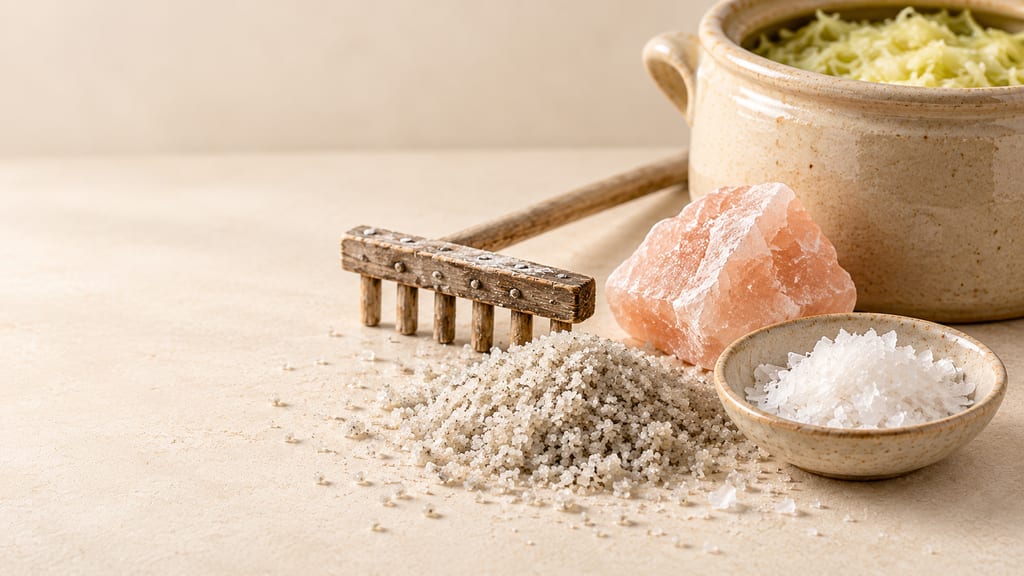
Salt: the mineral, the work and the foods it makes
Salt seasons a meal, shapes fermentation and preserves food. Its history follows the people who mine, harvest, trade and transform it, and the choices hidden inside an ordinary packet.
 FermenteaWhere food goes to change
Modern method
Quick Fresh-Pack Dill Pickles · Quick vinegar pickles
Whole small cucumbers are soaked in a measured salt solution, packed with dill and mustard seed, then covered with a boiling 5% vinegar brine and processed in a boiling-water canner.
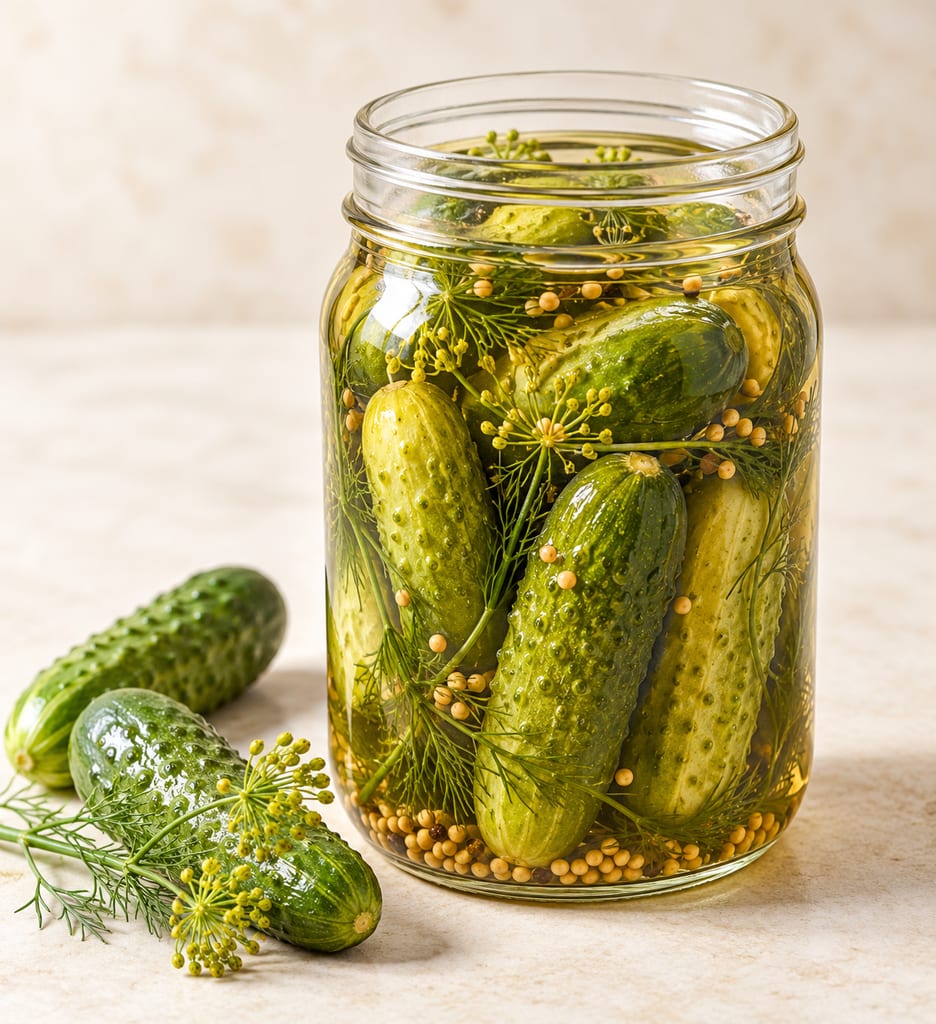
“Pickle” names a result and a family of methods, not one biological process. In this fresh-pack dill recipe, cucumbers spend time in a salt solution, then meet a measured vinegar brine and heat processing. The vegetables do not undergo the lactic fermentation used for naturally soured dill pickles. The vinegar brings acetic acid from outside the cucumber; a fermented pickle instead develops acidity as microorganisms transform sugars in the vegetable. The distinction affects flavor, timing and, most of all, which controls make the jar safe.
The National Center for Home Food Preservation calls these fresh-pack or quick-process pickles. Some recipes briefly soak the produce in brine before draining it and adding vinegar. This version does exactly that: the overnight salt soak is a preparation stage, not a fermentation. Salt moves water and seasoning, while the later vinegar solution supplies the acid in the tested formula. The boiling-water canner then applies the specified heat treatment to jars with that measured acid mixture.
Commercial and home-kitchen language can blur these categories. A jar sold simply as dill pickles might be vinegar-packed, fermented, or made with a combination; its name alone does not identify the process. USDA grade language, by contrast, defines fresh-pack dill pickles as packed in a vinegar solution with dill flavoring. This recipe belongs in that family. It is not a recipe for a barrel of naturally fermented cucumbers, a refrigerator quick pickle, or relish, which is chopped and cooked to a different consistency.
The cucumber itself has a history much older than the specific canning formula here. Botanical and historical evidence points to domestication on the Indian subcontinent. A study of texts and images traces the crop’s westward movement cautiously: cucumbers appear in evidence from areas east and northeast of the Mediterranean before their documented presence in Iberia and southern Europe. Earlier claims that every ancient image of a long green fruit depicts a cucumber are unreliable; some show other cucurbits, including vegetable melons. The researchers propose more than one route into Europe and make clear that the surviving evidence is uneven.
These movements describe the crop, not the invention of vinegar pickling. The earliest history of pickling remains uncertain. The National Center for Home Food Preservation suggests that food may once have been kept in wine or beer, whose acidity could help preserve it, but presents this as a possibility rather than a documented first recipe. Vinegar itself is made when bacteria oxidize alcohol into acetic acid. That chemistry explains why wine, cider and beer can become vinegar; it does not establish when people first put cucumbers into it.
Preserving methods expanded and changed with food trade, household equipment and the growth of commercial production. The history account describes a marked increase in European preservation in the sixteenth century, alongside new foods and increasingly varied sauces, relishes and condiments. That broad shift should not be mistaken for a date of origin for American dill pickles. The present formula is a modern tested home-canning recipe published by the National Center and adapted from the USDA Complete Guide to Home Canning, revised in 2015. It records a contemporary standard method, not an ancient or uniquely regional cucumber tradition.
The formula is built for 8 pounds of small pickling cucumbers, 3 to 5 inches long, and yields 7 to 9 pints. Freshness and firmness matter because the pickles are packed whole and their texture remains visible in the finished jar. Start with sound cucumbers, without spoiled or badly bruised sections. Wash them carefully. The recipe calls for removing a thin slice from the blossom end while leaving a short piece of stem. The blossom end can carry an enzyme associated with excessive softening; cutting away the stem end instead would not follow this instruction.
Salt appears in two separate stages and is not merely a finishing seasoning. Three-quarters of a cup dissolves into the two gallons of soak water; the other half cup goes into the vinegar brine. The divided amounts matter because the cucumber first sits in one solution and later receives another. The published formula uses canning or pickling salt. Its density and additives differ from some table or flake salts, so replacing it measure-for-measure with another kind may change the result. This is a recipe to follow by the listed amounts, not a template for improvised salinity.
Vinegar is the central preserving ingredient in this method. The recipe specifies 1½ quarts of vinegar at 5 percent acidity, plus two quarts of water. That exact ratio is part of the tested formulation. The sugar is a modest ¼ cup, contributing sweetness and rounding the sharpness; it does not turn the recipe into sweet gherkins. Whole mixed pickling spice flavors the liquid. Dill heads or dill seed provide the defining herbal note, and whole mustard seed adds its warm, peppery fragrance. The source gives either about 14 fresh dill heads or 4½ tablespoons of dill seed, with jar-level amounts for pints.
After washing and trimming, the cucumbers stand for 12 hours under a salt solution made from ¾ cup salt and two gallons of water. This is a measured brine soak, not an open-ended instruction to leave vegetables until they taste right. It gives the cucumbers time in a salty environment before the second liquid is prepared. They are drained afterward, so the soak is not carried forward as the jar brine. The published recipe does not say to ferment the cucumbers during this period, and no souring endpoint is used.
The drained cucumbers go into a hot vinegar mixture made from the remaining salt, sugar, vinegar and water. The mixed spices are tied in a clean cloth so their flavor can infuse the liquid without leaving a mass of whole spices in every jar. The liquid is brought to a boil before it is poured over the packed cucumbers. The heat distributes the measured acid solution and seasons the vegetables; because the acid-to-food ratio controls safety, the vinegar, water and cucumber quantities should stay as published.
The jars are filled with cucumbers, one teaspoon of mustard seed and one and a half heads of fresh dill per pint, or the corresponding dill-seed option. The boiling solution covers the cucumbers, leaving ½ inch of headspace. Headspace allows room for expansion and seal formation. Use the source’s raw-pack process in a boiling-water canner, with the canner and jars prepared according to its canning instructions. The canner water must cover the jar tops by at least an inch and remain at a complete boil for the whole processing time.
Processing time depends on elevation. For pint jars, the recipe specifies 10 minutes from 0 to 1,000 feet, 15 minutes from 1,001 to 6,000 feet, and 20 minutes above 6,000 feet. The altitude adjustment compensates for the lower boiling temperature of water at higher elevations. If the canner stops boiling, University of Georgia instructions say to bring it back to a vigorous boil and restart the full original time. The heat step is an essential safety control; it is not a flavor preference or a substitute for the specified vinegar concentration.
The same vegetable can become several quite different pickles. Regular fermented dills and sauerkraut are cured for weeks; refrigerator dills can ferment for a shorter time; fresh-pack pickles are acidified with vinegar. Quick sweet pickles use a sweeter liquid, and bread-and-butter styles add their own spice and slicing conventions. USDA standards separate fresh-pack dill from sweetened dill and distinguish both from relish, a chopped product. These names refer to methods and product forms, not just different spice mixes.
Fresh-pack recipes also vary in how the cucumbers are cut, whether they receive a salt soak, the amount of sugar, and the chosen spices. Those differences can shift the pickle from savory and sharply dill-scented toward sweet, mustard-forward or more aromatic. They do not make the formulas interchangeable for canning. This page follows one NCHFP version, which keeps the cucumbers whole and specifies a 12-hour brine soak, a boiling mixed-spice vinegar solution, and pint jars. Another recipe may safely use different proportions only if it has been tested as that recipe.
The formula has no single claimed birthplace. It is published as U.S. home-canning guidance in customary units, with processing times grouped by elevation in feet. Its place in the United States can be stated as the setting of the documented recipe, not as the origin of vinegar-pickled cucumbers or dill preservation. At home, cooks may add pickles to a sandwich or meal, but optional garlic, chile or extra herbs are not part of this published batch. They belong to a separately tested variation if the jars will be stored at room temperature.
After canning, the cucumbers can be served as a tart, dill-scented accompaniment to rich or salty foods, or sliced into sandwiches and salads. Their whole form also makes them easy to chop for a sauce, but draining matters when a wet pickle would thin the mixture. The measured brine has already done its preserving work; it is not a reason to assume that the vegetables will taste like a fermented sour pickle. The acid note is direct and vinegary, while the brief salt soak and dill-spice infusion give the cucumber its savory edge.
A finished jar can differ in color, firmness and how much liquid remains around the cucumbers. Freshness of the produce and careful handling affect quality. A softer result may reflect produce condition or the blossom-end enzyme; it does not prove that the jar is unsafe. Likewise, a lid that seals does not demonstrate that every ingredient proportion or processing step was correct. Safety comes from using the tested formula and process, not from appearance, smell, bubbles or a tasting test.
After the canner run, follow the canning guidance for cooling: switch off the heat, remove the lid, wait five minutes, then lift jars upright onto a protected surface with space between them. Let them cool undisturbed for 12 to 24 hours before checking seals. Refrigerate unsealed jars and use them first, or reprocess only by an established procedure. Store sealed jars in a cool, dry place away from direct light. The source does not give this cucumber recipe a separate shelf-life promise, so this account does not add one.
Home canning also changes what this formula can promise. The stated schedule belongs to the pint-sized raw pack prepared with these ingredient proportions. It should not be transferred to sliced cucumbers, a larger jar size, another vegetable, or a different vinegar-to-water ratio: the source does not validate those substitutions. An uncanned refrigerator pickle needs directions written for refrigeration and its own storage advice; the boiling-water times here belong to the published canning formula. For sealed jars, follow current canning guidance for storage and discard questionable jars without tasting. This recipe does not set a separate shelf-life guarantee, so none is added here.
The NCHFP publishes a modern tested formula adapted from the USDA Complete Guide to Home Canning, revised 2015. The earlier history of vinegar pickling is uncertain.
Scaling: source batch only
This is a room-temperature canning recipe for a low-acid vegetable made safe by the tested vinegar ratio and canner process. Changing the proportions or process can leave the mixture inadequately acidified or processed.
Hazard sourceUse the tested formula exactly, including vinegar labeled 5% acidity; do not change the cucumber, water or vinegar proportions.
Control sourceProcess pints for the full altitude-specific time and restart the full time if the water stops boiling.
Control sourceDo not substitute weaker or unlabeled vinegar, add extra cucumbers or water, or shorten the canner time.
Use canning jars and lids suited to boiling-water canning; do not rely on a lid seal or sensory inspection as proof of safety.
The NCHFP publishes this USDA-adapted home-canning formula; this is its documented publication context, not the origin of cucumber pickling.
Salt seasons a meal, shapes fermentation and preserves food. Its history follows the people who mine, harvest, trade and transform it, and the choices hidden inside an ordinary packet.
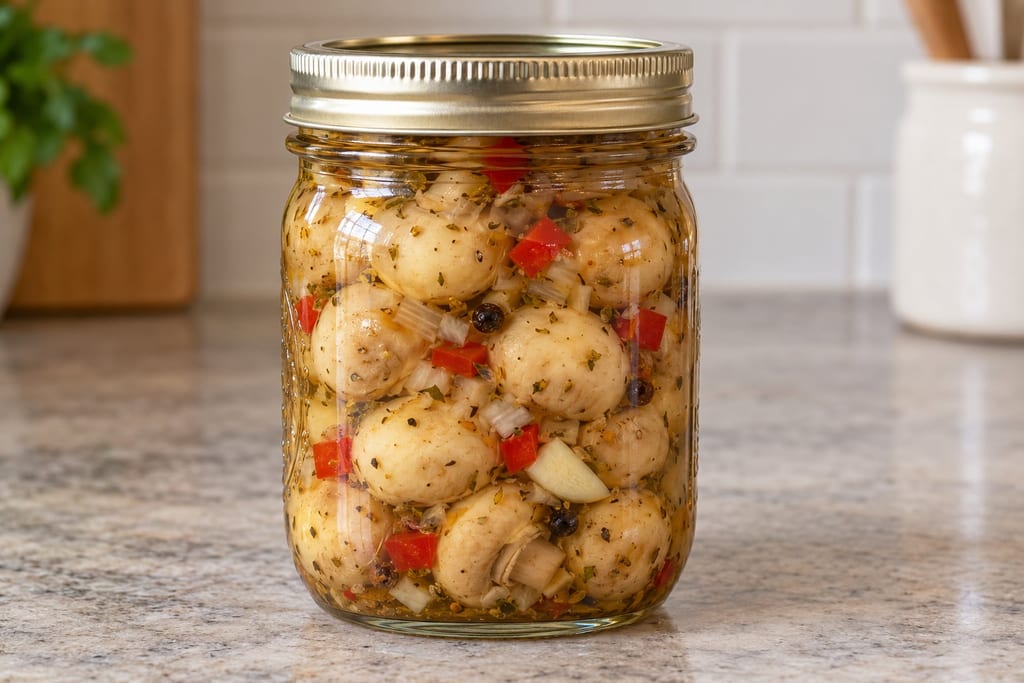
Small whole button mushrooms cooked in an acid and oil marinade and sealed in half-pint jars for shelf storage, using the tested US home-canning method.
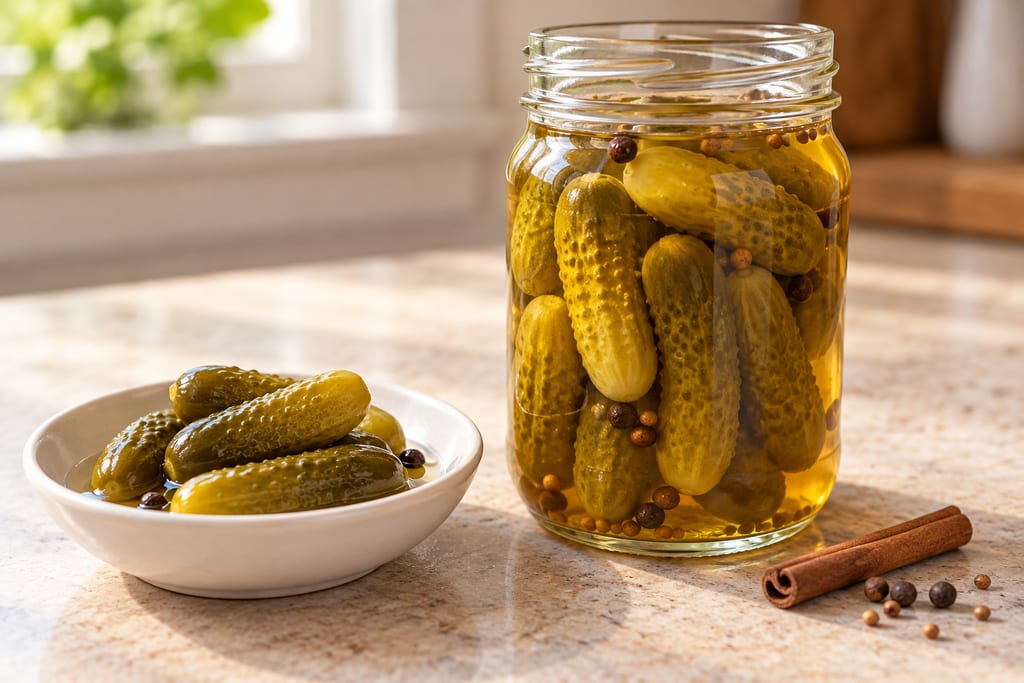
Sweet gherkin pickles are small whole cucumbers preserved in a spiced, sweet vinegar syrup. This four-day U.S. canning method uses repeated hot-water soaks, staged syrup additions, and a boiling-water process.
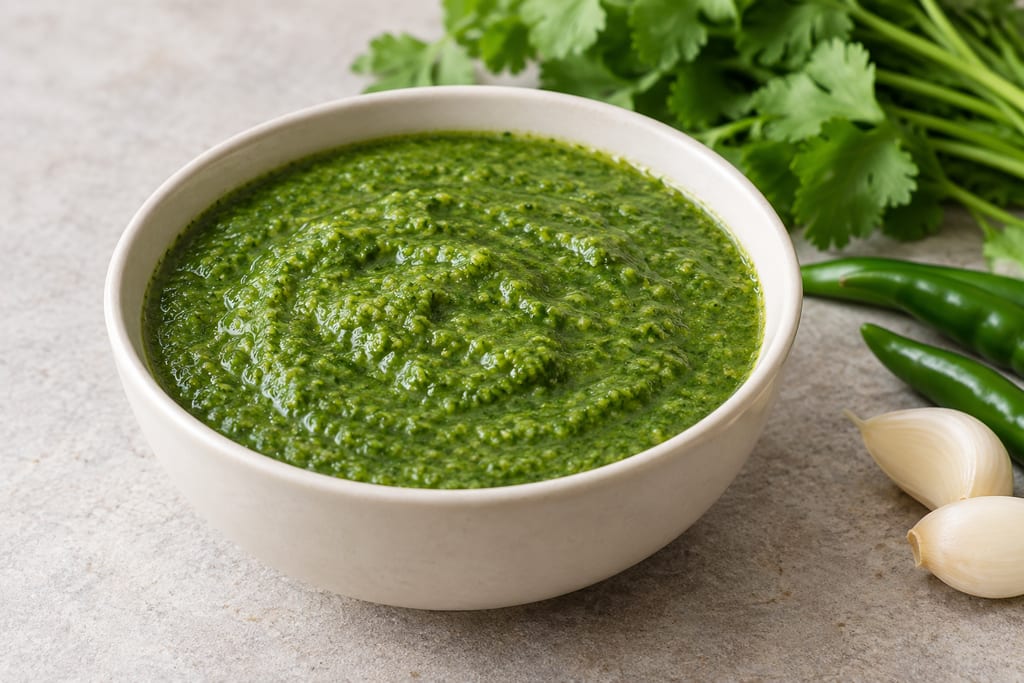
Afghan coriander chatni is a sharp, hot herb sauce with garlic and vinegar. A 2008 Afghanistan manual records green or red pepper and optional walnut; heat and household versions vary.
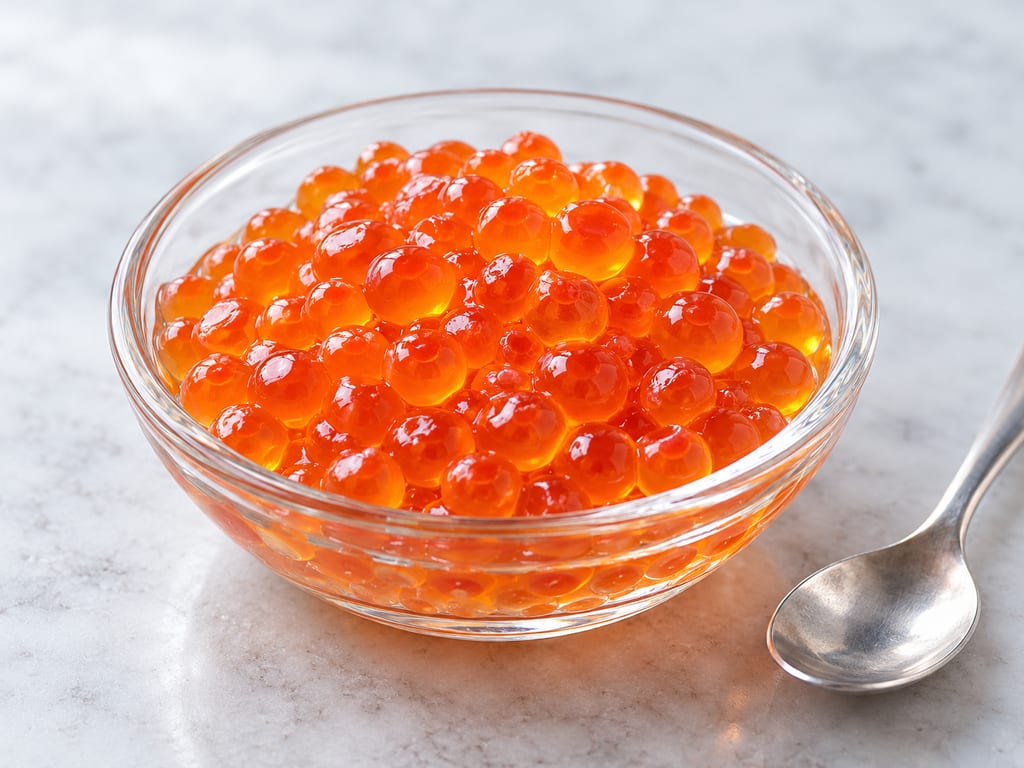
Salmon roe is separated from skeins and treated in two salt-water stages using a University of Alaska Extension formula.
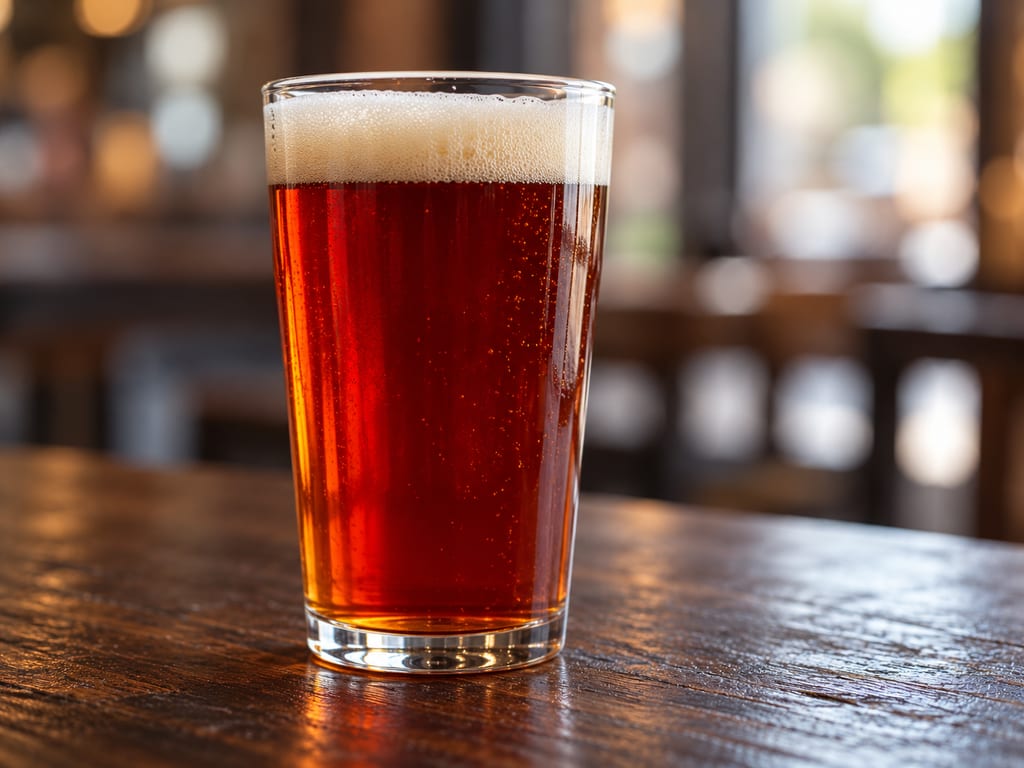
A deep amber-red American ale brewed from pale, Munich, CaraVienne and chocolate malts, bittered with Columbus hops and finished with Amarillo.

Kodiak salmon, halibut and cod cut as seg'aq and hung on an initaq rack to become tamuuq, with kac'amaasaq and kupcuunaq named as different results.
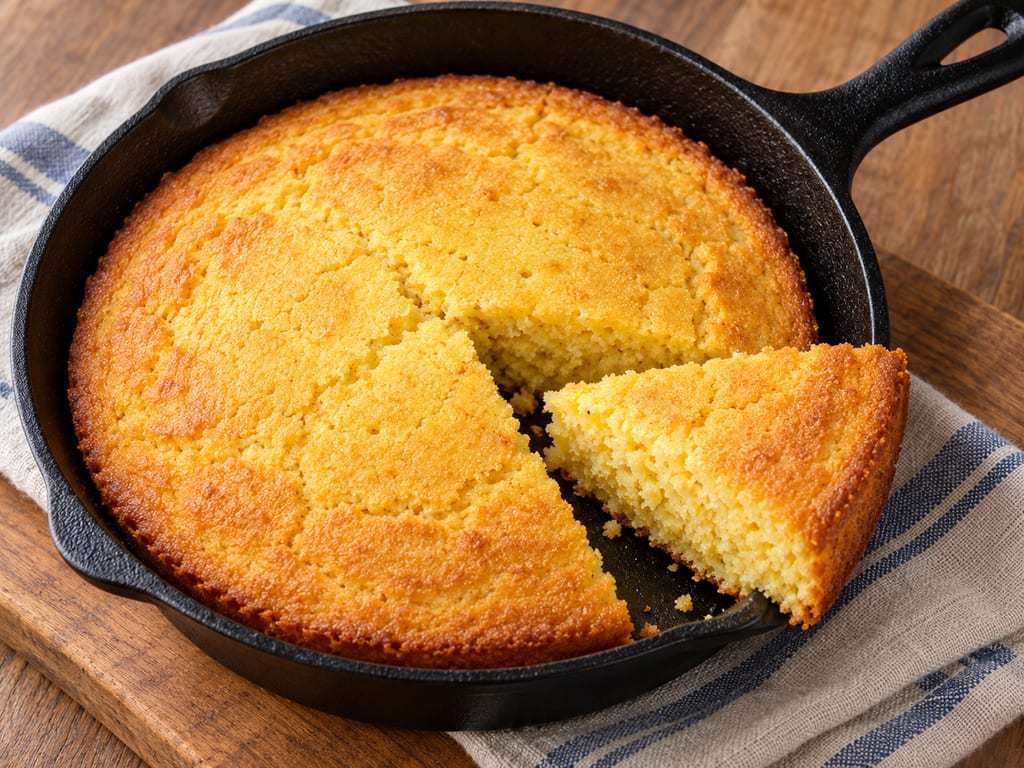
A modern cornmeal-and-wheat cornbread that King Arthur Baking describes as a compromise between Northern and Southern styles. The batter is baked in a pan or as muffins and served warm.
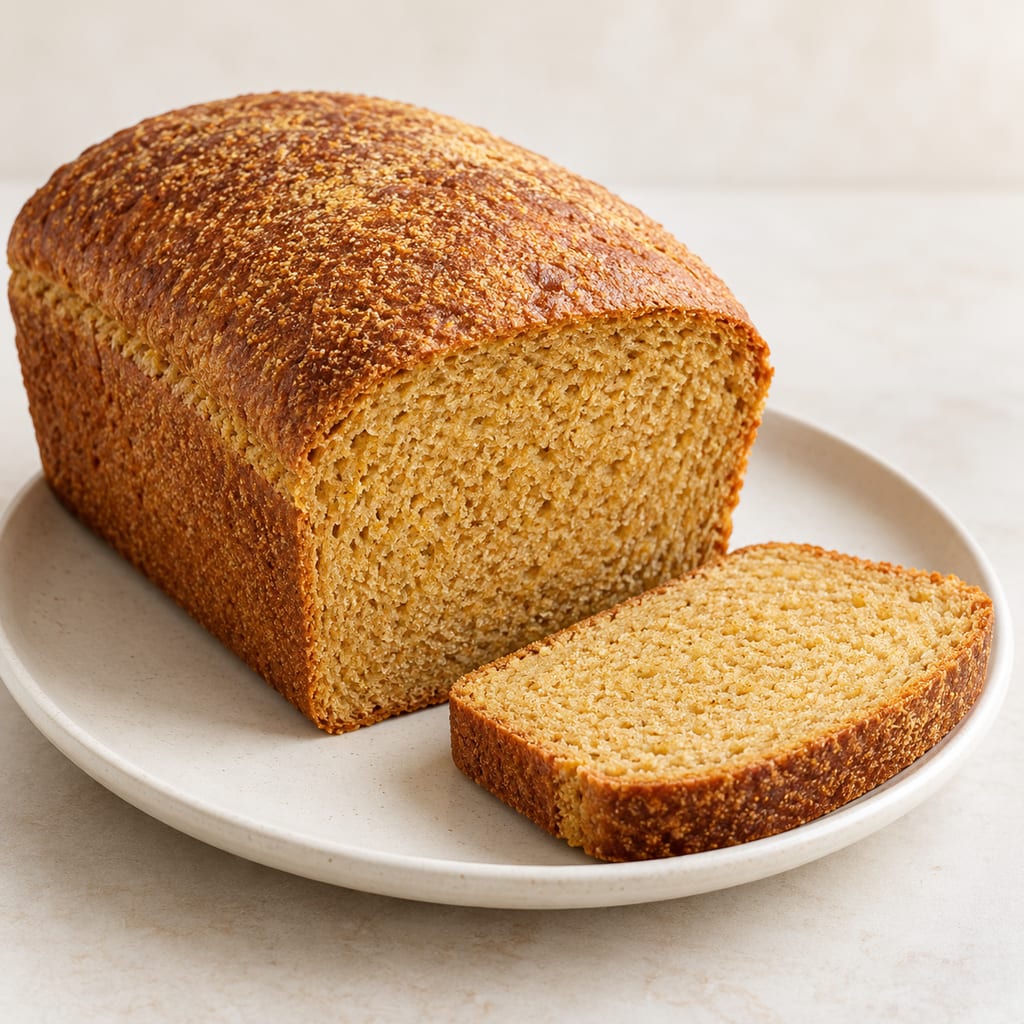
Anadama is a New England yeast loaf made with wheat flour, cornmeal and molasses. Scalded cornmeal enriches the dough, while molasses lends sweetness and a dark crust; it is especially good toasted or beside soup and baked beans.
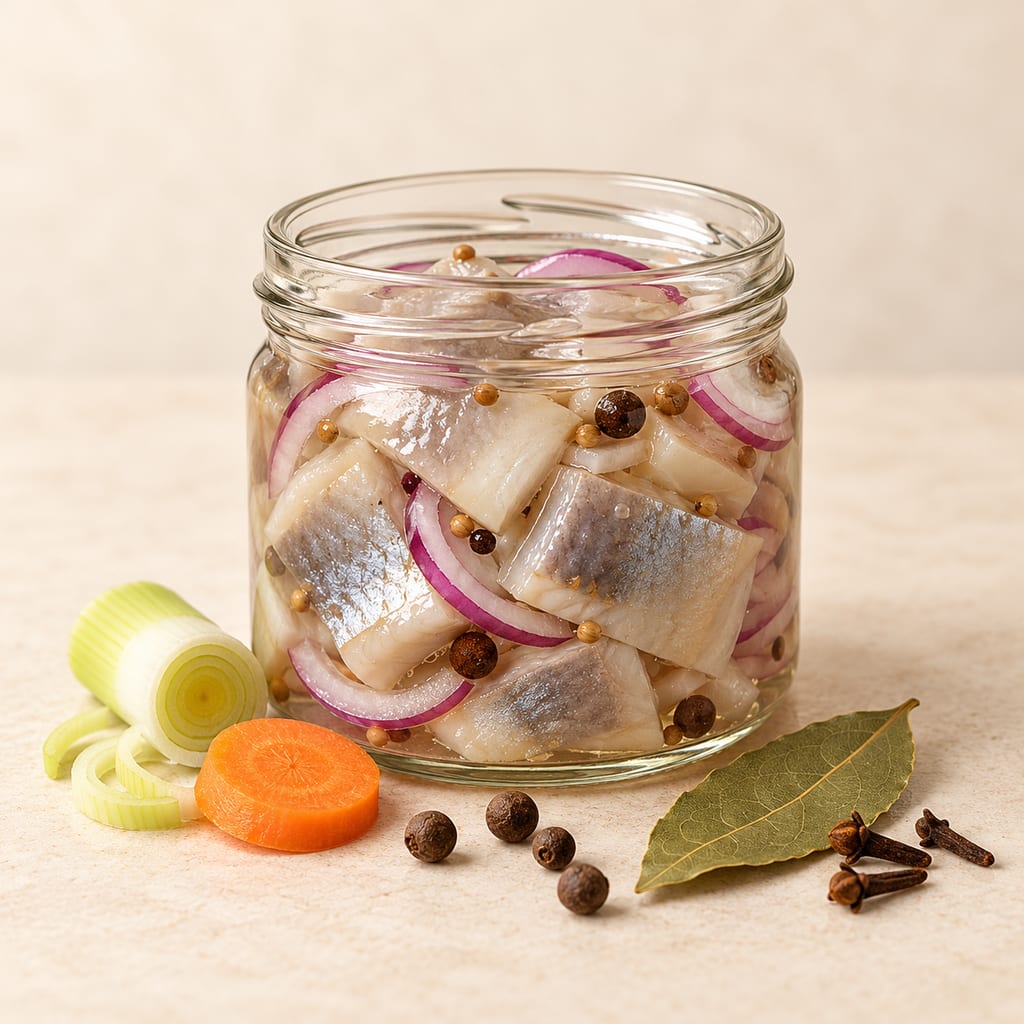
A Swedish ready-to-dress herring preparation: add the classic sliced aromatics and spices to already prepared herring, then serve or chill for fuller flavour.

Achcharu is a family of Sri Lankan vinegar pickles made with mixed vegetables or seasonal fruit and a piquant spice dressing. This version is a quick, refrigerated, non-fermented mixed-vegetable pickle.
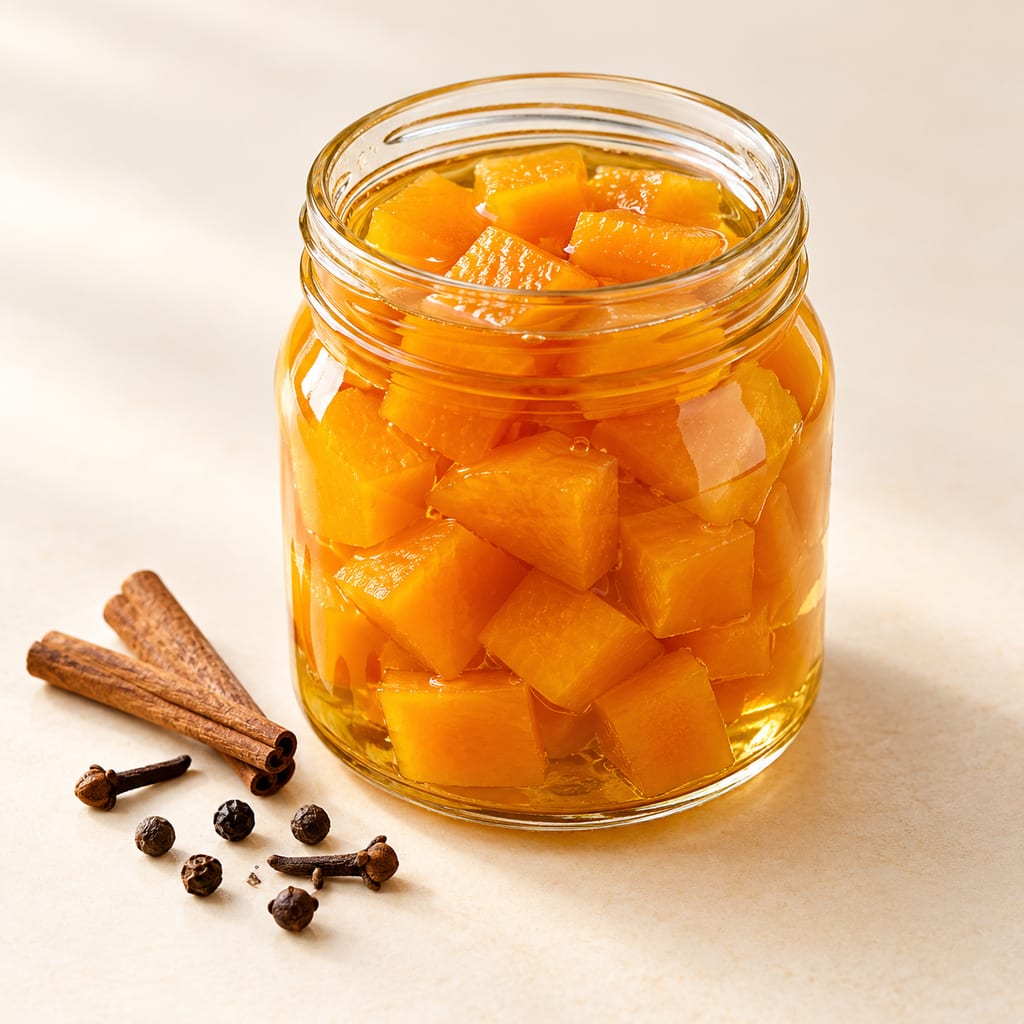
Ball sweet pumpkin pickles: Cupboard: exact published Ball formulation and water-bath process.
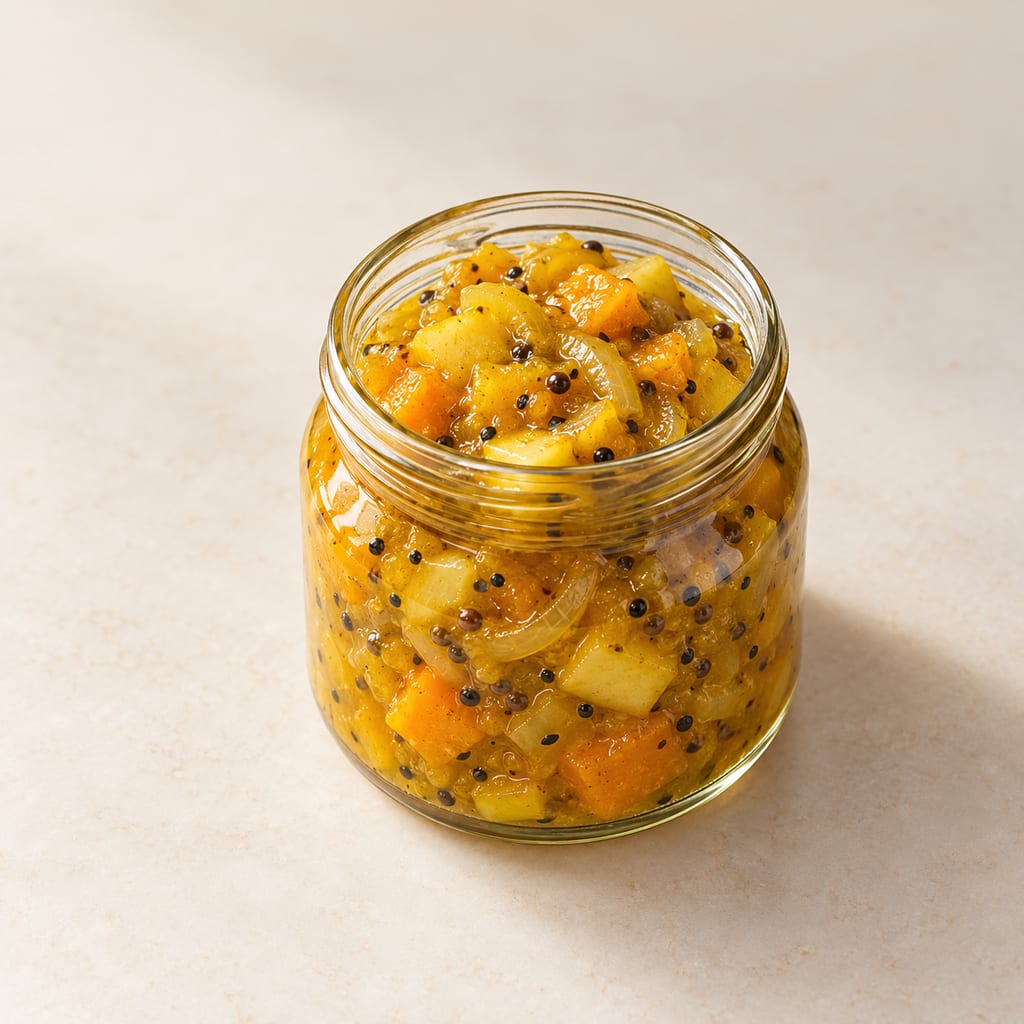
British pumpkin, apple and mustard pickle: Freeze for winter; small fresh portion refrigerated up to 48 hours.
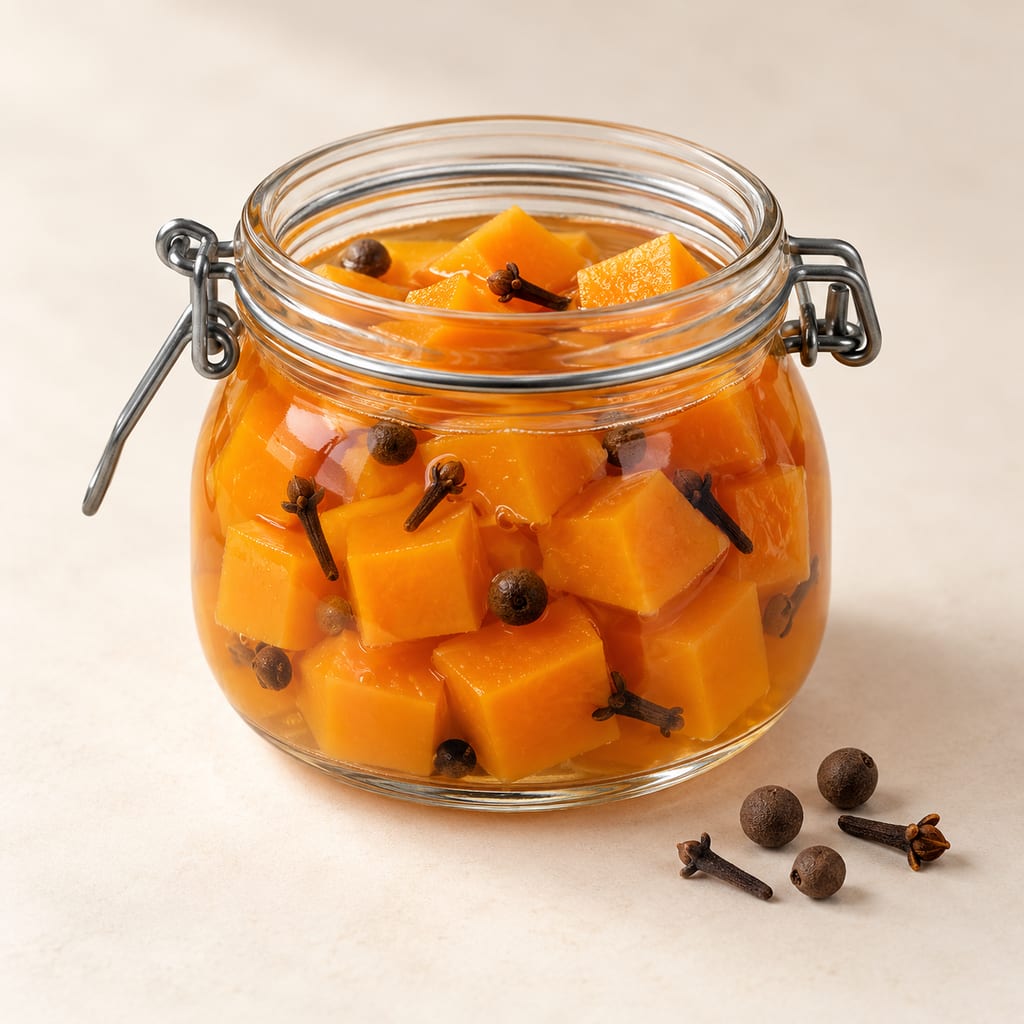
Dynia marynowana: Freeze for winter; small fresh portion refrigerated up to 48 hours.
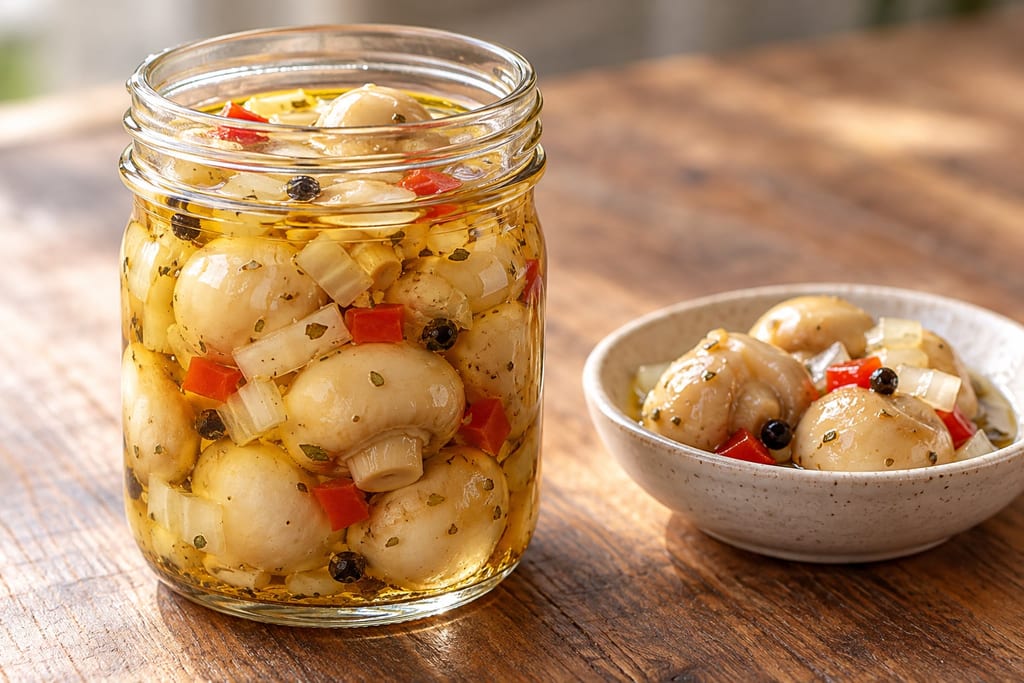
Small edible mushrooms are briefly cooked and packed in a seasoned vinegar marinade, a sweet-sour preserve served cold in Poland and neighbouring cuisines.

Fried or cooked food covered in a vinegar-based preparation, the heat and the externally supplied acid working together; a family of methods whose early form is a Roman instruction for treating fried fish with hot vinegar.
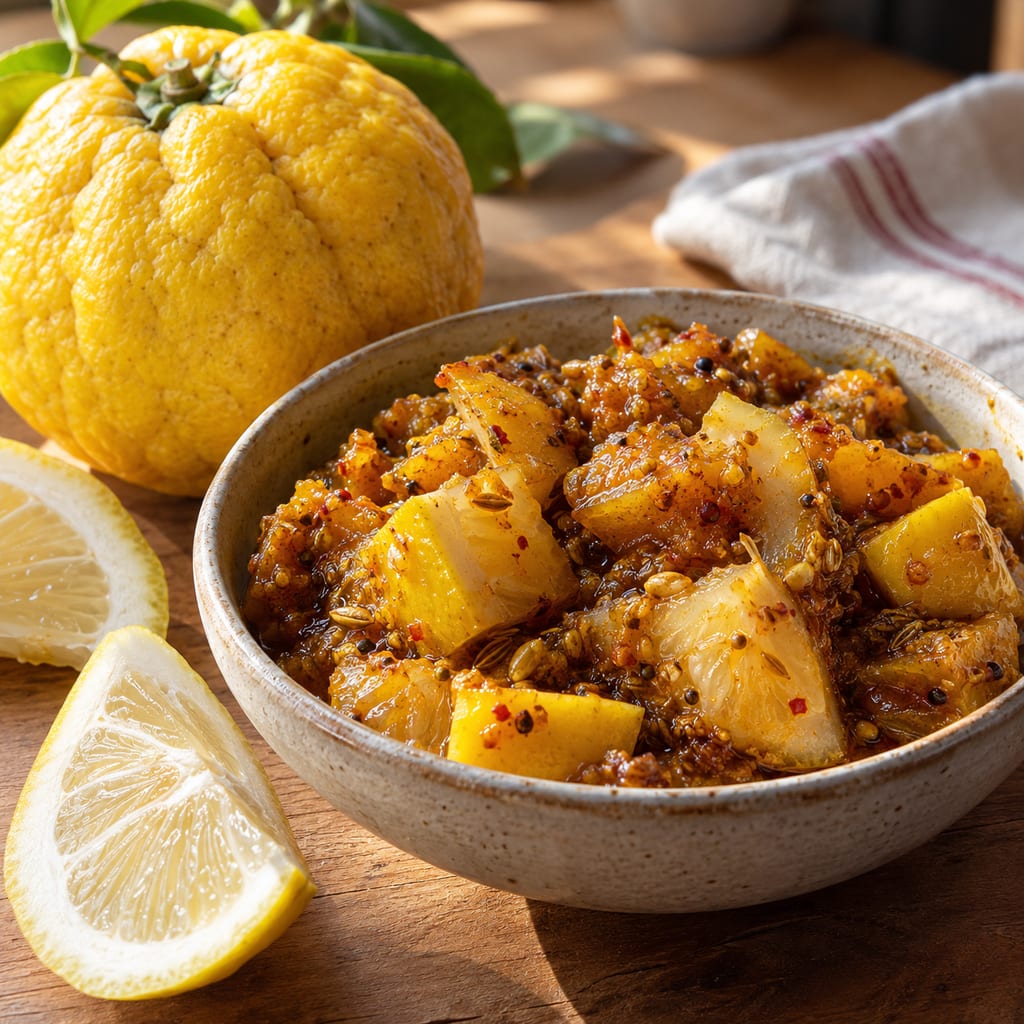
Ripe Himalayan galgal is boiled, sun-dried and cooked with mustard oil, spices and jaggery before a further rest in a ceramic jar.

Soft, spreadable Calabrian pork sausage made with a great deal of red chilli and fatty pork, stuffed into natural casings, sometimes smoked and matured while staying soft.

A way to add independent temperature logging to an existing food dehydrator without changing its built-in controls or protections. It is a monitoring method, not a rewiring plan.

Pleurotus cystidiosus is the abalone mushroom, a cultivated oyster-type fungus with dark brown caps that grows more slowly and is more demanding than other Pleurotus species.

A dark, balanced vinegar from Emilia-Romagna made by combining cooked or concentrated grape must with wine vinegar, then acetifying and refining it in wood under a protected specification.

A living dairy inoculum that starts controlled cream fermentation, developing acidity and aroma before sour cream or cultured butter is finished.

A small electric incubator holds jars at a selected temperature for yogurt and other documented warm food preparations. Controls, capacity and vessel arrangement vary by model.

Adygean salt is a seasoned table salt associated with Adygea and the wider North Caucasian culinary tradition. Salt is blended with garlic and a variable selection of herbs and spices; the exact mix depends on the named style and maker.

The African Caesar-group mushroom, Amanita masasiensis, is a wild ectomycorrhizal species of central and southern African woodlands, eaten locally. The genus contains deadly poisonous species, so identification needs care.
No community contributions have been published for this entry yet.
Sign in to contribute. Published comments and photos are free to read.
National Center for Home Food Preservation, University of GeorgiaTested recipe · Method · Ingredients · Yield · Process times
Quick Fresh-Pack Dill PicklesExact formula: 8 lb of 3–5 inch cucumbers; 2 gal soak water; 1¼ cups pickling salt divided between soak and brine; 1½ qt 5% vinegar; ¼ cup sugar; 2 qt water; pickling spice, mustard seed and dill; yield 7–9 pints.
Method: blossom-end trim, 12-hour salt soak, drain, heat measured vinegar brine to boiling, pack pints with dill and mustard seed, leave ½-inch headspace, process in a boiling-water canner using altitude-adjusted times of 10, 15 or 20 minutes for pints.
Cited in: The cucumber’s long journey, and the shorter history of this formula; Choosing cucumbers and understanding the ingredients; Why the stages are ordered this way; A family of styles, not one universal pickle; Serving, storage and reading the result
National Center for Home Food Preservation, University of GeorgiaMethod classification · Safety · Ingredients · Quality
General Information on PicklingFresh-pack or quick-process pickles are not fermented; some are soaked in brine, drained and covered with vinegar and seasonings.
Use only tested proportions and vinegar with known 5% acidity; uniform acidity matters for safety. Select fresh, firm produce and discard the blossom-end slice because blossoms may carry an enzyme that softens pickles.
Cited in: One word, several preservation routes; Choosing cucumbers and understanding the ingredients; Why the stages are ordered this way; A family of styles, not one universal pickle
National Center for Home Food Preservation; Brian A. Nummer, Ph.D.History · Preservation context
Historical Origins of Food PreservationThe origin of pickling is uncertain; the page proposes, rather than proves, preservation in wine or beer as a possible early route.
Vinegar results when bacteria oxidize alcohol to acetic acid; vinegar-based preserving is distinct from vegetable fermentation. The page describes a growth in European preservation and condiment forms in the sixteenth century, not a dated origin for this cucumber recipe.
Cited in: One word, several preservation routes; The cucumber’s long journey, and the shorter history of this formula
Economic Botany, via PubMed CentralCucumber history · Geography
Occidental diffusion of cucumber (Cucumis sativus) 500–1300 CE: two routes to EuropeThe authors distinguish cucumber (Cucumis sativus) from other cucurbits mistaken for it in older texts and images.
Lexical evidence places cucumbers in regions east and northeast of the Mediterranean by the sixth or seventh century; Arabic sources place them in Iberia by the ninth to tenth centuries. The paper proposes separate overland and maritime diffusion routes, with uncertainty retained.
Cited in: The cucumber’s long journey, and the shorter history of this formula
National Center for Home Food Preservation, University of GeorgiaIngredient quality · Method
Selection of Fresh CucumbersFresh, firm cucumbers are selected for pickle quality; blossom-end trimming is specified to reduce softening.
Cited in: Choosing cucumbers and understanding the ingredients
University of Georgia Cooperative ExtensionCanning method · Safety
Using Boiling Water CannersFor a raw pack, prepare canner water to 140°F before loading; keep water at least 1 inch above jar tops and maintain a complete boil for the full recipe time.
If boiling stops during processing, bring it back to a vigorous boil and restart the full original process time. After processing, let jars rest 5 minutes with heat off and lid removed, then cool undisturbed for 12–24 hours.
Cited in: Why the stages are ordered this way; Serving, storage and reading the result
National Center for Home Food Preservation, University of GeorgiaCooling · Storage · Safety
Cooling Jars and Testing Jar SealsCool processed jars without disturbance, then check seals; unsealed jars require refrigeration or a documented reprocessing procedure.
Cited in: Serving, storage and reading the result
USDA Agricultural Marketing ServiceProduct classes · Variation
United States Standards for Grades of PicklesUSDA distinguishes fresh-pack dill pickles and fresh-pack sweetened dill pickles as vinegar-packed products; it separately defines chopped relish.
Cited in: A family of styles, not one universal pickle