Gypsy mushroom
Cortinarius caperatus, formerly Rozites caperatus, is a wild food appreciated in northern Europe and parts of North America. Identification and contaminant risks require care.
 FermenteaWhere food goes to change
Modern adaptation
Grzyby marynowane · grzyby w occie · grzybki marynowane · marynowane borowiki · marynowane rydze · Nadbużańskie grzyby marynowane · borowik wielkopolski · маринованные грибы · мариновані гриби · vinegar-pickled mushrooms · marinated mushrooms · Polish pickled mushrooms
Small edible mushrooms are briefly cooked and packed in a seasoned vinegar marinade, a sweet-sour preserve served cold in Poland and neighbouring cuisines.
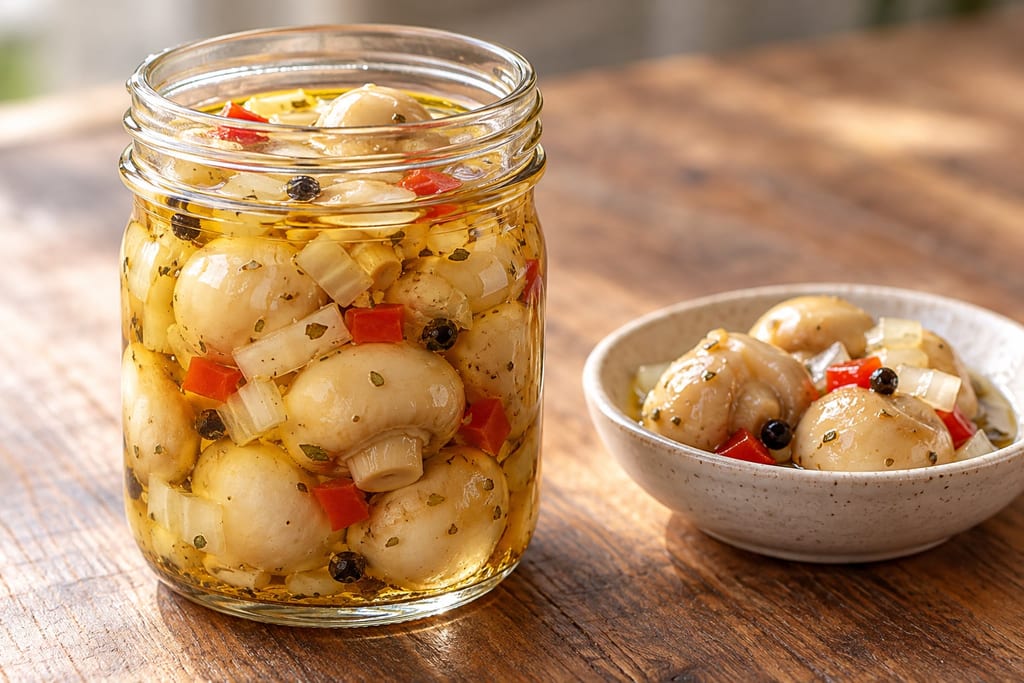
Grzyby marynowane are edible mushrooms cooked briefly and then held in a seasoned vinegar liquid. The result is firm but tender, sharp, faintly sweet and savoury, and it is eaten cold straight from the jar. Small mushrooms are preferred because they stay whole and look good on a plate; bigger ones are cut. Colour follows the mushroom and the marinade, anywhere from pale gold to dark brown.
No single species defines the dish. Polish State Forests names saffron milk caps (rydze, Lactarius deliciosus and relatives), slippery jacks (maślaki, Suillus), porcini (borowiki, Boletus edulis) and chanterelles (kurki, Cantharellus) as the usual woodland candidates, and cultivated button mushrooms, Agaricus bisporus, are common in modern kitchens. Species matters because firmness, flavour and handling differ from one to the next. The Polish name describes a method, not a particular fungus.
The usual components are mushrooms, vinegar, water, salt, sugar and whole spices, with onion, bay leaf, black pepper, allspice and mustard seed the most typical. The acid is added in the vinegar; nothing ferments. That sets it apart from grzyby kiszone, mushrooms soured by lactic fermentation, and from grzyby solone, mushrooms kept under salt. English-language writing blurs the three, but the chemistry and the risks are different.
A second distinction matters just as much. A refrigerated marinated mushroom is a cooked food in an acid dressing, kept cold and eaten within a limited time. A shelf-stable jar is a different product: its formulation and heat treatment must have been tested so that the acid reaches the centre of every piece. They can look the same on a table. A sealed lid, a sour taste or a family recipe that says the jars last all winter proves nothing about which of the two you are holding.
Poland's register of traditional products recognises several regional versions inside this family. Nadbużańskie grzyby marynowane, from the Bug River region, are described as soft, a little slippery and sweet-sour. Borowik wielkopolski, from Greater Poland, is a narrower preparation: small porcini in a nearly clear marinade in which the mushroom flavour stays in front. These are regional styles of one method, not separate kinds of fermentation.
Gathering wild mushrooms in the forests of Central and Eastern Europe is old, but that fact does not date vinegar pickling. Mushrooms were eaten fresh, dried, salted, soured and cooked long before anyone put them in vinegar, and evidence for one practice does not establish another. How long Poles have eaten mushrooms is therefore a poor guide to when they began to marinate them.
Poland's Ministry of Agriculture, in the entry for borowik wielkopolski, describes a progression from drying, cooking and souring towards vinegar marinades, and places those marinades in the sixteenth and seventeenth centuries, first in noble households and later on farms as vinegar production and small-scale food making spread. It also describes earlier preserves made with strongly acidic solutions, followed by milder, heat-processed jar methods. This is a retrospective account. No recipe or household inventory from those centuries survives to confirm it, so the dating is the register's claim and not an established fact.
The earliest specific record is much later. In 1877 Maria Ilnicka reported in the Polish periodical Bluszcz on a women's work exhibition and listed pickled mushrooms among the preserves shown by the cookery writer Lucyna Ćwierczakiewiczowa. It shows that grzyby marynowane were a recognisable prepared product by then. It says nothing about who first made them, which mushrooms were in the exhibited jars or how they were processed. Ćwierczakiewiczowa's first preservation manual appeared in 1858, which fits a mid-century culture of printed household instruction and bought vinegar; dates placing her recipes earlier in the century should not be repeated for this dish.
Interwar sources are more detailed. A booklet on mushroom dishes and preserves published by the Bluszcz company between 1927 and 1939 gives instructions that start from young, firm mushrooms cooked with onion, pepper, allspice, cloves, bay leaf and vinegar. It also shows that older household preserving could include a covering of oil and chemical preservatives, practices that no modern guidance supports.
Modern official recognition is precise. Borowik wielkopolski was entered on Poland's list of traditional products on 28 February 2006, Nadbużańskie grzyby marynowane on 28 July 2009, and a Western Pomeranian version made with honey and green pine cones on 8 June 2011, whose local account begins in 1955. These are administrative dates, not inventions, and they do not mean other families were not making something similar.
The control is acidity, backed by heat and cold storage. Vinegar is a dilute solution of acetic acid, CH3COOH. Fresh mushrooms are a low-acid food, and low-acid, moist, nutrient-rich food in a sealed container is where unwanted microbes thrive. A vinegar pickle does not encourage a useful fermentation; it makes the food a poor place for harmful organisms.
Acetic acid works through more than the pH number. Some of it stays undissociated in the liquid, and in that form it passes into microbial cells. Inside, where the pH is higher, it releases protons and acetate. The cell then has to spend energy pumping protons out, and enzymes and metabolism are disturbed. How well this works depends on the acid concentration, the pH, the organism and the temperature. Acid-tolerant yeasts and moulds can still grow in a weakly acidified jar.
The acid has to get into the mushroom. What counts is the equilibrium pH of the finished food, not the pH of the freshly mixed liquid. Mushrooms contain water and buffering compounds, and they trade material with the marinade until the two settle. Cut size, cooking, the ratio of liquid to solids and how hot the jar is packed all change where they settle. University of Minnesota Extension makes these points and gives no universal ratio of vinegar to mushrooms, because none exists.
The organism that sets the safety limit is Clostridium botulinum, an anaerobic, spore-forming bacterium found in soil. Its spores survive ordinary boiling, and in a low-acid, airtight, moist food they can germinate and make botulinum neurotoxin. Acidification prevents that growth. Canning guidance treats an equilibrium pH of 4.6 as the dividing line between low-acid and acidified foods. It is a control threshold for this one hazard, not a statement that everything below it is harmless.
Salt and sugar mostly season the pickle. Salt moves water by osmosis and sugar softens the vinegar's edge, but the amounts used in sweet-sour mushroom marinades should not be assumed to preserve anything on their own. Bay, pepper, allspice, mustard seed and onion add aroma and are not validated antimicrobials. No amount of spice makes up for too little acid.
Heat does two jobs that are easy to confuse. Boiling the mushrooms first softens the tissue, loosens soluble material into the cooking water and prepares the pieces to take up the marinade. Processing the sealed jar later is a separate step, designed to destroy organisms in the jar and to reach a defined result. The tested conditions in the American recipe below belong to that complete formulation and do not transfer to another mushroom or a different marinade.
Everything starts with selection. Small, firm, undamaged mushrooms hold their shape through cooking and fit a jar. Old or damaged ones are poor material. A wild mushroom has to be positively identified before it enters the pot, because vinegar and heat do not neutralise the toxins of poisonous species; Poland's Ministry of Agriculture says outright that long processing cannot be relied on to remove them. Where a mushroom was picked also matters, since fungi can accumulate environmental contaminants.
The mushrooms are then cleaned of soil and forest debris and left whole, with the stems shortened, or cut. Washing lowers visible contamination but does not remove bacterial spores. When a tested recipe specifies a cap size or a trim, the reason is acid penetration and even heating, which depend on the dimensions of each piece.
In the Polish household method recorded by State Forests, the mushrooms are boiled separately for 10 to 15 minutes and drained. This softens them, removes some of their own liquid and stops that liquid from thinning the marinade. The interval belongs to that recipe; it is not a validated treatment for every species.
The marinade combines vinegar, water, salt, sugar and aromatics. Vinegar supplies the acid, water tempers its sharpness, salt seasons and draws water, sugar rounds off the sourness, and onion adds sweetness. Whole spices flavour the liquid without clouding it. The State Forests recipe uses one part vinegar to three or four parts water and brings the cooked mushrooms and the marinade back to the boil together. It does not state the vinegar's strength, the weight of mushrooms or a final pH, so the ratio records how the dish is made at home and does not amount to a safe canning formula. Adding carrot, garlic or other low-acid vegetables changes the formulation, which matters whenever the jar is meant to be stored.
Then comes time. The mushrooms take on the marinade's flavour over days, and the household recipe lets them rest before eating. Waiting improves flavour but never replaces enough acid or refrigeration.
The only fully quantified recipe is the tested one from the National Center for Home Food Preservation, adapted from the USDA guide, and it is the method given with this recipe. It is American, not a traditional Polish formula. It uses small mushrooms with caps under 1¼ inches, simmers them for 5 minutes in water with bottled lemon juice, then packs them hot with a boiling oil, vinegar and herb mixture into half-pint jars with ½ inch of headspace, and processes them in a boiling-water canner for a time that rises with elevation. The oil is part of this tested acidified system. It does not mean mushrooms can safely be kept in plain oil. Taking its processing time for a Polish marinade, or its marinade for a different mushroom, voids the testing.
Variation begins with the mushroom. Borowik wielkopolski, in Greater Poland, is described as selected small porcini kept whole in a nearly transparent marinade, firm, with a clear porcini taste and a restrained sweet-sour edge. It is the opposite of a chopped, heavily dressed mixture.
Along the Bug River in Podlasie, Nadbużańskie grzyby marynowane covers a wider family. The official description allows different species, sizes and looks, and names a sweet-sour taste with clear vinegar sharpness and a gentle sweetness from the mushrooms. Local households vary the sugar and the vinegar strength and sometimes add paprika or garlic. Those are reported differences in practice and say nothing about whether a given jar is shelf-stable.
In Western Pomerania, grzyby marynowane z szyszką are pickled with honey and green pine cones. The local account begins in 1955 and describes a recipe passed between relatives and neighbours. The result is sweeter and less sharp than the usual jar and carries a resinous aroma. Preferred mushrooms include porcini, bay boletes, slippery jacks and Leccinum boletes. The pine cone belongs to this regional variant and is not part of Polish pickled mushrooms in general.
In the Low Beskids around Uście Gorlickie, saffron milk caps are the seasonal mushroom, and official documentation lists many ways of preparing them: fried, marinated with honey, soured. It links the local spread of marinating and souring them to the interwar period. The vinegar and fermented versions there are different processes and should not be merged.
Names mislead across borders. Russian маринованные грибы and Ukrainian мариновані гриби both mean marinated or pickled mushrooms, but sharing a word does not mean sharing a recipe or an origin. A modern Russian-style jar of marinated shiitake is a modern adaptation with a cultivated Asian mushroom and not evidence that shiitake belong to the old woodland tradition. Salted and lactic-soured mushrooms, common across the same region, are separate foods. Identify a preparation by what is in the jar and how it was made.
Vinegar-pickled mushrooms are served cold as an appetiser or relish. In Polish cooking the little whole mushrooms are lifted from the jar and set out on a plate with no further cooking. They supply acid, salt, spice and a bite that most vegetable pickles lack, and the sharpness cuts through cold meats and rich food.
The Ministry of Agriculture describes the Bug River pickles as a snack and accompaniment at family celebrations and holidays, naming Christmas Eve and Lent. Mushrooms are valued in Polish cooking for meat-free soups, fillings and fasting dishes, but that does not make every festive mushroom dish a pickled one; dried and cooked mushrooms have their own roles. In Greater Poland, pickled porcini are described as festive rather than everyday food, served with meat and at family gatherings where drink was poured. Small perfect caps suited serving on their own because they kept their form in the jar.
Modern kitchens put them on cold buffet plates, in sandwiches and in salads, and alongside potatoes, cheese or cured meat. These are present-day uses and not documented historical recipes. The marinade is usually too sharp and salty to use as a sauce undiluted, and a commercial product's label is the guide to storage after opening.
Texture depends on the mushroom. Young porcini stay meaty, saffron milk caps keep their own flavour and colour, chanterelles come out small and irregular, and slippery jacks stay soft and slick. The Bug River description counts softness and a slippery feel as normal for that product, so a pickled mushroom should be judged against its own type and not against a rule that all pickles must be crisp.
The vinegar jar is not a source of live cultures. Vinegar pickling should not be described as probiotic, and heat-processed commercial jars exist to preserve, not to keep microbes alive.
A good jar matches its own recipe. Small mushrooms mostly hold their shape, firmness varies with species and cooking, and the liquid may be clear or tinted by the spices. A soft or slightly slippery mushroom is not necessarily spoiled, and a clear liquid in a handsome jar does not show that the contents are safe.
First decide what the jar is: a refrigerated pickle or a tested, canned product. A low pH reading in the liquid does not show that the centre of a whole mushroom has reached the same pH, and no universal safe ratio of vinegar to mushrooms exists. A very sharp taste usually means too strong a marinade, and mushy texture means too much cooking. The National Center for Home Food Preservation lists weak vinegar, mouldy ingredients, unsuitable equipment and improper processing among the causes of pickle problems.
Gas, leaking, a swollen or loose lid, visible mould, odd colour or an off smell are reasons to throw the jar away, not to taste it. The reverse is not reassuring: the CDC points out that botulinum toxin cannot be detected by sight, smell or taste, so a jar that looks and smells normal can still be dangerous when its process is in doubt. The United Kingdom Food Standards Agency gives the same advice about damaged jars and untested methods.
Botulism is the main severe hazard for low-acid mushrooms sealed in airtight containers. Acidified canned foods need a tested formulation and process, and a good pH reading alone does not validate a home-invented one. Ordinary boiling-water canning is no substitute for approved pressure canning of unacidified mushrooms.
Mushrooms under oil need separate care. Oil limits oxygen without making the wet interior of a mushroom safe, and Health Canada identifies mushrooms in oil as a botulism concern that needs validated controls. The tested American recipe contains oil, but also fixed acid, fixed quantities, fixed jar size and a fixed thermal process. It does not license an improvised mushroom-and-garlic oil preserve.
A traditional description with no stated acidity or processing schedule should be read as a record of how a household cooks, not proof that the method meets modern food-safety rules. Jars of uncertain history or seal are discarded, not reboiled or tested by tasting.
Poland's traditional-product register dates vinegar mushroom marinades to the sixteenth and seventeenth centuries, but no original recipe from those centuries was found. The earliest specific attestation is a report by Maria Ilnicka in the periodical Bluszcz in 1877, which lists pickled mushrooms among the preserves exhibited by Lucyna Ćwierczakiewiczowa. Registration dates (2006, 2009, 2011) are administrative milestones, not invention dates.
Yield 9 half-pint jars
Fresh mushrooms are low-acid. Improperly acidified or processed mushrooms sealed airtight can allow spores to germinate and make toxin; spores survive ordinary boiling.
Hazard sourceOil limits oxygen while the mushroom keeps its moisture. Health Canada requires validated controls for mushroom products in oil; the oil in the tested recipe does not validate home oil-packing.
Hazard sourceThe acid must reach the mushroom tissue. The strength of the liquid alone does not give the finished equilibrium pH, and changing quantities changes the result.
Hazard sourceToo little processing time, the wrong jar size or ignoring elevation can leave an unsafe product. Hot filling or inverting a jar does not replace the thermal process.
Hazard sourceSome toxins are not destroyed by cooking, acid or preservation. Do not preserve a mushroom whose identity is uncertain.
Hazard sourceDamaged containers or poor storage allow spoilage. Toxin-containing food can look, smell and taste normal.
Hazard sourceUse the complete tested recipe without changing proportions or mushroom type
Control sourceUse vinegar of sufficient strength
Control sourcePrepare the mushrooms as specified
Control sourceUse the specified jar size and headspace
Control sourceProcess in a boiling-water canner for the elevation
Control sourceHold acidified foods to the recognised botulism threshold
Control sourceDiscard doubtful preserved food
Control sourceThis tested recipe is American. It is not a traditional Polish sweet-sour marinade and must not be presented as one.
The traditional Polish household formulas on this page (vinegar to water 1:3 to 4, a 10 to 15 minute boil) are not validated for shelf-stable canning.
Do not carry the processing time to another mushroom, a different vinegar strength or different proportions of oil and acid.
Do not swap in wild mushrooms without a validated procedure for that product.
Do not keep mushrooms in plain oil or rely on oil as a seal.
Refrigerate opened jars.
A country-level attestation: pickled mushrooms were a recognised preserve in Poland by 1877.
Regional style, not a claim of origin.
Regional style of small whole porcini; not a claim of origin.
The pine-cone and honey variant.
Cortinarius caperatus, formerly Rozites caperatus, is a wild food appreciated in northern Europe and parts of North America. Identification and contaminant risks require care.
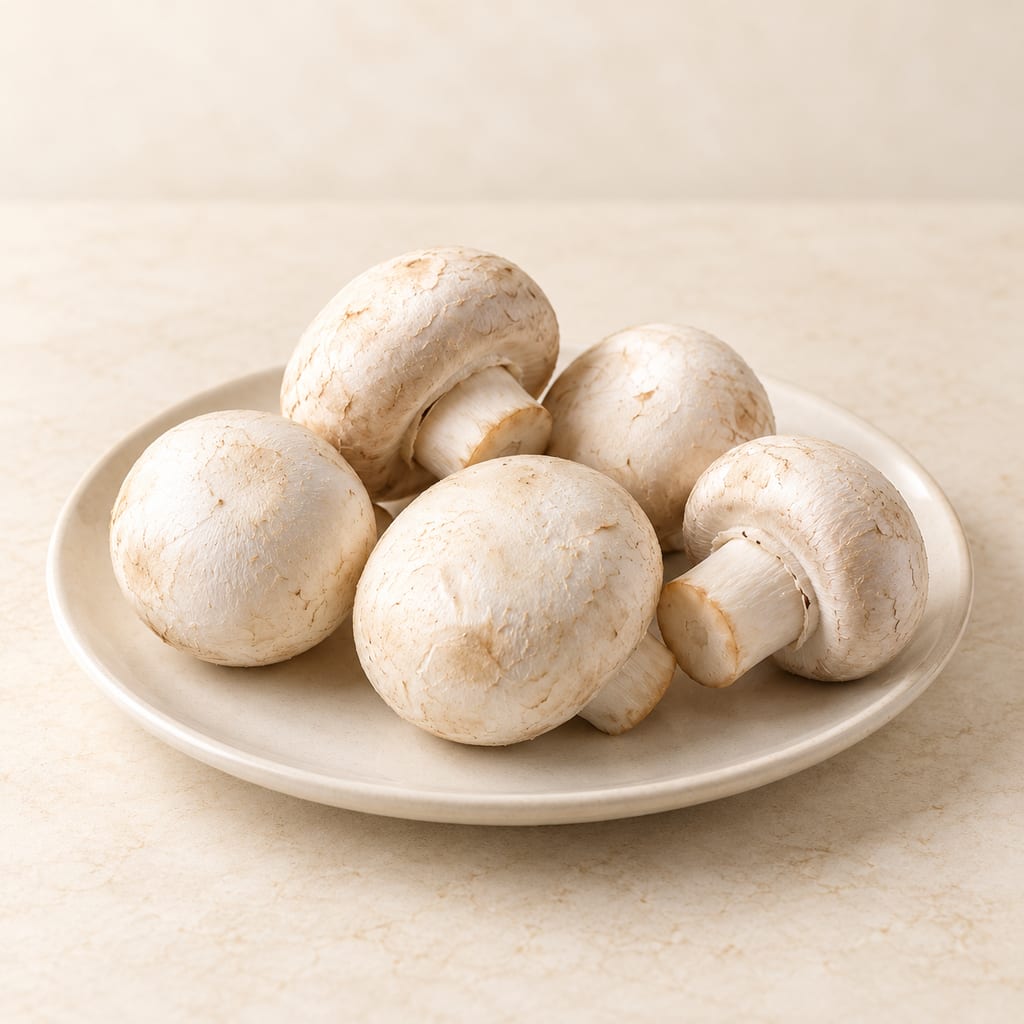
Mushrooms are the edible fruiting bodies of fungi, cultivated or gathered, and each species has its own texture, aroma and handling needs. Fresh, dried and roasted forms differ in water and in flavour compounds.
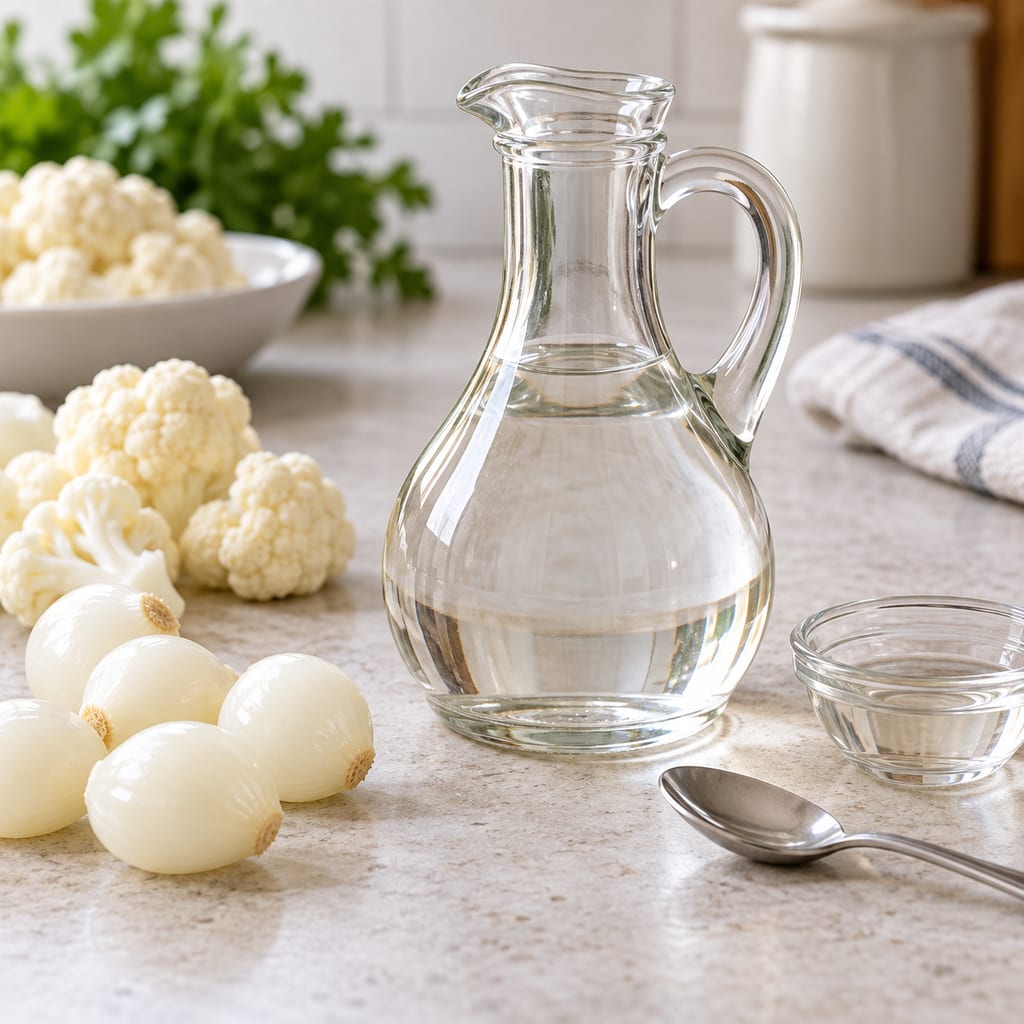
A clear, sharp vinegar made by acetifying alcohol. Its restrained color and aroma suit pickles, sauces and dressings where darker or more aromatic vinegars would change the result.
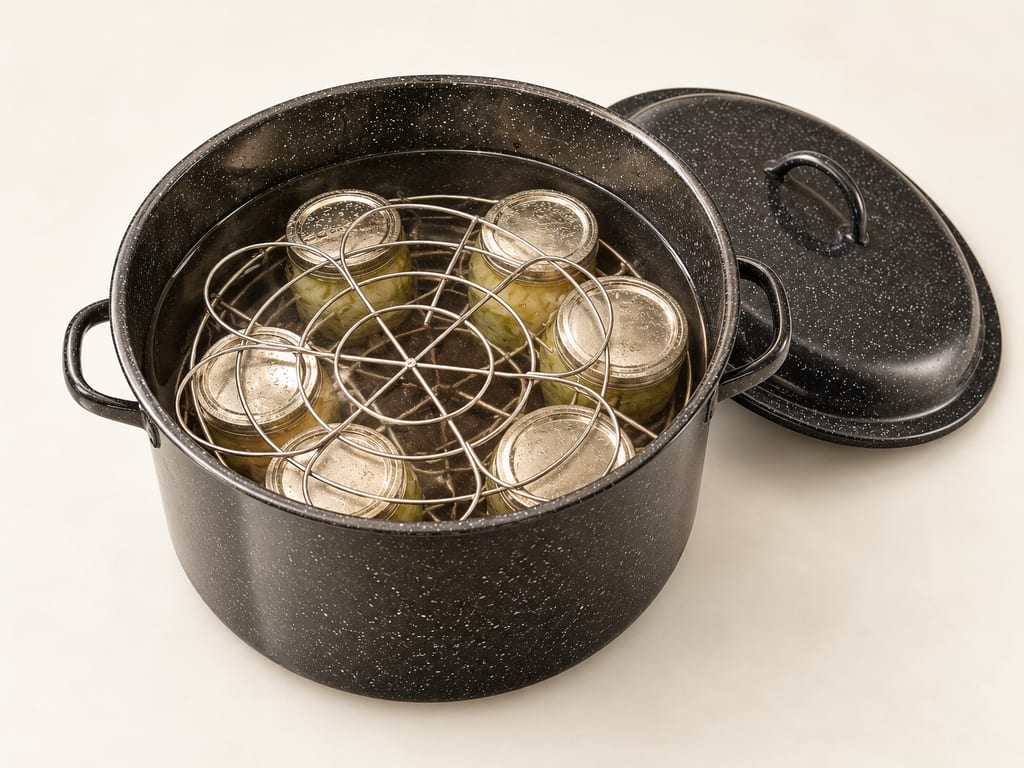
A deep, lidded pot with a removable rack processes jars beneath boiling water. It is intended for foods with tested boiling-water processes; low-acid foods require pressure canning.
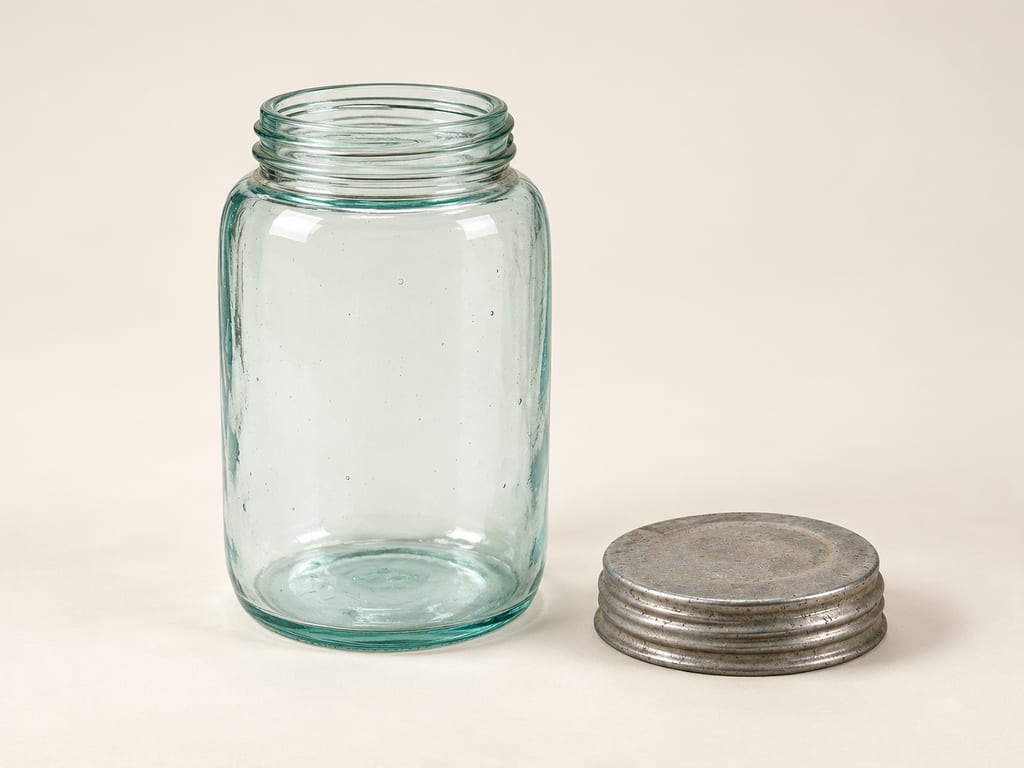
Threaded, heat-processing jars hold food and a fitted lid during a tested canning process; jar size and process belong to the specific recipe.
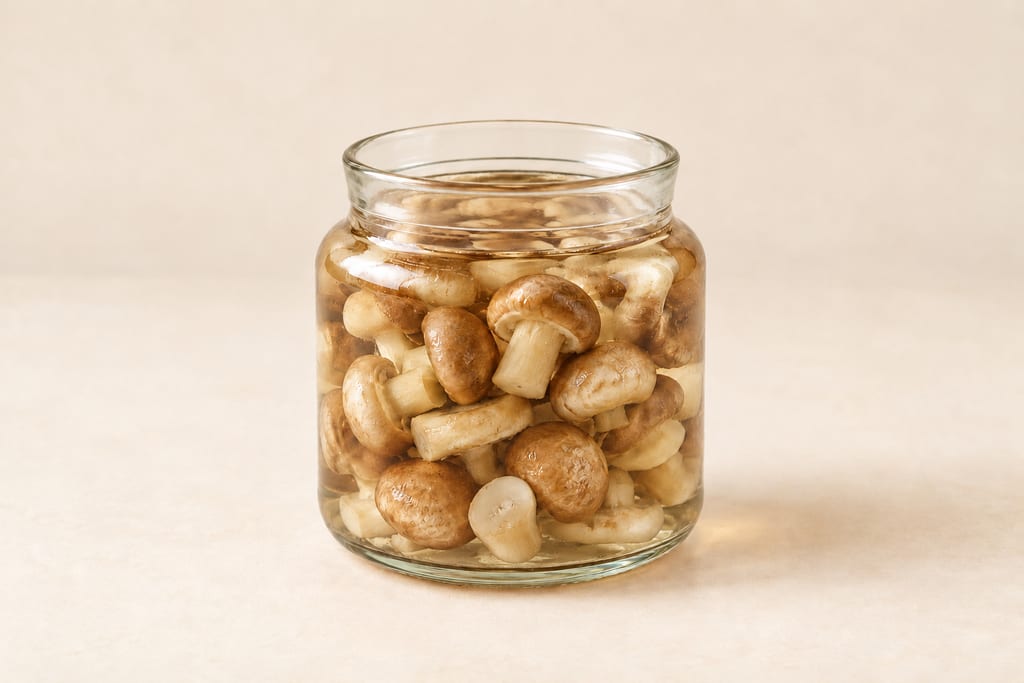
A clean, heat-tolerant food jar holds hot ingredients or liquor when a method calls for it. Its temperature limits depend on its design and maker; a jar does not make food shelf-stable.
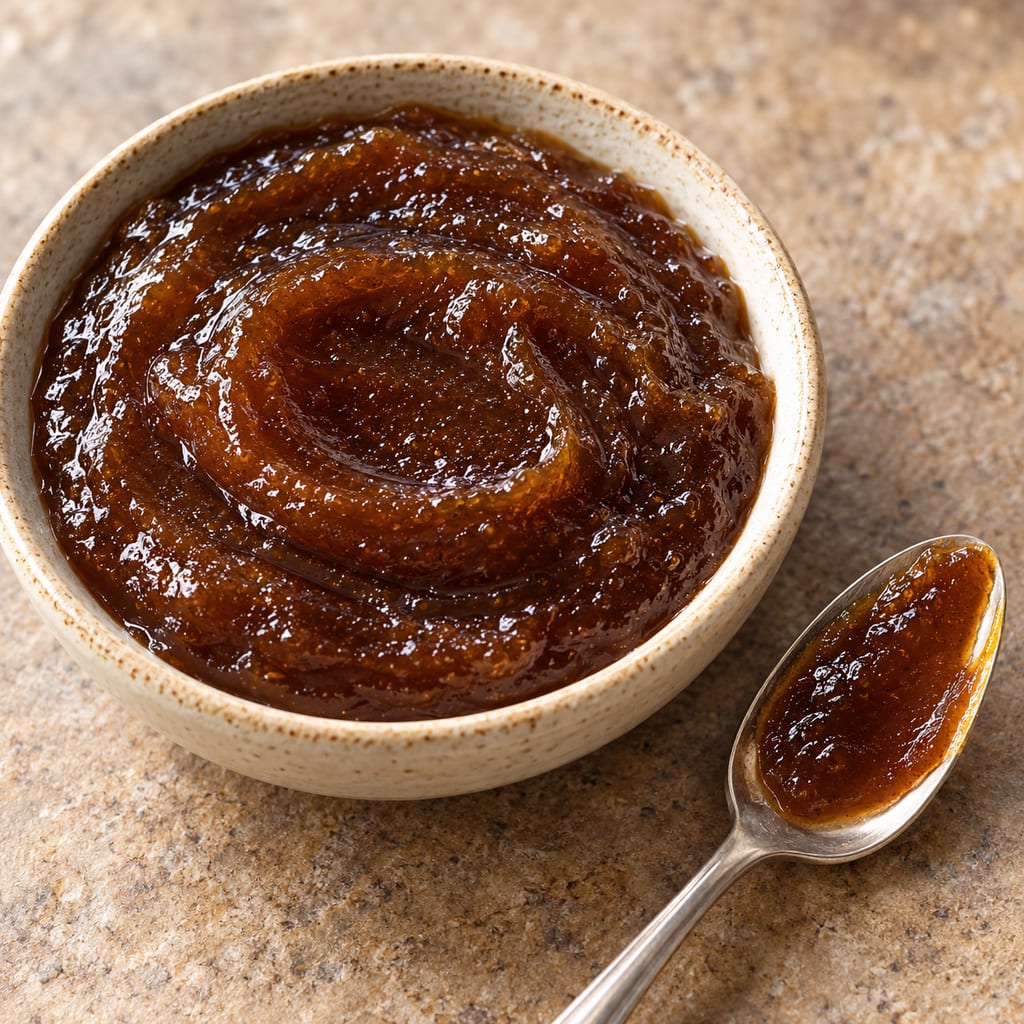
An experimental sweet mushroom preserve developed in Indian food-processing research, made by cooking mushroom pulp with sugar, added pectin and citric acid until concentrated into a thick, spreadable jam.

Salted mushrooms are a traditional wild-mushroom preserve, especially of Finnish and Russian milk caps, made by layering boiled mushrooms with coarse salt or keeping them under brine, and kept cold.
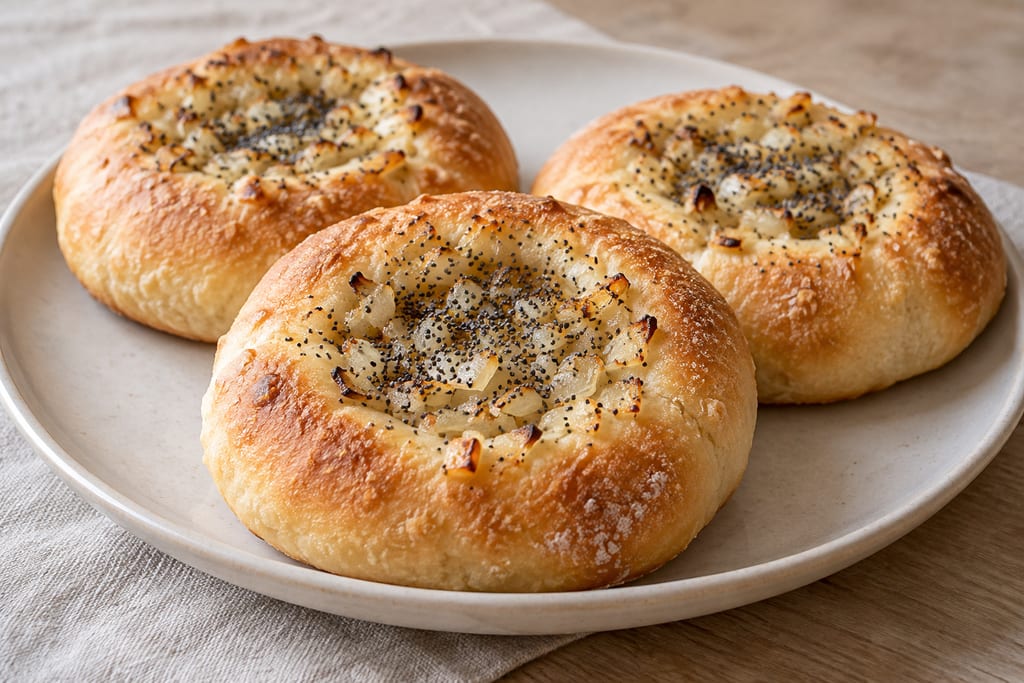
Bialys are soft, yeasted wheat rolls baked without boiling, each shaped with an onion-filled central depression instead of a hole.
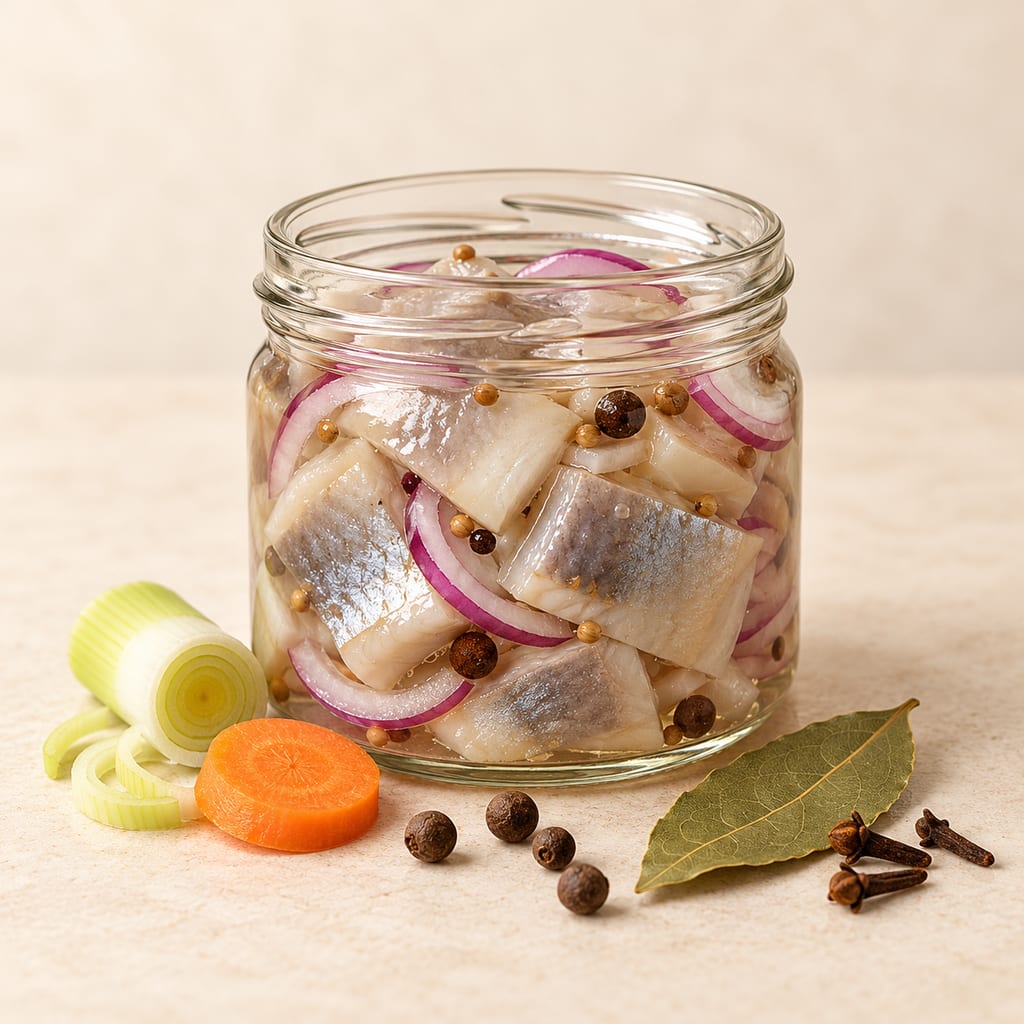
A Swedish ready-to-dress herring preparation: add the classic sliced aromatics and spices to already prepared herring, then serve or chill for fuller flavour.

Achcharu is a family of Sri Lankan vinegar pickles made with mixed vegetables or seasonal fruit and a piquant spice dressing. This version is a quick, refrigerated, non-fermented mixed-vegetable pickle.
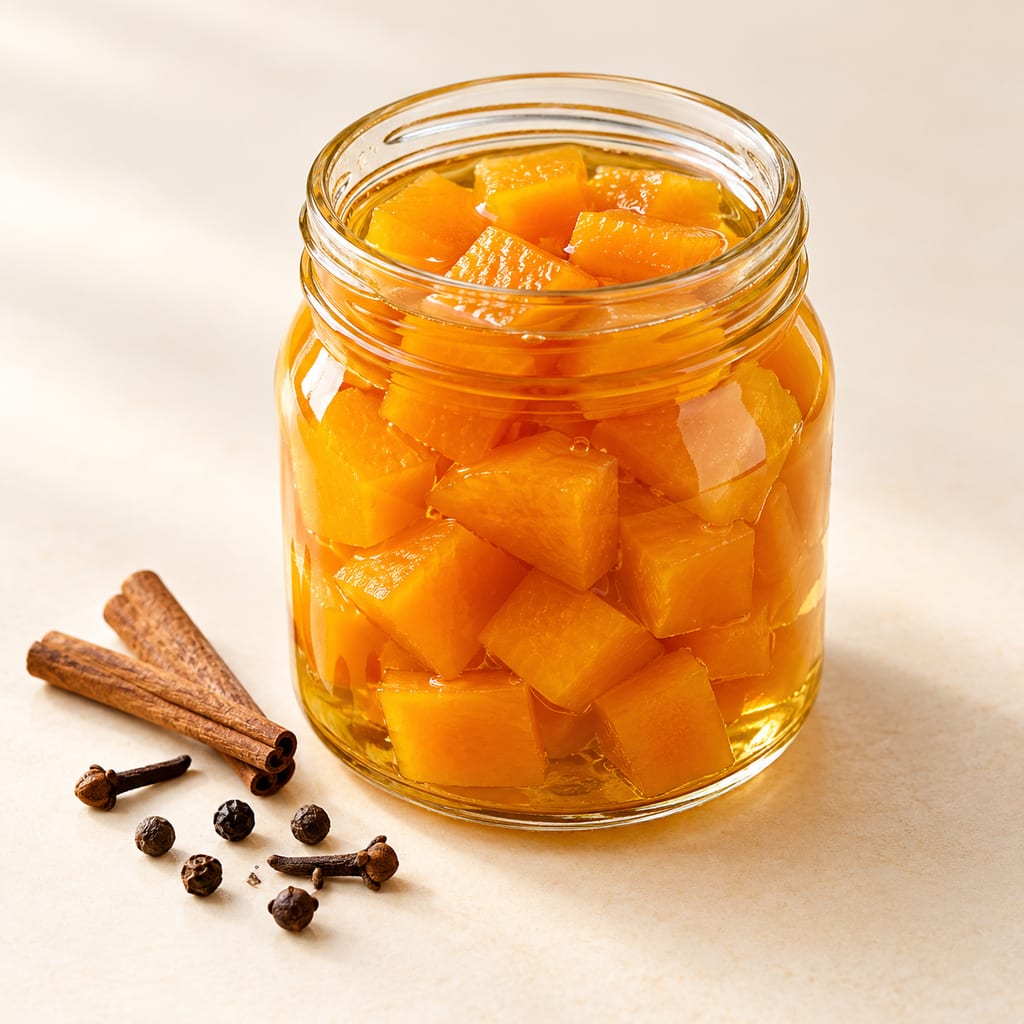
Ball sweet pumpkin pickles: Cupboard: exact published Ball formulation and water-bath process.
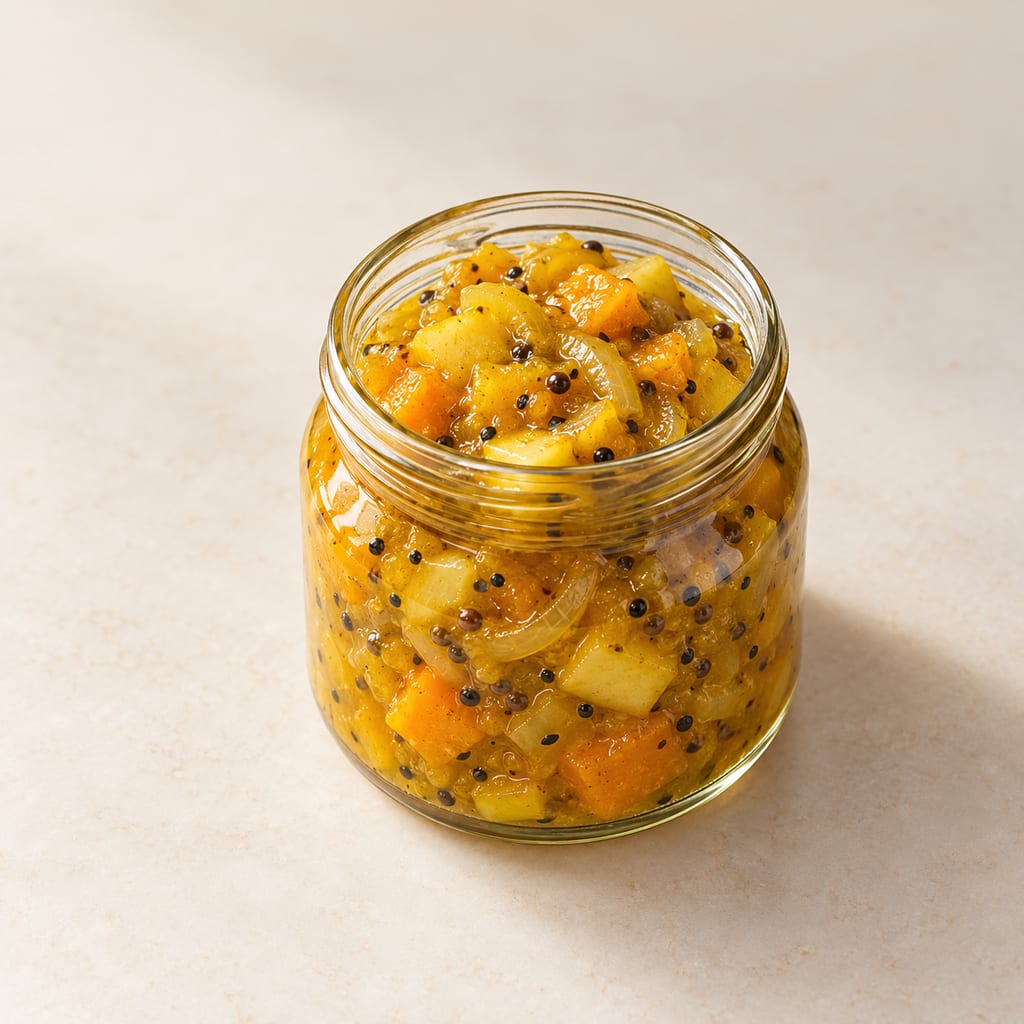
British pumpkin, apple and mustard pickle: Freeze for winter; small fresh portion refrigerated up to 48 hours.
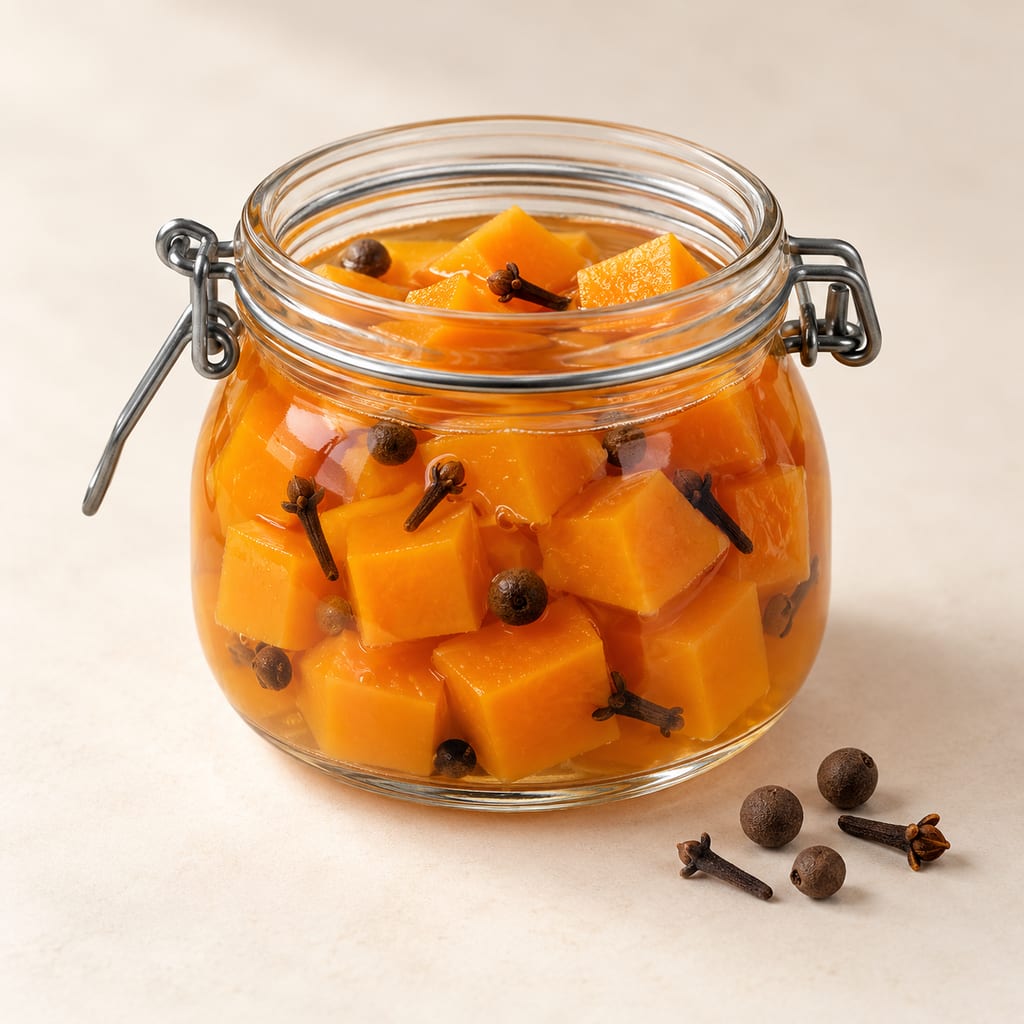
Dynia marynowana: Freeze for winter; small fresh portion refrigerated up to 48 hours.

Fried or cooked food covered in a vinegar-based preparation, the heat and the externally supplied acid working together; a family of methods whose early form is a Roman instruction for treating fried fish with hot vinegar.
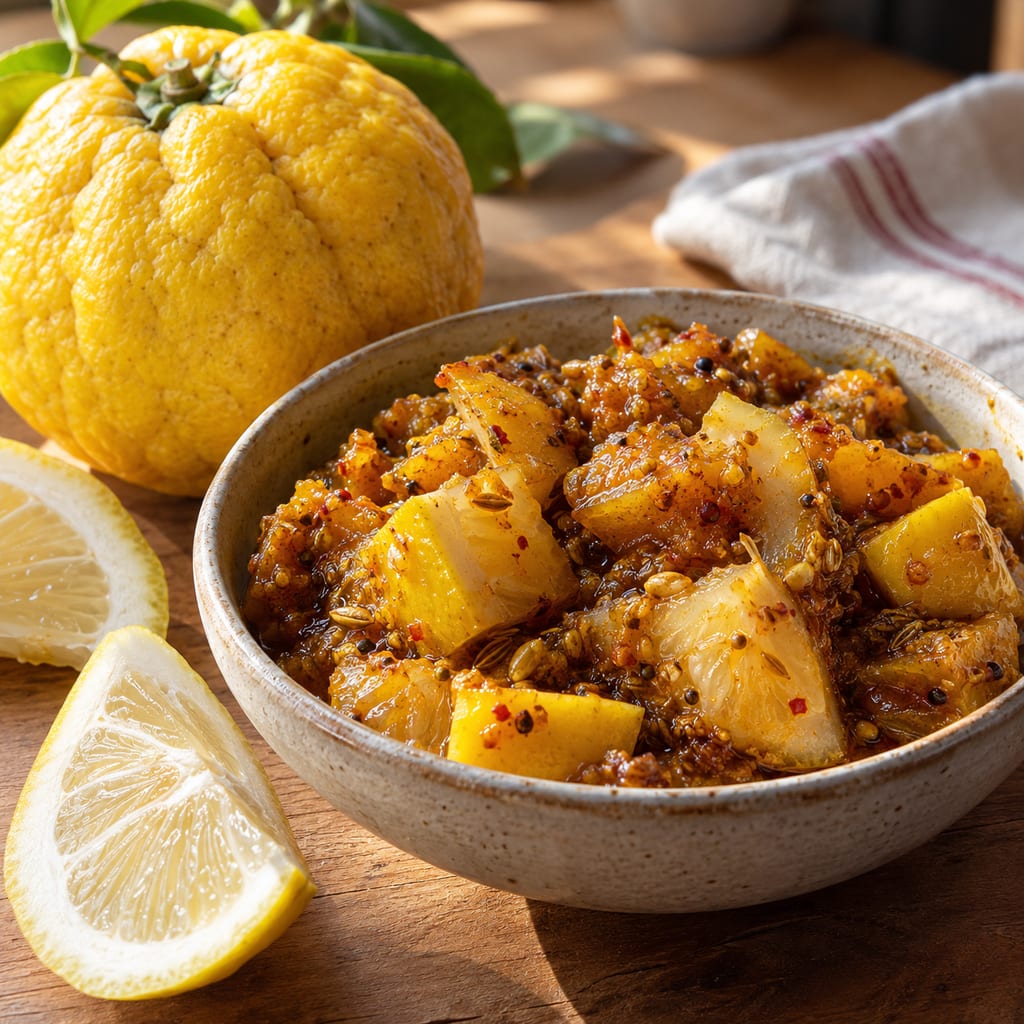
Ripe Himalayan galgal is boiled, sun-dried and cooked with mustard oil, spices and jaggery before a further rest in a ceramic jar.
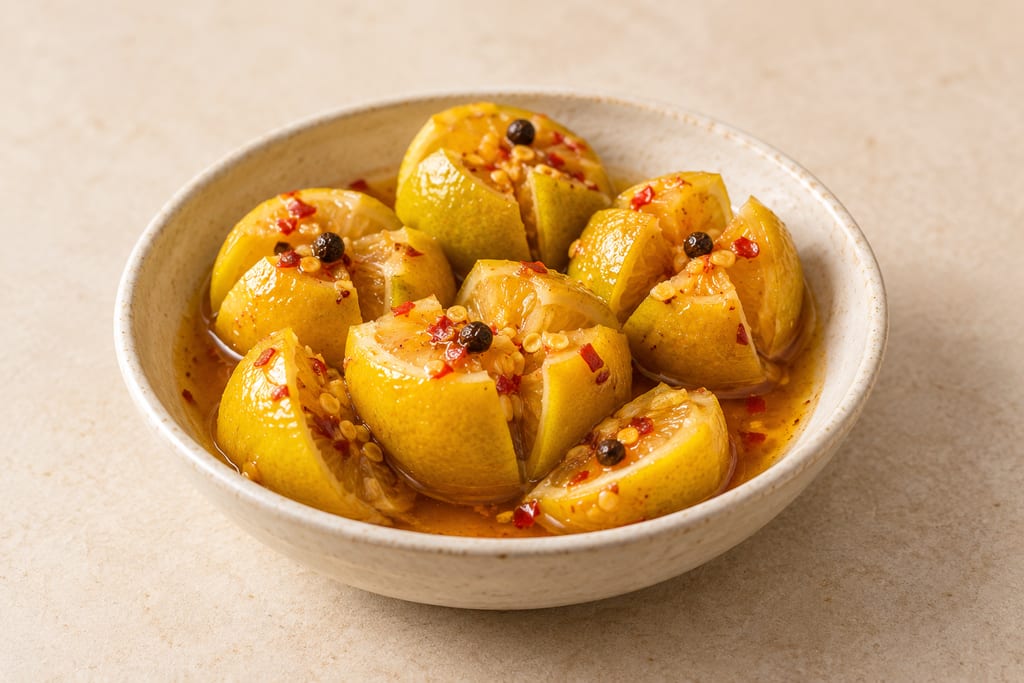
Peter Kuruvita’s published lime pickle stuffs 20 limes with rock salt, then simmers them in vinegar, sugar and chilli before a two-week rest.

A Cap-Pelé boucanière is an Acadian herring-smoking building. The documented Willie Niles example is a one-storey wood-frame structure with a ridge smoke vent and interior bays for hanging fish-bearing cannes.

The acocote is a long, hollowed and dried gourd used to draw aguamiel from a mature maguey. It is a harvesting tool: the sap is transferred to a separate vessel before it ferments into pulque.

Adrak murabba preserves young ginger in sugar syrup, a sweet South Asian preparation recorded in Indian cookery and food-processing sources.

Parkia biglobosa seeds are fermented into regional West African seasonings, including nététou, iru, dawadawa and soumbala. The yellow fruit pulp is a separate food, and names and methods vary by place.

Japanese reddish-brown vinegar from sake lees matured about three years, turned to vinegar by acetic bacteria; the vinegar of Handa and Edomae sushi rice.

A refined common-wheat flour blended for a broad range of baking; its protein and behavior vary with wheat, milling and market.

The almond mushroom, Agaricus subrufescens, was cultivated in eastern North America in the 1800s, lost its market, and returned as a cultivated mushroom from Brazil, where it is grown under several names.
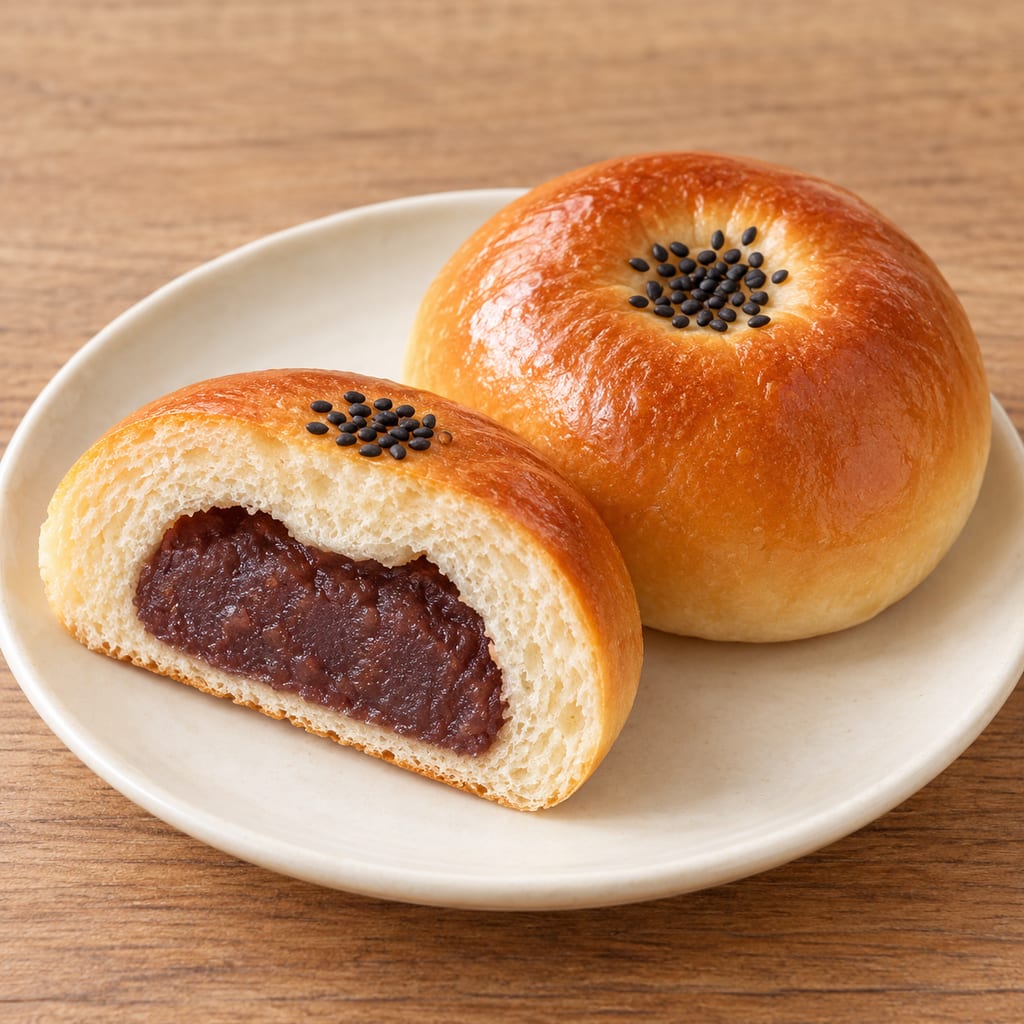
Anpan is a soft wheat bun filled with sweet red-bean paste and finished with egg wash and black sesame. This dough rises with commercial instant yeast.
No community contributions have been published for this entry yet.
Sign in to contribute. Published comments and photos are free to read.
National Center for Home Food Preservation, University of Georgia; adapted from the USDA Complete Guide to Home CanningMethod · Safety
Marinated Whole MushroomsTested recipe with every quantity
Cap size and the 5-minute preliminary simmer
Garlic and peppercorn per half-pint jar
Half-inch headspace
Yield of about nine half-pint jars
Boiling-water processing times by elevation
Cited in: How the preservation works; The method and why each step is there; Reading results and problems
National Center for Home Food Preservation, University of GeorgiaSafety · Method
General Information on PicklingFermented pickles and vinegar pickles are different
Vinegar strength matters
Changing tested proportions is a risk
Cited in: What it is; How the preservation works; The method and why each step is there
National Center for Home Food Preservation, University of GeorgiaSafety
Ensuring Safe Canned FoodsBotulism and low-acid foods
Equilibrium pH 4.6 threshold
Need for tested home-canning methods
Cited in: How the preservation works; Reading results and problems
National Center for Home Food Preservation, University of GeorgiaMethod · Safety
Using Boiling Water CannersOperating a boiling-water canner
Cooling and checking sealed jars
Ministerstwo Rolnictwa i Rozwoju Wsi, PolandHistory · Method · Use · Safety
Nadbużańskie grzyby marynowaneRegistered as a traditional product on 28 July 2009
Bug River and Podlasie association
Sweet-sour taste, soft and slightly slippery texture
Served at family celebrations, Christmas Eve and Lent
Poisonous mushroom toxins are not reliably destroyed by processing
Cited in: What it is; Where it comes from; The method and why each step is there; Regional and historical variations; How it is eaten; Reading results and problems
Ministerstwo Rolnictwa i Rozwoju Wsi, PolandHistory · Method · Use
Borowik wielkopolskiRegistered on 28 February 2006
Small whole porcini in a near-clear marinade
Retrospective sixteenth- and seventeenth-century dating
Vinegar manufacture and household preservation change
Festive serving
Cited in: What it is; Where it comes from; The method and why each step is there; Regional and historical variations; How it is eaten
Ministerstwo Rolnictwa i Rozwoju Wsi, PolandHistory · Method
Grzyby marynowane z szyszkąWestern Pomeranian variant with honey and green pine cones
Local tradition from 1955
Registered on 8 June 2011
Recipe passed between family and neighbours
Cited in: Where it comes from; Regional and historical variations
Lasy Państwowe (Polish State Forests)Method · History
Czas na rude grzybySpecies used for vinegar pickling
Household marinade of one part vinegar to three or four parts water
Onion, pepper, allspice, bay leaf, mustard seed
Boiling the mushrooms for 10 to 15 minutes before marinating
Letting flavours settle
Cited in: What it is; The method and why each step is there; Regional and historical variations; How it is eaten
Towarzystwo Wydawnicze Bluszcz, Warsaw; digitised by Polish WikisourceHistory · Method
Potrawy i konserwy z grzybów: Grzyby marynowaneInterwar Polish instructions for pickling mushrooms
Young firm mushrooms, onion, pepper, allspice, cloves, bay leaf, vinegar
Older practice of oil coverings and chemical preservatives
Cited in: Where it comes from; The method and why each step is there
University of Minnesota ExtensionSafety · Science
Preserving Food at Home: Pickling ProduceVinegar, produce, salt and water
Cut size and packing affect acidification
Acid moves into the tissue until equilibrium pH
Refrigerator pickles differ from shelf-stable ones
Sugar balances flavour
Cited in: How the preservation works; The method and why each step is there; Reading results and problems
US Centers for Disease Control and PreventionSafety
Botulism PreventionBotulism follows improperly preserved food
Toxin cannot be detected by sight, smell or taste
Discard doubtful preserved food
Cited in: How the preservation works; Reading results and problems
Health CanadaSafety
Guidance on Mitigating the Health Risk Associated with Clostridium botulinum in Plant and Mushroom Products Stored in OilMushrooms in oil need validated controls
Equilibrium pH below 4.6 as a control
Modifying a validated formulation voids its validation
Cited in: Reading results and problems
Food Standards Agency, United KingdomSafety
Consumer Advice for Food Preservation at HomeFollow recognised preservation instructions exactly
Reject bulging, leaking or spoiled jars
Appearance, smell and taste do not show safety
Cited in: Reading results and problems
Czas EmancypantekHistory
Lucyna ĆwierczakiewiczowaReproduces the 1877 Bluszcz report by Maria Ilnicka naming pickled mushrooms among the preserves exhibited by Ćwierczakiewiczowa
Cited in: Where it comes from