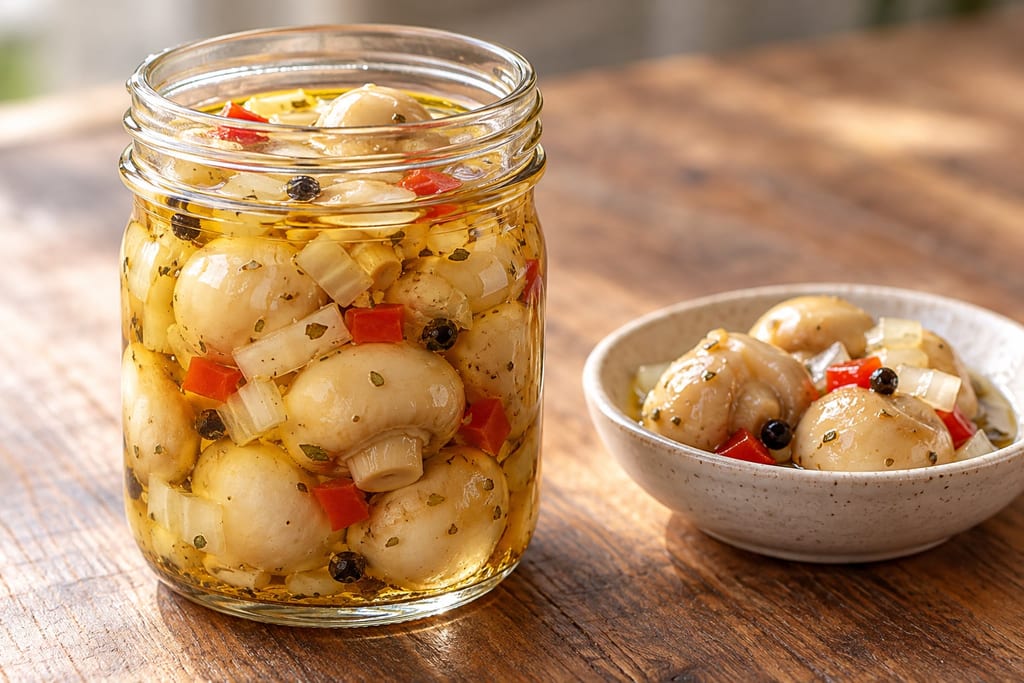
Eastern European Vinegar-Pickled Mushrooms
Small edible mushrooms are briefly cooked and packed in a seasoned vinegar marinade, a sweet-sour preserve served cold in Poland and neighbouring cuisines.
 FermenteaWhere food goes to change
Mushrooms
Cortinarius caperatus, formerly Rozites caperatus, is a wild food appreciated in northern Europe and parts of North America. Identification and contaminant risks require care.
The current name is Cortinarius caperatus (Pers.) Fr.; older books and labels may use Rozites caperatus or R. caperata. Molecular classification places this species within Cortinarius, a very large genus whose other members include dangerously poisonous mushrooms. The name change does not make all webcaps edible. Common field descriptions give an ochre to brown, often wrinkled cap, pale gills that darken toward rust brown, a pale stem, and a persistent membranous ring. A whitish veil may leave a thin coating on the cap and a rim around the stem base. These characters help describe the species but are not a safe one-photo identification rule.
The species forms ectomycorrhizal partnerships with trees. The 2018 IUCN assessment describes a widespread northern Eurasian and North American range, with less frequent records elsewhere in Europe, and names spruce, pine, beech, oak and birch-associated settings. Local fruiting dates vary: Vienna records summer through autumn, often beneath spruce on acidic sandy soils; Kyoto Prefecture reports October–November locally, mainly with red pine and sometimes Fagaceae. These are regional observations rather than a universal season.
The IUCN account calls C. caperatus an appreciated edible mushroom; the Burke Herbarium says it is commonly collected for food in the Pacific Northwest. A Polish specialist species guide describes use of young caps in vinegar pickles, fried and stewed dishes, soups and sauces. This supports regional food-use context, not a universal recipe or a safety validation for gathered mushrooms. Occurrence and season are established for Japan, but a distinct Asian culinary tradition is not.
Poisonous Cortinarius lookalikes make casual field identification unsafe. The North American Mycological Association advises that mushroom identification relies on multiple features and that a photograph is not enough. A second, species-specific issue is contaminant uptake: a study of fruit bodies from 20 northern Polish forest regions found C. caperatus efficiently accumulated mercury and advised against frequent seasonal consumption, while its conclusion treated occasional eating differently. Vienna also flags radiocaesium in areas affected by Chernobyl fallout. Neither finding supports a universal numeric intake limit. The species' documented edible status should be presented alongside these limits, and never as advice to forage an uncertain specimen.
The IUCN assessment describes it as appreciated edible in northern Europe; broad range does not imply one preparation.
A specialist guide records cooking uses and a study sampled Polish populations; not one uniform national tradition.
Burke Herbarium says this mushroom is commonly collected for food in this region.
Small edible mushrooms are briefly cooked and packed in a seasoned vinegar marinade, a sweet-sour preserve served cold in Poland and neighbouring cuisines.
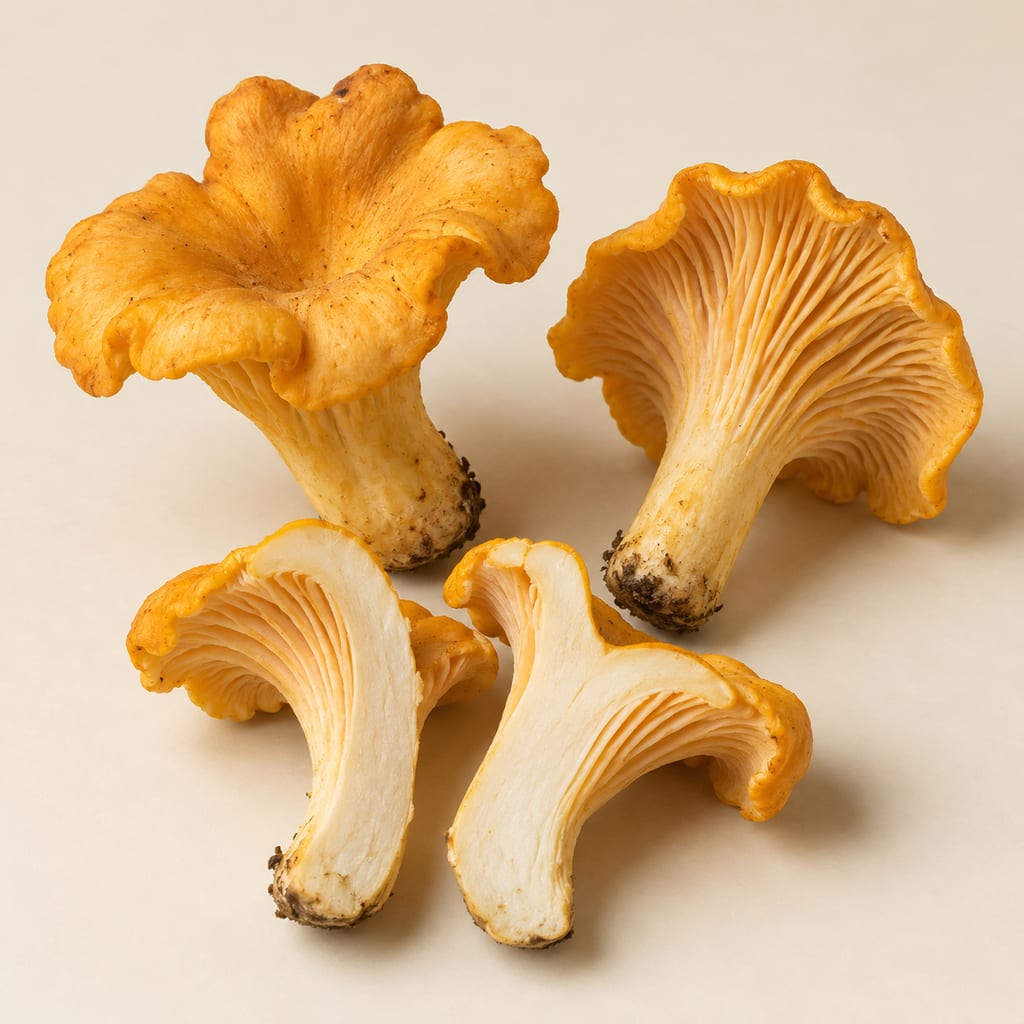
Cantharellus formosus is a wild ectomycorrhizal chanterelle of conifer forest in the Pacific Northwest of North America, gathered as a culinary mushroom.
No community contributions have been published for this entry yet.
Sign in to contribute. Published comments and photos are free to read.
Species FungorumIdentity
Cortinarius caperatus (Pers.) Fr. — name recordCurrent combination Cortinarius caperatus; former combination Rozites caperatus.
Cited in: Name and recognition
IUCN Red List of Threatened SpeciesDistribution · Habitat · Food use
Cortinarius caperatusWidespread edible ectomycorrhizal webcap of northern Europe and North America; appreciated edible mushroom; host and habitat context.
Cited in: Forest habitat and season; Documented food use
University of Washington Burke MuseumIdentity · Food use · Distribution
Cortinarius caperatus — Burke Herbarium Image CollectionField identification characters; commonly collected for food; Pacific Northwest distribution.
Cited in: Name and recognition; Documented food use
City of ViennaIdentity · Season · Safety
Reifpilz, ZigeunerSummer to autumn; spruce and acidic sandy soils; poisonous Cortinarius lookalikes; regional radiocaesium caution.
Cited in: Forest habitat and season; Identification and contaminant cautions
Kyoto PrefectureHabitat · Season · Distribution
Cortinarius caperatus — Kyoto Prefectural Red Data BookJapanese occurrence; mainly red pine, sometimes Fagaceae; local fruiting October–November.
Cited in: Forest habitat and season
JakiToGrzyb.plFood use
Płachetka zwyczajna (kołpak)Polish guide describes young caps as pickled, fried, stewed and used in soups and sauces.
Cited in: Documented food use
Ecotoxicology and Environmental SafetySafety
Distribution of mercury in Gypsy Cortinarius caperatus mushrooms from several populationsStudy of Polish populations found efficient mercury accumulation and cautioned against frequent consumption; distinguishes frequent use from occasional eating.
Cited in: Identification and contaminant cautions
North American Mycological AssociationSafety
Wild Mushroom SafetyIdentification takes multiple features and cannot be established from a photograph alone.
Cited in: Identification and contaminant cautions