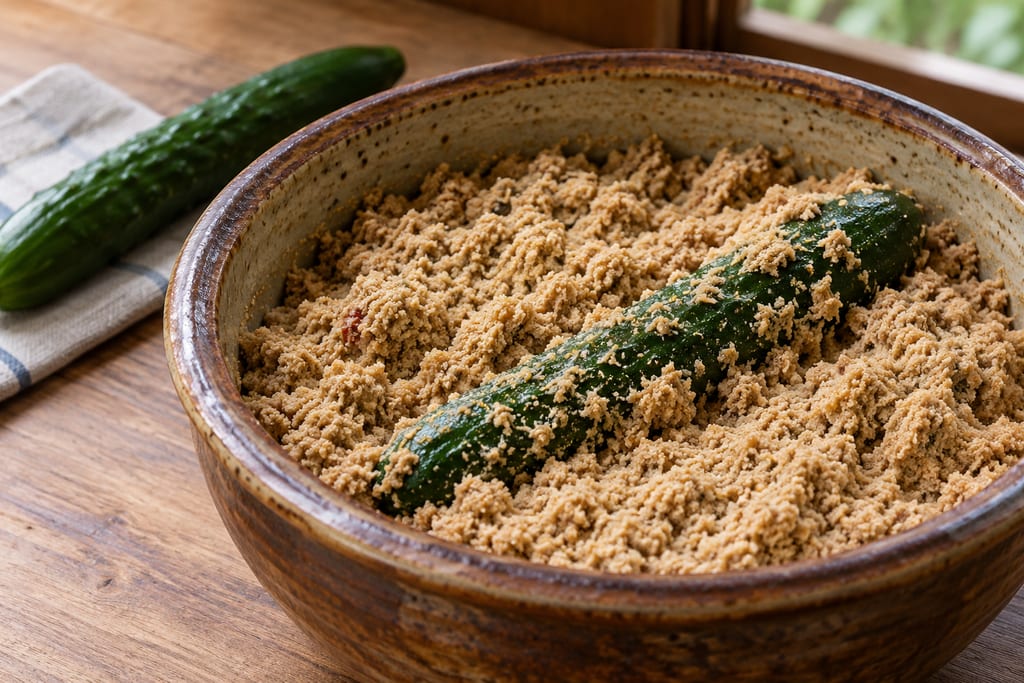
Nukazuke is a Japanese vegetable pickle produced by burying vegetables in a maintained, fermented rice-bran bed.
Unlike ordinary brine fermentation, the vegetable is not placed directly into a jar of free-flowing saltwater.
Instead, it is surrounded by a moist mixture of rice bran, salt and water that develops a complex microbial community.
The bed is called nukadoko.
A finished pickle is called nukazuke.
A family may maintain a nukadoko through repeated pickling cycles, adding fresh ingredients and adjusting its condition as necessary.
The preparation is both a food and an ongoing fermentation system.
This makes nukazuke particularly interesting from a microbiological perspective.
A cucumber buried in a mature bed may develop its characteristic flavour comparatively quickly, but the bed itself has a much longer fermentation history.
The timescale of the cucumber and the timescale of the microbial environment must not be confused.
Nukazuke is associated with Japanese rice culture.
Rice milling produces bran, the outer layers removed from grain during processing.
Rather than discarding this nutrient-rich material, it can be used as the basis of a fermentation medium.
Historical accounts connect rice-bran pickling with the wider development of milled rice consumption, but the current recipe does not establish an exact date for the invention of nukadoko.
It is therefore inappropriate to assign the present one-kilogram formula to a particular historical household or century.
What is well established is the continuity of the practice in Japanese domestic food culture.
Maintaining a rice-bran bed requires regular attention.
The medium changes through repeated fermentation, vegetable contact and replenishment.
The result is not a static preservation solution but a living system.
Dissolve 50 g salt in 500 ml hot water and allow it to cool.
Teramoto's mixing sequence starts with about two-thirds of the brine, adds most of the remainder, and reserves 50 ml for gradual moisture adjustment. Add the reserved liquid only as needed to reach the source's hand-squeeze cue: moisture is visible between the fingers but does not run.
The source gives no numeric moisture percentage or validated fermentation endpoint.
Bury vegetable scraps such as cabbage leaves or core, carrot, or cucumber stems and peel in the bran bed.
Leave the first scrap batch for 1½–2 days, replace it with fresh scraps, and remove that second batch within 1½ days. Repeat with fresh scraps each day for a week.
Turn the bed daily and remove all old scraps before adding new ones.
A soft, spongy bed with a noticeable aroma and sour flavour is the culinary ready-to-use cue. It is not a validated safety endpoint.
A newly mixed bed contains salt, moisture and nutrients, but has not necessarily developed the same acidic and microbial conditions as a maintained bed.
During maturation, microorganisms compete for available substrates.
Lactic-acid bacteria may gradually become more competitive as organic acids accumulate.
The process can involve different stages and different populations.
The documented one-week starter cycle is a practical household method, not a guarantee that every newly prepared bed has reached the same microbiological maturity.
Scientific experiments have followed beds for considerably longer periods.
Their results demonstrate why bed age and conditions influence the final pickles.
A cucumber removed from a young bed may differ in acidity and flavour from one pickled in a well-established bed.
Raw rice bran provides an existing population of microorganisms that can contribute to fermentation.
Heat treatment alters this population.
Roasted bran may offer handling or flavour advantages but can behave differently during startup.
Scientific comparison of treated and untreated bran has demonstrated differences in acidification and microbial development.
This does not mean roasted bran is inherently unsuitable.
It means that the two are not microbiologically identical starting materials.
For a new bed, the original method's quantities and preparation choices should be maintained rather than casually combined with unrelated alternative methods.
Nukazuke is made with several kinds of vegetables.
Cucumber is a particularly familiar choice.
Radish, carrot, cabbage and other vegetables may also be pickled.
Their different structures affect texture and treatment time.
The Marukome article additionally discusses less conventional summer ingredients such as okra and corn.
The same bed may produce different flavours when used with different vegetables.
For a fermentation reference, those examples belong under the broader nukazuke family, while cucumber is retained as the specific recipe on this page.
The recorded account also describes egg-based variations, but those require separate food-safety consideration and should not be assumed equivalent to fermenting raw vegetables.
This maintained living fermentation bed has no numeric validated pH, water activity or final salt concentration established for each cucumber.
General guidance for brined vegetable fermentation does not validate this rice-bran bed. Do not infer safe storage or a safety endpoint from the bed’s age, smell, taste or appearance.
Seek product-specific food-safety review before presenting this method as a validated preservation process.
Contamination or uncontrolled fermentation in the maintained bran bed
This source-specific home method repeatedly maintains a live bran bed but supplies no validated food-safety endpoint or safe-storage limit. Sensory cues do not establish safety.
Hazard source
Use clean hands and food-contact equipment when preparing and turning the bed. No nukazuke-specific validated pH, salt, storage-time or safety endpoint is established here; brined-vegetable limits are not applied to this rice-bran bed.
Control source
Prepare brine from 50 g salt and 500 ml hot water, then cool it. Mix the brine gradually into 500 g raw rice bran: Teramoto’s sequence first uses about two-thirds, then adds most of the remainder, reserving 50 ml for adjustment. Add the last brine gradually until the squeezed bran shows moisture between the fingers without running.
Start sutezuke (starter pickling) with vegetable scraps buried in the bed. Leave the first batch for 1½–2 days, replace it with fresh scraps and remove that second batch within 1½ days; then repeat with fresh scraps each day for a week. Turn the bed daily and remove old scraps before adding new ones. A soft, spongy bed with a noticeable aroma and sour flavour is the culinary ready-to-use cue, not a validated safety endpoint.
Bury a cucumber fully in the bed, keeping vegetables separate. Pickle about 12 hours, remove, brush off bran, rinse briefly and wipe dry.
Stir the bed daily between batches. In hot summer weather, refrigerate the bed; cucumber then needs about 24 hours.
Conditions
Yield1 kg rice-bran bed
Fermentation12–24 h
Temperature controlAmbient, monitored
Places
Japan
Traditional preparation · Country evidence
The Japanese source calls cucumber the classic nukazuke and documents an expert’s rice-bran bed method.
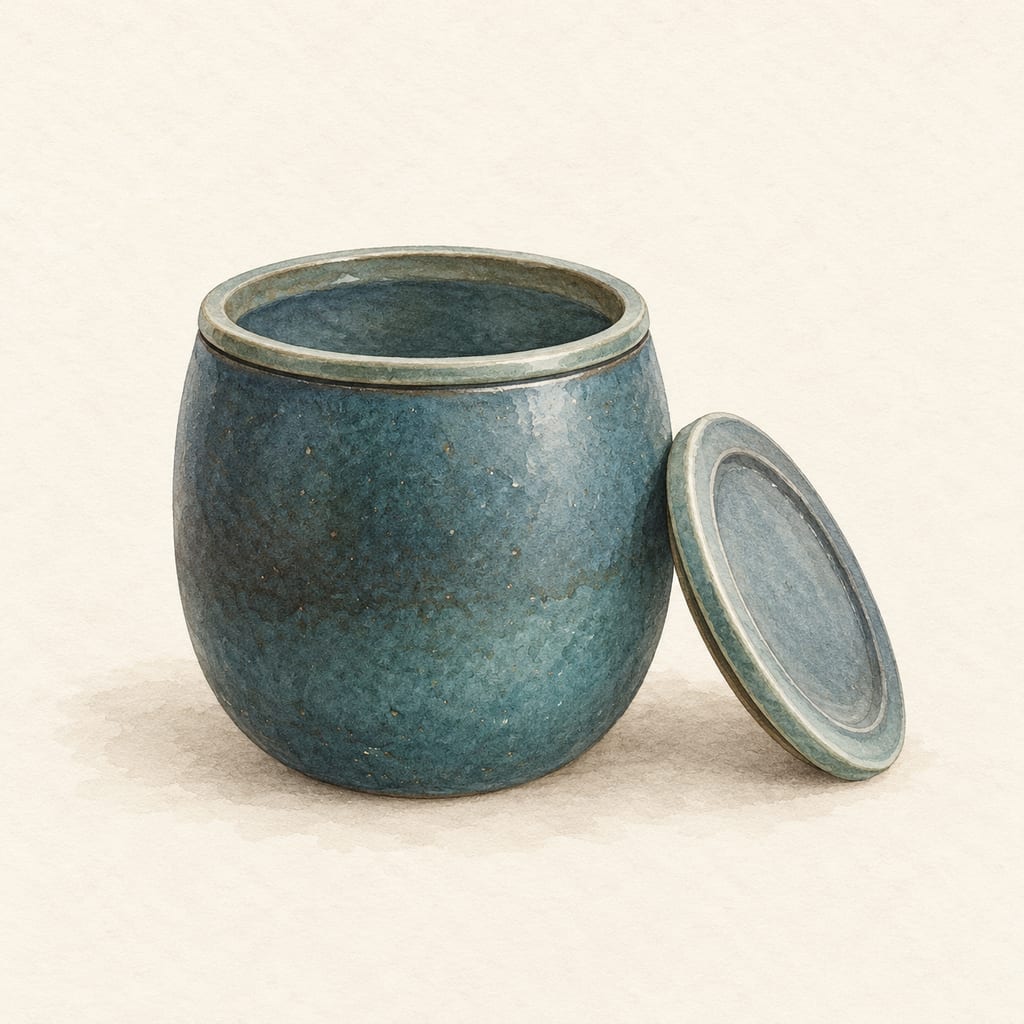
A nukadoko container holds the moist rice-bran bed in which vegetables are repeatedly pickled. Japanese households have maintained these beds in ceramic jars, while contemporary options also include compact ceramic and enamel designs.
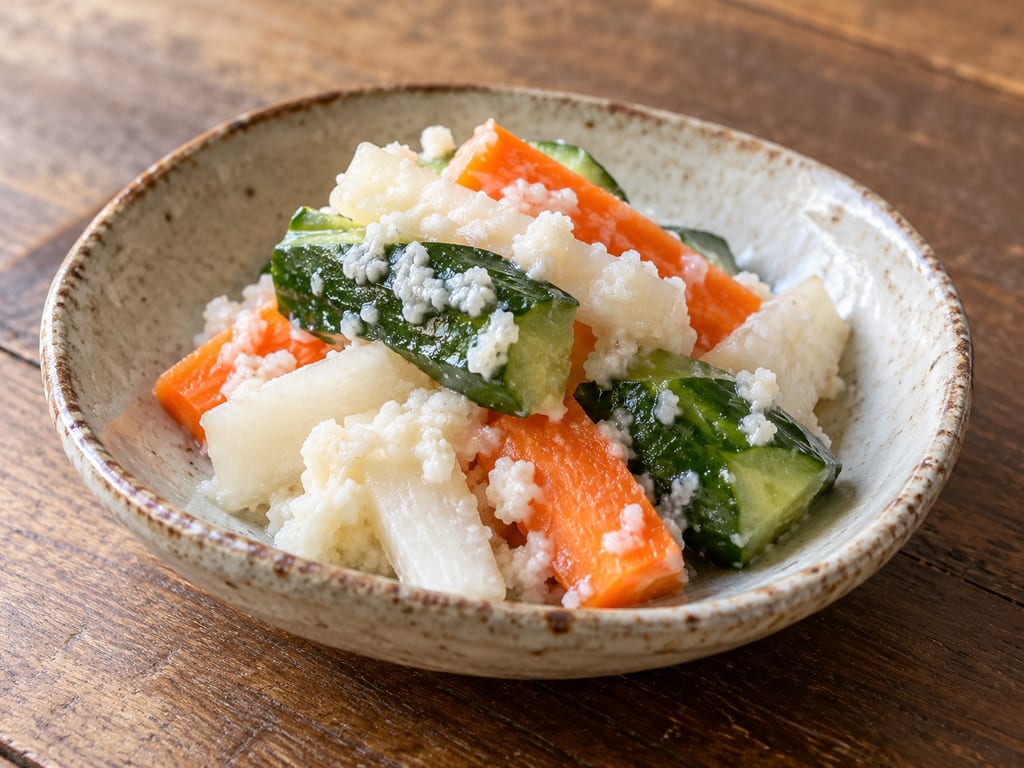
A traditional Japanese koji pickle from the Tohoku region: vegetables pickled in a matured bed of cooked rice, rice koji and salt, where koji enzymes bring sweetness alongside the salt.
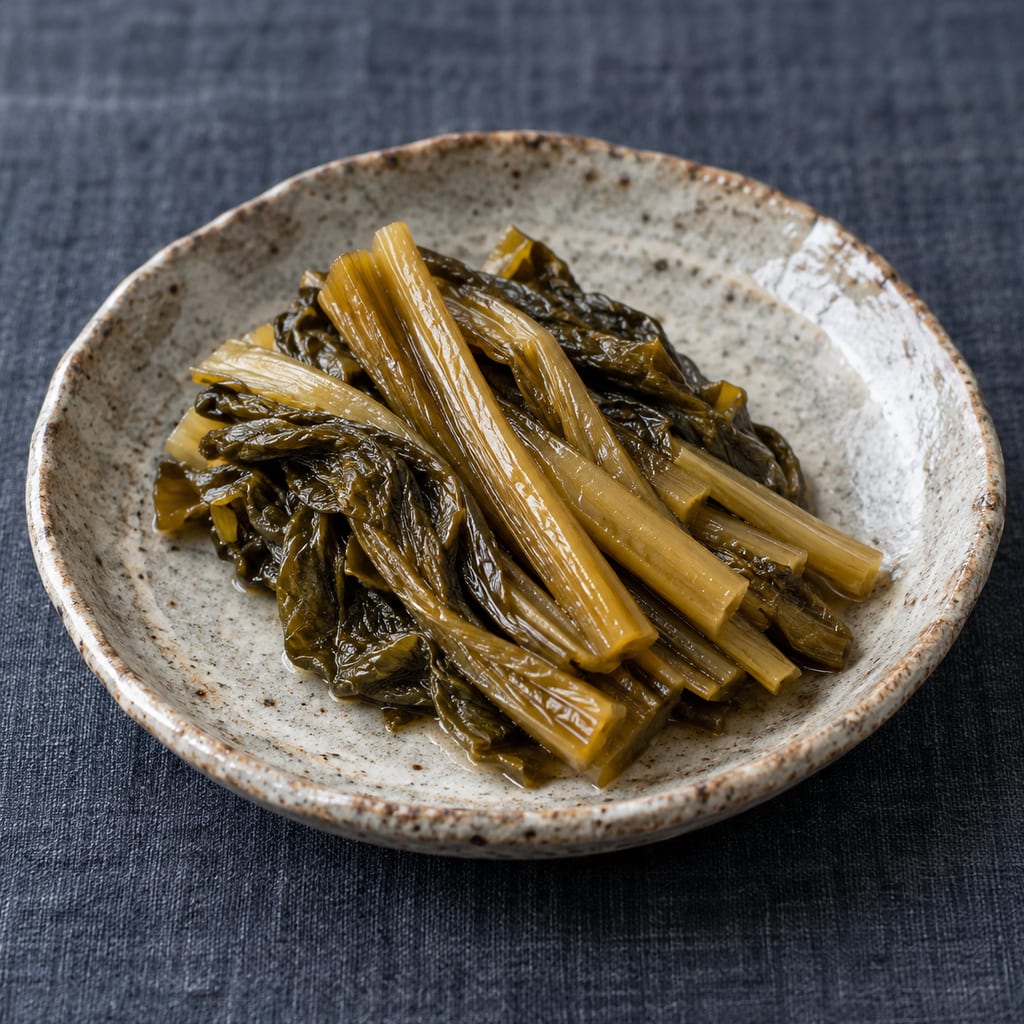
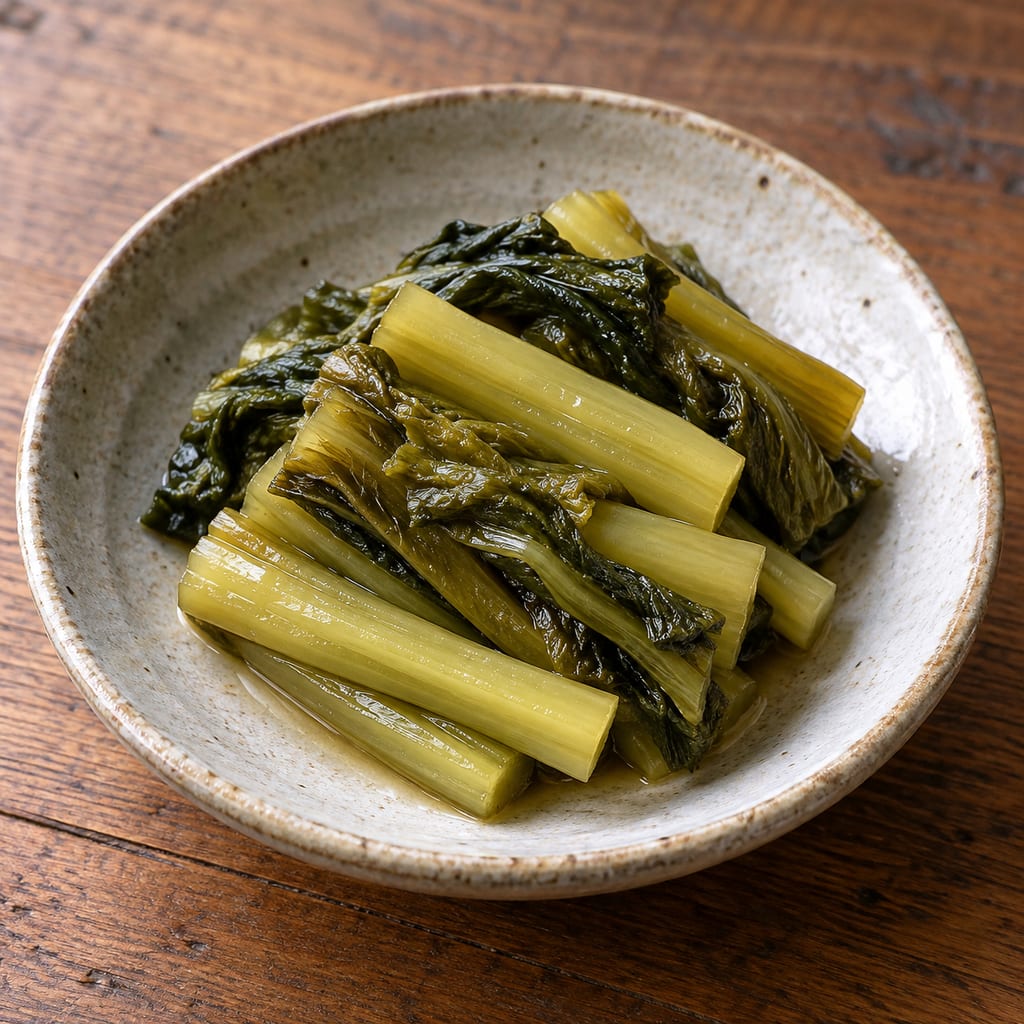
Takana mustard greens from Aso in Kumamoto are salted and pressed into a fresh spring pickle, or aged into a sour furuzuke that is fried and mixed into takana rice.
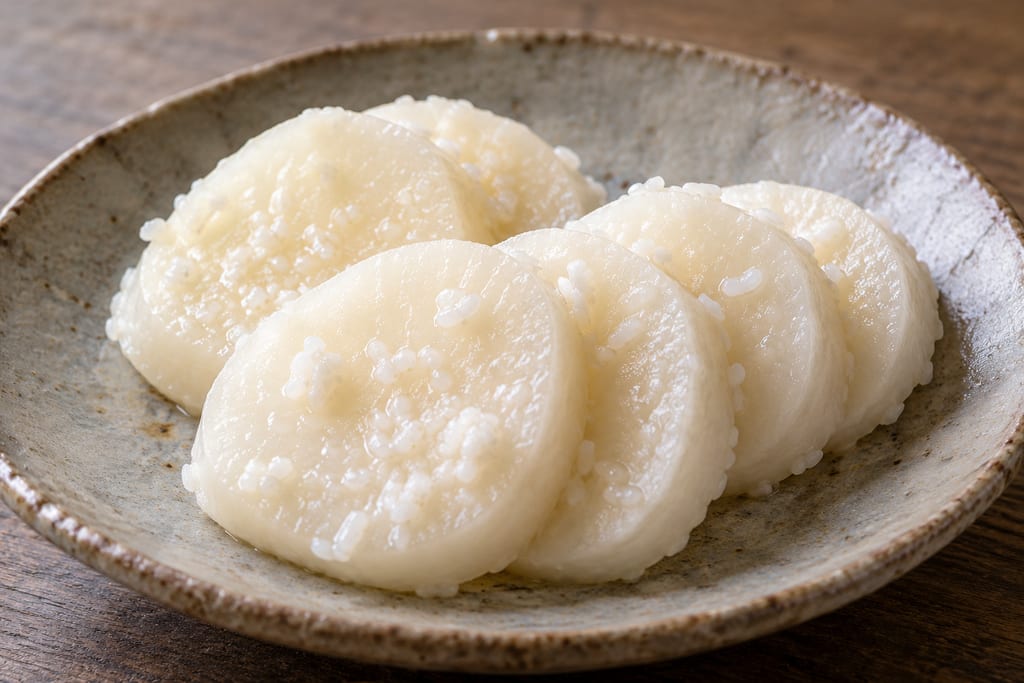
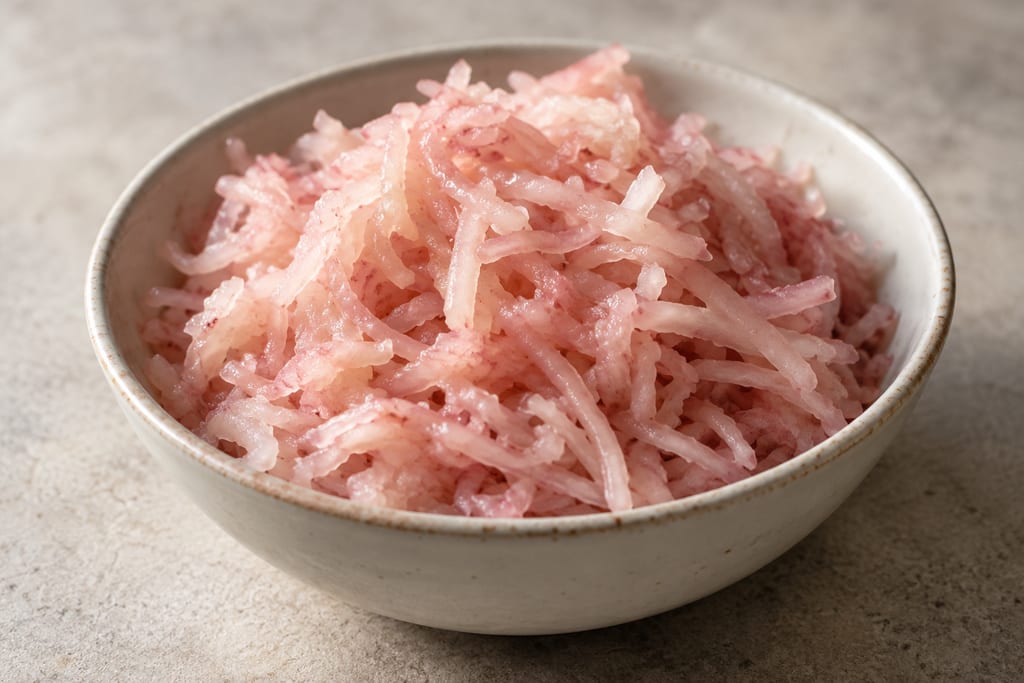
A sweet, crisp Japanese daikon pickle from Tokyo's Nihonbashi district, made by salting fresh radish and dressing it in rice koji, sugar or koji amazake without the heavy drying used for takuan.
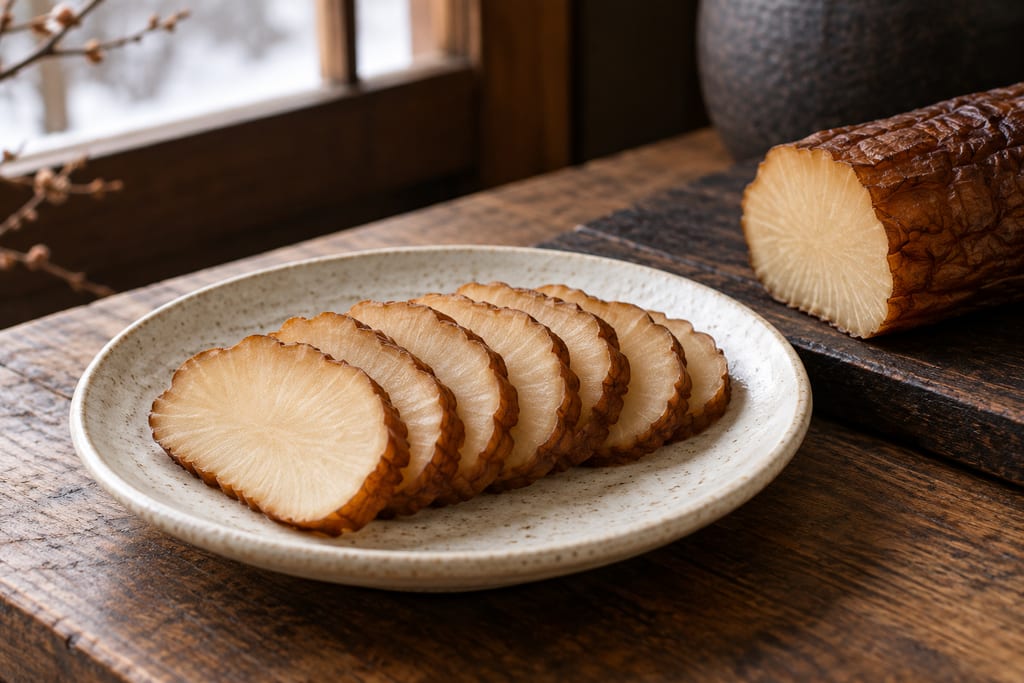
Regional takuan from Ise City, Mie, made with Misono daikon dried on a rack, then matured in a weighted barrel of rice bran and salt for months to years.
Foods embedded in salty fermented miso paste, which transfers salt and fermentation products into them; misozuke uses an already transformed medium rather than a fresh vegetable brine.
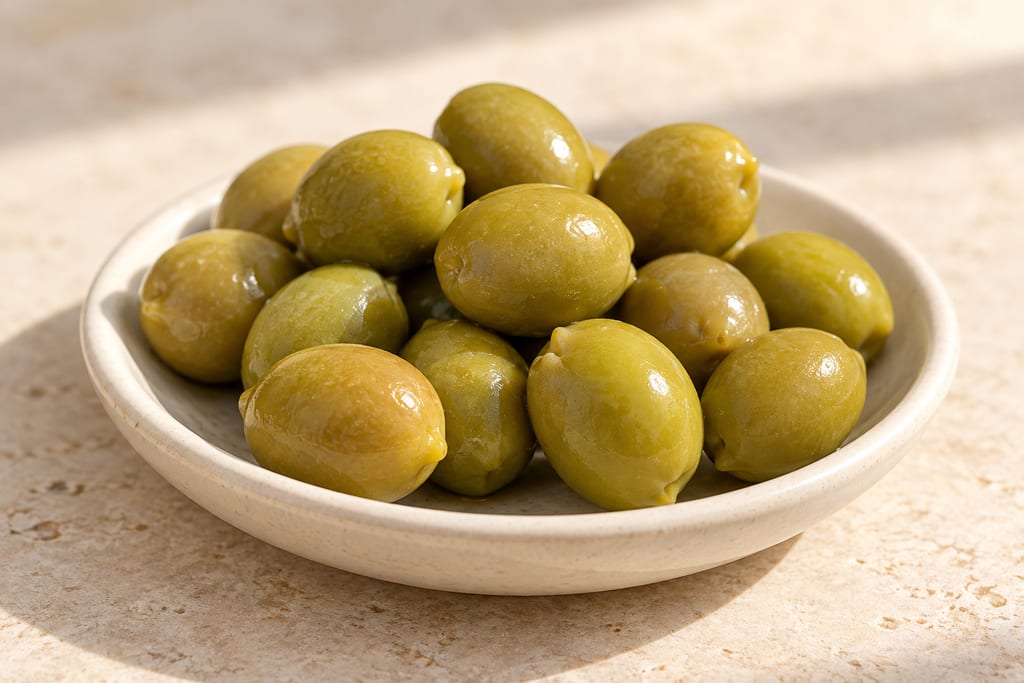
A Portuguese table-olive product from the Negrinha cultivar in northeastern Portugal, sold in three commercial styles, two of them brined fermentations and one oxidised to black.
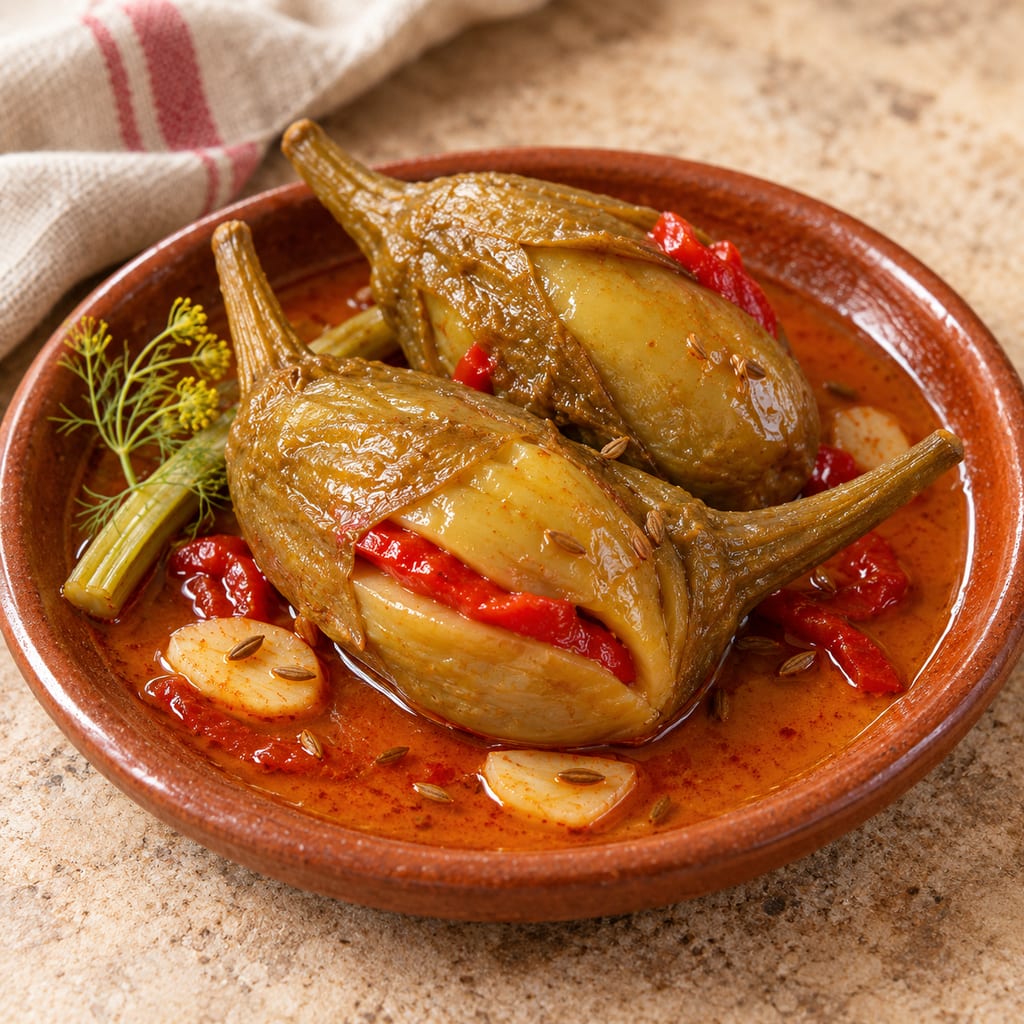
A protected aubergine preserve from Ciudad Real in Spain: tender fruit of the local Dealmagro variety, cooked briefly and then fermented in a vinegared, paprika-seasoned dressing.
Source-specific Brovada DOP producer method for Friuli Venezia Giulia turnips and red-grape marc. This records a regulated producer process; it is not a validated home-scale recipe.
An industrial fermentation patio places factory-made fiberglass-reinforced polyester olive tanks below floor level, with drainage and transfer infrastructure arranged around the buried vessels.
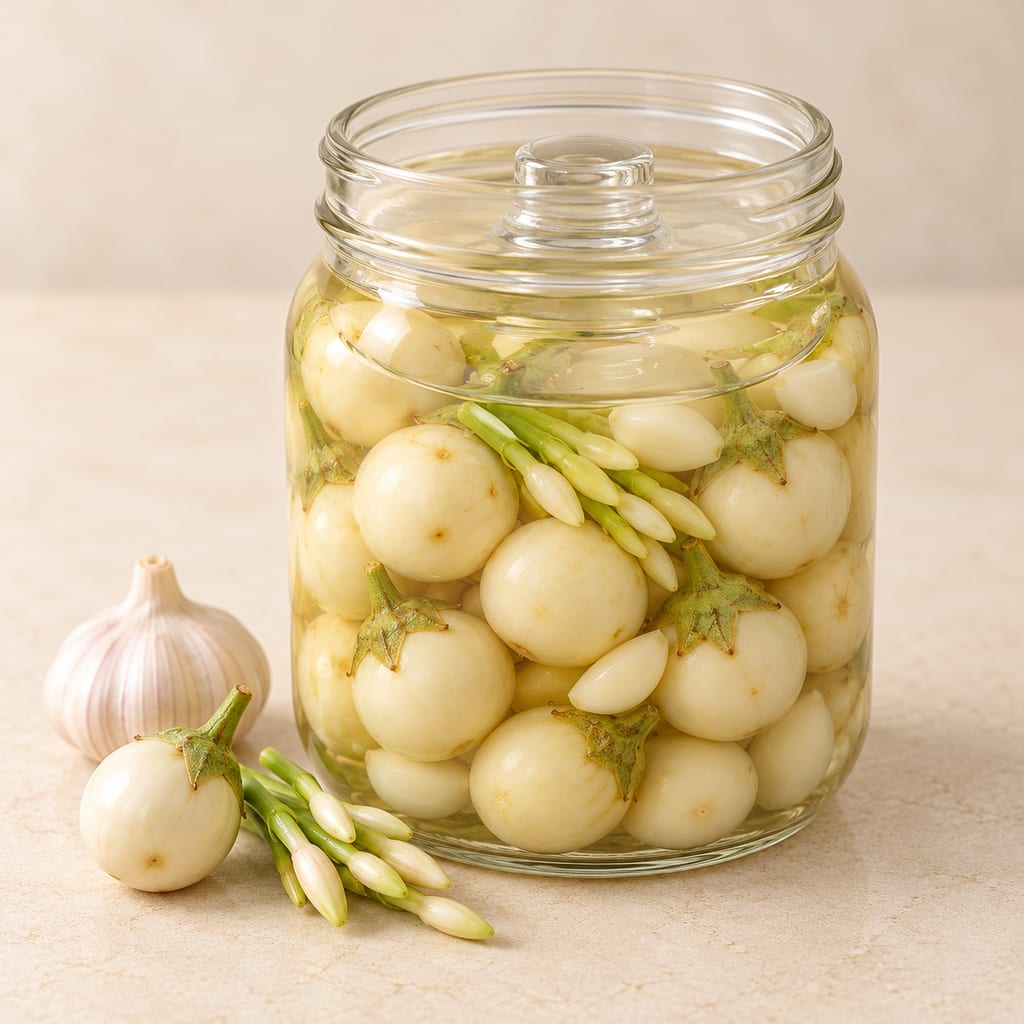
Vietnamese salted and fermented small eggplant, dried on the day of purchase, then held submerged in warm salty water with garlic and galingale flower for a week or longer.
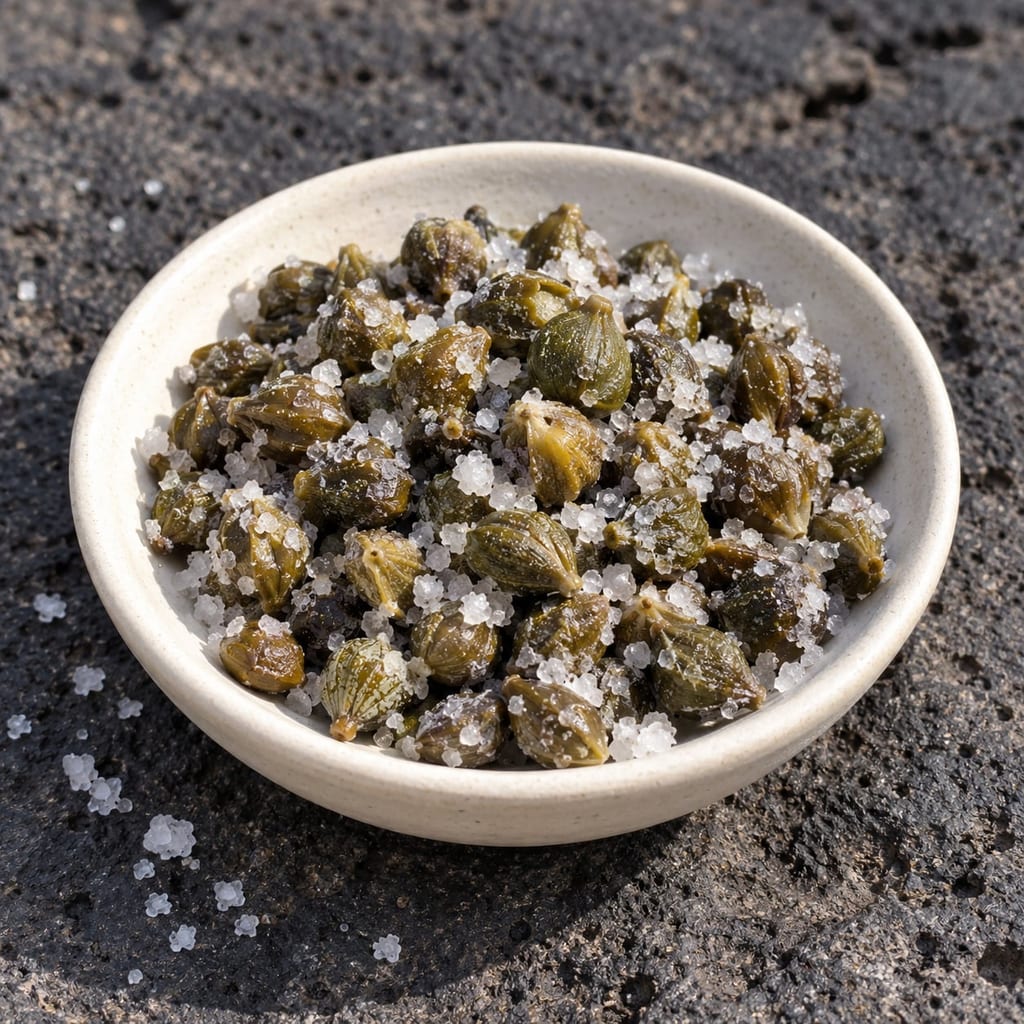
A protected Sicilian product: unopened caper buds from the island of Pantelleria, dry-salted with sea salt in a two-stage process that encourages lactic fermentation.
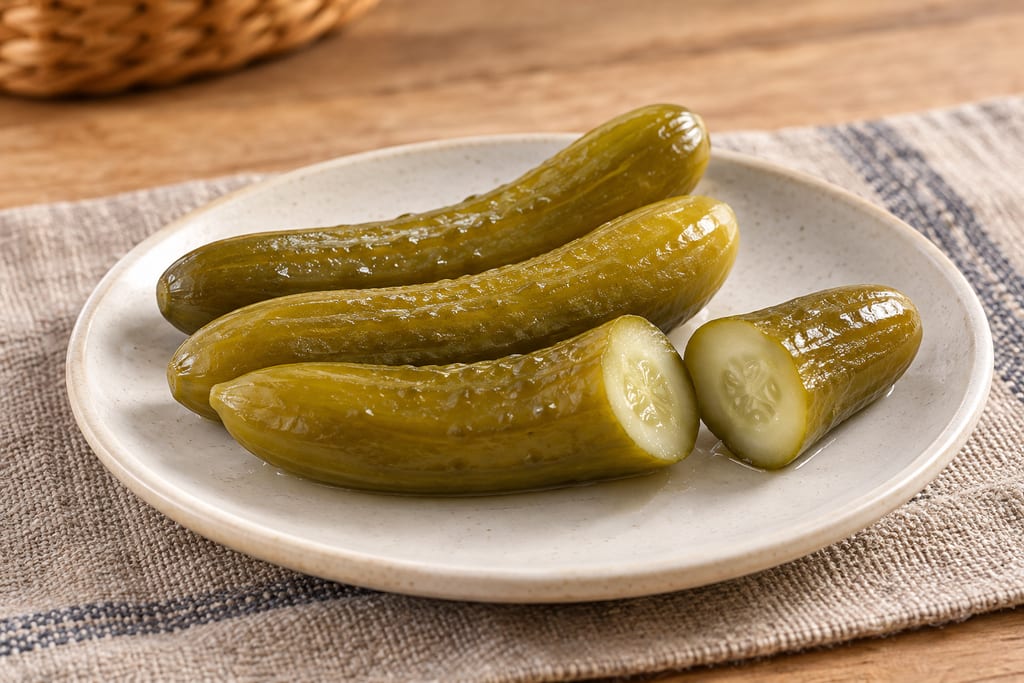
Çubuk turşusu is a registered pickle from Çubuk district in Ankara. Its cucumber variant is sold as Salatalık Turşusu, and a commercial specification sets its brine and room-temperature period.
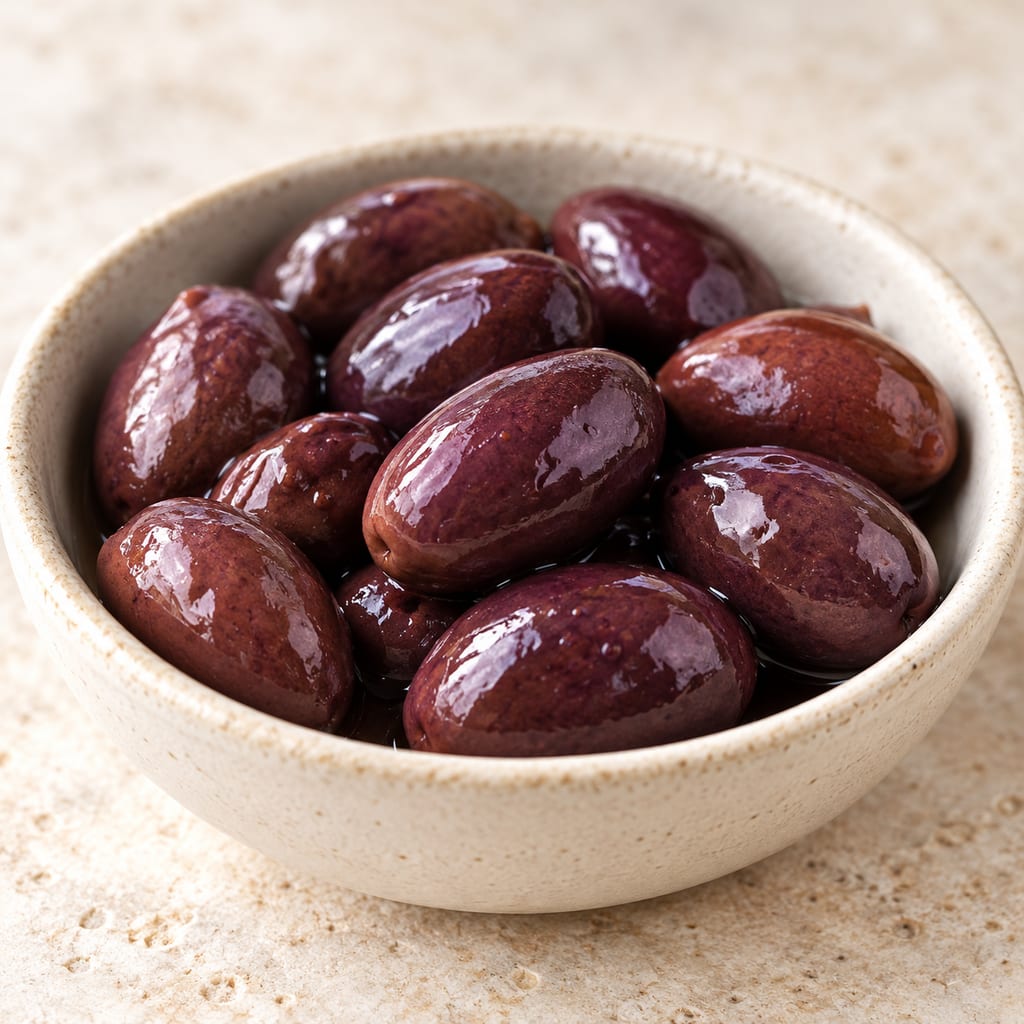
Elia Kalamatas is a Messinia table olive of the Kalamon variety, picked before full ripeness and fermented in brine for six to nine months; it is a PDO product, not a generic black olive.
Community
No community contributions have been published for this entry yet.
Share what you made
Sign in to contribute. Published comments and photos are free to read.
Japanese rice-bran pickle context; bed formula, starter cycle, cucumber timing and summer refrigeration advice.
Cited in: What is nukazuke?; For the rice-bran bed; For pickling; Stage 1 — Prepare the brine; Stage 2 — Combine the bed; Stage 3 — Add aromatics; Stage 4 — Begin the starter cycles; Stage 5 — Prepare the cucumber; Stage 6 — Bury the cucumber; Stage 7 — Pickle; Stage 8 — Remove and serve; Daily maintenance; Raw versus roasted bran; Regional and ingredient variations; How nukazuke is eaten; Safety and storage
Cited in: Historical context; Why rice bran works; Stage 1 — Prepare the brine; Stage 2 — Combine the bed; Stage 3 — Add aromatics; Stage 4 — Begin the starter cycles; Stage 5 — Prepare the cucumber; Stage 6 — Bury the cucumber; Stage 7 — Pickle; Stage 8 — Remove and serve; The microbiology of a mature nukadoko; Why a fresh bed and mature bed are not equivalent; Regional and ingredient variations; How nukazuke is eaten; Troubleshooting; Safety and storage