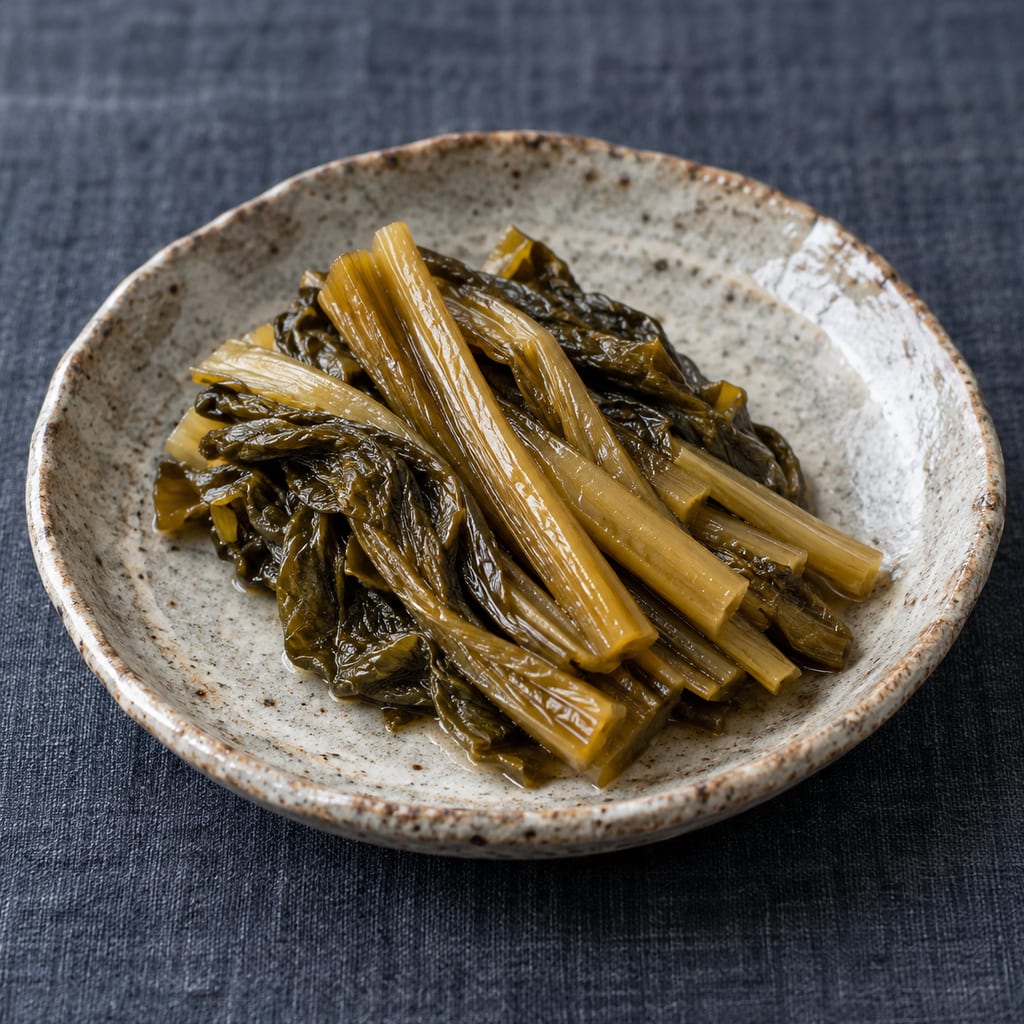
Aso takanazuke
Takana mustard greens from Aso in Kumamoto are salted and pressed into a fresh spring pickle, or aged into a sour furuzuke that is fried and mixed into takana rice.
 FermenteaWhere food goes to change
Traditional method
Nozawana-zuke
Nozawana greens salted in a barrel and weighted overnight, a Nagano household pickle sampled after about two weeks and soured by a month.
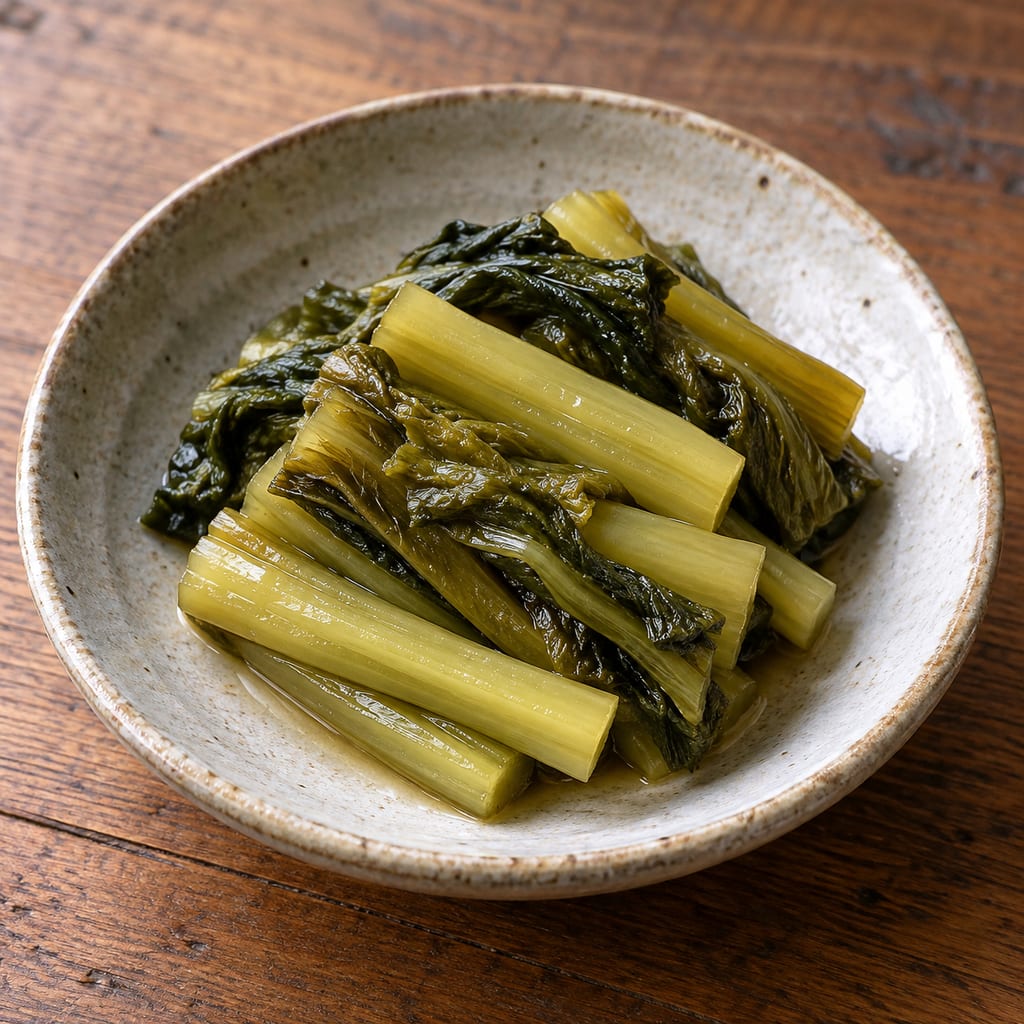
Nozawana-zuke is a traditional Japanese pickle made from the leaves and stems of nozawana, a leafy turnip vegetable particularly associated with Nagano Prefecture.
The name combines nozawana, the vegetable, with zuke, meaning a pickle or pickled preparation.
Nozawana belongs to Brassica rapa, a species containing several cultivated vegetable forms.
The plant is valued principally for its long leaf stalks and tender greens rather than for a large edible root.
When pickled, its stems retain a characteristic texture and its leaves become pleasantly salty, sour or both, depending on the preparation.
Young, lightly pickled nozawana may remain bright green and relatively mild.
Longer-aged nozawana develops stronger acidity and may turn yellowish or amber-brown.
These are not necessarily defects. They represent recognisable stages in the regional food tradition.
Nozawana-zuke belongs to the Japanese tsukemono family, but it has a distinct historical identity within Nagano.
Nagano is a mountainous prefecture with cold winters and extensive historical variation in local agriculture.
For farming households, winter limited access to freshly harvested green vegetables.
Pickling offered a way to carry part of the autumn harvest into the colder months.
A broad local category called ohazuke or onazuke refers to leafy pickles.
Different regions use different vegetables, including nozawana, Inanohana, Gensuke kabuna and Kisona.
Nozawana-zuke became particularly prominent.
Its association with winter is visible in the annual harvest and preparation cycle.
Seeds are sown during autumn.
The greens are harvested after cooler weather arrives.
Households clean and salt substantial quantities for use during winter.
The finished product is eaten with rice, in snacks and in cooked dishes.
It also became an important part of Nagano's wider food identity.
A priest associated with Kenmei-ji temple in Nozawa Onsen is said to have brought seeds of Tennoji turnip from the Kyoto or Osaka region.
The vegetable reportedly developed unusually large leaves and stems under the colder local growing conditions.
The resulting plant became associated with Nozawa and acquired the name nozawana.
This is an established local historical narrative.
The claim that a single sudden mutation directly produced the modern vegetable is harder to verify scientifically.
Plant adaptation, selection and cultivation may occur across generations, and the surviving food-history accounts do not establish a complete genetic history of the crop.
The story is therefore best understood as a regional explanation of the vegetable's identity rather than laboratory-confirmed botanical history.
The Japanese agricultural ministry records nozawana as one of Nagano's recognised traditional vegetables.
In 2007, it received designation under the Shinshu traditional-vegetable programme.
Nozawana is traditionally sown in September and harvested around November.
The plants can become quite large, with leaves and stems extending substantially above the ground.
Local accounts describe waiting until the vegetable has experienced frost.
Frost exposure is believed to improve sweetness and tenderness.
This is part of the established regional agricultural understanding.
The plant's structure makes it particularly suitable for pickling.
Long stalks can be arranged in bundles and packed into barrels.
Their texture remains recognisable after salting, while the leaves absorb brine and develop flavour.
Some historical methods retained part of the turnip root, while modern commercial harvesting often focuses on the foliage.
Cleaning the harvest became a seasonal event in northern Nagano.
The traditional practice is called onaarai or ohana-arai, meaning washing the pickling greens.
In Nozawa Onsen, the local hot-spring water was historically used for this work.
The association between the vegetable harvest, communal washing and winter preparations became part of regional cultural identity.
It demonstrates that pickling was not simply a kitchen operation.
Large quantities of vegetables had to be harvested, transported, cleaned, arranged and weighted.
These activities required labour and suitable equipment.
Modern plumbing and commercial processing have reduced the visibility of some older communal practices.
Nevertheless, the seasonal preparation of nozawana-zuke continues.
The Japanese Ministry of Agriculture publishes a traditional regional recipe supplied by the Saku City Rural Life Masters.
Nozawana greens — 40 kg
Pickling salt — 1–1.3 kg
Shochu, 35% alcohol — 360 mL
Cut kombu — Approximately 160 g
Chilli peppers — Up to approximately 80
Suitable barrel and food-contact liner — One large traditional batch
This is a substantial household or community-scale formulation.
The vegetable-to-salt ratio represents approximately 2.5–3.25% salt by vegetable weight, calculated from the published amounts.
The recorded method does not specify the exact finished equilibrium salt concentration after the greens release water.
The recipe should therefore not be represented as a laboratory-validated formula that every smaller jar can safely imitate without adjustment and testing.
Nozawana supplies the vegetable tissue, natural carbohydrates and characteristic flavour.
Salt draws water from the leaves and stalks, creating brine.
The salt also changes the environment in which microorganisms develop.
Shochu is used in the documented procedure partly for traditional mould suppression.
However, the quantity used does not sterilise the complete vegetable batch.
Kombu contributes savoury flavour, including compounds associated with umami.
Chilli adds pungency and aroma.
Different households may omit some seasonings or use alternative additions.
The vegetable and salt are fundamental to the traditional preservation method; the other ingredients belong to the documented regional formulation.
1. Prepare the barrel. Wash and dry the traditional vessel. Use suitable food-contact materials for the liner.
2. Trim and wash the greens. Leave a little of the stem base. Large stems may be slit so trapped soil can be removed thoroughly.
3. Apply shochu. The recipe uses 180 mL around the barrel and the remaining 180 mL inside the lined vessel.
4. Arrange the first vegetable layers. Place nozawana in the barrel and distribute pickling salt across the greens.
5. Compress successive layers. The traditional procedure uses protective plastic sheeting and foot pressure to compact the greens. This is a historical process description, not a substitute for modern hygienic equipment.
6. Continue layering. Add the remaining greens and salt, together with the documented seasonings as appropriate to the recipe.
7. Apply the first weight. The published method uses 30–40 kg of weight over the packed vegetables.
8. Allow brine to rise. Salt draws moisture from the vegetables, and the weight helps maintain contact and compaction.
9. Reduce the load. Once sufficient liquid has formed, the recipe reduces the weight to 10–20 kg, keeping the greens submerged.
10. Address insufficient liquid. The published method mentions adding 5–10% brine when necessary. This is an adjustment within that particular large-batch procedure, not a universal rule.
11. Allow the documented maturation. The recipe describes eating after approximately one month, with other regional accounts mentioning sampling after 2–3 weeks.
The regional recipe identifies preparation after 23 November as traditional timing.
That date belongs to the local seasonal context and should not be treated as a worldwide requirement.
Nozawana contains substantial water inside its cells.
When dry salt is applied, the concentration difference encourages water to leave the vegetable tissue.
The released water dissolves salt and forms brine.
Pressure assists the process by compressing leaves and stems.
The resulting brine allows salt to move through the vegetable mass.
However, salt distribution is not instantaneous.
Tightly packed stems, thick bases and different leaf structures may absorb salt at different rates.
This is one reason the preparation includes both initial heavy pressure and subsequent weight reduction.
Too little liquid may expose vegetables to air, while unsuitable pressure or handling can damage the product.
The desired outcome is adequate coverage and controlled maturation.
The early preservation stage involves salt extraction.
Microbial fermentation may then contribute increasing acidity.
Lactic-acid bacteria consume available vegetable carbohydrates and produce organic acids.
As acidity develops, the flavour becomes sharper.
The cold Nagano winter influences the process.
Lower temperatures generally slow bacterial metabolism compared with warm fermentation conditions.
A pickle may therefore continue developing over weeks rather than undergoing a rapid transformation.
The particular microbial community in nozawana-zuke is not established by the cited ministry recipe as one fixed set of species.
Japanese fermented-vegetable research identifies several lactic-acid bacterial groups in related pickles, but it would be inaccurate to assign every organism found in one study to all nozawana batches.
The fundamental process is salt-assisted preservation with subsequent microbial acid development in traditionally matured products.
Asazuke describes a relatively lightly pickled preparation.
In nozawana-zuke, this often means a greener, fresher-tasting product with less developed sourness.
The stems can remain crisp.
The flavour is more strongly associated with fresh vegetable and salt.
Modern commercial products frequently favour this brighter green appearance.
Not every product sold as asazuke has undergone substantial fermentation.
Some are more accurately described as lightly salted or seasoned vegetables.
The production method and actual acidity determine the distinction.
This matters in a fermentation database: the label nozawana-zuke alone does not prove that a particular packaged product is a live fermented vegetable.
Furuzuke means an older or longer-aged pickle.
In nozawana, it develops greater sourness and often an amber or yellowish colour.
The vegetable becomes more seasoned and less like a fresh green.
The acidity can become strong enough that the food is better used in cooking.
The Japanese agricultural ministry specifically recommends aged nozawana in stir-fried dishes because it pairs well with oil.
This reflects a wider culinary principle: acidity can balance rich fats, while cooking softens some of the sharper impressions of a fermented pickle.
The colour change is not necessarily spoilage.
Pigment degradation and changes in the plant tissue contribute to the older appearance.
Nevertheless, visual colour alone cannot establish safety.
The simplest serving is chopped pickle alongside rice.
It can be eaten with tea or offered as a savoury accompaniment to drinks.
Nozawana also appears in rice balls, onigiri.
The chopped vegetable can be mixed with rice or used as a filling.
Another important regional food is oyaki, a stuffed dumpling associated with Nagano.
Nozawana filling provides a savoury, slightly sour contrast to the dough.
The pickle can also be combined with natto, Japanese fermented soybeans.
In this pairing, nozawana contributes salt, vegetable texture and acidity to the sticky, strongly flavoured beans.
Modern dishes include pasta, fried rice and vegetable stir-fries.
The older sour pickle is especially useful when cooked with oil.
Some preparations rinse or desalt aged nozawana before using it in a cooked dish.
The exact soaking procedure depends on the original pickle's salt concentration and is not fixed by the ministry's general description.
Nagano has several local leafy vegetables used for winter pickles.
Inanohana, Gensuke kabuna and Kisona are among those identified in regional food histories.
Their relationship to nozawana-zuke is cultural and technical.
They share the practice of preserving autumn greens, but differ in plant variety, locality and sometimes flavour.
A reference collection should preserve their local names and botanical distinctions rather than merging every salted green into one entry.
Sunki from Kiso is another important comparison.
Although visually similar when aged, sunki is traditionally salt-free and relies on a starter-assisted fermentation.
Nozawana-zuke uses salt and follows a different preservation system.
A successful product should have the expected texture, seasoning and degree of sourness for its intended stage.
A young pickle should not be required to exhibit the strong acidity of a mature furuzuke.
Conversely, a mature pickle may become more yellow or amber without necessarily being defective.
Persistent exposure above the brine increases the opportunity for unwanted surface growth.
Visible mould, putrefaction or abnormal slime require rejection.
The traditional use of shochu does not eliminate the need for hygienic handling.
Commercial producers must establish appropriate microbiological standards.
Nozawana-zuke is a salt-preserved vegetable that may undergo lactic-acid fermentation.
Its safety depends on actual salt concentration, acidity, temperature and hygienic processing.
The ministry's 40 kg recipe is a documented traditional formulation.
It is not a blanket approval for arbitrary changes in salt quantity, temperature or storage.
The historical maturation periods describe culinary development, not independently validated shelf lives.
A commercial product should be assessed for its actual processing method and intended conditions of sale.
Nagano household tradition.
Scaling: source batch only
Poor brine coverage or inadequate acidity monitoring can allow spoilage; recipe-specific validated limits are not established.
Hazard sourceUse clean food-grade equipment, keep produce submerged and monitor acidity; no universal endpoint is supplied for this recipe.
Control sourceThe source supports this broad area and no precise location.
Takana mustard greens from Aso in Kumamoto are salted and pressed into a fresh spring pickle, or aged into a sour furuzuke that is fried and mixed into takana rice.
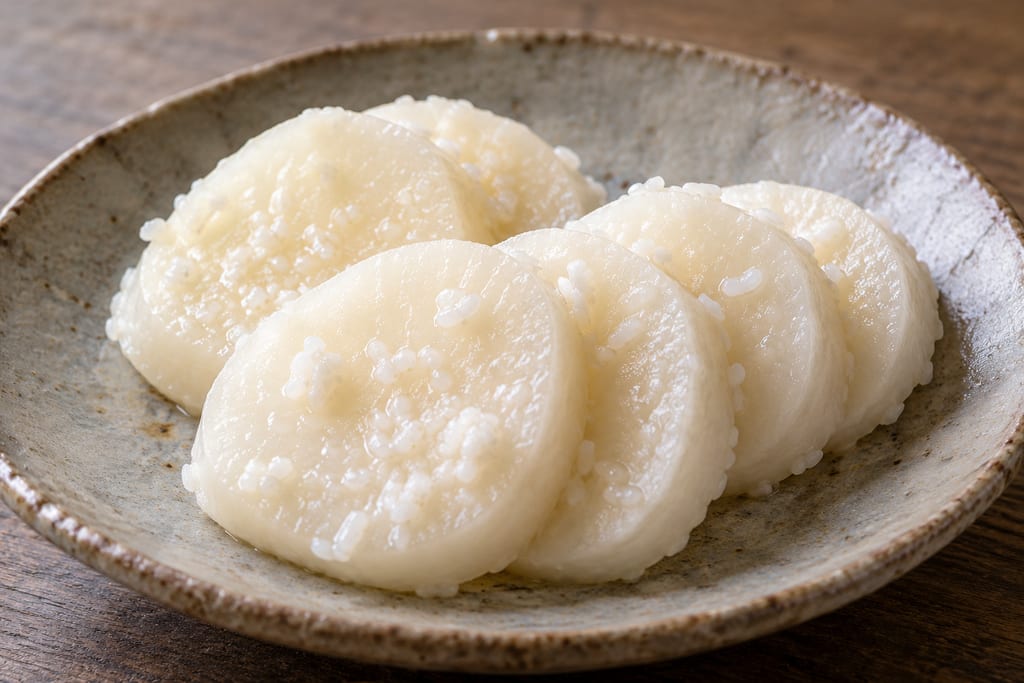
A sweet, crisp Japanese daikon pickle from Tokyo's Nihonbashi district, made by salting fresh radish and dressing it in rice koji, sugar or koji amazake without the heavy drying used for takuan.
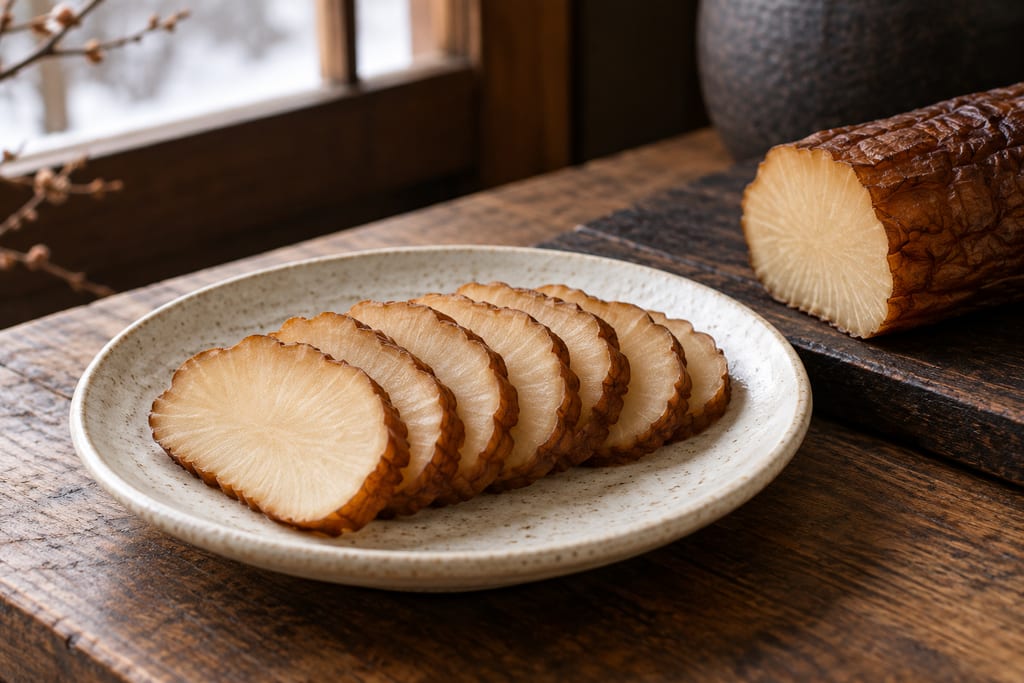
Iburigakko is Akita pickled daikon dried with smoke before it is fermented in rice bran.

A Morinaga snack pairs thin ribbons of iburigakko with cream cheese, then chills the roll before cutting it into portions.
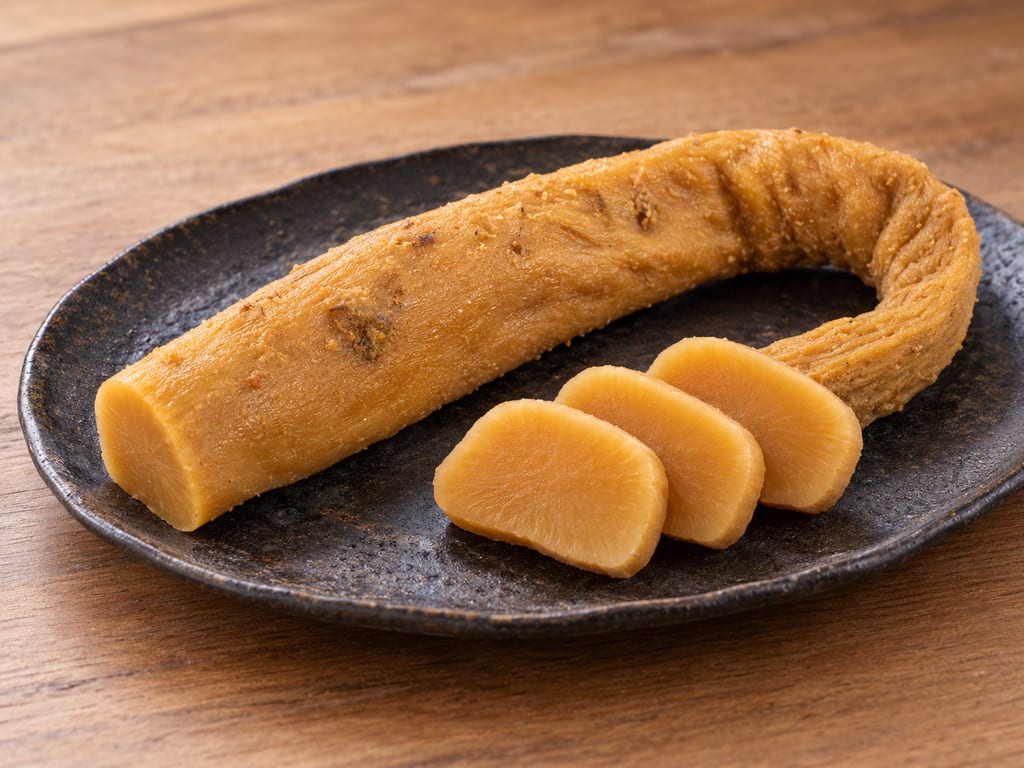
Regional takuan from Ise City, Mie, made with Misono daikon dried on a rack, then matured in a weighted barrel of rice bran and salt for months to years.
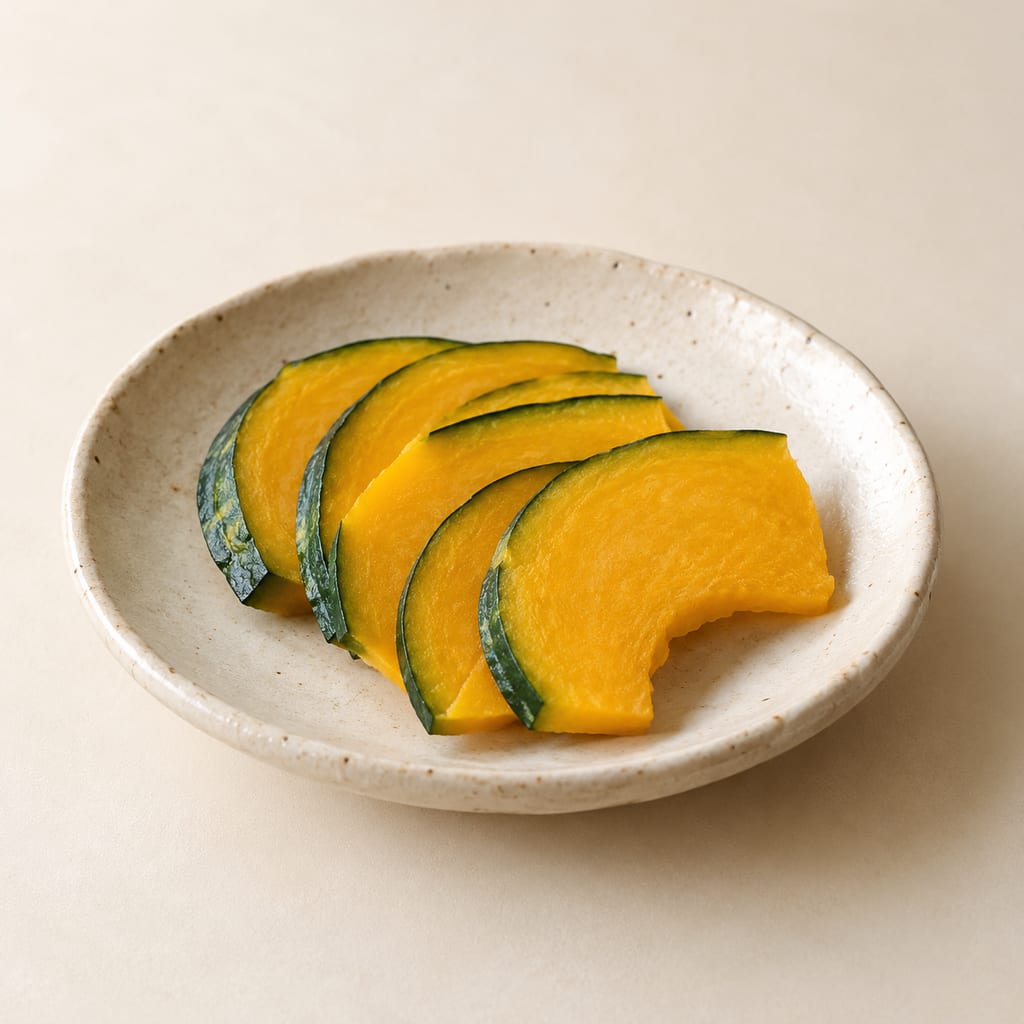
Kabocha no nukazuke: Refrigerated commercial fermented bed; use removed portions the same day.

Foods embedded in salty fermented miso paste, which transfers salt and fermentation products into them; misozuke uses an already transformed medium rather than a fresh vegetable brine.
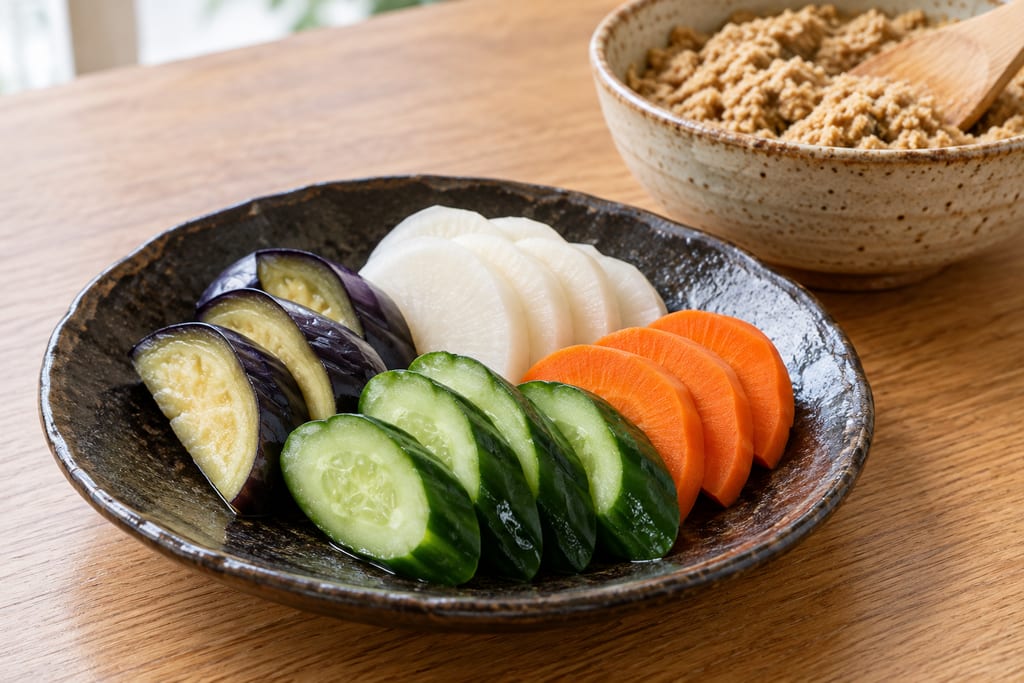
Japanese pickles made by burying vegetables in nukadoko, a reusable bed of rice bran, salt and water that is turned daily and ripened by lactic and yeast fermentation.
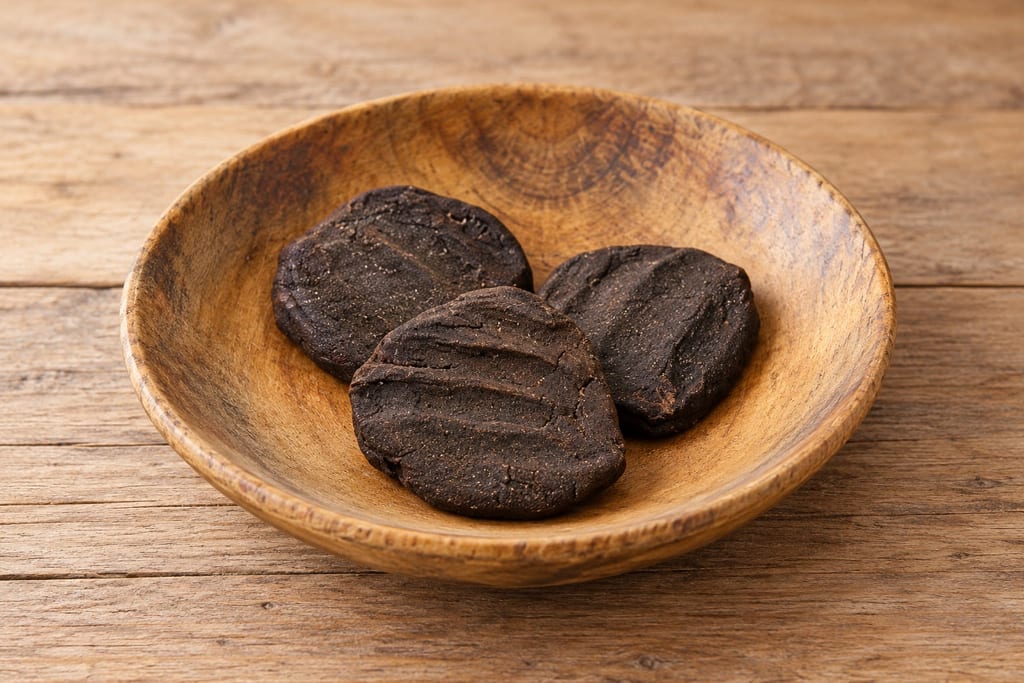
Dried cakes of pounded taro leaves from the Ao Naga in Nagaland, yellowed in a bag, then dried by hot ash or sun and used to flavour meat dishes.
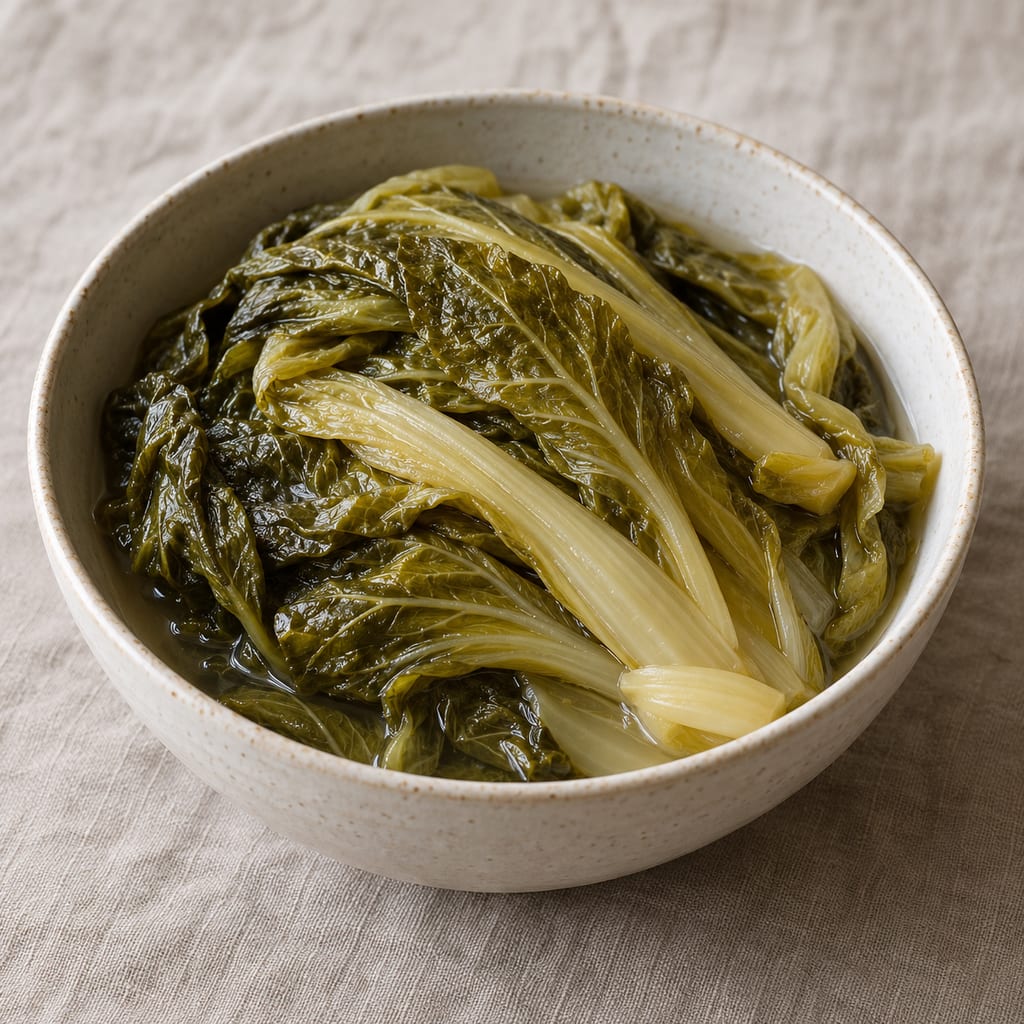
Wilted flat mustard leaves ferment with rice water and salt as a Filipino appetizer and cooking ingredient.
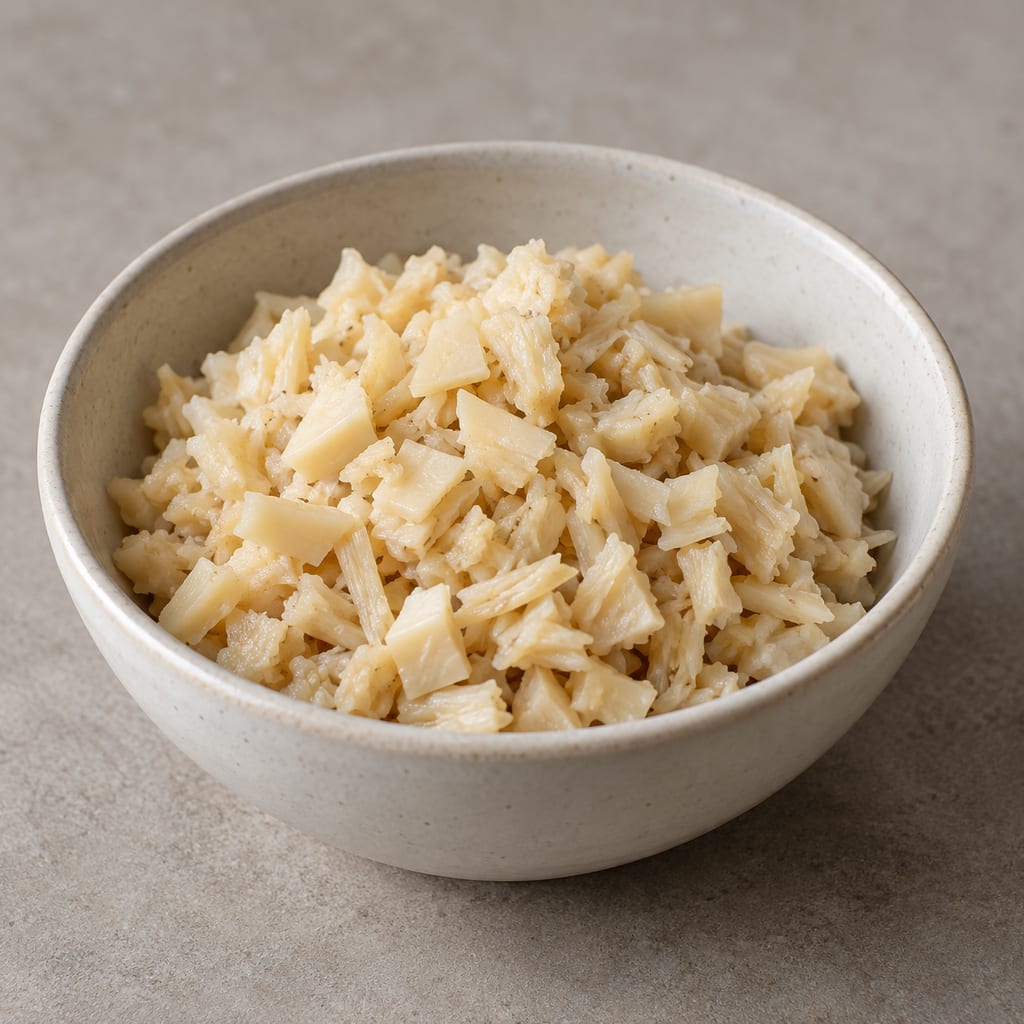
Finely chopped young bamboo shoots packed in leaf-lined baskets, sealed in a forest pit and weighted for one to three months, from Arunachal Pradesh.

Pit-fermented bamboo shoots from Arunachal Pradesh, cut smaller and sun-dried for five to ten days, used in curries.
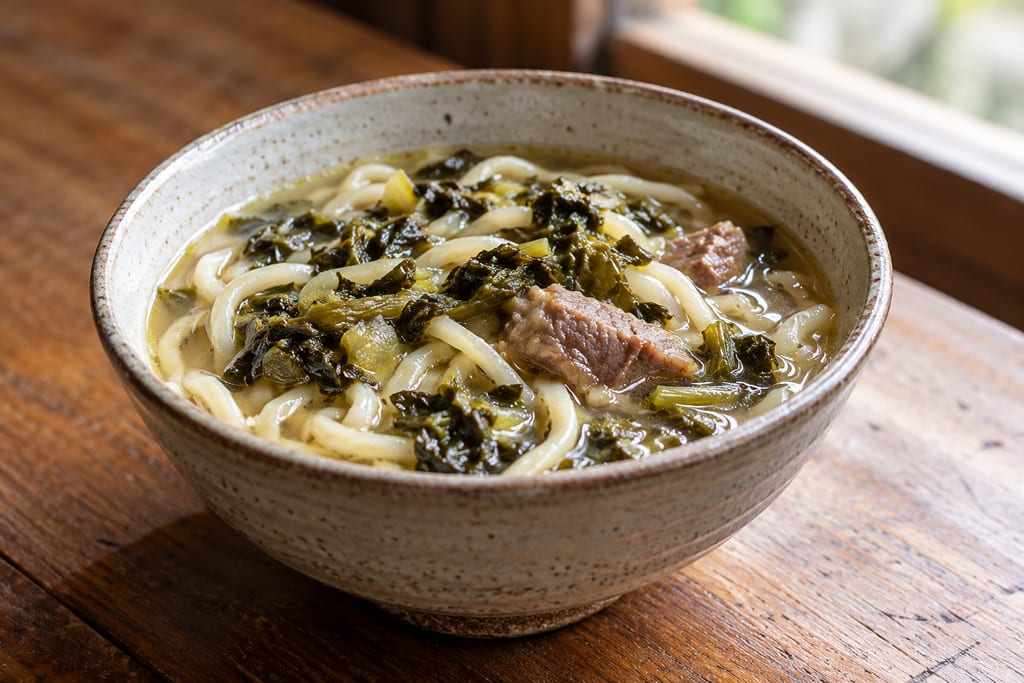
Goyang is a Sherpa fermented wild leafy food of the Darjeeling hills and Sikkim. Rainy-season magane-saag leaves are packed in a bamboo basket, held at room temperature for about a month, then eaten fresh or dried and used in soup.
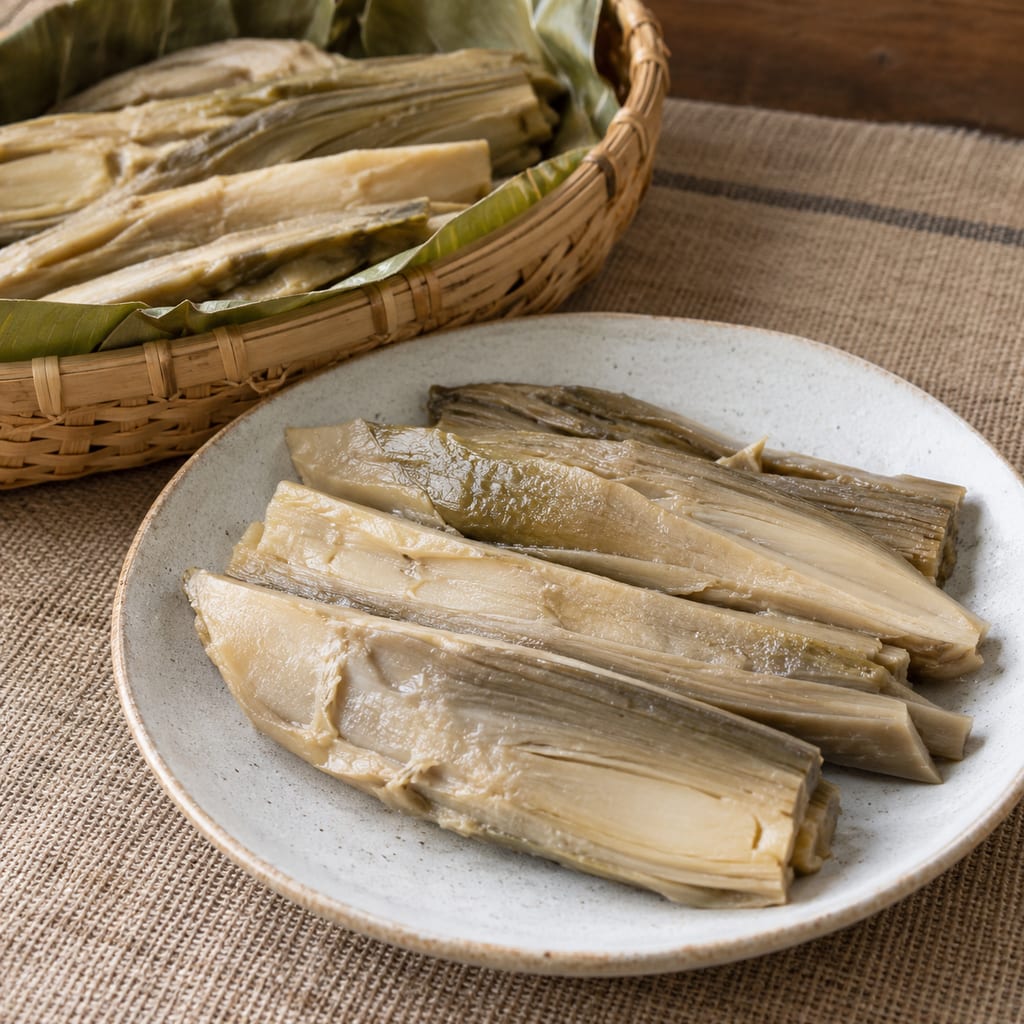
Upper tender bamboo-shoot tips, split or flattened, pit-fermented one to three months in Arunachal Pradesh and eaten in curries.
The original Polish barszcz: young hogweed leaves soured in warm water for a few days, then boiled into soup with egg, butter, cream or millet. Recorded from 1595, with warnings about the sap and lookalikes.
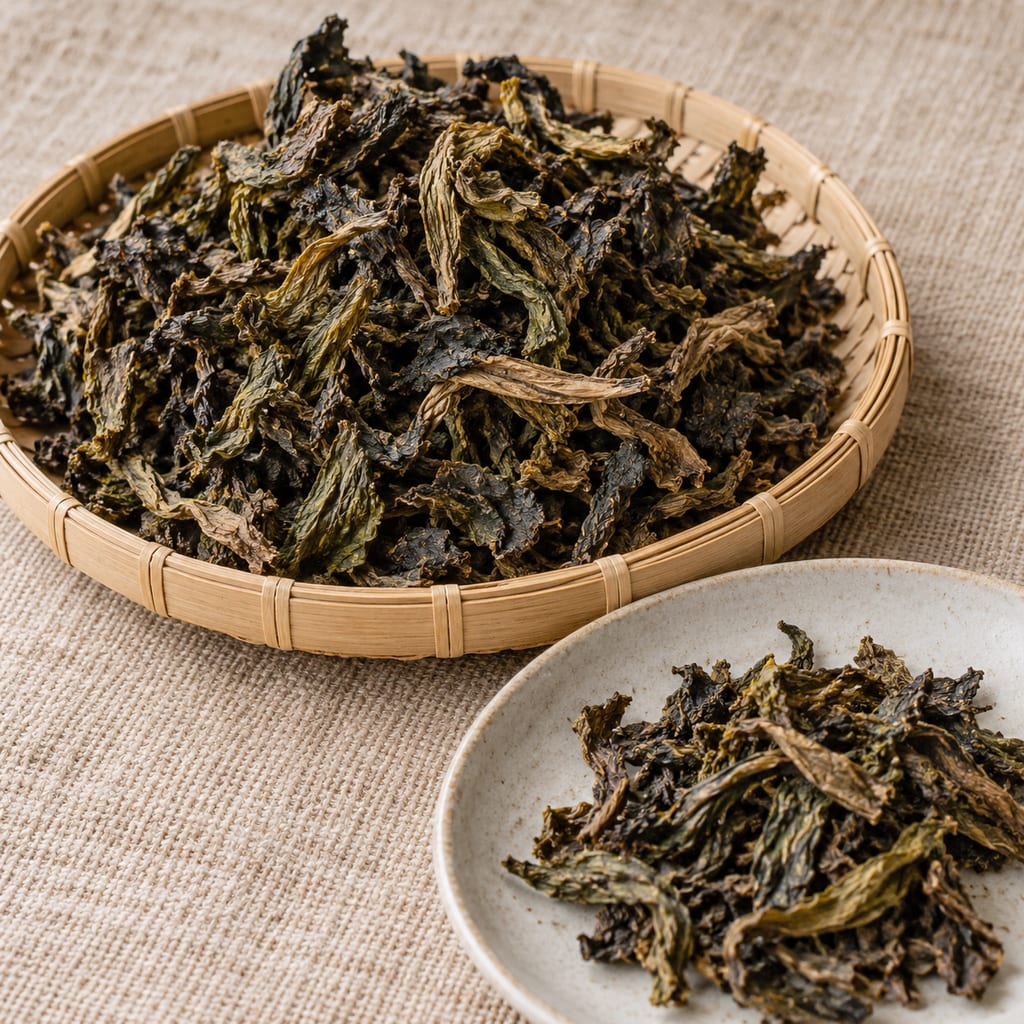
Inziangsang is a Naga fermented food of mustard leaves from Nagaland and Manipur. Crushed, soaked and squeezed leaves ferment for 7 to 10 days, then dry in the sun. A squeezed liquid can be boiled to a concentrate.
No community contributions have been published for this entry yet.
Sign in to contribute. Published comments and photos are free to read.
Japan MAFFInspiration
Nozawana-zukeregional household method and history
Cited in: What is nozawana-zuke?; Nagano's winter food culture; The traditional origin story; Seasonal harvesting; The custom of washing nozawana; Ingredients — documented large barrel batch; What the ingredients contribute; The documented barrel method; Asazuke: the younger pickle; Furuzuke: the aged pickle; How nozawana-zuke is eaten; Related leafy pickles; Safety and storage
University of Minnesota ExtensionSafety
Preserving food at home: FermentationProduce fermentation equipment, acidity monitoring and submersion controls.
Cited in: Ingredients — documented large barrel batch; What the ingredients contribute; The documented barrel method; How nozawana-zuke is eaten; Quality and troubleshooting; Safety and storage
MAFFReference
MAFF — Nozawana-zuke, Nagano Regional RecipeCited by the written account of this record.
Cited in: Ingredients — documented large barrel batch; What the ingredients contribute; The documented barrel method; How nozawana-zuke is eaten; Safety and storage
MAFFReference
MAFF — Japanese-language Regional RecipeCited by the written account of this record.
Cited in: Ingredients — documented large barrel batch; What the ingredients contribute; The documented barrel method; How nozawana-zuke is eaten; Safety and storage
FAOReference
FAO — Lactic-Acid Fermentation PrinciplesCited by the written account of this record.
Cited in: Ingredients — documented large barrel batch; What the ingredients contribute; The documented barrel method; The chemistry of salt extraction; Microbiology of maturation; How nozawana-zuke is eaten; Safety and storage