Hogweed
Hogweed, Heracleum sphondylium, is the meadow plant of the carrot family that gave barszcz its name. Its young leaves were soured into soup; its sap burns skin in sunlight.
 FermenteaWhere food goes to change
Traditional method
barszcz · barszcz z barszczu · hogweed borscht · kwaszony barszcz zwyczajny
The original Polish barszcz: young hogweed leaves soured in warm water for a few days, then boiled into soup with egg, butter, cream or millet. Recorded from 1595, with warnings about the sap and lookalikes.
Hogweed sap burns skin in sunlight. Common hogweed, Heracleum sphondylium, carries furocoumarins, including bergapten, in its sap, stems, leaves and fruits. Sap on skin makes it react to sunlight, with redness, blisters and burns that can last for weeks or months. Wear gloves and long sleeves when you gather and chop it, and keep sap off your skin and out of your eyes.
If sap touches your skin, wash it at once with soap and water and keep the skin out of sunlight for 1–2 days. If sap gets in your eyes, rinse them with water for at least 15 minutes. Seek medical advice if symptoms persist or get worse. Wash any clothes and tools the sap touches.
Never confuse it with giant hogweed, Heracleum mantegazzianum, or with poison hemlock and other toxic plants of the carrot family. Giant hogweed has thick, bristly stems blotched with purple and can reach 5 m; its sap causes severe burns and scarring. Poison hemlock is deadly in every part, and people mistake it for cow parsnip, wild chervil and wild carrot. Never gather from a plant with purple-blotched or purple-spotted stems.
Gather hogweed only when an expert botanist or experienced forager has confirmed the plant in person. If you have any doubt, do not forage it at all.
The European Food Safety Authority lists common hogweed among botanicals with substances of possible concern for human health in food, because of its furocoumarins. No source gives a safe intake, and none assesses hogweed in pregnancy. If you are pregnant, breastfeeding or have a medical condition, ask a doctor before eating it. The method on this page is historical and untested.
Hogweed barszcz is a sour soup made from the young leaves and stalks of common hogweed, Heracleum sphondylium. The greens were covered with water and left until they turned sour, then the sour liquid and the softened greens were boiled into soup. In Poland, Lithuania and Ruthenia it was an everyday soup in the sixteenth and seventeenth centuries, and the plant gave the soup its name. Barszcz meant hogweed before it meant a soup of beets.
Gloger's Old Polish encyclopedia says plainly that Polish country people first cooked barszcz from the herb called barszcz. The ethnobotanist Łukasz Łuczaj calls hogweed soup the original barszcz. Beetroot took over the pot and the name in the eighteenth century, and the hogweed version faded to a food of the poor and then to a few village memories.
This page sets out what is recorded about the soup, how it was made, how it was finished at the table, and why the plant needs more care than most wild greens. It separates the historical record from the modern method, and it does not treat the old method as tested.
Common hogweed is a perennial of the carrot family, Apiaceae. It grows on fertile meadows, on roadsides and around farmyards. The Royal Horticultural Society gives its height as up to 2 m and notes that its leaves are more rounded than those of giant hogweed and that its stems have no purple blotching. Gloger says it grows tall on meadows and near villages and flowers in June. Like other members of the family, it carries its flowers in compound umbels on furrowed stems, with leaf bases that widen into a sheath around the stem.
Aleksander Brückner's etymological dictionary gives barszcz as the old Slavic name for Heracleum, with related plant names in Czech and Slovene. He linked the word to a root for something bristly or pointed, after the sharp leaves, and compared German Borste. From the eighteenth century, he wrote, barszcz came to mean a sour soup of beets and also the rye soup called white barszcz, which replaced the original.
The first printed description in Polish is in the herbal of Marcin of Urzędów, published in Kraków in 1595. In Łuczaj's translation, Marcin writes that "when they make it sour in the Polish way, it is good to drink in fevers, thirst, as it alleviates thirst" and that it whets the appetite. He adds that, garnished with egg and butter, it was good on days when meat soup was not allowed. He also records the saying that barszcz neither helps nor harms, and argues that it does help.
Szymon Syreński's herbal, printed in 1613, gives the fullest early account. He says the leaves were commonly gathered in May and that the soup, as made in Poland, Lithuania and Ruthenia, was tasty, "either cooked on its own or with chicken or other ingredients such as eggs, cream, millet." That short list is the best evidence for how the soup was finished in his time.
In 1597 the English herbalist Gerarde wrote that the people of Poland and Lithuania made a drink from a decoction of the plant with leaven or something made of meal, used instead of beer. The Polish sources describe a soup. Both fit a sour liquid that could be drunk or boiled into a meal.
No early source gives a recipe with amounts. The method comes from short descriptions that agree with each other across three centuries. Łuczaj's 2007 review says the young leaves and stalks were covered with warm water and left for a few days to become sour. His 2011 survey says chopped stems, leaves and flower heads were put into barrels or other vessels and covered with water, and that they fermented after some time.
In 1799 the botanist Jundziłł, writing about Lithuania, said people gathered young leaves and fermented them "in the same fashion as other vegetables", in Łuczaj's translation. He also said the leaves could be dried in the shade like celery and kept for later use. So the plant was stored two ways, as a sour and as a dried green.
The clearest household account comes from the twentieth century. Anna Tomiak, born in 1880 in Straconka, now part of Bielsko-Biała, made the soup until the 1940s or 1950s. Her grandson, the botanist Adam Zając, told Łuczaj that she put stalks and leaves in a jar, covered them with water, left them for a few days and then cooked soup with them. No other detail of her method survives.
The change has been described but never measured. Łuczaj, who has made the ferment himself, writes that by a warm stove it becomes pleasantly sour in two days, and that after a few more days it smells stronger than sauerkraut. He notes that the fermenting greens can hold a little alcohol and describes the result as something between beer and pickled cabbage.
No source read for this page identifies the microbes involved or gives a pH, a salt level or an end point. The process here is therefore recorded as not established. Jundziłł's comparison with other fermented vegetables and Gerald Wyżycki's 1845 remark that the sour hogweed dish could stand in for pickled cabbage place it among the household sours, but they do not prove it behaves like a salted cabbage ferment. The historical method used no salt that any source mentions.
The sour greens were not eaten as a relish. They went into a soup. Syreński lists chicken, eggs, cream and millet as things cooked with it, and Marcin names egg and butter for days when meat soup was not allowed.
In the dinners of the Jagiellonian University professors in Kraków, as Karbowiak described them in 1900, barszcz was the Wednesday soup through Lent and was also served on the first day of Easter, after szołdra and eggs. The sources do not say what each of those soups contained, but they show that the same sour soup served both fast days and feast days.
Beyond Syreński's list, the sources give no proportions, cooking times or order of adding, so this page does not supply them.
Łuczaj writes that seventeenth-century sources agree hogweed soup was one of the main soups. By the eighteenth century it had become a rare food of poorer people. Kluk's plant dictionary of 1786 to 1788 does not mention it. Rostafiński concluded that it stopped being made in Poland in the eighteenth or nineteenth century, with the last Lithuanian record in 1845. The ethnographer Moszyński still saw it made in Russia in the twentieth century.
Letters sent to Rostafiński's 1883 questionnaire show the soup still in use in Polesie, now in Belarus, from places including Secieszyn near Kleck, Rawonicze, Kuchcice and Nowogródek. Inside today's Poland, the records are few and late: Kościerzyna in the nineteenth century, Łapsze Niże in the Spisz area until the 1920s, northern Podlasie into the first half of the twentieth century, Rabka Zdrój before the First World War, and Anna Tomiak's jar in Straconka.
In Rabka, a 1948 survey recorded the plant under the names borszczek and burak dziki, wild beet. By then the vegetable that had replaced hogweed in the pot had lent the plant its own name.
Rye barszcz, soured with leaven, was described by Hercius in 1660. Beet barszcz, made from a barrel of soured beets, took over the name in the eighteenth. Both kept the idea of a sour liquid boiled into soup, which is the thread that runs back to hogweed.
Related species have been eaten elsewhere. DermNet notes that the young leaf stalks and stems of cow parsnip, the North American relative, were traditionally eaten like stewed celery. Łuczaj's 2020 essay notes that the genus grows across Eurasia and North America. These uses are not the Polish sour soup, and nothing about them makes the plant safer to handle.
Identification comes before anything else. The carrot family includes deadly plants such as poison hemlock, and giant hogweed can be mistaken for the common species.
Giant hogweed, Heracleum mantegazzianum, is the first risk. The RHS describes thick, bristly stems blotched with purple, hollow inside, reaching 5 m or more, with umbels up to 60 cm across. Young giant hogweed can be mistaken for the common species. The RHS says all four giant hogweed species contain high levels of furanocoumarins, and that touching the plant with bare skin can cause severe photodermatitis with burning, blistering, pigmentation and long-lasting scarring.
Poison hemlock is the second. Poison Control describes smooth, hollow, bright green stems with red or purple spots, lacy fern-like leaves and a musty smell, and lists cow parsnip, angelica, wild chervil and wild carrot among the plants it is confused with. Its poison, coniine, is present in every part. Poison Control says a hemlock exposure is not safe to treat at home.
Syreński warned in 1613 that people mixed up a water-loving plant he called wodny barszcz with the Polish barszcz. Anyone who cannot identify common hogweed with complete certainty, in person and with an experienced botanist or forager, should not gather it.
Common hogweed contains furocoumarins, including bergapten, that make skin react to sunlight. DermNet describes the rash that follows cutting the plant with a string trimmer, streaked where the sap landed, which can last for months. The young leaves and stalks used for soup carry the same sap.
The RHS advice for giant hogweed applies to any contact with sap. Wash skin that touches the plant immediately, keep it out of sunlight and seek medical advice. Sap on clothes and tools can also damage skin, so handle them carefully and wash them well. Cover your skin while gathering and chopping.
The method below follows the documented steps and adds the safety controls the sources name. It is not a tested modern recipe. The sources give no weights, salt, pH or storage limits, and this page does not supply them. Treat it as a record of how the soup was made, not as a guarantee that a home batch is safe.
Gather only young leaves and stalks in May, as Syreński describes, and only from plants identified with certainty. Chop them under cover from direct sun, put them in a clean jar or crock and cover with warm water. Leave the jar in a warm place. Łuczaj found it pleasantly sour in about two days by a warm stove. The older sources say a few days. Then boil the liquid and greens together into soup and finish it with egg, butter, cream or millet. Smell, taste and bubbles do not prove the ferment is safe. Discard any batch that is mouldy, slimy or rotten.
The sources do not say how much greens went to how much water, whether salt was ever added, how long the sour was kept once made, or how the dried leaves Jundziłł mentions were cooked. Rostafiński's 1916 monograph on ćwikła, beets and barszcz is cited here through Łuczaj's accounts of it. No source gives a safety assessment of the ferment.
Marcin of Urzędów (1595) and Syreński (1613) describe hogweed soured in the Polish way and cooked as soup; it was a main soup in the seventeenth century, rare by the eighteenth, and survived in Polesie and a few Polish villages into the twentieth.
Scaling: not established
Hogweed contains furocoumarins, including bergapten, which cause phototoxic skin reactions; strimmer rashes can last for months.
Hazard sourceYoung giant hogweed can be mistaken for common hogweed; bare-skin contact can cause severe photodermatitis with blistering and scarring.
Hazard sourcePoison hemlock is confused with cow parsnip, angelica, wild chervil and wild carrot; coniine is present in all parts.
Hazard sourceThe sources describe greens soured in water for a few days with no salt, pH, end point or storage limit.
Hazard sourceWash skin that touches the plant immediately, keep it out of sunlight and seek medical advice; handle and wash sap-stained clothes and tools carefully.
Control sourceDo not gather unless the plant is identified with certainty; treat any suspected hemlock exposure as an emergency rather than at home.
Control sourceBoil the soured greens and liquid into soup before eating, as in every historical account.
Control sourceWear gloves and long sleeves; keep hogweed sap off skin in sunlight.
Smell, taste and bubbles do not prove this ferment is safe.
No tested modern method exists in the sources read; this is a historical method.
Never gather from plants with purple-blotched stems.
Place of printing of Marcin's and Syreński's herbals and of the professors' dinners.
The only area where the soup survived as a common dish.
Anna Tomiak's jar method.
Local names borszczek and burak dziki.
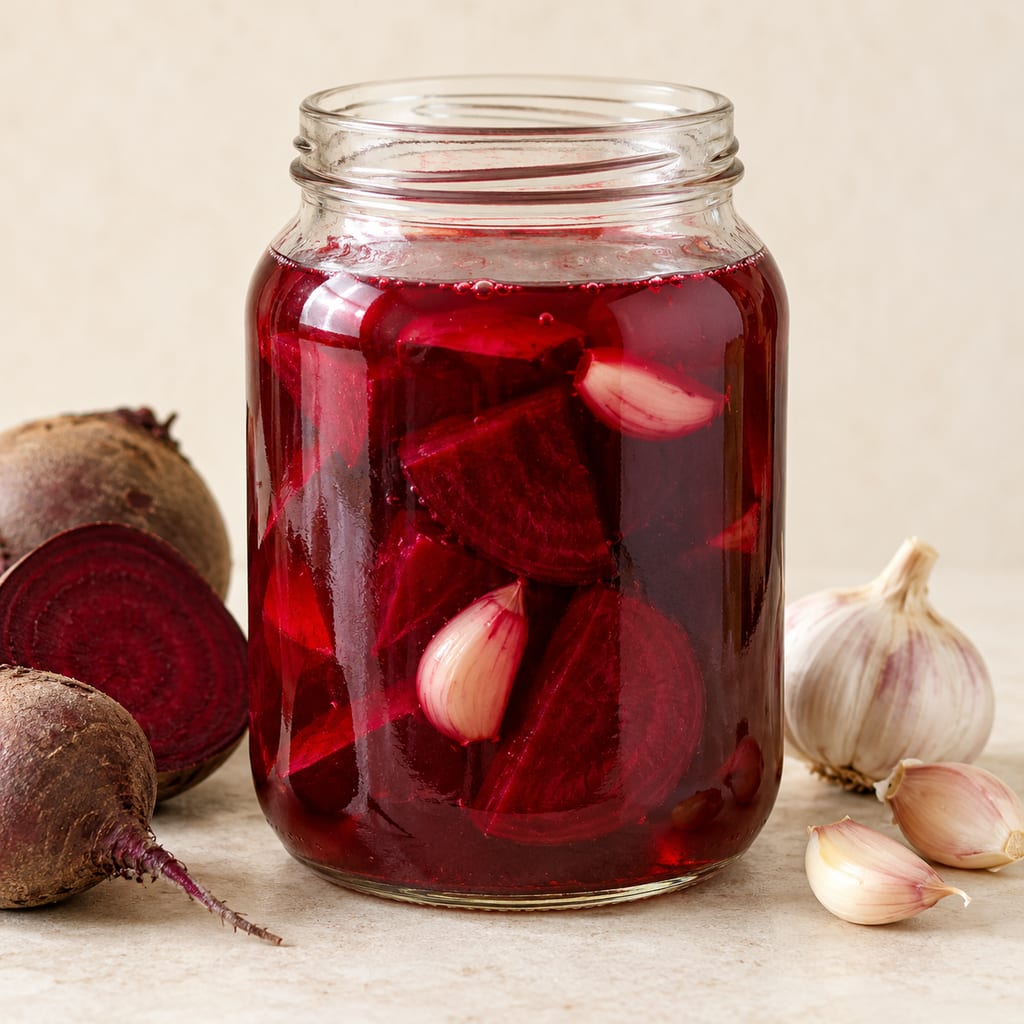
Zakwas buraczany is the fermented red-beet liquid used as the sour base for Polish beet barszcz. The liquid is made from beetroot, garlic, salt and water, and the official sources give no quantities.
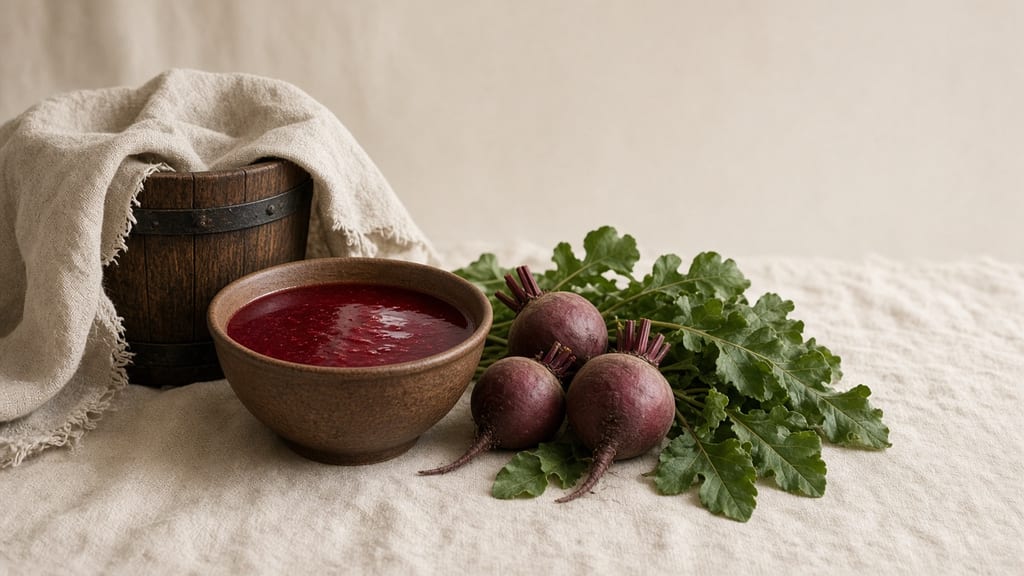
Before beetroot, Polish barszcz was a soup of soured hogweed leaves. Herbals, menus and an old cookbook show how a rye sour and then the beet barrel took over its name.
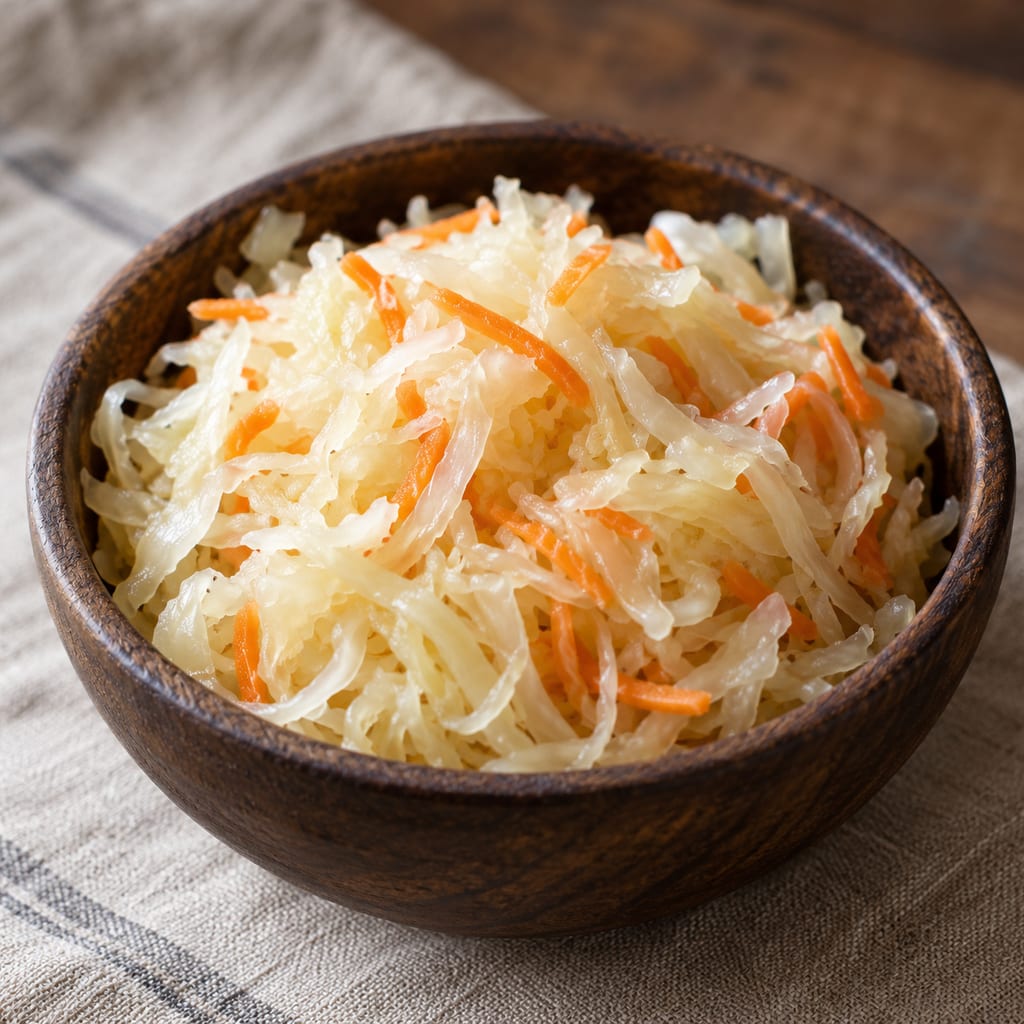
Kapusta kiszona z beczki is barrel-fermented cabbage from the Kołobrzeg area, entered on Poland’s List of Traditional Products in 2008. It is salted and fermented, with raw grated carrot added after souring.
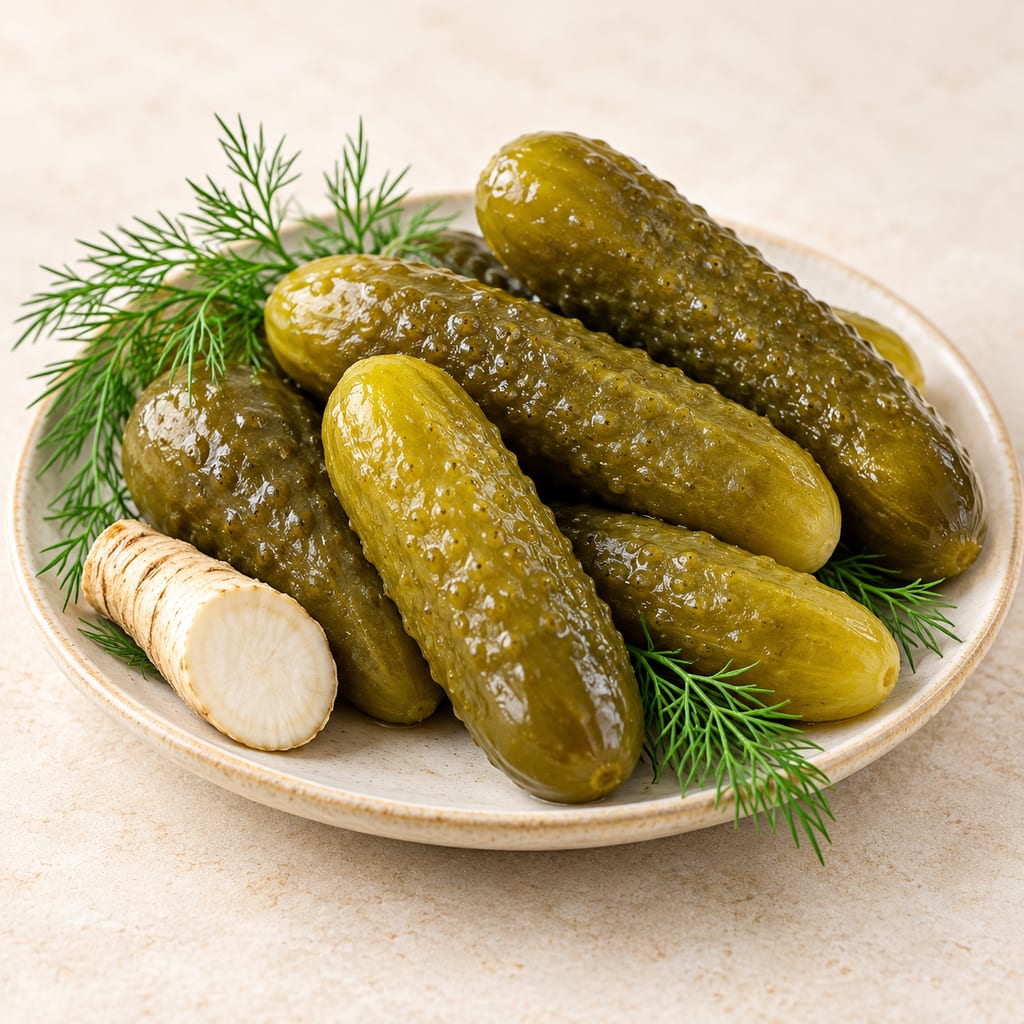
Ogórki kiszone are Polish brine-fermented cucumbers. Two registered local practices keep the barrels in a well near Zakliczyn and under lake water at Kalisz Pomorski. Neither gives a validated process.

A yeast-raised wheat ring shaped from a firm dough, briefly boiled and baked. This source-batch formula gives a gently malted crust and a chewy crumb.
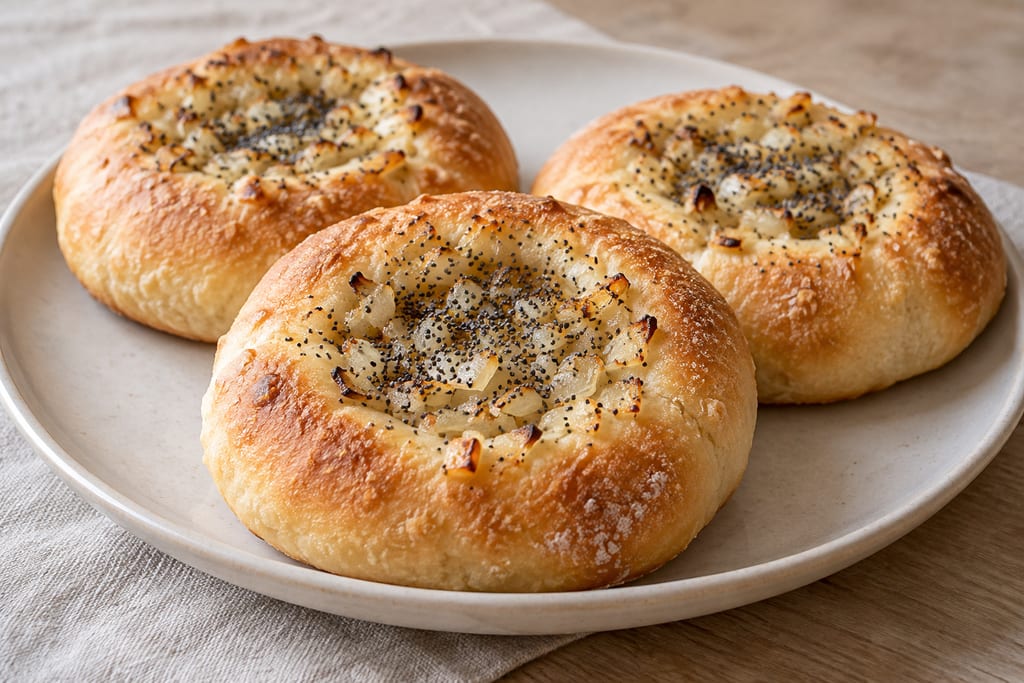
Bialys are soft, yeasted wheat rolls baked without boiling, each shaped with an onion-filled central depression instead of a hole.
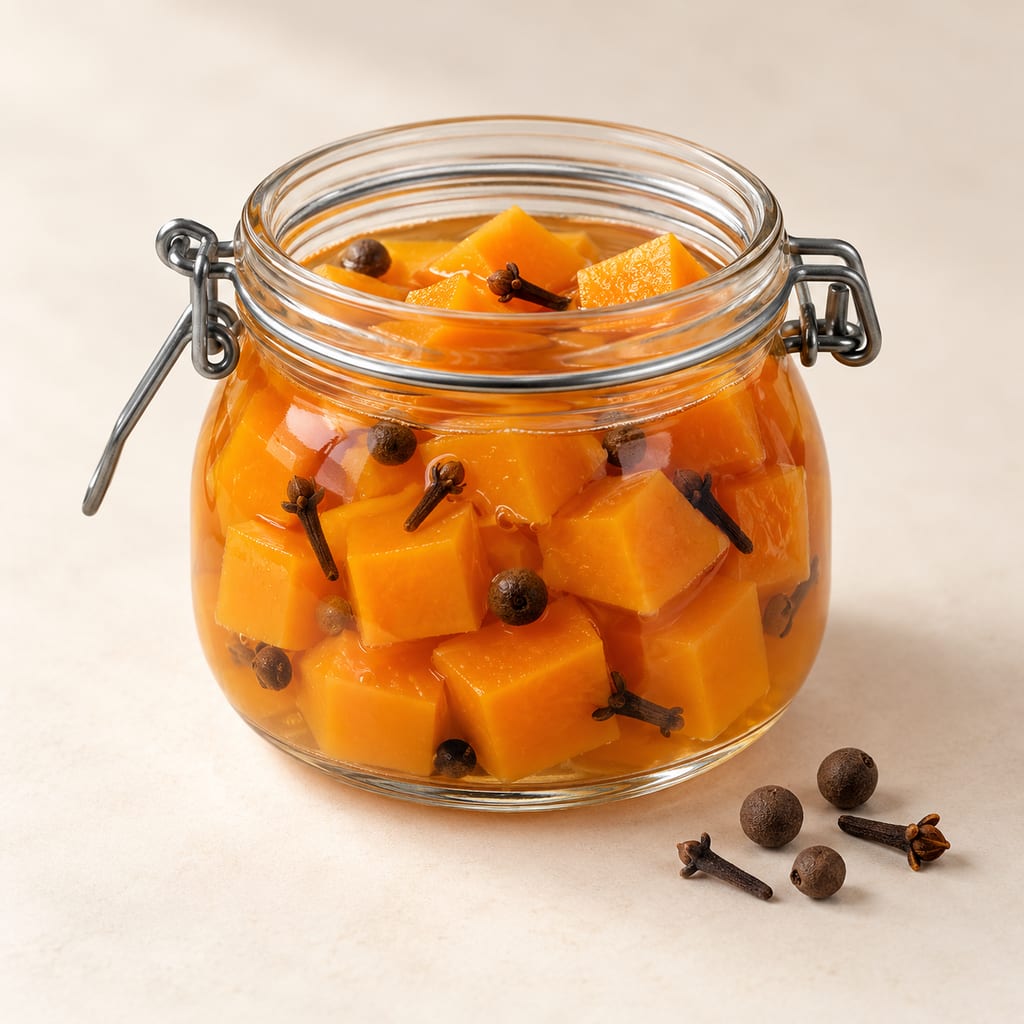
Dynia marynowana: Freeze for winter; small fresh portion refrigerated up to 48 hours.
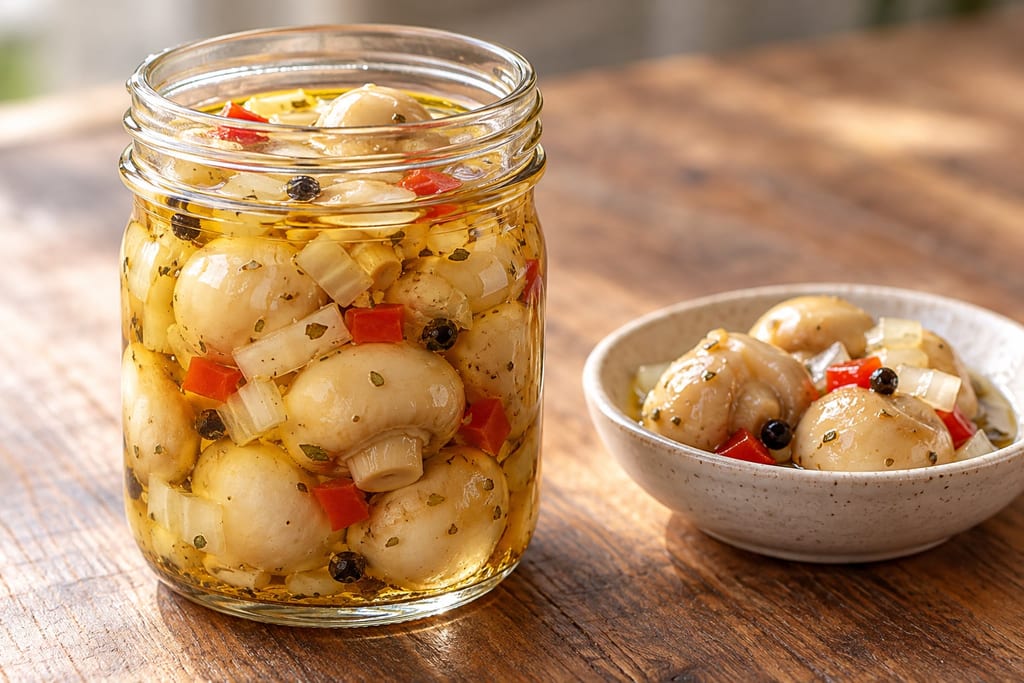
Small edible mushrooms are briefly cooked and packed in a seasoned vinegar marinade, a sweet-sour preserve served cold in Poland and neighbouring cuisines.
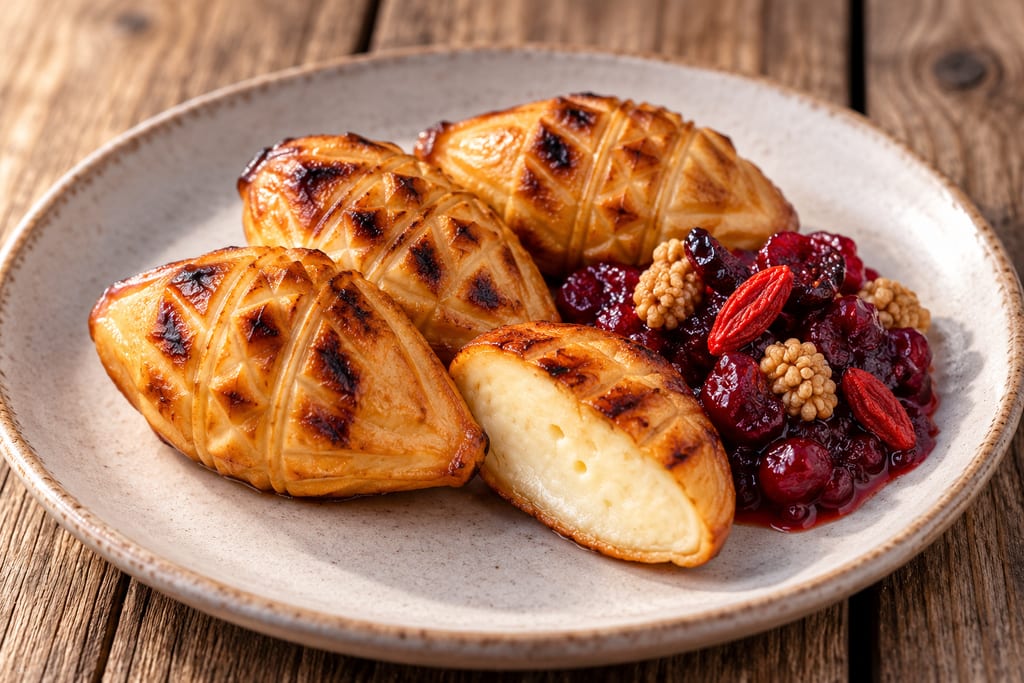
Small Oscypek are grilled until the exterior is crisp and the cheese softens, then served with cranberry, goji berries and mulberries.

A home version of the Kraków twisted ring: yeast dough is braided, briefly dipped in boiling water, topped with seeds or salt, then baked. It is not represented as a certified PGI product.
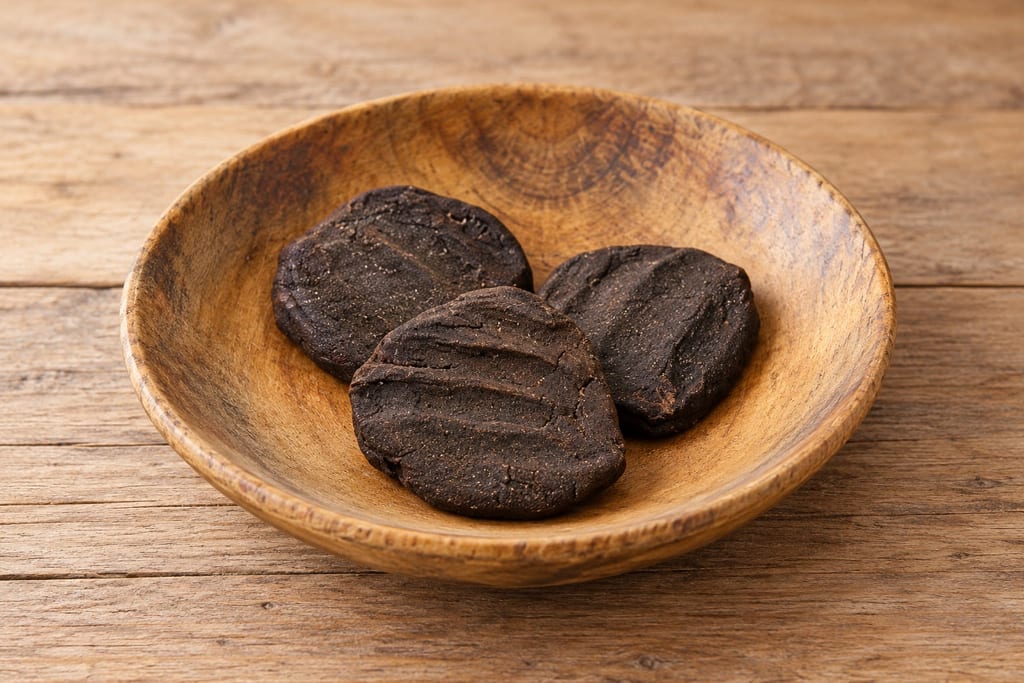
Dried cakes of pounded taro leaves from the Ao Naga in Nagaland, yellowed in a bag, then dried by hot ash or sun and used to flavour meat dishes.
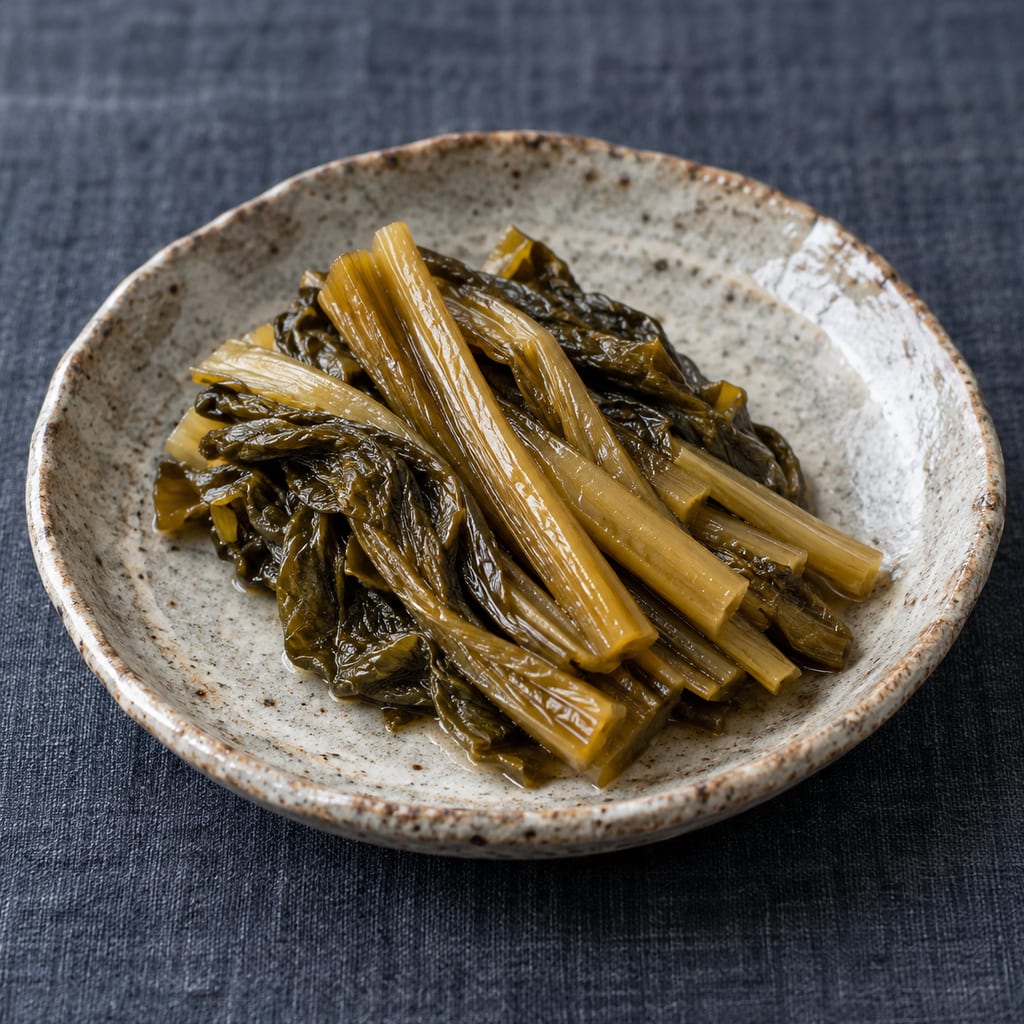
Takana mustard greens from Aso in Kumamoto are salted and pressed into a fresh spring pickle, or aged into a sour furuzuke that is fried and mixed into takana rice.
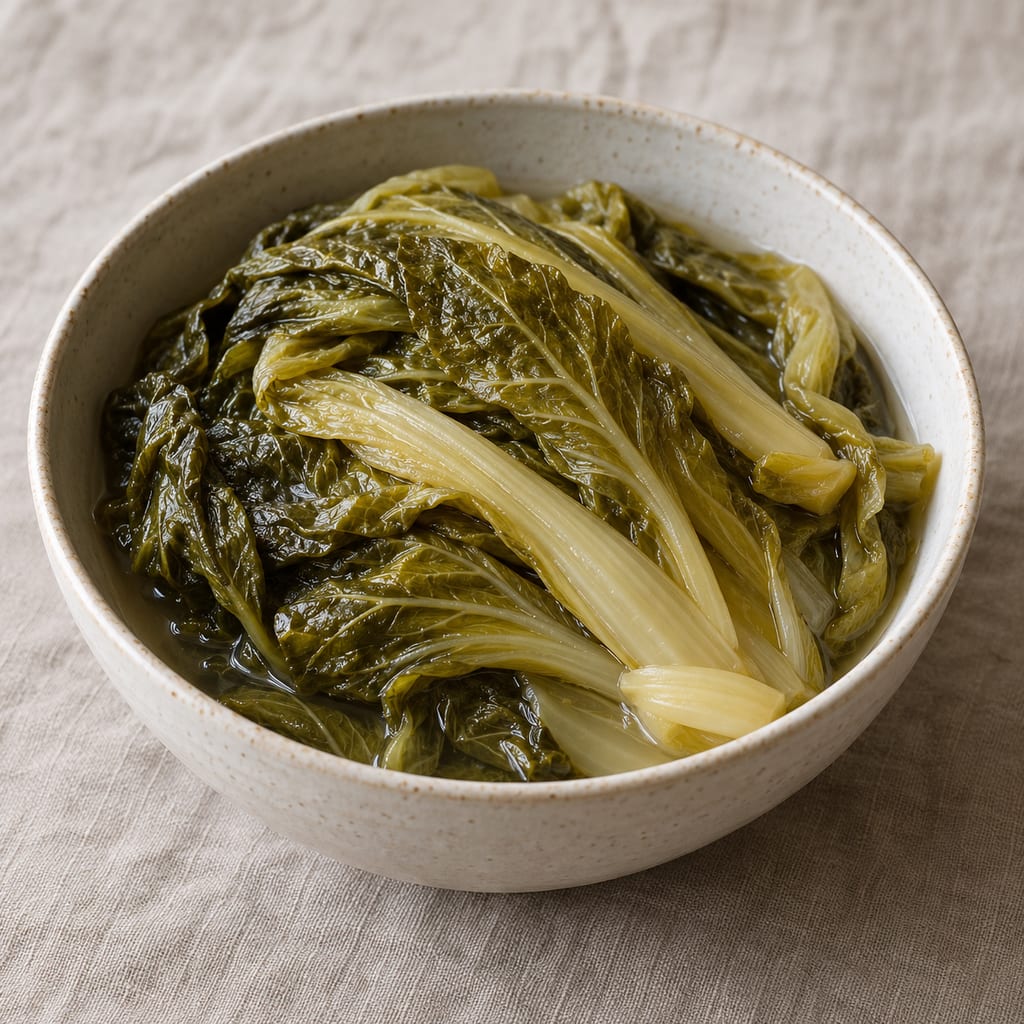
Wilted flat mustard leaves ferment with rice water and salt as a Filipino appetizer and cooking ingredient.
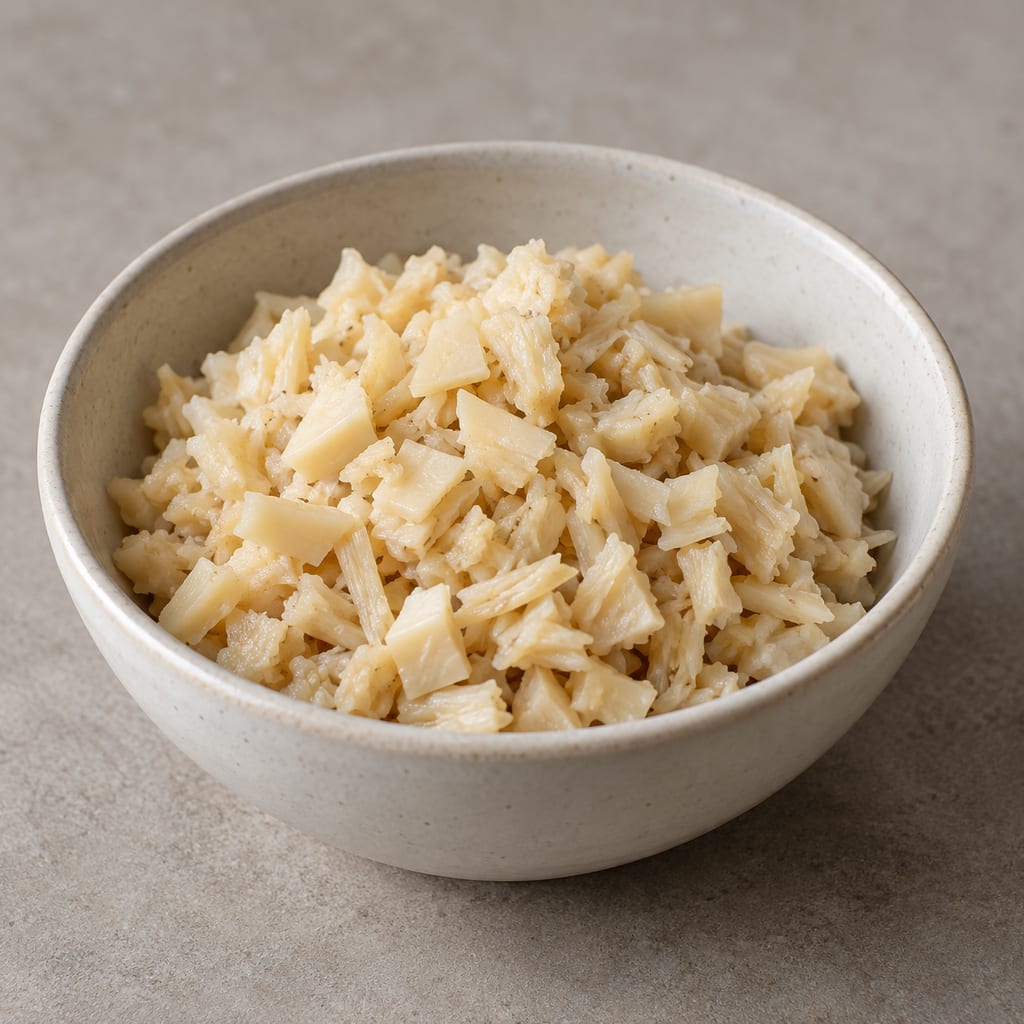
Finely chopped young bamboo shoots packed in leaf-lined baskets, sealed in a forest pit and weighted for one to three months, from Arunachal Pradesh.

Pit-fermented bamboo shoots from Arunachal Pradesh, cut smaller and sun-dried for five to ten days, used in curries.
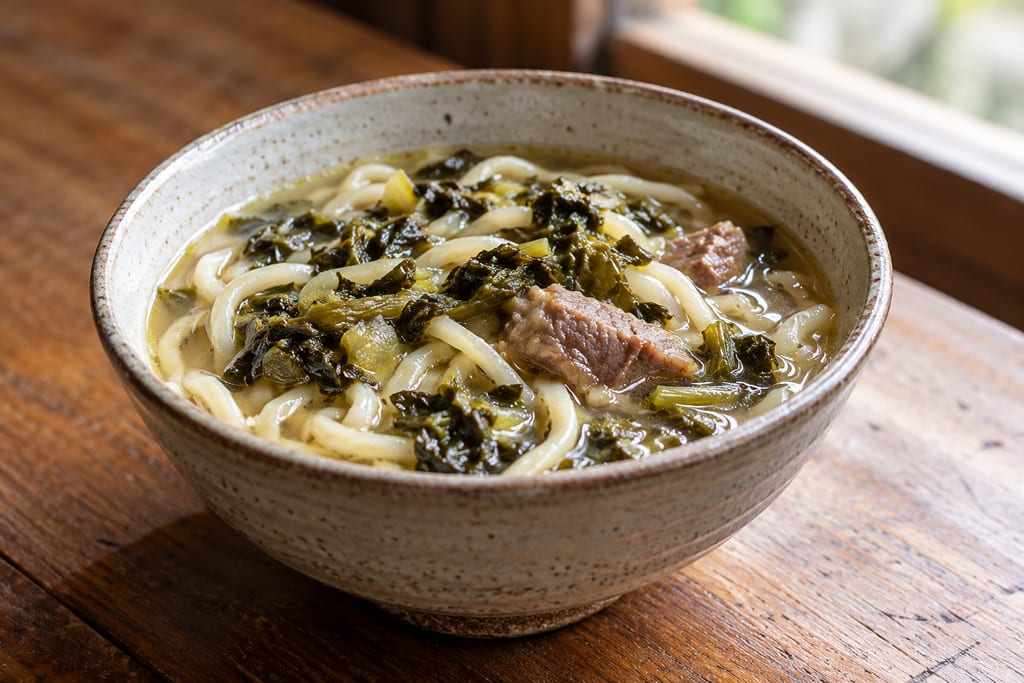
Goyang is a Sherpa fermented wild leafy food of the Darjeeling hills and Sikkim. Rainy-season magane-saag leaves are packed in a bamboo basket, held at room temperature for about a month, then eaten fresh or dried and used in soup.
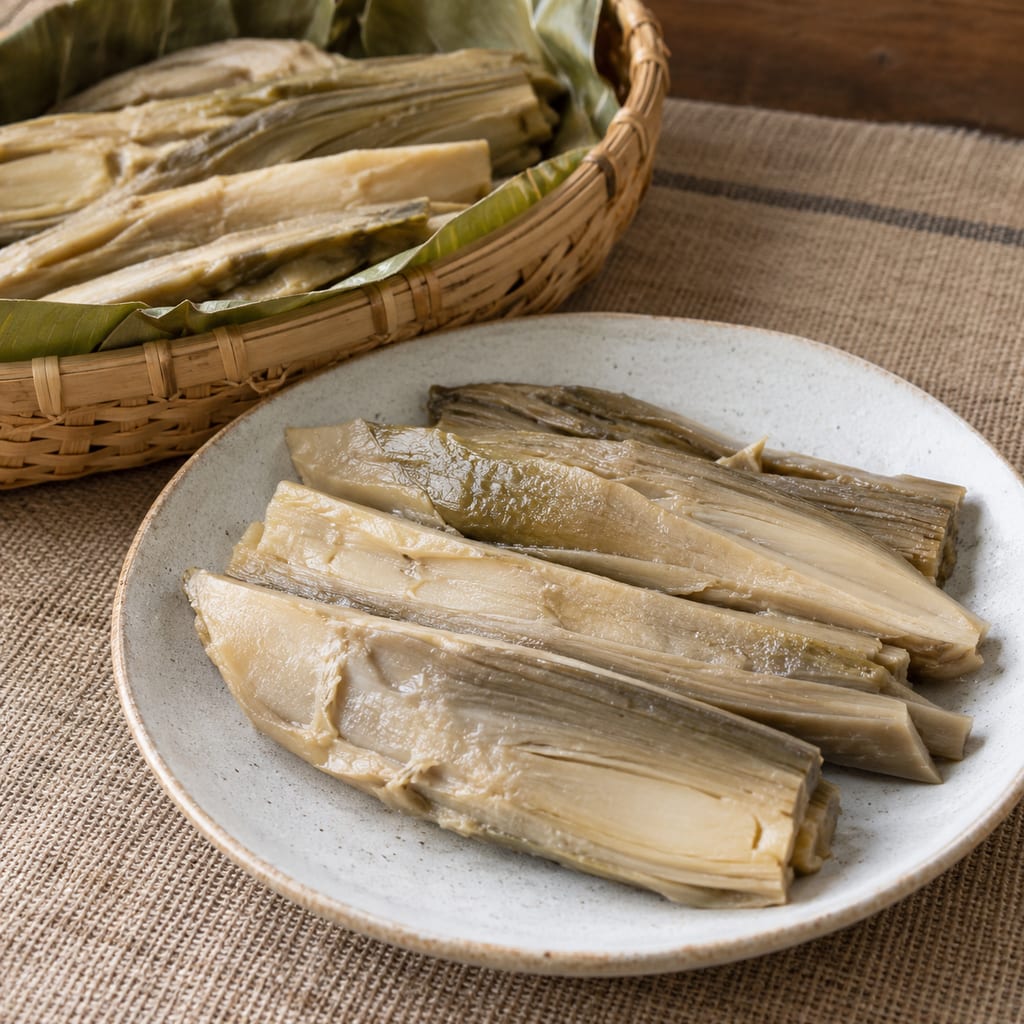
Upper tender bamboo-shoot tips, split or flattened, pit-fermented one to three months in Arunachal Pradesh and eaten in curries.
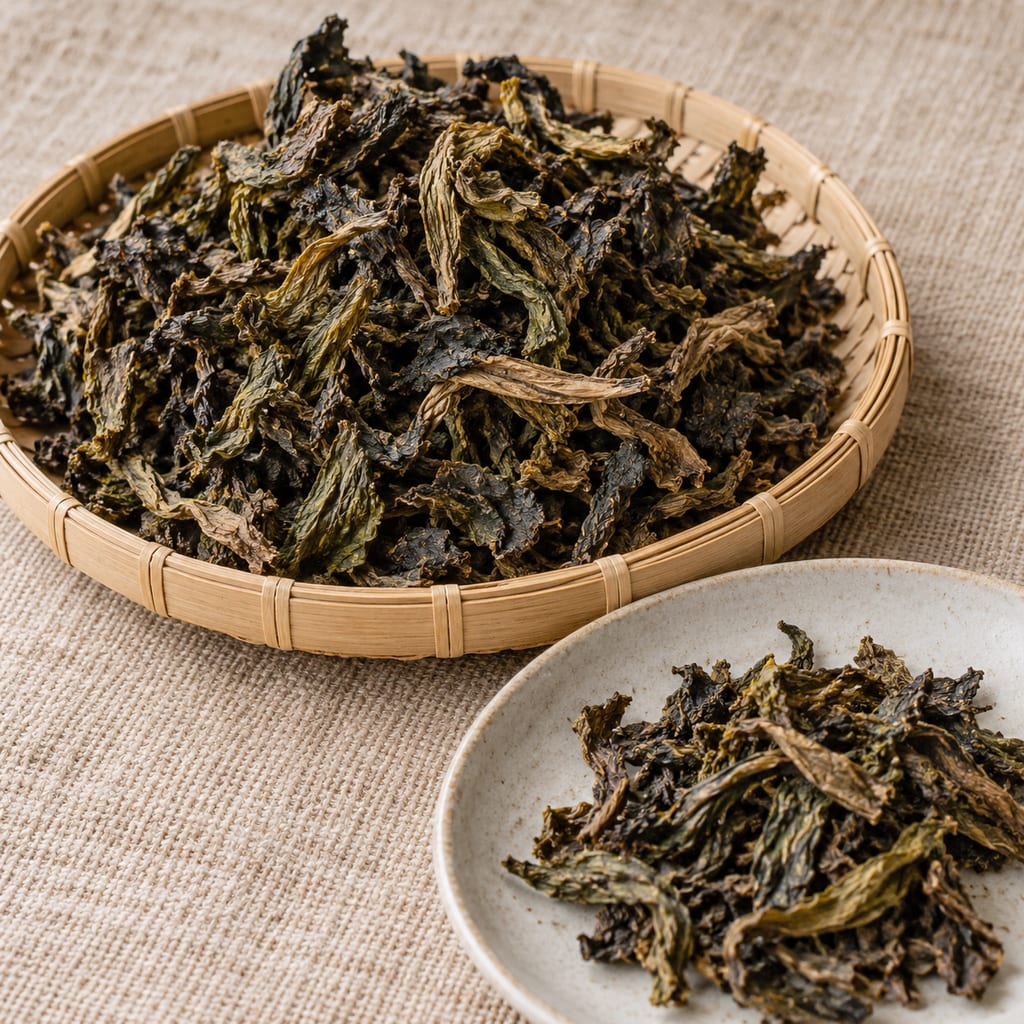
Inziangsang is a Naga fermented food of mustard leaves from Nagaland and Manipur. Crushed, soaked and squeezed leaves ferment for 7 to 10 days, then dry in the sun. A squeezed liquid can be boiled to a concentrate.

A gelling polysaccharide extracted from red seaweeds, sold as kanten strips or powder; it sets firm at a low concentration and stays solid until about 85 °C.

A Dominican table and seasoning condiment of sour orange juice, mixed with lime and salt and bottled raw; garlic, oregano or a hot pepper may be added for meat or a spicier bottle.

Cicerbita alpina is an alpine perennial whose tender shoots and leaves have been eaten raw or cooked. Sámi milk preparations and modern Carnian dishes are distinct uses, with serious identification and preservation limits.

Japanese skipjack tuna cooked, then repeatedly smoked and dried over a wood fire by the hand-fired tebiyama method into a hard block for shaving into dashi: the first stage of katsuobushi.

A Swedish-style spirit vinegar made by fermenting neutral alcohol with live vinegar bacteria, with a separate guide to commercial ättika strengths.

A warm dip of garlic, anchovy and olive oil, often enriched with butter, that Piedmont serves over a flame with raw and cooked vegetables and bread.

Bechamel is a white sauce of milk thickened with a butter and flour roux, one of the French mother sauces, and the base from which Mornay and other cheese and cream sauces are made.
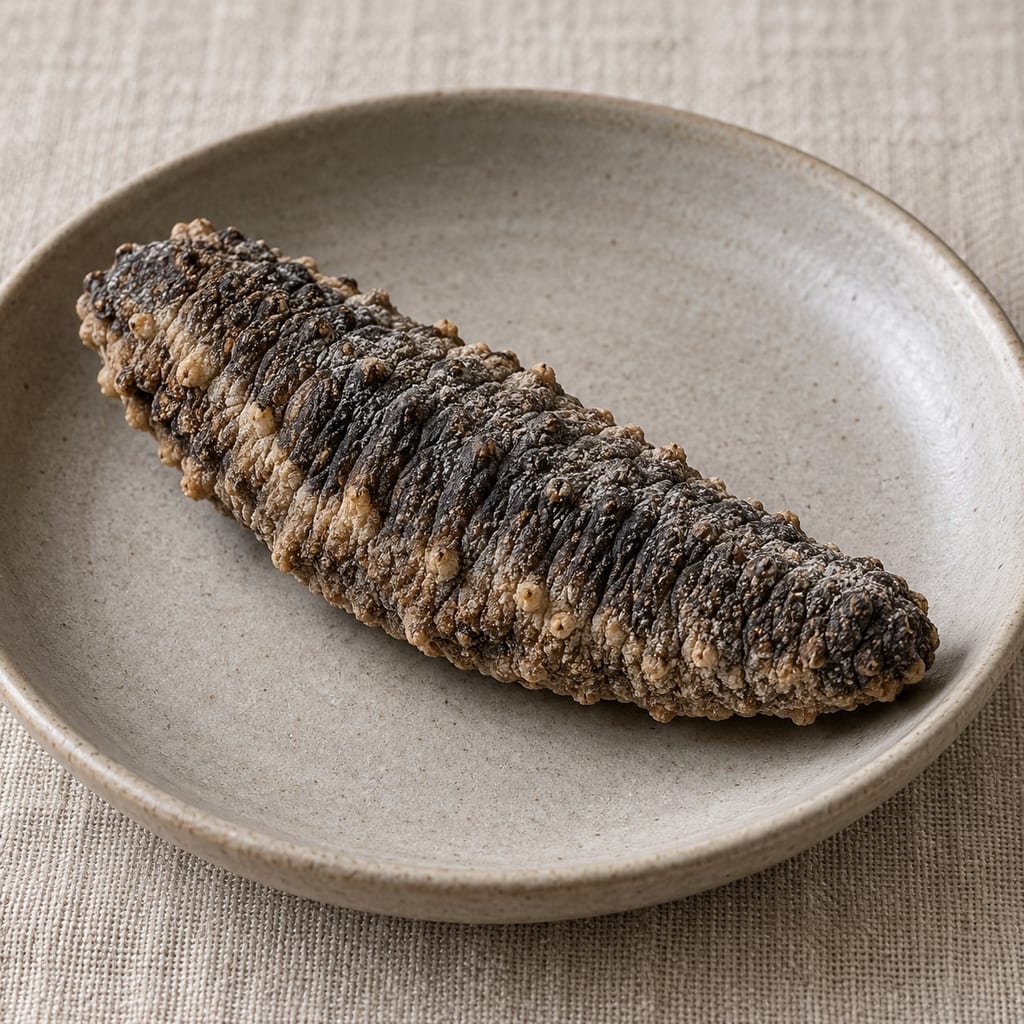
Sea cucumber cleaned, boiled and dried, sometimes with smoke, into a long-keeping trade product; Makassan processing in Arnhem Land is documented from at least the eighteenth century.
No community contributions have been published for this entry yet.
Sign in to contribute. Published comments and photos are free to read.
Łuczaj and Szymański, Journal of Ethnobiology and Ethnomedicine, 2007History · Method
Wild vascular plants gathered for consumption in the Polish countryside: a reviewLeaves and stalks covered with warm water, a few days to sour
Marcin 1595 and Syreński 1613 translations
Anna Tomiak's jar method, Straconka
Rostafiński's dating of the decline
Cited in: What hogweed barszcz is; What the herbals record; How the soup was made; What happens in the jar; Finishing the soup; Where it was eaten and when it stopped; The method on this page; Open questions
Łukasz Łuczaj, Etnobiologia Polska, 2011 (Wikisource)History · Method
Dziko rosnące rośliny jadalne użytkowane w Polsce od połowy XIX w. do czasów współczesnychChopped stems, leaves and flower heads in barrels covered with water
Polesie letters to Rostafiński's 1883 questionnaire
Cited in: How the soup was made; Where it was eaten and when it stopped; The method on this page
Łukasz Łuczaj, The Wild Food, 2020History · Method · Safety
Hogweed borscht and the food of people and bearsPleasantly sour in two days by a warm stove
Between beer and pickled cabbage
Jagiellonian University menus
Gerarde 1597
Cited in: What hogweed barszcz is; What the herbals record; How the soup was made; What happens in the jar; Finishing the soup; Where it was eaten and when it stopped; Relatives and later barszcz; The method on this page; Open questions
Łukasz Łuczaj, Journal of Ethnobiology and Ethnomedicine, 2008History
Archival data on wild food plants used in Poland in 1948Rabka Zdrój soup before the First World War; names burak dziki, borszczek
Cited in: Where it was eaten and when it stopped
Zygmunt Gloger, 1900 (Wikisource)History
Encyklopedia staropolska: BarszczBarszcz first cooked from the herb barszcz; tall, flowers in June
Cited in: What hogweed barszcz is; The plant and its name; Relatives and later barszcz
Aleksander Brückner, 1927 (Wikisource)History
Słownik etymologiczny języka polskiego: barszczSlavic plant name; shift of meaning in the eighteenth century
Cited in: The plant and its name; Relatives and later barszcz
DermNetSafety
Cow parsnip and hogweedFurocoumarins including bergapten; phototoxic strimmer dermatitis
Apiaceae description; cow parsnip stalks eaten like stewed celery
Cited in: Safety warning; The plant and its name; Relatives and later barszcz; Telling it apart from dangerous plants; Handling the sap
Royal Horticultural SocietySafety
Giant hogweedGiant hogweed identification and photodermatitis
Common hogweed up to 2 m, rounder leaves, no purple blotching
Wash skin, keep out of sunlight, seek medical advice
Cited in: Safety warning; The plant and its name; Telling it apart from dangerous plants; Handling the sap; The method on this page
National Capital Poison Center (Poison Control)Safety
Can poison hemlock be deadly?Hemlock lookalikes and identification
Coniine in all parts; not safe to treat at home
Cited in: Safety warning; Telling it apart from dangerous plants
National Capital Poison Center (Poison Control)Safety
Giant hogweed and its toxic cousinsFuranocoumarins in Heracleum sap, stems, leaves and fruits cause phototoxic dermatitis, from redness to blisters, burns and scarring, lasting weeks to months
Wash skin with soap and water and avoid sunlight for 1-2 days; irrigate eyes for at least 15 minutes; seek medical evaluation if symptoms persist
Cited in: Safety warning
Foods (MDPI), 2025Safety
Fast Determination of Furocoumarins in Food Supplements Containing Heracleum sphondylium L. Using Capillary ElectrophoresisEFSA compendium of botanicals lists Heracleum sphondylium as containing substances of possible concern for human health in food, citing furocoumarins (abstract)
Cited in: Safety warning