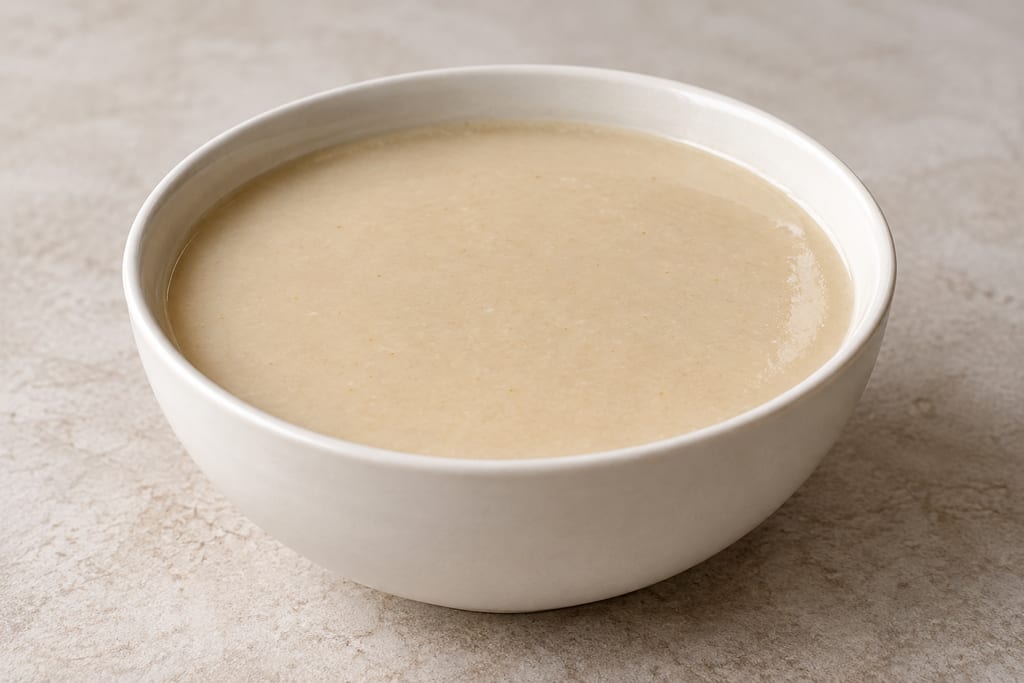
Ben-saalga
A fermented pearl-millet gruel documented in Ouagadougou, Burkina Faso. Whole grain is soaked, wet-milled and sieved; the settled paste ferments again before it is cooked with its liquid.
 FermenteaWhere food goes to change
Substrates
Millet names several small-seeded cereals. In African fermented foods, pearl millet and finger millet become sour gruels, doughs and drinks through distinct combinations of soaking, milling, cooking, malting and fermentation.
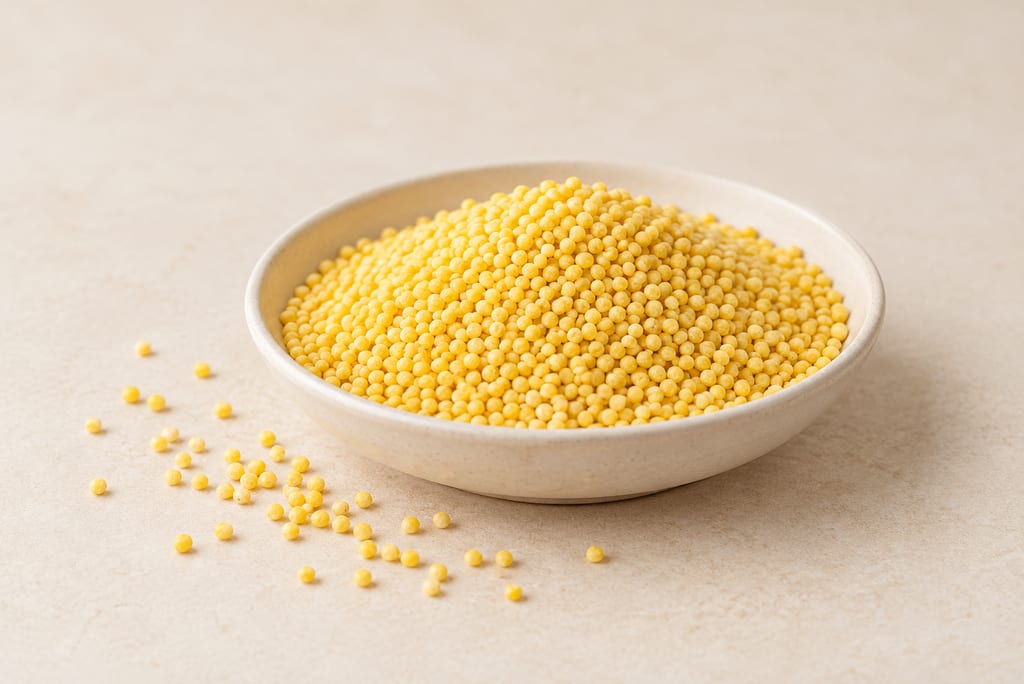
“Millet” does not name a single species. It is a convenient group name for small-seeded cereal grasses, and records of a millet food need to be read with the species and local name in view. African fermented-food studies commonly identify pearl millet (Pennisetum glaucum, also called Cenchrus americanus) or finger millet (Eleusine coracana). Those grains are not interchangeable in every preparation, and neither should be silently substituted for sorghum, maize or teff.
This distinction matters because millet pages can otherwise collect unlike foods under a false impression of uniformity. A study of pearl-millet dough in Mbeere, Kenya does not establish a method for finger millet in Uganda. A drink named as millet-based in a household survey may also have regional versions using other cereals. The useful question is not only “is there millet?” but which millet, in what state, and at which point in the process.
The item therefore uses millet as a broad ingredient family, not a claim that each food uses a generic interchangeable grain. Where a source identifies pearl millet or finger millet, the narrower name belongs with that preparation. If an account simply says millet, its uncertainty should remain visible.
Pearl millet and finger millet are the two species most relevant to the African preparations discussed here, but broad agricultural uses of the word include other grains. Sources sometimes use older botanical synonyms, local names or an umbrella term. Preserve the name a source actually identifies, then add the scientific name only where the source or authoritative crop reference supports it.
In food processing, millet can arrive as grain, meal, flour, malt or dough. These are consequential forms, not cosmetic variations. A whole kernel that is soaked and wet-milled is not the same starting material as flour fermented as a slurry; malted grain has germinated before it is milled or brewed. A recipe or study should make clear which form is fermented and whether fermentation precedes or follows cooking.
Pearl millet is a major cereal of dryland Africa, especially the Sahel and other arid and semi-arid regions. FAO describes its cultivation across Western, Central, Eastern and Southern Africa; ICRISAT's crop research likewise treats it as a rainfed staple of the drier sub-Saharan regions. These broad agricultural patterns describe a crop, not the birthplace of any one fermented food.
Finger millet has a different distribution. FAO and CGIAR references identify its strong association with eastern Africa, including Uganda, Kenya and Tanzania, with cultivation also documented elsewhere in Africa. Finger millet's crop geography should not be borrowed to place pearl-millet foods, or to claim a local recipe tradition without a source for that preparation.
The species themselves have distinct histories. Archaeobotanical evidence from the Lower Tilemsi Valley in northeastern Mali is important to research on pearl-millet domestication. Crop references identify East Africa as the native region of finger millet. Neither history means that every contemporary millet preparation began in that region, and a grain's growing area cannot stand in for evidence about the route by which a recipe spread.
Most fermented cereal preparations do not ferment intact dry kernels as they are. They are cleaned or sorted, then soaked, milled or ground, and combined with water. Depending on the food, the resulting meal or slurry may ferment before cooking, part of it may be cooked and returned to uncooked or fermenting material, or flour may first be malted so that germination produces enzymes that help release fermentable sugars. These are different process routes, not a single millet technique.
Kunun-zaki, a cereal drink studied in northern Nigeria, begins with steeped millet grain and wet milling. The 1995 microbiology study followed microbial populations during production; by the end, lactobacilli predominated, and increased acidity also favoured Saccharomyces cerevisiae. In that study, eight hours produced an acceptable beverage. This observation belongs to the tested process and product; it is not a universal fermentation time or a safety limit.
For ben-saalga in Burkina Faso, researchers documented pearl millet processing across 24 production units and examined fermentation kinetics in pilot-scale work. The preparation combines grain processing with a fermented liquid or slurry and a later cooking stage to make a gruel. A separate household and production-unit study of ben-saalga and ben-kida found wide nutritional effects from processing, including reductions in some antinutritional factors and losses of lipid, protein and minerals. These findings describe those foods and samples; they do not support a general health claim for fermented millet.
The grain's role also changes in drinks. Where a source describes malted millet, germination and drying are part of preparing a fermentable ingredient before brewing. Where a source describes a fermented cereal slurry, the grain is first made available as flour or meal for microbial acidification. A beverage may then include a cooking stage, additional ingredients or a second fermentation. Naming millet alone cannot tell a reader which sequence was used.
Milling changes the material on which fermentation acts: whole kernels, coarse meal and fine flour expose different amounts of grain surface to water and microbes. The cited food studies document wet milling and grain processing but do not prescribe one universal particle size or equipment. A process description should retain the source's own detail instead of adding a standardized mill setting.
The sourced preparations show why a single storage note cannot cover millet as an ingredient. Grain storage before use, a fermented dough intended for cooking, a gruel cooked after fermentation and a ready-to-drink beverage are different products. The cited studies do not establish a common shelf life, storage temperature or acid threshold for them.
For a historical or household description, retain the observed sequence and any measured conditions as observations. Do not turn a single study's fermentation duration into a universal instruction. No smell, taste, visible bubbling or home pH reading proves that a batch is safe. Use a validated method for the specific food and storage goal; where none is available in the evidence, the limit remains unknown.
In Burkina Faso, ben-saalga is a pearl-millet fermented gruel. It is associated with everyday food practice and has also been studied as a complementary food. Researchers sampled households and small production units rather than defining one fixed household formula. Names and exact steps can vary, so this ingredient page does not turn a study description into a universal recipe.
In northern Nigeria, kunun-zaki is a cereal beverage whose documented production includes steeping millet and wet milling. In Kenya's Mbeere community, kimere is a spontaneously fermented pearl-millet dough: a study sampled eleven homesteads and reported fermentation for 18–24 hours. These foods differ in texture, use and grain handling. The measurements in that study describe collected kimere, not an instruction for scaling or home safety.
Millet also appears in wider East and Southern African cereal-drink traditions. Names such as uji, bushera, oshikundu, mangisi and merissa refer to foodways with their own local histories and ingredient combinations. Some documented versions use finger or pearl millet, sometimes alongside sorghum or another cereal; some involve malting, some souring of flour or slurry, and some a cooked base. A shared cereal ingredient does not make these names synonyms, and a recipe's fermentation claim should be attached to the exact version its source documents.
Millet dough or porridge can also be one component of a served dish rather than the only fermented part. Fura is associated with shaped millet dough served with fermented milk in some versions. The milk fermentation and the grain preparation should be described separately unless the source explicitly says the dough itself ferments. This distinction prevents an ingredient association from being mistaken for evidence about every fermentation step.
Mixed-cereal foods need the same care. A preparation that combines millet with maize or sorghum should be represented as a combination, not collapsed into a millet-only tradition. If a source describes a grain alternative, that alternative is evidence for that version only. It does not establish that each household, locality or named food uses all listed grains.
Mungo Park's account of travels, published in 1799 from his 1795–97 journey, records a beer-like drink at Koojar on 11 December 1795. He describes grain that had first been malted and identifies it by the botanical name “Holcus spicatus,” a historical name associated in later references with pearl millet. This is evidence that Park observed a malted-grain drink in a particular place and moment. It is not a direct local-language account, and it cannot establish a single origin or uninterrupted history for African millet brewing.
The wording and viewpoint belong to a European travel narrative produced under the patronage of the African Association. That context matters when using it as evidence: it records an outsider's account of a drink, not the drink's local name, the brewer's own explanation, or a complete method. The date and place are useful historical anchors but do not resolve those gaps.
Archaeobotanical evidence gives a different kind of history. Manning and colleagues reported domesticated pearl millet remains from the Lower Tilemsi Valley in northeastern Mali and discussed the dating limits of pottery temper as well as directly dated material. Later analysis of ceramic inclusions from northern Mali distinguished wild exploitation, possible predomestication cultivation and the appearance of domestication traits over several millennia. These are crop-history findings, not evidence that a particular named fermented food existed at those sites.
Millet is a cereal grain. This page makes no claim about allergy prevalence or clinical suitability because the assembled sources address crop identity and fermented-food processing rather than an authoritative allergen assessment. Ingredient labels on a prepared food also depend on its full formula, shared equipment and added ingredients.
The study of pearl-millet gruels in Burkina Faso measured several components and found that processing changed them in more than one direction. A reduced measured amount of one compound does not mean every nutrient increased, and a traditional use as complementary food does not establish that a gruel meets the needs of every infant. Do not turn one study into a blanket dietary recommendation.
The live catalogue already connects millet to ben-saalga, damirga, fura, kimere, kirario, mangisi and uji, among other records. Those links are navigation aids, and each recipe's own sources must carry the evidence for its ingredients and fermentation steps. A catalogue relationship cannot show that all regional versions share one grain or method.
The strongest item-specific research in this profile concerns ben-saalga, kunun-zaki and kimere. For other named preparations, the ingredient relationship is useful as a search lead, but the source for that particular version should be read before assigning a species, place or stage of fermentation.
Fermentation studies may measure acidity, organism counts or pH to compare samples and process stages. In kimere, the reported mean pH of sampled dough was 3.63, with variation across eleven homesteads. The study isolated and characterized lactobacilli; its research question about potential probiotic strains does not demonstrate a clinical benefit from eating kimere. Likewise, organisms reported in a kunun-zaki study describe its sampled production and are not a guarantee that every batch follows the same course.
Fermentation does not by itself establish that a food is safe to store. The cited studies are not general home-preservation validations. They do not provide a single critical salt, acidity, time, temperature or storage limit for all millet foods. Keep process uncertainties attached to the named food and do not use sourness, smell, bubbles or a household measurement as proof of safety.
Crop history, crop geography and culinary history answer different questions. Archaeobotany can document the presence and changing form of a grain; an agricultural reference can describe where a species grows; a food study can document how one named preparation is made. None should be used as a substitute for the others.
Pearl millet is documented in ben-saalga and related fermented gruels; this is a documented use, not a claim that all millet foods originate here.
The cited study describes millet-grain steeping and wet milling in kunun-zaki production.
The study identifies kimere as pearl-millet dough prepared in the Mbeere community and sampled eleven homesteads; coordinates and a more exact locality are not asserted.
This is a broad pearl-millet cultivation association, not a claim about the origin of any specific fermented food.
Finger millet cultivation is documented across parts of eastern Africa; the location does not assert a recipe tradition for every place.
Archaeobotanical evidence concerns pearl millet cultivation and domestication, not a fermented food.
Park records a malted-grain beer-like drink at Koojar on 11 December 1795; period place names are retained without assigning modern coordinates or a present-day country.
A fermented pearl-millet gruel documented in Ouagadougou, Burkina Faso. Whole grain is soaked, wet-milled and sieved; the settled paste ferments again before it is cooked with its liquid.
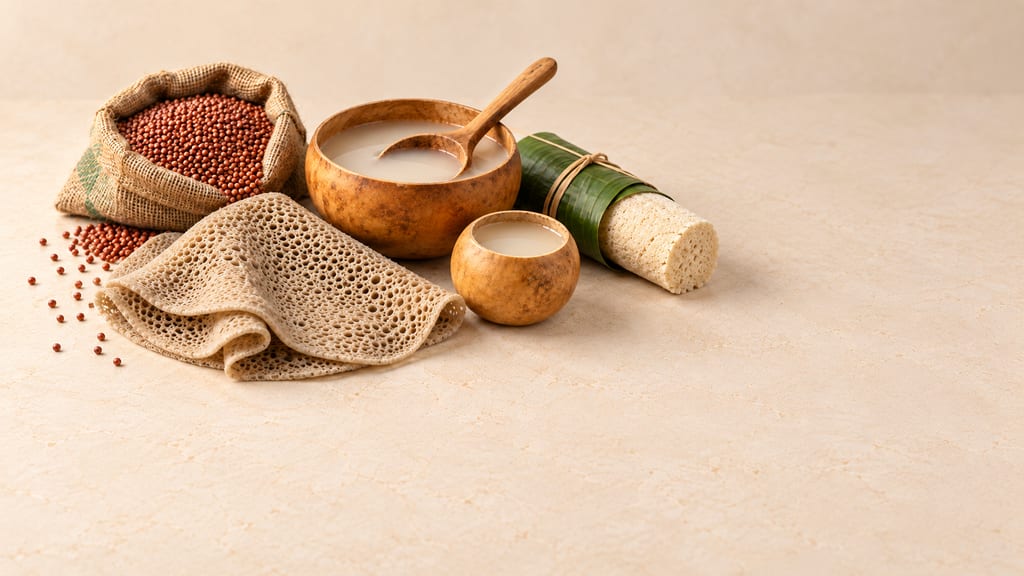
From sour breads and milk to savoury seeds, cassava staples and living beers, African fermentation follows the crop, the community and the work of transformation.
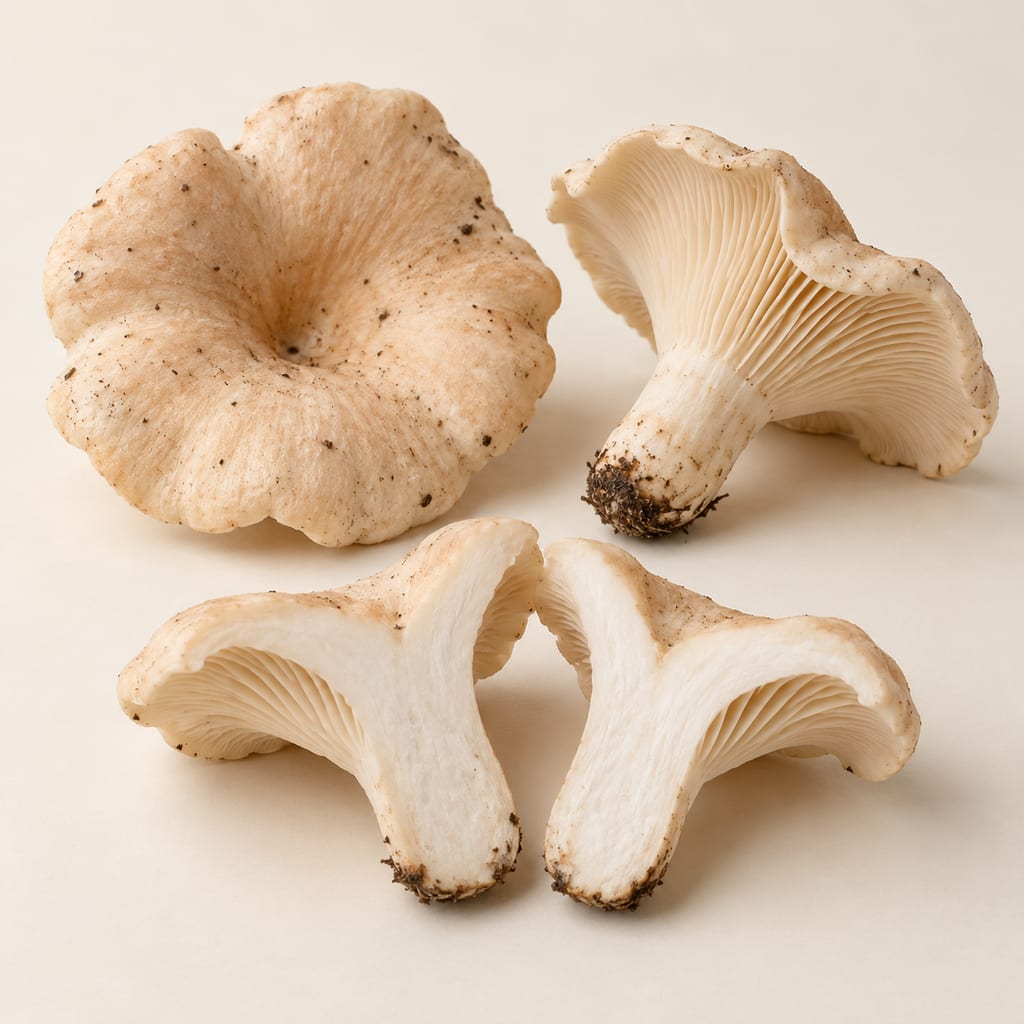
Lactifluus gymnocarpoides is an African milkcap of open Uapaca and miombo woodland. Regional inventories record it as food, but its bitter taste means local cooks remove it before eating, and the sources give no preparation.
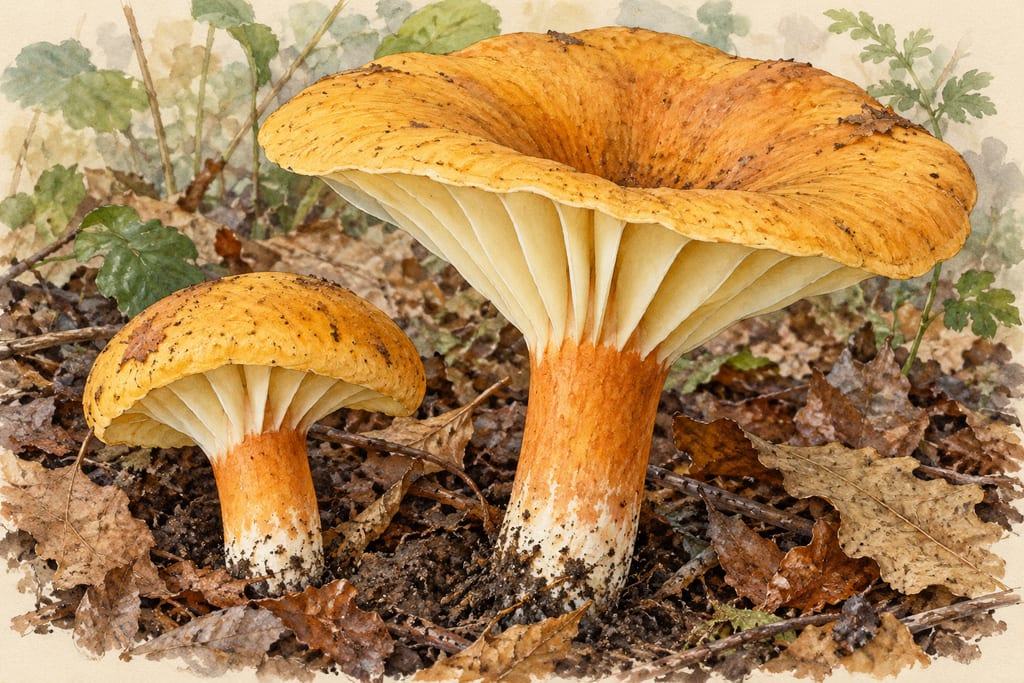
Lactifluus gymnocarpus is an African milkcap, a wild woodland mushroom of the Lactifluus group, recorded as an edible species in West and Central Africa.
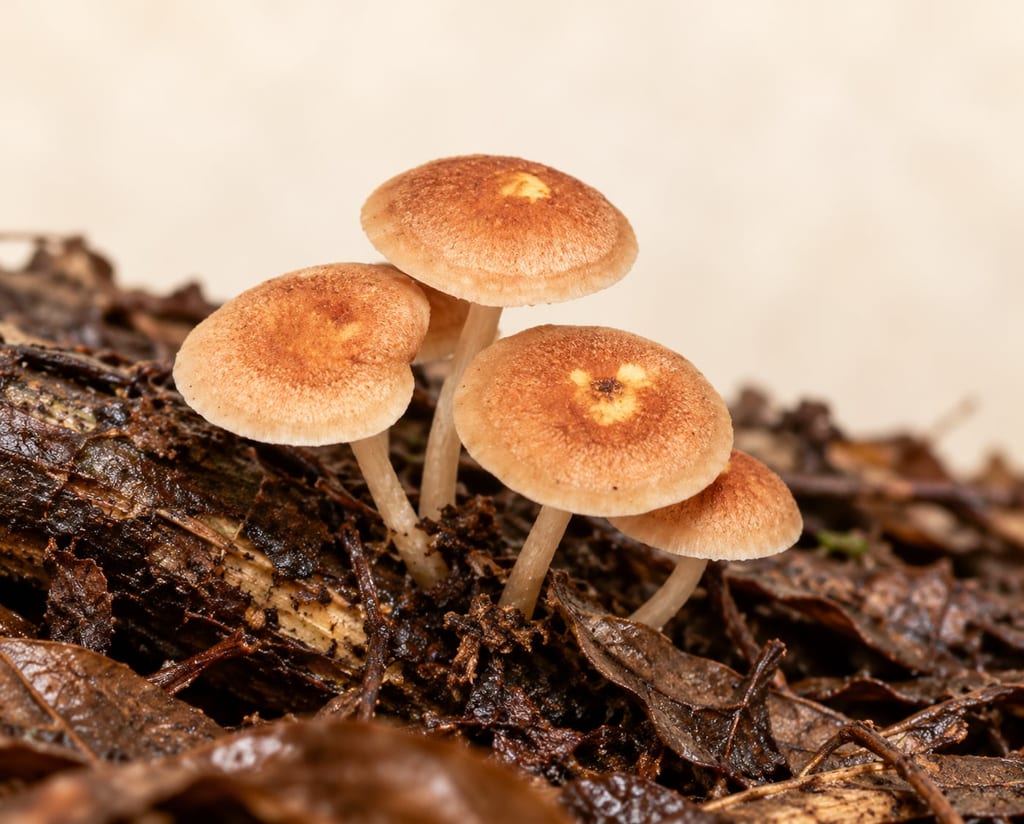
Marasmius buzungolo is a wild African saprotrophic mushroom recorded as food in Tshopo and around Kikwit in DR Congo. Its exact season and preparation remain undocumented.
Sugar-rich liquid tapped from different palms, gathered fresh or transformed into local drinks and sweeteners; species and collection stage shape its composition.
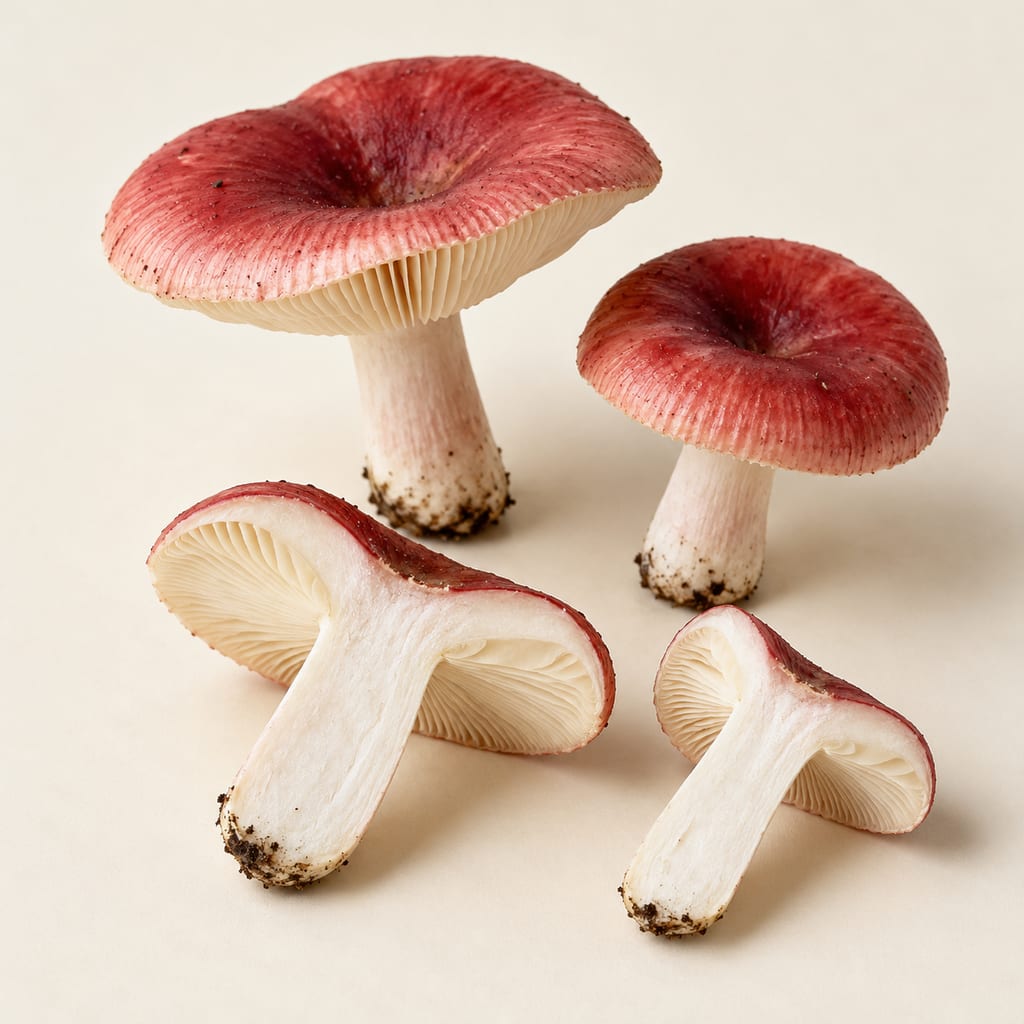
Russula congoana is an ectomycorrhizal brittlegill of miombo and savanna woodland in tropical Africa, recorded in an edible-fungi inventory. Preparation, identity and current safety still need validation.
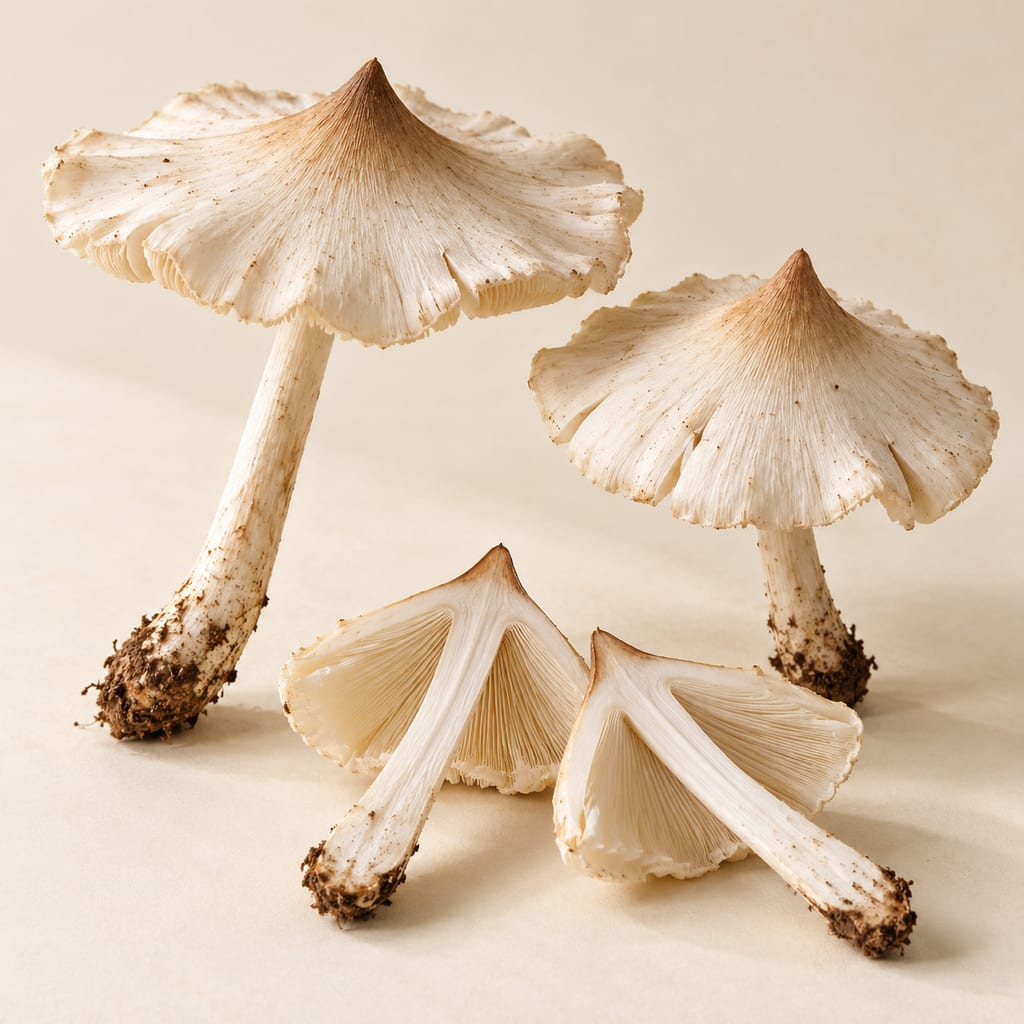
Termitomyces medius is a small termite mushroom of tropical Africa that grows with fungus-growing termites. The Edible Fungi of Tropical Africa project lists it as an edible species.
No community contributions have been published for this entry yet.
Sign in to contribute. Published comments and photos are free to read.
Food and Agriculture Organization of the United NationsBackground
Annex I: Types of milletMillet includes distinct species; pearl millet cultivation is described across African regions including the Sahel.
Cited in: Names and forms; Where it is grown or sourced
Food and Agriculture Organization of the United NationsBackground
Sorghum and millets in human nutrition: IntroductionMillets are a collective name for several cereals; crop distribution and uses differ by species.
CGIAR GenebanksBackground
Finger MilletFinger millet is a distinct species with an East African history and cultivation in parts of Africa and South Asia.
Cited in: Where it is grown or sourced
ICRISATBackground
Pearl Millet Production in Drier AreasPearl millet is extensively grown as a rainfed crop in dry regions including the Sahelian-Sudanian zones of West Africa.
International Journal of Food MicrobiologyBackground
Study through surveys and fermentation kinetics of the traditional processing of pearl millet (Pennisetum glaucum) into ben-saalga, a fermented gruel from Burkina FasoThe study documented pearl millet processing into ben-saalga across 24 production units and investigated fermentation kinetics.
Cited in: What it is; Its role in fermentation; Different preparations across the continent; Recipes that use it
International Journal of Food Sciences and Nutrition; PubMedBackground
Consumption pattern, biochemical composition and nutritional value of fermented pearl millet gruels in Burkina FasoHousehold and production-unit survey; effects of ben-kida and ben-saalga processing on nutrients and compounds affecting nutrient availability.
Cited in: Its role in fermentation; Preparation and storage; Allergens and dietary relevance
World Journal of Microbiology and Biotechnology; PubMedBackground
The microbiology of kunun-zaki, a cereal beverage from northern Nigeria, during the fermentation (production) processMillet grain steeping and wet milling; microbial changes in the studied process; eight hours reported as acceptable in that study only.
Cited in: What it is; Names and forms; Its role in fermentation; Preparation and storage; Different preparations across the continent; Recipes that use it; Evidence and uncertainty
Beneficial Microbes; PubMedBackground
Identification and characterisation of lactobacilli isolated from Kimere, a spontaneously fermented pearl millet dough from Mbeere, Kenya (East Africa)Kimere is a pearl-millet dough; eleven Mbeere homesteads sampled; 18–24-hour fermentation and mean sampled pH reported; study tested potential probiotic lactobacilli, not human clinical benefit.
Cited in: What it is; Preparation and storage; Different preparations across the continent; Recipes that use it; Evidence and uncertainty
Project Gutenberg (1799 edition)Historical
Travels in the interior districts of AfricaPark's dated 1795 account at Koojar describes a malted-grain beer-like drink and names the grain Holcus spicatus; a historically situated travel account, not a local-language ethnography.
Cited in: Names and forms; A documented historical observation
Journal of Archaeological ScienceHistorical
4500-Year old domesticated pearl millet (Pennisetum glaucum) from the Tilemsi Valley, Mali: new insights into an alternative cereal domestication pathwayArchaeobotanical evidence and chronology for domesticated pearl millet in the Lower Tilemsi Valley; the authors discuss dating uncertainty.
Cited in: Where it is grown or sourced; A documented historical observation; Evidence and uncertainty
Frontiers in Plant Science; PubMed CentralHistorical
Transition From Wild to Domesticated Pearl Millet (Pennisetum glaucum) Revealed in Ceramic Temper at Three Middle Holocene Sites in Northern MaliCeramic inclusion evidence distinguishes wild exploitation, likely predomestication cultivation and domestication traits over time in northern Mali.
Cited in: A documented historical observation