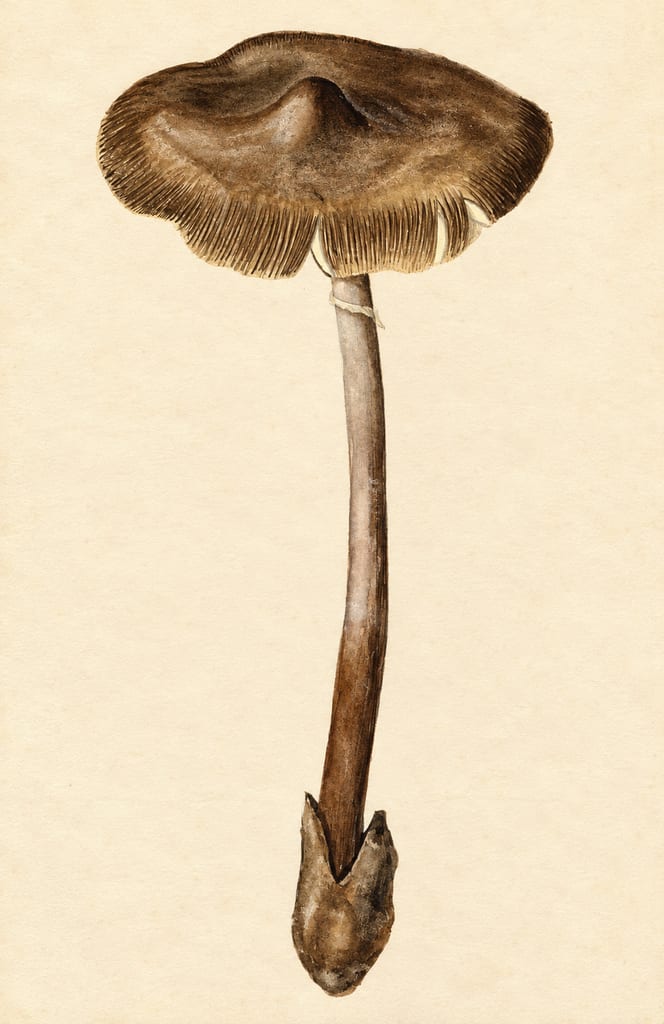
Amanita annulatovaginata
A wild ectomycorrhizal Amanita of the Congo rainforest, recorded as locally consumed in Tshopo province. Its preparation was not established, and the genus includes deadly species.
 FermenteaWhere food goes to change
Mushrooms
Marasmius buzungolo is a wild African saprotrophic mushroom recorded as food in Tshopo and around Kikwit in DR Congo. Its exact season and preparation remain undocumented.
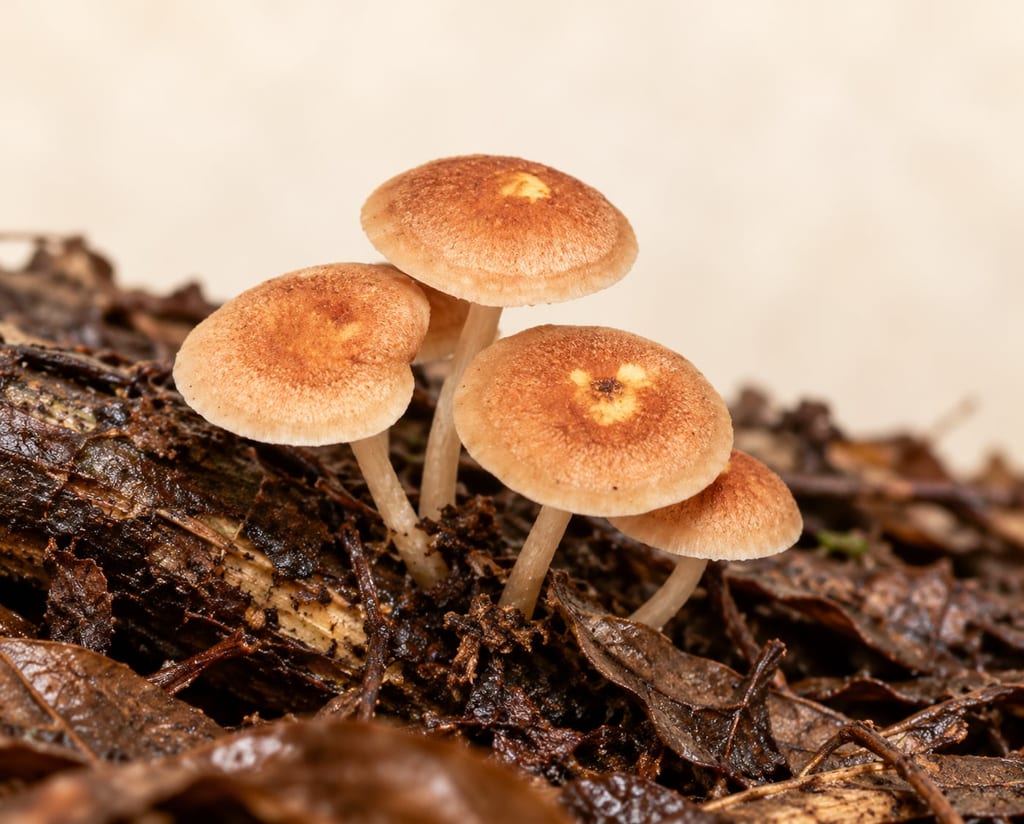
Marasmius buzungolo Singer is a mushroom-forming fungus in the family Marasmiaceae. Singer published the name in 1964. The Meise Botanic Garden's tropical-African species atlas retains that name and authority and connects it to taxonomic treatments and illustrated plates. The local catalogue gives no settled English common name and treats the species label as a research subject rather than an independently reconciled common food name.
The atlas describes fruit bodies growing in small groups. A cap begins bell-shaped and spreads with age around a raised central umbo. It is typically reddish brown, sometimes shifting toward flesh pink, with a darker centre and occasional whitish patches. The margin is rough and pitted; the surface may crack as it ages. A narrow, hollow, pale stem can be slightly twisted or curved and has abundant white basal mycelium. Close white-to-cream gills attach to the stem and may run down it slightly. The flesh is white. The atlas reports a strong odour and bitter taste. These are field-guide traits, not enough to identify a particular wild mushroom safely.
The species description includes microscopic details because its small brown caps are not distinctive on colour alone. Its spores are described as hyaline, thin-walled and ellipsoid to cylindric-ellipsoid. The cap surface includes smooth cells alongside brush-shaped cells characteristic of the Siccus-type group; the atlas also records abundant clamp connections. Such structures require microscopy and expert comparison. A photograph that resembles the species cannot substitute for microscopic or voucher-based identification.
In Tshopo, researchers tied the name to dried herbarium vouchers ADK5760 and MKH121. The later study explains that mushroom identifications followed specialist taxonomic works and used macroscopic and microscopic characters, with reference specimens deposited at Meise Botanic Garden. These records give the food-use report a stronger taxonomic basis than an unattributed vernacular name, while still leaving the limits of each survey intact.
The species is saprotrophic: it gets nutrients as it decomposes dead organic material rather than partnering with living tree roots. The species atlas places it on dead leaves and detritus in dense moist forests and wooded savanna. Tshopo researchers classify it among wood-decaying saprotrophs, a broad ecological category that includes mushrooms growing from fallen wood and litter.
That ecology helps explain why the fungus is part of food knowledge in forest landscapes: the fruiting body can emerge from substrate close to communities and does not require a living host-tree relationship. It does not mean every fruit body in leaf litter is this species, nor that forest setting alone predicts the mushroom's taste or food use.
The strongest species-specific food evidence comes from ethnomycological fieldwork around the Yangambi Man-and-Biosphere Reserve and Yoko Forest Reserve in Tshopo, in the Democratic Republic of the Congo. A study of 160 informants from six communities—Bakumu, Turumbu, Topoke, Lokele, Ngelema and Ngando—records M. buzungolo as food and supports the identification with the ADK5760 and MKH121 vouchers.
In a later paper's table, M. buzungolo appears with 138 frequency-of-mention records and an edible-mushroom cultural-significance score of 0.9. The authors' questions asked whether people ate a given mushroom; the score measures reported edible status in that survey. The paper also says the species was among the most appreciated and tasty taxa in its Tshopo sample. These figures describe the people and interview method used, not the whole country or all consumers.
The 2018 study's discussion notes that mushroom knowledge and preferences differ among communities, generations and household roles. It places M. buzungolo among wood-decaying mushrooms commonly eaten in Tshopo, not as a universal food shared identically by every group. This distinction matters: a species may be familiar and valued in one local network without carrying the same names, recipes or meanings elsewhere.
A 2017 survey in the hinterland of Kikwit and among city residents in DR Congo also names M. buzungolo among the species people consumed and particularly appreciated for taste. Its photograph 3 is labelled with the species name. The survey describes 74 mushroom taxa in local diets and markets, but its broad account does not supply a specific preparation for this one species.
A 2023 review of wild edible and medicinal mushrooms in Central and Southern Africa lists the vernacular names Boua and Ochiu vió with M. buzungolo and gives DR Congo and Gabon as recorded countries. Because the table does not tie each name to a particular community or locality, these names should not be treated as synonyms used everywhere. The species atlas additionally lists records from Benin and Burkina Faso; these extend the known distribution, but do not establish the same food practices in each country.
The Tshopo study sampled fungi in the main rainy season, March through June, during 2015 and 2016. That describes when the research team carried out its collection and interviews; it does not prove that M. buzungolo fruits only in those months. A second paper notes that saprotrophic fungi as a group can fruit through the year in Tshopo, where frequent rains and dead wood provide continuing conditions. It does not publish a species-by-species calendar for M. buzungolo.
The Kikwit survey calls the region's mushrooms seasonal resources and says their periods of productivity need more observation. The defensible account is therefore local and cautious: this species appears in rainforest and woodland food records, but its exact fruiting months, harvest window and season-to-season variation are not established in the sources reviewed here.
A paper on cultivation trials in Kisantu reports fruit bodies from local M. buzungolo strains on lignocellulosic substrates. The research describes experimental cultivation as a contribution toward lower-cost methods for local edible fungi. It should not be read as a standardized growing guide, a proven commercial supply chain or evidence that routine cultivation has replaced wild gathering.
The experiment's substrates were soaked, fermented under cover and composted before heat treatment. Those substrate-processing stages belong to that cultivation experiment. They do not make M. buzungolo a fermented ingredient, nor do they document a mushroom ferment, starter culture, preserved dish or traditional curing practice. The sources support its role as a mushroom eaten as food, while species-specific household preparation remains unreported.
The cited ethnomycological studies document food use; they are not toxicological assessments and do not give a safe-foraging test. The generated illustration is editorial artwork, not a diagnostic reference. Colour, a pale stem or a forest-floor habitat should never be used alone to decide whether an unknown mushroom is M. buzungolo or safe to eat.
The sources consulted here do not establish a species-specific cleaning method, cooking schedule, storage duration, drying method, nutritional analysis or fermentation use. Those details should remain open until reliable sources address this taxon directly. A regional record of eating a named mushroom is evidence about that community's reported knowledge, not a general instruction for identifying or preparing wild fungi.
Voucher-backed food-use records come from interviews and rainforest collections around Yangambi and Yoko; this is not a claim of uniform province-wide practice.
A survey of Kikwit and its hinterland names this species among locally consumed and appreciated mushrooms; its broad survey findings are not a species-specific preparation.
A cultivation study reports fruiting bodies from a local strain in substrate trials; this is experimental cultivation, not evidence of routine commercial supply.
The taxonomic atlas and regional review report occurrence; this row does not assert a specific Gabonese preparation or food custom.
The Meise Botanic Garden atlas reports a distribution record; this row does not infer local food use.
The Meise Botanic Garden atlas reports a distribution record; this row does not infer local food use.
Food use is documented at named study areas in Tshopo and around Kikwit; the country record does not imply a single practice across the DRC.
A wild ectomycorrhizal Amanita of the Congo rainforest, recorded as locally consumed in Tshopo province. Its preparation was not established, and the genus includes deadly species.
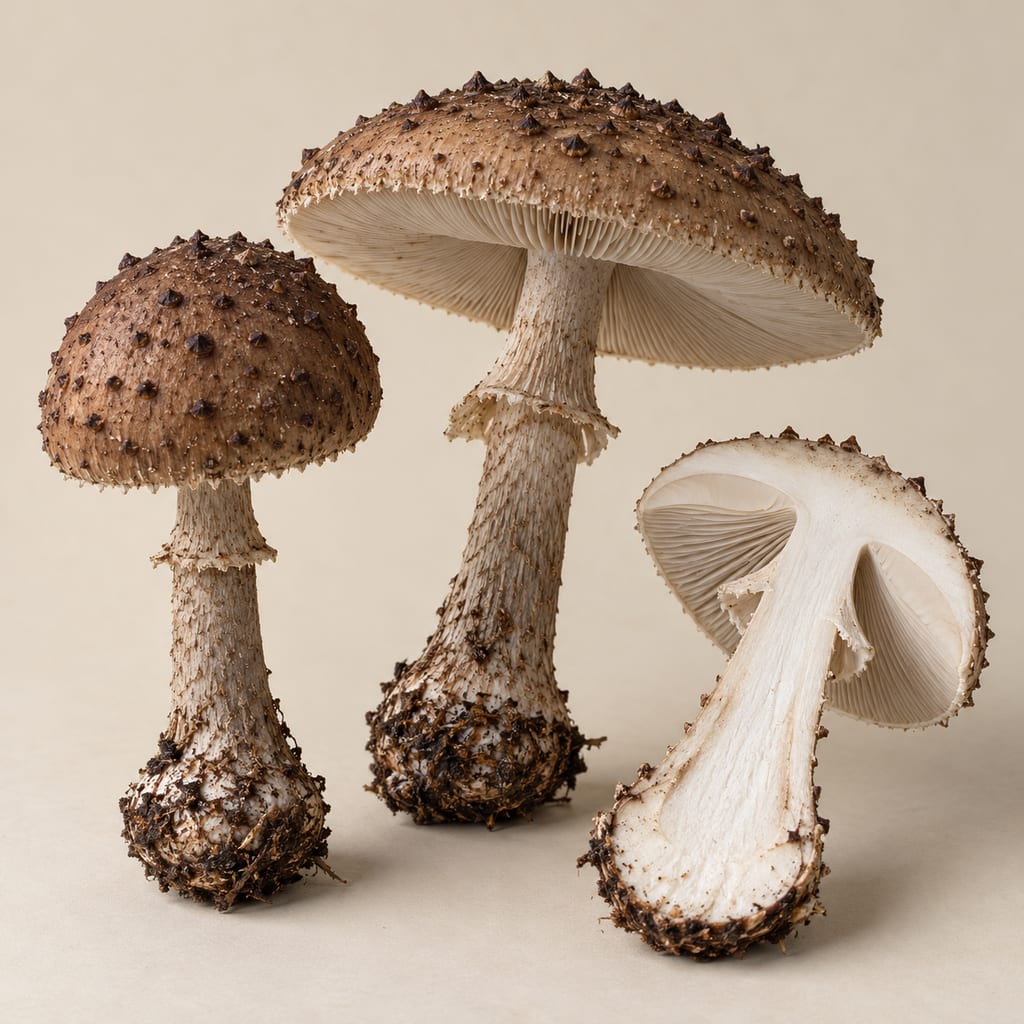
A wild ectomycorrhizal Amanita of the Congo rainforest, recorded as locally consumed in Tshopo province. Its preparation was not established, and the genus includes deadly species.
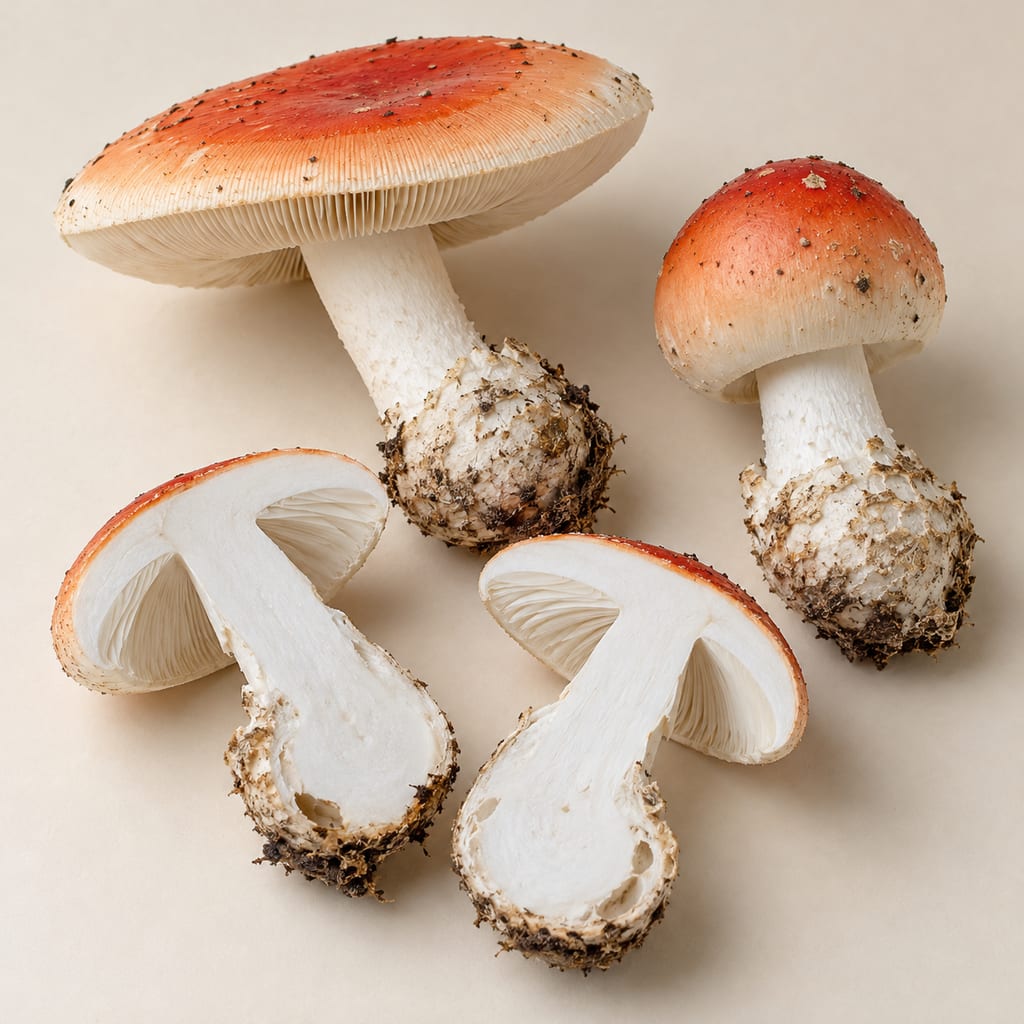
Amanita robusta Beeli is a poorly documented Central African Amanita known from voucher-backed rainforest collections in the Democratic Republic of the Congo and Cameroon. A Tshopo study reports local food use for a taxonomically supported voucher, but neither that record nor the name makes an unknown Amanita safe to identify or eat.
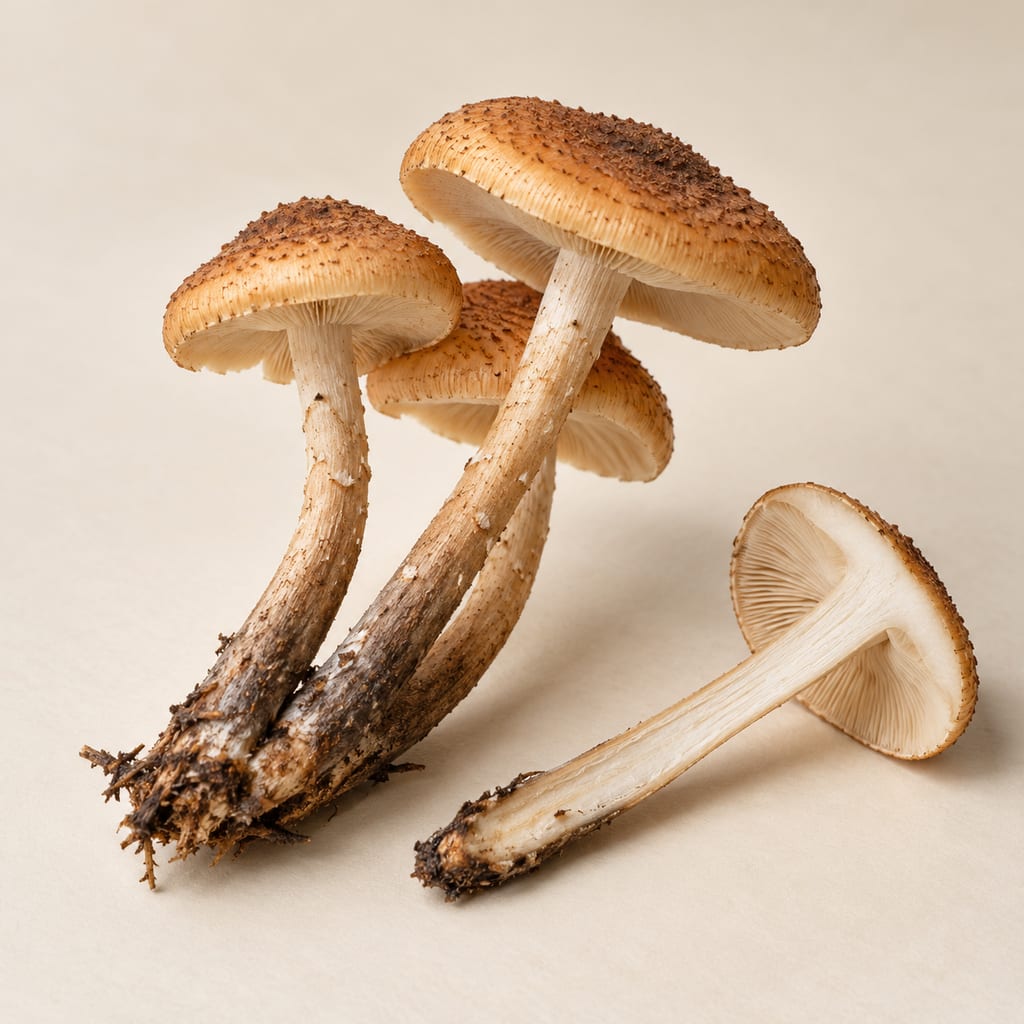
Armillaria heimii is a saprotrophic fungus of the honey-fungus genus, recorded as a wild food in Tshopo province, DR Congo. Its preparation and safety are not established in the sources.
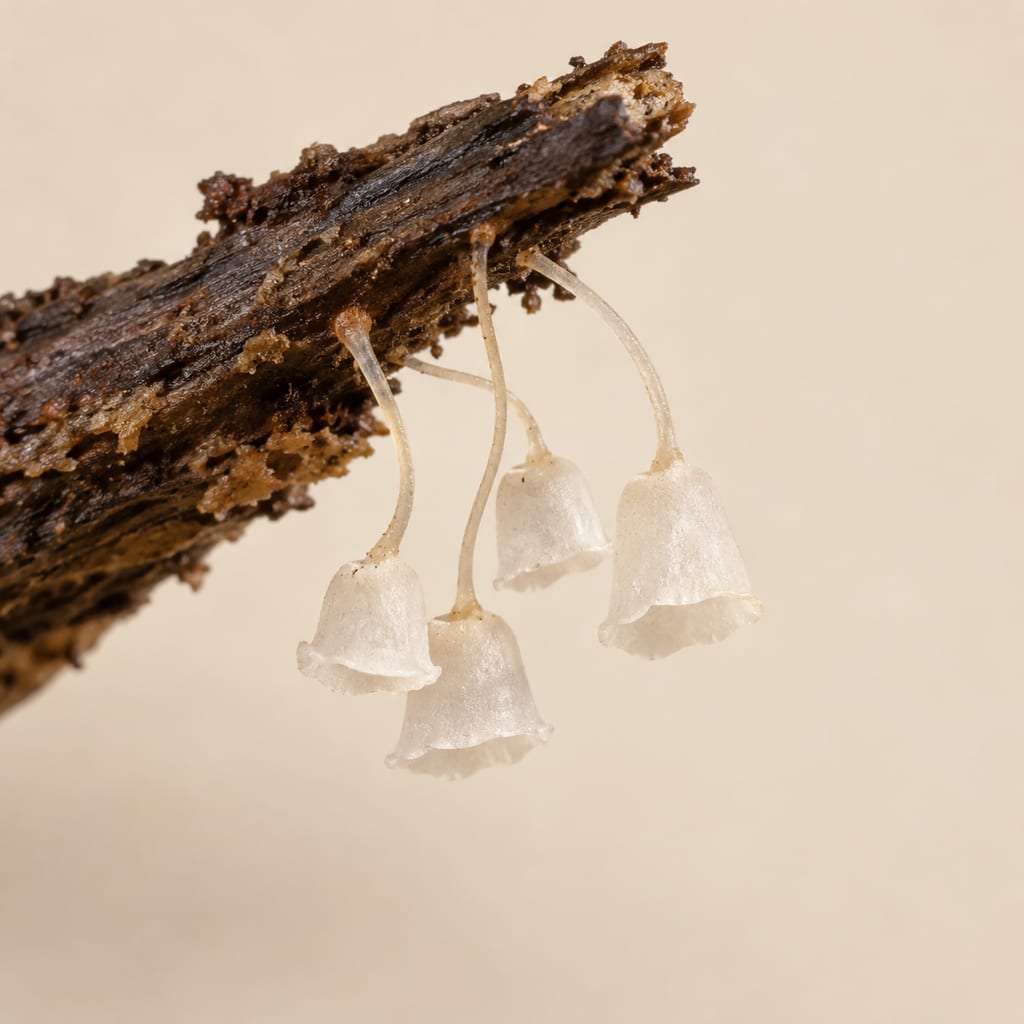
Calyptella longipes is a wood and litter decaying fungus of the rainforests of Tshopo province, DR Congo, where some ethnic groups in voucher-backed interviews eat it. Its preparation was not recorded.
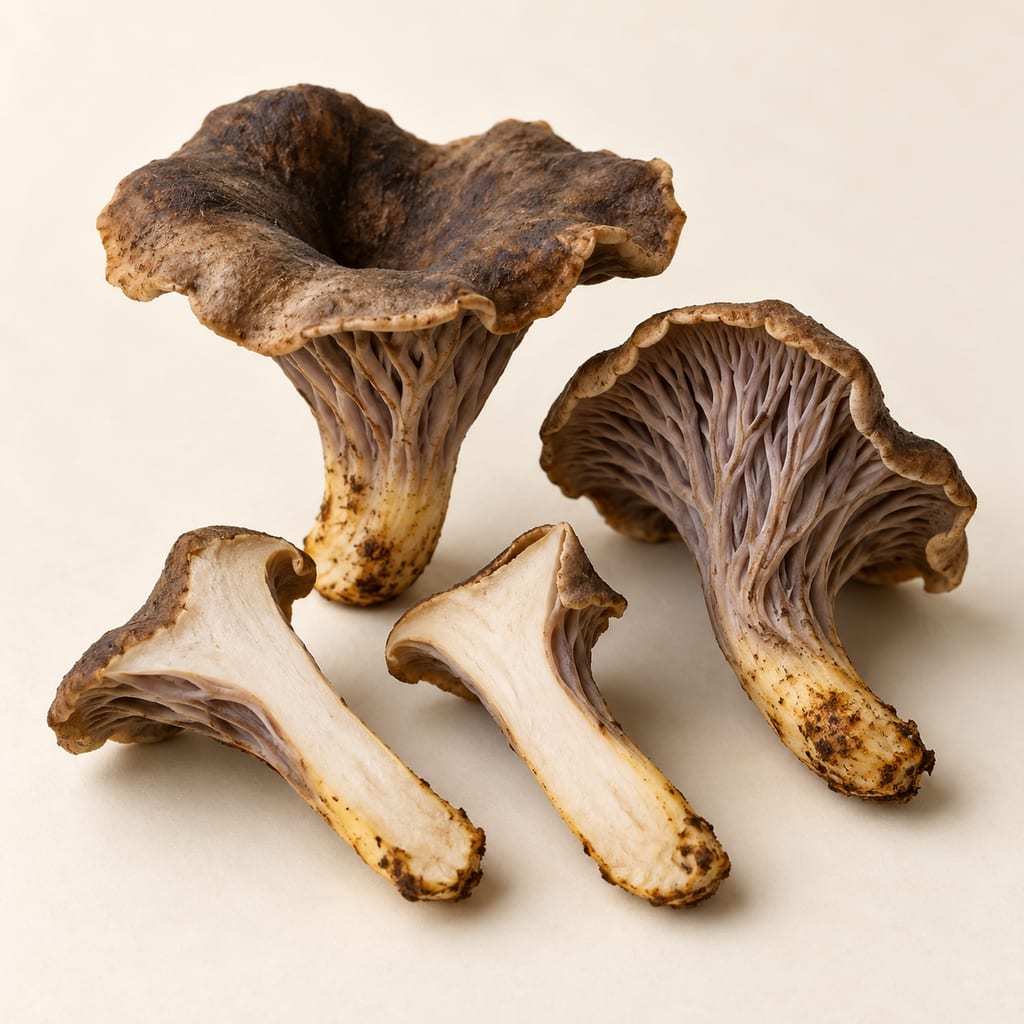
Cantharellus congolensis is an ectomycorrhizal chanterelle of sub-Saharan Africa, eaten in the Democratic Republic of the Congo under local names. Its edibility rests on food-use surveys, not on toxicity tests.
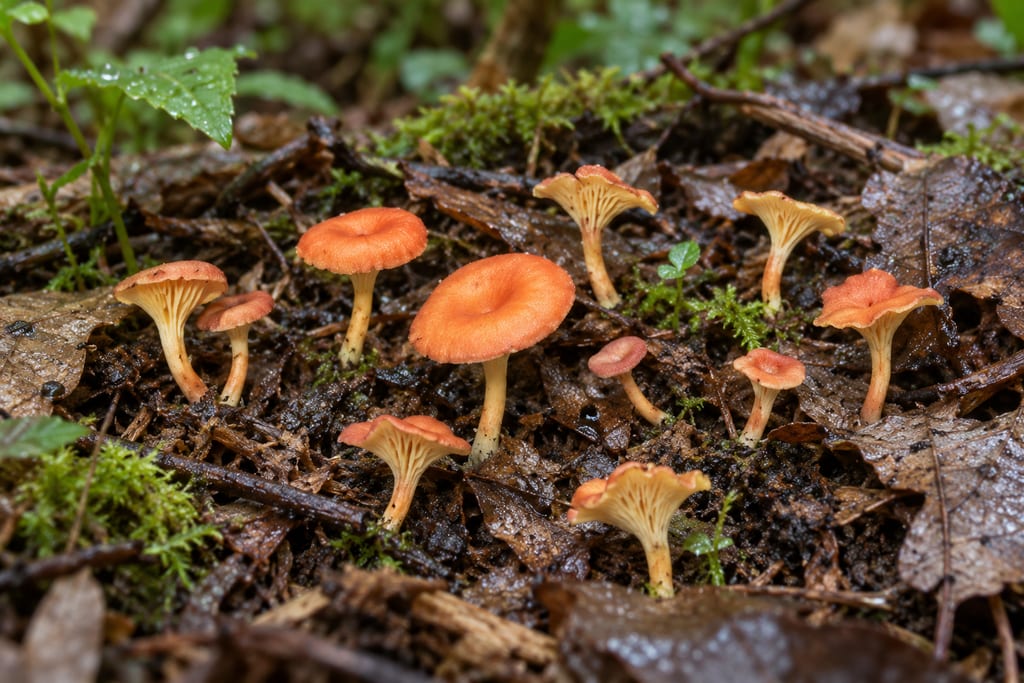
Cantharellus floridulus is an ectomycorrhizal rainforest fungus that informants in Tshopo province, DR Congo, eat in voucher-backed interviews. Its preparation is not recorded, and the source gives no toxicity statement.
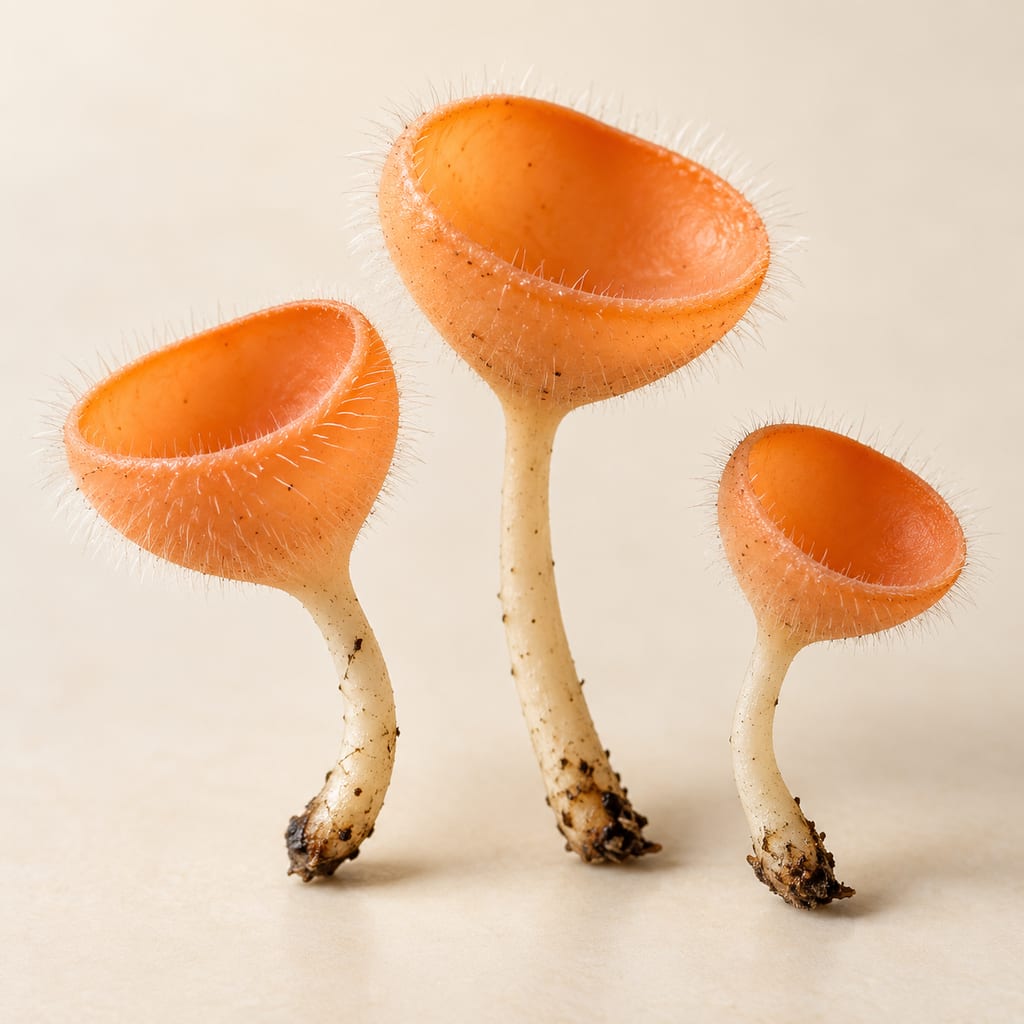
A forest cup fungus of the Tshopo province in the Democratic Republic of the Congo, recorded in local interviews as eaten. The species-level preparation is not established.
No community contributions have been published for this entry yet.
Sign in to contribute. Published comments and photos are free to read.
Edible Fungi of Tropical Africa; Meise Botanic GardenIdentity · Taxonomy · Morphology · Ecology · Distribution
Marasmius buzungoloName and authority Marasmius buzungolo Singer; 1964 publication reference; detailed macro- and microscopic morphology; saprotrophic ecology on dead leaves and detritus in dense moist forest and wooded savanna; distribution records for Benin, Burkina Faso, DR Congo and Gabon; cited illustrated references.
Cited in: A small forest mushroom with a taxonomic history; How taxonomists distinguish it; A decomposer of leaves and wood; Other records and names; Rainfall matters, but a calendar is not established; Cultivation research and fermentation limits; Handling, safety and evidence limits
Journal of Ethnobiology and EthnomedicineDocumented use · Geography · Voucher evidence · Ecology · Seasonality
Uses and importance of wild fungi: traditional knowledge from the Tshopo province in the Democratic Republic of the CongoThe study records M. buzungolo as food and a wood-decaying saprotroph, supported by vouchers ADK5760 and MKH121; it surveyed 160 informants across six Tshopo communities and sampled fungi in the main rainy season, March–June 2015 and 2016.
Cited in: How taxonomists distinguish it; A decomposer of leaves and wood; Food use documented in Tshopo; Rainfall matters, but a calendar is not established; Handling, safety and evidence limits
Journal of Ethnobiology and EthnomedicineFood use · Geography · Voucher evidence · Seasonality · Image reference
Wild edible ectomycorrhizal fungi: an underutilized food resource from the rainforests of Tshopo province (Democratic Republic of the Congo)Current taxonomy and herbarium-supported sampling at Yangambi and Yoko; M. buzungolo listed as Food, Sapr, with 138 frequency mentions and EMCS score 0.9, vouchers ADK5760 and MKH121; Figure 4(c) is captioned as M. buzungolo; paper's all-year fruiting statement applies to saprotrophs as a group, not this species specifically.
Cited in: How taxonomists distinguish it; A decomposer of leaves and wood; Food use documented in Tshopo; Rainfall matters, but a calendar is not established; Handling, safety and evidence limits
International Journal of Innovation and Applied Studies, 21(1), 124–136Documented use · Geography · Local appreciation · Image reference
Champignons comestibles de la région de Kikwit en République Démocratique du Congo : Approche écologique, nutritionnelle et socioéconomiqueA survey around Kikwit lists M. buzungolo among locally consumed and notably appreciated mushrooms; Photo 3 caption identifies the species; article states CC BY license.
Cited in: Other records and names; Rainfall matters, but a calendar is not established; Handling, safety and evidence limits
Afrique Science: Revue Internationale des Sciences et TechnologieExperimental cultivation · Geography
Culture de trois espèces fongiques sauvages comestibles du Groupement de Kisantu (R.D. Congo) sur des substrats ligno-cellulosiques compostésA 2015 article abstract reports fruiting bodies from local M. buzungolo strains grown in experiments using composted lignocellulosic substrates; it does not establish a standardized commercial method.
Cited in: Cultivation research and fermentation limits
Food FrontiersVernacular names · Distribution
Ethnomycological prospect of wild edible and medicinal mushrooms from Central and Southern Africa—a reviewThe review lists Boua and Ochiu vió with M. buzungolo and reports DR Congo and Gabon; it does not assign each name to a precise community.
Cited in: Other records and names