What the mushroom is
Termitomyces medius is a small agaric of the genus Termitomyces. It was described by Heim and Grassé in 1950. The catalogue records it as a wild termite mushroom, and the Edible Fungi of Tropical Africa record lists it as an edible species. The catalogue's common name, termite mushroom, is also used for several other species, so this page uses the scientific name.
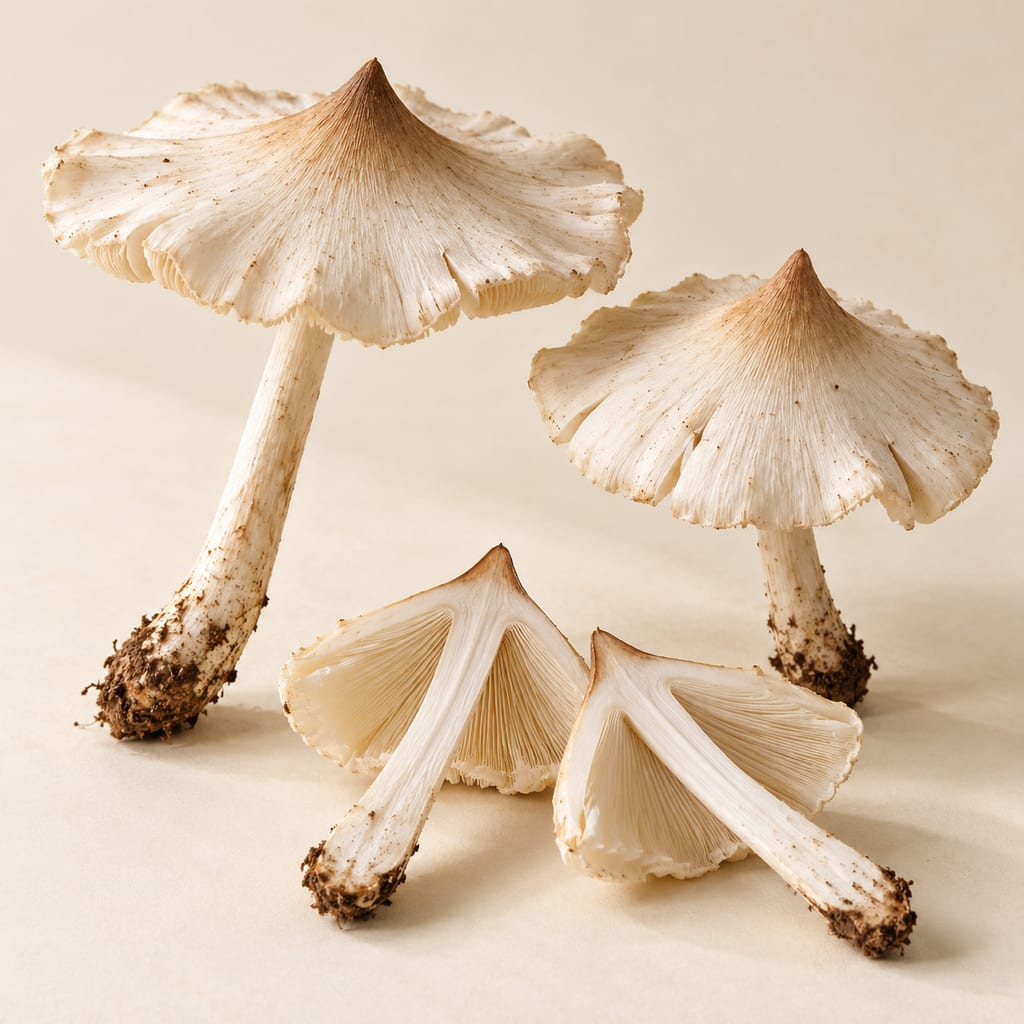
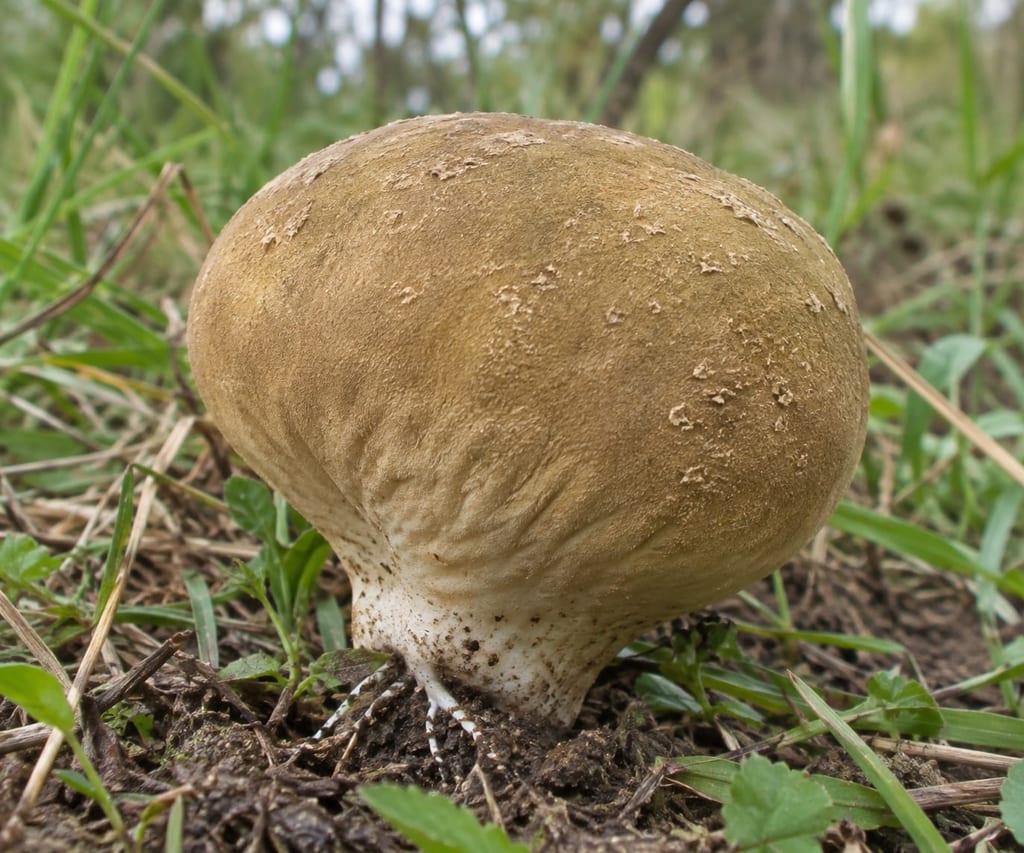
The cap is 2 to 3 (to 4) cm across, firm, conical at first and later spreading. It has a dark, sharp central point called the perforatorium, and it is grey-brown to brownish-beige in that area. The gills are free and whitish-flesh coloured. The stipe is 2 to 4 (to 5) cm long, silky, twisted at times and almost pure white. A fine, brittle, white root-like pseudorhiza up to about 10 cm long extends below the base. The spore print is cream to flesh-coloured.
Sources for this section
Termites and habitat
The fungus grows in association with fungus-growing termites, in the Microtermes, Ancistrotermes and Synacanthotermes groups, on underground termite mounds in miombo woodland. The fungus grows on the comb that the termites build from plant material. The habit at species level comes from the Edible Fungi of Tropical Africa account.
Sources for this section
Similar species
The species is similar to a very small Termitomyces striatus. It can be confused with T. microcarpus, which has no pseudorhiza. The species resembles T. mbuzi, which has an almost entirely white cap, a more pointed perforatorium and stipes that join at the base and branch into several fine pseudorhizae. Separating these species needs a specialist identification before any use.
Sources for this section
Distribution
The catalogue records Benin, Burkina Faso and DR Congo. The Edible Fungi of Tropical Africa page also lists records from Côte d'Ivoire, Ghana, Guinea, Nigeria, Senegal, Togo and Zambia. The sources show these as distribution records, which is not the same as a record of food use in each country.
Sources for this section
Food use and safety
The catalogue describes the species as a regional termite-mushroom food taxon, listed by EFTA as an edible species, with the supply recorded as wild. The catalogue states that preparation, identity and current safety need separate validation before any use. The EFTA record does not give a preparation method, and none is stated here.
Inclusion in the catalogue does not establish identity, edibility or a safe preparation for this species. The genus-level sources describe Termitomyces mushrooms as eaten in parts of Africa and Asia, but that does not establish a food use for T. medius in any particular country. This page gives no edibility verdict for wild specimens.
Sources for this section
Open questions
The sources do not record how the species is prepared, how it is stored, or which parts are eaten. The catalogue's species assignment for regional termite-mushroom records has not been checked by molecular work in these sources. A specialist identification and a documented regional food record are the next steps.
Sources for this section
Places
Benin
Documented use · Country evidenceCatalogued regional termite-mushroom food record; the EFTA page lists Benin among the known distribution records.
Burkina Faso
Documented use · Country evidenceCatalogued regional record; the EFTA page lists Burkina Faso among the known distribution records.
DR Congo
Documented use · Country evidenceCatalogued regional record; the EFTA page lists the Democratic Republic of the Congo among the known distribution records.