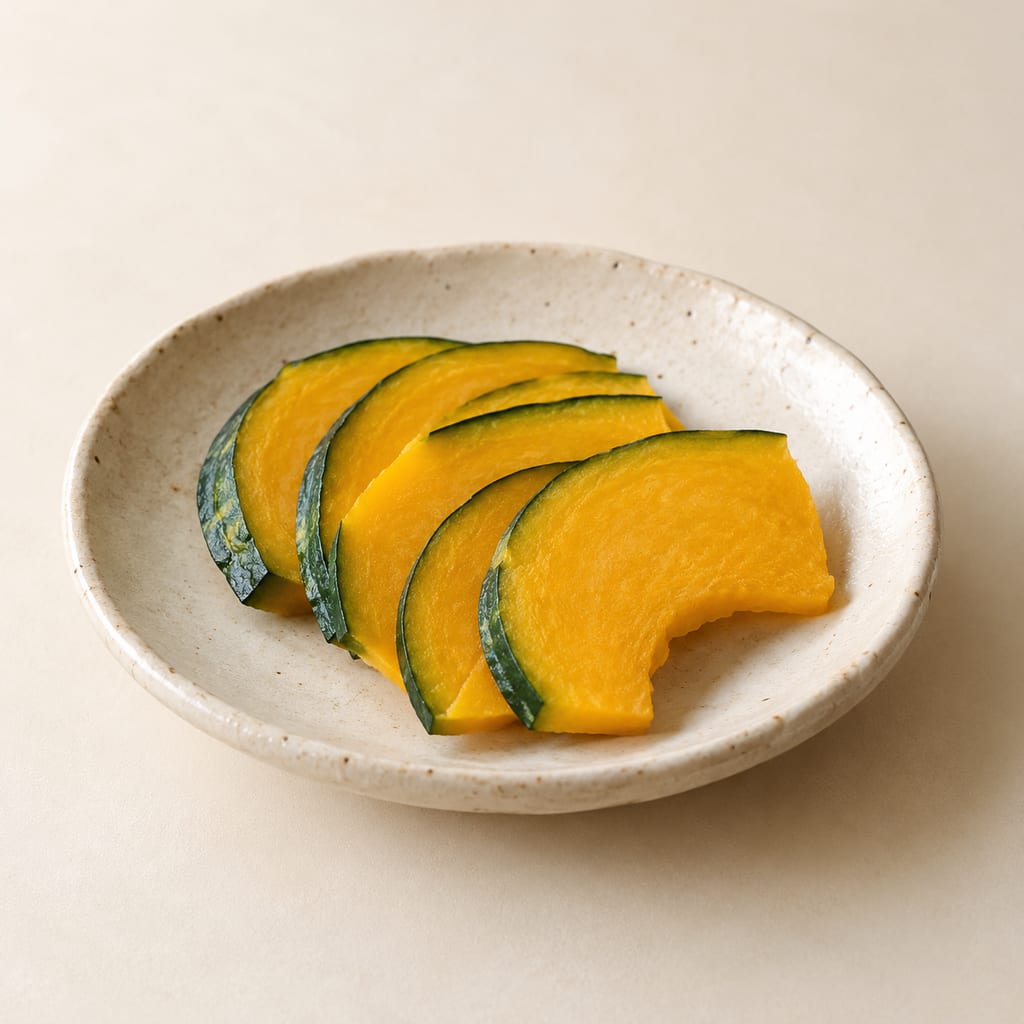
Kabocha no nukazuke: pumpkin in a fermented rice-bran bed
Kabocha no nukazuke: Refrigerated commercial fermented bed; use removed portions the same day.
 FermenteaWhere food goes to change
Equipment · Jars, pots and crocks
ぬか壺 · nukadoko jar · nukazuke crock
A nukadoko container holds the moist rice-bran bed in which vegetables are repeatedly pickled. Japanese households have maintained these beds in ceramic jars, while contemporary options also include compact ceramic and enamel designs.
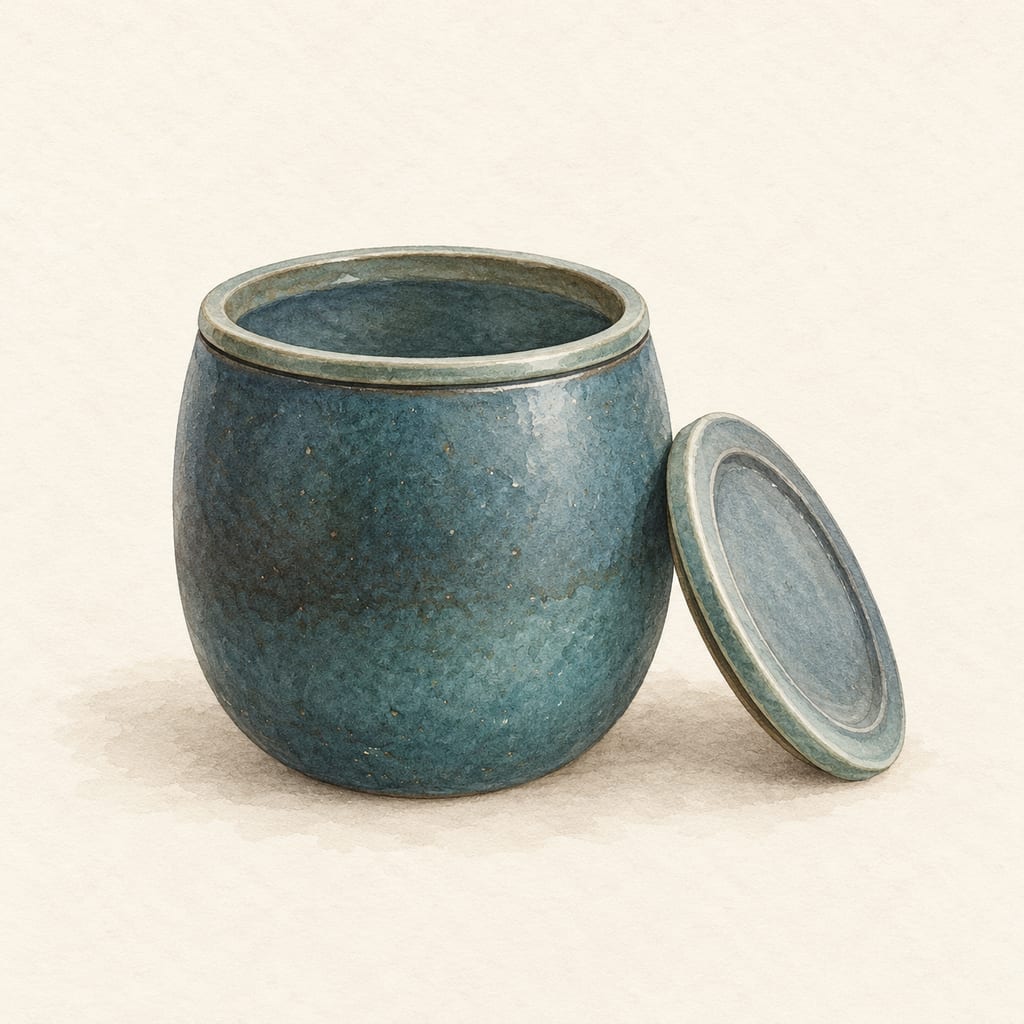
Nukadoko is the moist, granular rice-bran bed in which vegetables are repeatedly pickled. The container holds this bed between uses; it is not the bed itself. That distinction matters because the work lies in maintaining the bran mixture and its changing moisture, not in leaving vegetables submerged in free brine. A broad opening gives the keeper room to turn the bed and bury or retrieve vegetables. The documented vessels range from rounded ceramic jars to shallow rectangular boxes.
Kitakyushu's local food-culture report traces rice-bran-bed practice in Kokura to a 1626 letter and cites another mention in 1628. These are early documentary attestations of the practice. They do not prove that the same kind of jar, or even ceramic, was used then. The report's field interviews offer a separate and much later record: residents described long-kept family beds in wide-mouthed ceramic jars. One household jar was roughly cylindrical, about 25 cm in diameter and 30 cm high. Those measurements describe one interview, not a standard size.
The word nukadoko names the pickling bed; a ceramic vessel may be called a nukatsubo or nukadoko jar. An English guide from the Kitakyushu-Kokura Nuka-Doko, Nuka-Daki Kenkyukai shows the idea plainly: a brown rounded pot with its mouth open and vegetables nestled in the bran. The image records a teaching example, not an archaeological reconstruction. The sources document varied household forms, not one universal shape.
Vegetables are pressed into the rice-bran mixture, left to pickle, then removed; the bed is turned and used again. Kitakyushu's report describes daily mixing and repeated vegetable pickling as part of local maintenance. A particular maker's instructions may set out another schedule or storage practice. The equipment requirement is practical access to the bed and enough room to work it. The sources do not define one ideal proportion or capacity for all households.
Moisture enters the bed from vegetables. Some contemporary containers address that practical issue with a collector or draining arrangement, but these fittings are product features rather than defining parts of a nukadoko vessel. Noda Horo's Nukazuke Komachi, for example, is a shallow enameled-steel box with rounded corners, a polymer lid and a small porcelain water collector. Its dimensions are 255 by 160 by 70 mm and its capacity is 1.9 L. The maker says cold storage slows fermentation in this model and means the bed need not be mixed daily. That instruction belongs to this product, not every jar.
The fermentation bed remains a changing mixture. A 2024 study examined how vegetables affect the microbial community of nukadoko; it does not establish that vessel material alone creates a particular microbial profile. A ceramic pot can be a durable and culturally meaningful container without requiring a claim that clay guarantees a better ferment. The bed, its ingredients, the vegetables entering it and the keeper's routine all matter.
A fired-clay jar is the most familiar traditional vessel in the local examples. The glazed brown pot shown by the research society and ceramic household jars described in Kitakyushu interviews support a focus on pottery rather than substituting a generic plastic tub for older practice. They do not establish one universal clay body, glaze, lid, size or firing method. A home keeper's jar and a potter's current product are different kinds of evidence.
Potters continue to make ceramic vessels for nukadoko. Meizan Kiln sells a compact Shigaraki ceramic jar measuring 160 by 160 by 150 mm, with a fitted lid, in two glaze colors. The maker says it holds about 1.5 kg of prepared rice-bran mix and fits in a refrigerator. This present-day product carries pottery craft into a contemporary kitchen; it is not proof that historical containers had the same silhouette or capacity.
The range also includes enameled steel. Noda Horo's 1.9 L model is shallow and rectangular, unlike the rounded ceramic jar. Both can hold a maintained bed, but their capacities, closures and care directions are not interchangeable. Plastic boxes are also reported among contemporary options, though this entry gives greater attention to the ceramic forms supported by household interviews and the inspected photograph. Material alone is not a guarantee of fermentation quality.
Choose a container that suits the amount of bed you maintain and leaves room to work the mixture. Wide mouths in the documented ceramic examples support hand access. A compact lidded model may fit inside a refrigerator, while a larger household crock may sit on a counter or in a cool storage place; handling depends on the vessel and the maker's instructions. The sources do not provide a general cleaning, seasoning or repair routine for ceramic nukadoko jars, so care should not be invented from their age or material.
Capacity is not standardized across the class. The city report gives dimensions for one family's jar, but not its capacity. Meizan Kiln provides a loading guide for its own compact pot, and Noda Horo lists a precise capacity for its separate enamel model. Keeping measurements attached to the named examples prevents one product from becoming the historical norm.
For a documented use of the bed, follow the related cucumber nukazuke recipe. The jar is equipment; the rice-bran bed and the pickle are distinct subjects. Neither a traditional pot nor a new compact vessel replaces the need to maintain the bed itself.
Kitakyushu's local records trace rice-bran-bed practice to a 1626 letter; household ceramic jars are documented separately in recent interviews.
The Kitakyushu-Kokura research society presents nukadoko and nukazuke as Japanese food culture; this does not claim that every vessel style originated in Japan.
The report cites a 1626 letter connected with Kokura; it attests rice-bran-bed practice rather than a dated ceramic vessel design.
Recent interviews document ceramic jars used for long-maintained household beds, including one wide-mouth cylindrical example; the report does not generalize one size to the region.
Kabocha no nukazuke: Refrigerated commercial fermented bed; use removed portions the same day.
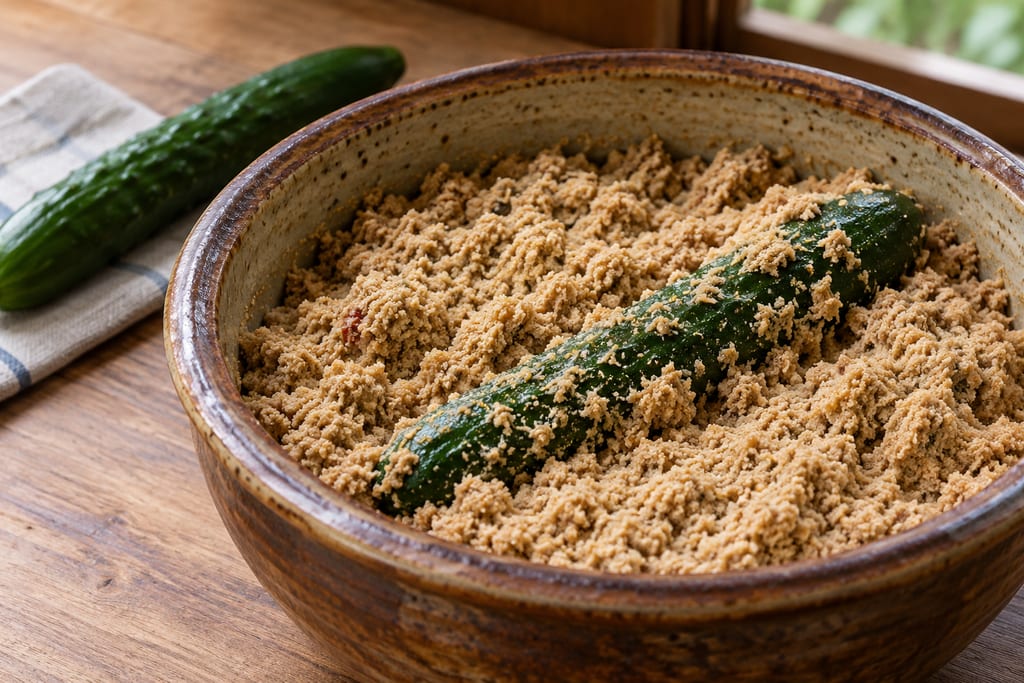
Cucumber ferments in a maintained rice-bran bed seeded through repeated vegetable scrap picklings; the record includes the starter-bed method.

A small electric incubator holds jars at a selected temperature for yogurt and other documented warm food preparations. Controls, capacity and vessel arrangement vary by model.
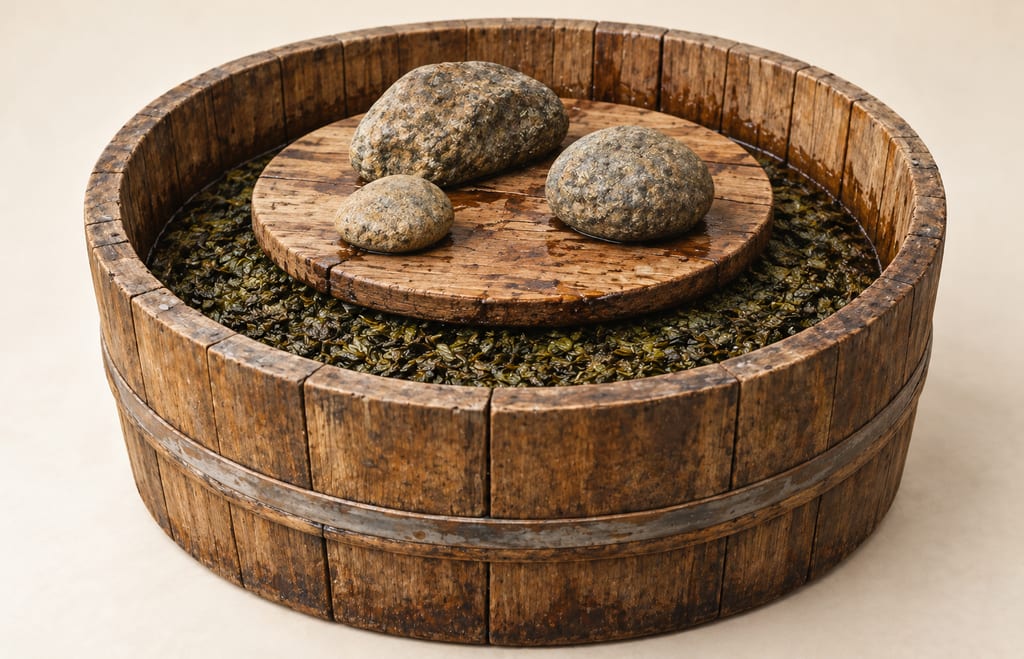
A large wooden tub used in Tokushima to ferment heated, worked Awabancha leaves with their cooking liquor. Its size and construction details are not specified in the sources.
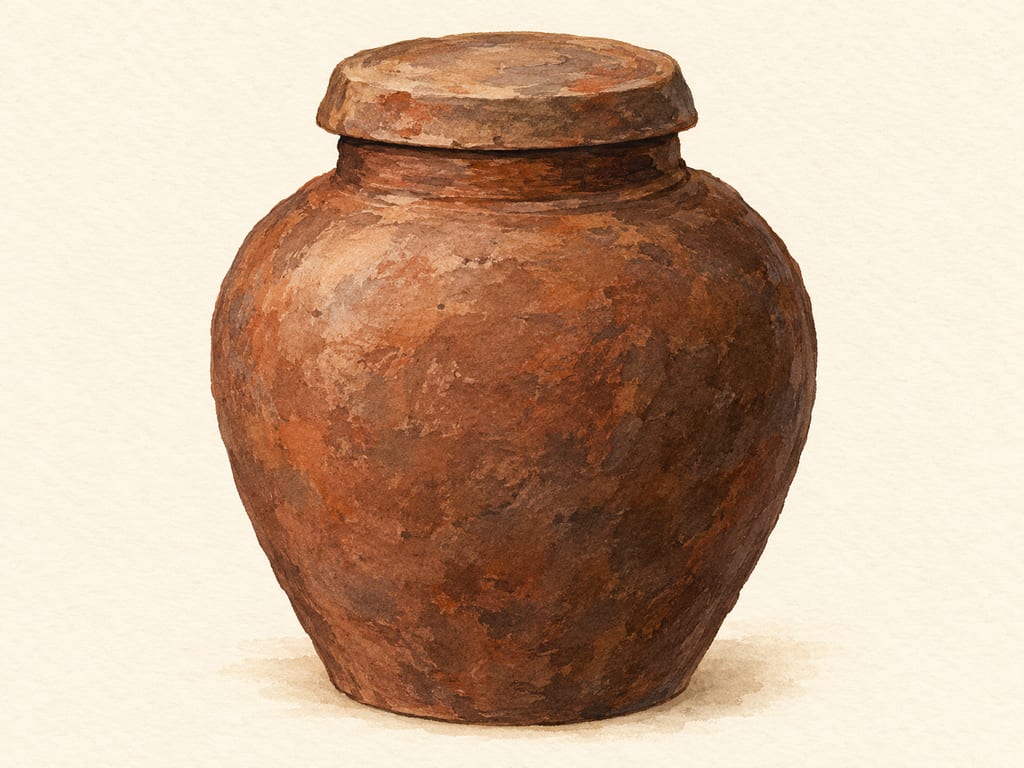
A ceramic jar used in Okinawa to store and mature distilled awamori into kusu; it holds the finished spirit after distillation rather than fermenting the rice mash.
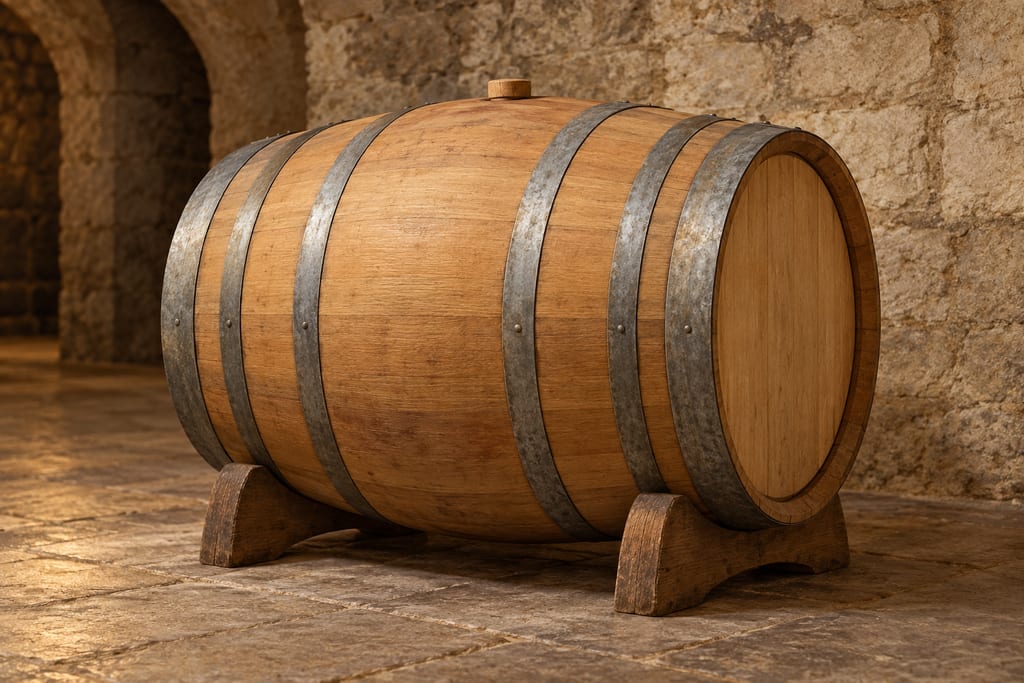
Coopered vessels use shaped staves and hoops, but portable barrels, large foeders and upright wooden vats serve different roles. Materials and uses vary by place and process.
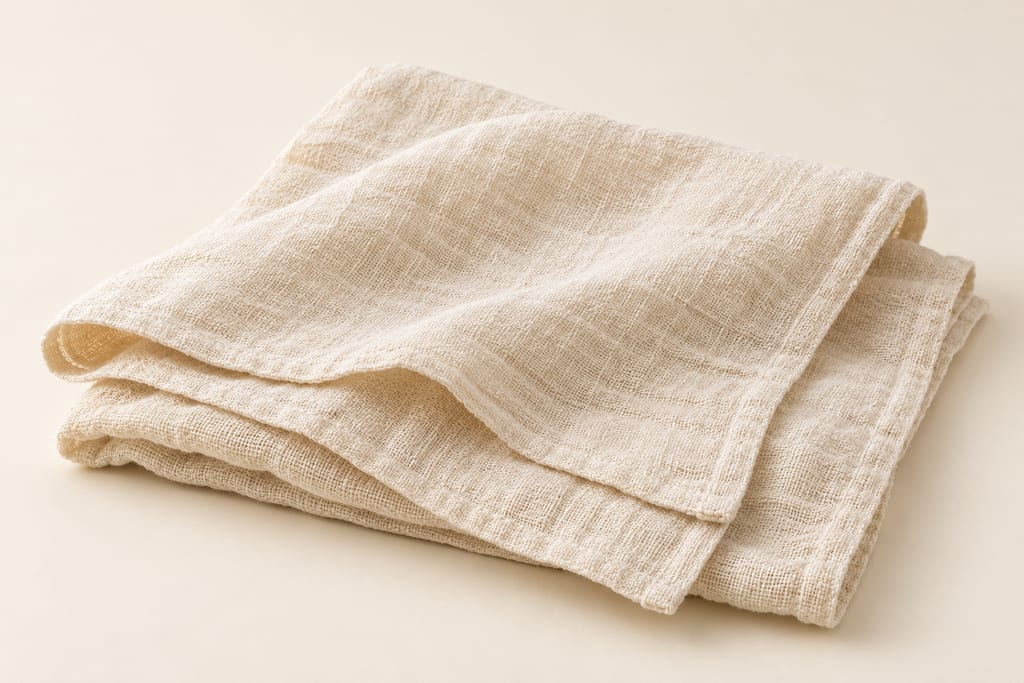
A cloth listed for steaming rice in a rice-koji method and identified as cloth for a koshiki in a brewery-museum caption; its fiber, weave, and size are not specified.
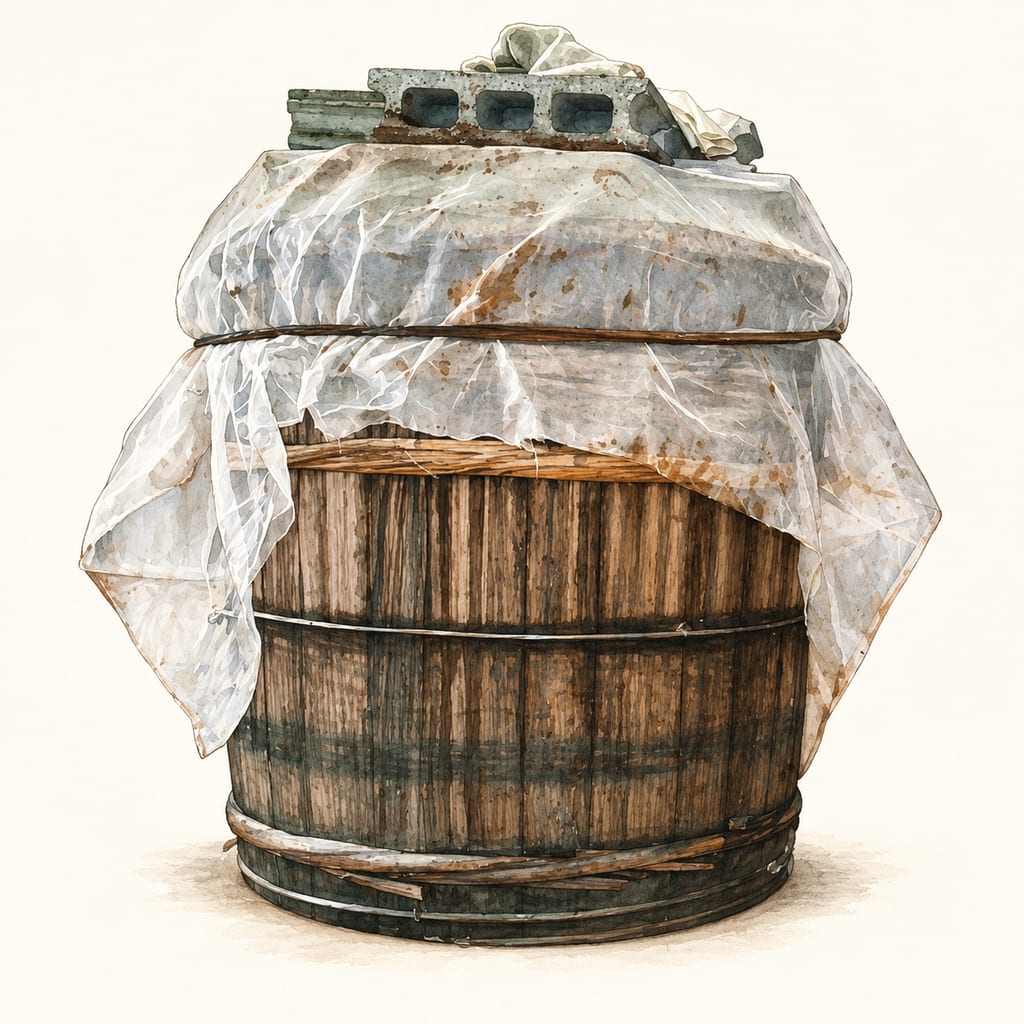
A Goishicha weighted tub holds tea leaves and steaming liquor during the second, wet fermentation stage in Ōtoyo, Kōchi. A current producer photograph documents one covered wooden tub under concrete-block weight.
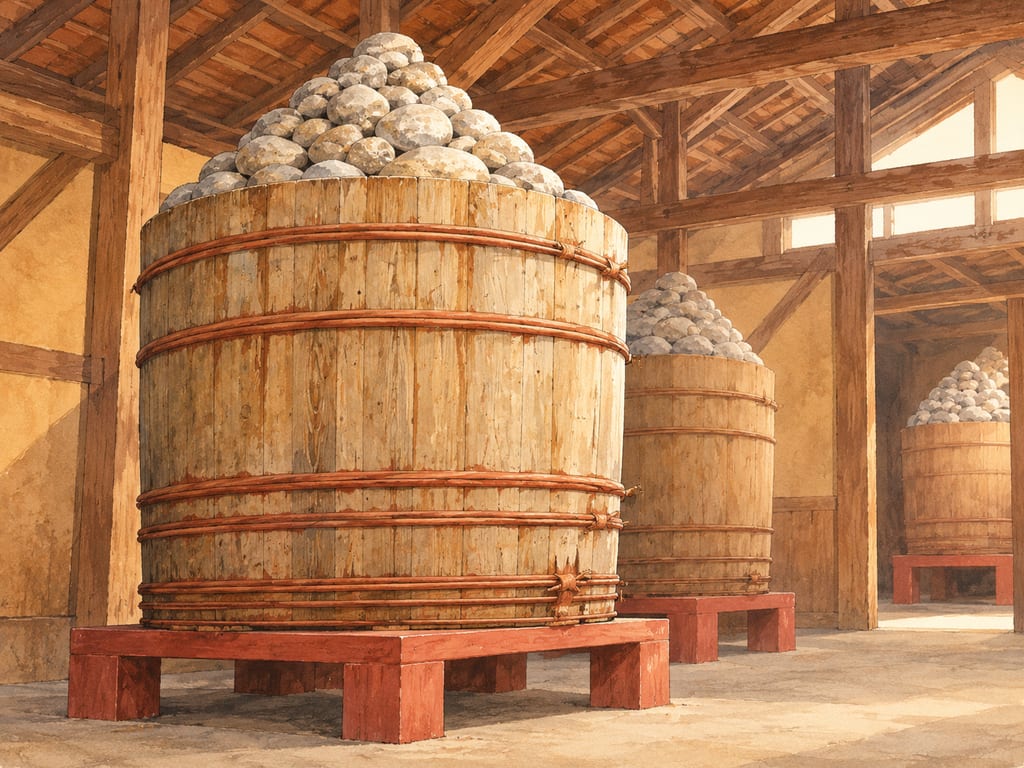
A coopered wooden kioke used by Kakukyu in Okazaki for Hatcho miso: a broad vat capped with a carefully stacked pyramid of river stones during maturation lasting more than two years.
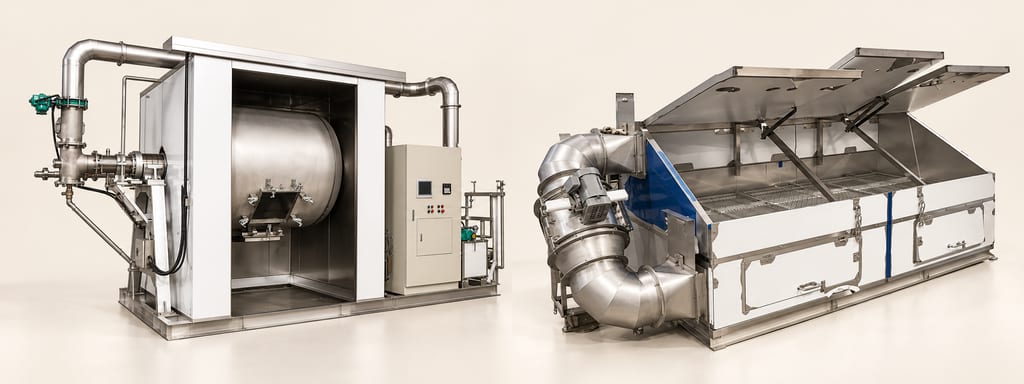
Industrial koji machines cultivate mold on prepared grain before sake, shochu, miso or soy-sauce production. Commercial designs include rotating drums and aerated beds.

A gelling polysaccharide extracted from red seaweeds, sold as kanten strips or powder; it sets firm at a low concentration and stays solid until about 85 °C.

A Dominican table and seasoning condiment of sour orange juice, mixed with lime and salt and bottled raw; garlic, oregano or a hot pepper may be added for meat or a spicier bottle.

Cicerbita alpina is an alpine perennial whose tender shoots and leaves have been eaten raw or cooked. Sámi milk preparations and modern Carnian dishes are distinct uses, with serious identification and preservation limits.

Japanese skipjack tuna cooked, then repeatedly smoked and dried over a wood fire by the hand-fired tebiyama method into a hard block for shaving into dashi: the first stage of katsuobushi.

A Swedish-style spirit vinegar made by fermenting neutral alcohol with live vinegar bacteria, with a separate guide to commercial ättika strengths.

A yeast-raised wheat ring shaped from a firm dough, briefly boiled and baked. This source-batch formula gives a gently malted crust and a chewy crumb.

A warm dip of garlic, anchovy and olive oil, often enriched with butter, that Piedmont serves over a flame with raw and cooked vegetables and bread.

Bechamel is a white sauce of milk thickened with a butter and flour roux, one of the French mother sauces, and the base from which Mornay and other cheese and cream sauces are made.
No community contributions have been published for this entry yet.
Sign in to contribute. Published comments and photos are free to read.
Kitakyushu City, under the Agency for Cultural Affairs Food Culture Story projectHistory · Geography · Form · Use · Care
北九州市の郷土料理「ぬか炊き」の食文化価値の再発見事業 調査報告書The report traces local rice-bran-bed records to 1626 and records a 1628 mention; these attest practice rather than date a particular pot shape.
Recent household interviews in Kitakyushu describe maintained beds in wide-mouthed ceramic jars, including one cylindrical example about 25 cm across and 30 cm tall.
The report describes repeated vegetable pickling and regular bed turning in local household practice.
Cited in: A jar for a living rice-bran bed; Working a bed without losing it; Ceramic crocks and newer compact designs; Choosing a vessel and keeping its limits clear
Kitakyushu-Kokura Nuka-Doko, Nuka-Daki KenkyukaiForm · Use · Image
Nuka-Doko and Nuka-Zuke: Pickling vegetables in Nuka-DokoThe 2018 English guide describes a rice-bran bed used for repeated vegetable pickling as Japanese food culture.
Its inspected photograph shows an open rounded brown glazed pot holding bran bed and vegetables; the publisher is identified but no photographer or image-use license is stated.
Cited in: A jar for a living rice-bran bed; Ceramic crocks and newer compact designs
Meizan KilnModern form · Material · Dimensions · Acquisition · Image
Handcrafted Shigaraki Pickling JarA current Shigaraki ceramic nuka jar measures 160 × 160 × 150 mm, includes a lid and is offered in two colors.
The maker says about 1.5 kg of ready-made nuka mix fits this compact refrigerator-sized model; those figures apply to this model only.
Cited in: Ceramic crocks and newer compact designs; Choosing a vessel and keeping its limits clear
Noda HoroModern variant · Dimensions · Capacity · Material
Nukazuke KomachiNoda Horo specifies a shallow rectangular enameled-steel model measuring 255 × 160 × 70 mm, 1.9 L, with a polymer lid and porcelain water collector.
The manufacturer says refrigeration slows fermentation for this product; that is not a universal property of all vessels or beds.
Cited in: Working a bed without losing it; Ceramic crocks and newer compact designs; Choosing a vessel and keeping its limits clear
Bioscience of Microbiota, Food and HealthResearch · Microbiology · Limits
Impact of vegetables on the microbiota of the rice bran pickling bed NukadokoThe 2024 primary study investigates how vegetables affect the nukadoko microbiota; its experiment does not establish that vessel material alone determines a bed's microbial community.
Cited in: Working a bed without losing it; Ceramic crocks and newer compact designs; Choosing a vessel and keeping its limits clear