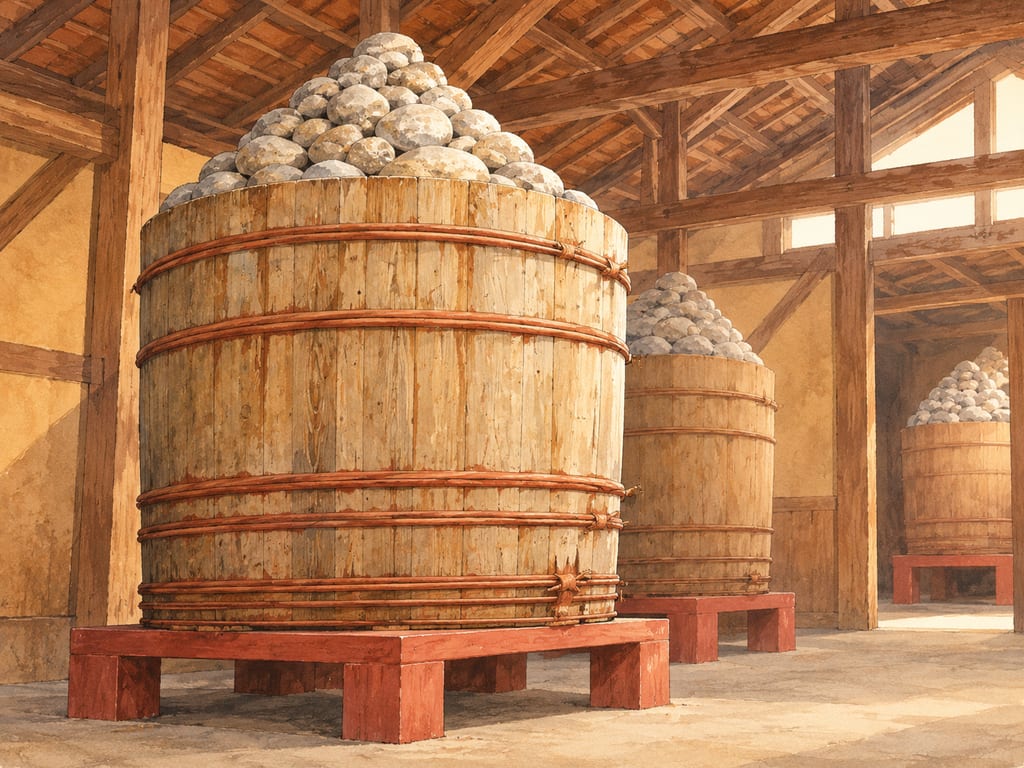
A wooden vat with a stone crown
At Kakukyu's Hatcho Miso works in Okazaki, broad wooden kioke hold the soybean paste while a pyramid of natural river stones rests on top. The prefectural tourism guide describes vats nearly two metres in diameter that are still used today. Its description gives the working arrangement, but not the vessel's height, capacity, timber species, or the stones' total weight.
Sources for this section
Use over two years
The stones remain stacked over the vat while the miso ages for two summers and two winters—more than two years. The documented function of this equipment is both containment and top weighting during long maturation. The account does not explain the engineering of the load, any follower or cover beneath the stones, or the vat's internal construction, so those details should not be assumed.
Sources for this section
A place-specific record
The kioke at Kakukyu in Hatcho-cho, Okazaki, Aichi Prefecture, is a place-specific arrangement, not a generic construction plan. No capacity, safe load rating, stone count, stacking instructions or maintenance procedure is given, and the reported diameter alone is not enough to size or safely load a vat.
Sources for this section
History
Aichi Now describes Kakukyu's maker history as continuing since the Edo period and says nearly two-metre wooden vats are still in use. The source does not date this particular vat or establish when the stone-weighted kioke form began.
Equipment details
CapacityThe cited source gives no capacity for Kakukyu's kioke.
SizeAichi Now says the vats are nearly two metres in diameter. No exact value or height is reported.
PowerNo power The source describes a stationary vessel and stone weights, with no powered mechanism.
How you get oneNot established The source documents Kakukyu's use but gives no construction, purchase, or acquisition route for an individual vat.
CareThe cited source documents use but does not describe cleaning, repair, or storage procedures.
Made of
- wood — vat
The source identifies large wooden vats but does not specify species. - natural river stones — top weight
Stacked into a pyramid on top of the vat; stone count and total mass are not reported.
Limits
The source gives no capacity, height, wood species, hoop material, stone count, or total weight for the vats or stone stacks.
Source →The reported nearly two-metre diameter describes Kakukyu's vats; it is not a construction specification or load rating for another vessel.
Source →Places
Hatcho-cho, Okazaki
Manufacture · Locality evidenceAichi Now locates Kakukyu in Hatcho-cho, Okazaki; this identifies the documented place of use, not the origin of every kioke.