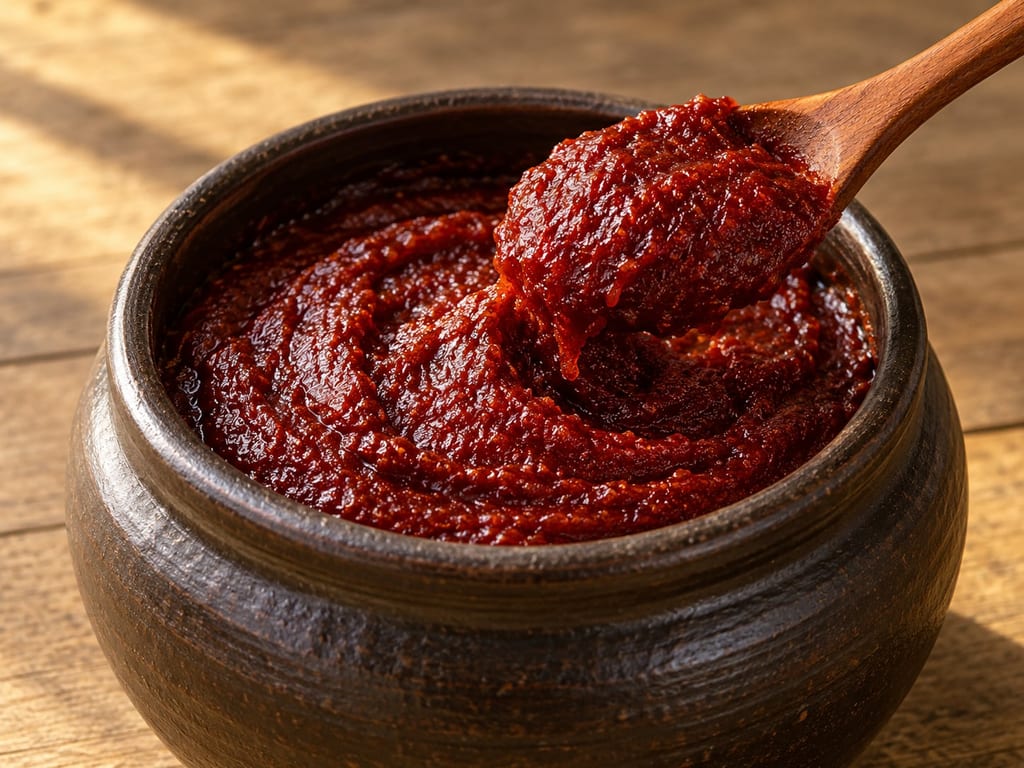
Gochujang with glutinous rice and meju powder
Korea’s sweet, savoury and fiery red paste of glutinous rice, barley-malt enzymes, fermented soybean meju powder and chilli powder, matured in earthenware.
 FermenteaWhere food goes to change
Spices and aromatics
Chilli is the pungent fruit of Capsicum plants, native to the Americas and eaten fresh, dried, ground or fermented in cuisines around the world.
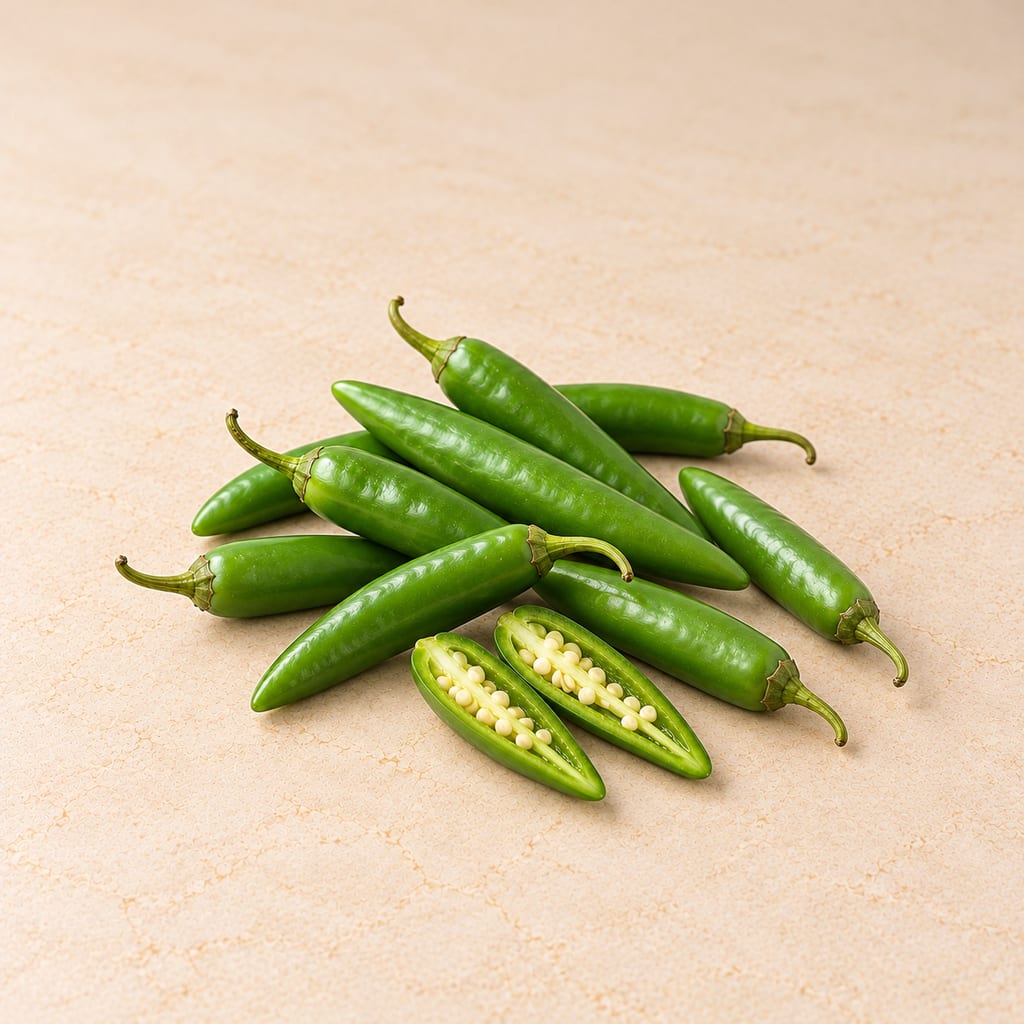
Chilli is the fruit of plants of the genus Capsicum, eaten fresh, dried, ground, pickled and fermented, and valued above all for the burn that capsaicin gives it. The name covers a huge range: a green jalapeño, a fiery habanero, a long red cayenne, a dried pod ground to gochugaru or a pinch of red flakes are all chilli. The English language shows how loosely the term is applied. Chilli, cayenne and red pepper are used as synonyms for the spice, and paprika, the red powder of milder cultivars grown in cooler climates, is a trade term of its own.
Botanically, Capsicum has 43 species, all native to the Americas from the southern United States to central Argentina and Brazil, with the greatest diversity in the Andes. Five are cultivated as crops. Capsicum annuum, C. chinense and C. frutescens are grown throughout the world, and C. baccatum and C. pubescens are grown mainly in South America. Within a species, sweet peppers and fiery chillies can sit side by side: the bell pepper and the cayenne are both Capsicum annuum, and the species and the heat are separate descriptions of the same plant. The pepper of the table, Piper nigrum, is not related. Europeans gave the American fruit the same name because they set it beside the Asian spice, and the name stuck.
About a quarter of the world's population eats chilli, and wherever the plant has gone it has been taken up into local cooking.
People have eaten chilli for a very long time. The genus has been used as a spice since about 6000 to 6500 BCE. The question of where Capsicum annuum was first domesticated has been answered more than once. One analysis combined species distribution modelling, historical linguistics, genetic data and archaeological plant remains and concluded that domestication could have happened in northeastern Mexico, in central-east Mexico, or in both, while the combined evidence favoured central-east Mexico, where chilli remains from before pottery have been found in the Valley of Tehuacán. A more recent interdisciplinary reconstruction argues for a geographically diffuse, long process with at least two separate events across Mexico, starting in lowland regions such as the Yucatán Peninsula and the coast of southern Guerrero, not in highland caves.
The other cultivated species have their own histories. C. baccatum and C. pubescens belong to South America, and the Andes are the centre of the genus's diversity. Domestication changed the fruit: wild plants shed their ripe berries, while the ripe fruit of domesticated species stays attached, and size, shape and colour vary widely. These changes did not occur together in every species, which is why no single story covers every pepper called chilli.
The first written record by a European is a letter of 1494 from Diego Álvarez Chanca, physician on Columbus's second voyage to the West Indies, who described agi as the spice the native people of Hispaniola used to season their food. In 1542 the German physician and botanist Leonhard Fuchs published the first three scientific illustrations of the plant, calling it Indian pepper, and the word capsicum was first coined in 1576 by Matthias de L'Obel. Europeans fitted the unfamiliar plant into the names they knew, which is why old writing often links chilli with India, a place it did not come from.
After Columbus, chillies were carried to Europe and then to Africa and Asia, where, over the centuries, farmers and cooks developed thousands of local landraces. Some of those regions are now treated as secondary centres of diversity. A pepper grown in Italy, Korea or Nigeria thus has a long local history while its ancestry is American. In Calabria the plant took root so firmly that its fruit is protected as a regional geographical indication, registered in 2026 for Capsicum annuum of medium-high pungency, from 5,000 to 70,000 Scoville heat units.
A chilli is botanically a berry. The outer wall is the pericarp, which is the flesh of the pod; inside are the seeds, which sit on the placenta, the tissue that runs along the inside of the fruit. The shape ranges from short and round to long and narrow, and the wall from thin to substantial.
The burn comes from capsaicinoids, of which capsaicin is the most abundant. Chemical analysis of ripe red Tabasco peppers, Capsicum frutescens, separated the fruit into pericarp, placenta and seeds and found different chemical profiles in each. Capsaicin is made mainly in the placenta, by joining vanillylamine to a branched-chain fatty acid derivative, with an enzyme encoded by the gene Pun1. Some sweet cultivars carry the precursors and lack the final step, so heat is not simply a matter of more of everything. Capsaicin is concentrated in the membranes and seeds, and removing them lowers the heat of a dish.
The sensation is a nerve response. Capsaicin opens a cation channel in sensory neurons that also opens in response to harmful heat, so the brain registers burning where there is none. Heat is stated in Scoville heat units, the measure used in the trade, and it depends on the cultivar: in New Mexico trials three cayenne cultivars measured between 12,900 and 17,400 units, while the protected Calabrian pepper spans 5,000 to 70,000 across its sixteen varieties. A name such as chilli, with no variety, carries no heat figure at all.
Chilli is a warm-season crop. It needs sun, a long growing season and fertile, well-drained soil, and it is transplanted when the soil has warmed to about 60 °F (16 °C). From flowering to full colour a fruit takes 35 to 45 days, depending on temperature and variety. Fruit set fails when nights fall below 55 °F (13 °C) or days rise above 90 °F (32 °C). The harvest stage is a matter of choice. Fruit can be picked green or when fully coloured but still firm. For the dried red chile of the spice trade, the best colour comes from letting pods begin to dry on the plant, and picking before the first freeze, since damaged and frosted fruit is more often diseased.
Stress and damage let fungi in. Rots caused by species of Alternaria, Rhizopus, Colletotrichum, Fusarium, Phytophthora and Aspergillus increase under plant stress, excess water and mechanical damage, and some of these fungi make mycotoxins. For that reason diseased pods are culled from a harvested crop that will be dried and ground.
A chilli changes its character with its form. The dried types of the American trade include New Mexican, cayenne, ancho, pasilla, mirasol, piquín and de árbol, and the same species gives the sweet red powder that the trade calls paprika. Colour decides the price of dried red chile, because much of it is used to colour food, and the variety has the greatest effect on both colour and pungency. Fresh, a chilli is a juicy pod of 65 to 80 per cent water. To store it, processors dry it to 8 to 12 per cent moisture at 60 to 65 °C, so that five parts of fresh fruit become about one part of dry, and sell it as whole pods, flakes or powder. Dried powder and flakes are the prevailing forms of the spice worldwide. Solvent extracts called oleoresins also exist, but they are an industrial material. Because ground chilli loses colour faster than whole pods, and flakes keep colour better than powder, the trade stores chile as flakes and grinds at the end.
The fruit can also be chopped, mixed with about 20 per cent salt and fermented into a mash. Cayenne mash is the key ingredient of Louisiana-style hot sauces. In many other traditions chilli is not fermented on its own but joins a fermentation as one of several ingredients, as in kimchi, where red pepper goes in with garlic, ginger, green onion and radish. Specific forms have their own pages: the ground spice on the chilli powder page, flakes on the dried chilli flakes page, a hot cayenne type on the cayenne page, and the protected pepper of southern Italy on the Calabrian pepper flakes page.
Wherever chilli arrived, it found work. In Calabria, the fruit became the seasoning of poor households: a writer in 1864 noted that the poor man's lard was a store of peppers, and the pepper dresses regional pasta shapes such as struncatura and fileja and goes into sausages. Louisiana-style hot sauces are built on fermented cayenne mash. In Ethiopia, strips of dried meat are coated in a sauce that is half hot pepper by weight, with salt and seasoning, and then air-dried and fried in butter fat. In Nigeria and the arid parts of West Africa, thin slices of lean meat are dried, coated with a paste of groundnut cake or soybean flour, garlic, pepper and ginger, dried again and roasted over a fire for about five minutes to make kilishi. In Korea, red pepper is one of the essential ingredients of kimchi.
In each of these the chilli is added for heat, colour and flavour, alongside salt, garlic or other spices, in places that had never seen the fruit before 1492.
Red pepper is one of the essential ingredients of kimchi. In a 100-day experiment, kimchi was made in batches that omitted one essential ingredient at a time. Without red pepper the community of microbes developed differently: Leuconostoc was a larger share, Bacillus was not detected at the start, which suggests it comes from the pepper itself, and lactic acid and quinic acid were lower. Red pepper and garlic are also described as natural antimicrobial agents that select which microbes grow. Those results apply to the kimchi in the experiment and cannot be extended to every ferment that contains chilli, but they show that a chilli is not a passive seasoning: it brings microbes and compounds of its own.
In cured meat and drying, chilli is mostly a seasoning. A coating of 50 per cent hot pepper with 25 per cent salt on strips of dried meat, as in Ethiopian qwanta, makes the pepper a major part of the surface of the product. In a starter-cultured salami, such as the soppressata and ventricina on this site, the pepper is a seasoning added to meat that the culture ferments. The pepper does not run those fermentations, and its heat is no guarantee of safety.
Fresh chillies are picked fully coloured but still firm. They keep for one to two weeks at 50 to 55 °F (10 to 13 °C), and long storage in a refrigerator can cause chilling injury. Dried chilli and its powder fade rather than spoil: ground chilli powder is usually put at two to three years, and the three checks are a strong aroma, a potent flavour and a vibrant, not dull, colour. Light, oxygen and warmth bleach the pigment, and commercial storage for the dried product is at 0 to 5 °C in the dark.
Capsaicin gets on hands and into eyes. When working with hot peppers, wear gloves, protect the eyes with glasses, and wash hands thoroughly with soap and water before touching the face.
Capsicum annuum was domesticated in Mexico; a diffuse process, not a single birthplace.
Primary centre of diversity of the genus and home of C. baccatum and C. pubescens; not a single origin of all chilli.
Chanca described agi used there to season food in 1494; the first written European record, not the origin.
Red pepper is an essential ingredient of kimchi; the source does not date its arrival.
Louisiana-style hot sauces are made from fermented cayenne mash; the source names the style.
Peperoncino di Calabria, a protected geographical indication.
Korea’s sweet, savoury and fiery red paste of glutinous rice, barley-malt enzymes, fermented soybean meju powder and chilli powder, matured in earthenware.
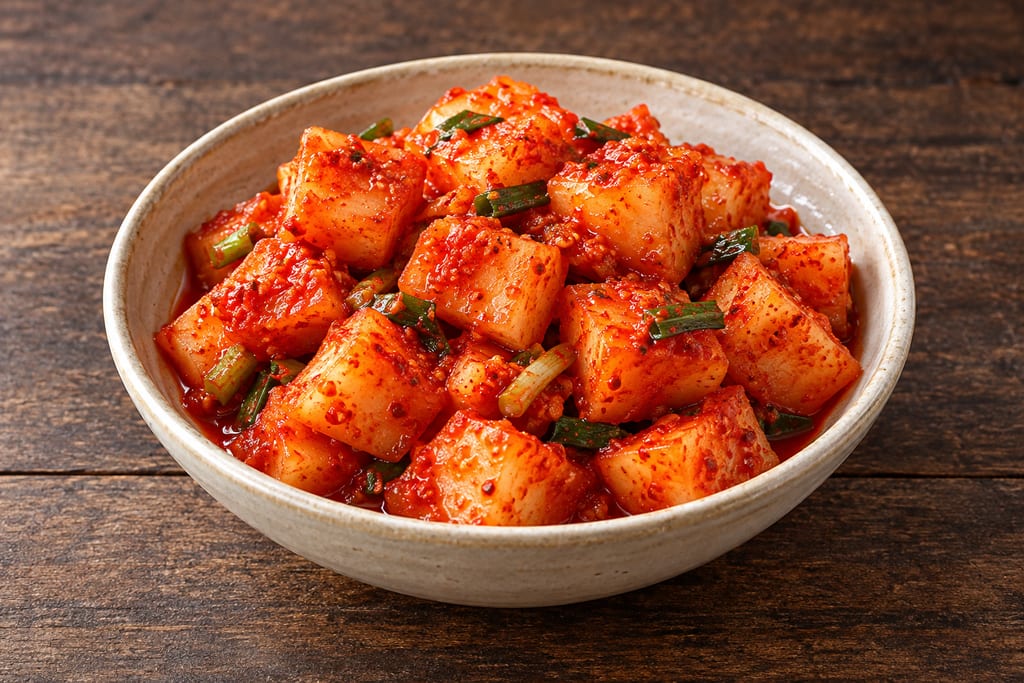
A radish kimchi cut into cubes and seasoned with gochugaru, fish sauce, garlic and ginger, eaten fresh or fermented a few days at room temperature.
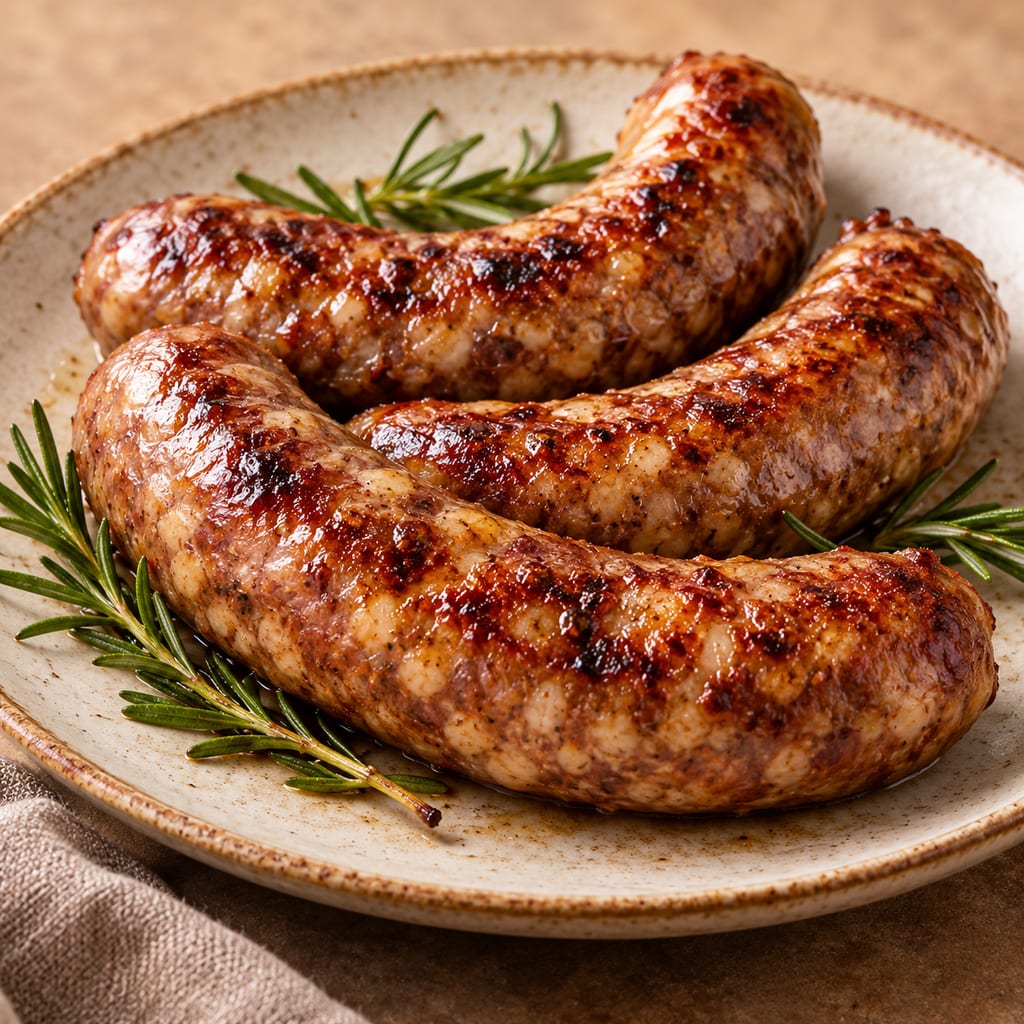
South Africa's spiced fresh sausage family, sold as masala, dhania or Punjab wors: cumin, ginger, garlic and chilli in place of the mild coriander-and-clove seasoning of boerewors.
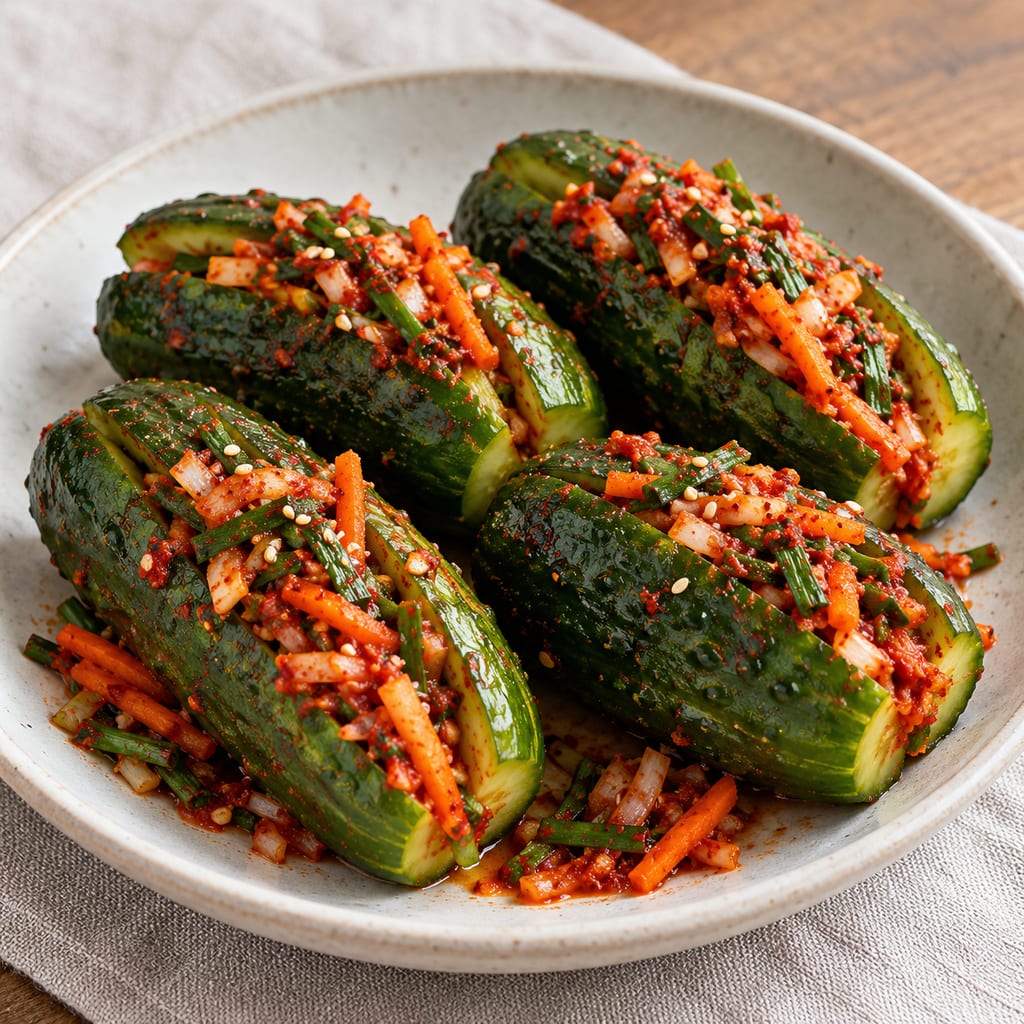
Oi-sobagi is a Korean stuffed cucumber kimchi: salted cucumbers slit and filled with a chive-and-chilli seasoning, eaten fresh or left to ferment.
Kimchi of salted napa cabbage and daikon with garlic, green onion and red pepper, kept at room temperature one to four days, then refrigerated.
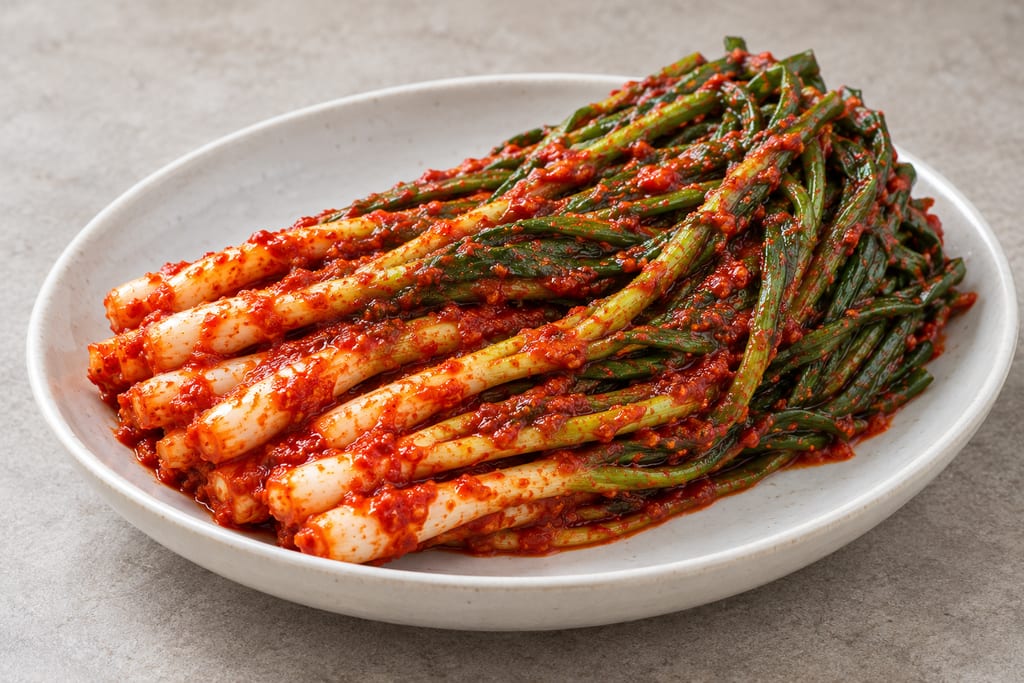
Pa-kimchi is a Korean kimchi of whole green onions salted, dressed with chilli and fish sauce, and fermented until pungent and sour.
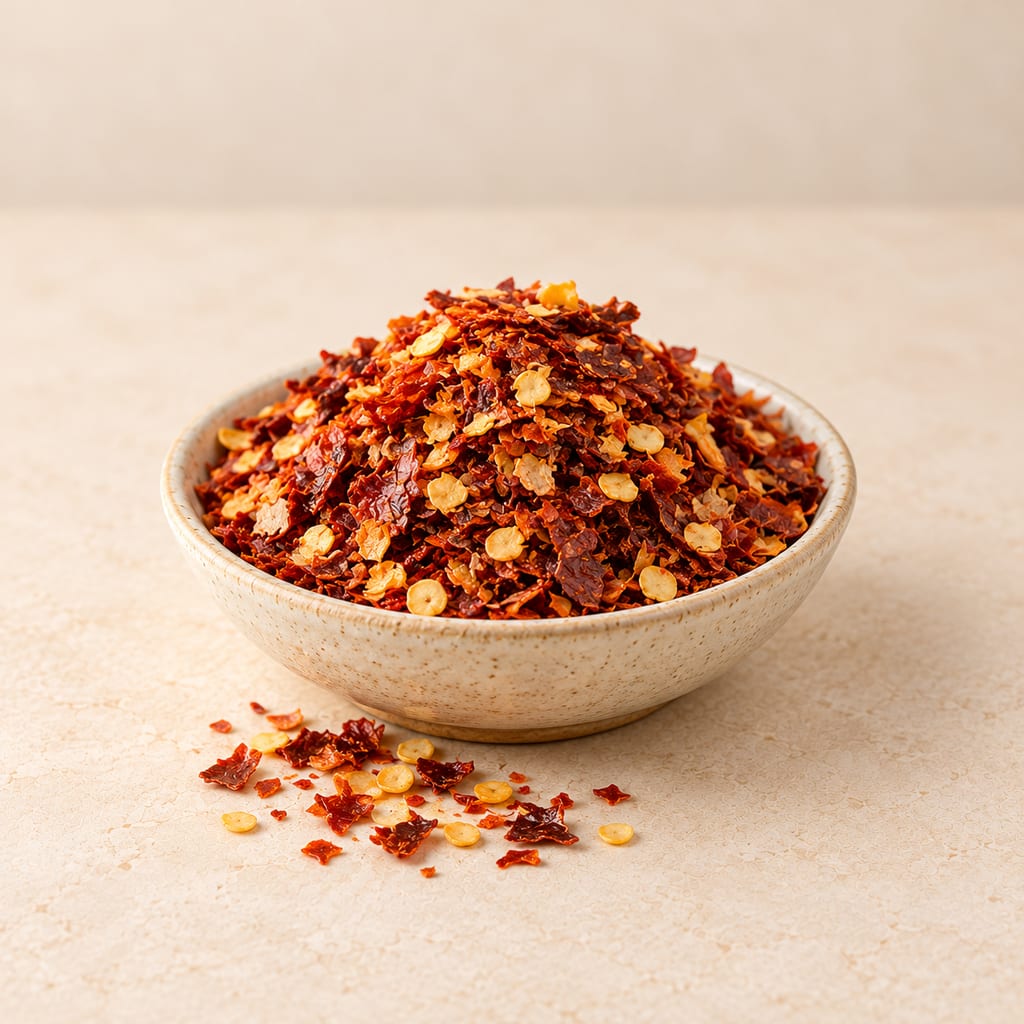
Calabrian pepper flakes are dried red Capsicum annuum from Calabria, crushed into coarse pieces; Peperoncino di Calabria is a protected geographical indication.
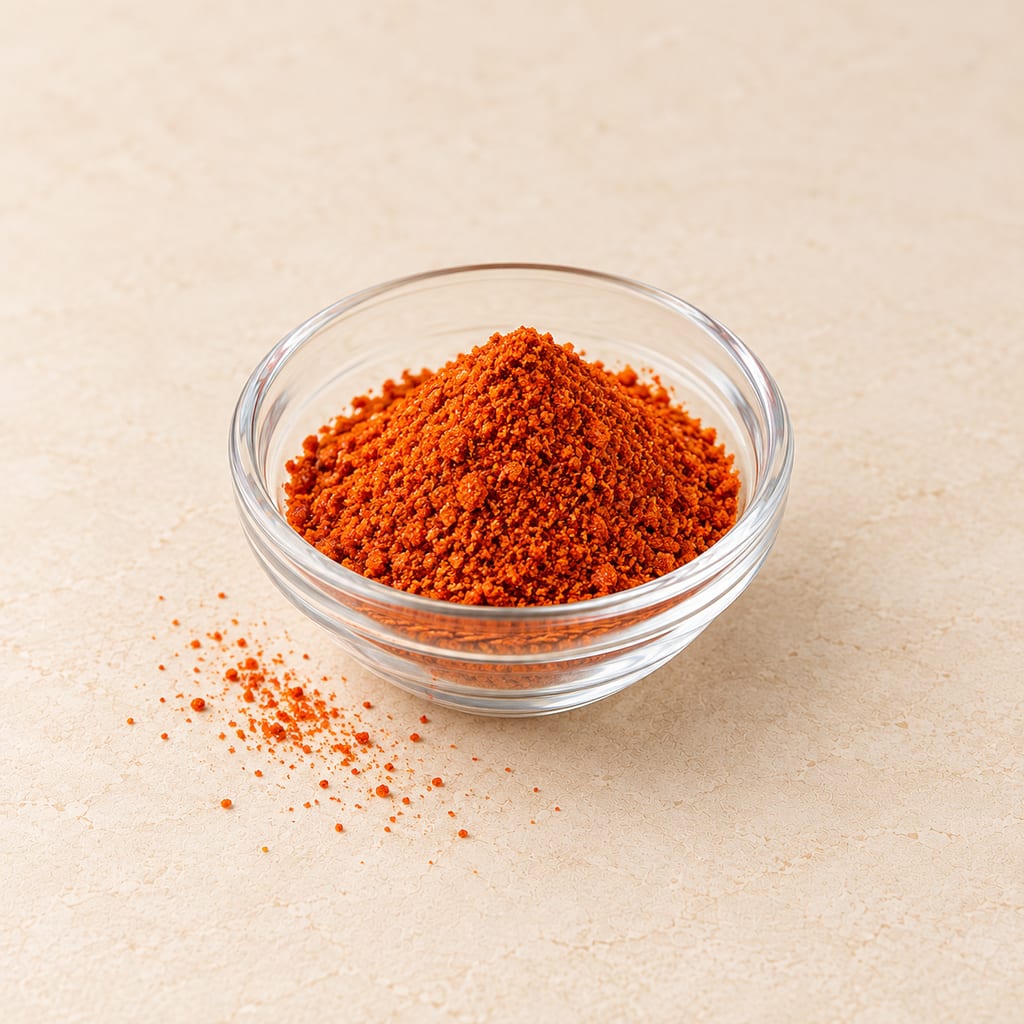
Cayenne is a very pungent red powder from dried, ground hot chilli pods, mostly Capsicum annuum, and the name of the long red peppers it comes from.
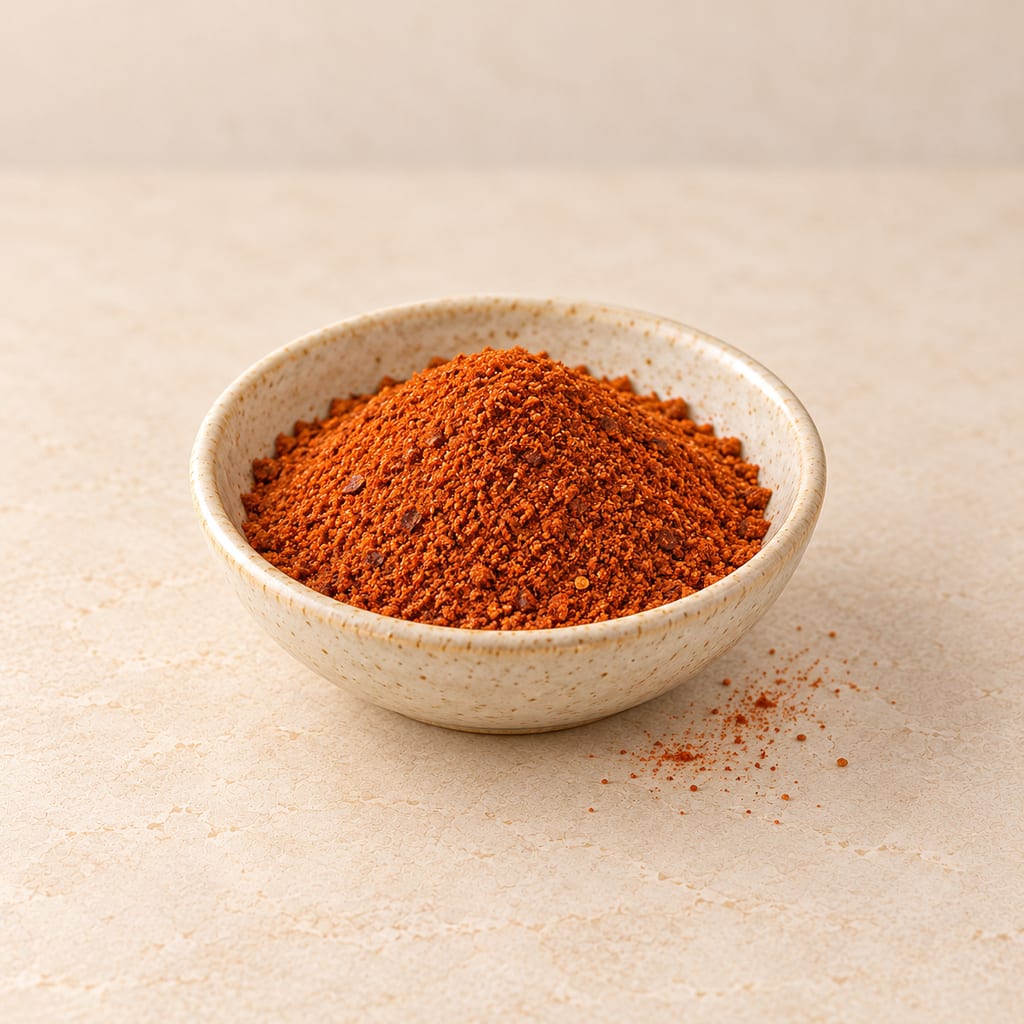
Chilli powder is dried chilli fruit ground fine, sold either as plain ground chillies or, in the United States, as a seasoning blend with salt, garlic and cumin.
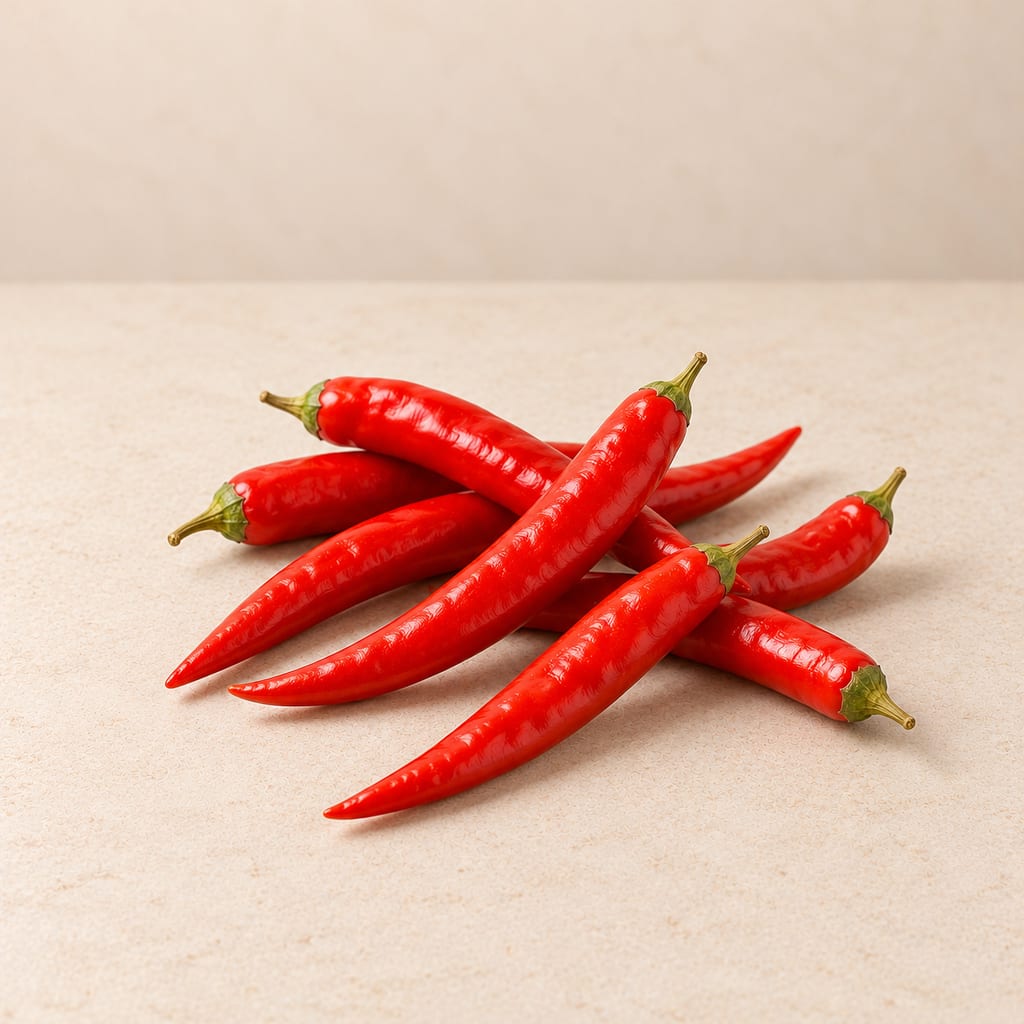
Red chilli is the ripe, red fruit of a Capsicum pepper plant, used fresh, dried, as flakes or as powder to add heat, colour and flavour to pickles, ferments, sauces and stews.
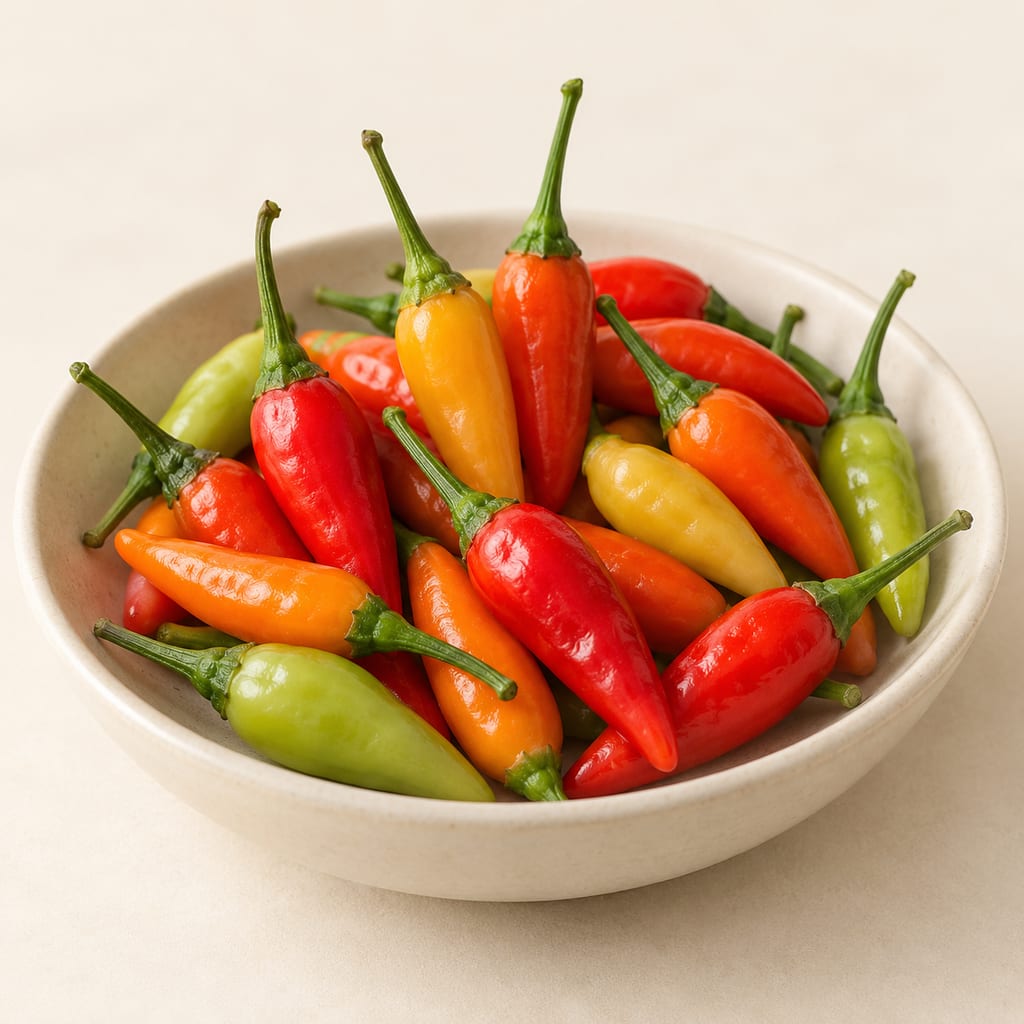
Tabasco chile is the small, upright, pungent fruit of Capsicum frutescens 'Tabasco', a cultivar long used in Louisiana pepper sauce.
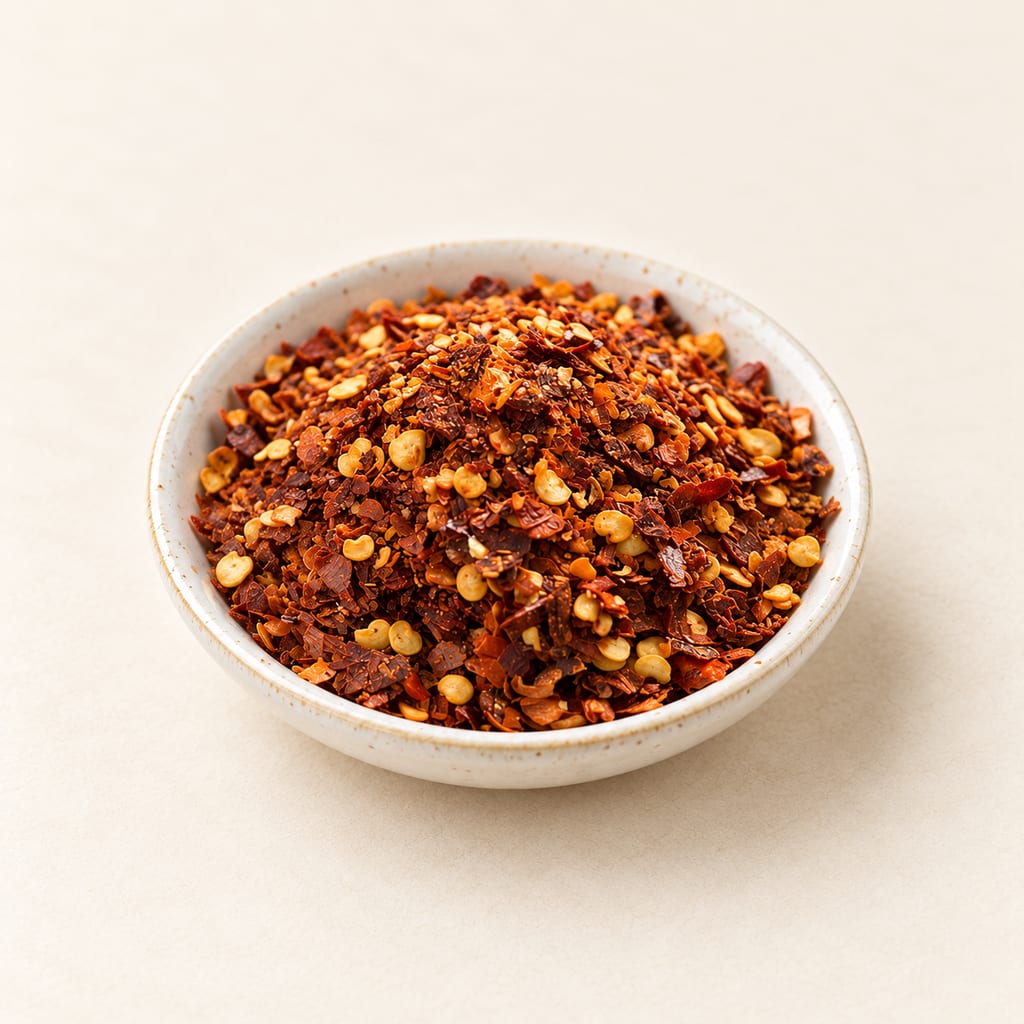
Dried chilli flakes are broken dried Capsicum fruit used for dispersed heat, colour and flavour; Peter Kuruvita's lime pickle includes one teaspoon.
Cane syrup is sugarcane juice boiled down until it is thick and sweet, or the first syrup left after sugar is crystallised. Historical American recipes used it as a sweetener in ham cures.

At North Abydos in Egypt, a fixed early Dynastic brewery comprised parallel semi-subterranean installations with rows of ceramic mash vats; excavation reports revise their number, scale and estimated batch capacity.

Ají amarillo is the orange-yellow Peruvian chilli cultivar group of Capsicum baccatum, used to colour and season huancaína sauce and ají de gallina. Published heat estimates do not establish one range for the named cultivar.

Toasted almonds are whole sweet almond kernels dry-roasted until golden to brown. Heat replaces their marzipan note with a roasted, nutty one; they thicken and flavour romesco.

Kodiak salmon, halibut and cod cut as seg'aq and hung on an initaq rack to become tamuuq, with kac'amaasaq and kupcuunaq named as different results.

Aniseed is the dried ripe fruit of Pimpinella anisum, an aromatic Apiaceae spice commonly called a seed. It adds a sweet, warm aroma to breads such as Moroccan krachel and South African mosbolletjies, and is distinct from star anise.

A fixed Late Chalcolithic installation in Areni-1 cave combined a shallow clay pressing basin with a large jar set into the cave floor and storage vessels nearby.

Ripe avocado flesh is the soft, buttery, fat-rich pulp of Persea americana, eaten raw. It is low in acid, so it is a fresh ingredient that needs care in chilled dishes.

A portable dome and pan used over a hearth, with embers on the lid and heat from below. Regional peka and saç forms share this principle while differing in materials, pan shape and how the food is cooked.
No community contributions have been published for this entry yet.
Sign in to contribute. Published comments and photos are free to read.
PhytoKeys 200:1-423 (PubMed Central)Identity · History
Monograph of wild and cultivated chili peppers (Capsicum L., Solanaceae)Capsicum has 43 species native to the Americas from the southern United States to central Argentina and Brazil, with the Andes as the main centre of diversity; five main domesticated species: C. annuum, C. chinense, C. frutescens (cultivated worldwide), C. baccatum and C. pubescens (mainly South America); used as spice since 6000 to 6500 BCE; eaten by about a quarter of the world population.
Chanca wrote in 1494 of agi, the spice the people of Hispaniola used to season food; Fuchs published the first three scientific illustrations in 1542; the name capsicum was first coined by L Obel in 1576; chillies spread to Europe, then to Africa and Asia after Columbus, giving thousands of landraces.
Cited in: A fruit with a thousand names; Domesticated in the Americas; Across the oceans
Proceedings of the National Academy of SciencesHistory
Multiple lines of evidence for the origin of domesticated chili pepper, Capsicum annuum, in MexicoDomestication of C. annuum in northeastern or central-east Mexico, with preceramic remains from the Valley of Tehuacan and a chili word reconstructed in Proto-Otomanguean.
Cited in: Domesticated in the Americas
Proceedings of the National Academy of Sciences (PubMed Central)History
Interdisciplinary insights into the cultural and chronological context of chili pepper (Capsicum annuum var. annuum L.) domestication in MexicoA geographically diffuse, protracted domestication with at least two asynchronous events across Mexico, in lowland regions such as the Yucatan Peninsula and southern coastal Guerrero.
Cited in: Domesticated in the Americas
Metabolites 9(10):206 (PubMed Central)Science
Placenta, Pericarp, and Seeds of Tabasco Chili Pepper Fruits Show a Contrasting Diversity of Bioactive MetabolitesRipe red Tabasco (C. frutescens) pericarp, placenta and seeds differ in chemical profile, and the placenta is the richest in capsaicinoids.
Cited in: The fruit, and where the heat is
Nature 389:816-824Science
The capsaicin receptor: a heat-activated ion channel in the pain pathwayCapsaicin activates a cation channel of sensory neurons that also responds to noxious heat.
Cited in: The fruit, and where the heat is
BMC Plant Biology 15:93Science
Evidence of capsaicin synthase activity of the Pun1-encoded protein and its role as a determinant of capsaicinoid accumulation in pepperCapsaicinoids are made in placental tissue by joining vanillylamine to a branched-chain fatty acid derivative with the Pun1 protein; nonpungent cultivars can hold precursors without making capsaicin.
Cited in: The fruit, and where the heat is
New Mexico State University Cooperative Extension ServiceMethod · Quality · Storage
Postharvest Handling of Dehydrated Chiles (Guide H-236)Field pods are 65 to 80 per cent water and dried to 8 to 12 per cent at 60 to 65 C; about 5 kg fresh to 1 kg dry; flakes, powder or whole pods; paprika is the trade name for nonpungent red C. annuum powder; colour is the key quality criterion; ground chile loses colour faster than whole, so it is stored as flakes before grinding; storage temperature matters most; 0 to 5 C in the dark recommended.
Harvest for colour when pods have partly dried on the plant; diseased fruit carry fungi, some of which make mycotoxins, and are culled.
Cited in: Growing and harvesting; Fresh, dried, ground and fermented; Choosing, storing and handling
HortScience 45(11):1751-1752 / New Mexico State UniversityUse
'NuMex Las Cruces' Cayenne PepperCayenne chilli is used fresh, dried, or chopped and mixed with about 20 per cent salt and fermented into a mash, the key ingredient of Louisiana-style hot sauces.
Cited in: Fresh, dried, ground and fermented; Chilli at the table
Utah State University ExtensionGrowing · Storage
How to Grow Peppers in Your GardenPeppers need sun, a long season and fertile, well-drained soil; transplant at 60 F soil; 35 to 45 days from flowering to full colour; pick fully coloured but firm, or green; fruit set fails below 55 F nights or above 90 F days; fresh peppers keep 1 to 2 weeks at 50 to 55 F and suffer chilling injury in long refrigerator storage.
Cited in: Growing and harvesting; Choosing, storing and handling
Penn State ExtensionSafety
Hot Peppers: Preserving the Heat!Capsaicin is concentrated in the membranes and seeds; wear gloves and glasses; wash hands with soap and water before touching the face.
Cited in: The fruit, and where the heat is; Choosing, storing and handling
Food Chemistry: X 22:101348 (PubMed Central)Fermentation
Impact of essential and optional ingredients on microbial and metabolic profiles of kimchiRed pepper is one of the essential kimchi ingredients; in a 100-day trial, kimchi made without red pepper had more Leuconostoc, no Bacillus at day 0 (suggesting red pepper is a source of Bacillus), and lower lactic acid and quinic acid; red pepper and garlic are described as natural antimicrobial agents that selectively suppress or enhance microbes.
Cited in: Chilli at the table; What chilli does in a ferment
USDA Agricultural Marketing ServiceIdentity · Trade
Limited Scope Technical Evaluation Report: Flavors - Handling/ProcessingCayenne, chili and red pepper are the usual English names for Capsicum spice fruits; paprika is the milder C. annuum of cooler climates; Tabasco is C. frutescens and habanero C. chinense; powder and flakes are the prevailing forms; oleoresins are solvent extracts; Scoville heat units measure pungency; India is about half of global chilli exports.
Cited in: A fruit with a thousand names; Fresh, dried, ground and fermented
Iowa State University Extension and OutreachStorage
Herbs and Spices Have an Expiration DateSpices lose potency rather than spoil; ground chilli powder 2 to 3 years; check aroma, flavour and colour.
Cited in: Choosing, storing and handling
Food and Agriculture Organization of the United NationsUse
Manual on simple methods of meat preservation, Chapter 2: Simple techniques for production of dried meatEthiopian qwanta: strips of dried meat coated with a sauce of 25 per cent salt, 50 per cent hot pepper and 25 per cent seasoning, air-dried and fried in butter fat; Nigerian kilishi is coated in a paste with groundnut cake, garlic, pepper and ginger.
Cited in: Chilli at the table
Italian Ministry of Agriculture, Food Sovereignty and Forests (MASAF)Use · Geography
Peperoncino di Calabria IGP: disciplinare di produzionePeperoncino di Calabria: Capsicum annuum, medium-high pungency of 5,000 to 70,000 Scoville heat units, sold fresh, whole, as flakes or powder; protected as a geographical indication in 2026.
Cited in: Chilli at the table