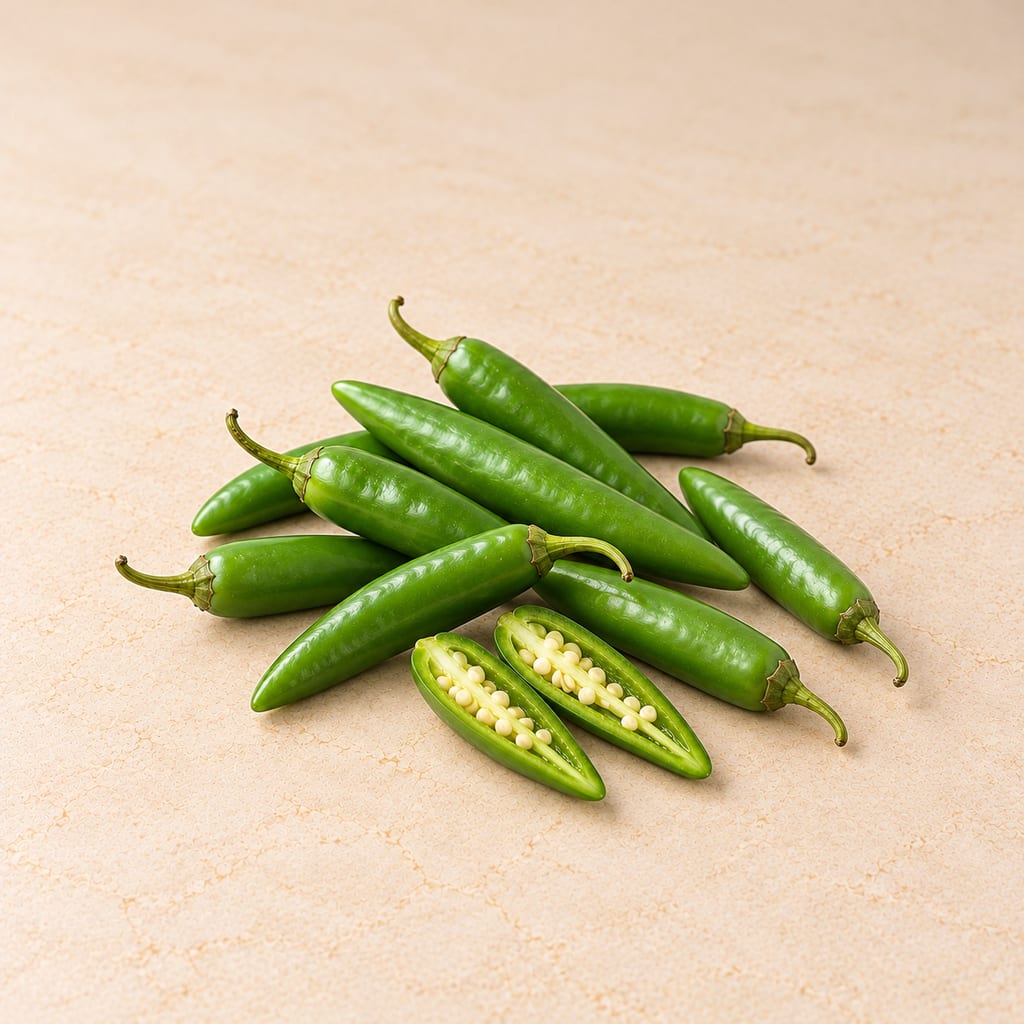
Chilli
Chilli is the pungent fruit of Capsicum plants, native to the Americas and eaten fresh, dried, ground or fermented in cuisines around the world.
 FermenteaWhere food goes to change
Traditional method
고추장 (gochujang)
Korea’s sweet, savoury and fiery red paste of glutinous rice, barley-malt enzymes, fermented soybean meju powder and chilli powder, matured in earthenware.
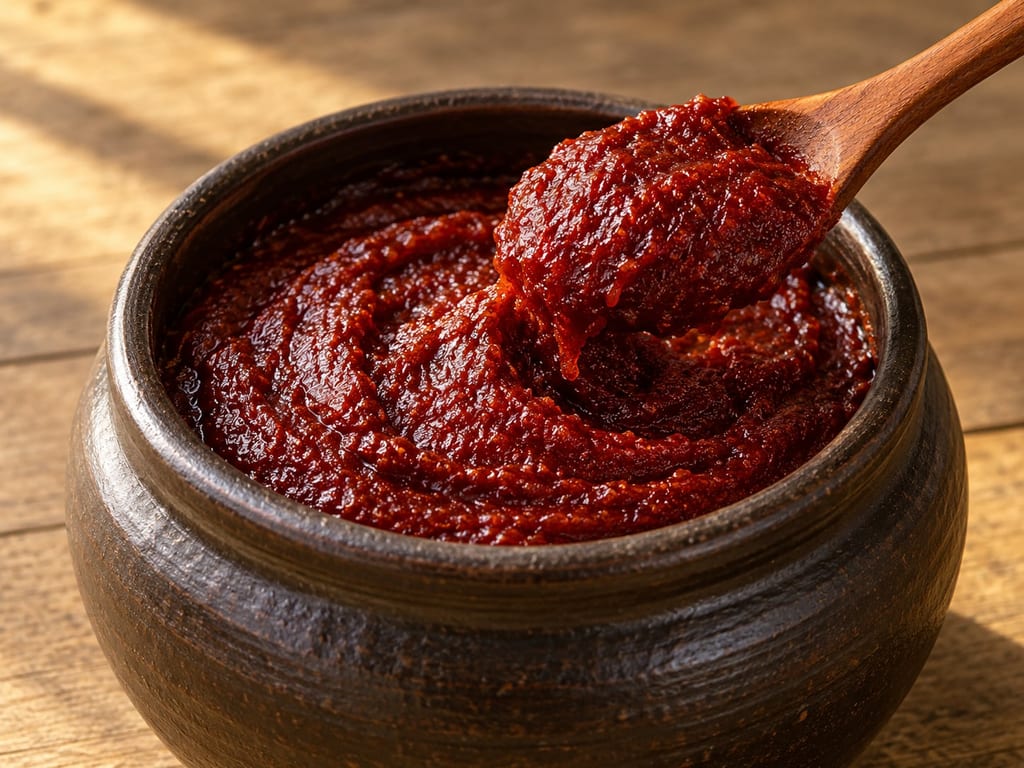
Gochujang is one of Korea's most important fermented condiments. It combines the heat and colour of dried red chillies with the sweetness of starch-derived sugars, the savoury flavour of fermented soybeans and the complexity developed during maturation.
Its Korean name is 고추장, romanised gochujang.
Gochu (고추) means chilli pepper, while jang (장) refers to a category of fermented pastes and sauces.
Gochujang belongs to the broader Korean jang tradition alongside doenjang and ganjang, but differs significantly in its ingredients and flavour.
The principal botanical ingredients in the present recipe are chilli pepper, usually Capsicum annuum L.; glutinous rice, Oryza sativa L.; barley, Hordeum vulgare L.; and soybean, Glycine max (L.) Merr.
The recipe also uses salt and cheongju (청주), a refined Korean rice wine.
This is a traditional-style formulation documented by the Korea Tourism Organization, with particular attention to the celebrated gochujang tradition of Sunchang.
It uses a barley-malt liquid, glutinous rice flour, fermented soybean powder and dried chilli powder, followed by approximately three months of fermentation.
The result is a thick, red condiment that can serve as a seasoning, sauce base, marinade ingredient or table accompaniment.
Korea has a long tradition of soybean fermentation, but modern red-chilli gochujang cannot simply be assigned the antiquity of every earlier Korean jang.
The chilli peppers used in contemporary gochujang belong to plants originating in the Americas.
Their introduction into East Asia occurred after transoceanic exchange began in the early modern period.
Korean historical literature generally associates the arrival of chilli with the late sixteenth or early seventeenth century, although the exact routes and dates remain subjects of scholarly investigation.
The Korean Academy's cultural encyclopaedia identifies a recipe for gochujang in Jeungbo Sallim Gyeongje (증보산림경제), published around 1760.
This is strong documentary evidence for a recognisable chilli-based paste in eighteenth-century Korea.
Other historical arguments cite older texts containing names interpreted as gochujang, but identifying those references with the modern chilli paste is disputed.
A pre-Columbian date for the precise contemporary formulation should therefore not be presented as established fact.
Sunchang, in present-day North Jeolla Province, developed a particularly strong reputation for its gochujang.
The 1809 household handbook Gyuhap Chongseo (규합총서), associated with the scholar Lee Bing-heogak, identifies Sunchang and Cheonan gochujang as notable regional specialities.
This provides an important historical connection between a named region and the condiment.
The tradition continued through household fermentation, specialist producers and modern commercial manufacturing.
Sunchang is particularly recognised for its fermented pastes.
Its climate, seasonal patterns and agricultural environment have influenced how producers prepare ingredients and manage fermentation.
Traditional gochujang is commonly associated with autumn production, when chilli peppers are harvested and dried.
Sunchang producers have been described as preparing some batches earlier in the season than producers elsewhere.
Differences in ingredient preparation and microbial growth can affect flavour.
The region has also developed institutions celebrating traditional fermented foods, including the Sunchang Traditional Gochujang Folk Village, established in 1997.
This heritage should not obscure the fact that gochujang is made across Korea.
Sunchang is a particularly famous centre, not the only place with a legitimate gochujang tradition.
The measured recipe here represents one documented traditional-style method rather than a universal formula for the entire country.
Gochujang is unusual because its characteristic flavour arises from several different ingredient systems acting together.
Glutinous rice flour supplies starch. Despite the English name, glutinous rice does not contain gluten; the term describes its sticky cooking texture.
Barley malt powder contributes enzymes capable of breaking starch into smaller sugars. Malted barley has undergone germination, during which the grain develops or activates enzymes involved in starch metabolism.
Meju powder supplies fermented soybean material and the enzymatic and flavour characteristics associated with Korean soybean fermentation.
Gochugaru, the Korean dried red chilli powder, provides colour, chilli flavour and capsaicinoid pungency.
Salt influences flavour and the environment in which microorganisms can grow.
Cheongju contributes rice-wine flavour and alcohol. The recipe includes it during paste mixing rather than as a separate fermentable grain stage.
The interactions between these components explain why gochujang is not simply chilli powder blended with sugar and soy sauce.
Its character develops through enzyme action, fermentation and maturation.
Documented traditional-style recipe
The cheongju measurement is described specifically as a small paper cup, not a US measuring cup.
The source does not state its exact millilitre capacity.
It would therefore be inaccurate to convert the quantity into 240 mL, 200 mL or another assumed volume.
The documented recipe also does not supply a measured final yield.
Some water is retained by the paste, some may evaporate during cooking, and the final quantity depends on the process.
Water — 5 L — Extracting barley malt and preparing the rice paste
Barley malt powder — 500 g — Supplies enzymes for starch breakdown
Glutinous rice flour — 2 kg — Main starch substrate and paste body
Meju powder — 1 kg — Fermented soybean component
Gochugaru — 3 kg — Chilli flavour, heat and red colour
Salt — 1.5 kg — Seasoning and preservation hurdle
Cheongju — 1 small paper cup — Rice-wine addition
Barley malt is more than an aromatic cereal ingredient.
During germination, enzymes involved in starch utilisation become available.
These include amylases that break larger starch molecules into smaller carbohydrates.
In this recipe, malt powder is mixed into water and allowed to stand.
The liquid is then strained.
The resulting malt extract is used with glutinous rice flour to create the cooked paste.
This provides a route for starch conversion and sweetness development.
The preparation does not separately quantify enzyme activity or the amount of sugar produced.
Two batches made with malt of different quality could therefore differ even when the measured ingredient masses are identical.
Using unmalted barley flour would not reproduce the same ingredient system.
Similarly, adding sugar instead of malt would alter flavour and sweetness without necessarily reproducing the enzymatic transformation.
Meju is a fermented soybean preparation central to Korean jang production.
Its enzymes participate in breaking down protein and starch.
Proteases generate peptides and amino acids from proteins.
Amylases contribute to the formation of smaller carbohydrates.
Glutamic acid and related amino compounds help create the deep savoury quality associated with fermented soybean pastes.
Traditional meju can contain a complex microbial community including bacteria, yeasts and moulds.
Selected food-fermentation strains of Aspergillus oryzae may participate in appropriate controlled systems.
However, the presence of the genus Aspergillus alone does not establish that an unidentified mould is safe.
The present recipe uses prepared meju powder.
It does not require the reader to create an unknown mould culture.
For repeatability, meju should be sourced from an appropriate food producer with suitable ingredient controls.
Gochugaru is not identical to every generic supermarket chilli powder.
It usually refers to Korean dried red chilli prepared in flakes or powder suitable for Korean cooking.
The chilli variety, drying method, seed inclusion and grind affect colour, flavour and pungency.
Capsaicinoids provide much of the perceived heat.
Carotenoid pigments contribute red colour.
The composition of the pepper powder can change with agricultural conditions and storage.
Poorly stored dried chillies can also become contaminated with moulds or other undesirable substances.
This makes raw-material quality particularly important in a product that undergoes extended maturation.
The recipe specifies 3 kg gochugaru, but does not identify a particular chilli cultivar, capsaicinoid concentration or particle-size grade.
Those variables remain legitimate sources of variation between traditional producers.
Malt extraction 2–3 hours · Rice paste cooking until thickened · Fermentation approximately 3 months · Subsequent maturation unspecified
The original method discusses periodically checking for and removing surface mould. That historical or culinary instruction does not establish that unidentified mould is harmless or that scraping it away makes a contaminated paste safe.
Prepare the malt liquid. Mix 500 g barley malt powder into 5 L water. Leave for 2–3 hours so soluble components and sweetness can develop in the liquid. The source does not give a numeric extraction temperature.
Strain the malt extract. Pass the mixture through a fine cloth or sieve, retaining the liquid and separating the larger malt solids.
Introduce the rice flour. Stir 2 kg glutinous rice flour into the strained malt liquid. Mix carefully to distribute the flour and minimise dry lumps.
Cook the rice paste. Simmer over low heat, stirring continuously until the mixture becomes thick and sticky. The source gives no exact cooking duration or internal temperature endpoint.
Cool completely. Remove the thickened rice paste from the heat and allow it to cool before introducing the fermented soybean component.
Make the gochujang mixture. Add 1 kg meju powder, 3 kg gochugaru and 1.5 kg salt. Mix until the ingredients are evenly incorporated. Add one small paper cup of cheongju.
Fill the fermentation vessel. Transfer the thick paste into a clean suitable jar and level its surface. The documented method covers the opening with a clean cloth before closing the lid.
Allow maturation. Keep the paste under the described conditions for approximately 3 months, traditionally in a sunny location. The same source identifies 20–25°C as a favourable fermentation temperature, but does not demonstrate that sunlight alone maintains this range.
Move to a shaded location. After the initial three-month period, the recipe describes further maturation away from direct sunlight. No specific additional duration is given.
Traditional Korean fermented pastes are strongly associated with ceramic jars called onggi (옹기).
These vessels form part of the material culture of Korean fermentation.
Their shape, glazing, porosity and interaction with the surrounding environment can influence how they are used.
However, a particular vessel does not automatically guarantee successful fermentation.
The documented recipe also allows suitable glass, ceramic, stoneware or food-grade plastic containers.
The source advises thorough cleaning and treatment of the vessel before use.
A jar used for fermented paste must be appropriate for contact with salty and acidic foods.
The recipe provides no pressure rating, gas-release schedule or validated sealed-storage system.
Consequently, its use of a lid should not be interpreted as permission to leave a gas-producing preparation in an arbitrary airtight container.
Several processes can occur simultaneously.
Enzymes continue modifying available starches and proteins.
Sugars and amino acids accumulate or are used in subsequent reactions.
Microorganisms associated with the fermented soybean component can contribute organic acids and other metabolites.
Lactic acid bacteria may produce acidity.
Yeasts may generate alcohol and other flavour compounds.
Oxidation and nonenzymatic chemical changes may also contribute to darkening and aroma development.
The resulting flavour is therefore not simply a function of elapsed time.
It reflects the starting ingredients, microbial population, enzyme activity, salt concentration and environmental conditions.
This is why a three-month-old commercial gochujang and a three-month-old experimental household paste cannot automatically be assumed equivalent.
This formulation contains 1.5 kg salt, a substantial addition.
Salt influences flavour and the availability of water to microorganisms.
However, it must not be interpreted as guaranteeing that harmful microbial growth is impossible.
The final water activity is not supplied.
Nor does the original recipe provide a measured final pH or microbiological analysis.
A calculation based on initial ingredient quantities is not the same as a direct measurement of the finished paste.
Evaporation, ingredient hydration and fermentation can all affect the final composition.
The measured salt addition should remain unchanged in the documented recipe, while its precise preservative effect remains subject to validation.
Gochujang is produced in numerous regional and household styles.
The type of starch source may vary.
Some recipes use glutinous rice, while others include different cereals or sweetening ingredients.
The proportion of meju and chilli may also differ.
Changing these components affects sweetness, savouriness, pungency and fermentation chemistry.
Sunchang gochujang has its own historical reputation and production customs.
Contemporary industrial products may use controlled cultures, processed starches, sweeteners or other ingredients to produce a consistent flavour.
Those are legitimate modern manufacturing categories, but they should be described accurately rather than presented as identical to a traditionally aged household paste.
This record preserves the malt-and-glutinous-rice formulation as one documented variant.
Gochujang is fundamental to many Korean dishes.
It contributes the distinctive sweet, spicy and savoury character of tteokbokki (떡볶이), the well-known rice-cake preparation.
It is a familiar seasoning in bibimbap (비빔밥), where it is mixed with rice, vegetables and other ingredients.
It appears in jeyuk-bokkeum (제육볶음), spicy stir-fried pork, and in numerous marinades, stews and dressings.
Gochujang can also be blended with vinegar, sugar, sesame oil or other ingredients to create dipping and dressing sauces.
The finished condiment is concentrated, so the amount used in a dish depends on the desired balance.
Its heat comes from chilli, its sweetness partly from starch conversion, and its savoury quality from fermented soybean chemistry.
Together, these give it a character difficult to reproduce through a simple mixture of hot sauce and sugar.
Gochujang should develop a coherent thick paste texture, characteristic red colour and complex flavour.
The chilli and soybean components should be evenly distributed.
An excessively dry or cracked surface can indicate changes in moisture distribution, although the cause requires investigation.
Uneven mixing may produce pockets of different salt or ingredient concentration.
Unexpected fuzzy growth, unusual discolouration, putrid odours or evidence of decomposition should not be dismissed as inevitable features of fermentation.
The presence of surface mould is particularly important.
Some traditional meju processes deliberately develop selected fungal cultures, but a mature gochujang paste that develops unidentified mould is a different situation.
Colour alone cannot identify the organism.
Removing a visible patch does not establish whether unwanted compounds or microorganisms have spread into the remaining material.
Gochujang contains several potential preservation hurdles: salt, available acidity, competition between microorganisms and changes in water availability.
However, the combination must be assessed for the specific product.
The documented three-month maturation process does not supply a validated household food-safety endpoint.
No final microbial count, water-activity measurement or universal storage duration is given.
The original recipe describes refrigeration of finished gochujang, but its statement that the paste keeps for a long time is not a quantified shelf-life validation.
Meju quality is especially important because it introduces an established fermentation ingredient with its own microbiological history.
Unidentified or visibly contaminated meju should not be used.
Food-grade chilli and grain ingredients also need suitable sourcing and storage.
For a commercial product, the full formulation would need process verification, final-product analysis and packaging-specific shelf-life assessment.
The record follows gochujang in a Sunchang food-culture context and supplies a modern presentation of its ingredient formula. It does not date this particular formula.
Scaling: source batch only
The source page gives no fermentation temperature, time or storage process; those missing values are necessary to assess the finished product.
Hazard sourceTreat this as a sourced formulation with an incomplete maturation stage; do not infer fermentation conditions from appearance or from another gochujang method.
Control sourceThe source does not give a complete fermentation schedule or safety control plan. It is not a complete validated process.
The source presents gochujang as part of Sunchang's regional food tradition, not as an exclusive origin.
Chilli is the pungent fruit of Capsicum plants, native to the Americas and eaten fresh, dried, ground or fermented in cuisines around the world.
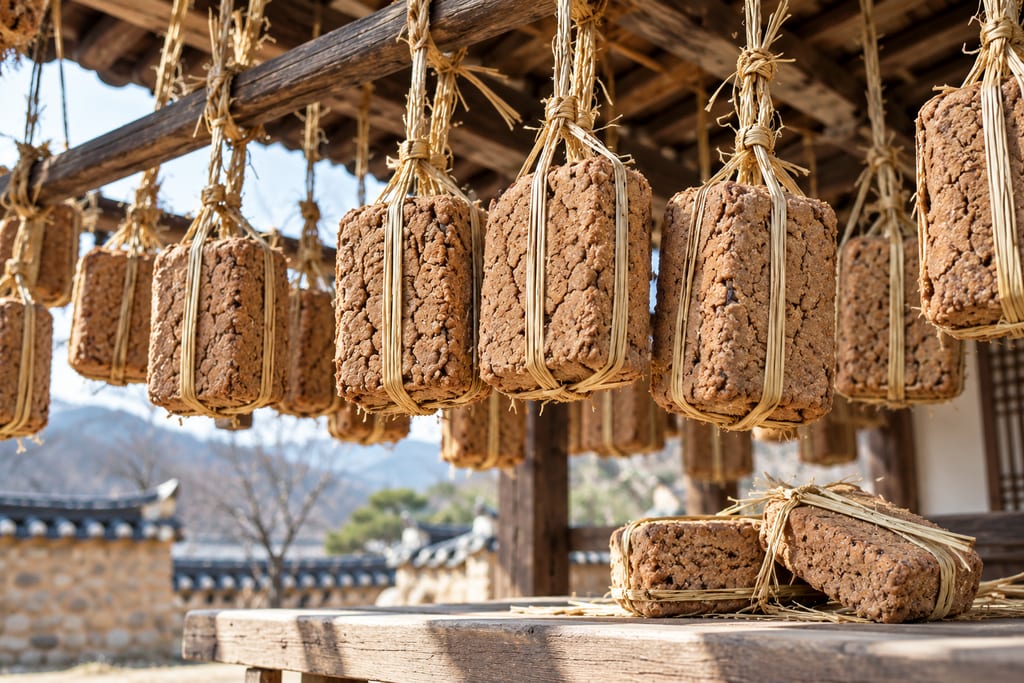
A cooked soybean brick, shaped and dried, that is fermented as a solid and later brined to make the Korean soy paste doenjang and the soy sauce ganjang.
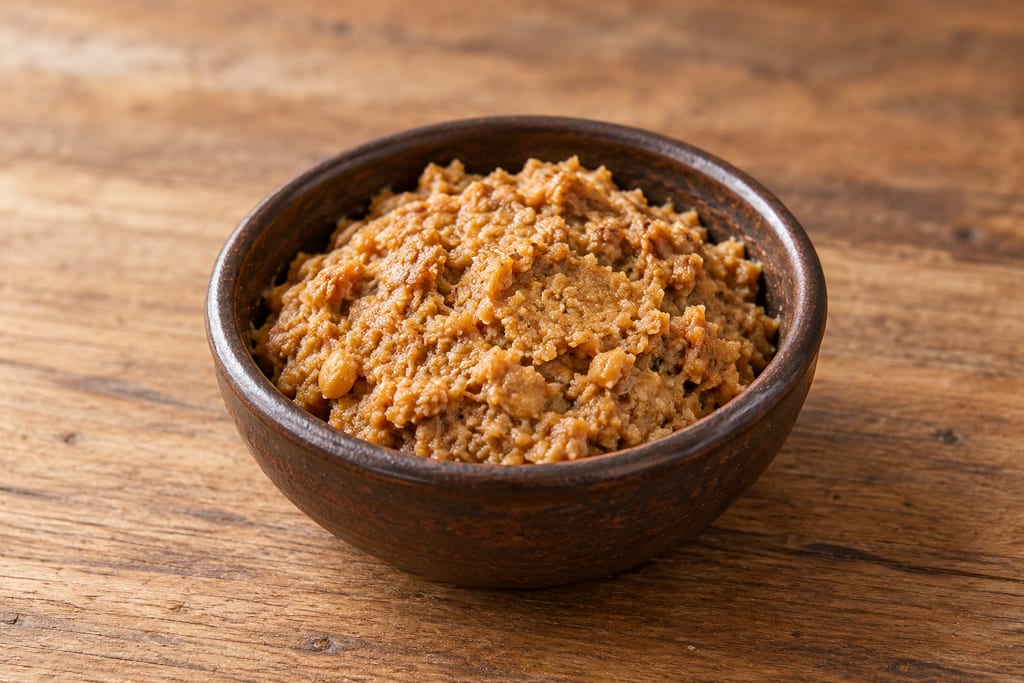
Doenjang (된장) is a Korean fermented soybean paste made by brining meju, separating ganjang, then mashing and aging the solids. This recipe follows one documented Sunchang processing study.
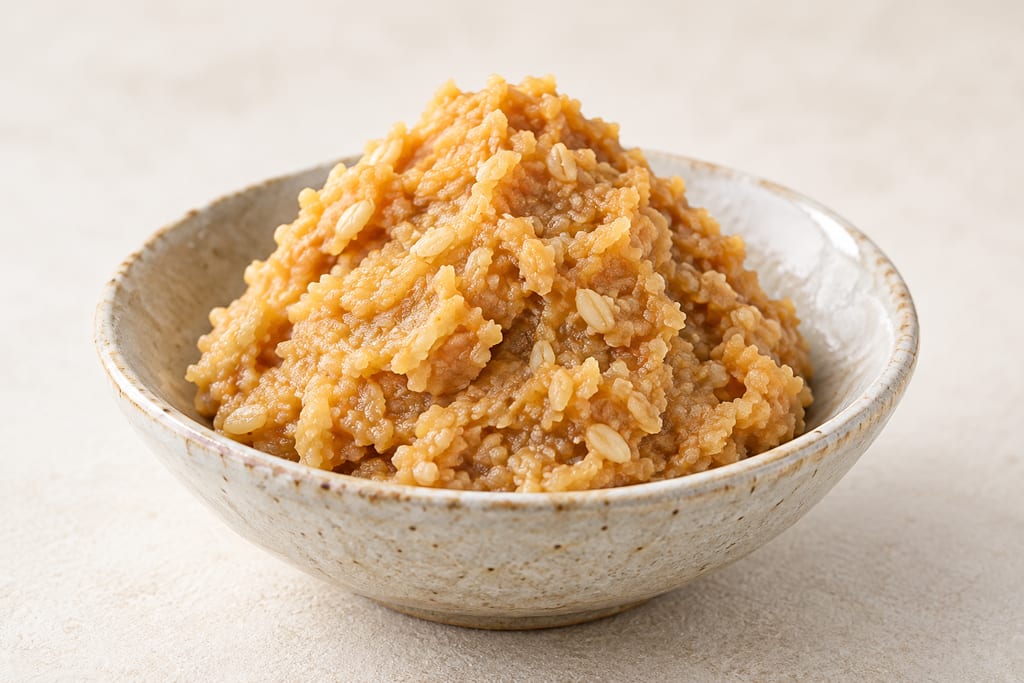
A Japanese soybean paste fermented with barley koji and salt, made mostly in Kyushu, Shikoku and western Japan. It is sweet, savoury and grainy.
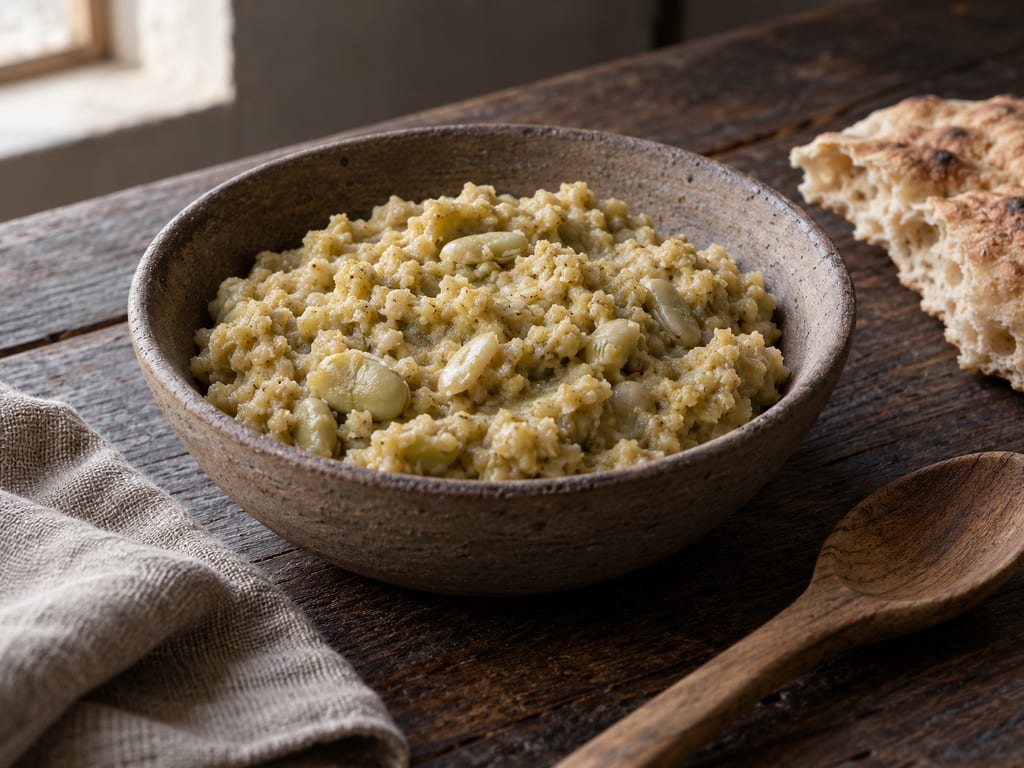
Cooked broad beans crushed to a thick paste with garlic and salt, a museum preparation built on the one European pulse that was already old when the Viking Age began.
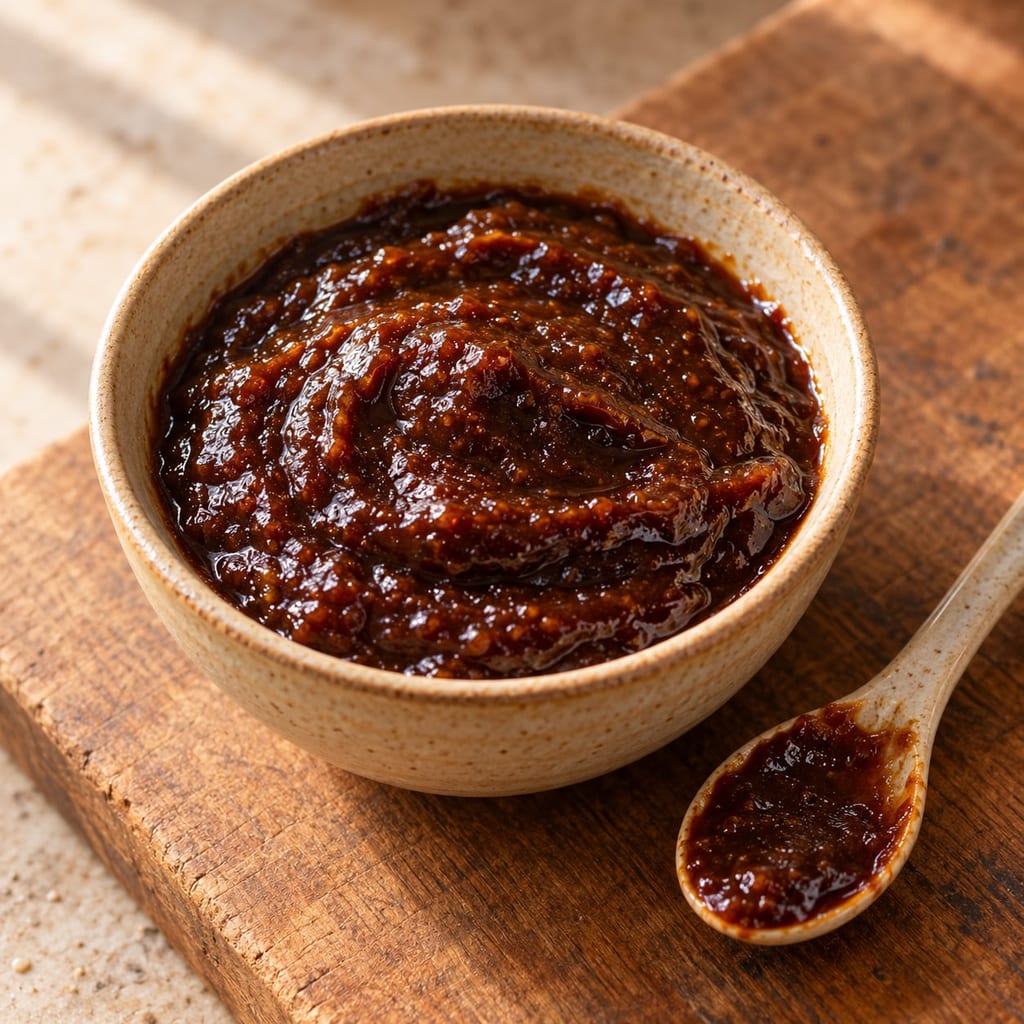
Chu hou is a sweet, savoury Cantonese paste of fermented soybeans, fermented bean curd, garlic, ginger and sesame, used mainly to braise meat.
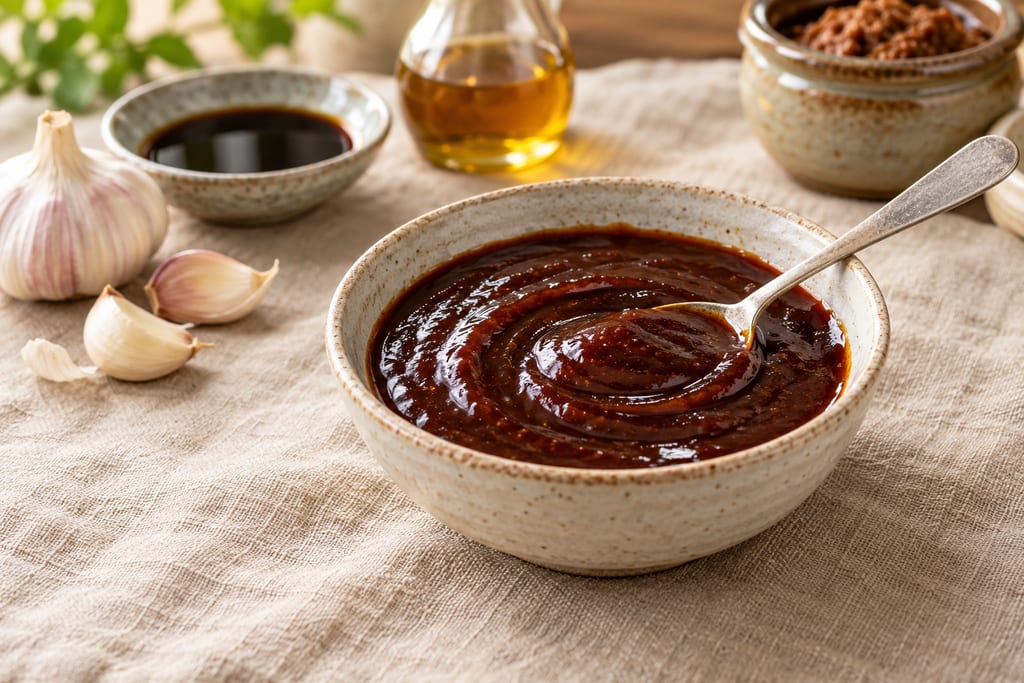
A thick, dark, sweet-salty Chinese condiment built on fermented soybean paste. This page gives one quick home version and records how commercial formulas differ.
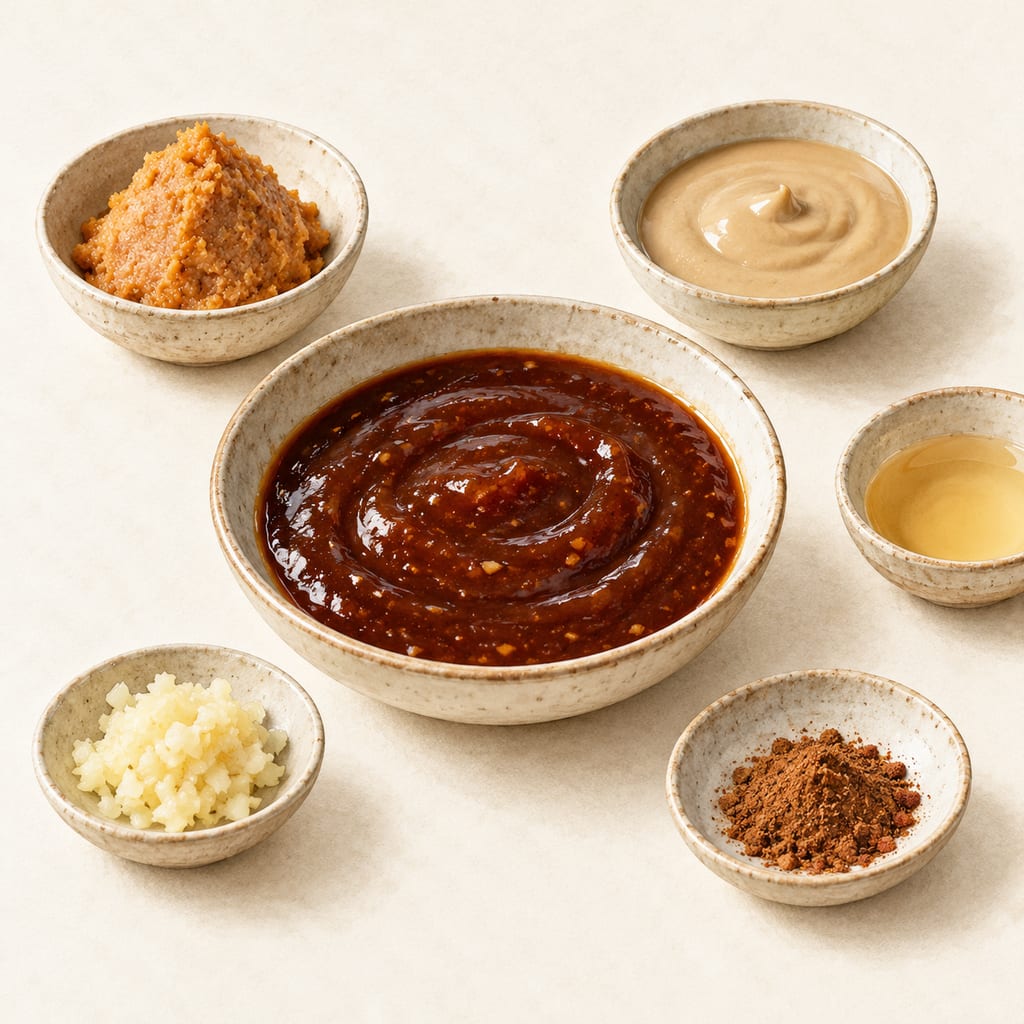
An untested modern miso-based sauce inspired by hoisin's sweet, savory profile; this prototype is not traditional hoisin or a copy of a commercial brand.
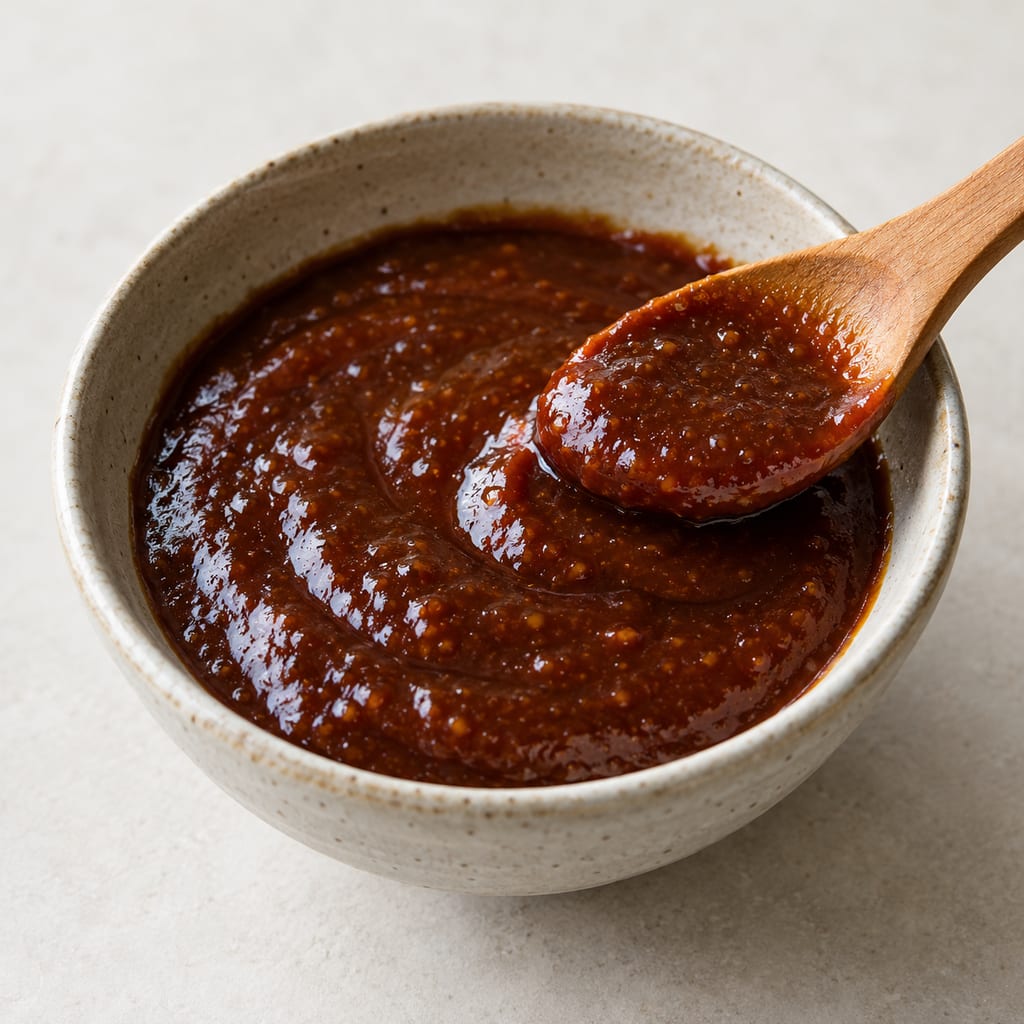
A sweet-salty Japanese glaze of miso, mirin, sake and sugar, warmed until thick and spread on grilled tofu, eggplant, daikon or konnyaku. Regional versions in Aichi use red miso and dashi.
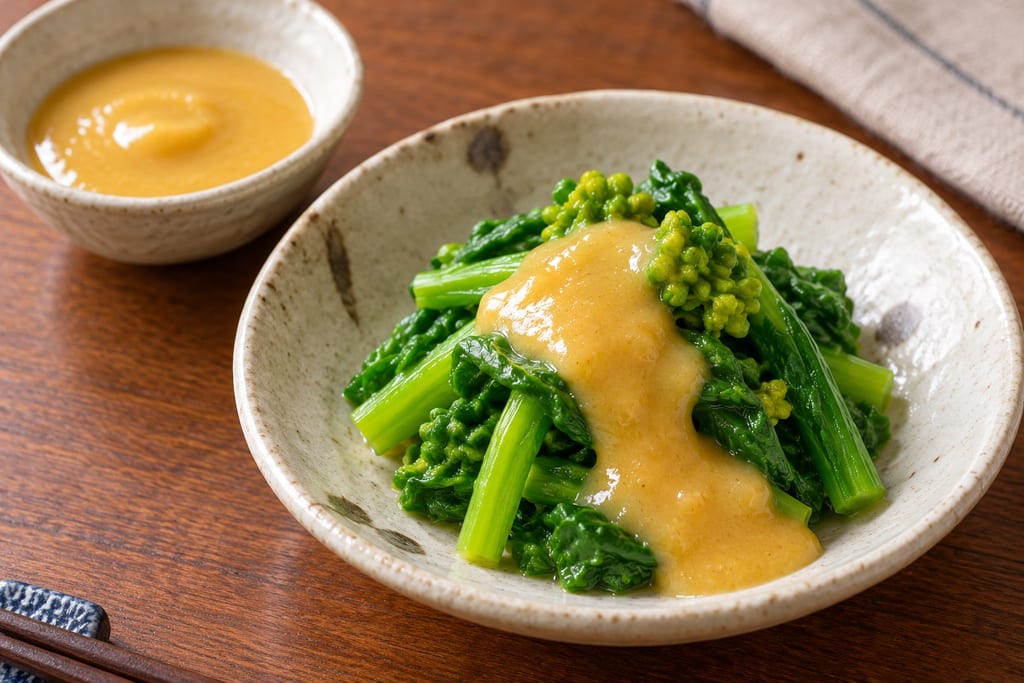
Karashi-su-miso is a smooth Japanese sauce of sweet miso, rice vinegar and hot mustard, stirred together for vegetables, seafood or poached fish.
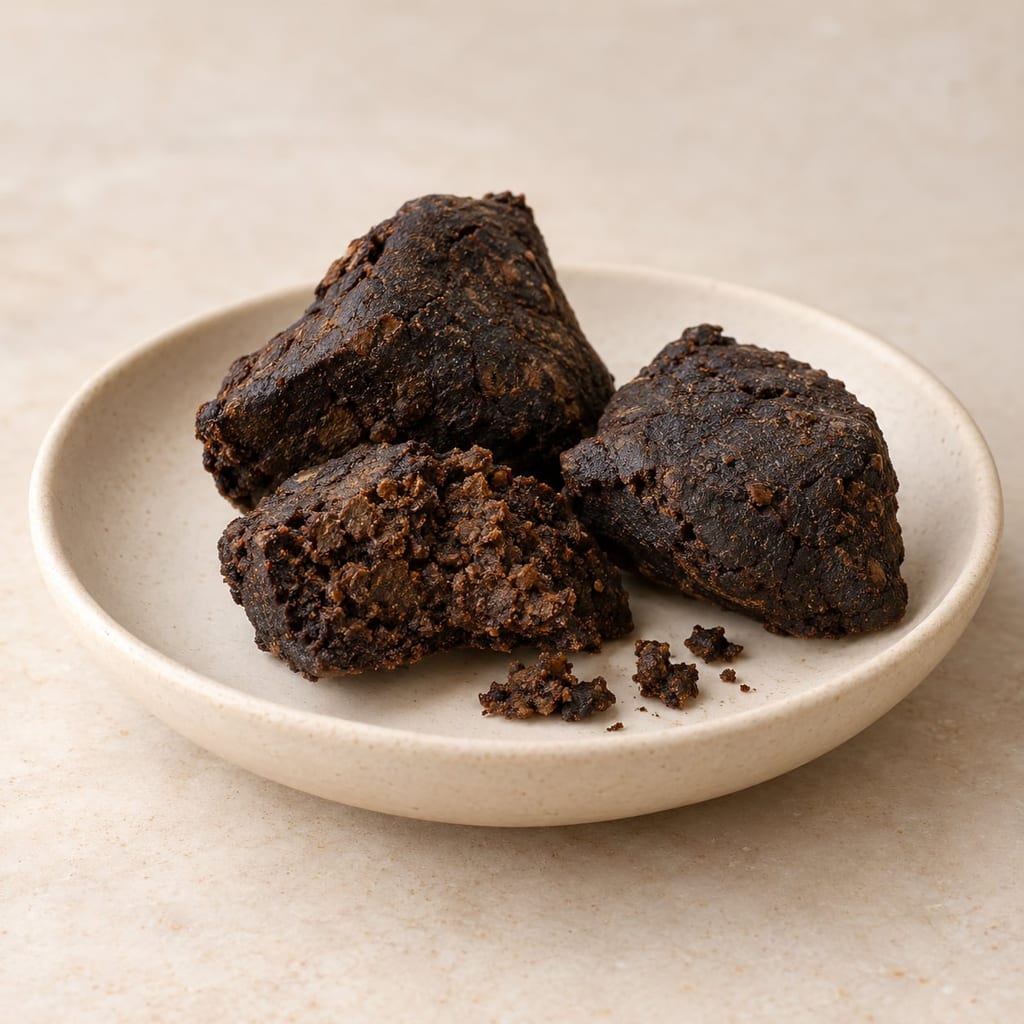
Okpiye, also written okpeye, is a Nigerian condiment from fermented Prosopis africana seeds; published studies describe laboratory batches, not a validated home method.

A gelling polysaccharide extracted from red seaweeds, sold as kanten strips or powder; it sets firm at a low concentration and stays solid until about 85 °C.

A Dominican table and seasoning condiment of sour orange juice, mixed with lime and salt and bottled raw; garlic, oregano or a hot pepper may be added for meat or a spicier bottle.

Cicerbita alpina is an alpine perennial whose tender shoots and leaves have been eaten raw or cooked. Sámi milk preparations and modern Carnian dishes are distinct uses, with serious identification and preservation limits.

Japanese skipjack tuna cooked, then repeatedly smoked and dried over a wood fire by the hand-fired tebiyama method into a hard block for shaving into dashi: the first stage of katsuobushi.

A Swedish-style spirit vinegar made by fermenting neutral alcohol with live vinegar bacteria, with a separate guide to commercial ättika strengths.

A yeast-raised wheat ring shaped from a firm dough, briefly boiled and baked. This source-batch formula gives a gently malted crust and a chewy crumb.

A warm dip of garlic, anchovy and olive oil, often enriched with butter, that Piedmont serves over a flame with raw and cooked vegetables and bread.

Bechamel is a white sauce of milk thickened with a butter and flour roux, one of the French mother sauces, and the base from which Mornay and other cheese and cream sauces are made.
No community contributions have been published for this entry yet.
Sign in to contribute. Published comments and photos are free to read.
Korea Tourism OrganizationInspiration · Process · Geography
Jang: The Story Behind Sunchang’s Renowned FlavorsIngredient quantities, malt extraction, rice-flour cooking and Sunchang regional context
Cited in: Korea's sweet, savoury and fiery fermented paste; History: what can actually be dated; Why Sunchang is associated with gochujang; Understanding the ingredients; Ingredients; The role of barley malt; The importance of meju powder; Ingredients and chilli quality; Method; Choosing the fermentation vessel; What happens during the three months?; The effect of salt; Regional variants; How gochujang is eaten; Recognising quality and faults
BC Centre for Disease ControlSafety
Safety of fermented foods: Koji and misoProcess-specific guidance for koji/miso and relevance of missing process controls; does not validate this gochujang formula
Cited in: Korea's sweet, savoury and fiery fermented paste; Why Sunchang is associated with gochujang; Understanding the ingredients; Ingredients; The role of barley malt; The importance of meju powder; Ingredients and chilli quality; Method; Choosing the fermentation vessel; What happens during the three months?; The effect of salt; Regional variants; How gochujang is eaten; Recognising quality and faults; Safety and shelf life
Korea Tourism OrganizationHistory
Korea Tourism Organization — Jang: The Story Behind Sunchang's Renowned FlavorsJang: The Story Behind Sunchang's Renowned Flavors
Cited in: History: what can actually be dated
Academy of Korean StudiesHistory
Academy of Korean Studies — 고추장, historical and culinary reference고추장, historical and culinary reference
Cited in: History: what can actually be dated
sciencedirect.comHistory
Sunchang Gochujang: The Unfolding of Authenticity (2016)Sunchang Gochujang: The Unfolding of Authenticity (2016)
Japanese and East Asian traditional-food reference contextHistory
Japanese and East Asian traditional-food reference context — MAFFMAFF
Wikimedia CommonsInspiration
Wikimedia Commons — Gochujang photographic reference collectionGochujang photographic reference collection