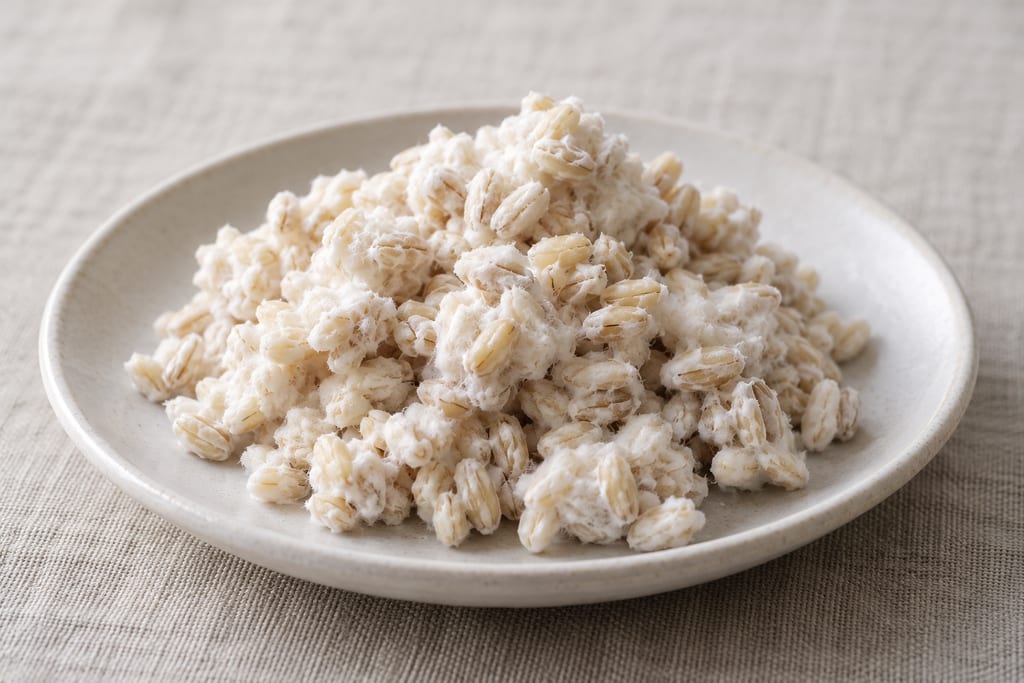
Barley koji
Steamed pearled barley grown into a white koji cake with Aspergillus oryzae over about 36 hours in a 30 °C chamber, turned three times under a damp cloth.
 FermenteaWhere food goes to change
Traditional method
麦味噌(むぎみそ) · Mugi miso · Mugi-miso · 麦みそ · むぎみそ · Barley miso · Barley-koji miso · 田舎味噌(いなかみそ, inaka miso) · 田舎みそ · Inaka miso · 九州麦味噌(きゅうしゅうむぎみそ, Kyushu mugi miso) · はだか麦味噌(はだかむぎみそ, hadaka-mugi miso)
A Japanese soybean paste fermented with barley koji and salt, made mostly in Kyushu, Shikoku and western Japan. It is sweet, savoury and grainy.
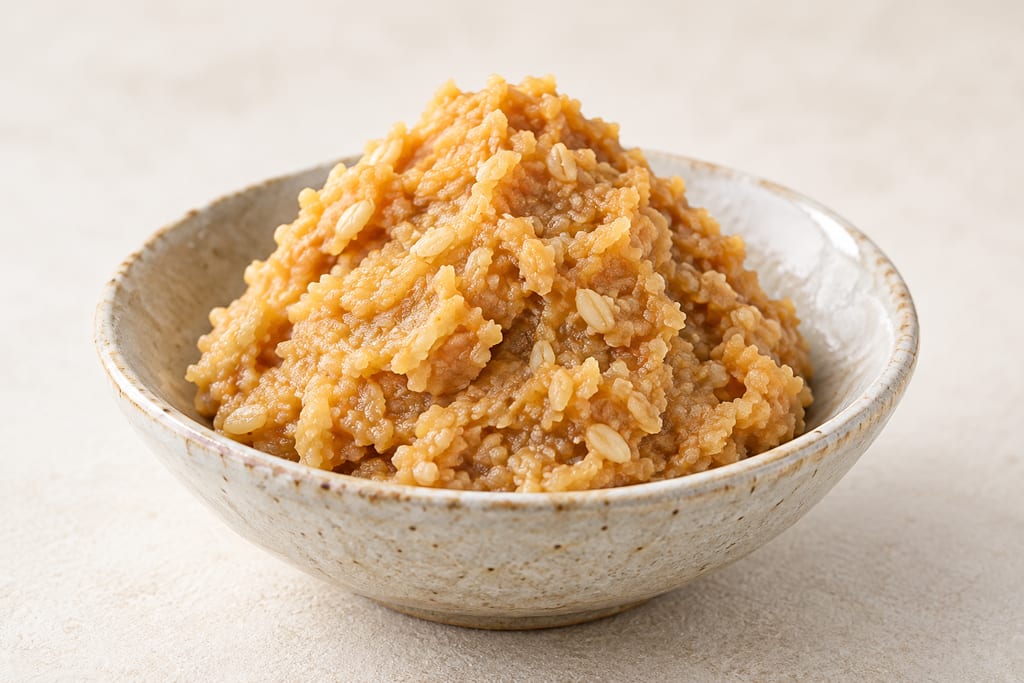
Mugi miso, 麦味噌, is a Japanese paste made from cooked soybeans, barley koji and salt. Barley koji, 麦麹, is barley that has been grown over with a koji mould, and it is what sets this miso apart from kome miso, made with rice koji, and mame miso, made with soybean koji. The colour runs from pale yellow through golden brown to reddish brown depending on the recipe and the ageing. Many versions keep visible barley grains or bits of husk, so the paste looks coarser than a finely strained rice miso.
The barley is normally polished before it becomes koji, to a degree that differs between makers. Both ordinary barley and naked barley, はだか麦, are used. Naked barley is not a separate species. It is Hordeum vulgare with a hull that falls away easily at threshing, and it matters most in western Japan, including Ehime. Polishing removes the outer layers, makes the grain behave more evenly and leaves more starch exposed for the mould. Barley koji is not malted barley. Its enzymes come from the mould growing on cooked grain, not from the barley sprouting.
Each ingredient does a different job. Barley koji brings starch, flavour and enzymes. Soybeans bring protein, fat and more carbohydrate. Salt seasons the paste and decides which microbes stay active. The koji mould is Aspergillus oryzae, and many miso ferments also involve Tetragenococcus halophilus, a salt-tolerant lactic acid bacterium, and Zygosaccharomyces rouxii, a salt-tolerant yeast. How much of each is present depends on the maker and the conditions.
Barley miso is most associated with Kyushu, Shikoku and parts of Chugoku, but it is not only southern. Kanagawa's agricultural research centre records barley miso made in Sagamihara, where barley grew on land unsuited to flooded rice. Western Japanese barley miso is often fairly sweet, with a lot of koji and a short ageing. Others use less koji, age longer, and turn saltier and darker. Inaka miso, country miso, is a common alternative name but it is not exclusive to barley miso.
It is a seasoning, usually dissolved in soup, stirred into sauces or cooked with other ingredients. Its flavour comes from starch conversion, protein breakdown, microbial activity and the chemistry of ageing, in proportions that vary from one recipe to the next. Barley miso is better thought of as a family of regional products than as one fixed formula.
Barley miso belongs to the wider history of Japanese soybean fermentation, but the two do not share dates. The Shosoin documents contain terms transcribed as mishō or masshō for a fermented soybean seasoning, and the tenth-century Wamyo Ruijusho includes vocabulary tied to miso. An account in the agriculture ministry's materials ties the arrival of such seasonings to the Korean peninsula in 666 CE. That date is an origin tradition, and it does not show that anyone then made miso from barley koji and soybeans.
In the medieval period miso spread from court and temple settings into rural households, helped by specialised koji making and wider soybean growing. Which grain went into the koji varied by place, and a record of miso is not a record of barley miso. No early document that names barley koji and soybeans together has been found.
The farming explanation is clearer. In Ehime barley was grown as a second crop after rice, while rice itself could be needed to pay tax. Farmers kept barley for the household and turned it into miso, and since many families made their own paste the product came to be called inaka miso. That explains why barley was a practical stand-in for rice koji, though not the year the habit began.
In Kyushu, where rice supplies were historically uneven, barley was an important household grain. Miyazaki's cold hiyajiru and the Ehime fish-and-miso dish satsuma reflect everyday cooking with barley, miso and local protein. Some origin stories for these dishes reach back to medieval or early modern times, but they are retold traditions and do not date barley miso itself.
What can be said securely is this: Japanese miso has medieval antecedents, barley miso grew out of regional farming and koji making, and its modern methods are well described. Kanagawa Prefecture records barley miso in Sagamihara, the ministry names Kyushu the largest producer and sets its sweet, short-aged products against darker, longer-aged barley miso elsewhere, and scientific reviews of 2008 and 2021 treat barley miso as an established category with its own manufacturing needs.
Mugi miso is made in two linked stages. First a koji mould is grown with plenty of air on prepared barley, and it fills the grain with enzymes. Then the koji is mixed with cooked soybeans and salt, and for months enzymes keep working while salt-tolerant microbes add their own activity. Aspergillus oryzae grows over and into the barley, uses it as food and releases enzymes outwards. How much it makes depends on the strain, the grain preparation, moisture, oxygen and temperature.
Most of the sweetness is starch breaking down. Alpha-amylase cuts internal bonds in starch into dextrins and smaller sugars, and glucoamylase frees glucose from the ends of those chains. Steaming gelatinises the starch and opens up the grain so the enzymes can reach it. Barley also holds beta-glucans and other cell-wall polysaccharides that affect texture and water movement, though that does not mean all the fibre turns into sugar.
The savoury side comes from protein. Koji proteases cut soybean and barley proteins into peptides, and further enzymes release free amino acids. Glutamate gives umami, joined by other amino acids and small peptides. Much of the protein available to be broken down comes from the soybeans, so the ratio of barley koji to soybeans shifts the balance between sweet and savoury. Japanese agricultural guidance notes that barley's amino acid make-up differs from rice, with a higher share of glutamate, though the finished miso depends on the whole recipe.
During ageing Tetragenococcus halophilus turns sugars into lactic acid and other organic acids, which lowers pH and changes which microbes can compete. Zygosaccharomyces rouxii can make ethanol and flavour compounds. These organisms may be added in commercial production, come in with a spoonful of mature miso, or arrive on their own. Which ones dominate depends on the batch.
Salt acts through lower water availability and osmotic stress. It suppresses many competitors and lets tolerant organisms carry on, and it also changes how well the enzymes work, so more salt does not simply slow everything equally. Temperature and koji ratio shift the balance further. A short-aged, high-koji miso gets much of its sweetness from starch breakdown, while a longer-aged one develops more acid, alcohol and aroma.
Colour comes partly from Maillard reactions between sugars and amino compounds, which build brown pigments and complex flavour as time goes on. Time, temperature and what went in all matter. A darker miso is not necessarily a different microbe at work or proof of a set age; the result is several processes running together.
Barley koji is made differently from rice koji. Japanese agricultural guidance says to wash polished barley well to remove bran and dust, then soak it according to the grain and the water temperature, because barley absorbs water faster than rice. Kanagawa Prefecture gives about 4 to 6 hours below 10 °C, 2 to 3 hours at around 15 °C and no more than about an hour at 20 to 30 °C. Over-soaking or poor draining leaves the grain too wet, which clumps and invites bacteria during cultivation.
The soaked barley is drained for about 30 minutes and steamed for 30 to 40 minutes once strong steam reaches the top of the steamer. It comes out slightly translucent and elastic with no hard centre. It is loosened, cooled and inoculated with commercial koji starter, then cultivated in a controlled, oxygenated setting; Kanagawa documents about 42 to 45 hours in its mechanical process, with mixing to break up clumps and spread heat.
Moisture and temperature are tricky with barley. The review by Kusumoto, Yamagata and Tazawa explains that barley koji gives off more metabolic heat than rice koji, the surface can dry out and stop the mould, and grain that is too wet supports unwanted bacteria. The industrial temperature programmes differ for pale and red barley miso. Keeping barley warm until it turns white is not a method.
The second ingredient is soybean. Beans are washed, soaked, cooked until soft and crushed. Cooking hydrates them, denatures the protein and exposes it to the koji enzymes. The third is salt, mixed thoroughly into the koji and beans, and some recipes add cooled bean cooking liquid to adjust consistency. Everything is blended evenly and packed into a vessel with the air pressed out. The surface is flattened and covered, and often weighted.
The measured recipe here is Ikedaya Jozo's: 1 kg dried soybeans, 2 kg fresh barley koji, 670 g salt and 1,160 ml cooled bean cooking liquid, for about 6 kg of miso at roughly 10.8 percent salt by the maker's calculation. Kanagawa publishes a large batch of 15 kg dried soybeans, 16 kg barley koji and 6.7 kg salt, and Pal System a smaller one of 500 g soybeans, 750 g dried barley koji and 300 g salt. These are separate formulas and should not be mixed.
During ageing the enzymes keep breaking down barley starch and soybean protein, salt-tolerant yeasts and bacteria develop, and some makers turn the paste over. Ikedaya Jozo calls for two months or more in summer and three months or more in winter for its barley miso, and its general guidance runs from two to three months in summer to three to six in winter. The finished paste can be left coarse, milled or strained.
Barley miso differs mainly in the barley used, the ratio of koji to soybeans, the salt and the ageing. The ministry separates a fairly sweet, pale style from Kyushu from longer-aged, darker barley miso in parts of Kanto, and gives typical salt ranges of 9 to 11 percent for sweet barley miso and 11 to 13 percent for salty types. These describe categories and are not safe minimums for a home recipe. Kyushu also makes dark barley miso, so geography alone does not fix colour or flavour.
Ehime is linked to naked barley, hadaka-mugi. Its barley miso usually has a high koji share, making a notably sweet paste with a strong grain aroma, and it ties to barley grown after the rice harvest. The ministry lists miso soup as an everyday use, with seasonal vegetables and tofu. In the Nanyo area barley miso goes into satsuma, a fish-and-miso dish poured over barley rice.
Kyushu holds several distinct traditions. Miyazaki's hiyajiru is a cold dish of miso, toasted or ground ingredients, fish, stock and vegetables, served over rice or barley rice. In Kagoshima barley miso goes into buta-miso, pork cooked with miso until thick. These dishes share barley miso but have their own local histories.
Barley miso also turns up outside western Japan. Sagamihara in Kanagawa made it in its barley districts. Yamanashi's Koshu miso traditionally mixes rice koji and barley koji, often in about equal parts, which makes it a neighbouring style and not pure barley miso under the Japanese classification.
Modern variants use imported barley, different polishing grades, dried koji in place of fresh, controlled starters and shorter or longer ageing, and some experimental ferments use pearled barley koji with other protein sources. They are modern adaptations. What a miso actually contains and how it was made says more than a broad label like country-style.
Miso soup is the best-known use. The paste is dissolved in dashi after the vegetables are cooked. Ehime's traditional soup uses seasonal vegetables, tofu, fried tofu, dried shiitake and a dried-sardine stock, and the ministry's four-serving recipe takes 60 g of barley miso to 500 ml of water. Adding the miso at the end keeps more of its aroma than boiling it, although gentle reheating does no harm.
It also seasons cooked vegetables, stews, hotpots and sauces. Its grain sweetness and amino acids supply salt and savour without many other seasonings, and it mixes with sesame, citrus or sugar into dips and dressings. A pale, high-koji barley miso tastes much sweeter and less salty than a long-aged red one, so equal spoonfuls of two misos are not equal in salt.
Hiyajiru in Miyazaki combines miso with ground sesame, fish and stock, plus cucumber, shiso, myoga and tofu; some methods toast the miso mixture lightly before thinning it, and the cool liquid is served over rice. Ehime's satsuma mixes cooked fish with barley miso and stock over barley rice, with sea or freshwater fish by district. Kagoshima's buta-miso cooks pork with barley miso, sometimes with vegetables and sweet seasonings, until thick, to eat with rice. These are dishes made with the miso, not the miso itself.
Miso can also marinate fish or meat, but it does not make raw animal products safe to keep without refrigeration, and a marinade that touched raw meat should not go back into the jar.
Texture matters at the table. A grain-rich barley miso leaves small pieces of barley in soup, which some cooks like, while a smooth or strained one disperses evenly in sauces. Unpasteurised miso keeps some enzyme activity and living microbes, and pasteurised miso has been treated to stabilise it. Thorough cooking inactivates active enzymes and many microbes, but the flavour stays, so barley miso does not need to be eaten raw to be worth using.
Barley takes up water faster than rice, which is the root of most koji trouble. Kanagawa Prefecture and the Yamagata soy sauce and miso cooperative both warn that over-soaked or badly drained barley turns wet and sticky and supports unwanted bacteria. Barley koji also makes more heat and clumps more as it grows, and grain that is too wet or too dry will not colonise properly. A white surface alone does not prove that the culture went well. For that reason this recipe starts from finished, food-grade barley koji.
Salt is a process control, not only a seasoning. The published home recipes use quite different amounts of soybeans, koji, salt and liquid, and the final salt level cannot be worked out from dry weights because cooking and hydration change the mass. Taking the low salt of one recipe and the extra liquid or longer ageing of another gives an untested ferment. Commercial short-aged and reduced-salt miso rely on controls that a home batch does not have.
Soft, pale, sweet miso after a couple of months is normal for a high-koji recipe, and a darker, saltier paste after a long winter is normal too. Ageing is faster in warm rooms and slows markedly below about 15 °C. Ikedaya Jozo puts the ideal at about 27 °C and advises avoiding sustained heat above 35 °C. Bags can swell with gas, and the producer says to release it. Check the seal, the surface and the weight now and then.
Surface mould is the main thing to watch. Packing firmly, pressing out air, covering the surface closely and weighting the cover all reduce it. Ikedaya Jozo describes treating the surface with food-grade alcohol or a thin layer of salt. Mould on miso is not automatically the koji mould, and its species cannot be told by looking, so unknown growth should never be treated as harmless.
Biogenic amines are a real consideration in soybean ferments. A 2012 study of 22 commercial miso products found low amounts in many but elevated histamine and tyramine in some, linked to the ratio of ingredients and to contaminating bacteria. It says nothing about this exact recipe, but it shows why salt, ingredient choice and microbial conditions matter, and cooking does not remove amines already formed.
Soybeans are an allergen, and barley contains gluten. Ordinary mugi miso is unsuitable for anyone who needs a gluten-free diet, and polishing the barley does not change that. Claims that barley miso is probiotic, detoxifying or protective against heart disease rest on tradition more than on tests, and Kanagawa's research centre removed some health claims from its public pages for lack of confirmation.
Once the miso tastes right, move it to the refrigerator to slow further darkening and flavour change. Use clean utensils, and keep raw meat or fish well away. The recipe has no tested pH, water activity or shelf life, so any off smell or unidentified surface growth is a reason to discard the batch.
Fermented soybean seasonings are recorded in Japan from the Shosoin documents and the tenth-century Wamyo Ruijusho, and an account in the agriculture ministry's materials links their arrival to the Korean peninsula in 666 CE. Those records concern miso in general, and a document that mentions miso is not evidence for barley miso unless it names barley.
The regional explanation is clearer. In Ehime barley was grown after the rice harvest while rice itself could be needed for tax payments, so farmers kept barley for household food and made it into miso. Kanagawa Prefecture records barley miso in Sagamihara's barley-growing districts, and the ministry names Kyushu as the largest production region.
Yield 6 kg · Scaling: source batch only
Surface mould can grow where oxygen, moisture and unprotected surfaces allow it. Mould in miso is not automatically the koji Aspergillus oryzae, and its species and metabolites cannot be identified by eye.
Hazard sourceSalt helps select which microbes grow. Changing salt, moisture or koji ratios makes a different formulation, and the maker warns that low-sodium-chloride salts need adjusting.
Hazard sourceBarley absorbs water quickly and makes more heat than rice during koji growth; excess moisture, clumping and poor temperature control favour unwanted bacteria and uneven mould.
Hazard sourceA study of 22 commercial miso products found elevated histamine or tyramine in some samples, with amine-producing contaminant bacteria. It concerns miso generally, not this recipe.
Hazard sourceSoybeans are a principal ingredient and a regulated allergen.
Hazard sourceBarley contains gluten; pearling and fermentation do not make the miso gluten-free.
Hazard sourcePoorly cleaned vessels, utensils or hands can introduce unwanted microbes before and during months of ageing.
Hazard sourceThe home formula has no laboratory specification for pH, water activity, microbial counts or shelf life; the 10.8% salt figure is a calculated recipe value.
Hazard sourceUse food-grade prepared fresh barley koji, not uncontrolled mould on ordinary cooked barley.
Control sourceWeigh to the maker's formula; do not reduce the salt or add liquid without a validated alternative.
Control sourceCook the soybeans until soft enough to crush into a paste.
Control sourceCool the beans and cooking liquid before mixing with the koji.
Control sourceMix salt, bean paste, koji and liquid thoroughly so salt is evenly spread.
Control sourcePack firmly, press out air and protect the surface with the maker's container or bag method.
Control sourceKeep out of direct sunlight and avoid extreme ageing temperatures; the maker's preferred temperature is not a validated limit.
Control sourceRefrigerate the finished miso to slow further change.
Control sourceKeep equipment and hands clean and prevent contact with raw animal products.
Control sourceThis is a maker's home formula, not a laboratory-validated food safety process.
About 10.8% salt is the maker's own calculation for its ingredients and yield.
Do not substitute dried barley koji for fresh at the same weight.
Do not substitute raw pearled barley, malt or starter spores for prepared barley koji.
Making barley koji needs separate controls for hydration, temperature, inoculation and contamination.
A familiar miso smell, colour or taste does not show the batch is safe.
Unknown mould must not be assumed to be harmless koji; the maker discusses removing some surface growth, but that does not show that unidentified growth or its metabolites are safe.
Do not reduce the salt or add water.
The ageing temperatures are guidance, not microbiological critical limits.
Live beneficial microbes in the finished homemade miso have not been shown for this formula.
Barley miso contains soybeans and barley gluten.
No unrefrigerated storage period has been validated.
The ministry names Kyushu the largest production region, with comparatively sweet, short-aged styles.
Associated with naked barley and barley grown after rice.
Named with the western regions that keep the barley miso tradition.
Barley miso made where barley grew on land unsuited to wet rice; shows the food is not only southern.
Home of the cold hiyajiru made with barley miso.
Barley miso is a documented ingredient of buta-miso.
Steamed pearled barley grown into a white koji cake with Aspergillus oryzae over about 36 hours in a 30 °C chamber, turned three times under a damp cloth.
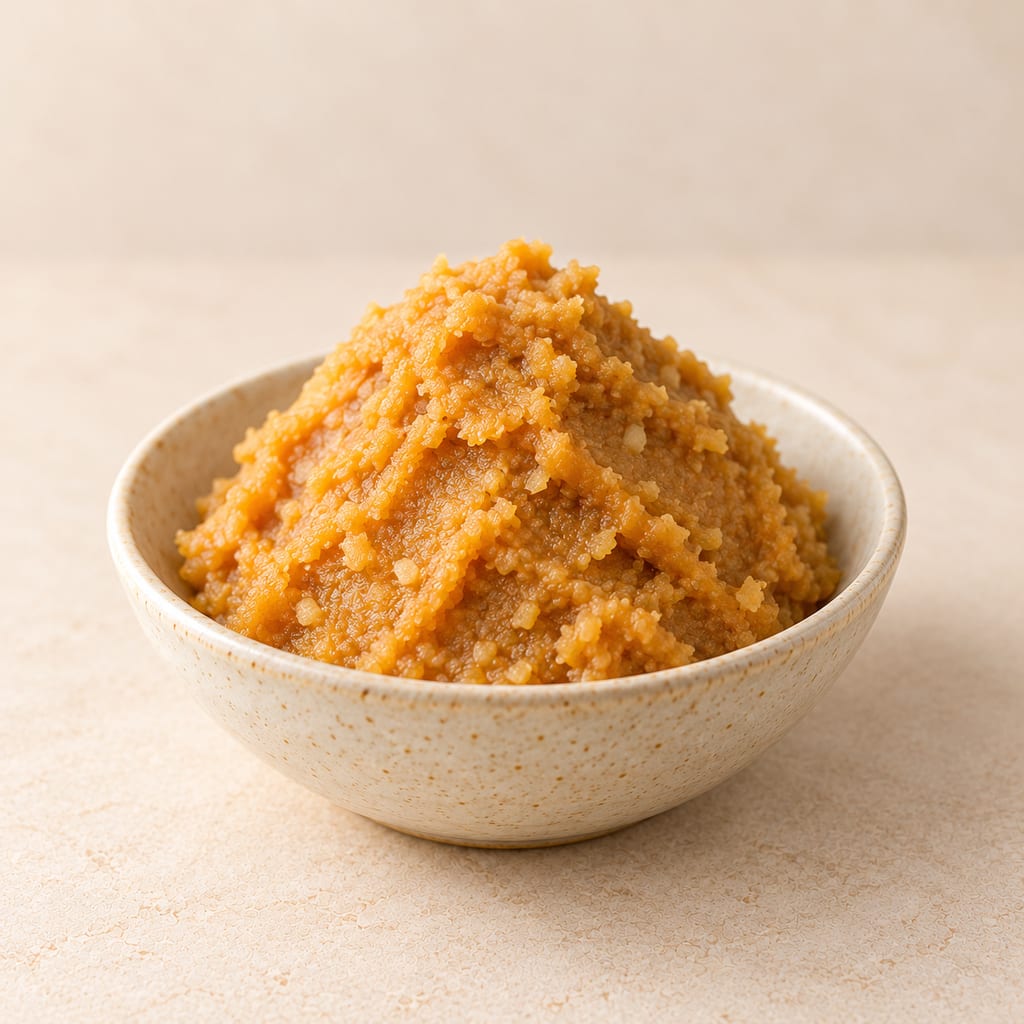
A traditional Japanese fermented paste made by mixing cooked soybeans with rice koji and salt. This guide details the ratio, the long enzymatic breakdown, and the months-long maturation required for depth.
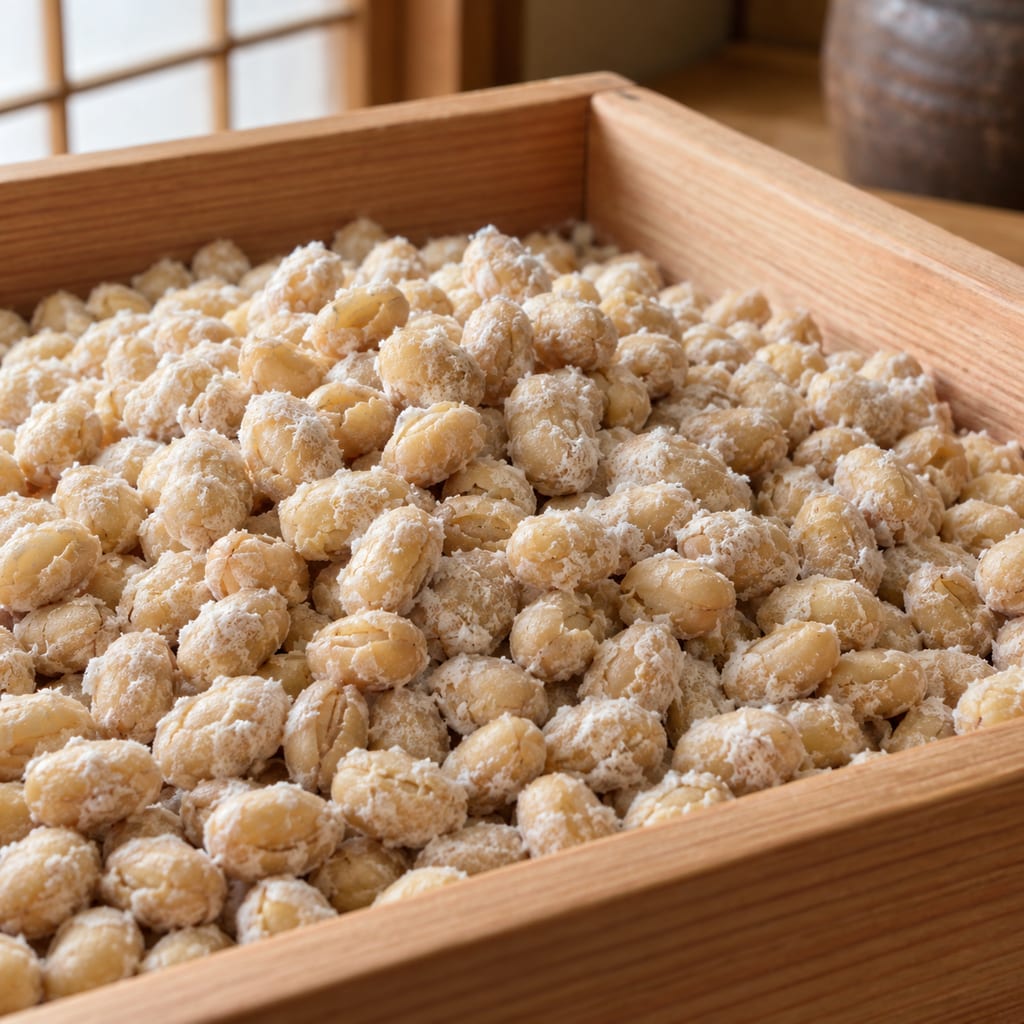
Japanese soybean koji: steamed soybeans, loose or formed into balls, grown over with Aspergillus mould to make the enzymes for mame-miso, tamari and regional soybean condiments.

Rice koji is steamed white rice through which koji mold has grown. It carries the enzymes that turn rice starch into sugar, and it is the starting point of sake, sweet miso, amazake and shio koji.
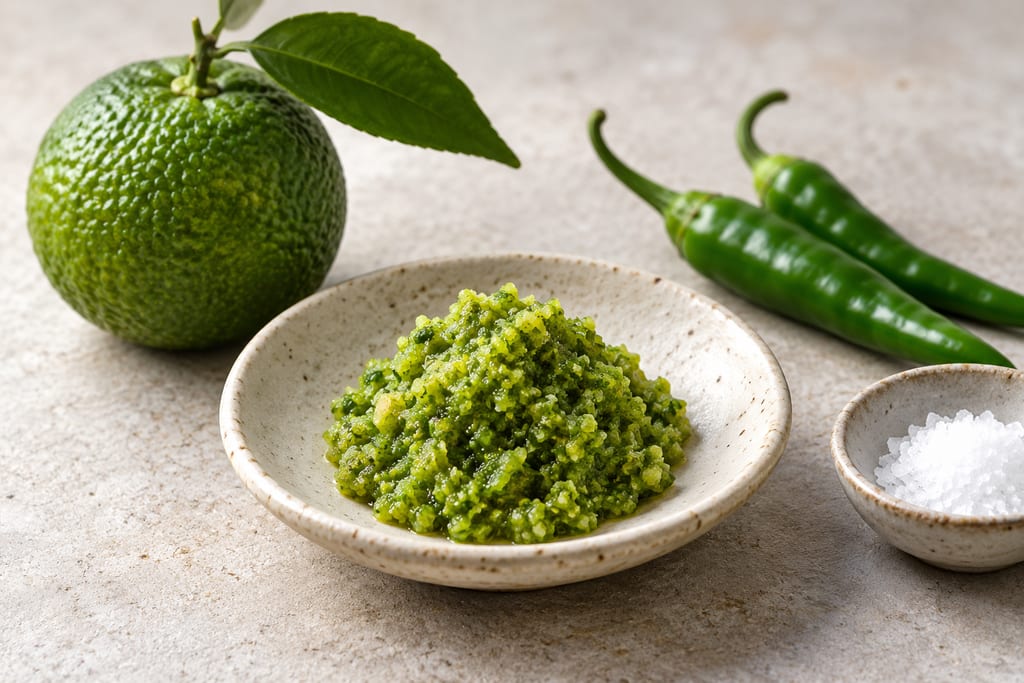
A fresh, uncooked yuzu and green chilli paste inspired by Kyushu’s yuzu kosho, made here as an untested small-batch seasoning rather than a preservation formula.
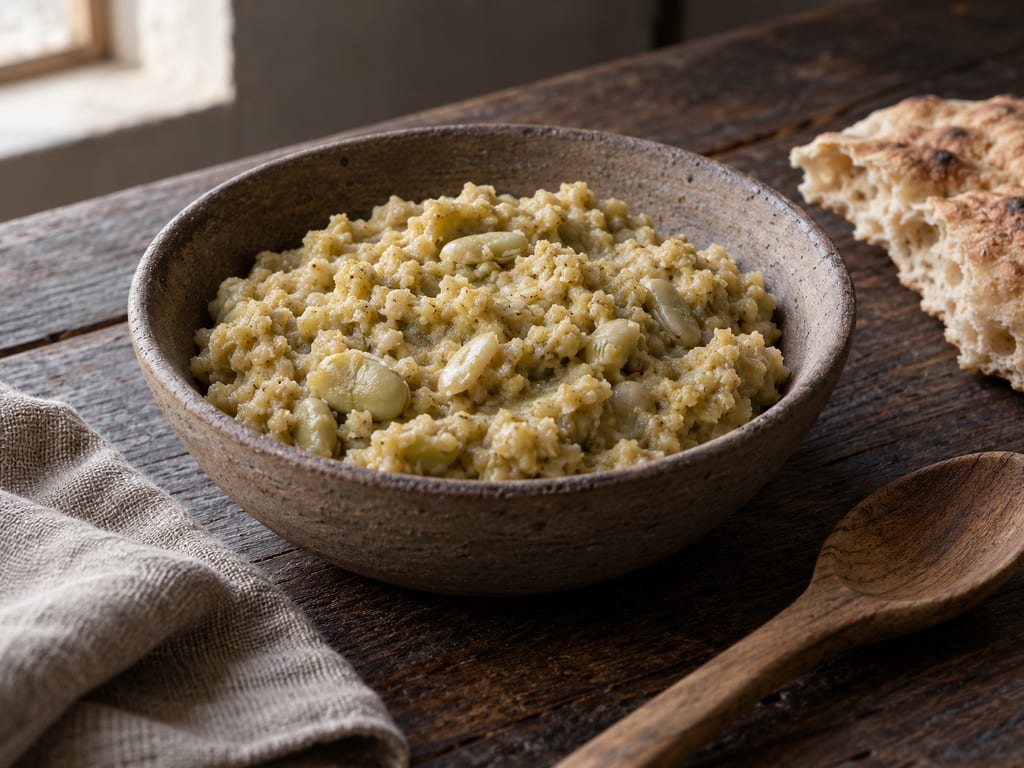
Cooked broad beans crushed to a thick paste with garlic and salt, a museum preparation built on the one European pulse that was already old when the Viking Age began.
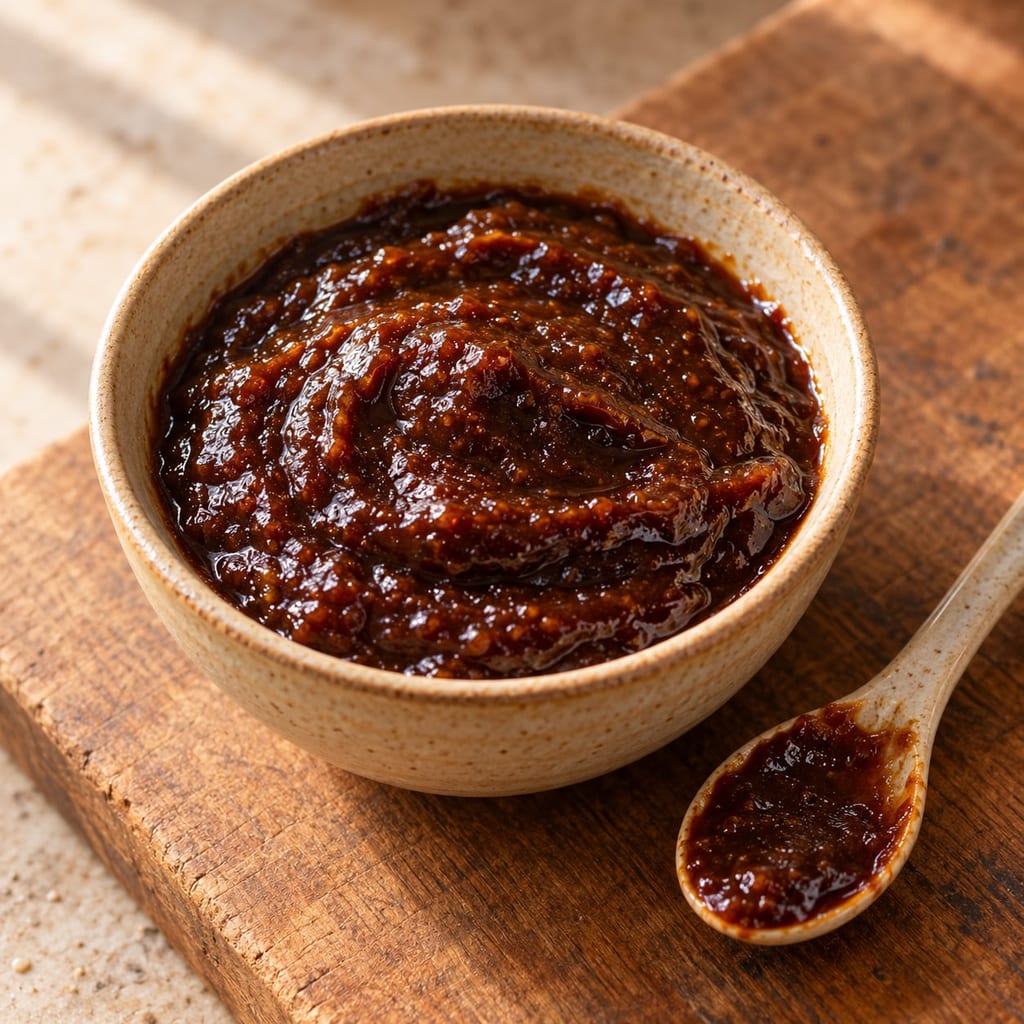
Chu hou is a sweet, savoury Cantonese paste of fermented soybeans, fermented bean curd, garlic, ginger and sesame, used mainly to braise meat.
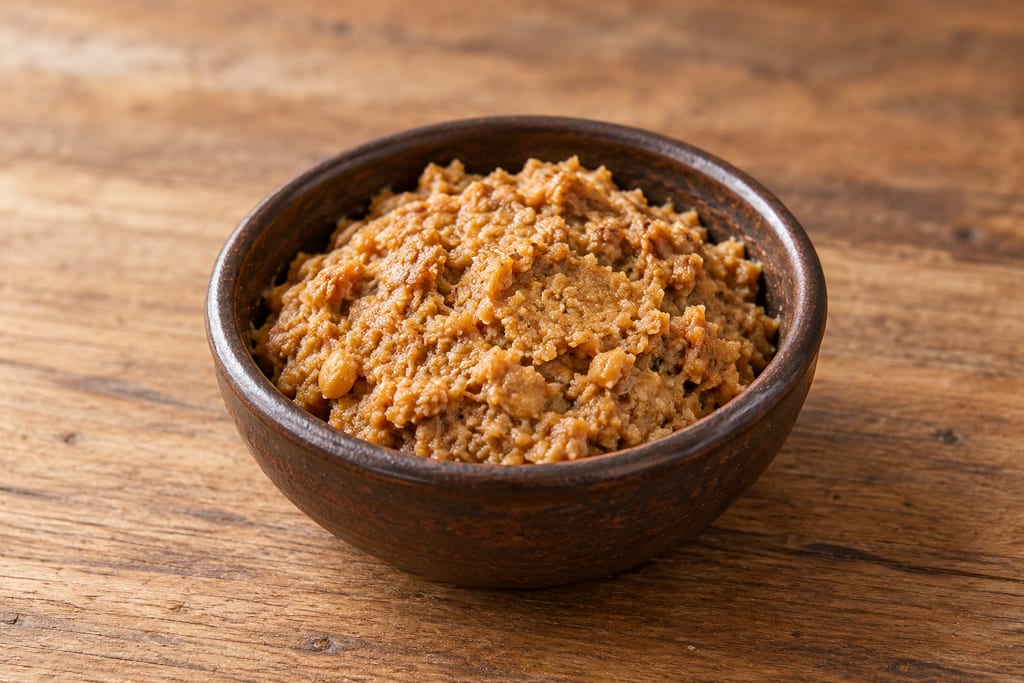
Doenjang (된장) is a Korean fermented soybean paste made by brining meju, separating ganjang, then mashing and aging the solids. This recipe follows one documented Sunchang processing study.
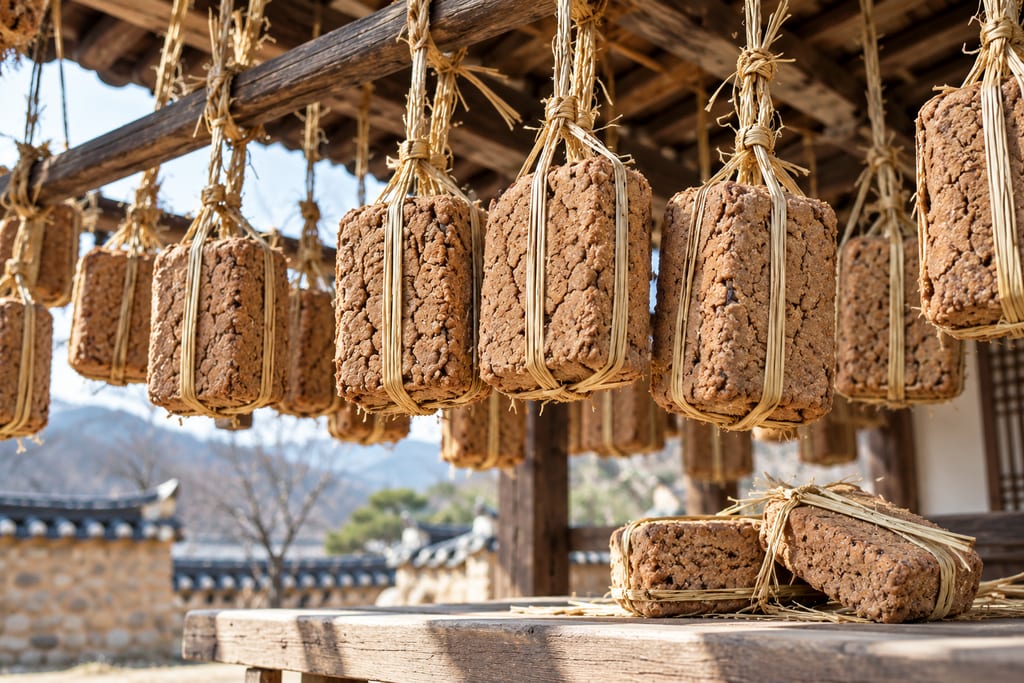
A cooked soybean brick, shaped and dried, that is fermented as a solid and later brined to make the Korean soy paste doenjang and the soy sauce ganjang.
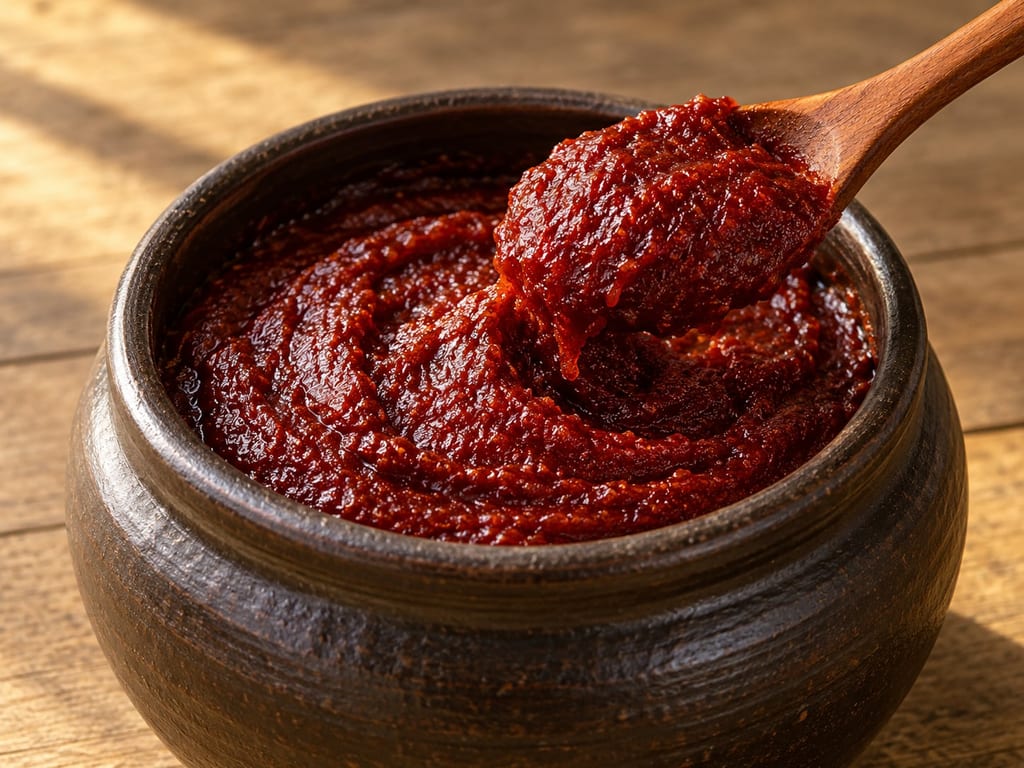
Korea’s sweet, savoury and fiery red paste of glutinous rice, barley-malt enzymes, fermented soybean meju powder and chilli powder, matured in earthenware.
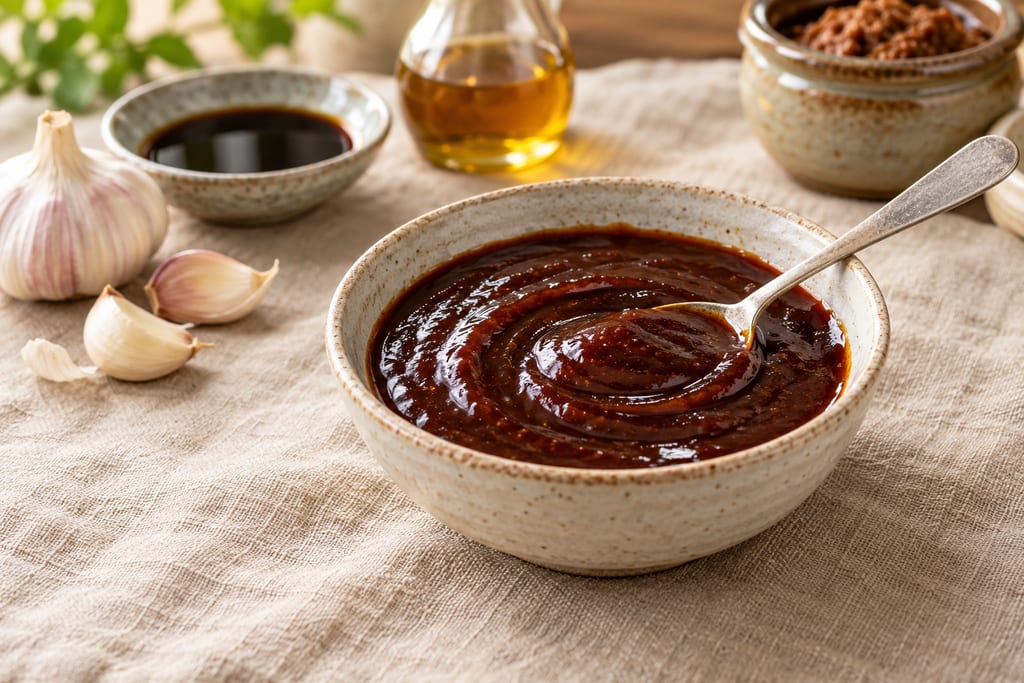
A thick, dark, sweet-salty Chinese condiment built on fermented soybean paste. This page gives one quick home version and records how commercial formulas differ.
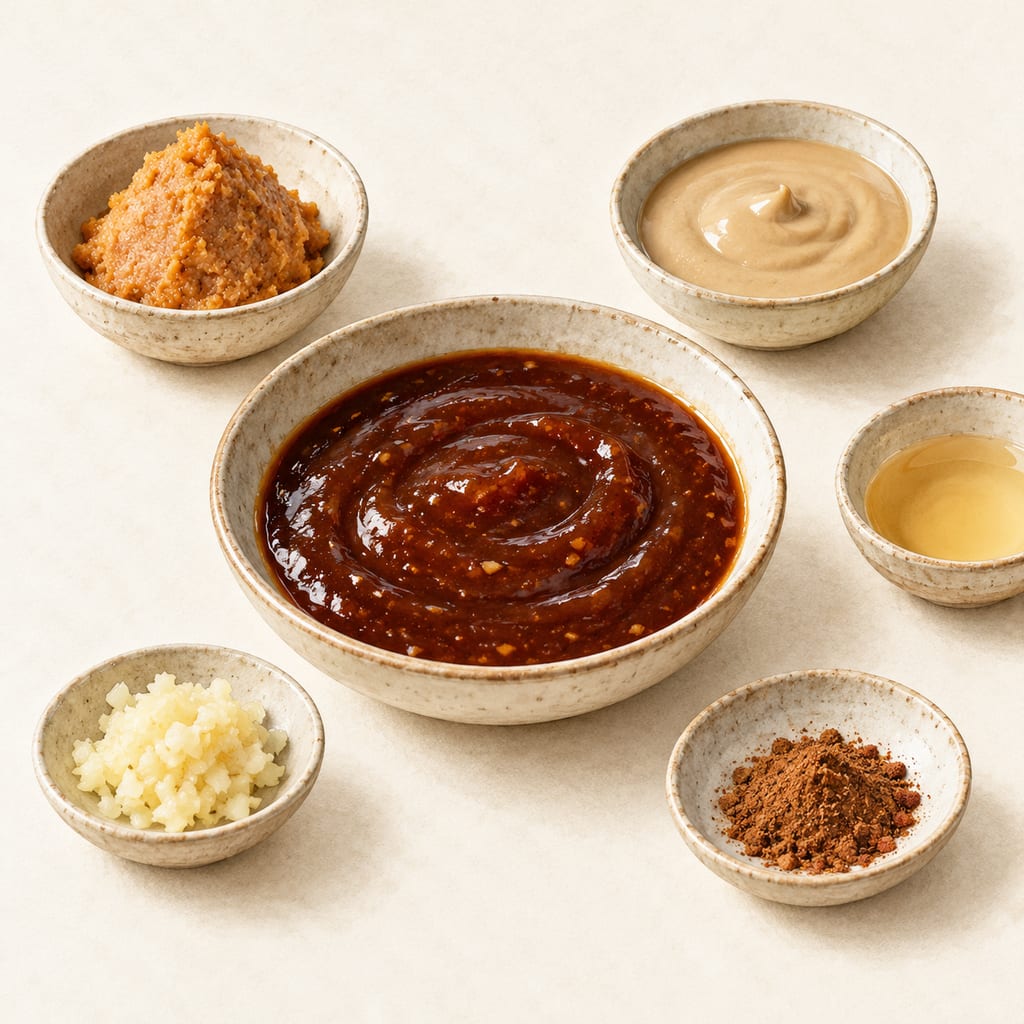
An untested modern miso-based sauce inspired by hoisin's sweet, savory profile; this prototype is not traditional hoisin or a copy of a commercial brand.
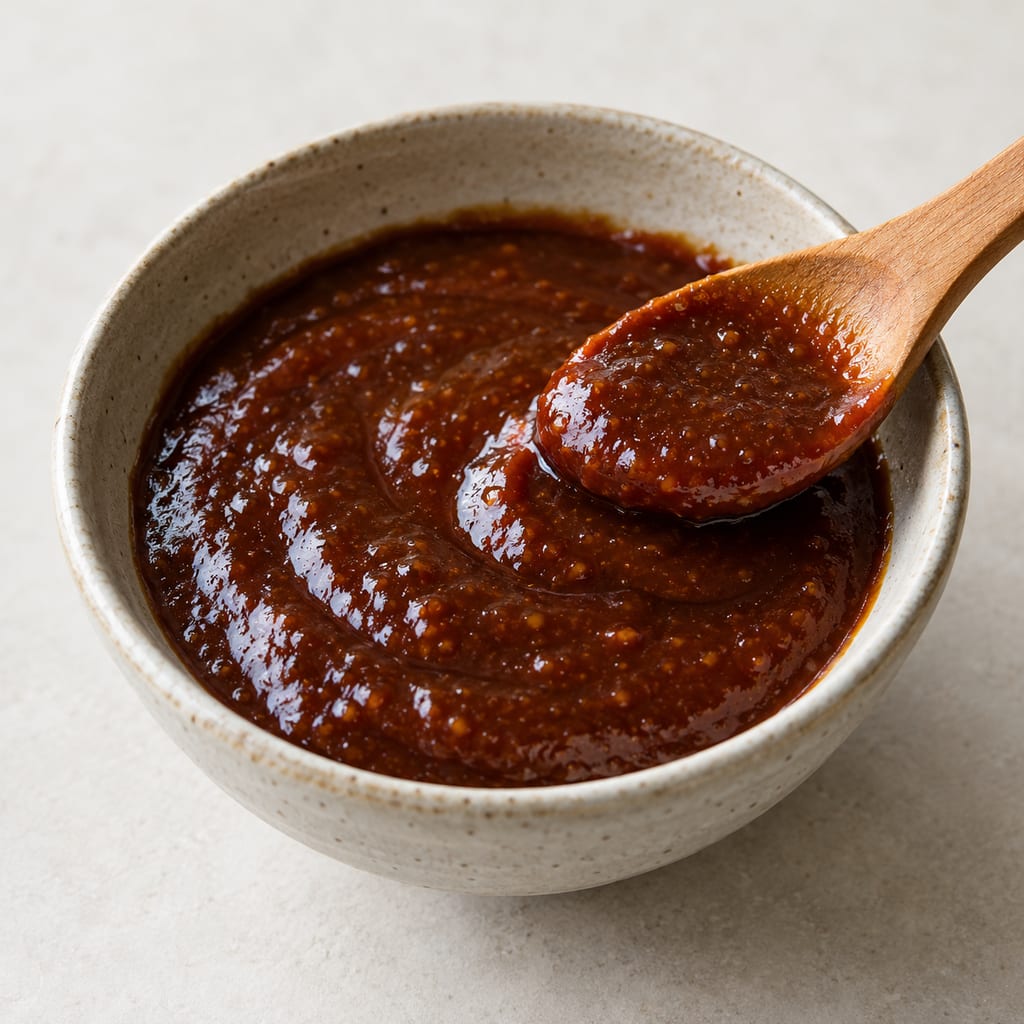
A sweet-salty Japanese glaze of miso, mirin, sake and sugar, warmed until thick and spread on grilled tofu, eggplant, daikon or konnyaku. Regional versions in Aichi use red miso and dashi.
No community contributions have been published for this entry yet.
Sign in to contribute. Published comments and photos are free to read.
Ikedaya JozoMethod · Safety
味噌の作り方|一度作れば、味噌は自分で作るという結論。1 kg dry soybeans, 2 kg fresh barley koji, 670 g salt, 1,160 ml cooking liquid; about 6 kg yield; about 10.8% salt
Soaking, pressure cooking, crushing, mixing, packing and covering
Ageing two months in summer or three in winter; ideal about 27 °C
Refrigerate when ready; optional alcohol or finishing salt on the surface
Cited in: Why each ingredient and step matters; Reading the batch and fixing problems
Pal System Consumers' Co-operative Union, Daidoko LogMethod · Variation
麦みそ500 g dry soybeans, 750 g dried barley koji and 300 g salt; about 2.5 kg yield
Rehydrating dried barley koji
Cited in: Why each ingredient and step matters
Kanagawa Prefectural Government, Agricultural Technology CenterMethod · History
農産物の上手な利用法(麦味噌の材料)Barley miso is soybeans, barley koji and salt
Production in Kyushu, Shikoku and Chugoku; historical production in Sagamihara
Large batch of 15 kg soybeans, 16 kg barley koji and 6.7 kg salt
Cited in: What it is; Where it comes from; How it works; Why each ingredient and step matters; Regional and historical variations; Reading the batch and fixing problems
Kanagawa Prefectural Government, Agricultural Technology CenterMethod
農産物の上手な利用法(麦味噌の作り方)Large-batch method: washing, soaking, boiling and pressure cooking soybeans
Cooling cooked beans before mixing with barley koji
Cited in: How it works; Why each ingredient and step matters
Kanagawa Prefectural Government, Agricultural Technology CenterMethod
農産物の上手な利用法(麦こうじ(発酵機利用)/作り方)Barley koji in a fermentation machine; washing and moisture control
Barley absorbs water faster than rice; soaking 4 to 6 hours at 10 °C or below
Draining 30 minutes, steaming 30 to 40 minutes, cultivation of about 42 to 45 hours
Cited in: Why each ingredient and step matters; Reading the batch and fixing problems
Journal of Fungi, MDPIScience
Japanese Traditional Miso and Koji MakingClassification of barley, rice, soybean and mixed miso
Barley and naked barley as koji substrates
Barley koji gives off more heat than rice koji; temperature programmes for pale and red barley miso
Mould species and enzyme production
Cited in: What it is; Where it comes from; How it works; Why each ingredient and step matters; Reading the batch and fixing problems
Ministry of Agriculture, Forestry and Fisheries of JapanHistory · Context
今昔、豆の加工品。Regional spread of miso and classification by koji
Barley miso mostly in Kyushu and parts of Shikoku and Chugoku; barley and naked barley
Account of the arrival of fermented soybean seasonings in 666 CE
Cited in: What it is; Where it comes from; How it works; Regional and historical variations
Ministry of Agriculture, Forestry and Fisheries of JapanContext · Variation
Soy sauce and misoMiso types and regions
Typical salt 9 to 11% for sweet barley miso and 11 to 13% for salty types
Kyushu sweet short-aged versus darker longer-aged barley miso
Cited in: What it is; How it works; Regional and historical variations
Ministry of Agriculture, Forestry and Fisheries of JapanHistory
Traditional foods: soy sauce and misoEarly Japanese terms for fermented soybean seasonings
Spread of miso into rural households
Cited in: Where it comes from
Ministry of Agriculture, Forestry and Fisheries of JapanHistory · Use
味噌汁(麦味噌) 愛媛県Ehime barley grown after rice; rice paid as tax
Household barley miso, also called inaka miso
Miso soup with seasonal vegetables, tofu, fried tofu, dried shiitake and dried-sardine stock; 60 g miso to 500 ml water for four
Cited in: Where it comes from; Regional and historical variations; How it is eaten and used
Ministry of Agriculture, Forestry and Fisheries of JapanUse
さつま 愛媛県Satsuma: fish mixed with barley miso and stock over barley rice in Nanyo
Cited in: Regional and historical variations; How it is eaten and used
Ministry of Agriculture, Forestry and Fisheries of JapanUse
冷や汁 宮崎県Cold hiyajiru of miso, sesame, fish, stock and vegetables over rice or barley rice
Cited in: Where it comes from; Regional and historical variations; How it is eaten and used
Ministry of Agriculture, Forestry and Fisheries of JapanUse
豚みそ 鹿児島県Buta-miso: pork cooked with barley miso in Kagoshima
Cited in: Regional and historical variations; How it is eaten and used
Ministry of Agriculture, Forestry and Fisheries of JapanVariation
甲州味噌 山梨県Koshu miso combines rice koji and barley koji, often in about equal parts
Cited in: Regional and historical variations
Ministry of Agriculture, Forestry and Fisheries of JapanUse
Miyazaki regional food informationMiyazaki hiyajiru and its use of barley miso
Cited in: How it is eaten and used
Ministry of Agriculture, Forestry and Fisheries of JapanContext
Ehime regional food and natureEhime naked barley and miso
Yamagata Prefecture Soy Sauce and Miso Industry CooperativeMethod · Safety
やまがたの味噌 Q&ABarley and naked barley for barley koji
Barley takes up water faster than rice; excess water gives sticky grain
Cited in: What it is; Why each ingredient and step matters; Reading the batch and fixing problems
Journal of Food ScienceSafety
Occurrence of biogenic amines in Miso, Japanese traditional fermented soybean paste22 commercial miso products analysed
Most samples low in biogenic amines; some elevated histamine and tyramine
Relationship with ingredient ratios and contaminating bacteria
Cited in: Reading the batch and fixing problems
Ministry of Agriculture, Forestry and Fisheries of JapanSafety
これで解決!食中毒予防のポイントHand and utensil hygiene; preventing cross-contamination
Cited in: Reading the batch and fixing problems
UK Food Standards AgencySafety
Allergen guidance for food businessesSoybeans as a regulated allergen; barley among cereals containing gluten
Cited in: Reading the batch and fixing problems