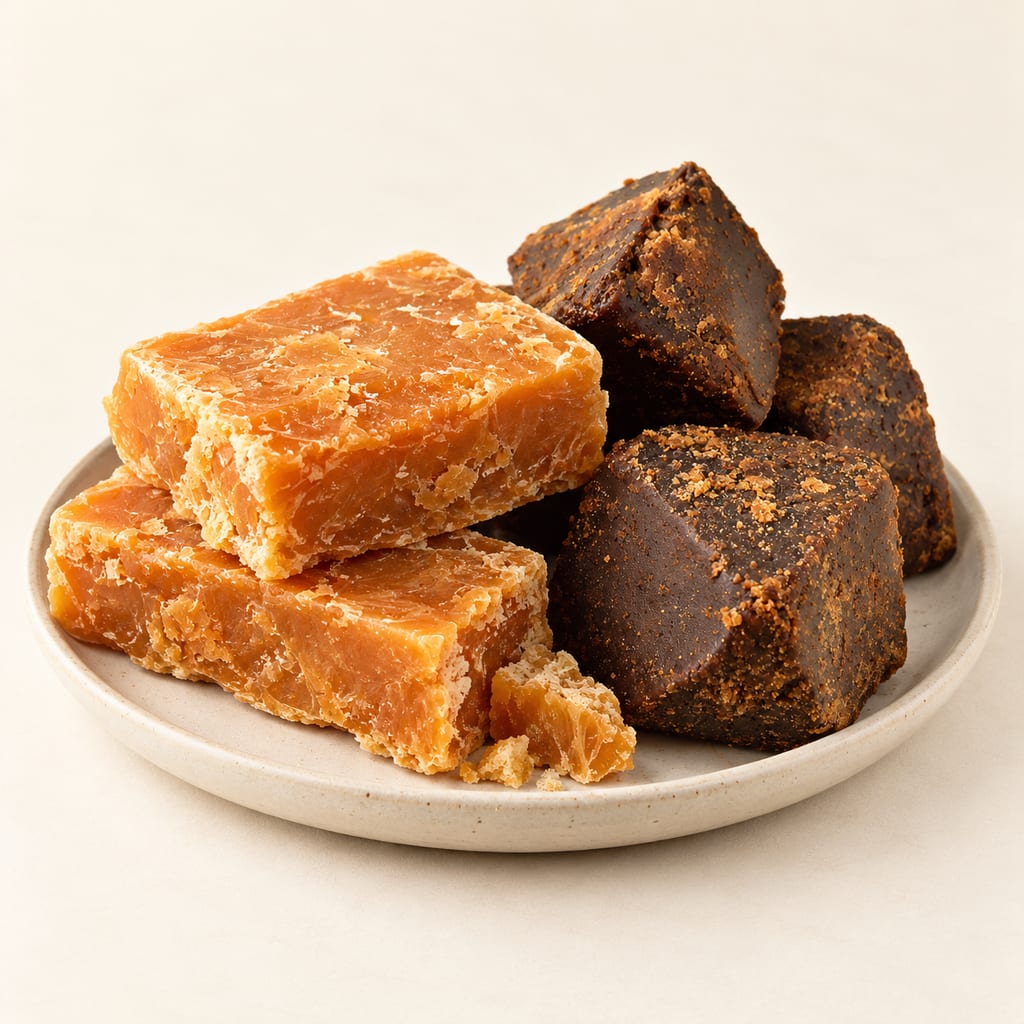
Jaggery
Jaggery is a family of concentrated, non-centrifugal sweeteners made from cane juice or palm sap. Plant source and form shape its flavour and use.
 FermenteaWhere food goes to change
Sugar sources
Cane syrup is sugarcane juice boiled down until it is thick and sweet, or the first syrup left after sugar is crystallised. Historical American recipes used it as a sweetener in ham cures.
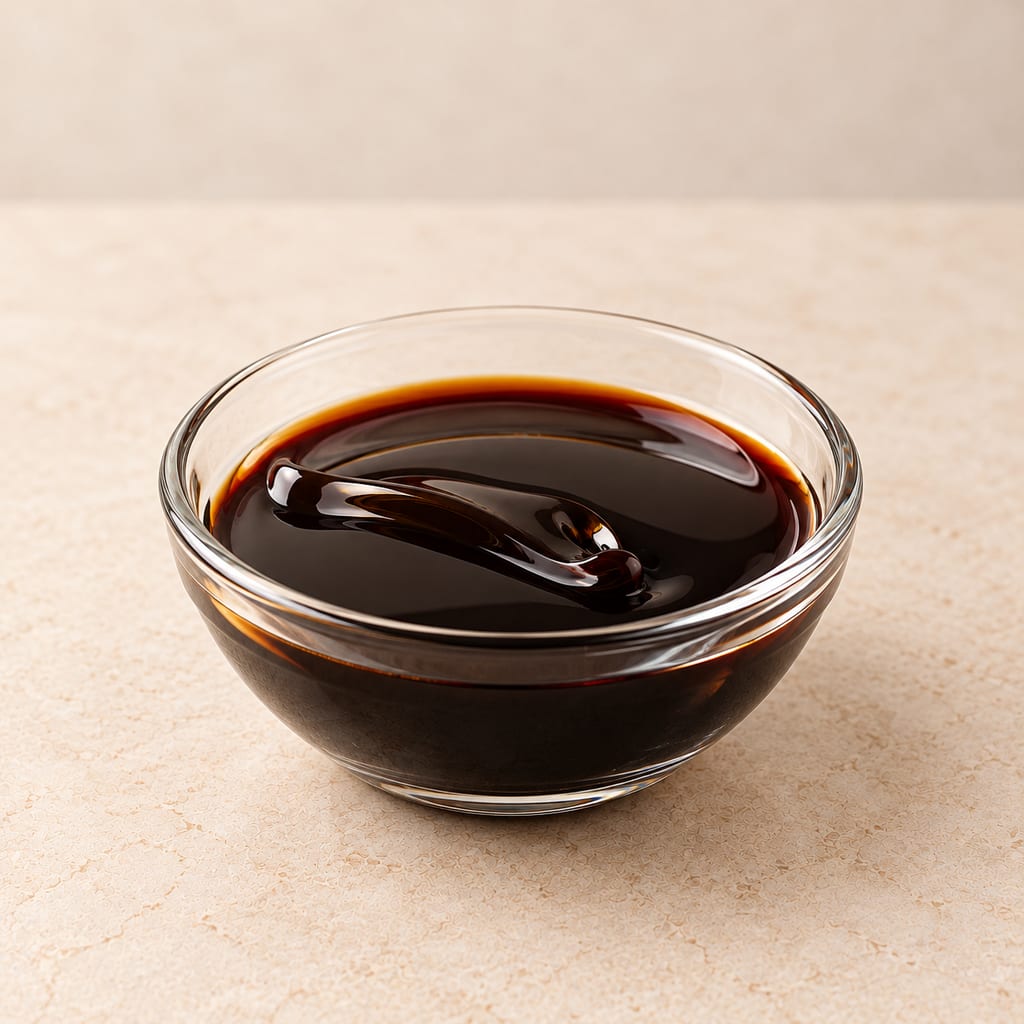
Cane syrup is what is left when most of the water is boiled out of sugarcane juice. The word covers two related things. In one sense it is a syrup made directly from the juice: ribbon cane juice pressed out by animal-powered crushers, boiled like maple syrup in a flat pan, and used in syrup form as a food sweetener. In the other, it is the name the American South gives to first molasses, the syrup left after the first boiling and crystallisation of sugar, which has the highest sugar content of the molasses grades. Both are concentrated sugarcane syrups, and neither has been darkened and stripped by repeated boilings.
That sets it apart from its neighbours. Blackstrap, the third-boiling molasses, is darker, thicker and far more bitter, and the page on dark treacle covers that side of the family and the refinery route to black treacle. Golden syrup is a pale inverted syrup recovered from refining. Jaggery is cane juice evaporated to a thick mass that is cooled and moulded, rather than kept as a syrup. The phrase concentrated cane syrup that this record carries is not a term any of the sources defines; this page reads it as a cane juice boiled to a syrup, or first molasses.
Sugarcane is a perennial tropical grass of the genus Saccharum, in the grass family, 2 to 7 metres tall, with stout jointed stalks in which sucrose accumulates. A mature stalk is about 11 to 16 percent fibre, 12 to 16 percent soluble sugars, 2 to 3 percent non-sugar carbohydrates and 63 to 73 percent water. About 70 percent of the world’s sugar comes from Saccharum officinarum and its hybrids, and sugarcane supplies 79 percent of global sugar, with sugar beet providing most of the rest.
Cane is a crop of warm, wet places. It needs at least 60 centimetres of annual moisture and a plentiful water supply for more than six or seven months of the year, and most production lies between 22 degrees north and 22 degrees south. A stand is typically harvested from two to ten times before it is replanted, each regrowth being a ratoon. Per tonne of harvested cane, the reported output is 740 kilograms of juice and 260 kilograms of moist bagasse, the dry fibre left after pressing, which is mainly burned as boiler fuel. In 2022 Brazil grew 724.4 million tonnes of the world’s 1,922.1 million, followed by India with 439.4 million and China with 103.4 million.
Saccharum officinarum was first domesticated by Papuans in New Guinea beginning about 6,000 years ago, and another species was an early major crop of the Austronesians in southern China and Taiwan. Crystalline sugar production is linked to northern India. The juice a syrup maker boils is the juice a sugar mill starts with.
Ribbon cane is a subtropical type of sugarcane that was once grown across the southern United States, as far north as coastal North Carolina. Its juice was crushed by animal power and boiled in a flat pan into syrup. It is no longer a major commercial crop. Sugarcane itself is a tropical or subtropical grass that needs at least 60 centimetres of annual moisture and does not tolerate severe frost, and cut cane has to be processed quickly because its sugar content declines after cutting.
The wider commercial industry in the South grew around Louisiana, where the first commercial sugarcane crop was produced in 1795 by Étienne de Boré and the chemist Antoine Morin. By 1853 Louisiana supplied almost a quarter of the world’s exportable sugar, and the work was done by enslaved Black people; just before the Civil War the state’s sugar industry was worth more than 200 million dollars.
The cooking of cane juice follows the same logic as the cooking of sweet sorghum juice, the sister crop whose syrup is known in the American South as sorghum molasses. A University of Kentucky extension bulletin on sweet sorghum describes the process in detail, and the points that carry over to any plant juice are the useful ones. Cane juice starts at about 12 to 14 percent sucrose. In traditional open-pan sugar making, the juice is boiled until it reaches about 30 percent of its former volume, the point at which sucrose begins to crystallise; a syrup is a juice that has been boiled down and not taken that far on to sugar.
Heating coagulates the proteins and other non-sugar substances in the juice, and they rise as a scum that has to be skimmed off continuously; the bulletin says boiling juice must be skimmed throughout to produce a high-quality syrup. Juice cooked off too fast comes out dark and carries small dark particles of impurities. Preheating the juice to 160 to 180 °F and letting it settle for one or two hours removes many impurities and shortens the cook, and straining before the pan removes stalk fragments. Raw juice is perishable: held for more than three or four hours without cooling or heating, it may ferment and spoil.
The finish is judged by temperature or density. In the sorghum bulletin, the syrup is drawn off at 226 to 230 °F, which is 108 to 110 °C, or at 78 to 80 degrees Brix on a hydrometer or refractometer, then cooled and strained. The bulletin advises inexperienced operators to use a good thermometer. These are figures for sorghum, not for cane, and the sources consulted give no temperature, time or yield for a cane syrup.
Sucrose is a disaccharide of glucose and fructose. In a strong solution it can crystallise, which is what the sugar maker wants and the syrup maker does not. Inversion works against that. Splitting sucrose into glucose and fructose is slow without help, and the enzyme sucrase or a weak acid such as cream of tartar or lemon juice speeds it greatly. Syrup that contains free glucose and fructose is less likely to crystallise than a pure sucrose syrup, which is how golden syrup is kept liquid.
Cane has its own help. The sorghum bulletin notes that delaying milling for three to five days after harvest lets the stalks lose some water and lets their natural enzymes invert more of the sucrose, making the syrup less likely to crystallise and the cook easier and faster. It also warns that immature or over-mature stalks make crystallising and gelling syrup, and that a hard freeze ruins the juice for syrup. A syrup that has been allowed to invert partly is therefore a mix of sucrose, glucose and fructose, not sucrose in water.
Sugar has a long place in meat curing. In the nineteenth century, adding sugar, which favours the reduction of nitrate to the active nitrite, became common practice in curing mixtures of salt, saltpetre and sugar; at first it was added to soften the saltiness of the meat. Curers found the meat cured faster and developed a better colour. A newspaper recipe of 1845 for a sweet ham cure, known from the research record that supplied it, uses molasses or brown sugar with saltpetre and rock salt.
Early twentieth-century accounts are clear about what the sugar was for. Ralph Hoagland of the United States Department of Agriculture wrote in 1921 that its value was entirely a matter of quality and not preservation: sugar-cured hams and bacon were seen as superior, the quantity in a cure was too small to help preserve the meat, and meat could be cured in complete safety without it. The same account counts nearly 16 million pounds of sugar and 1.7 million pounds of syrup used in curing in inspected United States establishments in 1917, and estimates about 20 million pounds in all with dry cures, excluding farm curing. Sugar at high concentration also binds water, making it unavailable to microorganisms, which is why it is used in canning, fruit preservation and curing, but a cure’s sugar is far too dilute to do that.
None of this is a recipe. The 1845 recipe shows that molasses was used, not that its quantities are safe or that its storage was validated, and historical cure doses should not be copied. This page gives no cure formula.
Sweet sorghum is a different plant that is made into syrup in much the same way, and in the southern United States the result is called sorghum molasses. Much of the syrup-making knowledge written down for Kentucky and Tennessee concerns sorghum and applies in principle to cane. The Kentucky bulletin says the crop should be harvested at about 15.5 to 16.5 degrees Brix, with most of the seeds at the soft- to hard-dough stage, and before any hard freeze. An efficient mill delivers 45 to 50 pounds of juice from 100 pounds of clean stalks. The season is short, fewer than 60 days, so reliable milling matters.
The bulletin also shows how much the maker’s skill counts. It describes a sanitary processing building, a furnace and an evaporator pan of stainless steel, copper or galvanised iron, a pan divided by baffles so that the juice moves in one direction as it thickens, and a water jacket in the last six inches of the pan so that the finished syrup does not overheat. Iron exposed in a galvanised pan darkens the syrup. Cooking too fast gives a dark syrup with small dark particles, so the colour and flavour of the finished syrup are made in the pan as well as in the field.
Cane syrup is a ready supply of yeast food. In alcoholic fermentation, sucrose is first split into glucose and fructose, and then fermented. Sugar at low levels feeds microorganisms, and it is sometimes added to wine when grape juice is low in sugar and to yoghurt and bread dough to boost fermentation. A cane syrup or molasses can supply that sugar along with its own flavour; blackstrap is used to make ethanol and in yeast production, and first molasses is the sweetest of the grades.
The dark treacle page covers the rum industry and the colonial use of molasses in beer, which this page does not repeat.
Labels vary, and the same kind of syrup may be sold as cane syrup or as molasses. The ingredient list shows whether a jar is cane juice alone or contains other sweeteners. First molasses is milder than blackstrap, and golden syrup is a different, inverted syrup that is sweeter than white sugar, with about 25 percent less needed to match it, so none should be swapped for another by volume without tasting.
Ribbon cane syrup is used in syrup form as a food sweetener. The sources give no keeping time for any cane syrup, and this page gives none.
The phrase concentrated cane syrup has no definition in the sources. The cane syrup of the American South is sometimes ribbon cane juice boiled in a pan and sometimes the first molasses of a sugar mill, and no source separates the two by composition. No source gives a temperature, a time or a yield for cane syrup, and the figures above are those of sorghum. The 1845 recipe is known only from the research record that supplied it.
Ribbon cane was grown as far north as coastal North Carolina and its juice boiled to syrup; the region is named without a locality.
First commercial sugarcane crop in 1795; about a quarter of the world’s exportable sugar by 1853.
Inspected establishments used about 15.9 million pounds of sugar and 1.7 million pounds of syrup in curing in 1917; farm curing is excluded from the figure.
Jaggery is a family of concentrated, non-centrifugal sweeteners made from cane juice or palm sap. Plant source and form shape its flavour and use.
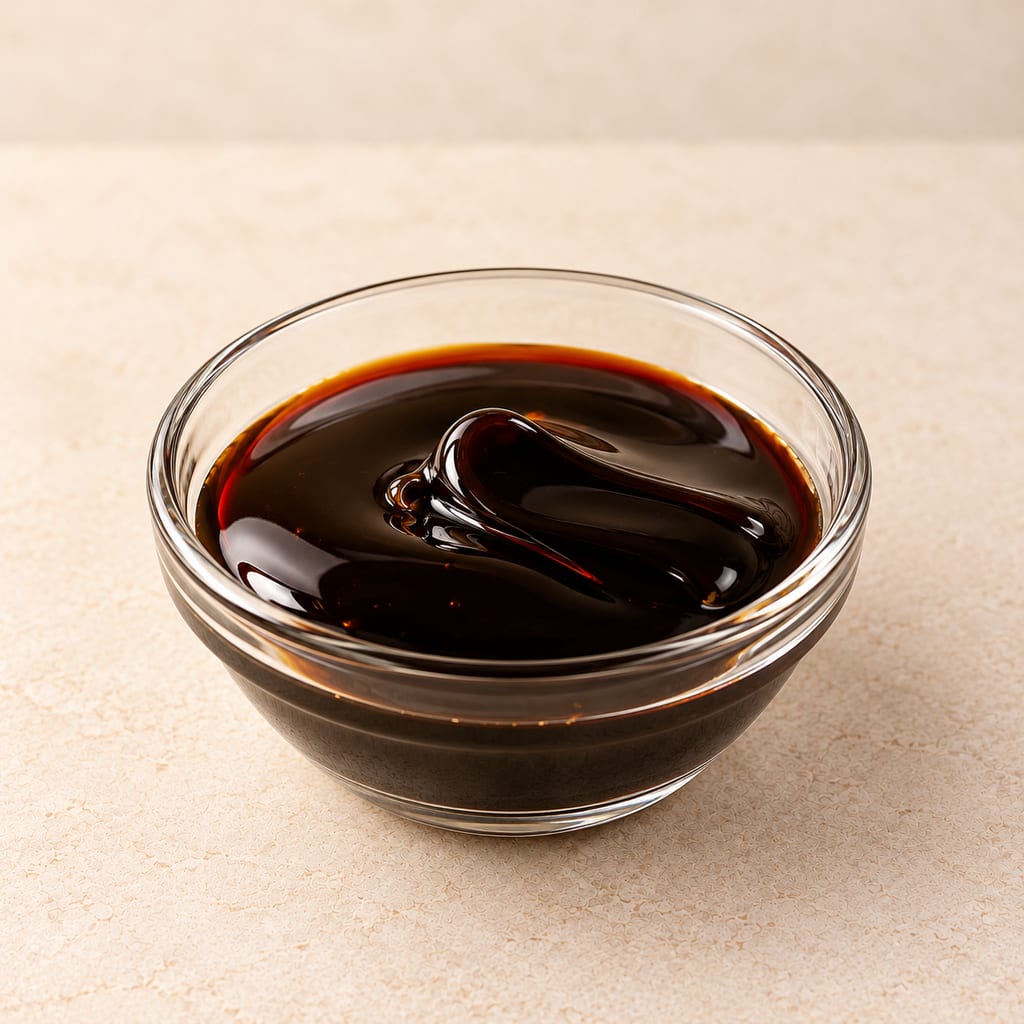
Molasses is the syrup separated as sugar crystallises from cane or beet; its grades and food uses vary, from Anadama and steamed brown bread to fermentation.
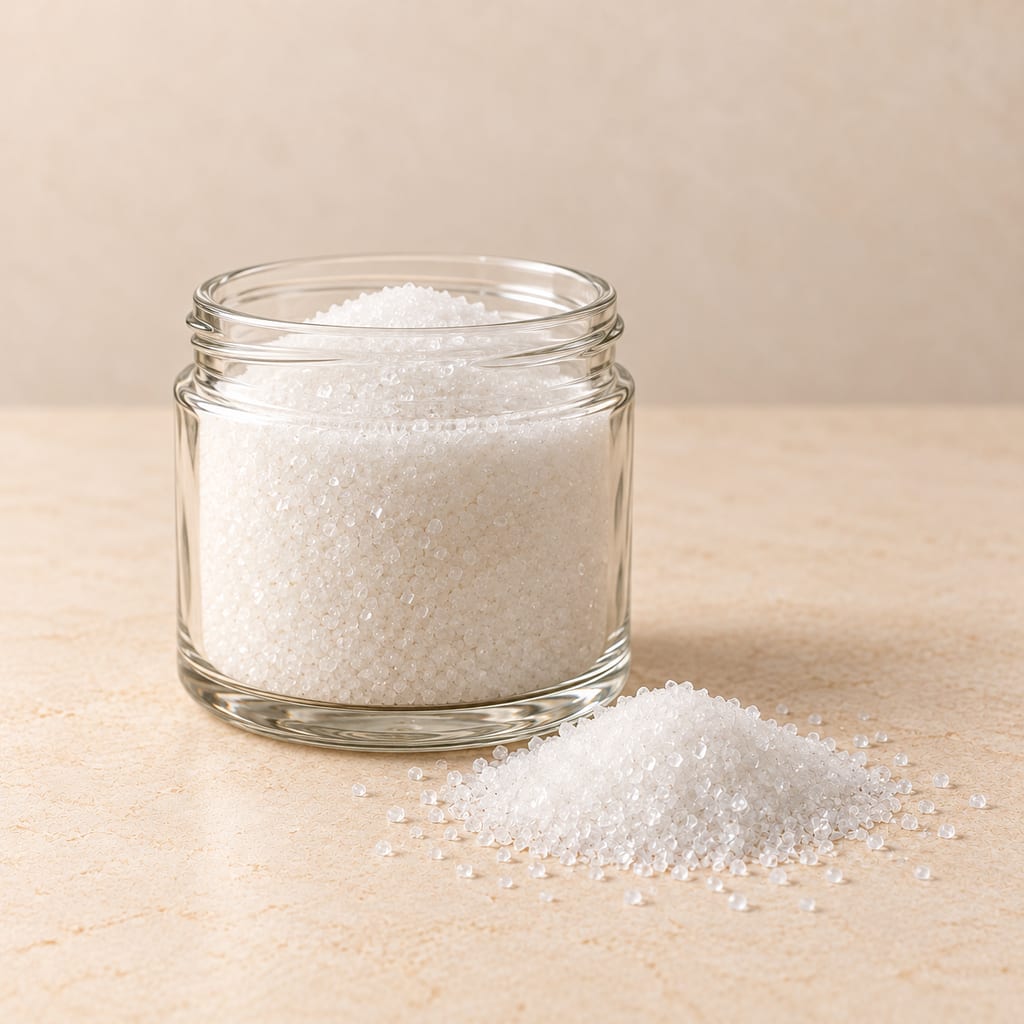
Sugar is a family of sweeteners with different forms and food roles; refined white sucrose may come from cane or beet, while less refined forms add other flavours and moisture.
Cheese, tofu, agar, nixtamal and cured ham all begin with a liquid or soft food made to set, sour or keep. Rennet is one branch of that history, beside plant enzymes, acids, minerals, alkalis, gels, finings and curing salts.
Cayenne is a very pungent red powder from dried, ground hot chilli pods, mostly Capsicum annuum, and the name of the long red peppers it comes from.
Chilli is the pungent fruit of Capsicum plants, native to the Americas and eaten fresh, dried, ground or fermented in cuisines around the world.
Tabasco chile is the small, upright, pungent fruit of Capsicum frutescens 'Tabasco', a cultivar long used in Louisiana pepper sauce.

A Cap-Pelé boucanière is an Acadian herring-smoking building. The documented Willie Niles example is a one-storey wood-frame structure with a ridge smoke vent and interior bays for hanging fish-bearing cannes.

Achcharu is a family of Sri Lankan vinegar pickles made with mixed vegetables or seasonal fruit and a piquant spice dressing. This version is a quick, refrigerated, non-fermented mixed-vegetable pickle.

The acocote is a long, hollowed and dried gourd used to draw aguamiel from a mature maguey. It is a harvesting tool: the sap is transferred to a separate vessel before it ferments into pulque.

Adrak murabba preserves young ginger in sugar syrup, a sweet South Asian preparation recorded in Indian cookery and food-processing sources.

Parkia biglobosa seeds are fermented into regional West African seasonings, including nététou, iru, dawadawa and soumbala. The yellow fruit pulp is a separate food, and names and methods vary by place.

Japanese reddish-brown vinegar from sake lees matured about three years, turned to vinegar by acetic bacteria; the vinegar of Handa and Edomae sushi rice.

A refined common-wheat flour blended for a broad range of baking; its protein and behavior vary with wheat, milling and market.

The almond mushroom, Agaricus subrufescens, was cultivated in eastern North America in the 1800s, lost its market, and returned as a cultivated mushroom from Brazil, where it is grown under several names.
No community contributions have been published for this entry yet.
Sign in to contribute. Published comments and photos are free to read.
WikipediaIdentity · Secondary
MolassesFirst molasses (A) has the highest sugar content and is often called cane syrup in the Southern United States; grades by boiling.
Cited in: Cane juice boiled to a syrup; Sorghum, the other molasses; Syrup as a fermentation substrate; Buying and using it; Open points
WikipediaProduction · History · Secondary
SugarcaneRibbon cane, its range and flat-pan syrup; jaggery; climate; Louisiana dates and labour.
Cited in: Cane juice boiled to a syrup; The plant and its juice; Ribbon cane and the American South; Open points
WikipediaProduction · Secondary
Brown sugarTraditional open-pan boiling to about 30 percent of the original juice volume.
Cited in: What happens in the kettle
American Society of BakingComposition
Brown sugar (BAKERpedia)Cane juice is 12 to 14 percent sucrose.
Cited in: The plant and its juice; What happens in the kettle
WikipediaContrast
Golden syrupGolden syrup is inverted; free glucose and fructose reduce crystallisation; about 25 percent less needed for equal sweetness.
Cited in: Why syrup stays syrup; Buying and using it
WikipediaScience
SucroseSucrose is a disaccharide of glucose and fructose; inversion is slow uncatalysed and accelerated by sucrase or weak acids.
Cited in: Why syrup stays syrup
University of Kentucky Cooperative Extension Service; Bitzer and FoxMethod · Analogue
Processing sweet sorghum for syrup (AGR-123)Settling, preheating, continuous skimming, cooking too fast, finishing at 226 to 230 F or 78 to 80 Brix, delayed milling and inversion, juice spoilage after 3 to 4 hours. Describes sweet sorghum, used here as an analogue for cane.
Cited in: What happens in the kettle; Why syrup stays syrup; Sorghum, the other molasses
Eben van Tonder (earthwormexpress.com), 31 May 2016, quoting Hoagland 1921, Lauer 1991 and KraybillHistory · Curing
Bacon curing: a historical reviewSugar became common in 19th-century cures; Hoagland 1921: sugar adds quality, not preservation; 1917 sugar and syrup quantities. A secondary account quoting the primary authors.
Cited in: Syrup in the ham cure
Kansas State University Research and ExtensionFermentation · Preservation
SweetenersSucrose is inverted in alcoholic fermentation; low levels feed microorganisms; high concentrations bind water.
Cited in: Syrup in the ham cure; Syrup as a fermentation substrate