
Coagulants intake
Setting, souring and curing: a global history of food coagulants
Cheese, tofu, agar, nixtamal and cured ham all begin with a liquid or soft food made to set, sour or keep. Rennet is one branch of that history, beside plant enzymes, acids, minerals, alkalis, gels, finings and curing salts.
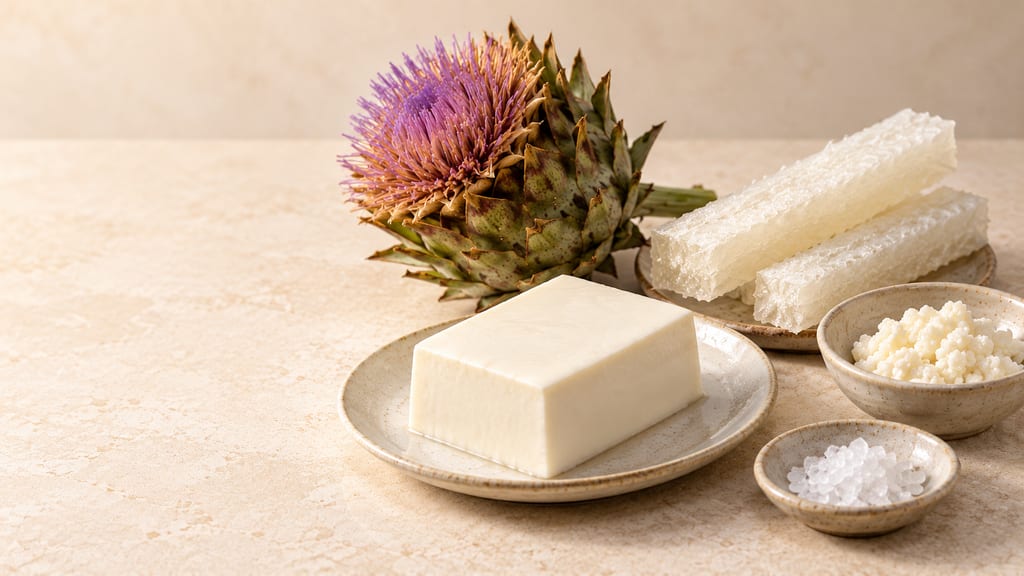
Silken tofu, a cardoon flower, bars of kanten and a curd: foods set by salts, plant enzymes, seaweed and acid.
A liquid becomes a solid
Warm milk left in the stomach of a young calf thickens. Hot soy milk stirred with the bitter liquor left over from making sea salt sets into tofu. The seeds of a climbing fig, washed in water, turn that water into jelly. Maize cooked with lime or wood-ash water becomes nixtamal or hominy. A ham packed in salt and then smoked keeps. Each of these is a food made by changing the state of a liquid or a soft tissue, and every food culture has some of them. They are often filed together as natural rennets or natural coagulants. That label hides the most useful fact about them: they are several separate technologies, with different chemistry, different raw materials and different histories.
The best known is rennet, the enzyme preparation taken from the fourth stomach of a suckling calf, lamb or kid. Its main enzyme, chymosin, cuts one specific bond in kappa-casein, between the amino acids phenylalanine 105 and methionine 106, and that cut lets the casein of milk gather into a curd that holds the fat and releases whey. Many plant enzymes act on casein as well. The cardoon flower owes its clotting power mainly to two aspartic proteases, cardosins A and B, which resemble chymosin and pepsin in their activity and specificity. Ginger juice breaks down the alpha-s, beta and kappa caseins of milk. This first mechanism is proteolytic coagulation: an enzyme alters the milk protein so that it can aggregate.
Acid works differently. Fermented whey, cultured milk, vinegar or citrus juice lowers the pH and changes the electrical charge on the proteins, often with heat to finish the job. In the fermented soy whey that Chinese tofu makers recycle as a coagulant, lactic acid lowers the pH of the soy milk and reduces the negatively charged groups on the heated soy protein; the acid, not the metal ions in the liquid, does most of the setting. Mineral coagulation relies on dissolved calcium and magnesium. Nigari, purified magnesium chloride, calcium sulphate and calcium chloride all set prepared soy milk, and food standards list them side by side as tofu coagulants. Alkaline transformation goes the other way on the pH scale. Food lime, carbonate blends and certain plant ashes change proteins, starches and plant tissues, and this is how preserved eggs, nixtamal, konnyaku and alkaline noodles get their texture.
The remaining mechanisms do not make curds at all. In a hydrocolloid gel, a long polymer such as gelatin, agar, carrageenan, alginate or pectin forms a network that holds water in place. Fining agents, among them isinglass, egg white, casein and bentonite clay, are stirred into wine so that the haze gathers and can be removed: the goal is a clear drink, not a solid food. Curing changes the water available to microbes, the acidity, oxidation and microbial growth together, using salt, sugar, acid, nitrite, smoke or sulphites, and it works only as a whole process. A last group of adjuncts breaks proteins down or binds them together: the proteases in salted rice koji tenderise meat and release amino acids, and the microbial enzyme transglutaminase links glutamine and lysine residues across protein chains.
These eight mechanisms explain why one material can turn up in several places. Calcium chloride is listed as a tofu coagulant in one Indian food standard and, in the same text, as a firming agent for canned tomatoes. In a home pickle it supplies calcium that firms the pectin of the vegetable, without the hydroxide of pickling lime that can lower the acidity of the brine. The mechanism also explains what setting does not do. Rennet-set cheese, an acid-set curd such as paneer and a heat-and-sour-milk curd such as Ethiopian ayib belong to different families: cheese technologists treat acid, rennet and heat-and-acid coagulation as distinct cheese families, and the same calcium chloride that sets tofu can also assist dairy coagulation. A jelly is not thereby preserved, and a firm curd is not by its firmness a safe food: cheese specialists treat acidity, water activity, an active starter culture and storage temperature as the conditions that decide how a cheese may be held, not the fact that the milk curdled.
Before the cheese
People planned around stored food long before anyone kept a cow. At Qesem Cave in Israel, occupied between about 420,000 and 200,000 years ago, marks on animal bones and experiments with stored bones point to marrow kept inside the bone and eaten later. It is the earliest known evidence of food stored for delayed eating. It says nothing about rennet, salt or herbs, and it would be wrong to connect it to any named setting agent. What it shows is a habit of mind: food kept back for a later meal.
The familiar origin story of cheese has a traveller carrying milk in a bag made from a young animal's stomach and finding curd and whey at the end of the day. The chemistry is plausible, because the stomach lining of a suckling ruminant does carry clotting enzymes. The event is not dated and cannot be. Versions with a shepherd, a desert crossing or a hunter's pouch belong with origin stories, kept with the place and date at which they were written down, rather than with archaeology.
The archaeology of dairying comes in layers, and each layer answers a narrower question. The first is fat. The carbon isotope values of the main fatty acids of milk fat, absorbed into the walls of cooking pots, can be told apart from those of other animal fats, and a survey of more than 2,200 vessels from the Near East and southeastern Europe showed that milk was in use by the seventh millennium BCE, with milking especially important in northwestern Anatolia. The second layer is equipment. Potsherds pierced with small holes appear at early Neolithic sites in temperate Europe in the sixth millennium BC, among them sites in the Kuyavia region of present-day Poland, and had long been called cheese strainers on their shape alone; milk residues inside them turned that guess into a strong case for separating curd from whey. In the green Sahara of the fifth millennium BC, milk fats in pottery from Libya gave the first unequivocal chemical evidence of dairying in Africa. In South Asia, lipid residues from an agro-pastoral settlement of the Indus Civilization, Kotada Bhadli in Gujarat, occupied around the middle to late third millennium BCE, about 2300 to 1950 BCE, provide the earliest direct evidence of dairy processing there, mainly from cattle and possibly from water buffalo.
The third layer is protein and DNA, which can identify a product more closely. Protein analysis of Early Bronze Age dairy remains from China pointed to a kefir-type product. Ancient DNA recovered from kefir cheese of about 3,500 years ago at the Xiaohe cemetery in Xinjiang then traced the Lactobacillus strains it carried and suggested a route by which kefir spread from Xinjiang into inland East Asia, alongside the route long proposed from the northern Caucasus into Europe.
None of these layers names a coagulant. A sieve with milk fat inside it shows that curds were drained; it does not show whether the milk was set by a stomach, a plant, heat or souring alone. Soured milk curdles without any added enzyme, and a kefir cheese is a fermented product, not proof of stomach rennet. A cheese found in an archaeological context therefore does not imply rennet, and the identity of the first coagulant remains unknown.
Some claims sit at the edge of what the methods can show. Fatty-acid isotope values from Neolithic pottery in Croatia, published in 2018, were presented as the earliest documented lipid residue evidence for fermented dairy in the Mediterranean region, about 7,200 years old; three of the four rhyta, a vessel type, tested held residues of secondary dairy products consistent with cheese. The authors themselves called the mechanism behind one isotope effect uncertain, and other specialists questioned whether reference fats and isotope values can separate cheese from other dairy products. The fair summary is a debated claim of early fermented dairy, not the world's oldest cheese.
Fig juice, kid rennet and thistle flowers
Greek and Roman writers give the first named coagulants. In the fifth book of the Iliad, Homer compares the rapid healing of a wound to the way fig juice curdles milk, a simile that only works if the audience already knew the effect. Aristotle, in the History of Animals, describes the practice concretely: fig juice is squeezed into wool, the wool is washed and rinsed, and the rinsing goes into a little milk, which curdles other milk it is mixed with. He calls rennet a kind of milk found in the stomach of an animal while it is still suckling, says that all ruminants produce it and, among other animals, the hare, and judges the rennet of the young deer the best of all. His explanations of what rennet is belong to ancient biology; the practices he describes are the useful evidence.
Columella, writing on agriculture in the first century CE, gives the fullest Roman account in book seven of De re rustica. Milk is set with the rennet of a lamb or a kid, he writes, though it can also be curdled with the flower of the wild thistle, with the seeds of cnecus, or with the milky sap of the fig tree. The passage goes on to keep the milk warm, drain off the whey, press the curd under weights and salt it. Those are separate stages with separate purposes, and only the first is coagulation. The words need care. The Latin names a wild thistle, not a modern species, and although cnecus is commonly interpreted as safflower, the text itself gives no identification. Safflower must not become saffron in translation, and the thistle should not silently become cardoon.
Pliny the Elder adds a ranking in the Natural History: the rennet of the fawn, the hare and the kid is the most esteemed. Pliny mixed kitchen practice with medicine and belief, so each statement needs sorting into food use or medical claim. Hare and fawn rennet belong in this history because the texts name them, not because anyone today should collect those stomachs.
Roman preservation writing runs in parallel. Cato's handbook on farming gives a direct account of salting hams in a jar, layer by layer, with coarse Roman salt, then cleaning, airing, oiling and smoking them before they hang in the meat store. It needs no rennet and no plant. A second Roman word needs more caution. The nitrum of ancient recipes is often translated as saltpetre, but in the Roman cookery collection attributed to Apicius it sits in a recipe for keeping vegetables green, where the English edition renders it as cooking soda: most likely an alkaline soda mineral rather than modern potassium nitrate.
Many methods at once
The medieval and early modern record does not show a neat progression from animal rennet to plant rennet or from tradition to industry. Stomach rennet, plant coagulants, souring and gelling coexisted in the same kitchens and the same manuscripts, and the word cheese covered more than one technology.
A Viennese cookery manuscript whose recipe section dates from the middle of the fifteenth century gives a recipe for almond cheese. It calls for hausen plater, which the modern edition glosses as isinglass, a gelling material made from the swim bladders of fish. Almond milk has no casein for rennet to act on, so this cheese is a moulded gel set by fish collagen, not a curd. The recipe is a reminder that a historical name tells you what a dish looked like, not how it set.
A sixteenth-century German recipe in a Wolfenbüttel manuscript makes a sweet soured milk. The soured milk is wrapped in cloth and weighted until the water runs out, and sugar goes on top of the shaped piece rather than into the milk. It sits between fresh cheese and fermented milk, and its method is drainage and pressure rather than a named coagulant.
The Fairfax family recipe book, kept between 1694 and 1795, has a recipe for slipcoat cheese. Warm cream is set with runet, the curd is drained in a sieve, laid in a wet cloth for two days, then laid in rushes or nettles. Rennet makes the curd; the rushes and nettles come afterwards and surround it. The recipe is a clean example of a confusion that recurs throughout this field. A herb in a cheese recipe is not proof that the herb set the milk. It may be a wrapper, a mat, a filter, a dye, a rind wash or a flavouring.
A rennet recipe in a 1793 manuscript associated with James Dinwiddie, held in the Dalhousie archives as MS-2-726, salts and dries a calf's stomach and names a pigeon's stomach and artichoke flowers as alternatives. Animal and plant coagulants stand side by side in one late eighteenth-century text. The pigeon stomach is named without anatomical detail or a method of extraction, and the bird is most likely the domestic pigeon, though the manuscript does not identify it. The manuscript's present home in a Canadian archive does not mean its techniques began in Canada: archive, author, place of observation and claimed origin are separate facts.
The ham cure in the Garrett Clopper manuscript of the 1790s, now with the New Brunswick Museum, supplies a different cluster of ingredients: salt, sugar and saltpetre, followed by smoking. It is strong evidence of a documented cure in that decade, and its historical proportions are not modern processing instructions.
Museum collections show the equipment around these methods. The Horniman Museum in London holds a vat for ewe's milk cheese from the village of Salva in Romania, a wooden tally stick from the same village, an eighteenth-century ceramic strainer made and used in Denmark, an early twentieth-century English mould, and a basket for separating curds and whey collected in Cyprus in 1990. Each object does one job in one stage: holding, straining, pressing or shaping. None of them sets the milk.
Rennet: the stomach of a young animal
Ruminants have four stomach compartments, and the fourth, the abomasum, is the one that secretes digestive enzymes. In calves, lambs and kids still feeding on milk it produces chymosin, with pepsin alongside. Cheese makers call the dried or salted stomach a vell. Calf rennet, lamb rennet and kid rennet are the standard animal coagulants of European and West Asian cheese making, and their history runs from Columella's lamb and kid rennet to the commercial extracts of today.
Modern commercial animal rennet comes from the stomachs of slaughtered animals under controlled manufacture. In its 2024 evaluation of an animal rennet, the European Food Safety Authority describes the enzyme as prepared from the abomasa of suckling calves, goats, lambs and buffaloes, which are minced and macerated in salt water to extract the enzymes. Another evaluation, of a rennet prepared from the abomasa of both calves and cows, lists chymosin and pepsin A and concludes, from the animal source, the manufacture and a long history of safe use, that it raises no safety concerns under its intended use. That second opinion found one sequence match with pig pepsin, a respiratory allergen, and judged the risk of an allergic reaction from food to be low.
Rennet pastes are a different product from liquid rennet. An Italian maker in Cadorago describes lamb and kid pastes still made by traditional methods from suckling lambs and kids, with an enzyme ratio of 75 per cent chymosin to 25 per cent pepsin, and recommends them for the typical Italian cheeses it calls spicy and semi-spicy. In a paste the abomasa keep the clotted milk they contained. The EFSA evaluation of such a paste lists three enzymes: chymosin, pepsin A and a triacylglycerol lipase. The lipase acts on milk fat and shapes the flavour of those cheeses, separately from the clotting. The same company sources buffalo-calf vells from Lazio and Campania and keeps raw stomachs frozen, a reminder that buffalo rennet is a recorded product, not only a laboratory idea.
Home and small-farm rennet continues. An American cheese maker and writer has published her method for making traditional rennet from the dried abomasum of a kid, lamb or calf, with photographs of the dried stomach. It is a craft account. Her notes on keeping are her own observations, not tests, and a historical drying method is not microbiological validation.
Ethnographic and regional records add local preparations. The Sámi Museum at Inari in Finland records that Inari Sámi made cheese from cows', sheep's and reindeer milk, set with rennet from the stomach of a reindeer or a calf, and that reindeer were milked only in autumn on the grazing lands. In Tusheti, in the highlands of Georgia, a firsthand account written in 2022 describes herders on their summer transhumance cutting up dried calf abomasa still full of coagulated milk and steeping them in sour whey. As the author puts it, the rennet is also a starter culture: the liquid brings gastric enzymes and live fermentation together. The same herders pour milk through a cloth laid over a funnel packed with nettles, a plant used to filter the milk, not to set it.
Other animals appear in narrower evidence. In camel-herding regions, an FAO survey of camel milk products records that a peptic enzyme from rabbit stomach, or an extract from the abomasum of young goats, added to camel milk produces a curd. The same survey notes that Tuareg herders say cheese cannot be made from camel milk, and that not all communities make camel milk products. Camel milk is known to be difficult to coagulate, and a 2011 comparison tested crude gastric extracts from the abomasa of camels against bovine rennet and pepsin. Pepsin from pigs and chickens has been tried as a substitute for calf rennet. A 1972 trial of Cheddar made with pig, cow and chicken pepsins found that the chicken pepsin cheeses had poor body, weak flavour and many intense off-flavours, and that the milk-clotting ratio was low for both pig and chicken pepsin; pig pepsin worked only under particular ripening conditions. Porcine pepsin remains a permitted food enzyme in Canada, taken from the glandular layer of the pig's stomach and listed for Cheddar, cottage cheese and cream cheese.
These records differ in kind. Hare and fawn rennet survive in ancient texts, and pigeon-stomach rennet in an eighteenth-century manuscript. Reindeer rennet is a documented regional practice. Rabbit, camel and chicken enzymes come from field notes and laboratory trials. Calf, lamb, kid and buffalo rennet are standard commercial products. Each animal source has its own name, its own evidence and its own anatomy: not every animal has a calf-like abomasum, and a historical text describes the stomach it actually names.
From the stomach to the fermenter
Industry changed rennet in three steps. The first was standardisation. Chr. Hansen dates standardised animal rennet to 1874, when Christian Hansen began to make it: an extract of known strength, so that cheese makers no longer had to judge the power of a home-dried stomach by eye. The second was microbial enzymes. Several moulds and one bacterium secrete proteases that clot milk, and United States regulations allow milk-clotting enzymes from pure-culture fermentation of named strains of Endothia parasitica, Mucor pusillus, Mucor miehei and Bacillus cereus, provided the strains are nonpathogenic and nontoxic and the production organism is removed. The fungi have since been renamed: Endothia parasitica is now Cryphonectria parasitica, and the two Mucor species are now placed in Rhizomucor. The same federal list includes an Aspergillus oryzae strain carrying a gene for the Rhizomucor miehei enzyme, a mucorpepsin made in a different mould.
Bacillus cereus needs a note of its own. The species includes strains that cause food poisoning, and the regulation names only selected nonpathogenic strains. A product made from such a strain is a modern standard enzyme, not a reason to culture the species at home.
Microbial rennets are themselves several products. A European evaluation in 2024 assessed a mucorpepsin made with a non-genetically modified Rhizomucor miehei strain. The native enzyme can be chemically modified into a form that is more easily destroyed by heat, and the finished preparation is free of viable cells of the mould.
The third step was fermentation-produced chymosin, sometimes called FPC. Here the gene for calf chymosin, or for a chymosin from another species, is placed in a microorganism, which then makes the enzyme in a fermenter. The first US GRAS affirmation of a recombinant product followed an application made in 1988: a federal rule dated 23 March 1990, later amended in 1992 and 1993, covers chymosin preparations made this way with nonpathogenic and nontoxigenic strains of Escherichia coli K-12, Kluyveromyces marxianus variety lactis and Aspergillus niger. In the E. coli process the prochymosin forms an insoluble aggregate that is treated with acid to destroy residual cellular material. Chr. Hansen dates the launch of its fermentation-produced chymosin, CHY-MAX, to 1989. In Europe, a chymosin made by a Kluyveromyces lactis strain was assessed on the basis that the final preparation contains neither viable cells nor DNA of the production organism.
The same technology also made new chymosins. Camel chymosin, produced in Aspergillus niger and described in 2006, clotted bovine milk with about 70 per cent more clotting activity than bovine chymosin in that comparison, and a protein-engineered variant of it reached a US GRAS notice whose response letter is dated June 2019. Yak chymosin has been expressed in the yeast Pichia in the laboratory. In 2025 the US Food and Drug Administration answered a notice from Chr. Hansen for a chymosin produced by Aspergillus niger carrying a gene that encodes the chymosin of the European hedgehog, Erinaceus europaeus, for cheese and whey production. The agency wrote on 6 March 2025 that it had no questions about the company's conclusion that the preparation is safe under its intended use, and corrected the letter on 3 July 2025 to change the intended use from whey powder production to whey production. The letter states that it is not an affirmation of GRAS status.
These products make one distinction unavoidable. A modern enzyme has three separate identities: the species whose gene sequence it carries, the microorganism that produces it, and the final purified preparation sold to cheese makers. A hedgehog-sequence chymosin made by a mould is a specified industrial product; it is not evidence that anyone ever collected hedgehog stomachs to make cheese. Experimental yak chymosin is not a historical yak rennet. A chymosin with a bovine sequence need not come from cattle, while the cheese made with it still comes from animal milk. A label that says natural can mean source-derived, minimally processed, traditional, fermentation-produced or simply not seen as synthetic, and those meanings are worth keeping apart.
Flowers: cardoon, artichoke and the thistles
The Iberian Peninsula keeps the strongest living tradition of plant rennet, and its material is a flower. Serra da Estrela cheese, a protected-origin cheese of Portugal, is made only from the raw milk of Serra da Estrela sheep, cardoon flower and salt. The flowers of the cardoon, Cynara cardunculus, are dried, and the dried flowers are macerated in water to give the coagulant. In this cheese the cardoon does two jobs: it clots the milk, and its enzymes go on breaking down protein during ripening, which gives the soft paste and a flavour cheese scientists describe as slightly bitter and piquant. Those enzymes are mainly the cardosins A and B, two aspartic proteases.
Torta del Casar, a traditional Spanish cheese of raw ewe's milk made under protected-origin rules, owes its character to vegetable rennet and to the lactic acid bacteria that come with the raw milk. Its official specification names the cardoon, Cynara cardunculus, as the coagulant and links it to the cheese's characteristic texture and ripening. A 2026 study of 22 cheeses from different makers found Lactiplantibacillus plantarum to be the dominant bacterium and recorded some batches above the pH limits set by the protected-origin rules, a sign of how variable a raw-milk, plant-set cheese can be. In the Canary Islands, the 2008 Spanish specification for Flor de Guía cheese allows only vegetable rennet in its flower cheese: an aqueous extract of the dried flower heads of two named cardoon forms, Cynara cardunculus var. ferocissima and Cynara scolymus. The half-flower version of the same cheese must use at least 50 per cent vegetable rennet, with the rest from other authorised rennets or enzymes.
Two facts about cardoon rennet matter most. The first is milk. Cardoon extract has made good ewe's milk cheeses but poor cheese from cow's milk, so the same coagulant behaves differently with different milks. The second is variation. A 2026 review of Spanish and Portuguese protected-origin cheeses names inconsistent coagulant quality as a key challenge: cardoon ecotypes, the activity of their enzymes and the microbes in the raw milk all change texture, aroma and safety. Setting is only the start. A coagulant that keeps working through ripening can soften a cheese or make it bitter, and those effects are part of the choice.
The artichoke raises a naming question. Its flowers have been studied for their milk-clotting properties, and the Flor de Guía specification names Cynara scolymus beside the cardoon. Kew's Plants of the World Online places Cynara scolymus within Cynara cardunculus subsp. cardunculus, so the artichoke is a crop form rather than a separately accepted species, while the GBIF backbone still lists Cynara scolymus as accepted. The thistle Cynara humilis needs its author too: Cynara humilis L. is the accepted species, distinct from Cynara humilis Sm. Either way, the crop form and the part of the flower used are what a cheese maker needs to know, and the cardoon flower and the artichoke flower deserve linked but separate records.
Other thistles extend the list without becoming cardoon. A 2000 study of Los Pedroches cheese in Spain compared Cynara humilis with Cynara cardunculus and found slower protein breakdown with Cynara humilis but similar flavour and aroma. Flowers of the Scotch thistle, Onopordum acanthium, have been tested as a coagulating agent for cheese, and a 2023 study compared freeze-dried extracts of Onopordum platylepis and Cynara humilis. Flower peptidases of the milk thistle, Silybum marianum, break down goat and sheep caseins in the laboratory, with no cheese made. Centaurea calcitrapa enters the list through cultured cells, not a harvested flower: in 2008 an aspartic protease precursor from cell-suspension cultures was processed into an active milk-clotting enzyme, while a cell extract tested in 2000 did not clot milk on its own and was used alongside chymosin in cheese ripening. Neither is advice to add the wild thistle to milk. Lady's bedstraw, Galium verum, also called cheese rennet, is a herb traditionally used in cheese making; in 2018 a team isolated two of its milk-clotting aspartic protease genes and expressed one of them in the yeast Pichia pastoris. These are laboratory findings or old names, not proof of a cheese tradition for each species, and the word thistle on its own identifies nothing.
Latex, fruit and rhizome: fig, papaya, ginger and Indian rennet
Figs supply two different materials. The milky latex of the fig tree is the coagulant of the ancient texts, and it is still in use: in southern Italy the latex of the caprifig, the wild fig, sets Cacioricotta, a craft cheese made from goat's milk heated well above the usual temperature for cheese. Fig extracts work best at high temperatures, which suits that hot process. Fig leaves are the second material, used in parts of Ethiopia. Latex and leaf are different preparations of one tree with different effects. So does papain: in one comparison its strong protein breakdown gave poor coagulation, a reminder that more proteolysis does not mean a better curd.
Other figs have been studied as enzyme sources. A protease from Ficus johannis, a species of its own rather than a form of the common fig, made a cheese comparable with one set by commercial rennet in a 2019 trial. Religiosin, from the latex of the sacred fig, Ficus religiosa, and an aspartic protease from the cluster fig, Ficus racemosa, have been purified and characterised. So has the coagulum formed by a leaf extract of Streblus asper, which gave a very soft curd, and a serine protease, streblin, purified separately from its latex; leaf extract and latex enzyme are different materials, and neither establishes a Thai cheese tradition. These are laboratory materials.
Withania coagulans, known as Indian rennet, is a plant whose fruit has traditionally been used to set milk. A milk-clotting aspartic protease has been purified from the fruit. The 1918 edition of Kirtikar and Basu's Indian Medicinal Plants reports experiments by Joseph Dalton Hooker at Kew in which a decoction of the fruit coagulated warm milk in about half an hour, and quotes Sheridan Lea's judgement that the active substance was a ferment closely resembling animal rennet. The quantities in that account are historical and are not a recipe. The same book notes that seeds of the related Withania somnifera, the ashwagandha of herbal medicine, showed some coagulating power in the authors' own test. The two plants are different species with different uses and should never be swapped.
Papaya gives a living tradition and a laboratory product. Dangke is a traditional dairy product of Enrekang in South Sulawesi, Indonesia, made by heating buffalo, cow, goat or sheep milk, adding papaya latex, and pressing the curd into a coconut-shell mould until compact. The traditional coagulant is fresh latex. Researchers have also dried papaya latex in a vacuum oven to make a storable coagulant, and found that dried latex and commercial papain kept the count of Staphylococcus aureus in dangke from rising over 24 hours at room temperature. That is a short antibacterial test, not a shelf life. Fresh latex, dried latex and purified papain differ in composition and strength.
Ginger milk curd is a clear culinary example of a plant enzyme outside the Mediterranean. Ginger proteases set the southern Chinese traditional milk product called jiangzhinai or jiangzhuangnai. A 2011 study purified three closely related forms of the protease from fresh rhizome. A 2025 study followed ginger-juice milk curd as it formed and showed the juice breaking down the alpha-s, beta and kappa caseins. A 2013 comparison of kiwifruit, melon and ginger extracts gave kiwi curds a texture comparable to that of commercial rennet, while melon extracts made fragile curds with low yield. Bromelain recovered from pineapple waste has set an experimental pandanus probiotic cheese, described in a Vietnamese university journal. Fresh ginger juice is the cooking ingredient; purified ginger protease is a manufactured enzyme; neither is a dose-for-dose substitute for calf rennet.
Africa and the Americas: living plant coagulants and toxic plants
There is no single African rennet. Milk fats in Saharan pottery show dairying in North Africa thousands of years before any recorded plant coagulant, but they do not identify any present-day cheese plant or its ancestors. Each regional practice has to be studied in its own community and process.
In Benin, the soft cheese wagashi gassirè is made mainly by Peulh women and is the country's most consumed dairy product. A 2022 survey of 390 people in the municipalities of Dassa and Nikki, among them dairy farmers, cheese makers, traders and consumers, recorded how it is made. The coagulant is almost always a preparation of Calotropis procera. Two thirds used its leaves and stems together, about a third its stems alone, and about one in eleven its sap; leaves alone and papaya leaves were rare, and fermented maize liquid or salt appeared only alongside Calotropis. Boiling was the main way of keeping the cheese, followed by sun-drying, colouring, immersion in whey or water, smoking and frying. The red wagashi sold in markets is coloured by soaking the white cheese in water dyed with sorghum cobs or panicles or with teak leaves: another plant role that is not coagulation.
Calotropis is also a hazard. Its latex has injured eyes: a clinical series described 29 eyes with ocular toxicity after contact with the latex between 2003 and 2006, and a case report describes corneal injury after a patient applied the latex as a home remedy. In rats, oral doses of the latex and of a leaf extract damaged heart and testicular tissue. A purified cysteine protease from the latex, CpCP3, has been studied for cheese making, and a protease from the related Calotropis gigantea has been characterised, but a purified enzyme is a different material from raw sap. The tradition can be documented with care; it does not supply a recipe, and no detoxification step should be invented for it.
Ethiopia shows enzyme and acid paths in one dairy landscape. People in and around the Ab'ala area of the Afar Regional State add extracts of fig leaves and of the fruit of the bitter apple, Solanum incanum, to milk to make it coagulate quickly. Laboratory screening of both plants found phenolics, saponins and tannins, flavonoids in the fig leaf and alkaloids in the Solanum fruit, and no oxalates; the authors concluded only that the plants posed no threat as far as oxalate and metal toxicity are concerned. A 2018 study in Tigray compared Solanum incanum, fig latex and leaves of the northern dune currant, Rhus natalensis, now named Searsia natalensis; it rated the dune currant inferior in clotting and yield and noted the Solanum fruit's toxic property and the colour change it gives the cheese. The alkaloid finding and that warning are reasons to treat Solanum incanum as a documented practice with an unresolved safety question, not as a recipe. Ayib, the fresh cheese of Ethiopia, is made by heat and sour milk and belongs with the acid curds.
The wider African inventory is mainly laboratory work. A milk-clotting extract has been characterised from the fruit pulp of the desert date, Balanites aegyptiaca. Dubiumin, a serine protease, was purified from the seeds of Solanum dubium, a name now treated as a synonym of Solanum coagulans.
In Chihuahua, in northern Mexico, the berries of trompillo or silverleaf nightshade, Solanum elaeagnifolium, are linked to local asadero cheese, and a 2015 study characterised the coagulant obtained from them. The link does not date the practice to before European contact, and fruit stage and botanical identity have to be kept with any record of it. The plant is a weed in Australia, where the state weed authority of New South Wales notes that it produces glycoalkaloids and is poisonous to livestock that eat the ripe berries, though livestock poisoning is uncommon. No human safe dose appears in that guidance. Trompillo therefore sits in this field with a toxicity flag attached.
Other American plants are enzyme leads, not traditions. Unripe fruits of Bromelia hieronymi, a South American species, yield cysteine proteases of the hieronymain family that a 2010 study fractionated and used to make experimental firm curds, with an ethanol step to reduce pigments; identity, purification and residual solvent would all need validation in a food process. A crude extract of the fruit of Bromelia pinguin clots milk quickly but shows only a quarter of its maximum activity at the usual cheese-making temperature of 30 to 35 °C, carries cysteine and serine proteases, and breaks down protein more than chymosin does. Extracts of Vallesia glabra have been tested as milk coagulants. A 2024 trial of freeze-dried papain from three mountain papayas found Vasconcellea pubescens the most promising, with a higher yield of fresh cheese, while Vasconcellea chachapoyensis and Vasconcellea heilbornii, a name the same paper also writes as a hybrid, did not give good fresh cheese. Where a plant grows and where it was tested are not evidence of cheese making before European contact.
The same caution applies to Oceania. Studies of noni, Morinda citrifolia, found milk-clotting cysteine proteases in the fruit in 2020, with a slightly bitter result, and in the seeds in 2022, which the authors describe as the first report from that source. These are modern experiments. They do not establish a dairy tradition in Polynesia before contact, and they say nothing about the region's own preservation knowledge, which belongs to a different and separately researched history.
Leaves, microbes and the long list of leads
Some plants associated with setting milk work through the microbes on their leaves. In Scandinavia, the leaves of butterwort, Pinguicula vulgaris, are linked to a ropy fermented milk. A Norwegian study of 20 leaf samples from five locations found Lactococcus on all of them, together with DNA sequences linked to the exopolysaccharides that make milk ropy. That supports a microbial contribution to the tradition; it neither proves that the plant acts like rennet nor rules out any enzyme effect.
Nettle shows how many jobs one plant can do. In Tusheti it lines a filtering funnel. In the slipcoat cheese of the Fairfax book it surrounds the finished cheese. A 2016 gastronomy study used nettle leaves as a microbial starter to coagulate milk for a fresh cheese, and a 2022 study tested protease extracts of nettle on dromedary milk. Nettle rennet is too vague a name for any of these.
Charles Darwin's sundew experiments belong here as history, not as food. In a letter of 11 May 1874 to Thomas Lauder Brunton, Darwin reported that a tiny drop of skimmed milk placed on the glands of a sundew leaf curdled in about ten minutes, and that after six to eight hours a large part of the curds had dissolved and disappeared. It is an observation of a carnivorous plant at work.
Modern screening has produced a long list of plant proteases that clot milk in the laboratory. A preliminary Romanian study screened native plants including dandelion, sorrel, lettuce and nettle. A milk-clotting protease called lettucine was isolated from lettuce leaves in 2002. Flower and seed extracts of Moringa oleifera both clot milk, the seed extracts far more strongly. Saline extracts of the dried seeds of lebbeck, Albizia lebbeck, and of peeled sunflower seeds were compared as milk coagulants in 2007; the laboratory method used sodium azide, a reagent that must never pass into an edible preparation, and edible sunflower seeds do not make it acceptable. Young seeds of the silk tree, Albizia julibrissin, gave a partially purified enzyme used in an experimental Gouda in 1991: the fresh cheese yield was 13.3 per cent against 13.5 per cent with chymosin, and no bitterness developed after three months of ripening. A protease called neriifolin S has been purified from the latex of Euphorbia neriifolia. Fennel stems and leaves harvested in spring in Tunisia, normally discarded as crop by-products, gave an aqueous milk-clotting extract in a 2018 study. A 2014 review of plant proteases points further, to oryzasin, an aspartic protease of rice seeds, to an enzyme from cultured cells of the four-o'clock, Mirabilis jalapa, and to an extract of Onopordum turcicum, from primary work of 1993 and 1997; Onopordum turcicum should not be merged with the Scotch thistle. Each is a lead for research. None is a documented food tradition, and none comes with a kitchen preparation.
Ethnographic reports sit between the two. A 1996 field report from the Kolli Hills in Tamil Nadu recorded three local materials used to curdle milk: the stem latex of a plant recorded under the older name Plecospermum spinosum, now Maclura spinosa; scrapings of Premna tomentosa bark; and the latex of Wrightia tinctoria. Its authors called for a detailed bioassay. A later study of the proteases in Maclura spinosa latex, made for their action on blood-clotting proteins rather than on milk, repeats that Kollamalayaali communities use it to curdle milk. They are precise local practices whose chemistry and food safety are unknown.
Acid, with or without heat
Acid makes a different family of curds, and many of them use acid made by an earlier fermentation. A sour whey is not a harvested plant. It is the product of a previous batch of curd or fermented milk, and it carries that history: its acidity, its microbes and its minerals depend on what was made before.
Paneer is the familiar South Asian example: milk heated and set with acid, then drained. Its coagulants include citric acid, lemon juice and the juice of amla, the Indian gooseberry, which researchers compared in 2019; amla gave higher recovery of solids and protein, while citric acid kept more fat. Another tradition reuses sour whey from earlier paneer. A 1996 study made goat milk paneer with paneer whey fermented with a dahi culture and then heat-treated, a controlled version of the household habit of keeping back sour whey. Cheese-technology teaching lists lime juice, citric acid, sour whey and lactic cultures as paneer coagulants and treats the product as perishable.
Ethiopian ayib uses heat on milk already soured by fermentation. Buttermilk, the by-product of churning butter, or sour milk is heated slowly in a clay pot on a low fire until the curd and whey separate; the heating stops, the pot cools, and the whey is drained, sometimes through straw or fibre of the false banana used as a sieve. A study of Ethiopian ayib found that makers who used a stronger fire coagulated the casein faster. The acid comes from the lactic acid bacteria that fermented the milk, not from an added plant.
The Himalayan dairy cultures build a whole range of products on sour buttermilk. In Bhutan a soft cheese is made by gently warming the sour buttermilk left after butter making, straining the curd and squeezing it by hand into small balls. In Nepal the curd for sher or shergum, called dartsi in Bhutan, comes from the buttermilk of the churn or from milk coagulated separately, and is drained in a cloth and wrapped in leaves. Durukho is made by boiling buttermilk, wrapping the solids in cloth, pressing them under stones, then cutting the mass into cubes and drying them in the sun. Chhurpi, made from the milk of yak or chauri, is a hard dried casein product, called chhurpi or durukhwa in Nepal, chhuggu in Bhutan and chhurpi in Sikkim and Darjeeling; in Tibet a pliable form is made as well. In Bhutan, a slab of curd smoked over the farmhouse fire and packed into a leather or calfskin bag keeps for a long time. Nepalese chhanna, by contrast, is milk brought to the boil and set with the juice of a ripe lime. Their hardness comes from heat, pressing, drying and smoking; it is no evidence of rennet.
Iranian dried kashk adds an acid-and-drying tradition. A study of samples from eleven Iranian regions describes yogurt fermentation, removal of the butter, heating and straining of the resulting sour buttermilk, and then shaping and drying of the solids that remain. That describes the documented kashk; qurut, qara qurut and related foods should each keep their own name and preparation rather than be merged, and the study does not establish a universal safe storage life.
Fruit acids also set soy milk. In Southeast Asian experiments, tofu has been made with lime juice and with the juice of bilimbi, Averrhoa bilimbi, a very sour tree fruit; a 2020 study found both to be effective acid coagulants with good functional properties. A 2025 comparison found lime juice gave tofu a better texture and moisture than a tamarind extract. A 2019 study of tofu made with lime, Epsom salt and tamarind used the tamarind seed, not the pulp, as a strong solution, which matters because pulp and seed are different materials with different chemistry. As a food acid, tamarind is the sour pulp strained from shell and seeds, and papers on tamarind seed as a flocculant for wastewater describe a different application altogether. Oxalic acid is prominent in bilimbi, so concentrated bilimbi juice is not a general souring substitute and needs its own safety assessment before any recipe; the experiment says nothing about historical tofu use. Sour Garcinia fruit extracts appear in the references of the bilimbi study as candidate acid coagulants for tofu, though the species has not been identified. Purified acids complete the list. Citric and acetic acids appear in food standards as tofu coagulants. Glucono-delta-lactone, made from gluconic acid, is used where a slow drop in pH is wanted, and the same standards list it for tofu.
Tofu and the mineral coagulants
Tofu is the reason a history of coagulants cannot stop at milk. The earliest secure mention of tofu in China is in the Qing Yilu of 965 CE. In Japan the word first appears in a diary at the end of the twelfth century, dated 1182 in one account by the same historians and 1183 in another. The well-known story that Liu An, lord of Huainan in the early Han dynasty, invented tofu around 164 BCE is a later attribution: the first hint of a link between Liu An and tofu appears in the poems of the Song-dynasty scholar Zhu Xi, who lived from 1130 to 1200. The story is old, but it is not evidence from Liu An's time.
By the Ming dynasty, Chinese descriptions of tofu making, among them Li Shizhen's work of 1578, name several ways of setting soy milk: nigari diluted in water, a decoction of the leaves of the shan fan tree, soured whey from an earlier batch of tofu, or pouring the soy milk into a vat with powdered gypsum. These are mineral, botanical and acid routes side by side. The shan fan tree has been rendered as Symplocos prunifolia, a name that a major taxonomic database now treats as a synonym of Symplocos sumuntia. Which tree was meant, and what its leaves contributed, remain open questions.
Nigari is the bitter liquor left when seawater is made into salt. For the tofu made at the Miho Museum in Japan, seawater is drawn from the sea, left to evaporate slowly on sand terraces, boiled down with care in special kilns, and finally divided into salt and nigari. It is a mixture, sold in Japan as crude magnesium chloride, and not the same thing as the sodium chloride it was separated from. Its composition varies. A 2006 Japanese survey analysed 17 commercial nigari samples and 15 crude magnesium chloride products sold as food additives for magnesium, calcium, sodium, potassium, sulphate, bromide and chloride, and found that only 5 of the 15 additive samples met the specification. Purified magnesium chloride is a defined chemical, and even it behaves differently at different strengths: low concentrations gave smooth tofu-like precipitates and high concentrations rough ones with different solubility.
Gypsum, calcium sulphate, is a different coagulant with a different ion. In the United States it reaches food either from mined mineral deposits or as a by-product of industrial processes, and the organic rules accept only the mined form, which is the main source; a 2026 material review for the National Organic Standards Board calls calcium sulphate essential for traditional soy-based tofu. An Indian food standard lists the permitted range of tofu coagulants together: magnesium chloride, which it glosses as nigari, calcium sulphate, calcium chloride, citric acid, acetic acid, magnesium sulphate and glucono-delta-lactone. Magnesium sulphate is Epsom salt. Each of these needs a food-grade identity and, for a liquid, a stated concentration, even when it is sold as a natural product.
Seawater itself is used. Chodang sundubu, a soft tofu made in Gangneung on Korea's east coast, is made fresh every day from local soybeans and seawater from the East Sea, by a method passed down in one family for three generations. The seawater is the coagulant: its naturally mixed magnesium, calcium and sodium salts set the heated soy protein. A documented practice of this kind does not mean that untreated water from any coast is suitable for food.
Chinese tofu makers also set soy milk with its own fermented whey. In this acid slurry the whey left from one batch of tofu is inoculated with a little previously fermented whey and allowed to sour; a 2019 study describes it as a coagulant used in China for more than four centuries, a figure that rests on tradition rather than archaeology. Lactobacillus made up about half to three quarters of the bacteria in the naturally fermented slurry, yeasts in it showed no coagulating ability, and the lactic acid it contained, not its metal ions, was the main factor that set the soy protein. Soy whey is not dairy whey, and acid setting is not enzyme setting, even when the words whey and rennet are borrowed for both.
Ash, lime and alkali
Some of the world's staple foods depend on alkali rather than acid. In Mesoamerica and North America, maize is cooked with an alkaline agent to make nixtamal and hominy. Until recently the practice was traced indirectly: the milling stones associated with it date from as early as 1500 to 1200 BCE, and in 2020 two archaeologists wrote that there was then no method for identifying nixtamalization directly in the archaeological record. They developed one from starch spherulites in experiments, and noted that Mesoamerican cooking with calcium hydroxide may be more likely to produce those spherulites than the wood-ash lye, sodium or potassium hydroxide, more common in the American Southwest and the Eastern Woodlands, where hominy stews and porridges dominated; further work with lye was needed. In 2022 researchers reported the first archaeological identification of nixtamalized maize, direct starch evidence from two pit latrines at the Maya site of San Bartolo in Guatemala, dating to the seventh and eighth centuries CE. That is the date of the detected material, not proof that people invented nixtamalization then, and lime and ash traditions each have their own local history. Hardwood-ash water, made by burning clean plant material and leaching the ash with water, served North American hominy and other Indigenous alkaline maize treatments. Ash water is not chemically pure lye and has no standard concentration: wood species, contaminants, burning and leaching all change it.
Ash is a family of ingredients, not one. Juniper ash has been added to cornmeal dishes in Navajo (Diné) cooking and may have supplied calcium to traditional diets. A 2026 analysis of freshly made ash from two juniper species collected in North Dakota and of a commercial sample from a vendor in the Navajo Nation found an average of 445 ± 141 mg of calcium per teaspoon of ash, but also lead at 1.09 to 15 parts per million, the vendor sample being the surprise. An earlier study of ash from the Navajo Nation, published in 1998, had found no detectable lead. The authors concluded that what is known about the nutrients and potentially toxic elements in juniper ash is not enough to judge its safety as a calcium source. The botanical source, the place of collection and each batch matter.
In Assam, kolakhar is the alkaline liquid made by filtering water through the ash of a banana plant. In one study the pseudo-stem of a mature Musa balbisiana plant, the banana considered best for it, was sun-dried for ten days, burned, and the ash was suspended in water and filtered through muslin. Kolakhar is used as a food additive in cooking and as an antacid, and in laboratory plates it inhibited several pathogens. That shows activity in a dish of agar, not preservation of a food. The chain of identities is the point: plant, plant part, ash, water extract and any concentrated salt made from it are different materials. Assam has other khar, or khardwi, made by ashing and water-extracting dried sesame and mustard plants and coconut husk. A small compositional study describes them, and each source plant gives a different ingredient.
In southeastern Nigeria, palm-bunch ash, called ngu, goes into a gravy. A 2025 analysis compared ash from the Umuduru community in Imo State with ash from Rivers State and found different mineral profiles, with potassium the most concentrated mineral in both. In Cameroon, kanwa, an earthy material used in achu soup and other vegetable soups, was found by X-ray diffraction to consist mainly of trona, a hydrated sodium carbonate mineral. Neither ash nor kanwa is a pure substance, and neither is a rennet.
Carbonates go into alkaline noodles. Kansui, the alkaline salt used for noodles, combines potassium carbonate with sodium carbonate, and noodle makers use it to condition the dough; a 2021 study of frozen cooked noodles measured how salt and kansui together change their moisture and structure. Preserved eggs take the alkali further. A producer in Tainan, Taiwan, coats or immerses eggs in a mixture of rice ash, sodium carbonate and lime, and tells the legend of a hut whose stove was made of lime and clay. Hong Kong's food safety authority reported in 2013 that lead oxide has been used in making lime-preserved eggs, and that copper sulphate, a permitted processing aid in mainland China, can replace it to lower lead levels; its own surveillance found lead results satisfactory. The episode shows why the exact chemistry of an alkaline cure is not a detail.
Japanese konnyaku combines a prepared konjac substrate with a setting alkali. In Shimonita, Gunma, the corm of Amorphophallus konjac is sliced thin, dried and ground into powder, which is then mixed with water containing calcium hydroxide, pickling lime, to form a firm jelly that does not dissolve. The area's own tourism account mentions this history as reaching back about 250 years. A regional recipe from Ibaraki for sashimi konnyaku dissolves edible lime in water, shapes the mixture and boils it before rinsing: the dish is eaten raw in the sense of uncooked after that, not without heat.
Lime and its relatives need exact names. Pickling lime, calcium hydroxide, firms cucumbers when they are soaked in lime water before pickling, but the excess must be rinsed and soaked out because lime left in the vegetables lowers the acidity of the pickle, which matters for safety. Alum increases firmness only up to a point, and more of it makes pickles softer. Food-grade sodium hydroxide, lye, is the strongest of these alkalis. A University of California guide to home olive processing documents its use for debittering olives and mentions hominy and lutefisk; it is strongly caustic and belongs only in a validated process with protective handling and removal of the alkali, and drain cleaners are never a substitute. Its modern purity says nothing about the composition of older household lyes. Potassium carbonate can also be made from cocoa pod husks, but that work concerns soap and industry, not food. Gypsum, slaked lime, trona, carbonate blends, caustic soda and lime juice are chemically different materials, and raw ash, filtered ash water and concentrated potash are different preparations of one ash.
Gels from animals, seaweeds, seeds and leaves
Gels set a liquid without curdling it. Gelatin is the result of the partial hydrolysis of collagen in animal skins, connective tissue and bones. Some gelatins are deliberately broken down further than edible gelatin so that they dissolve cold, and those no longer form a gel with water. Isinglass, called fish glue in the international wine standards, is made from the swim bladders, gills and ears of certain fish, notably sturgeon, and is sold as clear or yellowish sheets, ribbons that look like dry parchment, threads or powder. The almond cheese of the fifteenth-century manuscript was set this way.
Agar comes from red seaweeds. In Japan agar is considered to have been discovered by Minoya Tarozaemon in 1658, and its manufacture as a dry, stable product began early in the eighteenth century. The best-known version of the discovery is told as a legend: an innkeeper threw surplus seaweed jelly outdoors on a winter night, where it froze and thawed over several days and nights. The industrial process still uses freezing and thawing. Red seaweed such as Gracilaria is extracted with hot water and filtered, the extract sets to a gel, and the gel is frozen slowly so that large ice crystals form, then pressed and dried, with some agar extruded into strips.
Carrageenan comes from other red seaweeds. Its original source was Irish moss, Chondrus crispus, still used to a limited extent, and Irish moss extracts were once popular as thickening agents. Most carrageenan is now extracted from the cultivated tropical seaweeds Kappaphycus alvarezii and Eucheuma denticulatum, by heating the seaweed with water containing an alkali. The three main types behave differently: kappa gels most strongly with potassium salts, then calcium; iota gels most strongly with calcium, then potassium; lambda does not gel and gives a thick solution. Whole Irish moss, a crude extract and a refined carrageenan are therefore different ingredients. Alginate comes from brown seaweeds, whose cell walls hold the calcium, magnesium and sodium salts of alginic acid. Extraction yields powdered sodium alginate, which gels when a calcium salt is added. Brown-seaweed extracts were first produced commercially in the 1930s, and alginate's gelling property was used to make the first artificial cherries in 1946. The date when people first ate seaweed is not the date when a purified hydrocolloid was first extracted.
Pectin sets fruit. Apples and citrus peel are the usual pectin-rich sources, fruit maturity changes how well they set, and purified low-sugar pectins need their own method. A jam or jelly needs the right balance of fruit, pectin, acid and sugar; pectin from under-ripe or over-ripe fruit will not form a gel, and lemon juice or citric acid is added when the fruit is low in acid. Acid here is part of the gel and part of the flavour, and the gel itself does not make the jar safe: tested home preserving instructions still govern that.
East and Southeast Asia have a separate archive of plant gels. Taiwanese aiyu jelly is made from the seeds of the jelly fig, Ficus pumila var. awkeotsang, which are washed in water. Rubbing the dried achenes, conventionally called seeds, in water releases the surface material, and water that carries minerals helps it set; distilled water, common-fig latex or ornamental fig leaves are no substitute. The exudate is a low-methoxyl pectin that gels at room temperature with nothing but water, because divalent ions such as calcium bind the pectin chains, and an enzyme in the exudate drives the gelation. The calcium crosslinks start as short-lived bonds and slowly reorganise into long, stable junctions. This is pectin gelation, not ficin acting on casein, even though the plant is a fig. The seeds of Nicandra physalodes, the apple-of-Peru, often spelled physaloides in the literature, carry a pectin on their surface that dissolves easily and sets at room temperature without additives; this seed-surface pectin is the material of the Chinese jelly bingfen, traditionally made by rubbing the seeds in water. The prepared seed material and the living plant are separate records, and an ornamental member of the nightshade family should not be gathered for food. Green jelly leaf, Cyclea barbata, crushed in water, gives an extract that gels at room temperature through divalent cations. Leaves of Premna microphylla have long been used in China to make a green tofu, a leaf jelly whose gelation is affected by the plant ash added to it: the ash supplies cations and changes the pH, and too much of it weakens the gel. Black grass jelly is made from yet another herb, Platostoma palustre, long sold under the name Mesona chinensis. A 2025 study extracted the dried herb with food-grade sodium carbonate and combined the extract with different starches, and the starch chosen changed the gel: herb, alkali and starch are separate inputs, and this starch system differs from green jelly leaf. These are not one interchangeable herb but several plants and several mechanisms.
Grape leaves have a different job in a pickle jar. They contain a substance that inhibits the enzymes that soften pickles, and removing the blossom ends of cucumbers, where those enzymes come from, makes the leaves unnecessary. That is a texture aid, not a preservative and not an acid.
Clearing wine
Fining agents are the setting agents of the cellar. They are added to wine so that unwanted particles and proteins gather and settle out, and the purpose is removal, not a new food. Egg white is used as a fining agent when the wine is in barrel or a few days before bottling. Casein is hard to mix into wine because it does not dissolve in acid; once dispersed, it coagulates and precipitates quickly in the acid of the wine, taking haze with it. Both are allergens, and international wine practice requires them to be declared on the label where allergenic protein remains. Isinglass and gelatin appear in the same international standards. Bentonites are hydrous aluminium silicates of the montmorillonite group, used to clarify musts and wines and to stabilise their proteins. Oenological tannins are extracted from different parts of plants such as oak or quebracho, and the plant decides the tannin class. Chitosan for wine must be of fungal origin, prepared from food or biotechnological sources such as the mushroom Agaricus bisporus or the mould Aspergillus niger, and it is also used to stabilise wine. A clay, a mushroom polymer and an egg protein are very different materials doing a similar job.
Curing: ingredients inside a system
Curing ingredients do not act alone; they act within a process. Salt is the oldest. Its preserving effect comes from lowering the water available to microbes to a level that inhibits bacterial growth, and Cato's buried hams show the method more than two thousand years ago. Salt can also set protein directly. In the salted egg of Chinese cooking, a 2019 study followed the yolk as salting went on: its moisture fell, oil seeped out, hardness rose, and the yolk's low-density lipoprotein formed an aggregate gel. Salt alone says little about a finished food, though. Moisture, acidity, concentration, time, temperature, the microbes present and storage work together, and a cure is safe only as a whole.
Sugar has long preserved fruit, and in fermented sausages it feeds the lactic acid bacteria that speed acidification. Honey preserved fruit in the ancient Mediterranean: in Greece quince was mixed with honey, dried a little and packed into jars, and Roman cooks improved the method by cooking the quince and honey to a solid paste. An American newspaper, the Nauvoo Neighbor of 29 January 1845, printed a meat cure of molasses or brown sugar, saltpetre and rock salt. Its quantities belong to their time and are not instructions.
The nitrogen salts are where precision matters most. Saltpetre or nitre is potassium nitrate. Chile saltpetre is sodium nitrate. Sodium nitrite is a third substance, sold in standard curing salts as a measured premix; one Canadian guidance example uses a premix of 6.25 per cent sodium nitrite. Nitrite is what cures meat, and an international meat-processing manual calls it indispensable for curing, with no substitute yet found, and notes that even small amounts prevent the growth of many microorganisms. Nitrate works more slowly, after bacteria convert it to nitrite. Celery shows the same chemistry under another name. Celery for curing is harvested, cleaned, macerated and blanched; it is naturally high in nitrate, which is converted to nitrite during fermentation. Canadian inspectors distinguish non-converted celery juice powder, a nitrate source for slow cures, from cultured celery powder, which already contains nitrite made by bacteria, and expect the maker of an alternative cure to validate that it works and to test residual nitrite in each batch. Cultured celery and Swiss chard powders are now studied as cure ingredients in their own right. A vegetable source does not take the nitrite chemistry away, and none of this is evidence for an ancient celery cure.
Smoke adds flavour and colour and hardens the surface of meat. It is one preservation step among salting, nitrite, heat and storage, not a guarantee on its own. US food-safety guidance treats smoking meat and poultry as a matter of safe handling and cooking, not evidence of shelf stability, and ties shelf-stable food to defined product and process conditions. Sulphur dioxide plays a similar part in wine: added to crushed grapes or must as a gas, a solution or potassium disulphite, it acts against unwanted microbial growth and against oxidation. Hops protect beer through a specific mechanism: iso-alpha-acids act as proton ionophores against beer-spoiling bacteria such as Lactobacillus brevis. The hop is the mature female cone, dried or processed after harvest, and brewing heat transforms its bitter acids; the effect is specific to the drink and to certain bacteria, not a general replacement for other preservatives.
Botanicals in cures should be given their real roles. Turkish çemen, the coating of pastırma, is a paste of ground fenugreek, garlic and hot red pepper; in a laboratory test the whole paste inhibited three pathogenic bacteria more strongly than any of its ingredients alone, and the authors called for tests in real meat. Rosemary extract is a regulated antioxidant, made from dried rosemary leaves by acetone extraction, filtration, purification and solvent evaporation. In biltong, a dried beef made without a heating step, a challenge study found that marinating in vinegar, salt, coriander and pepper and then drying gave a more than five-log reduction of three pathogens in six to eight days, with internal water activity below 0.85; those are the results of one tested process, not a recipe. Allyl isothiocyanate, the pungent compound associated with mustard, eliminated E. coli O157:H7 from experimental dry sausages at a level tasters accepted. A compound that inhibits microbes in a test does not make the food that contains it shelf-stable.
Some protective ingredients are microbial products. Nisin is a small, heat-stable antimicrobial peptide made by certain strains of Lactococcus lactis, and natamycin is made by Streptomyces natalensis and Streptomyces chattanoogensis; both are listed food ingredients. Nisin is no reason to trust raw milk: in the words of the US food regulator, substantial nisin production in raw milk would suggest only poor hygiene and poor refrigeration, and pasteurisation remains the way to eliminate vegetative pathogens.
The adjuncts that break down or join proteins complete the picture. Pork soaked in shio-koji, salted rice koji, was judged the most tender in a Japanese tasting, lost less weight in cooking because of the salt, and had two to three times as many free amino acids as untreated pork, thanks to the protease activity of the koji. Microbial transglutaminase, produced by a named strain of Streptomyces mobaraensis, links glutamine and lysine residues in proteins and was assessed in Japan in 2024. Fish viscera supply enzymes of their own. In garum and the fish sauces of East and Southeast Asia, fresh fish and their digestive organs bring proteolytic enzymes into a controlled salted fermentation that breaks proteins down rather than setting anything. Modern experiments revisiting garum made fermented sauces from fish, insects, game and peas and separated the work of the raw material's own enzymes from that of added koji; histamine, salt and contamination controls remain specific to each product. In cheese, too, safe keeping depends on acidity, water activity, an active starter culture and storage temperature. A firm curd or a set jelly is not preserved by being firm.
Why species, part and preparation matter
A coagulant is only as definite as the material behind it. For animal rennet that material is a species, an animal of a particular age or feeding stage, and a preparation. A whole salted or dried stomach, a stomach paste, a crude soaking liquid and a standardised extract are four different products, and pastes from lambs and kids carry lipase that shapes flavour apart from clotting. Commercial enzyme assessments describe inspected animal sourcing and controlled production; an old drying description is not evidence that every home-made stomach will be microbiologically sound. Not every animal has a calf's abomasum, so the hare, fawn and pigeon stomachs of the old texts are best read in their own anatomical words, and chicken and pig pepsins and experimental rabbit and camel preparations are each distinct enzymes. An enzyme that can clot milk does not by that fact establish a local cheese tradition.
With flowers, the species or crop form, the part of the flower, whether it is fresh or dried, and the liquid used to extract it all change the coagulant, and the word thistle says none of this. Flower head, receptacle, petal, stigma and style are different materials. Harvest seasons differ across climates and hemispheres, so no single month suits every cardoon, and an official cheese specification or an experimental paper describes one exact preparation, not every flower rennet.
Latex is a mixture, not an enzyme. Where on the plant it was collected, how it was prepared, and whether a study used crude latex or a purified enzyme all change what it is, and raw sap, dried sap and a purified protease differ in strength and in safety. Different tissues of one species are different ingredients. Withania fruit is not an unspecified medicinal root powder; ginger juice is pressed rhizome, while a purified ginger enzyme is a manufactured preparation; tamarind pulp provides acid, while seed-processing studies concern something else; and noni fruit and seed, moringa flower and seed, and fig leaf and latex are each different coagulants. Where a leaf works through the microbes it carries, as nettle and butterwort may, its action depends on a living community rather than a protein, and a dried commercial herb need not carry the live community of a freshly picked leaf.
Mineral coagulants need their chemical identity, grade and hydration state and, for liquids, a concentration. Nigari is a variable mixture, magnesium chloride a specified chemical, gypsum calcium sulphate and slaked lime calcium hydroxide, and that precision matters even when all of them are sold as natural. Ash needs a chain of identities: botanical source, part collected, the ash, its water extract and any concentrated salt. No general figure for ash strength can replace a measurement of the batch, and food-grade lime or standardised carbonate blends give a comparison without erasing the cultural identity of a local ash. Seaweed species, whole dried seaweed, crude extract, semi-refined material and purified polymer are distinct, and cultivated tropical carrageenan seaweeds are not Atlantic Irish moss. For aiyu and bingfen the prepared seed-surface material matters more than a whole-plant label; for konjac, the prepared flour or documented corm method and, separately, the setting alkali. Sour dairy whey, sour soy whey, cultured buttermilk and bought lactic acid all supply acid but have different compositions and histories, and a live starter is not the acid it produces. An industrial fermentation-produced enzyme is an enzyme preparation, not the living production organism.
A comparison of coagulants that means something records seven things. The first is the exact substrate: milk species, prior heat treatment and composition, or the soy preparation and its solids, since milk should not silently include every plant beverage. The second is the material's identity: taxon or chemical, part harvested, preparation, supplier or collection batch, and food grade where it applies. The third is functional strength, as measured enzyme activity, acid concentration or mineral composition, because weight alone does not make different extracts comparable. The fourth is the process conditions of the particular protocol: temperature, pH, order of addition, holding time and stirring. The fifth is setting performance, as onset of coagulation, firmness, whey release, yield and uniformity, with the method of measurement. The sixth is later quality: bitterness, excessive softening, aroma, texture and change over the intended storage or ripening. The seventh, kept apart from the rest, is the preservation of the finished food: its acidity, water activity, salt distribution, heat process, storage and the microbiological validation that fits it. Rennet activity testing is already standard in cheese making, and technical guidance separates coagulation from how a finished cheese stores; a validation designed for tofu cannot simply be copied to fresh curd, aged cheese or cured meat.
Some of these coagulants are far better understood than others. Food-grade calf, lamb and kid rennet with the commercial microbial and fermentation-produced products, cardoon and artichoke flower coagulants, ginger milk curd and papaya-set dangke, nigari, food-grade gypsum and acid-set tofu and paneer, and agar, pectin, aiyu and prepared konjac are well described in both tradition and technical literature, and the last group carries the subject beyond dairy. Fermented soy whey, ash-derived foods, alkaline eggs and cured meats are living traditions whose inputs vary from batch to batch, so each depends on its own chemistry and microbiology. Hare, fawn and pigeon rennet, butterwort practice and the Kolli Hills plants are known from history and ethnography. Novel proteases, unidentified plant materials, crude toxic latex and ambiguous tree decoctions are known from laboratories or single reports. How thoroughly a food is documented is no judgement on the community that keeps it.
How to read this field
Three questions sort almost every entry in this history. What is the mechanism: enzyme, acid, mineral, alkali, gel, fining, cure or adjunct? What exactly is the material: which species or chemical, which part of the plant or animal, fresh or dried, crude or purified, and at what strength? And what kind of evidence stands behind it? A plant name or a common word such as rennet answers none of these on its own.
The evidence question splits into four. Was the practice documented? Was the material correctly identified? Was the claimed function demonstrated? Was a complete food process validated? A historical recipe can be strong on the first question and weak on the others. A purified enzyme experiment can demonstrate a function while saying nothing about traditional use. A modern standard can validate a specified preparation for a specified use in one jurisdiction without making it a universal authorisation.
The evidence itself comes in six kinds. An established tradition is a culinary practice recorded across several sources, such as cardoon rennet in Iberian cheese or nigari in tofu. A historical text records a material in a dated source, such as the hare rennet of Aristotle and Pliny, without saying anything about safety. An ethnographic report records a specific community and the preparation it actually uses, such as the Kolli Hills latex plants. Laboratory evidence shows a function under test, such as the milk-clotting proteases of noni or lettuce. A modern standard is a regulated, specified product, such as fermentation-produced chymosin or rosemary extract. Some materials remain unresolved, their identity or their effect still open, as with the shan fan tree. Some materials are available in food-grade form; ash-derived foods, fermented soy whey and cured meats depend on specialist validation; hare, fawn and butterwort practices survive as history; and crude toxic latex and many laboratory proteases remain laboratory materials. Documenting a practice and publishing instructions for strangers using unfamiliar materials are different things, and the difference is no judgement on the community that uses it.
Eleven confusions do most of the damage in this field. The first is that a cheese containing a herb proves the herb is its rennet; the herb's stage has to be named, whether coagulant, starter, filter, wrapper, dye, flavouring or coating, as the nettles of Tusheti and the Fairfax slipcoat cheese show. Herby cheese, otlu peynir, a very popular staple of the Turkish diet, is set with calf rennet, and its locally chosen herbs, Allium species among them, are added to the drained curd afterwards: they are a flavour and ripening adjunct, not a rennet, and regional herb names cover different species. The second is that a plant which clots milk in a paper must have been used traditionally; laboratory and historical evidence stay separate. The third is that a purified plant enzyme and raw sap are equivalent; they need separate preparations and separate safety records, as Calotropis shows. The fourth is that nigari is ordinary salt; it is a mineral mixture, and sodium chloride is a different ingredient.
The fifth is that gypsum, lime and lime juice are the same kind of souring ingredient; calcium sulphate, calcium hydroxide and citrus juice are three different chemicals with three different actions. The sixth is that all thistles are cardoon; the taxon and the harvested organ are required. The seventh is that every fig gel is made by ficin; casein proteolysis by fig latex and pectin gelation in aiyu are different processes. The eighth is that any sour whey will do; soy whey and dairy whey, sweet whey and acid whey, and their fermentation histories all differ.
The ninth is that historical nitrum is saltpetre; the text should be kept as written and identified from its context, which in Roman cookery points to soda. The tenth is that vegetable-derived curing contains no nitrite chemistry; the nitrate source, its conversion and any preformed nitrite are separate facts. The eleventh is that a jelly or a firm curd is preserved; the finished food needs its own storage and process assessment.
Several questions remain open. Most first-use dates are unknown, and evidence of early dairying cannot fill them in. Much inherited knowledge and many local names have never been written down in the scientific literature and live with the communities who hold them. The wild thistle and cnecus of Columella and the shan fan tree of Ming tofu remain unidentified. The curing botanicals discussed here are those with a clear role in a food process; many more herbs inhibit microbes in a laboratory dish without that making them preservatives. What the field offers instead is a way of reading: mechanism, material and evidence, kept apart, so that a regional flower rennet and an unidentified historical tree can sit side by side without pretending to carry the same weight.
Related
Discussed in this article

Agar / kanten
A gelling polysaccharide extracted from red seaweeds, sold as kanten strips or powder; it sets firm at a low concentration and stays solid until about 85 °C.
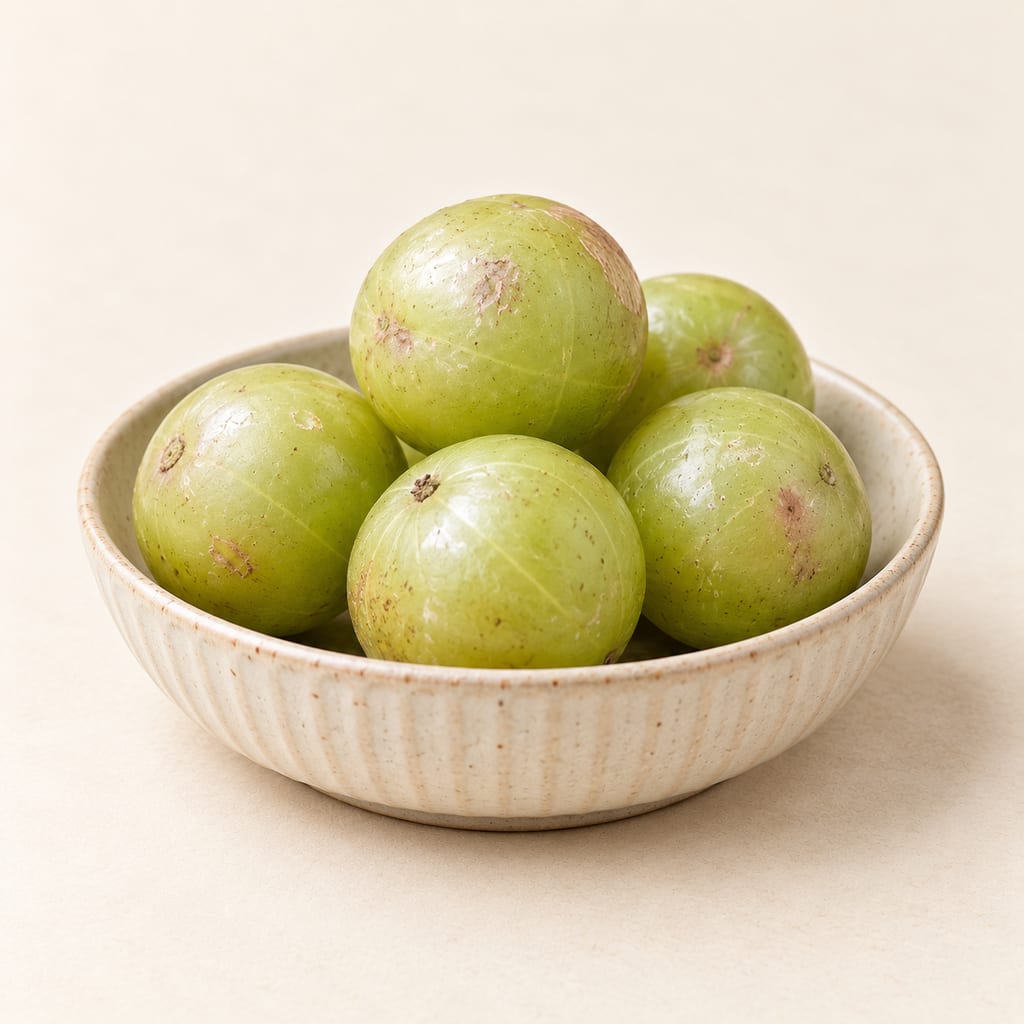
Amla (Indian gooseberry)
Amla is the firm, sharply sour fruit of Phyllanthus emblica. Cooks transform it into murabba, pickles, chutneys, drinks and dried snacks.
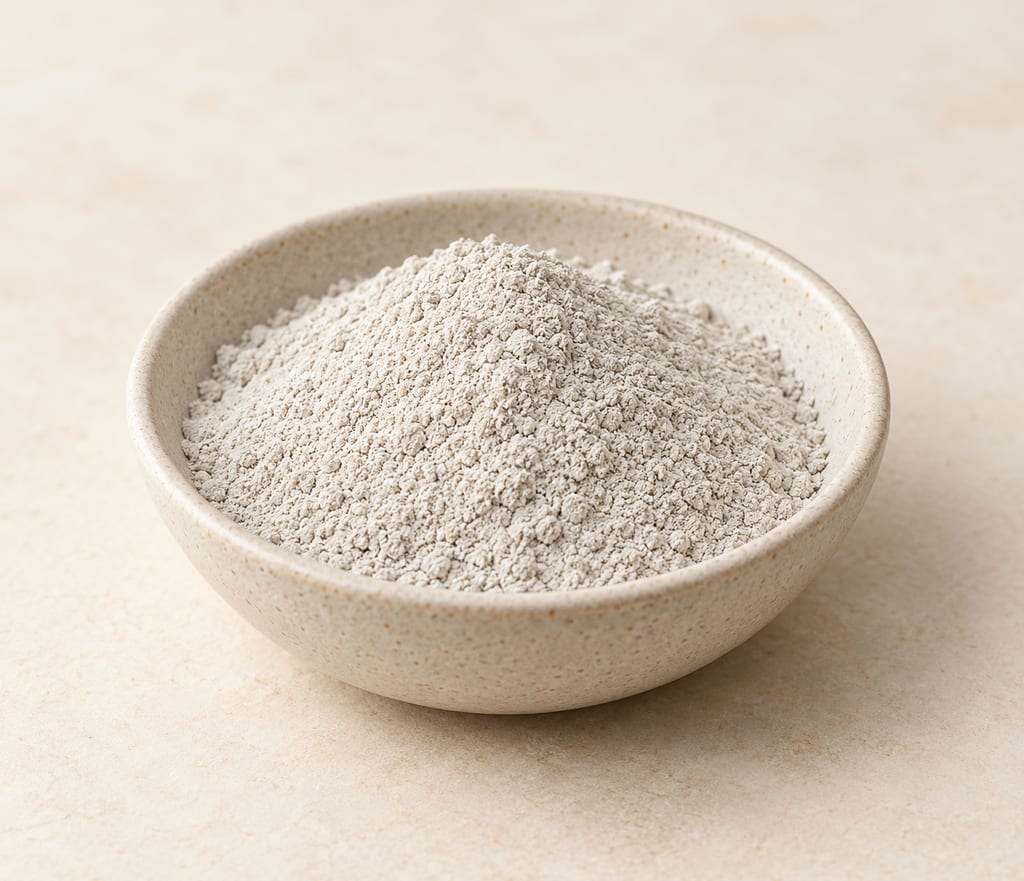
Bentonite
A swelling mineral clay used as a processing aid in a named beer recipe's primary fermentation; it helps remove suspended haze-active material as sediment.
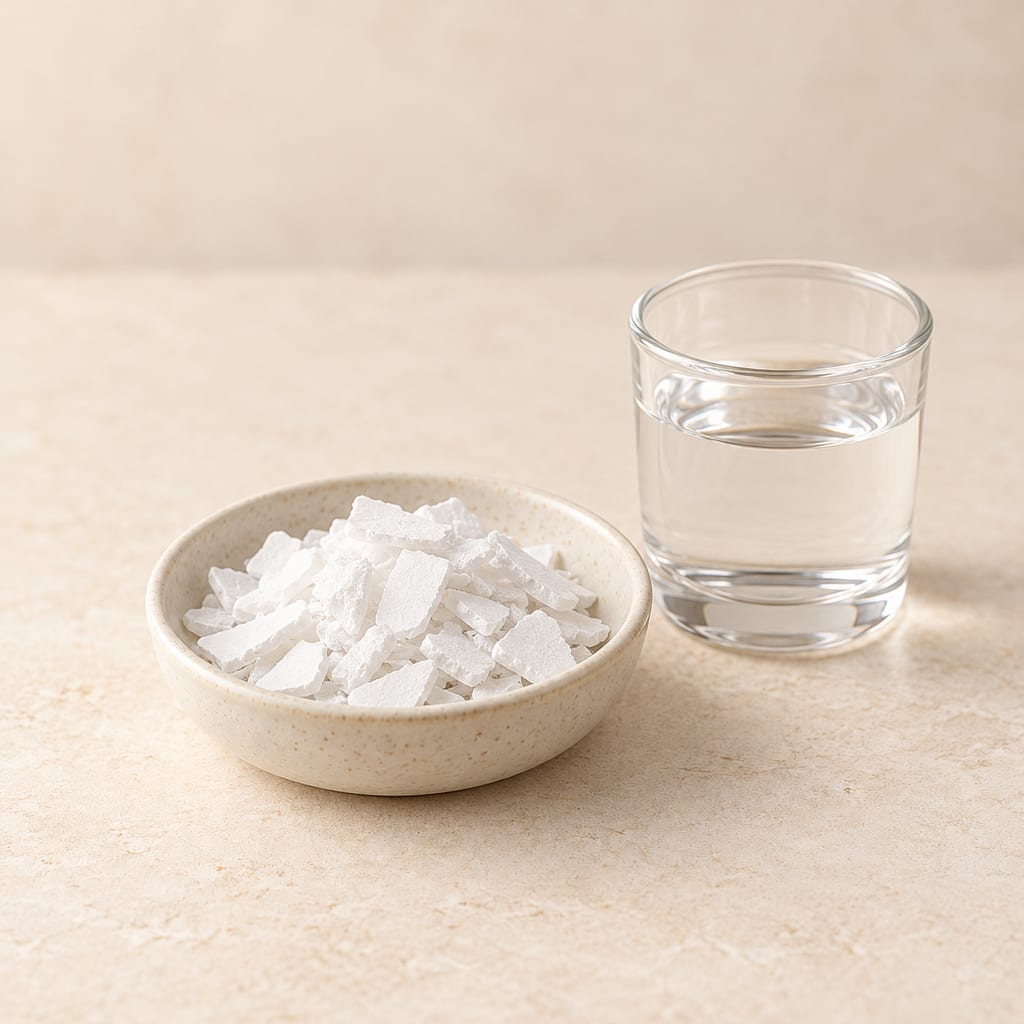
Calcium chloride
A soluble calcium salt used to support cheese curd formation, balance cheese brines, reinforce some plant tissues and adjust brewing water.
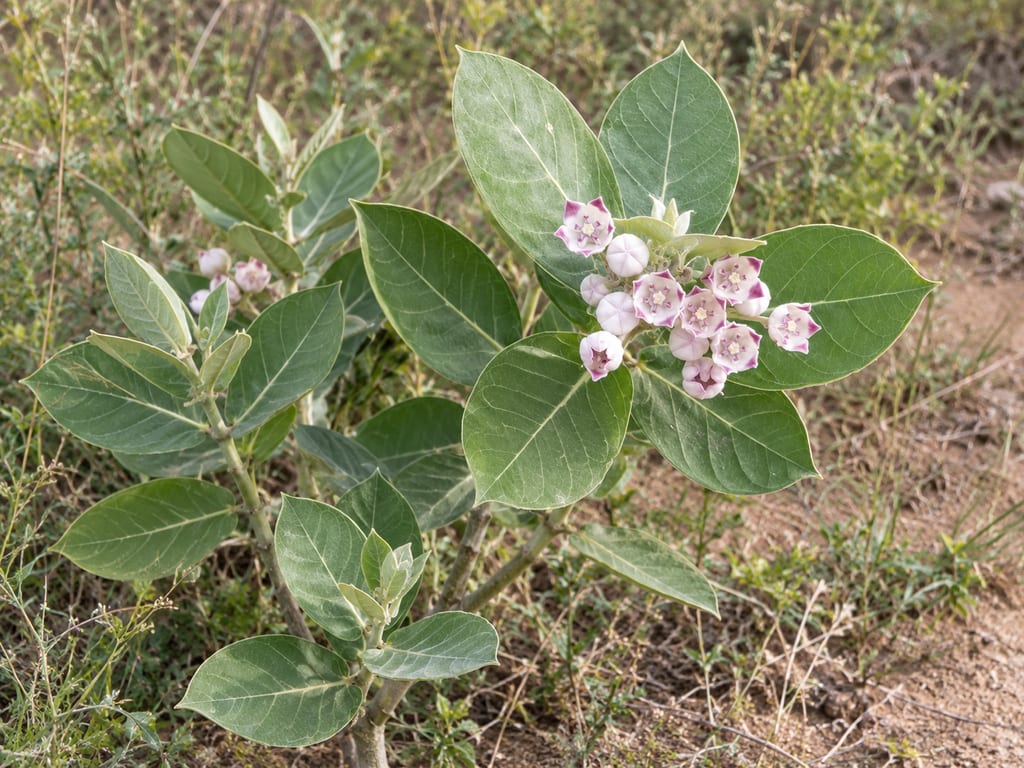
Calotropis coagulant for wagashi and wara
Calotropis procera preparations are documented as coagulants for wagashi gassirè in Benin and wara in Nigeria. Crude plant materials differ from purified research enzymes, and current evidence does not support a general home preparation.
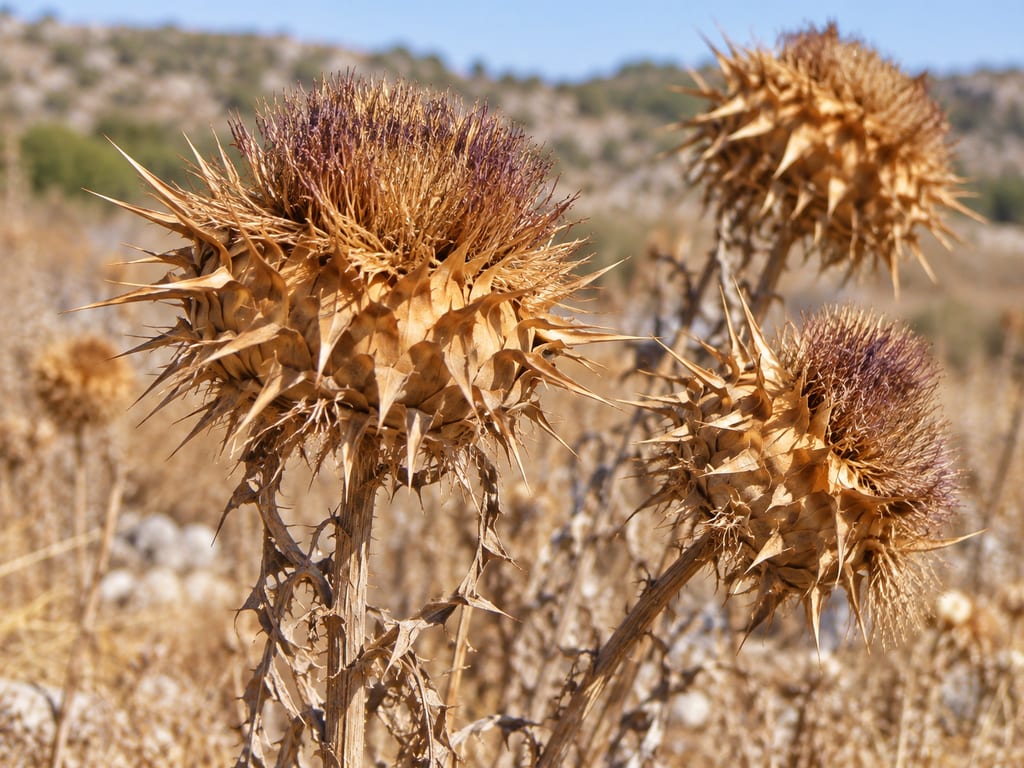
Cardoon flower rennet
Dried flower heads of cardoon (Cynara cardunculus) supply plant proteases used to coagulate milk in several documented regional cheeses. Plant, extraction, milk and dose matter; evidence does not establish a universal home method.
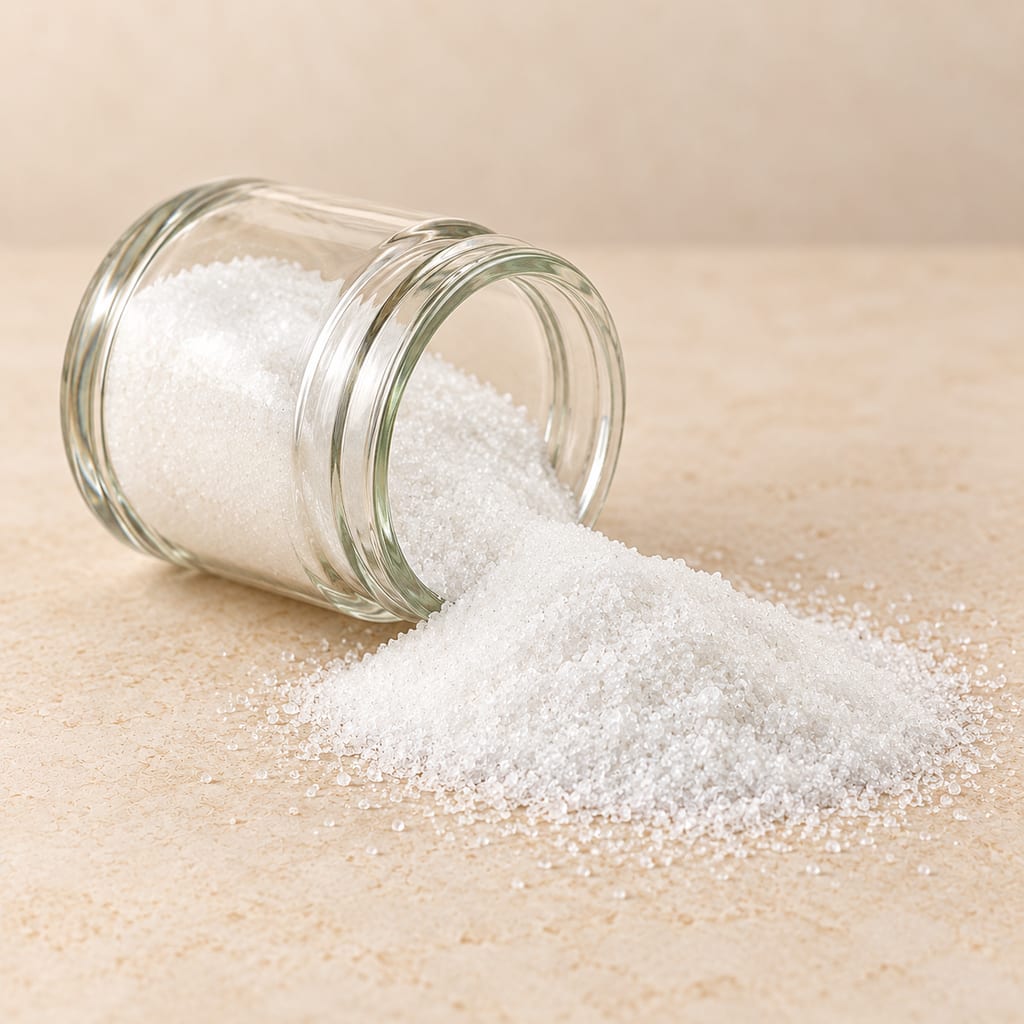
Citric acid
Citric acid is a sour, crystalline food acid found in fruit and made industrially by fermentation. In quick mozzarella it directly acidifies milk before the rennet set.
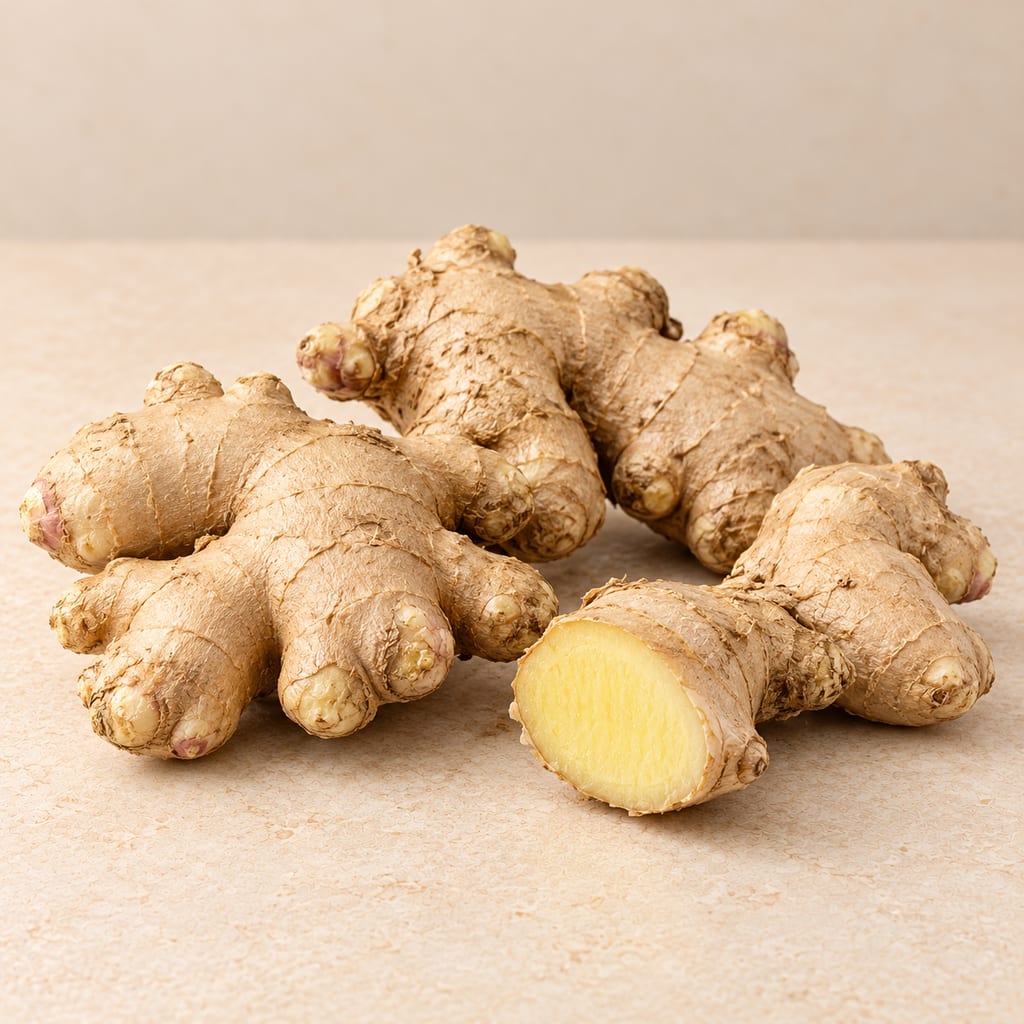
Ginger
Ginger is the aromatic rhizome of Zingiber officinale, used fresh, dried and preserved. Historical ginger wines sliced or bruised it to flavour a sugar-based ferment.
Community
No community contributions have been published for this entry yet.
Share what you made
Sign in to contribute. Published comments and photos are free to read.
Sources
US Food and Drug Administration
GRAS Notice GRN 000801 response letter: chymosin enzyme preparation produced by Aspergillus niger expressing a protein-engineered variant of Camelus dromedarius chymosinCited in: A liquid becomes a solid; From the stomach to the fermenter
Foods (MDPI), 2020
Influence of Cardoon Flower (Cynara cardunculus L.) and Flock Lactation Stage in PDO Serra da Estrela CheeseCited in: A liquid becomes a solid; Flowers: cardoon, artichoke and the thistles
Journal of Zhejiang University Science B, 2025
Dynamic changes in physiochemical, structural, and flavor characteristics of ginger-juice milk curdCited in: A liquid becomes a solid; Latex, fruit and rhizome: fig, papaya, ginger and Indian rennet
Frontiers in Microbiology, 2019
Naturally Fermented Acid Slurry of Soy Whey: High-Throughput Sequencing-Based Characterization of Microbial Flora and Mechanism of Tofu CoagulationCited in: A liquid becomes a solid; Tofu and the mineral coagulants; Why species, part and preparation matter
Food Safety and Standards Authority of India
Food Safety and Standards (Food Products Standards and Food Additives) Regulations, 2011 (text mirrored by FAOLEX)Cited in: A liquid becomes a solid; Acid, with or without heat; Tofu and the mineral coagulants; Why species, part and preparation matter; How to read this field
Utah State University Extension
Getting Crisp Home Pickled VegetablesCited in: A liquid becomes a solid; Ash, lime and alkali
Miho Museum
TofuCited in: A liquid becomes a solid; Tofu and the mineral coagulants; How to read this field
Food Hydrocolloids (Elsevier), 2022
Rheo-chemistry of gelation in aiyu (fig) jellyCited in: A liquid becomes a solid; Gels from animals, seaweeds, seeds and leaves; Why species, part and preparation matter; How to read this field
LacusCurtius, University of Chicago
Cato, De Agricultura, section 162 (Loeb translation, 1934)Cited in: A liquid becomes a solid; Fig juice, kid rennet and thistle flowers; Curing: ingredients inside a system
Journal of Archaeological Science, 2020 (author copy, Boston University)
The experimental identification of nixtamalized maize through starch spherulitesCited in: A liquid becomes a solid; Ash, lime and alkali
International Organisation of Vine and Wine (OIV)
International Oenological Codex: Gelatine (COEI-1-GELATI)Cited in: A liquid becomes a solid; Gels from animals, seaweeds, seeds and leaves; Clearing wine
FAO, A guide to the seaweed industry
CarrageenanCited in: A liquid becomes a solid; Gels from animals, seaweeds, seeds and leaves
FAO, A guide to the seaweed industry
AlginateCited in: A liquid becomes a solid; Gels from animals, seaweeds, seeds and leaves
National Center for Home Food Preservation, University of Georgia
Jellied Product IngredientsCited in: A liquid becomes a solid; Gels from animals, seaweeds, seeds and leaves
International Organisation of Vine and Wine (OIV)
Code of good fining practices for wine to be applied in the use of proteinaceous wine fining agents with allergenic potential (casein and egg white)Cited in: A liquid becomes a solid; Clearing wine
International Organisation of Vine and Wine (OIV)
Bentonites (Resolution OENO 11/2003)Cited in: A liquid becomes a solid; Clearing wine
International Organisation of Vine and Wine (OIV)
International Oenological Codex: Fish glue (isinglass) (COEI-1-COLPOI)Cited in: A liquid becomes a solid; Many methods at once; Gels from animals, seaweeds, seeds and leaves; Clearing wine
FAO
Guidelines for slaughtering, meat cutting and further processing: meat productsCited in: A liquid becomes a solid; Curing: ingredients inside a system
International Organisation of Vine and Wine (OIV)
International Code of Oenological Practices II.2.1.2: SulphitingCited in: A liquid becomes a solid; Curing: ingredients inside a system
Journal of Cookery Science of Japan, 2018
Effects of Soaking Pork in Shio-Koji before CookingCited in: A liquid becomes a solid; Curing: ingredients inside a system
Food Safety Commission of Japan
Safety Assessment Report FS/631/2024: Transglutaminase produced using Streptomyces mobaraensis TTG-1 strainCited in: A liquid becomes a solid; Curing: ingredients inside a system
Center for Dairy Research, University of Wisconsin-Madison
Cheese Safety/StorageCited in: A liquid becomes a solid; Curing: ingredients inside a system; Why species, part and preparation matter; How to read this field
Journal of Food Science and Technology, 2019
Composition, texture and microstructure appraisal of paneer coagulated with sour fruit juicesCited in: A liquid becomes a solid; Acid, with or without heat
Livestock Research for Rural Development, 2007
Manufacturing efficiencies and microbial properties of butter and Ayib, Ethiopian cottage cheeseCited in: A liquid becomes a solid; Africa and the Americas: living plant coagulants and toxic plants; Acid, with or without heat
Taiwan News, 2024
Dark mysteries on the dining table: Century eggs (Taiwan Panorama, reprinted)Cited in: A liquid becomes a solid; Ash, lime and alkali
Japan Tourism Agency multilingual commentary database
Shimonita Area: Shimonita-Negi, Konnyaku, and Mulberry LeavesCited in: A liquid becomes a solid; Ash, lime and alkali
USDA Agricultural Marketing Service, National Organic Program
Technical Report: Potassium Carbonate, Handling/Processing (8 March 2023)Cited in: A liquid becomes a solid; Ash, lime and alkali; Why species, part and preparation matter
Science Advances, 2019
Bone marrow storage and delayed consumption at Middle Pleistocene Qesem Cave, Israel (420 to 200 ka)Cited in: Before the cheese
EFSA Journal, 2024
Safety evaluation of the food enzyme rennet containing chymosin and pepsin A from the abomasum of suckling calves, goats, lambs and buffaloesCited in: Before the cheese; Rennet: the stomach of a young animal; Why species, part and preparation matter
Nature, 2008
Earliest date for milk use in the Near East and southeastern Europe linked to cattle herdingCited in: Before the cheese
Nature, 2013
Earliest evidence for cheese making in the sixth millennium BC in northern EuropeCited in: Before the cheese
Nature, 2012
First dairying in green Saharan Africa in the fifth millennium BCCited in: Before the cheese; Africa and the Americas: living plant coagulants and toxic plants
Scientific Reports, 2020
Compound specific isotope analysis of lipid residues provides the earliest direct evidence of dairy product processing in South AsiaCited in: Before the cheese
Journal of Archaeological Science, 2014
Proteomics evidence for kefir dairy in Early Bronze Age ChinaCited in: Before the cheese
Cell, 2024
Bronze Age cheese reveals human-Lactobacillus interactions over evolutionary historyCited in: Before the cheese
PLOS ONE, 2018
Fatty acid specific δ13C values reveal earliest Mediterranean cheese production 7,200 years agoCited in: Before the cheese
National Geographic, 2018
Hints of 7,200-Year-Old Cheese Create a Scientific StinkCited in: Before the cheese
The Internet Classics Archive, MIT
Homer, The Iliad, Book V (Samuel Butler translation)Cited in: Fig juice, kid rennet and thistle flowers
The Internet Classics Archive, MIT
Aristotle, The History of Animals, Book III (D'Arcy Wentworth Thompson translation)Cited in: Fig juice, kid rennet and thistle flowers; Rennet: the stomach of a young animal; Latex, fruit and rhizome: fig, papaya, ginger and Indian rennet; Why species, part and preparation matter
The Latin Library
Columella, De re rustica VII (Latin text)Cited in: Fig juice, kid rennet and thistle flowers; Rennet: the stomach of a young animal; How to read this field
Project Gutenberg
The Natural History of Pliny, Volume 3 (Bostock and Riley translation)Cited in: Fig juice, kid rennet and thistle flowers; Rennet: the stomach of a young animal; Why species, part and preparation matter
LacusCurtius, University of Chicago
Apicius, De re coquinaria, Book III, recipe 66 (1936 English edition)Cited in: Fig juice, kid rennet and thistle flowers; How to read this field
CoReMA, University of Graz
Almond cheese (Aber ein ander essen), Wien ÖNB Cod. 2897, recipe 33Cited in: Many methods at once; Gels from animals, seaweeds, seeds and leaves
CoReMA, University of Graz
Soured milk, sweet (Tockhen millch), Wolfenbüttel HAB Cod. Guelf. 42.6 Aug. 4Cited in: Many methods at once
George Mason University Libraries
To Make a Slipcoat Chees, Fairfax-Spencer family recipe book, 1694/1795Cited in: Many methods at once; Leaves, microbes and the long list of leads; How to read this field
Horniman Museum and Gardens, 2015
Stories of Cheese at the Horniman MuseumCited in: Many methods at once
EFSA Journal, 2022
Safety evaluation of the food enzyme rennet containing chymosin and pepsin A from calf abomasumCited in: Rennet: the stomach of a young animal
EFSA Journal, 2023
Safety evaluation of the food enzyme rennet containing chymosin and pepsin A from the abomasum of calves and cowsCited in: Rennet: the stomach of a young animal
EFSA Journal, 2021
Safety evaluation of the food enzyme rennet paste from the abomasum of suckling goats, lambs and calvesCited in: Rennet: the stomach of a young animal; Why species, part and preparation matter
Siida, the Sámi Museum
Anaras: Way of Life, Food TraditionCited in: Rennet: the stomach of a young animal
The Common Table, 2022
The Milk TrekkerCited in: Rennet: the stomach of a young animal; Leaves, microbes and the long list of leads; How to read this field
FAO
Camels and camel milk: milk products and their usesCited in: Rennet: the stomach of a young animal
Emirates Journal of Food and Agriculture, 2011
Comparative study of milk clotting activity of crude gastric enzymes extracted from camelsCited in: Rennet: the stomach of a young animal; Why species, part and preparation matter
Journal of Dairy Research, 1972
Assessment of swine, bovine and chicken pepsins as rennet substitutes for Cheddar cheese-makingCited in: Rennet: the stomach of a young animal; Why species, part and preparation matter
Chr. Hansen press release, 2008
Introducing CHY-MAX M: a major innovation in coagulantsCited in: From the stomach to the fermenter
Legal Information Institute, Cornell Law School
21 CFR 173.150: Milk-clotting enzymes, microbialCited in: From the stomach to the fermenter
US Food and Drug Administration
Enzyme Preparations Used in Food (Partial List)Cited in: From the stomach to the fermenter
GBIF Backbone Taxonomy
Endothia parasitica (Murrill) P.J.Anderson & H.W.Anderson, synonym of Cryphonectria parasiticaCited in: From the stomach to the fermenter
GBIF Backbone Taxonomy
Mucor miehei Cooney & R.Emers., synonym of Rhizomucor mieheiCited in: From the stomach to the fermenter
GBIF Backbone Taxonomy
Mucor pusillus Lindt, synonym of Rhizomucor pusillusCited in: From the stomach to the fermenter
EFSA Journal, 2024
Safety evaluation of the food enzyme mucorpepsin from the non-genetically modified Rhizomucor miehei strain LP-N836Cited in: From the stomach to the fermenter
Legal Information Institute, Cornell Law School
21 CFR 184.1685: Rennet (animal-derived) and chymosin preparation (fermentation-derived)Cited in: From the stomach to the fermenter
EFSA Journal, 2022
Safety evaluation of the food enzyme chymosin from the genetically modified Kluyveromyces lactis strain CHYCited in: From the stomach to the fermenter; Why species, part and preparation matter
Biochemical and Biophysical Research Communications, 2006
Characterization of recombinant camel chymosin reveals superior properties for the coagulation of bovine and camel milkCited in: From the stomach to the fermenter
Asian-Australasian Journal of Animal Sciences, 2016
Cloning and Expression of Yak Active Chymosin in Pichia pastorisCited in: From the stomach to the fermenter
US Food and Drug Administration, GRAS Notice Inventory
GRN No. 1195: Chymosin enzyme preparation produced by Aspergillus niger expressing a gene encoding chymosin from Erinaceus europaeusCited in: From the stomach to the fermenter
US Food and Drug Administration
Corrected response letter to GRAS Notice GRN 001195 (3 July 2025)Cited in: From the stomach to the fermenter; How to read this field
Foods (MDPI), 2026
Identification and Characterisation of Lactic Acid Bacteria from "Torta del Casar", a Semi-Soft Artisanal CheeseCited in: Flowers: cardoon, artichoke and the thistles
Boletín Oficial del Estado (Spain)
Resolución de 15 de abril de 2008: pliego de condiciones de la Denominación de Origen Protegida Queso de Flor de Guía, Queso de Media Flor de Guía y Queso de GuíaCited in: Flowers: cardoon, artichoke and the thistles; Why species, part and preparation matter
Foods (MDPI), 2019
An Evaluation of the Clotting Properties of Three Plant Rennets in the Milks of Different Animal SpeciesCited in: Flowers: cardoon, artichoke and the thistles; Latex, fruit and rhizome: fig, papaya, ginger and Indian rennet; Why species, part and preparation matter
Foods (MDPI), 2026
Role of Cardoon (Cynara spp.) and Raw Milk Microbiota in Iberian PDO and PGI Small Ruminants' Milk CheesesCited in: Flowers: cardoon, artichoke and the thistles
International Dairy Journal, 2007
Characterization of the milk-clotting properties of extracts from artichoke (Cynara scolymus, L.) flowersCited in: Flowers: cardoon, artichoke and the thistles
Journal of Agricultural and Food Chemistry, 2000
Chemical and microbiological characteristics of ewes' milk cheese manufactured with extracts from flowers of Cynara cardunculus and Cynara humilis as coagulantsCited in: Flowers: cardoon, artichoke and the thistles
LWT Food Science and Technology, 2012
Onopordum acanthium L. (Asteraceae) flowers as coagulating agent for cheesemakingCited in: Flowers: cardoon, artichoke and the thistles; Why species, part and preparation matter
Foods (MDPI), 2023
Clotting and Proteolytic Activity of Freeze-Dried Crude Extracts Obtained from Wild Thistles Cynara humilis L. and Onopordum platylepis Murb.Cited in: Flowers: cardoon, artichoke and the thistles
Universidade Católica Portuguesa repository
Aspartic peptidases from Silybum marianum flowers: degradation of caprine and ovine caseinsCited in: Flowers: cardoon, artichoke and the thistles
Journal of Biotechnology, 2018
Expression, activation and processing of a novel plant milk-clotting aspartic protease in Pichia pastorisCited in: Flowers: cardoon, artichoke and the thistles
Biochemistry Research International, 2020
Application of Ficus carica L. and Solanum incanum L. Extracts in Coagulation of Milk: The Case of Traditional Practice in Ab'ala Area, Afar Regional State, EthiopiaCited in: Latex, fruit and rhizome: fig, papaya, ginger and Indian rennet; Africa and the Americas: living plant coagulants and toxic plants
International Journal of Biological Macromolecules, 2019
A novel milk-clotting cysteine protease from Ficus johannis: Purification and characterizationCited in: Latex, fruit and rhizome: fig, papaya, ginger and Indian rennet
Plants of the World Online, Royal Botanic Gardens, Kew
Ficus johannis Boiss.Cited in: Latex, fruit and rhizome: fig, papaya, ginger and Indian rennet
Journal of Agricultural and Food Chemistry, 2010
Decolorization of crude latex by activated charcoal, purification and physico-chemical characterization of religiosin, a milk-clotting serine protease from the latex of Ficus religiosaCited in: Latex, fruit and rhizome: fig, papaya, ginger and Indian rennet
Phytochemistry, 2008
An unusual thermostable aspartic protease from the latex of Ficus racemosa (L.)Cited in: Latex, fruit and rhizome: fig, papaya, ginger and Indian rennet
International Journal of Food Properties, 2012
Microstructure and Texture of Milk Coagulum of Streblus asper Leaf ExtractCited in: Latex, fruit and rhizome: fig, papaya, ginger and Indian rennet
International Journal of Biological Macromolecules, 2017
Purification and characterization of a milk-clotting aspartic protease from Withania coagulans fruitCited in: Latex, fruit and rhizome: fig, papaya, ginger and Indian rennet; Why species, part and preparation matter
Wikisource
Indian Medicinal Plants (Kirtikar and Basu, 1918): Natural Order SolanaceaeCited in: Latex, fruit and rhizome: fig, papaya, ginger and Indian rennet
Indian Journal of Agricultural Research, 2024
Physicochemical Properties of Dangke Cheese Made at Different Processing TemperaturesCited in: Latex, fruit and rhizome: fig, papaya, ginger and Indian rennet
Jurnal Teknologi dan Industri Pangan, 2014
Antibacterial activity of dried papaya latex and papain in dangkeCited in: Latex, fruit and rhizome: fig, papaya, ginger and Indian rennet; Why species, part and preparation matter
Journal of Dairy Science, 2011
Purification, characterization, and milk coagulating properties of ginger proteasesCited in: Latex, fruit and rhizome: fig, papaya, ginger and Indian rennet; Why species, part and preparation matter
Food Chemistry, 2013
Comparison of the milk-clotting properties of three plant extractsCited in: Latex, fruit and rhizome: fig, papaya, ginger and Indian rennet
Can Tho University Journal of Science, 2018
Application of bromelain enzyme obtained from pineapple waste in milk clotting to produce pandanus probiotic cheeseCited in: Latex, fruit and rhizome: fig, papaya, ginger and Indian rennet
Heliyon, 2022
Processing and preservation methods of Wagashi Gassirè, a traditional cheese produced in BeninCited in: Africa and the Americas: living plant coagulants and toxic plants; How to read this field
Indian Journal of Ophthalmology, 2009
Ocular toxicity by latex of Calotropis procera (Sodom apple)Cited in: Africa and the Americas: living plant coagulants and toxic plants; Why species, part and preparation matter; How to read this field
Middle East African Journal of Ophthalmology, 2019
Corneal Toxicity after Self-Application of Calotropis procera (Ushaar) Latex: Case Report and Analysis of the Active ComponentsCited in: Africa and the Americas: living plant coagulants and toxic plants
SpringerPlus, 2016
Cardiac and testicular toxicity effects of the latex and ethanolic leaf extract of Calotropis procera on male albino rats in comparison to abamectinCited in: Africa and the Americas: living plant coagulants and toxic plants; Why species, part and preparation matter
Food Chemistry, 2020
Biotechnological potential of a cysteine protease (CpCP3) from Calotropis procera latex for cheesemakingCited in: Africa and the Americas: living plant coagulants and toxic plants
Pharmacognosy Magazine, 2014
Hemostatic, milk clotting and blood stain removal potential of cysteine proteases from Calotropis gigantea (L.) R. Br. latexCited in: Africa and the Americas: living plant coagulants and toxic plants
Livestock Research for Rural Development, 2018
Milk clotting characteristics of Solanum incanum, Ficus carica and Rhus natalensis extracts in TigrayCited in: Africa and the Americas: living plant coagulants and toxic plants
GBIF Backbone Taxonomy
Rhus natalensis Bernh. ex Krauss, synonym of Searsia natalensisCited in: Africa and the Americas: living plant coagulants and toxic plants
International Dairy Journal, 2014
Characterisation of a milk-clotting extract from Balanites aegyptiaca fruit pulpCited in: Africa and the Americas: living plant coagulants and toxic plants
Phytochemistry, 2009
Dubiumin, a chymotrypsin-like serine protease from the seeds of Solanum dubium Fresen.Cited in: Africa and the Americas: living plant coagulants and toxic plants
Plants of the World Online, Royal Botanic Gardens, Kew
Solanum dubium Fresen.Cited in: Africa and the Americas: living plant coagulants and toxic plants
GBIF Backbone Taxonomy
Solanum dubium Fresen., synonym of Solanum coagulansCited in: Africa and the Americas: living plant coagulants and toxic plants
CyTA Journal of Food, 2015
Partial characterization of a plant coagulant obtained from the berries of Solanum elaeagnifoliumCited in: Africa and the Americas: living plant coagulants and toxic plants
NSW WeedWise, NSW Department of Primary Industries
Silverleaf nightshade (Solanum elaeagnifolium)Cited in: Africa and the Americas: living plant coagulants and toxic plants
Journal of Microbiology, Biotechnology and Food Sciences, 2017
Exploring the milk-clotting properties of extracts from Bromelia pinguin fruitCited in: Africa and the Americas: living plant coagulants and toxic plants
Applied Biochemistry and Biotechnology, 2021
Exploring the Milk-Clotting and Proteolytic Activities in Different Tissues of Vallesia glabra: a New Source of Plant Proteolytic EnzymesCited in: Africa and the Americas: living plant coagulants and toxic plants
Brazilian Journal of Food Technology, 2024
Fresh cheese production using freeze-dried papain as a vegetable coagulantCited in: Africa and the Americas: living plant coagulants and toxic plants
Food Research International, 2020
Noni (Morinda citrifolia L.) fruit as a new source of milk-clotting cysteine proteasesCited in: Africa and the Americas: living plant coagulants and toxic plants; Why species, part and preparation matter
Hoehnea, 2022
A new milk-clotting enzyme from noni seeds (Morinda citrifolia L.)Cited in: Africa and the Americas: living plant coagulants and toxic plants; Why species, part and preparation matter
Journal of Dairy Science, 2016
Short communication: Presence of Lactococcus and lactococcal exopolysaccharide operons on the leaves of Pinguicula vulgaris supports the traditional source of bacteria present in Scandinavian ropy fermented milkCited in: Leaves, microbes and the long list of leads; Why species, part and preparation matter
International Journal of Gastronomy and Food Science, 2016
Nettle cheese: Using nettle leaves (Urtica dioica) to coagulate milk in the fresh cheese making processCited in: Leaves, microbes and the long list of leads; Why species, part and preparation matter
Colloids and Surfaces B: Biointerfaces, 2022
Characterization of nettle leaves (Urtica dioica) as a novel source of protease for clotting dromedary milk by non-destructive methodsCited in: Leaves, microbes and the long list of leads; Why species, part and preparation matter
Darwin Correspondence Project, University of Cambridge
Letter to T. L. Brunton, 11 May 1874 (DCP-LETT-9453)Cited in: Leaves, microbes and the long list of leads
Scientific Papers, Series D, Animal Science (USAMV Bucharest), 2021
A preliminary study on the potential of Romanian native flora to obtain milk-clotting plant proteasesCited in: Leaves, microbes and the long list of leads
Journal of Agricultural and Food Chemistry, 2002
Characterization of "lettucine", a serine-like protease from Lactuca sativa leaves, as a novel enzyme for milk clottingCited in: Leaves, microbes and the long list of leads
Food Chemistry, 2012
Caseinolytic and milk-clotting activities from Moringa oleifera flowersCited in: Leaves, microbes and the long list of leads
Foods (MDPI), 2017
Utility of Milk Coagulant Enzyme of Moringa oleifera Seed in Cheese Production from Soy and Skim MilksCited in: Leaves, microbes and the long list of leads; Why species, part and preparation matter
Japanese Journal of Zootechnical Science, 1991
Gouda-type cheese made with a milk-clotting enzyme from young seeds of Albizia julibrissinCited in: Leaves, microbes and the long list of leads
Food Chemistry, 2012
Neriifolin S, a dimeric serine protease from Euphorbia neriifolia Linn.: Purification and biochemical characterisationCited in: Leaves, microbes and the long list of leads
Ancient Science of Life, 1996
An ethnic method of milk curdling using plantsCited in: Leaves, microbes and the long list of leads; How to read this field
Plants of the World Online, Royal Botanic Gardens, Kew
Maclura spinosa (Willd.) C.C.BergCited in: Leaves, microbes and the long list of leads
GBIF Backbone Taxonomy
Plecospermum spinosum (Willd.) Trécul, synonym of Maclura spinosaCited in: Leaves, microbes and the long list of leads
Pharmacognosy Magazine, 2015
Synergistic Caseinolytic Activity and Differential Fibrinogenolytic Action of Multiple Proteases of Maclura spinosa (Roxb. ex Willd.) latexCited in: Leaves, microbes and the long list of leads
Indian Journal of Small Ruminants, 1996
Manufacture of goat milk paneer using sour paneer wheyCited in: Acid, with or without heat
FAO
The technology of traditional milk products in developing countries: cheese and cheese productsCited in: Acid, with or without heat
International Journal of Food Properties, 2018
SPME/GC-MS characterization of volatile compounds of Iranian traditional dried KashkCited in: Acid, with or without heat
Journal of Food Science and Technology, 2020
The utilization of bilimbi (Averrhoa bilimbi) and lime (Citrus aurantifolia) juices as natural acid coagulants for tofu productionCited in: Acid, with or without heat
Chemical Engineering Transactions, 2025
Sustainable Tofu Production Using Lime Juice and Tamarind Extract: Natural, Low-Carbon Alternatives to Synthetic CoagulantCited in: Acid, with or without heat; Why species, part and preparation matter
African Journal of Food Science, 2019
Effect of coagulants on the physicochemical properties of fresh tofuCited in: Acid, with or without heat
Soyinfo Center
History of Tofu and Tofu Products (965 CE to 2013)Cited in: Tofu and the mineral coagulants
Soyinfo Center
History of Tofu, page 1Cited in: Tofu and the mineral coagulants; How to read this field
GBIF Backbone Taxonomy
Symplocos prunifolia Siebold & Zucc., synonym of Symplocos sumuntiaCited in: Tofu and the mineral coagulants
Food Hygiene and Safety Science (Shokuhin Eiseigaku Zasshi), 2006
Survey on the Quality of Commercial Nigari (Crude Magnesium Chloride [Sea Water])Cited in: Tofu and the mineral coagulants; Why species, part and preparation matter; How to read this field
Bioscience, Biotechnology, and Biochemistry, 2013
Magnesium Chloride Concentration-Dependent Formation of Tofu-Like Precipitates with Different Physicochemical PropertiesCited in: Tofu and the mineral coagulants
USDA Agricultural Marketing Service
National Organic Standards Board Spring 2026 meeting packet: calcium sulfateCited in: Tofu and the mineral coagulants; Why species, part and preparation matter
Korea Tourism Organization, 2024
Long-lasting Restaurants to Visit in WinterCited in: Tofu and the mineral coagulants
Journal of Archaeological Science, 2022
First archaeological identification of nixtamalized maize, from two pit latrines at the ancient Maya site of San Bartolo, GuatemalaCited in: Ash, lime and alkali
Nutrients, 2026
Assessment of Juniper Ash Elemental Composition for Potential Use in a Traditional Indigenous Dietary PatternCited in: Ash, lime and alkali; Why species, part and preparation matter
Journal of the American Dietetic Association, 1998
Juniper ash as a source of calcium in the Navajo dietCited in: Ash, lime and alkali
Journal of Food Processing and Technology, 2014
Analysis of Traditional Food Additive Kolakhar for its Physico-Chemical Parameters and Antimicrobial ActivityCited in: Ash, lime and alkali; Why species, part and preparation matter
Asian Journal of Biological Sciences, 2025
Proximate, Mineral and Fatty Acid Composition of Gravy Prepared from Palm Bunch Ash (Ngu)Cited in: Ash, lime and alkali
African Journal of Biotechnology, 2010
X-ray diffraction study of kanwa used as active ingredient in achu soup in CameroonCited in: Ash, lime and alkali; Why species, part and preparation matter
Foods (MDPI), 2021
Moisture Distribution and Structural Properties of Frozen Cooked Noodles with NaCl and KansuiCited in: Ash, lime and alkali
Centre for Food Safety, Hong Kong, Food Safety Focus 84, 2013
Heavy Metals in Lime-preserved EggsCited in: Ash, lime and alkali
Ministry of Agriculture, Forestry and Fisheries of Japan, Our Regional Cuisines
Tezukuri Sashimi Konnyaku (Hand-made Sashimi Konjac), IbarakiCited in: Ash, lime and alkali; Why species, part and preparation matter
National Center for Home Food Preservation, University of Georgia
General Information on PicklingCited in: Ash, lime and alkali; Gels from animals, seaweeds, seeds and leaves
FAO, A guide to the seaweed industry
Introduction to commercial seaweedsCited in: Gels from animals, seaweeds, seeds and leaves
FAO
Production, trade and utilization of seaweeds and seaweed products: seaweed productsCited in: Gels from animals, seaweeds, seeds and leaves
FAO, A guide to the seaweed industry
Seaweeds used as a source of carrageenanCited in: Gels from animals, seaweeds, seeds and leaves; Why species, part and preparation matter
FAO, A guide to the seaweed industry
Carrageenan (extraction methods)Cited in: Gels from animals, seaweeds, seeds and leaves
Polymers (MDPI), 2022
Probing the Stoichiometry Dependence of Enzyme-Catalyzed Junction Zone Network Formation in Aiyu Pectin Gel via a Reaction Kinetics ModelCited in: Gels from animals, seaweeds, seeds and leaves
GBIF Backbone Taxonomy
Ficus awkeotsang Makino, synonym of Ficus pumilaCited in: Gels from animals, seaweeds, seeds and leaves
International Journal of Biological Macromolecules, 2022
Extraction, characterization and spontaneous gelation mechanism of pectin from Nicandra physaloides (Linn.) Gaertn seedsCited in: Gels from animals, seaweeds, seeds and leaves; Why species, part and preparation matter
GBIF Backbone Taxonomy
Nicandra physalodes (L.) Gaertn.Cited in: Gels from animals, seaweeds, seeds and leaves
International Journal of Biological Macromolecules, 2017
Physicochemical properties of pectin from green jelly leaf (Cyclea barbata Miers)Cited in: Gels from animals, seaweeds, seeds and leaves
Carbohydrate Polymers, 2014
Extraction of pectin from Premna microphylla turcz leaves and its physicochemical propertiesCited in: Gels from animals, seaweeds, seeds and leaves
Food Research International, 2022
On the gelation of Premna microphylla turcz extracts: The effects of supernatant and precipitate of plant ash suspensionCited in: Gels from animals, seaweeds, seeds and leaves
GBIF Backbone Taxonomy
Mesona chinensis Benth., synonym of Platostoma palustreCited in: Gels from animals, seaweeds, seeds and leaves
National Center for Home Food Preservation, University of Georgia
General Pickling FAQsCited in: Gels from animals, seaweeds, seeds and leaves
International Organisation of Vine and Wine (OIV)
International Oenological Codex: Oenological tanninsCited in: Clearing wine
International Organisation of Vine and Wine (OIV)
International Oenological Codex: Chitosan (COEI-1-CHITOS)Cited in: Clearing wine
Poultry Science, 2019
Formation mechanism of low-density lipoprotein gel induced by NaClCited in: Curing: ingredients inside a system
National Center for Home Food Preservation, University of Georgia
Historical Origins of Food PreservationCited in: Curing: ingredients inside a system
BYU Studies
Nauvoo Neighbor, 29 January 1845, Curing MeatCited in: Curing: ingredients inside a system
JECFA database, World Health Organization
Potassium nitrate (saltpetre; nitre), INS 252Cited in: Curing: ingredients inside a system
JECFA additives database, FAO
Sodium nitrate (Chile saltpetre), INS 251Cited in: Curing: ingredients inside a system
Canadian Food Inspection Agency
Preventive control recommendations on the use of nitrites in the curing of meat productsCited in: Curing: ingredients inside a system; How to read this field
Molecules (MDPI), 2025
Characterization of Volatilized Compounds in Conventional and Organic Vegetable-Source Alternative Meat-Curing IngredientsCited in: Curing: ingredients inside a system
Journal of Agricultural and Food Chemistry, 2009
Mechanisms of hop inhibition: hop ionophoresCited in: Curing: ingredients inside a system
Meat Science, 2006
Sensitivity of three pathogenic bacteria to Turkish cemen paste and its ingredientsCited in: Curing: ingredients inside a system
legislation.gov.uk
Commission Regulation (EU) No 231/2012: E 392 Extracts of rosemary (UK retained text)Cited in: Curing: ingredients inside a system
Food Standards Agency, Authorised Regulated Food and Feed Products for Great Britain
Extracts of rosemary (E 392)Cited in: Curing: ingredients inside a system
JECFA database, World Health Organization
Rosemary extractCited in: Curing: ingredients inside a system
Microorganisms (MDPI), 2022
Effect of Biltong Dried Beef Processing on the Reduction of Listeria monocytogenes, E. coli O157:H7, and Staphylococcus aureus, and the Contribution of the Major Marinade ComponentsCited in: Curing: ingredients inside a system
Applied and Environmental Microbiology, 2006
Elimination of Escherichia coli O157:H7 from fermented dry sausages at an organoleptically acceptable level of microencapsulated allyl isothiocyanateCited in: Curing: ingredients inside a system
US Food and Drug Administration
Raw Milk Misconceptions and the Danger of Raw Milk ConsumptionCited in: Curing: ingredients inside a system
US Food and Drug Administration
Microorganisms and Microbial-Derived Ingredients Used in Food (Partial List)Cited in: Curing: ingredients inside a system
International Journal of Gastronomy and Food Science, 2017
Flavour of fermented fish, insect, game, and pea sauces: Garum revisitedCited in: Curing: ingredients inside a system
Foods (MDPI), 2019
The Determination of Some Microbiological and Chemical Features in Herby CheeseCited in: How to read this field
International Journal of Food Properties, 2010
Determination of Biogenic Amines in Herby CheeseCited in: How to read this field
University of Guelph, Cheesemaking Technology eBook
University of Guelph: Cheese FamiliesCited in: A liquid becomes a solid
Early Modern Maritime Recipes, University of New Brunswick
Rennet for Cheese: James Dinwiddie manuscript, 1793Cited in: Many methods at once; Rennet: the stomach of a young animal; Why species, part and preparation matter
Early Modern Maritime Recipes, University of New Brunswick
Garrett Clopper manuscript, 1790–1799, New Brunswick Museum / UNB Early Modern Maritime RecipesCited in: Many methods at once
National Academies Press (NCBI Bookshelf), 1998
National Academies: Direct Food Ingredient Technologies, Chymosin case study (1998)Cited in: From the stomach to the fermenter
Official Journal of the European Union (EUR-Lex), 2023
EU specification for Torta del Casar (2023)Cited in: Flowers: cardoon, artichoke and the thistles; Why species, part and preparation matter
Plants of the World Online, Royal Botanic Gardens, Kew
Kew POWO: Cynara scolymus L.Cited in: Flowers: cardoon, artichoke and the thistles
Plants of the World Online, Royal Botanic Gardens, Kew
Kew POWO: Cynara humilis L.Cited in: Flowers: cardoon, artichoke and the thistles
Process Biochemistry (Elsevier), 2008
Centaurea calcitrapa aspartic proteinase from cell suspension cultures (2008)Cited in: Flowers: cardoon, artichoke and the thistles
International Dairy Journal (Elsevier), 2000
Centaurea calcitrapa cell extract in cheese ripening (2000)Cited in: Flowers: cardoon, artichoke and the thistles
Food Chemistry (Elsevier), 2011
Streblin, a serine protease from Streblus asper latex (2011)Cited in: Latex, fruit and rhizome: fig, papaya, ginger and Indian rennet
International Dairy Journal (Elsevier), 2007
Albizia lebbeck and Helianthus annuus seed extracts as milk coagulants (2007)Cited in: Leaves, microbes and the long list of leads
LWT Food Science and Technology (Elsevier), 2010
Bromelia hieronymi fruit enzymes as milk coagulants (2010)Cited in: Africa and the Americas: living plant coagulants and toxic plants
SANBI Red List of South African Plants
SANBI Red List: Searsia natalensisCited in: Africa and the Americas: living plant coagulants and toxic plants
Dairy Science and Technology (Springer), 2014
Plant proteases as milk coagulants: review (2014)Cited in: Leaves, microbes and the long list of leads
ResearchGate (author copy), 2018
The non-edible parts of fennel as a new milk-clotting protease source (2018)Cited in: Leaves, microbes and the long list of leads
University of Guelph, Cheesemaking Technology eBook
University of Guelph, Heat-Acid Precipitated Cheese, paneer sectionCited in: Acid, with or without heat; Why species, part and preparation matter
ResearchGate (author copy)
Mazumder et al., Physico-chemical Characterization and Qualitative Analysis of Phytochemicals Present in Food Additives Derived from Sesamum indicum, Brassica nigra Plant Wastes and Cocos nucifera HuskCited in: Ash, lime and alkali
Recycling (MDPI), 2020
On the Production of Potassium Carbonate from Cocoa Pod Husks (2020)Cited in: Ash, lime and alkali
University of California Agriculture and Natural Resources (eScholarship)
University of California Agriculture and Natural Resources: Olives — Safe Methods for Home PicklingCited in: Ash, lime and alkali
University of Guelph, Cheesemaking Technology eBook
University of Guelph: Culture and Rennet Activity TestsCited in: Why species, part and preparation matter
University of Minnesota Extension
University of Minnesota Extension: Fruit spreadsCited in: Gels from animals, seaweeds, seeds and leaves
Taiwan Ministry of Agriculture, Agriculture and Food Agency
Taiwan Ministry of Agriculture: Aiyu processingCited in: Gels from animals, seaweeds, seeds and leaves
Food Production, Processing and Nutrition (Springer Nature), 2025
Zhou et al. 2025: Grass jelly with different starchesCited in: Gels from animals, seaweeds, seeds and leaves
USDA Food Safety and Inspection Service
USDA FSIS: Shelf-stable food safetyCited in: Curing: ingredients inside a system; Why species, part and preparation matter
USDA Food Safety and Inspection Service
USDA FSIS: Smoking meat and poultryCited in: Curing: ingredients inside a system
Gaps
- The first coagulant used to make cheese is unknown; archaeological residues show dairying and curd draining but not how the milk was set.
- Columella's wild thistle and his cnecus are not identified to species.
- The shan fan tree of Ming tofu making is unidentified, and what its leaves contributed is unknown.
- How the mineral composition of ngu, palm-bunch ash, varies between communities and batches is unknown.
- The Garcinia species proposed as an acid tofu coagulant has not been identified.
- Human safe doses for trompillo berries and for Calotropis latex have not been established.
- The composition of Diné juniper ash varies by species, place and batch, and its safety as a calcium source is undetermined.
Updated 2026-10-27