From fruit acid to a pantry crystal
Citric acid is the clean, direct tartness in a pinch of sour salt, the crystal-clear acidifier in a soft drink and, in one quick home mozzarella method, the ingredient that shifts warm milk toward a rennet-set curd. It is a small molecule with an outsized place in food: a naturally occurring fruit acid now made chiefly at industrial scale through microbial fermentation. The pantry powder is not lemon juice in dry form. It brings concentrated acidity, but not a lemon’s water, sugars, aroma oils or variable mix of juice components.
The name points to citrus, and citrus remains one natural source: lemons and pineapples contain citric acid, which can be recovered from their juices. The food-additive specification also recognizes fermentation of carbohydrate solutions as a source. That shift from squeezing fruit to making an ingredient by fermentation changed citric acid from something constrained by crop and juice supply into a standardized material that can serve many foods.
A key early step in the industrial story was James N. Currie’s 1917 study of *Aspergillus niger*, a common filamentous fungus. The title, “The citric acid fermentation of *Aspergillus niger*,” captures the then-surprising result: the fungus could produce citric acid from sugar solutions. The paper belongs to food chemistry and industrial microbiology, not to kitchen cheesemaking; the home cook uses the purified acid after it has been separated from its manufacturing process. Histories of the industry trace commercial fermentation to the years after Currie’s study, when Pfizer developed production from sugar rather than relying solely on fruit-derived acid. The change made commercial supply less dependent on citrus harvests and imports.
Today, food standards allow citric acid recovered from fruit or produced through fermentation. JECFA’s specification names *Candida* species and non-toxin-producing strains of *A. niger* as possible fermentation organisms. That is a high-level description of accepted sources, not a promise that every retail product came from a particular fruit or microorganism. The label usually tells the cook what the material is and its grade, not its exact feedstock or manufacturing route.
Sources for this section
A molecule, two crystalline forms
Citric acid is 2-hydroxy-1,2,3-propanetricarboxylic acid: a molecule with three carboxylic acid groups. Its formula is C₆H₈O₇ in anhydrous form. Monohydrate citric acid includes one water molecule of crystallization, written C₆H₈O₇·H₂O. “Anhydrous” and “monohydrate” describe the crystal’s water content, not different sour ingredients. The monohydrate has a greater molecular mass because that water is part of the crystal; equal spoonfuls or weights of the two forms are therefore not automatically identical formulations.
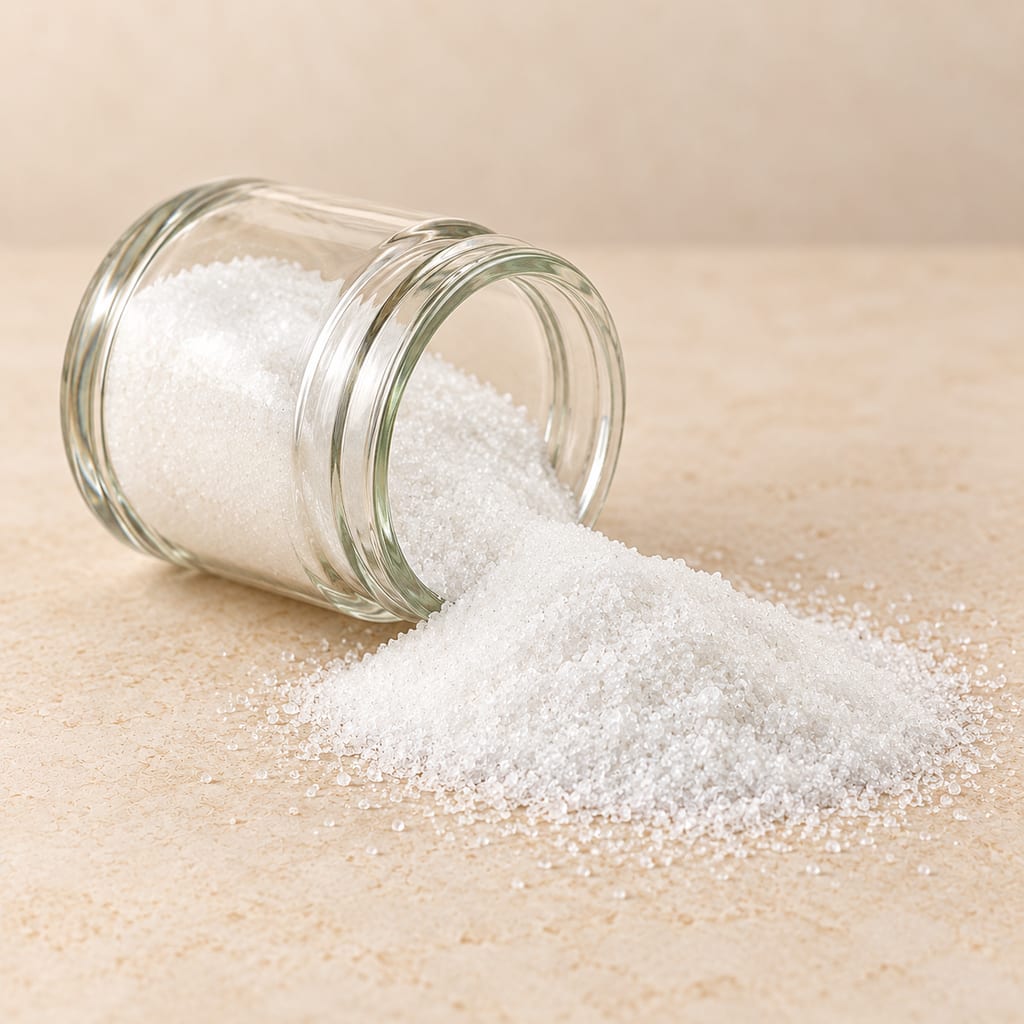
For the cook, either form appears as a white or colorless, odorless crystalline solid: it may be sold as clear crystals, granules or a finer powder. The texture depends partly on the product’s grade and how it was milled. Citric acid dissolves very readily in water, which is why a recipe can first dissolve the crystals in water before adding them to milk or another liquid. In a dry ingredient blend it remains a fine granular or powdered acid until moisture reaches it. Its taste is sharply sour, but it does not smell of lemon; the familiar citrus association comes from its name and use, not from volatile lemon aroma compounds.
JECFA calls it INS 330 and lists its food functions as acidifier, sequestrant, antioxidant synergist and flavouring agent. A sequestrant binds certain metal ions, such as calcium or iron, and can change their availability in a food. “Antioxidant synergist” means it can support other antioxidant systems by tying up metals that otherwise promote oxidation; it is not itself a universal preservative or a guarantee against rancidity. The same substance can sharpen a drink, help manage a product’s acidity or alter mineral balance, but the purpose and effect depend on the food around it.
Citric acid’s acidity is not a single on/off switch. In water it can release hydrogen ions in stages, while the food’s other ingredients buffer those changes. A spoonful added to a strongly buffered milk, for example, does not produce the same pH shift as that quantity dissolved in plain water. This is why ingredient quantity alone cannot be transferred casually between recipes. Neither a sour taste nor a low pH reading by itself proves that a preserved food is microbiologically safe.
Sources for this section
What acid does to milk
Milk is a buffered mixture, not a glass of water. Its proteins include casein, assembled in tiny structures called micelles, with calcium phosphate associated with them. Acidification changes the balance of electrical charges and minerals around those proteins. As the pH falls, some colloidal calcium phosphate dissolves and calcium shifts between the solid curd and the watery serum. The protein network’s mineral content and hydration affect how firm, elastic, moist or meltable a cheese becomes.
Citric acid contributes in two related ways. First, it supplies hydrogen ions that lower pH. Second, citrate can bind calcium ions, changing how much calcium remains associated with the casein network. In controlled mozzarella research, direct acidification with citric or acetic acid produced cheeses whose softness and heating behavior tracked strongly with calcium content; in that study, calcium affected function more directly than pH over the tested range. This is an important corrective to the idea that acid simply “makes milk curdle.” The acid shifts a complicated protein-mineral system, and the resulting curd’s behavior depends on moisture, calcium and the exact process as well as acidity.
That chemistry is distinct from biological acidification. In cultured cheese, lactic-acid bacteria grow and convert lactose into lactic acid over time. Citric-acid mozzarella adds a preformed acid; no starter needs to grow to create that first drop in pH. It is also distinct from rennet coagulation. Rennet enzymes act on casein and help form the gel that traps milk fat and water. An acid can alter the conditions in which proteins behave, but it does not perform the same enzymatic job as rennet. In the quick mozzarella recipe, both acid and rennet are used for different parts of the transformation.
Sources for this section
Why it appears in quick mozzarella
The Utah State University Wasatch County cooking-class recipe uses one gallon of whole milk, one and a half teaspoons of citric acid dissolved in half a cup of cooled, unchlorinated water, half a teaspoon of liquid rennet diluted separately, and salt. The handout describes warming the milk to “60 degrees” before adding the acid, then to “90 degrees” before adding the rennet, and heating the cut curd with whey to “105 degrees.” It does not state Fahrenheit or Celsius, so those printed numbers cannot serve as complete temperature instructions without clarification from the publisher. The sequence is clear: acid first, rennet after further warming, a short covered curd set, then curd-and-whey heating, draining, microwaving and stretching.
The method compresses a process that cultured mozzarella generally lets unfold over time. Here the citric acid enters at the beginning, so the recipe does not wait for bacteria to make acid from lactose. Rennet still needs its own brief setting phase: it creates the gel that can be cut and handled as curd. Heating and gentle stirring help the cut curds separate from whey and firm. Draining and hand pressing remove free whey; microwaving then makes the curd warm and pliable enough to knead and stretch. These are physical and enzyme-driven operations acting on already acidified milk, not additional fermentation.
The recipe’s short ingredient list should not be mistaken for a universal formula. The source specifies a volume of acid, not its crystal form, pH endpoint, milk buffer capacity or a calibrated dose for every brand of milk. It says microwaves vary, and that the cheese may be refrigerated; it does not provide a measured acid target. Milk differs, and citric acid changes calcium balance as well as pH. The method is therefore best read as a particular home recipe with a specific order and batch size, not a conversion chart for all mozzarella or all milk.
This quick cheese also differs from cultured pasta-filata mozzarella. In a cultured route, lactic bacteria acidify the milk or curd as they grow, and their metabolism contributes to the cheese’s flavor profile. A direct-acid route uses acid already made, bypassing that biological stage. Both are acidified curds that can be stretched when their structure and conditions allow it, but time, flavour development, calcium state and the way acid enters the milk differ. Citric acid is not itself a mozzarella culture, and using a cultured starter is not a like-for-like swap that leaves timing unchanged.
Sources for this section
More than cheese: tartness, browning and minerals
Citric acid is useful anywhere a cook needs a clean, measurable sour note without adding a large volume of liquid or a distinct lemon aroma. Food standards list acidification and flavouring functions; in practice, it appears in drinks, sour sweets, powdered mixes and formulated foods. A manufacturer can use it to balance sweetness, make a tart taste more prominent or adjust the acidity of a product. Because it is odourless, it brings sourness without adding the bouquet of lemon peel or juice.
Its ability to bind metal ions also explains why it can help protect foods from some metal-catalysed changes and why citrate is used in other formulated products. But the word “preservative” needs care. Lowering a food’s pH can discourage some microbes, yet citric acid alone does not sterilize food, destroy every pathogen or make an untested preservation recipe safe. Home canning instructions are deliberately formula-specific: changing the amount or substituting another acid changes the finished acidity. Use citric acid for preservation only in a tested recipe that names it and gives a quantity; do not replace lemon juice, vinegar or another acid on an assumed teaspoon-for-teaspoon basis.
Lemon juice and citric acid overlap chemically but are not interchangeable ingredients in every dish. Juice carries water, citrus aroma, small amounts of sugars and other naturally occurring components; its acidity varies with fruit and product. Powdered citric acid can supply a more concentrated, neutral-tasting acid, but no lemon fragrance. That makes it a useful tool when the recipe wants sourness without extra liquid, while fresh lemon remains the better choice when zest, aroma or juice volume is part of the result. A source-supported recipe may prescribe a specific substitution, but a general conversion should not be inferred from the fact that citric acid is abundant in lemons.
Sources for this section
Choosing, storing and using it
For eating, choose a package explicitly labeled food grade. Citric acid is also sold for cleaning and industrial uses, and the shared chemical name does not establish that every grade meets food specifications. The regulated and compendial identity is specific: the Food Chemicals Codex describes colorless crystals or white crystalline powder in anhydrous or monohydrate form; JECFA sets purity and identification criteria for food additive material. Where a recipe depends on a measured dose, follow the product form and measurement unit it specifies. Powder can be scooped by volume more easily than coarse crystals, but the same spoon volume can hold different masses depending on crystal size and packing.
A tightly closed, dry container helps keep a fine powder easy to measure and dissolve. The monohydrate can lose its water of crystallization in dry air, a change called efflorescence; the chemical specification records this as a property of the material. Product labels may give their own storage guidance, but a universal shelf life should not be assumed from another brand’s page. If an ingredient has become damp, contaminated or is no longer clearly identified as food grade, do not rely on appearance alone to establish suitability.
In the kitchen, dissolve crystals thoroughly in the liquid the tested recipe specifies, then add them in the stated order. A small, fully dissolved quantity distributes more evenly than crystals tipped into a concentrated patch. In dairy, order matters because the milk’s pH and calcium state affect both rennet set and curd texture. For drinks and sweets, add modestly and taste only when the recipe permits; citric acid tastes sharper than lemon juice’s rounded combination of acid, aroma and fruit solids. In cheese, keep the batch and procedure as written: the Utah recipe’s citric-acid method is not a general permission to improvise mozzarella acidity or storage limits.
Sources for this section
Places
Unknown
Documented preparation · Place not establishedCitric acid occurs in multiple fruits and is produced in many places; a single ingredient origin is not established.