Red flakes with a regional name
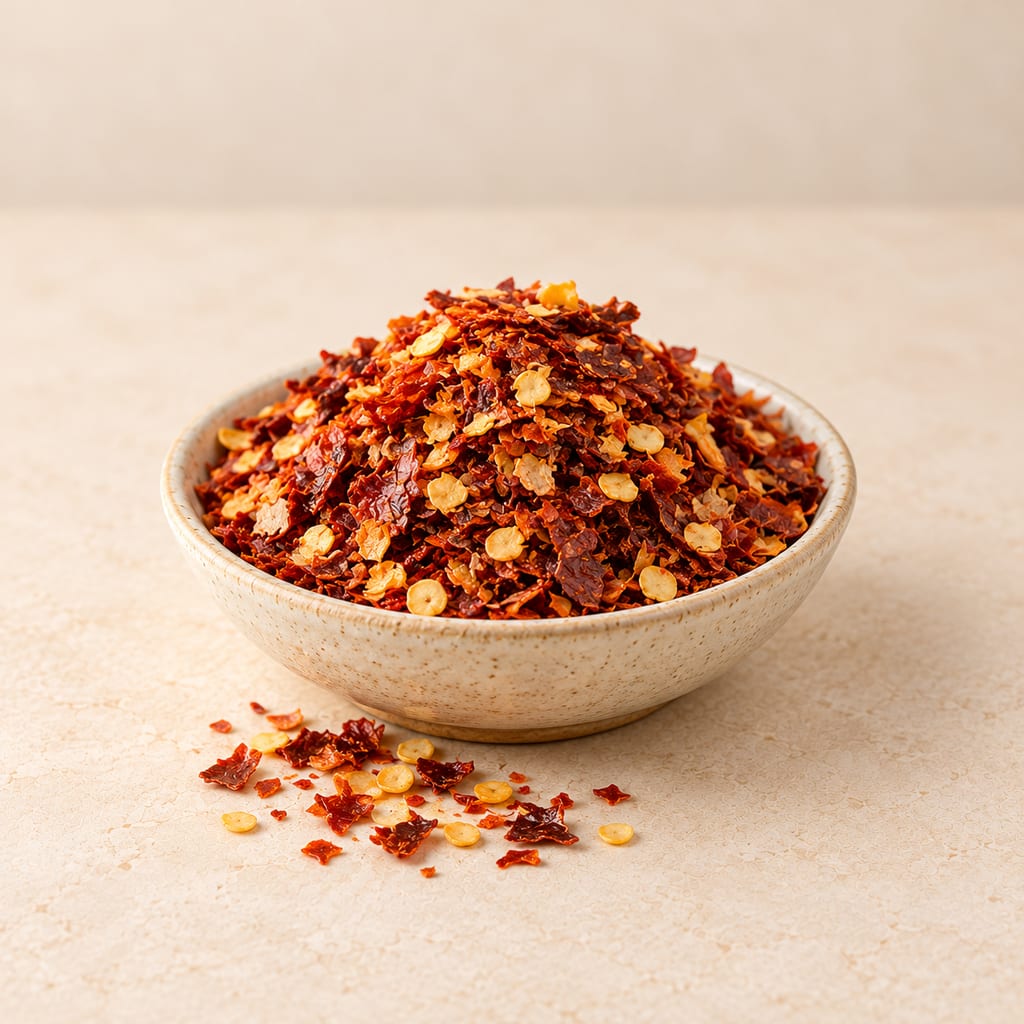
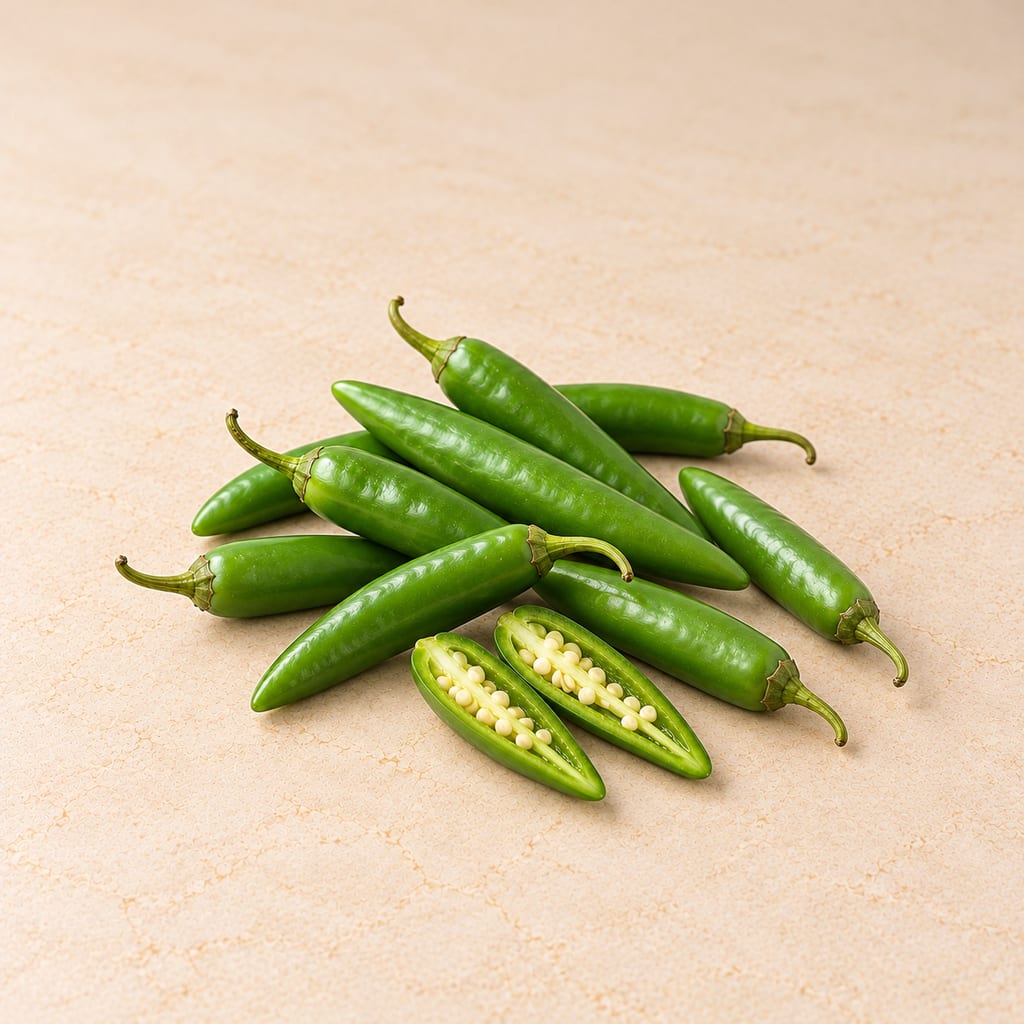
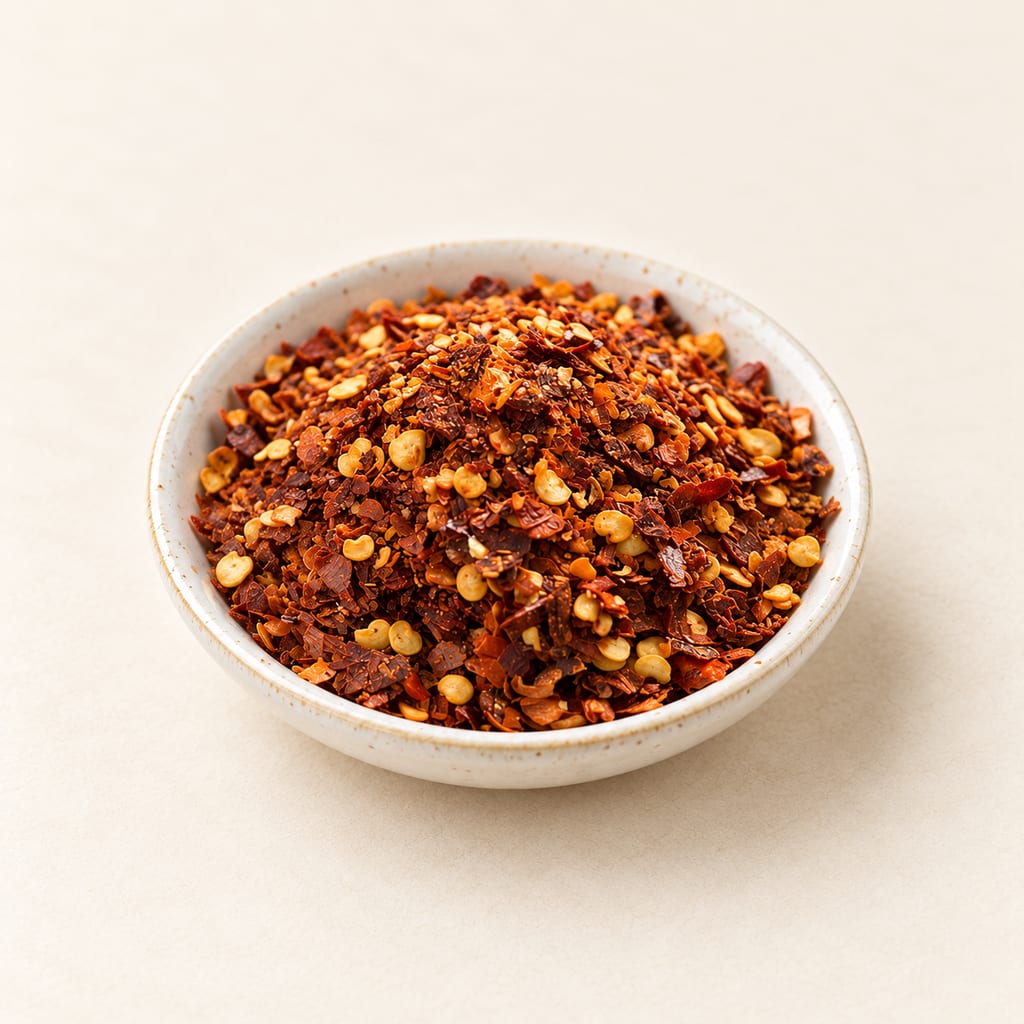
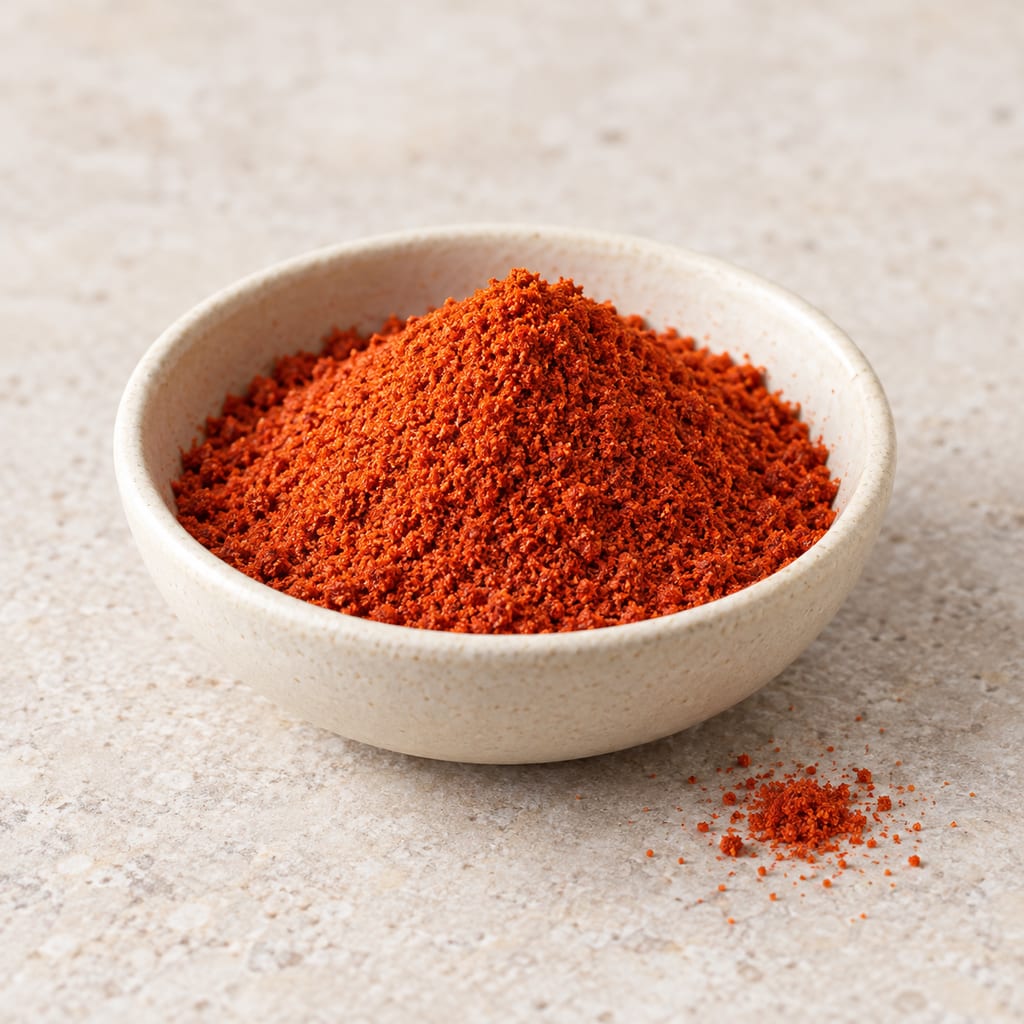
Calabrian pepper flakes are dried red chilli peppers from the toe of Italy, crushed into coarse, irregular pieces. They are brick red to deep carmine, with yellow showing only where the seed is left in. The same pepper is also sold fresh, dried whole, strung in garlands called collane, and ground to a fine powder. In Italian the pepper is peperoncino; its traditional Calabrian name is cancaricchio.
Pepper here has nothing to do with black pepper. The word was given to the fruit of Capsicum by Europeans who hoped it would replace the expensive spice from Asia, and it stuck; the plant is a member of the nightshade family and a native of the Americas, and its accepted botanical name is Capsicum annuum L.
Flakes are the form a cook reaches for when a dish should show the pepper. Whole dried peppers are brittle and awkward to measure, powder dissolves into the food, and flakes are the coarse middle: they can be spooned, they scatter, and they stay visible.
The name is more than a place on a jar. Peperoncino di Calabria is a protected geographical indication of the European Union, registered in 2026, and it covers the fresh and dried fruit of Capsicum annuum grown in Calabria in sixteen named varieties. The ordinary phrase Calabrian pepper flakes also turns up on products that do not carry the protected name, and neither the phrase nor a red colour tells you which variety, which heat or which harvest is inside.
Sources for this section
An American fruit in the Mediterranean
Capsicum annuum is a plant of the Americas. Its domestication happened in Mexico, over a long time and across a wide area: archaeologists, botanists and ecologists combining ancient seed finds, site locations and ecological modelling propose a geographically diffuse process with at least two separate events, with early encounters between wild Capsicum and people in lowland regions such as the Yucatán Peninsula and the coast of southern Guerrero rather than in highland caves, as earlier work had assumed.
The plant crossed the Atlantic with the Spanish. It was noted on Columbus's second voyage in 1493 and was introduced into Spain in the first years of the sixteenth century. It was cheap and grew well in temperate climates, and many people saw it as a substitute for black pepper. The hope faded in most of Europe, and only traces of that early interest remain in countries once under Spanish influence. Calabria is the exception. There the plant took root and came to stand for the region's cooking.
Sources for this section
How Calabria made the pepper its own
The documentary trail starts in the nineteenth century. By 1863 observers noted that peasants would eat nothing without their fiery peppers. In 1864 the writer Vincenzo Padula, studying the condition of the poor in Calabria, wrote that the poor man's lard was a store of peppers. An unpublished manuscript of 1883 in the State Archive of Cosenza notes that the rich and the poor felt differently about the cancaricchio. Where the pepper in other countries was a failed substitute for pepper, in Calabria it did a larger job: it gave flavour to a monotonous and insufficient diet.
Norman Douglas, in Old Calabria (1915), recorded a love of red pepper peculiar to the region, eaten voraciously in every form and above all in red sausages seasoned with it, which he saw at Morano. He guessed that Saracens had brought the taste, which cannot be right for a crop of American origin. Today the strings of peppers drying on house fronts are part of the look of Calabrian towns, the pepper is a protection against bad luck and the evil eye, and it appears in folk medicine, proverb and festival. The Peperoncino Festival has run at Diamante since 1992; a pepper museum stands in nearby Maierà; and a consortium of growers has existed since 2016. Pepper is indispensable in the dressings for struncatura and fileja, two pasta shapes native to Calabria, and regional cookery books are full of recipes for it: one history of the pepper appends 85, and another collection holds more than a hundred.
Sources for this section
The plant and its fruit
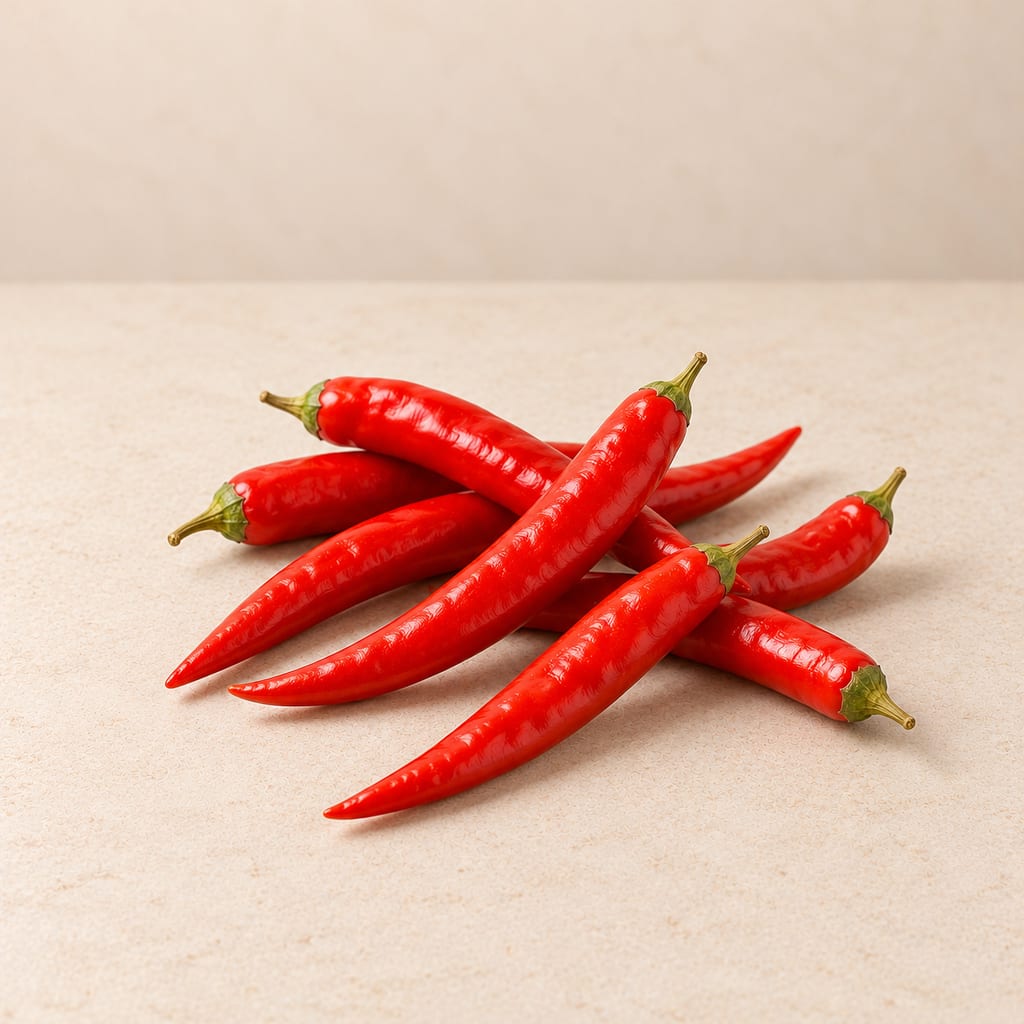
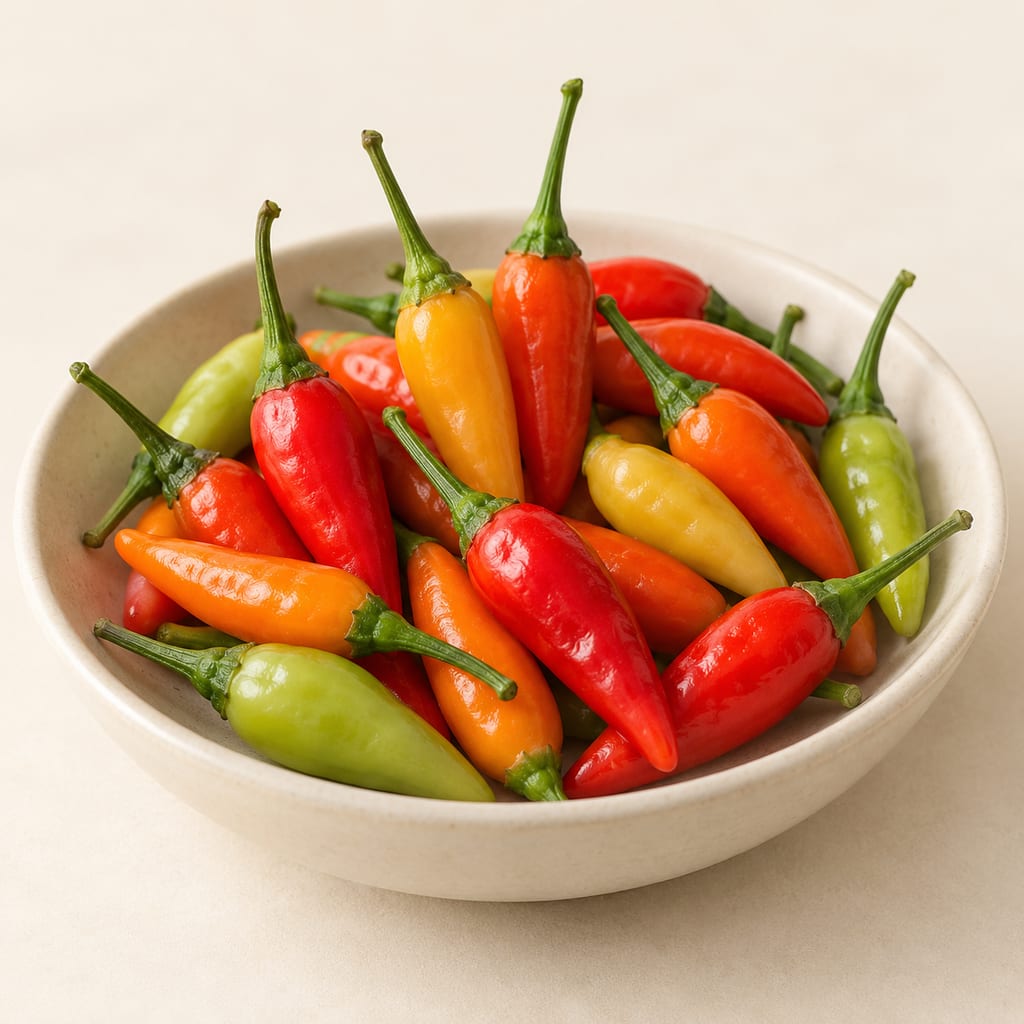
The protected pepper is not one cultivar. The specification lists sixteen varieties of Capsicum annuum: Amando, Barbarian, Corno di capra, Cayenna, Ciliegia, Pinocchio, Red devil, Rodeo, Picaro, Shakira, Trottolino amoroso (locally Naso di cane), Vulcan, Sigaretta, Calabrese, Pizzitano and Jalapeno. The fruit are either conical, tapering, sometimes with a curved tip, 3 to 25 cm long, or round like a cherry, 1 to 4 cm across.
Because the plant ripens gradually, a field is picked by hand every eight to ten days between early June and January, or mechanically once about 80 per cent of the fruit has ripened. The Mediterranean climate of Calabria, which has a long warm season with no extreme swings in temperature and some summer water stress, is credited with the capsaicinoid content that gives the pepper its heat. The fresh fruit has a penetrating aroma with herbal and fruity notes, which come from a volatile fraction rich in aldehydes and alcohols that varies with variety, soil, climate and origin. Calabria is the tip of the Italian peninsula, surrounded by 800 km of sea, and its autumns are warmer than its springs, which is when most of the crop is picked.
The crop is propagated by seed sown in trays from January to September and transplanted from March to July in the open field, or from March to November under glass. It is grown conventionally, under the region's integrated-production rules, or organically. The specification requires a rotation of at least two years, caps the planting density at 30,000 plants per hectare in the open and 60,000 under glass, and limits nitrogen to 160 kg, phosphorus to 150 kg and potassium to 300 kg per hectare each year. Irrigation is allowed. The two best-known names on the list, Cayenna and Jalapeno, show how little separates a Calabrian pepper from chillies grown elsewhere: the protected name is about where the crop is grown and dried, not about a variety found nowhere else.
Heat comes from capsaicinoids, which the fruit makes mostly in the placental septum, the tissue that carries the seeds. In a few extremely pungent varieties the pericarp, the fleshy wall, makes them as well. Capsaicin is concentrated in the membranes and seeds, so removing them reduces the heat of a dish. The protected product is rated medium-high, from 5,000 to 70,000 Scoville heat units, which is wide: a mild variety and a hot one fall under the same name.
Sources for this section
Drying and milling
Fruit for drying is picked fully red, washed, sorted and laid out to dry on cloths or racks in airy, dry rooms. For garlands, the stems are tied or threaded on string 20 to 120 cm long and hung in a sheltered, dry, well-ventilated place for 30 to 90 days. Whole or cut peppers can finish drying naturally or in an oven at not more than 55 °C. In every case the product must end with a moisture content of no more than 15 per cent.
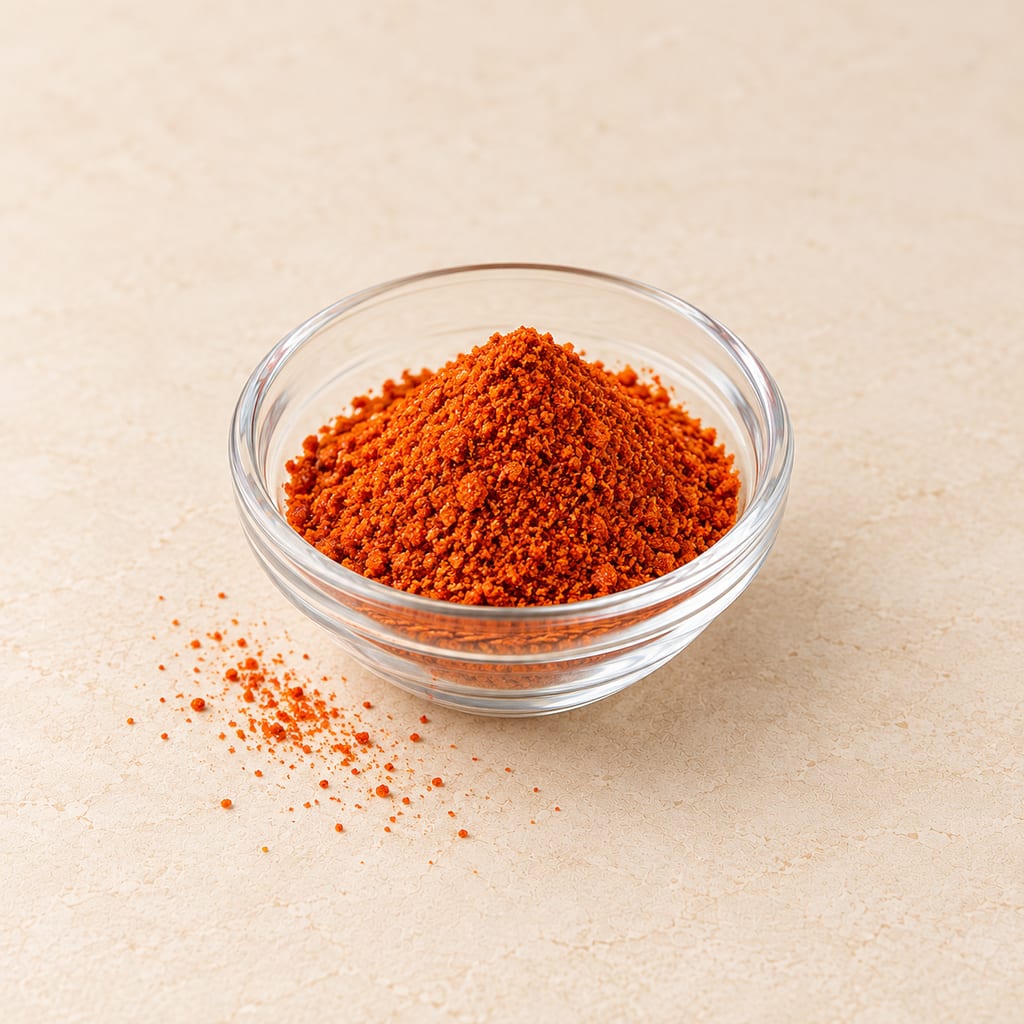
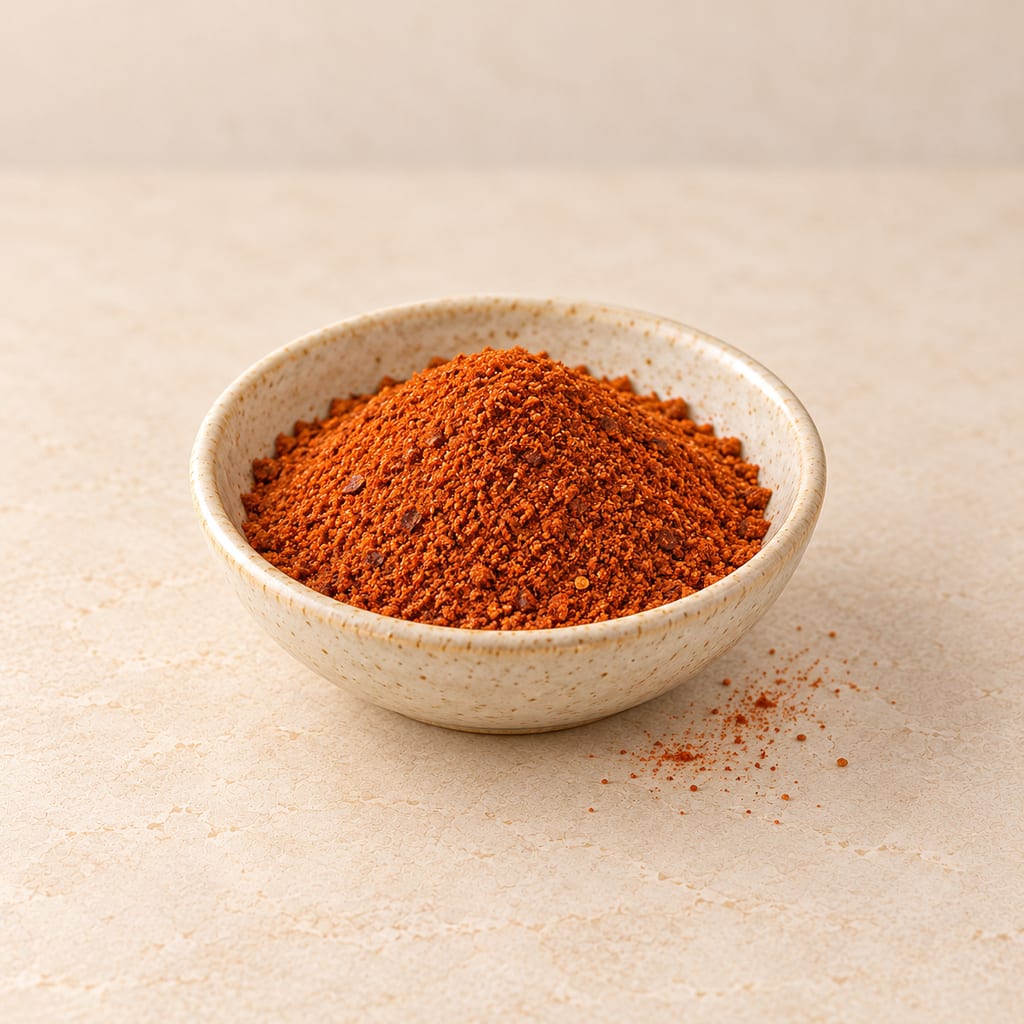
Flakes and powder follow the same route and are then ground. The dried pepper is dried on racks or in low-temperature ovens, again not above 55 °C, until it reaches 15 per cent moisture, the stem is removed, and the pepper is milled, with or without seeds, into flakes or fine powder and packed within 24 hours. Between drying and packing it is kept in humidity-controlled rooms so that it cannot take up water. A flake is therefore a coarse piece of dried pepper, and the seed that comes with it, if any, is a choice of the producer. The specification sets no particle-size grade for flakes, so one bag may contain larger or smaller pieces than another.
Sources for this section
What the protected name guarantees
The European regulation registering the name was adopted on 4 June 2026 and published on 11 June, and entered into force twenty days later. Production and drying have to take place in Calabria; the pepper may be packed outside the region. Dried ground pepper is sold in sealed containers of up to 10 kg, whole dried pepper in containers of up to 3 kg, and garlands loose or packed. The label names the product as Peperoncino di Calabria IGP, with the logo and the European symbol, and may say the physical form: fresh, dried in garlands, dried whole or in pieces, or dried as flakes or powder. A producer may also say whether it was dried naturally or in an oven.
The protected name rests on reputation. Since the 1990s the name has spread through trade and through the labels of processed foods that list the pepper as an ingredient, and American and Australian websites now write of Calabrian chilis or Calabria peppers as a pepper with a distinctive aroma and heat. In Calabria the pepper has its own calendar of festivals: the Peperoncino Festival at Diamante, a pepper fair at Castelsilano in August, a pepper festival at Cerchiara di Calabria on the third Saturday of September, the Notte piccante at Catanzaro, and a travelling Peperoncino Jazz Festival that reached its twenty-third edition in 2024.
The name does not set the cultivar, the seed content, the grind or a heat for the flakes, only a range. A bag marked only as Calabrian is a producer's or shop's description and carries none of those guarantees.
Sources for this section
In the kitchen and the curing room
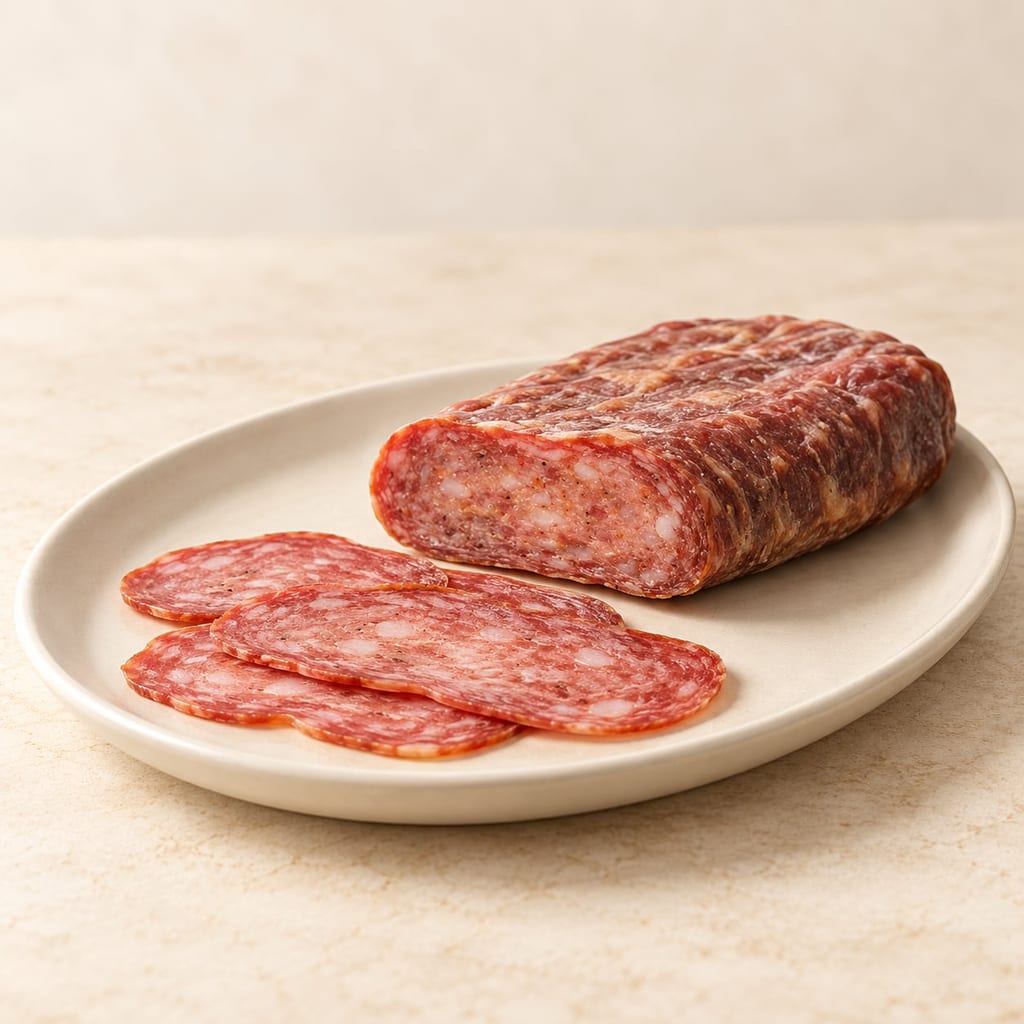
Flakes sit between whole dried pepper and powder. Because they are coarse, they stay visible as red pieces in a dish, where powder disappears into it. In Calabrian cooking the pepper is a base seasoning rather than a garnish. It dresses the local pasta shapes struncatura and fileja, it seasons home preparations, and it goes into sausages, as it did in the red sausages Douglas saw at Morano.
In cured meat the flakes can be used alongside the powder. A modern formula for soppressata di Calabria weighs 2.27 g of Calabrian pepper flakes and 15.89 g of Calabrian pepper powder, separately, into 2,270 g of minced meat and fat, which it ferments with a starter culture before the sausages dry. The pepper takes no part in the fermentation; the starter culture does that, and the pepper seasons the meat.
Sources for this section
Choosing, storing and handling
The dried protected pepper ranges from brick red to deep carmine, with yellow parts only where seed is included, and its moisture is capped at 15 per cent. Producers pack the ground product within a day of milling and keep it in humidity-controlled rooms so that the moisture cannot rise, which is why a flake should be stored dry and closed. No shelf life is published for the protected product.
Whether a bag of flakes is milled with its seeds changes what is in it. The specification allows both, and since capsaicin is concentrated in the membranes and seeds, a flake with the seed left in carries more of the heat than one without; the label that says the physical form does not say which it is. The fine-ground form of the same pepper is described on its own page as Calabrian pepper powder.
Hot peppers irritate. Wear gloves, protect the eyes, and wash your hands with soap and water before touching your face.
Sources for this section
Places
Calabria
Traditional preparation · Region evidenceProduction area of the protected Peperoncino di Calabria: the whole administrative territory of the region; production and drying must occur there.
Mexico
Historical attestation · Country evidenceCapsicum annuum was domesticated in Mexico in a diffuse process; this is the origin of the species, not of Calabrian flakes.
Diamante
Modern adaptation · Locality evidenceSeat of the annual Peperoncino Festival; the nearby town of Maiera has a pepper museum.