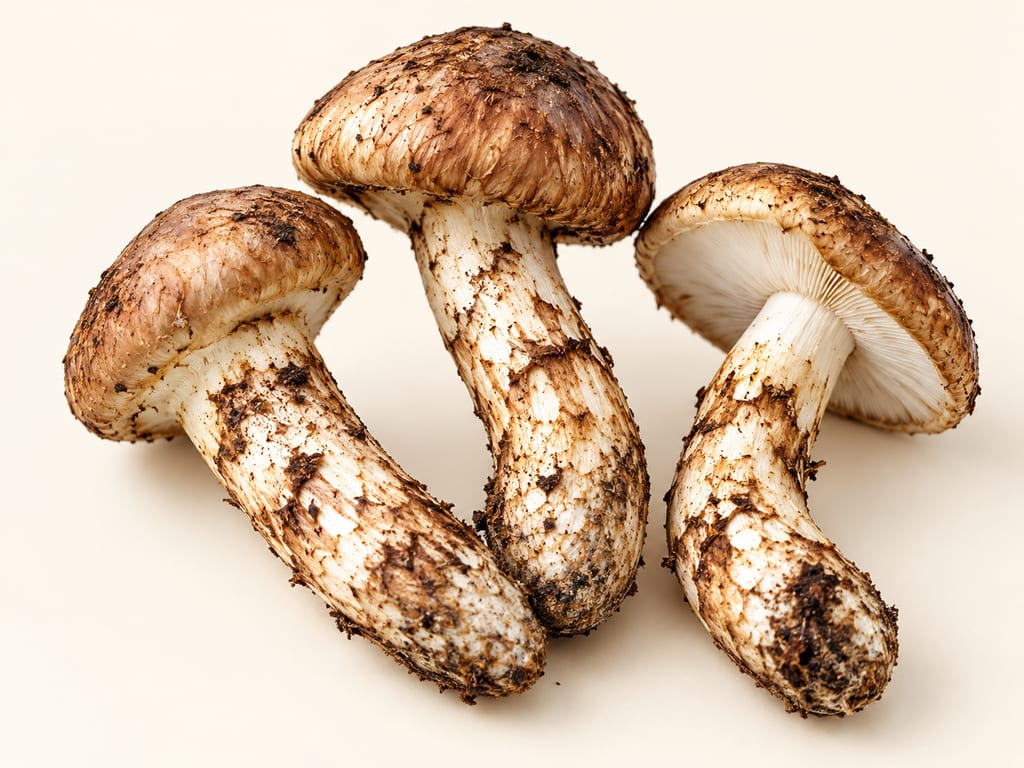
Matsutake
Matsutake is a prized wild ectomycorrhizal mushroom associated with pine and other forest trees, valued especially in Japan, Korea and China for its distinctive spicy aroma, firm texture and seasonal rarity.
 FermenteaWhere food goes to change
Mushrooms
Chanterelles are wild, tree-associated edible mushrooms, particularly the European golden chanterelle Cantharellus cibarius, prized for their firm flesh, fruity aroma and use fresh, frozen, dried or pickled.
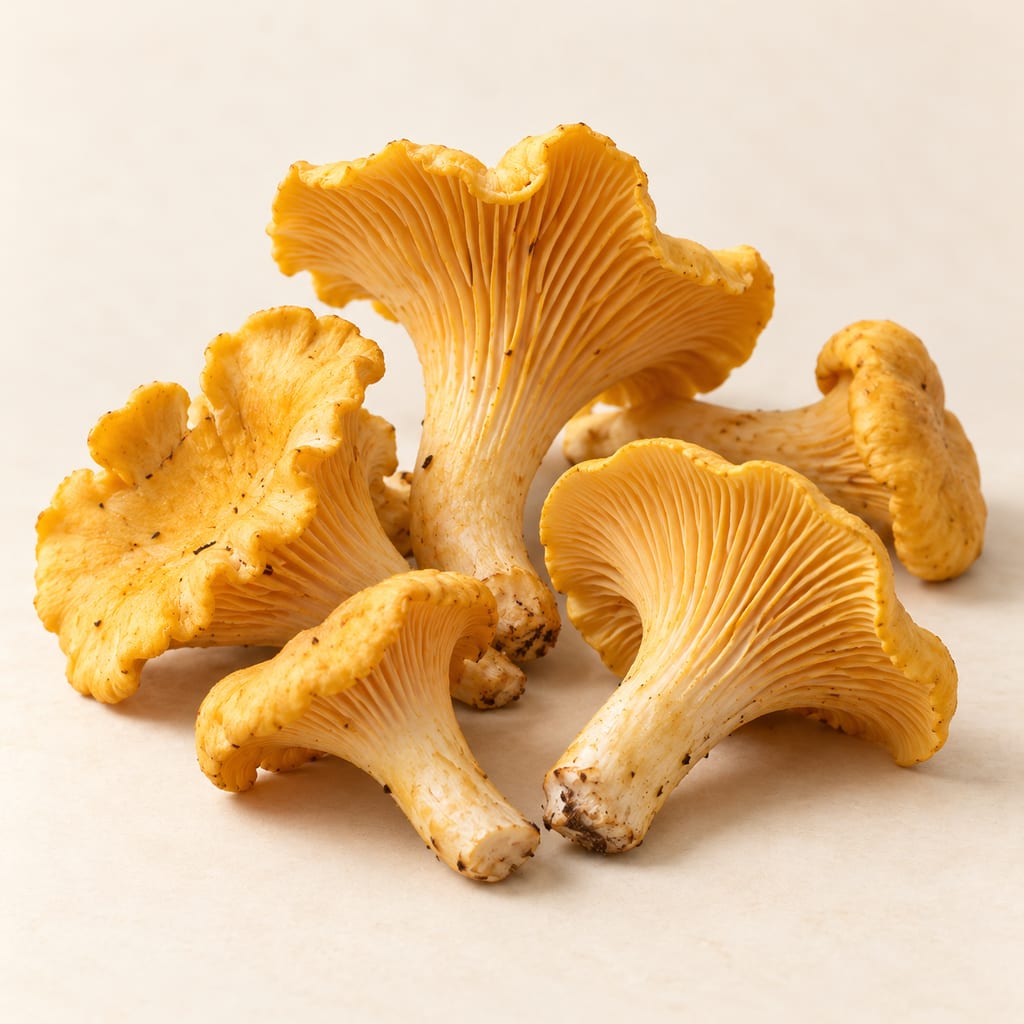
Chanterelles are edible forest mushrooms associated especially with the genus Cantharellus, a group of basidiomycete fungi in the family Cantharellaceae. The most familiar European species is Cantharellus cibarius, called the golden chanterelle, girolle or common chanterelle. The term chanterelle is broader than this one biological species. It is used for several yellow, orange and pale relatives, and sometimes for related mushrooms now classified in Craterellus. A commercial packet labelled chanterelles is therefore not necessarily a packet of genetically confirmed C. cibarius.
A typical golden chanterelle has a firm yellow or golden-orange fruiting body with a cap that becomes shallowly funnel-shaped and often develops an irregular, wavy edge. The underside bears blunt, branching, often interconnected ridges that run down the stem. These are commonly called false gills, but they differ from the thin, separately formed true gills of many other mushrooms. The flesh is usually paler than the outer surface and can have a fruity smell reminiscent of apricots. Size, colour and shape vary with growing conditions and maturity. The mushroom is the reproductive structure of a larger fungus whose mycelium lives in association with tree roots.
Its identity depends on modern taxonomy. A multigene revision of European Cantharellus published in 2017 recognised eight European species and sorted out many older names. Cantharellus cibarius remains the type species of the genus, but pale chanterelles, amethyst chanterelles and certain southern European forms are biologically distinct. Many older North American records of C. cibarius have been reassigned to species such as C. formosus and C. enelensis. In China, edible yellow chanterelles commonly marketed in Yunnan were identified by molecular and morphological analysis as C. yunnanensis rather than C. cibarius.
Fresh chanterelles are prized for their firm, slightly elastic texture and characteristic aroma. They are sold mainly from wild harvesting, although limited experimental cultivation has produced fruiting bodies in association with inoculated trees. They are also dried, frozen, preserved in vinegar or brine and incorporated into processed foods. They can serve as ingredients in fermented dishes or be subjected to experimental microbial processing, but those are separate preparations.
Chanterelles have a long history as European woodland foods, but the date when people first collected them is unknown. The USDA Forest Service's historical review points to Matthias de L'Obel's botanical writing of 1581 as an early European mention. Carolus Clusius recorded vernacular names used in German- and Hungarian-speaking areas in 1601. A later mycological history gives a French name for the mushroom in a seventeenth-century botanical work by Bauhin and Cherler.
Linnaeus used the name Agaricus chantarellus in Species Plantarum, published in 1753, at a time when many fungi were placed under the broad genus Agaricus. Elias Magnus Fries then set the accepted name Cantharellus cibarius in Systema Mycologicum in 1821. These are milestones in scientific nomenclature, not the discovery of an edible mushroom. By the nineteenth century, chanterelles were documented in European regional cooking. A historical study of southwestern France cites an 1840 account describing chanterelles as highly valued around Pontacq, while an 1876 culinary description includes mushrooms cooked with butter, olive oil, tarragon, seasoning and cream or egg yolks. The same research records differences in their popularity between neighbouring French communities.
Northern European collecting traditions also developed unevenly. A recent ethnomycological study reports that the golden chanterelle was among the first wild mushrooms widely adopted by urban Swedish collectors during the late nineteenth century. In Finland, keltavahvero became a familiar and valued edible species, associated particularly with birch and mixed woodlands. In central Europe, the mushroom is known as Pfifferling, kurka and other regional names, and it appears in fresh cooking and preservation traditions.
During the twentieth century, commercial wild-mushroom trade expanded beyond established European markets. US Forest Service research describes increasing collection in the Pacific Northwest during the 1980s, with chanterelles transported to domestic and European buyers. Much of this North American material is now known to belong to species other than European C. cibarius. Similarly, Chinese market records once used the European name for yellow chanterelles from Yunnan. Research published in 2021 showed that many of these are C. yunnanensis, so a market may have sold chanterelles for decades without selling the same species.
Chanterelles are ectomycorrhizal fungi. Their underground hyphae colonise the fine roots of suitable living trees, forming a fungal mantle around root tips and an intercellular network known as the Hartig net. The fungus receives carbon compounds produced through the tree's photosynthesis, while the mycelium helps the host acquire water and mineral nutrients from the surrounding soil. European Cantharellus cibarius grows mainly with birch, beech and oak, and can also associate with conifers. Its relationships are influenced by soil conditions, tree species, moisture and woodland structure. The visible mushroom develops from this larger mycelial system when environmental and physiological conditions permit fruiting.
The chanterelle fruiting body produces sexual spores on specialised cells called basidia, distributed over the ridges beneath the cap. The ridges increase the spore-bearing surface without forming the thin true gills characteristic of many agaric mushrooms. Mature spores are dispersed into the environment, where successful establishment depends on suitable conditions and compatible fungal partners. Fruiting can recur in the same woodland area over successive years because the underground mycelium may persist after the mushroom has disappeared. In Finland, harvesting commonly occurs from late June until September, while British woodland records extend from summer into late autumn. These are regional observations, not one universal fruiting calendar.
Commercial supply comes overwhelmingly from wild forests. Collectors identify suitable mushrooms, remove soil and debris, and transport the harvest in ventilated containers that limit crushing and condensation. Finnish wild-food guidance recommends selecting sound specimens, cleaning them promptly and keeping different species separate. Harvesting practices vary: mushrooms may be cut or carefully lifted, with attention to avoiding unnecessary damage to woodland soil. Research begun by the Oregon Mycological Society in 1986 investigated how repeated picking affected future chanterelle production. Its findings did not support a simple claim that harvesting always reduces subsequent fruiting, although the ecological effects of trampling, intensive collection and forest disturbance still require attention.
Experimental cultivation has gone beyond growing mycelium in a laboratory. Researchers established pure cultures, inoculated tree seedlings and reported greenhouse fruiting bodies of European C. cibarius fruiting bodies in the 1990s. Japanese researchers have also produced fruiting bodies of the related C. anzutake through controlled mycorrhizal associations. After wild harvest, chanterelles may be sorted, cooled, sold fresh, frozen, dried or prepared in vinegar or brine. A 2017 study compared convective drying, freeze drying and vacuum-microwave methods.
The characteristic aroma of chanterelles comes from mixtures of volatile organic compounds produced through fungal metabolism and altered by handling and cooking. A study published in 2017 identified 39 volatile compounds in fresh and dried Cantharellus cibarius. Among the most abundant measured in fresh material were 1-octen-3-ol, 1-hexanol and 2-octen-1-ol. These contribute mushroom-like, green and other odour notes. Other studies find aldehydes, ketones, alcohols and carotenoid-derived compounds as contributors to chanterelle aroma.
Many characteristic mushroom volatiles are associated with the transformation of unsaturated fatty acids, especially linoleic acid. Enzymatic oxidation and subsequent reactions generate eight-carbon alcohols, aldehydes and ketones. Their relative proportions depend on species, maturity, damage and processing conditions. Chanterelle flavour also includes nonvolatile components such as free amino acids, organic acids and nucleotides. Glutamate and aspartate contribute savoury taste, while particular 5-prime nucleotides can modify umami perception. These compounds differ a great deal between species.
Heat changes both texture and aroma. The fungal tissue contains chitin and glucans in its cell walls, together with proteins, soluble carbohydrates and water. Cooking softens the mushroom and drives off moisture, changing how flavours are released into a sauce or cooking fat. Drying produces more complex changes: water is removed, some volatiles are lost and others may be formed or become more prominent. The 2017 drying study found that convective drying at 70–80°C gave favourable sensory results under its experimental conditions. A separate 2005 study compared chanterelles preserved by drying, freezing, olive oil and vinegar and found measurable differences in organic acids and phenolic compounds. These changes are chemical and physical effects, not necessarily microbial fermentation.
Plain chanterelles are non-fermented ingredients. Laboratory research also examines chanterelle proteins, polysaccharides and enzymatically generated flavour ingredients.
Choose fresh chanterelles for secure identification, sound condition and the dish you plan. Good specimens generally have firm flesh, intact caps and a characteristic yellow colour, although colour varies between species and growing conditions. The underside of the European golden chanterelle has blunt, branching ridges that descend onto the stem. These differ from the thin, closely spaced true gills of the false chanterelle, Hygrophoropsis aurantiaca. Other potentially dangerous lookalikes include orange jack-o'-lantern mushrooms in the genus Omphalotus.
Fresh chanterelles deteriorate quickly after picking: the tissue is mostly water and still active. Crushing, retained soil, excessive moisture and poor ventilation can accelerate quality loss. Finnish harvesting guidance recommends removing soil and debris during collection and keeping the mushrooms in airy baskets rather than sealed plastic bags. French government guidance recommends refrigerating collected wild mushrooms at a maximum of 4°C and consuming them within two days. It also advises against eating gathered mushrooms raw and recommends thorough cooking.
For longer storage, chanterelles may be frozen, dried or preserved in vinegar or brine. Drying reduces the water available for microbial growth, but the required conditions depend on the product's size, shape and equipment. A 2023 study investigated ultrasound pretreatment before hot-air drying, showing that the process could alter moisture migration and product quality. Earlier experiments compared freeze drying, vacuum-microwave drying and convective drying, reporting different aroma profiles and rehydration properties. Dried chanterelles must remain protected from moisture, while frozen mushrooms require appropriate frozen storage. Preserved mushrooms should follow the storage conditions of their actual product and process.
Environmental contaminants are another consideration. Wild fungi can accumulate elements from the soil, and contamination varies with species and location. Scientific studies have measured mercury and other potentially toxic elements in chanterelles, with cooking or preservation sometimes changing concentrations through leaching. Radioactive caesium may also be relevant in regions affected by historical fallout. For commercial supplies, species traceability and the condition of the harvesting environment matter. In Scotland, customary collecting for personal use is treated differently from commercial gathering, which requires landowner permission. Harvesting restrictions may also apply in protected woodland or conservation areas.
European golden chanterelles include several closely related species that are easily grouped together in ordinary food trade. Cantharellus cibarius is the principal familiar species. Cantharellus pallens is a paler, often robust European chanterelle, while C. amethysteus may have violet or lilac-toned scales on its cap. Cantharellus friesii is a smaller orange species, and C. ferruginascens is another distinct European taxon. A multigene revision published in 2017 clarified their boundaries and recognised eight European species.
Regional European names reflect old culinary traditions. French girolles and chanterelles are used fresh in sauces, sautéed dishes and mushroom preparations. German Pfifferlinge and Austrian Eierschwammerl are strongly associated with seasonal woodland collection and cooked dishes. Finnish keltavahvero or kantarelli is an especially familiar edible mushroom, often found in birch-dominated woodland. Sweden and Norway use the name kantarell for the golden chanterelle. Poland's kurka or pieprznik jadalny is included in the official list of mushrooms permitted for commercial sale.
Funnel chanterelles, known as trattkantarell in Swedish and suppilovahvero in Finnish, are now generally treated as Craterellus tubaeformis, historically Cantharellus tubaeformis. Yellowfoot chanterelles and black trumpets also belong to related groups rather than being alternative forms of C. cibarius. Their texture, colour, harvesting periods and drying behaviour differ. The distinctions matter in Nordic markets, where several different mushrooms are gathered and sold.
Outside Europe, molecular research has changed the classification. The common golden chanterelle of western North America includes C. formosus and other species, while Newfoundland and Labrador has C. enelensis, formerly identified as European C. cibarius. In Japan, research has separated C. anzutake from mushrooms previously called C. cibarius. Chinese Academy of Sciences researchers showed that yellow chanterelles commonly sold in Yunnan markets are C. yunnanensis rather than European C. cibarius. Additional studies found several distinct or potentially undescribed lineages in southwestern China.
Fresh chanterelles are commonly cooked in butter or oil and served as an accompaniment to meat, fish, eggs, potatoes or vegetables. In French cooking, girolles appear in sautéed preparations, omelettes and sauces, sometimes with cream and herbs. Nineteenth-century French culinary records describe cooking chanterelles with butter, olive oil, tarragon and seasoning, then finishing them with cream, stock or egg yolks. They do not provide a modern validated storage or preservation method. The firm texture of the mushrooms makes them suitable for dishes where individual pieces remain visible rather than dissolving into the sauce.
In Finland, Sweden and other Nordic countries, chanterelles are used in creamy sauces, soups, savoury pies, toast toppings and preparations with potatoes. Fresh chanterelles have a delicate aroma and are cooked soon after picking. Chanterelles may also be frozen or preserved for winter use. In central European cooking, Pfifferlinge and related local forms are served in sauces, with dumplings, potatoes, eggs or meat dishes. Polish kurki are used in seasonal mushroom cooking and preserved preparations.
Preserved chanterelles include dried mushrooms, frozen products and mushrooms kept in vinegar, oil or brine. Drying changes the aroma and texture, so rehydrated chanterelles do not replace fresh ones exactly. A 2005 study found that drying, freezing, oil preservation and vinegar preservation produced different organic-acid and phenolic profiles. When dried mushrooms are rehydrated, some soluble flavour components enter the soaking liquid. The result goes into sauces or soups.
Chanterelles also appear in modern food-processing research. Their proteins, organic acids, polysaccharides and aroma compounds are examined for use in flavour ingredients, extracts and dried food preparations. Research on mushroom protein hydrolysates investigates how enzymatic treatment and controlled heating can generate new savoury and roasted flavours.
Matsutake is a prized wild ectomycorrhizal mushroom associated with pine and other forest trees, valued especially in Japan, Korea and China for its distinctive spicy aroma, firm texture and seasonal rarity.
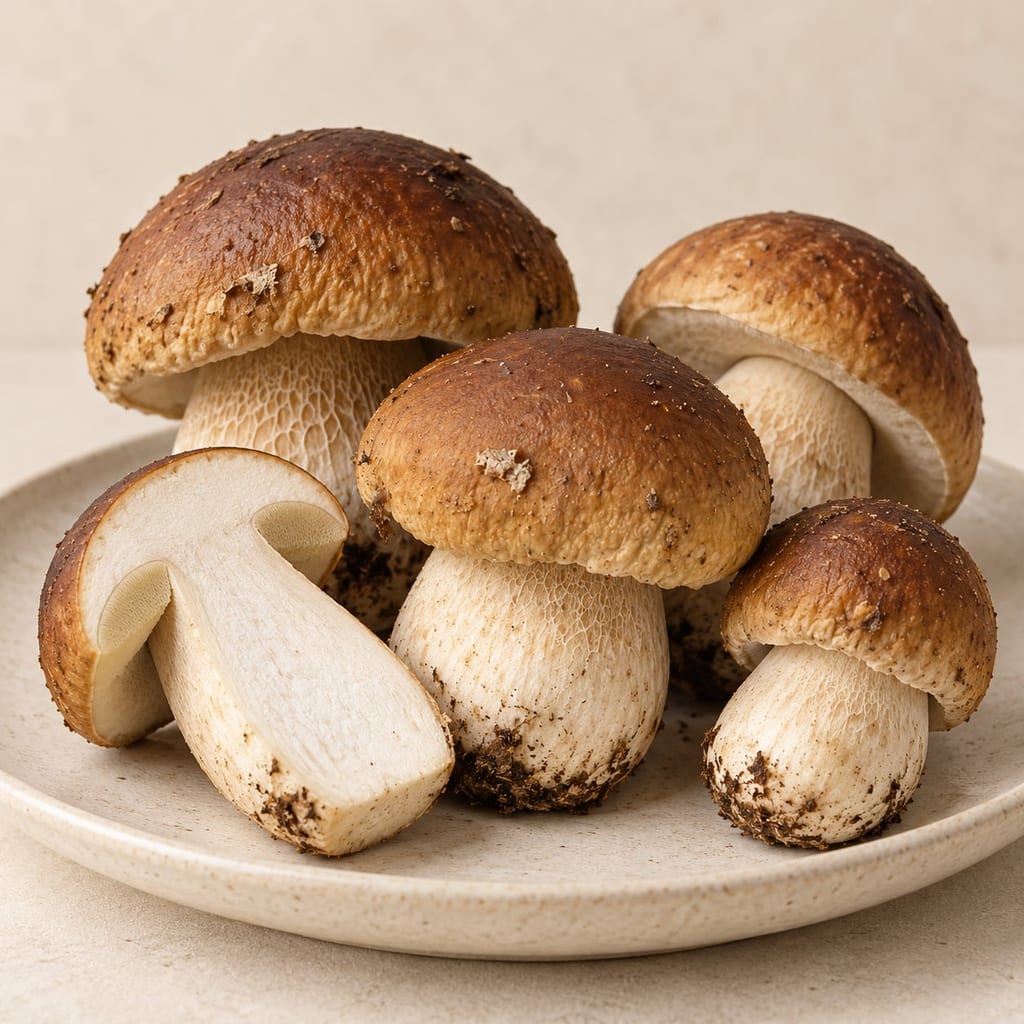
Porcini are prized wild ectomycorrhizal mushrooms from several closely related Boletus species, harvested chiefly from forests and sold fresh, dried or frozen for their firm texture and concentrated savoury aroma.
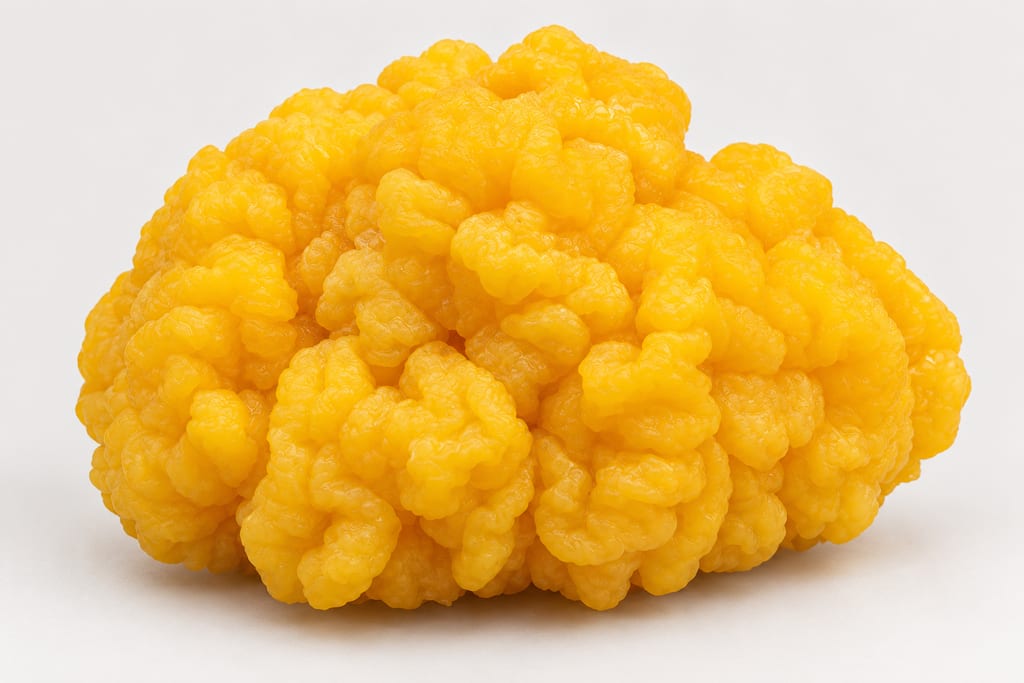
Cultivated golden ear, Naematelia sinensis (jin'er), is a gelatinous yellow-orange fungus of southwestern China, eaten and used as a medicinal fungus and grown on Stereum wood-fungus partners.
Tuber panzhihuanense is a truffle described in 2012 from southwestern China. A 2026 Chinese species catalogue lists it as edible, but its culinary use, host association and safety are not established by the sources reviewed.

A gelling polysaccharide extracted from red seaweeds, sold as kanten strips or powder; it sets firm at a low concentration and stays solid until about 85 °C.

A Dominican table and seasoning condiment of sour orange juice, mixed with lime and salt and bottled raw; garlic, oregano or a hot pepper may be added for meat or a spicier bottle.

Cicerbita alpina is an alpine perennial whose tender shoots and leaves have been eaten raw or cooked. Sámi milk preparations and modern Carnian dishes are distinct uses, with serious identification and preservation limits.

Japanese skipjack tuna cooked, then repeatedly smoked and dried over a wood fire by the hand-fired tebiyama method into a hard block for shaving into dashi: the first stage of katsuobushi.

A Swedish-style spirit vinegar made by fermenting neutral alcohol with live vinegar bacteria, with a separate guide to commercial ättika strengths.

A yeast-raised wheat ring shaped from a firm dough, briefly boiled and baked. This source-batch formula gives a gently malted crust and a chewy crumb.

A warm dip of garlic, anchovy and olive oil, often enriched with butter, that Piedmont serves over a flame with raw and cooked vegetables and bread.

Bechamel is a white sauce of milk thickened with a butter and flour roux, one of the French mother sauces, and the base from which Mornay and other cheese and cream sauces are made.
No community contributions have been published for this entry yet.
Sign in to contribute. Published comments and photos are free to read.
Index Fungorum, Royal Botanic Gardens, KewReference
Cantharellus cibarius Fr. — Nomenclatural RecordAccepted scientific name Cantharellus cibarius Fr.
Publication in Elias Magnus Fries's Systema Mycologicum, volume 1, page 318, in 1821
Index Fungorum registration identifier 200345
Historical typification and later epitypification
Historical synonymy and taxonomic nomenclature
Existence of competing modern family-level classifications
Distinction between a formal scientific description and the earliest human use of the mushroom
Cited in: What it is; Where it comes from and its history
Fungal Diversity, Springer NatureReference
Cantharellus (Cantharellales, Basidiomycota) Revisited in Europe Through a Multigene PhylogenyComprehensive molecular revision of European Cantharellus
Recognition of eight European species using genealogical concordance
Use of ITS2, LSU, RPB2 and TEF-1 sequence data
Clarification of historical European chanterelle names
Epitypification of Cantharellus cibarius
Identification of Cantharellus pallens, C. amethysteus, C. ferruginascens, C. friesii and C. alborufescens as distinct taxa
Description of Cantharellus roseofagotorum
Demonstration that cap colour alone is insufficient for species delimitation
Use of young hymenophore colour, microscopic characters and ecology in distinguishing species
Importance of revising historical species records based on morphology alone
Cited in: What it is; Regional variations and kinds
NatureScot, Scottish Government's Nature AgencyReference
Genetic Scorecard Indicator — ChanterelleIdentification of Cantharellus cibarius as a native ectomycorrhizal fungus in Scotland
Association with Betula, Fagus and Quercus woodland
Occasional occurrence in conifer plantations
Genetic distinction between European and many North American chanterelles
Recognition of a broader historical Cantharellus cibarius species complex
Global, European and Great Britain conservation assessments reported as Least Concern
Assessment of negligible current genetic risk in Scotland
Possible effects of habitat loss and nitrogen deposition
Lack of evidence that ordinary harvesting causes significant population decline
Limited knowledge of local mycelial persistence and population turnover
Cited in: What it is; How it is grown, harvested or made; Regional variations and kinds
Woodland Trust, United KingdomReference
Chanterelle (Cantharellus cibarius)British common names including chanterelle and girolle
Golden-yellow appearance and wavy cap margins
Blunt, branching ridges rather than conventional true gills
Association with British broadleaved and coniferous woodland
Typical summer and autumn fruiting
Distinctive fruity aroma
Potential confusion with false chanterelles and poisonous jack-o'-lantern mushrooms
Importance of reliable mushroom identification
Wild harvesting and culinary use
Cited in: What it is; How it is chosen and stored; How it is eaten and used
Finnish Food Authority, RuokavirastoReference
Keltavahvero eli KantarelliOfficial Finnish identification of Cantharellus cibarius
Finnish common names keltavahvero and kantarelli
Yellow cap and pale interior flesh
Shallow, winding, descending folds beneath the cap
Characteristic fruity aroma
Ecological association with birch-dominated and mixed woodland
Occurrence in pine woodland and other suitable habitats
Distribution concentrated in southern and central Finland
Recognition of the paler Cantharellus pallens as a separate related species
Importance of species identification before collection for food
Cited in: What it is; How it is grown, harvested or made; How it is chosen and stored
Arctic Flavours Association (Arktiset Aromit), FinlandReference
Chanterelle or Golden ChanterelleDescription of the Finnish golden chanterelle
Distribution in southern and central Finland and occasional occurrence farther north
Association with birch and lighter woodland habitats
Finnish harvesting season from late June to September
Difference between false chanterelle gills and true chanterelle ridges
Use of fresh chanterelles in cooked dishes
Traditional freezing and drying
Commercial and household brine preservation
Culinary importance of the fruity aroma
Changes in texture following storage and preservation
Cited in: Where it comes from and its history; How it is grown, harvested or made; How it is chosen and stored; How it is eaten and used
Martat, Finnish Home Economics AssociationReference
ChanterelleFinnish household gathering and cooking practices
Association of chanterelles with birch stands and mixed forest
Long seasonal availability
Characteristically slow growth compared with some other edible mushrooms
Preparation by cooking in their own released moisture
Use of butter and oil for pan cooking
Recommendation to cook chanterelles before freezing
Possible toughness and altered texture after drying or freezing
Different keeping qualities of fresh chanterelles and other wild mushrooms
Use in Finnish household side dishes and seasonings
Chinese Academy of SciencesReference
Edible Yellow Chanterelles Commonly Sold in Mushroom Markets of Yunnan Are Cantharellus yunnanensisHistorical misapplication of Cantharellus cibarius to Chinese market chanterelles
Morphological and molecular study of collections from Yunnan, Guizhou and Jilin
Examination of material gathered between 2007 and 2019
Identification of the common edible Yunnan market chanterelle as Cantharellus yunnanensis
Confirmation of Cantharellus cibarius in northeastern China
Differences between the two species in colour and cap morphology
Use of tef-1-alpha sequence analysis
Chinese culinary trade name jiyoujun
Importance of separating Chinese commercial chanterelles from the European species
Cited in: What it is; Where it comes from and its history; Regional variations and kinds
Genes, MDPIReference
Genetic Analyses of Discrete Geographic Samples of a Golden Chanterelle in Canada Reveal Evidence for Recent Regional DifferentiationRecognition of Cantharellus enelensis as distinct from European C. cibarius
Historical misidentification of eastern Canadian chanterelles
Sampling of 230 fruiting bodies from Newfoundland and Ontario
Study of regional population genetic structure
Evidence of genetic differences among populations
Association of C. enelensis with ectomycorrhizal host plants
Importance of molecular analysis for North American chanterelle identification
Limitations of treating European and North American golden chanterelles as one species
Cited in: What it is; Regional variations and kinds
Oregon Encyclopedia, Oregon Historical Society and Portland State UniversityReference
Chanterelle MushroomsHistorical and modern commercial harvesting of chanterelles in Oregon
Identification of Cantharellus formosus as the Pacific golden chanterelle
Association with Douglas-fir, hemlock and spruce
Selection of the Pacific golden chanterelle as Oregon's state mushroom in 1999
Recognition of other Pacific Northwest chanterelles
Relationship between chanterelle mycelium and tree roots
Influence of weather, soil conditions and tree health on fruiting
Observations of slow development and persistent fruiting bodies
Description of studies comparing cutting and picking
Historical expansion of commercial wild-mushroom gathering
Experimental greenhouse fruiting of European Cantharellus cibarius
Distinction between experimental production and reliable industrial cultivation
Cited in: Where it comes from and its history; How it is grown, harvested or made
Mycoscience, Mycological Society of JapanReference
Cultivation Studies of Edible Ectomycorrhizal Mushrooms: Successful Establishment of Ectomycorrhizal Associations in Vitro and Efficient Production of Fruiting BodiesScientific difficulties of cultivating ectomycorrhizal mushrooms
Dependence on living host plants
Laboratory establishment of fungal cultures and mycorrhizal tree seedlings
Controlled production of fruiting bodies of the Japanese chanterelle Cantharellus anzutake
Successful associations with pine and oak seedlings
Repeated experimental fruiting under controlled conditions
Importance of suitable fungal strains and host plants
Distinction between experimental chanterelle cultivation and routine commercial production
Cited in: How it is grown, harvested or made; Regional variations and kinds
Journal of the Science of Food and Agriculture, WileyReference
Volatile Composition and Sensory Profile of Cantharellus cibarius Fr. as Affected by Drying MethodAnalysis of 39 volatile compounds in fresh and dried chanterelles
Importance of 1-octen-3-ol, 1-hexanol and 2-octen-1-ol in fresh chanterelles
Comparison of convective, freeze, vacuum-microwave and combined drying
Influence of dehydration on volatile compound composition
Experimental convective drying at 70°C and 80°C
Sensory comparison of different drying treatments
Changes in aroma intensity, colour, structure and shrinkage
Different concentrations of measured volatiles in different dried samples
Distinction between experimental drying conditions and validated home-preservation instructions
Cited in: How it is grown, harvested or made; What it does in fermentation and cooking; How it is chosen and stored; How it is eaten and used
Journal of Agricultural and Food Chemistry, American Chemical SocietyReference
Effect of the Conservation Procedure on the Contents of Phenolic Compounds and Organic Acids in Chanterelle (Cantharellus cibarius) MushroomStudy of chanterelles preserved using four different methods
Comparison of drying, freezing, preservation in olive oil and preservation in vinegar
Analysis of phenolic compounds using HPLC
Analysis of organic acids using HPLC
Demonstration that preservation method changes measurable chemical composition
Distinction between vinegar preservation and deliberate microbial fermentation
Limitations of using laboratory chemical changes as evidence of improved nutritional or clinical effects
Cited in: What it does in fermentation and cooking; How it is chosen and stored; How it is eaten and used
Foods, MDPIReference
Effect of Ultrasound Pretreatment on the Moisture Migration and Quality of Cantharellus cibarius Following Hot Air DryingExperimental use of ultrasound pretreatment before hot-air drying
Comparison of ultrasound powers from 0 to 500 W
Reduction of drying time by 18.90% at 400 W in the tested system
Measurement of water mobility using low-field nuclear magnetic resonance
Analysis of internal structural changes using scanning electron microscopy
Effects on rehydration properties
Changes in measured phenolic and flavonoid retention
Experimental processing research rather than a household drying or food-safety standard
Food & Function, Royal Society of ChemistryReference
Insights into Chemical Components, Health-Promoting Effects, and Processing Impact of Golden Chanterelle Mushroom Cantharellus cibariusReview of nutritional and biochemical constituents of golden chanterelles
Presence of carbohydrates, proteins, fatty acids and fungal polysaccharides
Review of aroma-active compounds
Effects of drying and other processing methods on mushroom composition
Research on extracts and isolated mushroom constituents
Difference between in vitro biochemical activity and demonstrated effects from eating mushrooms
Importance of distinguishing experimental medicinal claims from ordinary food use
Cited in: What it does in fermentation and cooking
Journal of Ethnobiology and Ethnomedicine, Springer NatureReference
How Funnel Chanterelle (Craterellus tubaeformis) Became an Urban Forager Favorite in ScandinaviaHistorical differences in wild-mushroom consumption between Nordic regions
Resistance to wild-mushroom eating among some preindustrial Swedish and Norwegian communities
Increased urban interest in gathering golden chanterelles and porcini in the late nineteenth century
Role of field guides, newspapers and mycological education
Distinction between golden chanterelles and funnel chanterelles
Modern Scandinavian commercial gathering and mushroom markets
Evidence that current Nordic mushroom traditions developed at different times
Historical context only; the principal subject of this study is Craterellus tubaeformis rather than Cantharellus cibarius
Cited in: Where it comes from and its history; Regional variations and kinds; How it is eaten and used
Service Public, Direction de l'information légale et administrative, FranceReference
Cueillette de Champignons: Comment Éviter les Intoxications?French public-health guidance updated on 20 October 2026
Risks of confusion between chanterelles and poisonous Omphalotus mushrooms
Importance of collecting only positively identified fungi
Recommendation to retain complete specimens for identification
Advice against relying exclusively on identification applications
Transporting wild mushrooms in ventilated containers rather than plastic bags
Avoiding polluted collection sites
Refrigeration at a maximum of 4°C
Consumption within two days after gathering
Recommendation against eating gathered mushrooms raw
General cooking guidance of 20–30 minutes in a pan or 15 minutes in boiling water with the water discarded
Importance of inspecting damaged, old or deteriorating specimens
Cited in: How it is chosen and stored; How it is eaten and used
Scottish Outdoor Access Code, NatureScotReference
Guidance on Foraging in ScotlandRecognition of customary personal gathering of wild mushrooms
Exclusion of commercial gathering from Scottish statutory access rights
Requirement for landowner permission for commercial mushroom collection
Responsibility to avoid unnecessary disturbance of woodland habitats
Advice to collect only quantities that can reasonably be used
Avoidance of rare species
Importance of protected-area restrictions
General guidance to avoid excessive collection and trampling
Cited in: How it is grown, harvested or made; How it is chosen and stored
Finnish Food Authority, RuokavirastoReference
Sienten Käsittelyohjeet Cesium-137 VähentämiseksiPossible radiocaesium-137 contamination of wild mushrooms in affected regions
Variation in contamination between mushroom species and gathering sites
Methods of reducing radiocaesium through soaking or boiling
Importance of discarding the treatment water
Reported reductions under the specified processing conditions
Distinction between radiocaesium reduction and removal of other contaminants
Importance of separating flavour-preserving culinary methods from decontamination procedures
Cited in: How it is chosen and stored
Publisher via DOIReference
Journal article (DOI) 12a68Cited in: Where it comes from and its history; How it is eaten and used
ElsevierReference
ScienceDirect article S0953756208613167Cited in: Where it comes from and its history; Regional variations and kinds
PubMed CentralReference
PubMed Central article PMC8317506Cited in: Where it comes from and its history; Regional variations and kinds
arktisetaromit.fiReference
Web page harvestingCited in: How it is grown, harvested or made; How it is chosen and stored
ElsevierReference
ScienceDirect article S0308814619301219Cited in: What it does in fermentation and cooking
PubMed CentralReference
PubMed Central article PMC11717058Cited in: What it does in fermentation and cooking
PubMed CentralReference
PubMed Central article PMC10379320Cited in: How it is chosen and stored; How it is eaten and used
Index FungorumReference
Index Fungorum name record namesrecord.aspCited in: Regional variations and kinds