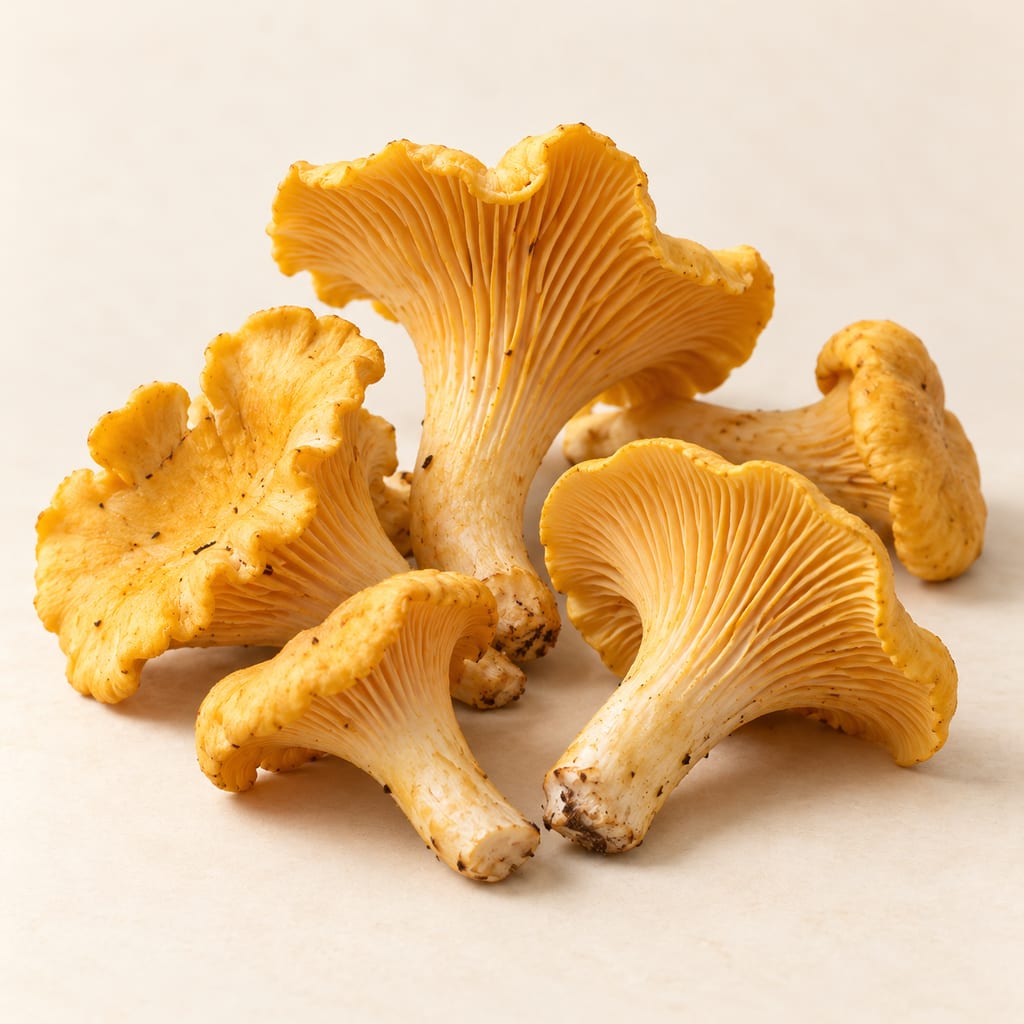
Chanterelles
Chanterelles are wild, tree-associated edible mushrooms, particularly the European golden chanterelle Cantharellus cibarius, prized for their firm flesh, fruity aroma and use fresh, frozen, dried or pickled.
 FermenteaWhere food goes to change
Mushrooms
Porcini are prized wild ectomycorrhizal mushrooms from several closely related Boletus species, harvested chiefly from forests and sold fresh, dried or frozen for their firm texture and concentrated savoury aroma.
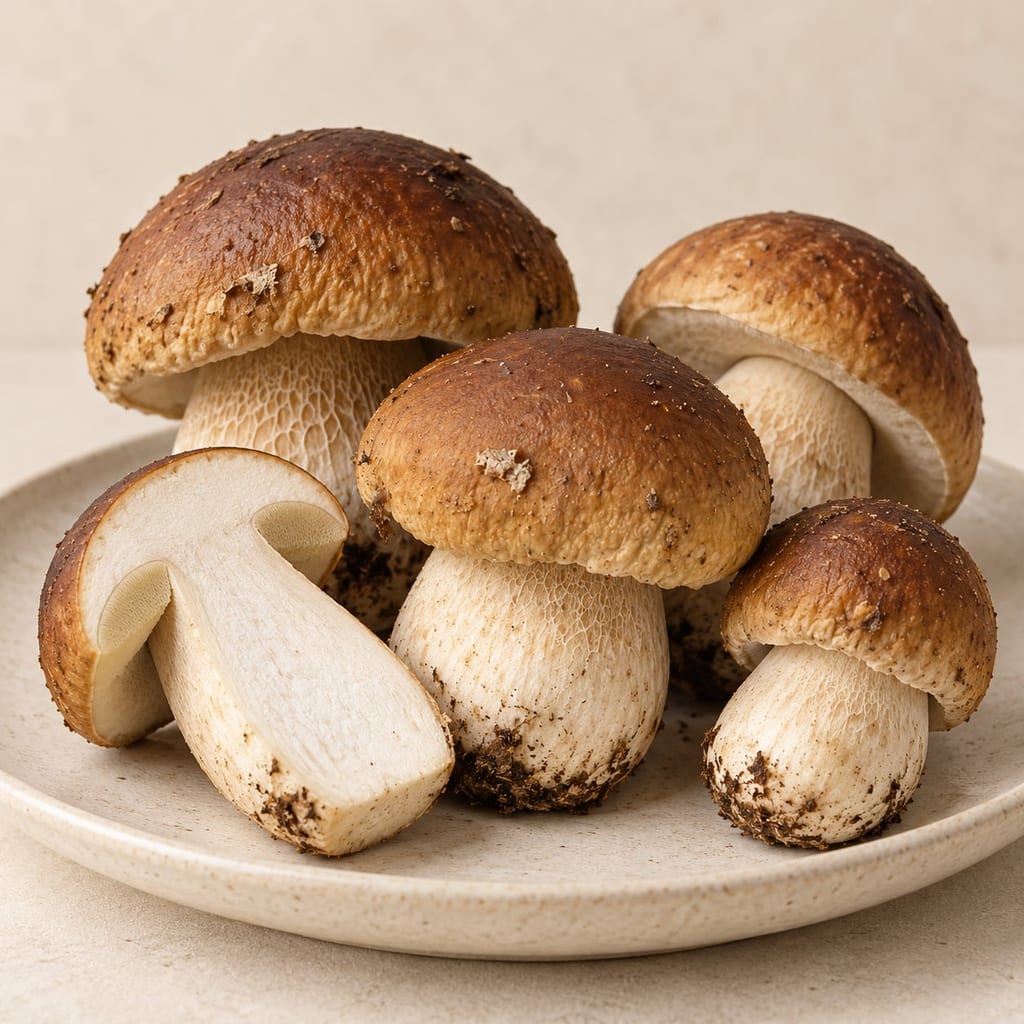
Porcini are edible woodland mushrooms belonging to a closely related group of species in the genus Boletus, family Boletaceae. The best-known is Boletus edulis, the penny bun or king bolete, but the culinary name is broader than that single species. The four principal European porcini are Boletus edulis, Boletus aereus, Boletus reticulatus and Boletus pinophilus. Boletus reticulatus is also widely published as Boletus aestivalis, while Boletus pinophilus was historically called Boletus pinicola. Italy's food regulations explicitly recognise Boletus edulis and its associated group as porcini. Similar-looking species in Asia and North America add further complexity to the international trade.
A typical porcini mushroom has a fleshy brown cap, a thick central stem and a layer of fine tubes beneath the cap. The tubes end in pores rather than the blade-like gills found under many other mushrooms. Young specimens commonly have whitish pores, which become yellowish and eventually olive-green as they mature. The stem often has a raised net-like pattern called reticulation. Boletus edulis generally has firm, pale flesh that does not turn blue when cut. Many unrelated or less desirable boletes also have brown caps, stout stems and pore-bearing undersides.
Porcini are the reproductive fruiting bodies of ectomycorrhizal fungi. The mushroom appearing above the soil is only a temporary structure; the long-lived organism includes microscopic fungal filaments associated with living tree roots. Porcini are therefore fundamentally different from commercially cultivated button mushrooms or oyster mushrooms, which can be produced on prepared compost or agricultural substrates. Attempts to manage porcini production through tree inoculation and forest management exist, but dependable industrial cultivation of fruiting bodies has not replaced wild collection. Fresh, dried and frozen porcini are consequently important commercial forest products.
The Italian name porcini is the plural of porcino, literally little pig. French cèpes, German Steinpilze, Polish borowiki and Finnish herkkutatit overlap with the Italian culinary group, but their precise meanings vary with language and species. Plain fresh or dried porcini are non-fermented ingredients. Their characteristic flavour develops naturally within the fungus and changes during cooking or drying. Fermented mushroom preparations exist, but those are separate products rather than the defining form of porcini.
The European porcini group occurs in temperate forests from northern Europe through central Europe and the Mediterranean region. Its members were gathered as edible wild mushrooms long before the development of modern fungal taxonomy. Old writers used broad words for mushrooms and boletes that do not map onto today's species. Roman authors praised mushrooms, but their most famous example is Amanita caesarea, not porcini, so no Roman text shows that Boletus edulis was eaten. The first securely dated formal scientific descriptions are much later: Jacob Christian Schäffer described Boletus reticulatus in 1774, and Pierre Bulliard published Boletus edulis in 1782.
The Apennine forests around Borgo Val di Taro have one of the best-documented regional trades. Emilia-Romagna's tourism authority associates historical local mushroom trade with writings by Alberto Clemente Cassio, who lived from 1669 to 1760. The precise date and wording of the original passage remain to be checked. The region's food heritage museum records four local porcini species, each with its own traditional name. The trade became more formally organised during the nineteenth century, and the product later received protected geographical indication recognition.
Elsewhere in Europe, porcini became seasonal foods and a staple for drying and preserving. Polish borowik szlachetny has a place in dried mushroom preparations and vinegar-preserved regional foods. Finland's Food Authority says herkkutatti has been a commercial mushroom since the 1990s, with much of the harvest frozen whole for export. French cèpes and German Steinpilze are major market categories, and similar wild-mushroom traditions run through central and eastern Europe.
The modern international trade is much larger than the regions traditionally associated with porcini cooking. A FAO global survey describes Italian traders importing wild boletes from eastern Europe, China and southern Africa, with drying, freezing, brining and grading undertaken across international supply chains. Royal Botanic Gardens, Kew has shown that the wider porcini group holds many unrecognised species, especially outside Europe. DNA analysis of commercial dried porcini has confirmed that some products labelled Boletus edulis contain other related species. So the old European names describe a changing trade category, not one genetically uniform product.
Porcini grow through a symbiotic relationship between fungal mycelium and living trees. Fine fungal filaments colonise the outside of suitable root tips, forming a mantle and an intercellular network called the Hartig net. This is an ectomycorrhizal association: the fungus receives carbohydrates originating from the tree's photosynthesis, while the extended fungal network helps the tree acquire nutrients, particularly nitrogen and phosphorus, and can improve access to water. Boletus edulis associates with several broadleaf and coniferous trees, including beech, oak, birch, spruce and fir. Other porcini species have different ecological preferences. Boletus aereus is especially associated with warmer oak woodland, while Boletus pinophilus is strongly associated with pine. These are ecological tendencies rather than absolute rules.
The familiar mushroom develops when suitable environmental and physiological conditions allow the underground mycelium to form a fruiting body. Young mushrooms expand into a cap and stem. Inside the tubes beneath the cap, specialised cells called basidia produce sexual spores. As the spores mature, the initially pale pore surface becomes yellow and then olive-green. Released spores can establish new fungal mycelia when they encounter suitable conditions and compatible partners. Fruiting is influenced by rainfall, soil moisture, temperature, tree condition and season. Many European porcini appear from summer into autumn, but species, altitude and regional climate change the timing. The presence of a suitable tree does not guarantee fruiting in any particular year.
Harvesting remains predominantly wild. Collectors search suitable forest, identify each mushroom and cut or lift it carefully to disturb the soil and mycelium as little as possible. Responsible harvesting guidance emphasises leaving rare or damaged specimens, avoiding excessive collection and allowing fungi to release spores. Mushrooms are normally carried in ventilated baskets or other suitable containers and separated by species. Fresh porcini deteriorate rapidly because they contain considerable water and remain metabolically active after collection. Slugs, flies and insect larvae also consume the fruiting bodies, so commercial sorting includes checking for internal infestation, decay and physical damage.
After harvesting, porcini may be sold fresh, sliced and dried, frozen, or processed into preserved foods. The Finnish Food Authority describes cutting caps vertically and stems into approximately five-millimetre slices for drying. Italy's 1995 mushroom regulation defines commercial dried mushrooms using a moisture requirement of 12% with a tolerance of two percentage points. Industrial operations may use forced-air, vacuum or freeze drying. A controlled 2018 study compared several methods and found that drying temperature changed which aroma compounds were kept. Reliable industrial cultivation remains difficult because fruiting depends on the fungus's living relationship with tree roots; managing forest habitat does not make the mushroom equivalent to an artificially cultivated compost-grown species.
Porcini have a distinctive aroma produced by mixtures of volatile compounds, especially eight-carbon molecules associated with fungal lipid metabolism. Key examples are 1-octen-3-ol, 1-octen-3-one and 3-octanone. These compounds are associated with mushroom-like, earthy and sometimes buttery odours. A 2018 Food Chemistry study used aroma extraction, chromatography, odour-activity calculations and aroma recombination to identify the most important contributors to the smell of fresh and dried Boletus edulis. In the fresh mushrooms, 1-octen-3-one had the highest calculated odour activity among the measured compounds.
Drying changes this aromatic balance a great deal. Water removal concentrates nonvolatile material on a dry-weight basis, but the aroma cannot be explained by simple concentration because many volatile substances evaporate or react during processing. The 2018 study identified 20 compounds with odour-activity values of at least one in dried porcini, compared with 12 in the fresh material. Methional (3-(methylthio)propanal), 1-octen-3-one and pyrazines mattered most. These contribute cooked-potato-like, mushroom-like and roasted notes. Other drying studies show that convective drying, vacuum microwave drying and freeze drying produce different volatile profiles.
The savoury taste also involves nonvolatile compounds. Porcini contain free amino acids, including glutamate and aspartate, together with nucleotides and other soluble constituents. A University of Turku study measured these taste-related compounds in four Nordic forest mushrooms, including Boletus edulis. It found that umami-linked amino acids mattered, while the umami-enhancing 5-prime nucleotides were comparatively low in the species examined. This matters because the familiar explanation that all mushrooms contain large amounts of guanylate is too general. The quantities differ across fungal species, processing methods and analytical studies. Heating also softens fungal tissue, removes water and changes the way flavour compounds are released into cooking liquids.
Fresh and dried porcini are not fermented, though controlled fermentation has been tried in the laboratory. A 2026 Food Bioscience study compared spontaneous and guided lactic acid fermentation of Boletus edulis using 2.5% salt over six days. The guided process used a defined Lactiplantibacillus plantarum strain and achieved pH below 4.5 within 48 hours, while spontaneous batches showed slower and more variable acidification and included potentially undesirable microorganisms. A separate 2022 study investigated lactic acid bacterial biopreservation of wild mushrooms, including Boletus edulis. That shows what microbes can do to porcini under control; it is not a traditional ferment or a safe home method.
Choose fresh porcini for correct identification, good condition and the dish you plan. Young specimens usually have firm stems, closed or gently rounded caps and a pale, compact pore layer. Older mushrooms may have large, soft, olive-green tubes beneath the cap and may be more vulnerable to insect damage. An old mushroom is not necessarily inedible, but decay, grubs inside and poor storage can ruin it. Check the whole mushroom, not just the cap. The Finnish Food Authority describes the fine raised network on the upper stem of Boletus edulis, its pores changing from whitish to yellow-green and the white flesh that does not turn blue when cut.
Freshly harvested mushrooms require prompt handling. French government safety guidance, updated in October 2026, recommends transporting mushrooms in ventilated containers rather than plastic bags, refrigerating them at no more than 4°C and eating them within two days of gathering. It advises against consuming wild mushrooms raw and recommends thorough cooking. These precautions are especially relevant because porcini are sometimes described in traditional regional cuisine as suitable for raw salads or carpaccio. Keep different species apart, and never eat a mushroom identified only by a phone photograph or app.
For dried porcini, look for identifiable slices with a characteristic mushroom aroma and no evidence of dampness, mould, insect infestation or deterioration. A scientific DNA-barcoding study published in 2023 examined nine commercial dried porcini products and found that only three contained Boletus edulis. Several samples contained other porcini species, while some included visibly deteriorated material and fungi outside the declared group. Buy from traceable suppliers and keep the label. Store thoroughly dried mushrooms in suitable moisture-resistant packaging, away from humidity, heat and direct sunlight, following the manufacturer's instructions.
Wild mushrooms can accumulate environmental contaminants. The European Commission lists wild mushrooms as a dietary source of cadmium. The current EU cadmium maximum for wild fungi is 0.50 mg/kg on a wet-weight basis, under Regulation 2023/915 as amended. Studies of commercially available dried porcini have also measured mercury, lead and arsenic. Radioactive caesium can remain a concern in particular regions affected by historic fallout. The Finnish Food Authority explains that soaking or boiling mushrooms and discarding the water may reduce caesium-137, although the measured reduction depends on the species and treatment. Such processing does not reliably remove every contaminant. Mushrooms from polluted roadsides, industrial locations or contaminated soil should not be picked for food.
The principal European porcini group contains four species with overlapping culinary uses but differing appearance and ecology. Boletus edulis, the classic penny bun or cèpe de Bordeaux, typically has a brown cap, a sturdy pale stem with fine reticulation and white flesh that does not blue when cut. It can associate with both broadleaf and coniferous trees. Boletus aereus, known as the dark cep, bronze bolete or porcino nero, usually has a dark brown to nearly black cap and grows in warmer oak and chestnut woodland. Boletus reticulatus, also called Boletus aestivalis, is a summer-fruiting species with a drier cap that may crack in warm conditions. Boletus pinophilus has a reddish-brown cap and is especially associated with pine.
The protected Italian product Fungo di Borgotaro includes all four European species, not only Boletus edulis. The regional food museum describes B. reticulatus as rosso or fungo del caldo, B. pinophilus as moro, B. aereus as magnan and B. edulis as fungo del freddo. These local names reflect appearance and seasonal tendencies. Emilia-Romagna's tourism authority names the protected production zone around Borgo Val di Taro, Albareto and Pontremoli. The mushrooms must originate from natural growth in the designated territory.
Northern and eastern Europe have their own species distinctions and commercial traditions. Finland recognises three commercially important herkkutatti species: Boletus edulis, Boletus pinophilus and Boletus reticulatus. Poland's borowik szlachetny is Boletus edulis; related boletes have their own names. In France, the word cèpe often covers several premium edible boletes, but cèpe bronzé, cèpe d'été and cèpe des pins are useful species-specific names. German Steinpilz can likewise refer broadly to the group.
Outside Europe, the situation becomes more complicated. Royal Botanic Gardens, Kew describes a much larger evolutionary group of porcini-related species across the Northern Hemisphere and elsewhere. North American king boletes include distinct lineages that have historically been described or sold as Boletus edulis. Asian species can also enter European dried-mushroom markets. DNA analysis of UK-bound commercial porcini found Boletus bainiugan and Boletus meiweiniuganjun in a product marketed under the familiar porcini name. Some porcini-group fungi have also been introduced with exotic tree plantations into parts of the Southern Hemisphere. These records support a broad international culinary category, but biological identities must be verified rather than assuming that every traded porcini is European Boletus edulis.
Fresh porcini have a meaty texture and a savoury, nutty aroma. In Italian cooking, they are commonly sliced and sautéed with olive oil, garlic or parsley, then served as a vegetable accompaniment or incorporated into pasta, risotto, sauces and soups. Young, firm porcini suit dishes in which the mushroom remains recognisable. Larger specimens may be chopped into sauces, stocks or fillings if they remain in good condition. The Fungo di Borgotaro region has established traditions of porcini cooked with olive oil, garlic and parsley or used with local pasta and meat dishes. Some older regional preparations use raw slices, but current French public-health guidance recommends cooking wild mushrooms rather than eating them raw.
Dried porcini matter because drying changes their aroma and lets cooks use them out of season. They are typically rehydrated before being added to risotto, soups, sauces, stews or braised dishes. The soaking liquid carries flavour; strain it for grit and use it only if the mushrooms were sound. Research on Boletus edulis has compared rehydration at different temperatures and found that freeze-dried and conventionally dried tissues absorb water differently. A sensory study found that dried porcini smell roasted, seasoning-like and cocoa-like, quite unlike fresh ones, so one does not simply replace the other.
In France, cèpes are served in sautéed dishes, sauces and preparations with potatoes or meat. Central European kitchens use dried boletes in soups, dumpling accompaniments, cabbage dishes and seasonal sauces. In Poland, dried borowiki flavour mushroom soups and festive dishes. Polish government records also document a regional Kociewie preparation of Boletus edulis preserved in vinegar. In Finland, herkkutatit are cooked fresh, frozen industrially or dried for later use. Powdered dried porcini may be added in relatively small quantities to broths, savoury fillings and sauces.
Porcini also have modern food-processing applications. The European Union's agricultural innovation network documents research with the University of Bologna on a porcini cream made using underused dried mushroom material. Food scientists have investigated dried porcini powders, flavour extracts, controlled drying and fermentation with selected lactic acid bacteria. These developments may create separate products such as mushroom pastes, fermented mushroom preparations or seasoning powders, but their manufacturing methods and safety requirements differ from ordinary fresh porcini. Plain fresh, frozen and dried porcini themselves remain non-fermented ingredients.
Four European porcini are clearly separated by DNA: Boletus edulis, B. aereus, B. reticulatus and B. pinophilus. Inside the penny bun group, DNA could not separate the birch form, B. betulicola, or the pine-heath form, B. pinetorum, but Finnish authors keep both as species on microscopic and ecological grounds, and each has its own page here. Wikipedia lists B. persoonii (white), B. venturii (yellow cap) and B. quercicola as part of the same species complex. Fechtner's bolete, once listed with the porcini, was moved to Butyriboletus after molecular data placed it far from the penny bun.
In short, from the sources. B. edulis has a pale to dark brown cap, viscid when wet, a fine white net clearest at the top of a whitish or brownish stem, pores that are whitish when young and turn yellow-green, white flesh that does not blue, and grows with spruce, pine, fir, beech, oak and other trees in summer and autumn. B. aereus has a dark bronze-brown, slightly velvety cap, a net of stem colour and a hazelnut-like smell, under oak, beech and chestnut in hot weather. B. reticulatus has a velvety cap that cracks in dry weather to show white flesh and a strong net, under oak and other broadleaf trees. B. pinophilus has a reddish-brown cap with a thicker, gelatinous skin and a coarse reddish net, under Scots pine and other conifers. B. betulicola is slender and grows with birch; B. pinetorum has a greyish-brown cap with a wrinkled edge and grows with Scots pine.
The bitter bolete, Tylopilus felleus, is the classic confusion. Its pores are white when young and turn pink with age, and its stem carries a coarse dark brown net on a lighter ground, the reverse of the whitish net on a brownish stem in a penny bun. Its flesh is intensely bitter, cooking makes this worse, and sensitivity to the bitterness varies between people, so tasting is not a safe test. Red- and orange-pored boletes are a different hazard. Satan's bolete, Rubroboletus satanas, has yellow to orange pores that turn red and blue at a touch, a stem running from yellow to carmine at the base, and is described as moderately poisonous, especially raw. The bitter beech bolete, Caloboletus calopus, has a pink-red lower stem, pores that bruise blue and flesh that stays bitter after cooking.
This record is not a field guide. Identification has to be certain, from the whole mushroom and several features together, and checked by an experienced local identifier before anything is eaten. Smell, taste or colour change alone never establish safety.
Chanterelles are wild, tree-associated edible mushrooms, particularly the European golden chanterelle Cantharellus cibarius, prized for their firm flesh, fruity aroma and use fresh, frozen, dried or pickled.
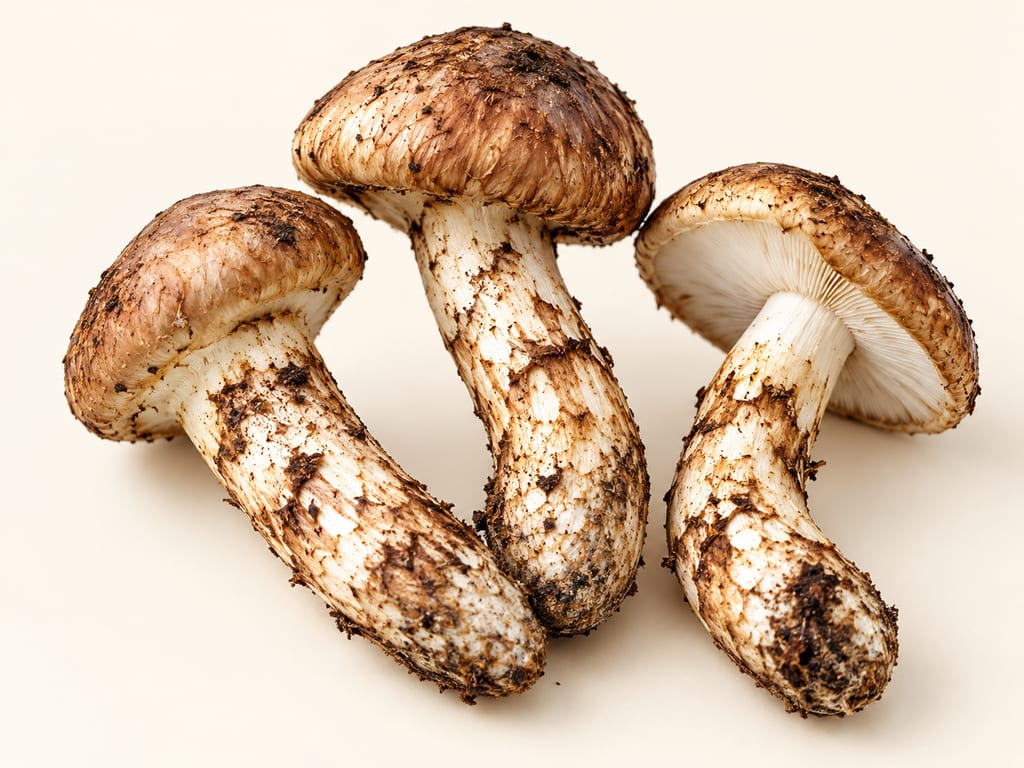
Matsutake is a prized wild ectomycorrhizal mushroom associated with pine and other forest trees, valued especially in Japan, Korea and China for its distinctive spicy aroma, firm texture and seasonal rarity.

Salted mushrooms are a traditional wild-mushroom preserve, especially of Finnish and Russian milk caps, made by layering boiled mushrooms with coarse salt or keeping them under brine, and kept cold.
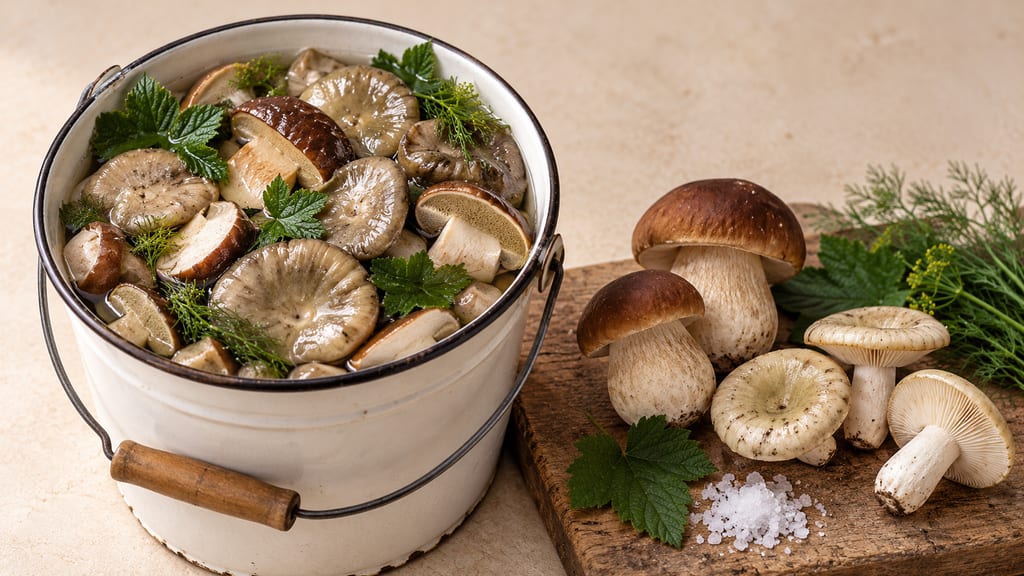
Seto and Russian foragers on the Estonian border still salt russulas and ceps and let them ferment for weeks. What grows in the jar, why it varies, and why the tradition is fading.
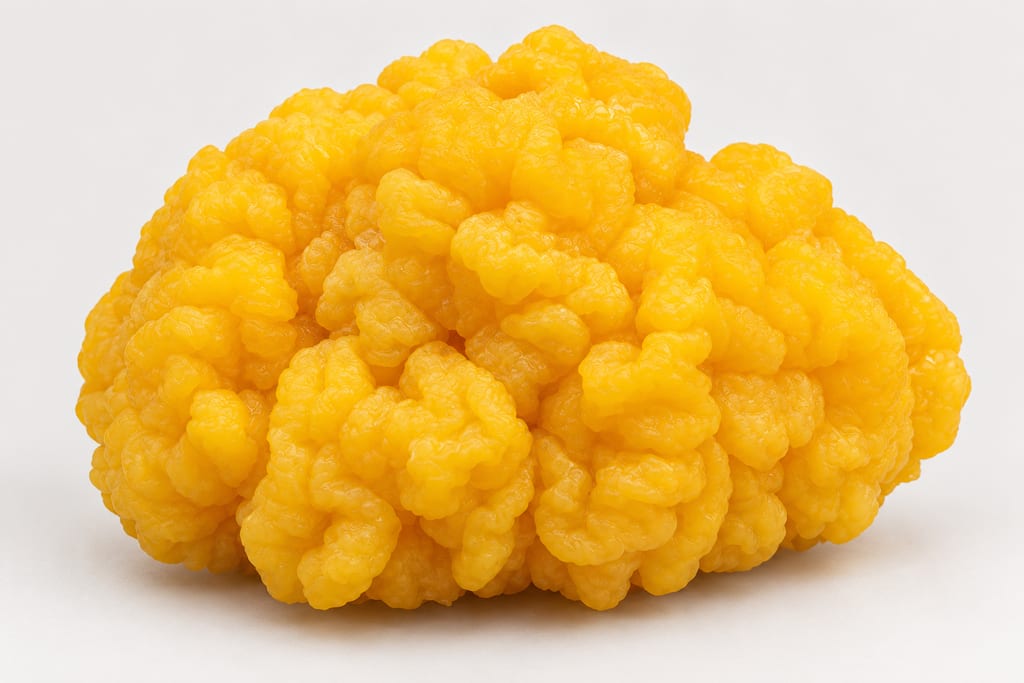
Cultivated golden ear, Naematelia sinensis (jin'er), is a gelatinous yellow-orange fungus of southwestern China, eaten and used as a medicinal fungus and grown on Stereum wood-fungus partners.
Tuber panzhihuanense is a truffle described in 2012 from southwestern China. A 2026 Chinese species catalogue lists it as edible, but its culinary use, host association and safety are not established by the sources reviewed.

A gelling polysaccharide extracted from red seaweeds, sold as kanten strips or powder; it sets firm at a low concentration and stays solid until about 85 °C.

A Dominican table and seasoning condiment of sour orange juice, mixed with lime and salt and bottled raw; garlic, oregano or a hot pepper may be added for meat or a spicier bottle.

Cicerbita alpina is an alpine perennial whose tender shoots and leaves have been eaten raw or cooked. Sámi milk preparations and modern Carnian dishes are distinct uses, with serious identification and preservation limits.

Japanese skipjack tuna cooked, then repeatedly smoked and dried over a wood fire by the hand-fired tebiyama method into a hard block for shaving into dashi: the first stage of katsuobushi.

A Swedish-style spirit vinegar made by fermenting neutral alcohol with live vinegar bacteria, with a separate guide to commercial ättika strengths.

A yeast-raised wheat ring shaped from a firm dough, briefly boiled and baked. This source-batch formula gives a gently malted crust and a chewy crumb.

A warm dip of garlic, anchovy and olive oil, often enriched with butter, that Piedmont serves over a flame with raw and cooked vegetables and bread.

Bechamel is a white sauce of milk thickened with a butter and flour roux, one of the French mother sauces, and the base from which Mornay and other cheese and cream sauces are made.
No community contributions have been published for this entry yet.
Sign in to contribute. Published comments and photos are free to read.
Royal Botanic Gardens, KewReference
Discovering New Species of Porcini Using Food, Phylogenetics and FieldworkPorcini as a group of closely related edible species within Boletus section Boletus
Identification of four principal European species: Boletus edulis, Boletus aereus, Boletus pinophilus and Boletus reticulatus
Meaning of the Italian word porcini
Economic importance of wild porcini
Complex evolutionary history of the porcini group
Discovery of previously unrecognised porcini species through molecular phylogenetics
Detection of new species in commercial dried mushroom products
Diversity of porcini-related fungi in Asia and other regions
Limitations of identifying commercial porcini solely through traditional European species names
Differences between a culinary trade category and a biological species
Cited in: What it is; Where it comes from and its history; How it is grown, harvested or made; Regional variations and kinds
Species Fungorum, Royal Botanic Gardens, Kew and Index FungorumReference
Boletus edulis — Species Fungorum Nomenclatural RecordScientific name Boletus edulis Bull.
Original description attributed to Pierre Bulliard
Historical scientific combinations and synonyms
Taxonomic separation between Boletus edulis and related porcini species
Importance of scientific-name authorities for a taxonomic database
Index FungorumReference
Boletus reticulatus — Index Fungorum Nomenclatural RecordScientific name Boletus reticulatus Schaeff.
Historical scientific description by Jacob Christian Schäffer
Taxonomic distinction between Boletus reticulatus and Boletus edulis
Relationship between accepted names and historical nomenclatural records
Need to verify original publication dates independently
Department for Environment, Food and Rural Affairs, GOV.UKReference
Fungo di BorgotaroFungo di Borgotaro as a protected geographical indication
Original European registration on 21 June 1996
UK scheme registration on 31 December 2020
Identification of the product as an Italian protected food
Distinction between an ordinary porcini trade name and protected geographical origin
Legal recognition of the named regional product
Emilia-Romagna Tourism, Regional Government of Emilia-RomagnaReference
PGI Fungo di BorgotaroProtected gathering area including Borgo Val di Taro and Albareto in Parma
Inclusion of Pontremoli in Massa-Carrara, Tuscany
Recognition of four porcini species within the geographical indication
Historical trade associated with Alberto Clemente Cassio's history of Borgo Val di Taro
Relationship between the mushrooms and their forest tree partners
Local production and seasonal mushroom gathering
Regional culinary preparations involving olive oil, garlic, parsley, pasta and meat
Traditional fresh, dried and preserved mushroom products
Importance of the annual Fiera del Fungo di Borgotaro
Museo del Fungo Porcino di Borgotaro, Musei del CiboReference
Le Specie di PorciniFour porcini species recognised within the Borgotaro food tradition
Boletus edulis and its local name fungo del freddo
Boletus reticulatus or Boletus aestivalis and its names rosso and fungo del caldo
Boletus pinophilus and its local name moro
Boletus aereus and its local name magnan
Morphological descriptions of caps, stems, pores and flesh
Seasonal and habitat differences between the four species
Distinction between regional folk names and scientific species names
Cited in: Where it comes from and its history; Regional variations and kinds
Ministero della Salute, Government of ItalyReference
Commercializzazione dei FunghiItalian regulation of fresh wild mushrooms intended for sale
Application of Presidential Decree 376/1995
Requirements for competent mushroom identification and commercial approval
Official mycological inspection of fresh wild mushrooms
Separate regulatory categories for fresh, dried, frozen, pickled and otherwise preserved fungi
Commercial dried-mushroom moisture requirement of 12% with a tolerance of two percentage points by mass
Distinction between regulations governing different preserved mushroom products
Importance of correct species identification and product labelling
Cited in: What it is; How it is grown, harvested or made; How it is chosen and stored
Ministero della Salute, Government of ItalyReference
Raccolta dei FunghiItalian regulations concerning wild mushroom collection
Role of regional and autonomous-province harvesting rules
National default collection quantity of 3 kg, subject to regional modification
Restrictions on rakes and other damaging collection tools
Advice to collect whole specimens for reliable identification
Importance of not collecting deteriorated or excessively immature specimens
Distinction between collecting for food and commercial sale
Need to consult the rules applying in the actual harvesting area
Finnish Food Authority, RuokavirastoReference
HerkkutatitIdentification of Boletus edulis in Finnish food-mushroom guidance
Recognition of Boletus pinophilus and Boletus reticulatus as related commercial species
Cap, stem, pore and flesh characteristics
White flesh that does not blue in the described porcini group
Characteristic raised net-like pattern on the stem
Association with several host trees, especially spruce
Typical Finnish harvesting seasons
Commercial importance since the 1990s
Industrial freezing of whole mushrooms for export
Drying preparation including approximately 5 mm stem slices
Possibility of confusion with bitter Tylopilus felleus
Distinction between an unpalatable lookalike and a poisonous species
Cited in: What it is; Where it comes from and its history; How it is grown, harvested or made; How it is chosen and stored; Regional variations and kinds; How it is eaten and used
Finnish Food Authority, RuokavirastoReference
Suositeltavat RuokasienetCurrent Finnish advisory list of recommended edible mushroom species
Recognition of Boletus edulis, Boletus pinophilus and Boletus reticulatus
Historical existence of a regulated commercial-mushroom list
Repeal of the previous Finnish commercial-mushroom decree in July 2012
Current responsibility of food businesses for selling safe mushrooms
Distinction between an advisory list and compulsory approval of every wild mushroom collected
Woodland Trust, United KingdomReference
Penny Bun (Boletus edulis)British names penny bun, cep, porcini and king bolete
Recognition of Boletus edulis as a woodland fungus
Summer-to-autumn fruiting season
Occurrence in British broadleaf and coniferous woodland
Association with oak, beech, birch and conifers
Physical appearance of cap, pores and stem
Role of fruiting bodies as food for wildlife
Importance of mature mushrooms for spore production
Culinary use of dried porcini as flavouring
Potential confusion with bitter and otherwise unsuitable boletes
Cited in: What it is; How it is grown, harvested or made; Regional variations and kinds
Scottish Outdoor Access Code, NatureScotReference
Guidance on Foraging in ScotlandLegal distinction between customary personal foraging and commercial collection
Exclusion of commercial mushroom gathering from Scottish statutory access rights
Requirement for landowner permission for commercial harvesting
Recommendations of the Scottish Wild Mushroom Code
Taking only quantities that can reasonably be used
Avoiding rare or unsuitable mushroom species
Allowing mushrooms to mature and release spores
Respecting woodland habitats and the interests of other foragers
Importance of local restrictions and responsible collection practices
Cited in: How it is grown, harvested or made
Food Standards Agency, United KingdomReference
Guidance for Safe ForagingFood-safety precautions for collecting wild fungi
Risk of poisoning from incorrect species identification
Importance of uncontaminated collection sites
Avoiding food gathered from polluted environments
Sustainable gathering practices
Distinction between apparently edible fungi and positively identified food species
Geographical scope of the guidance in England, Wales and Northern Ireland
Service Public, Government of FranceReference
Cueillette de Champignons: Comment Éviter les Intoxications?French public-health advice on safe wild mushroom gathering
Recommendation to transport mushrooms in ventilated containers
Advice to keep different collected species separate
Warning against relying on smartphone identification applications
Recommendation for examination by a competent pharmacist or mycological association if identification is uncertain
Refrigeration at a maximum of 4°C
Consumption within two days after harvesting
Recommendation to cook wild mushrooms thoroughly rather than eat them raw
Published cooking guidance of 20–30 minutes in a pan or 15 minutes in boiling water with the water discarded
Extra caution concerning young children, pregnancy and other susceptible consumers
Distinction between French government consumer guidance and universal legal requirements
Food Control, ElsevierReference
It's What's Inside That Counts: DNA-Barcoding of Porcini (Boletus sp., Basidiomycota) Commercial Products Reveals Product MislabellingDNA-barcoding analysis of nine commercial dried porcini products
Sampling of twelve mushroom pieces from each product, totalling 108 samples
Use of fungal ITS sequencing and phylogenetic analysis
Detection of Boletus edulis in only three of the nine commercial products
Detection of Boletus reticulatus, Boletus aereus and Boletus pinophilus
Identification of Chinese Boletus bainiugan and Boletus meiweiniuganjun in a UK-sold product
Detection of Imleria badia, unidentified boletes and parasitic fungi in some products
Visible decay and insect damage in five of the nine commercial products
Difference between products labelled Boletus edulis and products actually containing that species
Limitations of visual identification after drying
Need for better species traceability in the international porcini trade
Small sample size and need to avoid generalising the findings to every commercial producer
Food Chemistry, ElsevierReference
Characterization and Comparison of Key Aroma Compounds in Raw and Dry Porcini Mushroom (Boletus edulis) by Aroma Extract Dilution Analysis, Quantitation and Aroma Recombination ExperimentsIdentification of aroma-active compounds in fresh and dried Boletus edulis
Use of aroma extraction, quantitation and recombination experiments
Twelve odour-active compounds with odour activity values of at least one in fresh samples
Twenty odour-active compounds with odour activity values of at least one in dried samples
Importance of 1-octen-3-one in fresh porcini aroma
Importance of methional, 1-octen-3-one and pyrazines in dried porcini aroma
Contribution of aldehydes and other compounds to the overall aroma
Changes towards roasted and seasoning-like aroma notes after drying
Distinction between compound concentration and sensory odour activity
Cited in: What it does in fermentation and cooking; How it is eaten and used
Applied Sciences, MDPIReference
Comparative Study of Raw and Dehydrated Boletus edulis Mushrooms by Hot Air and Centrifugal Vacuum Processes: Functional Properties and Fatty Acid and Aroma ProfilesExperimental collection of Boletus edulis from the Avrig region of Romania in 2021
Comparison of hot-air drying with centrifugal vacuum drying
Experimental hot-air treatment at 60°C for 275 minutes
Experimental centrifugal vacuum treatment at 60°C for 749 minutes
Differences in water absorption, solubility and emulsifying properties
Comparison of fatty acid profiles before and after drying
Changes in measured volatile aroma compounds
Relative importance of 1-octen-3-ol within the tested volatile profiles
Loss of particular aldehydes and ketones under the study's drying conditions
Evidence that drying technology affects aroma and food-processing properties
Distinction between laboratory dehydration of mushroom paste and a validated home method for drying whole mushrooms
Cited in: What it does in fermentation and cooking
Food Bioscience, ElsevierReference
To Guide or Not to Guide? Comparison Between Guided and Spontaneous Fermentation of Boletus edulis in Laboratory and Culinary Conditions: Impact on Microbial Population and Aromatic CompoundsExperimental comparison of spontaneous and starter-guided porcini fermentation
Parallel trials in a laboratory and professional kitchen
Use of 2.5% salt over six days
Inoculation with Lactiplantibacillus plantarum UPCCO 4932
Acidification below pH 4.5 within 48 hours in guided batches
Slower and more variable acidification in spontaneous batches
Microbial-community analysis using metagenomics
Detection of potentially undesirable taxa in some spontaneous treatments
Changes in volatile aroma compounds during fermentation
Explicit need for further validation before definitive safety conclusions
Distinction between experimental fermentation and the ordinary non-fermented porcini ingredient
Cited in: What it does in fermentation and cooking; How it is eaten and used
Foods, MDPIReference
Biopreservation of Wild Edible Mushrooms (Boletus edulis, Cantharellus, and Rozites caperata) with Lactic Acid Bacteria Possessing Antimicrobial PropertiesExperimental lactic acid bacterial treatment of wild edible mushrooms including Boletus edulis
Use of selected Lacticaseibacillus casei and Liquorilactobacillus uvarum strains
Comparison of pre-treatments and fermentation outcomes
Effect of fermentation on pH, colour, volatile compounds and microbial growth
Assessment of biogenic amines in fermented mushrooms
Potential food-safety concerns from biogenic amine formation
Need to select suitable strains and processing conditions
Limitations of presenting experimental fermented mushrooms as an established safe household product
Cited in: What it does in fermentation and cooking
Official Journal of the European UnionReference
Commission Regulation (EU) 2023/915 on Maximum Levels for Certain Contaminants in FoodEuropean limits for cadmium and other contaminants in food
Current consolidated regulation, including amendments effective by August 2026
Cadmium maximum of 0.50 mg/kg for wild fungi
Application of the wild-fungi limit on a wet-weight basis
Different treatment of cultivated and wild fungi
Importance of considering concentration changes in dried foods
Distinction between a regulatory maximum and typical concentrations in every porcini sample
Finnish Food Authority, RuokavirastoReference
Sienten Käsittelyohjeet Cesium-137 VähentämiseksiPresence of radiocaesium-137 in some wild mushrooms due to historical radioactive fallout
Variation in contamination between species and harvesting locations
Methods for reducing caesium-137 through soaking and boiling
Potential reduction of 70–90% under the described processing conditions
Importance of discarding contaminated soaking or cooking water
Separate instructions for fresh and dried mushrooms
Distinction between radiocaesium reduction and removal of all other environmental contaminants
Cited in: How it is chosen and stored
Ministry of Agriculture and Rural Development, PolandReference
Kociewski Borowik Szlachetny w Zalewie OctowejRegional Polish tradition of vinegar-preserved Boletus edulis
Registration on Poland's list of traditional products on 24 April 2007
Use of young porcini caps in vinegar-preserved preparations
Description of mushroom, vinegar, onion and mustard flavours
Regional terminology for Boletus edulis
Historical importance of drying and preserving boletes in Polish cooking
Distinction between a traditional preserved product and a validated home-canning procedure
Cited in: Where it comes from and its history; Regional variations and kinds; How it is eaten and used
Food ControlReference
DNA barcoding of commercial dried porcini productsCited in: What it is; Where it comes from and its history; How it is chosen and stored; Regional variations and kinds
Emilia-Romagna TourismReference
Fungo di Borgotaro PGICited in: Where it comes from and its history; How it is grown, harvested or made; Regional variations and kinds; How it is eaten and used
EU CAP NetworkReference
Mushroom-based food preparation: porcini mushroom creamCited in: How it is eaten and used
EUR-LexReference
Commission Regulation (EU) 2023/1510, cadmium in foodstuffsCited in: How it is chosen and stored
Museo del Fungo Porcino di BorgotaroReference
The species of porciniCited in: How it is eaten and used
Journal of Food Quality (Wiley)Reference
Study of aroma compounds in Boletus edulisCited in: How it is grown, harvested or made; What it does in fermentation and cooking
PubMedReference
Study of Boletus edulisCited in: What it does in fermentation and cooking; How it is eaten and used
Ministère de la Santé, FranceReference
Preventing mushroom poisoningCited in: How it is chosen and stored
Food and Agriculture Organization of the United NationsReference
Global survey of the wild mushroom tradeCited in: How it is grown, harvested or made
Food and Agriculture Organization of the United NationsReference
Non-wood forest products: mushroomsCited in: Where it comes from and its history; Regional variations and kinds
Gazzetta UfficialeReference
Italian decree on the sale of fresh and preserved mushrooms (1995)Cited in: How it is grown, harvested or made
Index FungorumReference
Index Fungorum name record 356530Cited in: What it is; Where it comes from and its history
LWT (Elsevier)Reference
Study of porcini mushroomsCited in: What it does in fermentation and cooking
Food Chemistry (Elsevier)Reference
Aroma of fresh and dried Boletus edulisCited in: What it does in fermentation and cooking
Service-public.frReference
Mushroom picking and poisoningCited in: How it is chosen and stored; How it is eaten and used
Species FungorumReference
Species Fungorum synonymy 200521Cited in: What it is; Where it comes from and its history; Regional variations and kinds
Karstenia 49, Finnish Mycological SocietyTaxonomy · Identification
A new boletoid fungus, Boletus pinetorum, in the Boletus section Boletus from FennoscandiaFour European DNA lineages and the unseparated B. edulis group; Finnish descriptions of B. edulis, B. pinophilus, B. reticulatus, B. betulicola and B. pinetorum
Cited in: The European porcini compared
WikipediaIdentification · Taxonomy
Boletus edulisCap, stem, pores, hosts and season of B. edulis; whitish net on brownish stem against the bitter bolete's dark net on white; B. betulicola, B. persoonii, B. venturii and B. quercicola treated as part of a species complex
Cited in: The European porcini compared
WikipediaIdentification
Boletus aereusCap, stem, hosts and season of B. aereus
Cited in: The European porcini compared
WikipediaIdentification
Boletus reticulatusCap, stem, hosts and season of B. reticulatus
Cited in: The European porcini compared
WikipediaIdentification
Boletus pinophilusCap skin, stem network and hosts of B. pinophilus
Cited in: The European porcini compared
WikipediaTaxonomy
Butyriboletus fechtneri (Boletus fechtneri)Fechtner's bolete moved from Boletus to Butyriboletus after molecular data placed it in the Regius clade, distant from the B. edulis core clade
Cited in: The European porcini compared
WikipediaIdentification · Safety
Tylopilus felleusPores white then pink; coarse dark net on lighter stem; intensely bitter flesh, worse on cooking; sensitivity to the bitterness varies between people
Cited in: The European porcini compared
WikipediaIdentification · Safety
Rubroboletus satanasSatan's bolete: pore, stem and flesh colours, bluing, moderate poisoning with gastrointestinal symptoms
Cited in: The European porcini compared
WikipediaIdentification · Safety
Caloboletus calopusBitter bolete: pink-red lower stem, pores that bruise blue, intensely bitter flesh not removed by cooking; red stem distinguishes it from B. edulis
Cited in: The European porcini compared