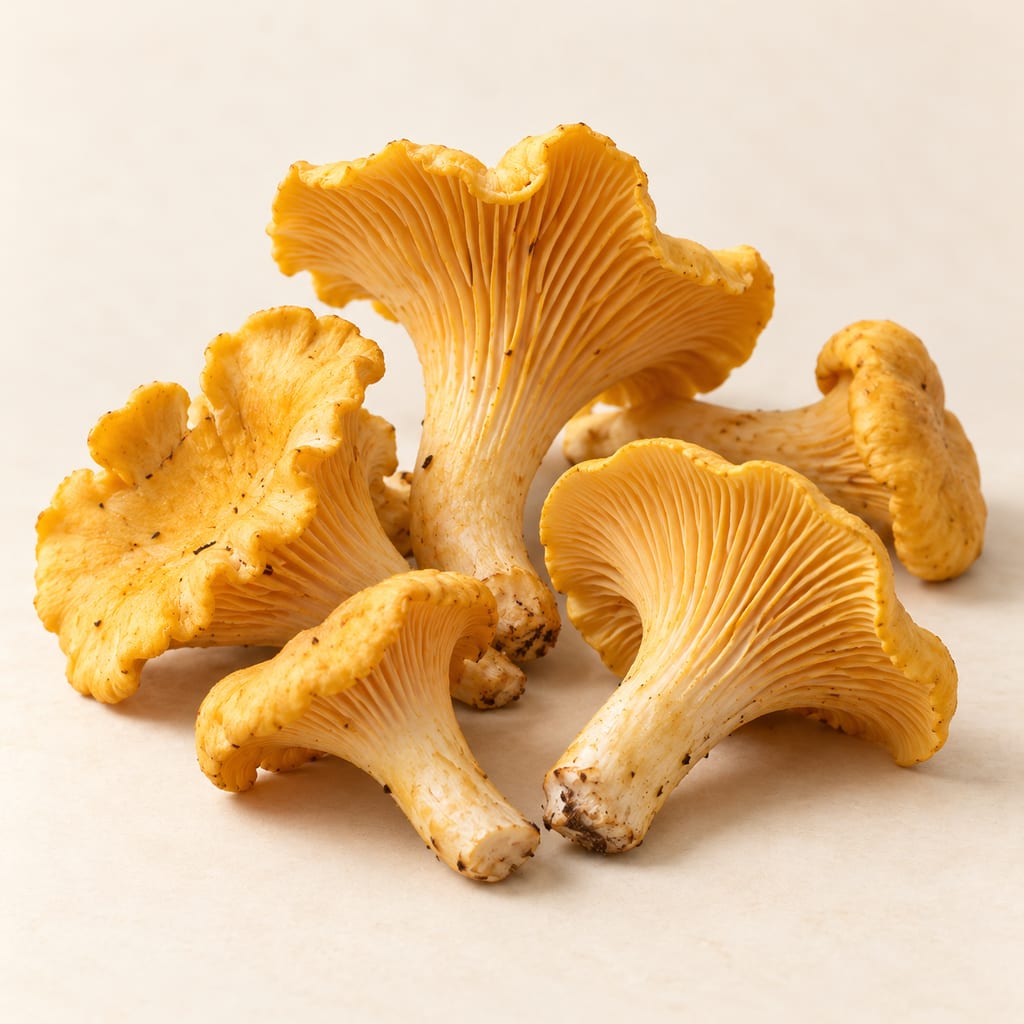
Chanterelles
Chanterelles are wild, tree-associated edible mushrooms, particularly the European golden chanterelle Cantharellus cibarius, prized for their firm flesh, fruity aroma and use fresh, frozen, dried or pickled.
 FermenteaWhere food goes to change
Mushrooms
Cultivated golden ear, Naematelia sinensis (jin'er), is a gelatinous yellow-orange fungus of southwestern China, eaten and used as a medicinal fungus and grown on Stereum wood-fungus partners.
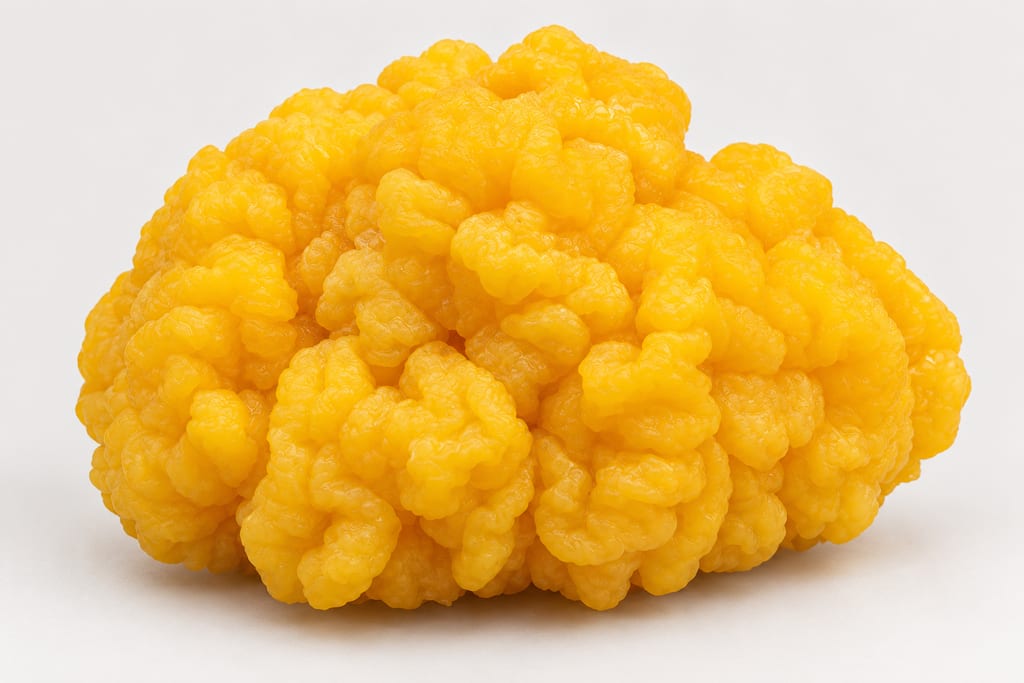
Cultivated golden ear is the fungus that Chinese growers call jin'er, the golden ear. In the 2024 taxonomic revision of the Naematelia aurantialba complex in southwestern China, the commonly cultivated species was described as Naematelia sinensis (Zhu L. Yang and J.Y. Tang). It is a member of the Tremellomycetes, in the family Naemateliaceae.
The fruiting body is gelatinous, globose to hemispherical, yellow to orange-yellow, with a wrinkled or contorted surface. The record treats it as a species of its own, distinct from the tremella fungi it was once confused with.
The species has been named several times. The 2026 genome paper lists earlier names including Tremella mesenterica, Tremella aurantialba and Naematelia aurantialba. Cultivated material was often labelled with the older names, so the literature does not yet use one name uniformly. Some Chinese and international sources still write N. aurantialba for the cultivated fungus.
The 2024 revision reworked the complex from specimens in southwestern China. It described several species, three of them new, and assigned the commonly cultivated fungus to N. sinensis. The record reviewed for this page treat that assignment as the current name, with the synonyms kept beside it rather than merged.
Naematelia sinensis is an obligate parasite. It cannot complete its fruiting bodies alone; it needs a wood-decaying partner, Stereum hirsutum or a closely related Stereum species, and it penetrates the hyphae of that host. The relationship is the reason cultivation depends on a partner fungus rather than on the golden ear by itself.
In the wild it grows on dead wood in subtropical broad-leaved forests at about 1,800 to 2,600 metres. The record describes it as endemic to China.
The fungus is commercially cultivated in parts of China. Growers work with the Stereum partner, and the ratio of the two fungi at the spawn stage and the conditions of growth both affect the crop. The lack of a high-quality reference genome has held back cultivation research, and 2026 genome work was published to address that gap.
One cultivation review in the supplied record describes the fruiting bodies as grown on an industrial scale. The record reviewed do not give a complete growing schedule, so this page does not give one.
The 2026 genome paper describes Naematelia sinensis as a rare edible and medicinal fungus with a dual role as a gourmet food and a source of traditional medicine. Wikipedia records its economic and medicinal importance and its value as an edible fungus.
The record reviewed do not describe the dishes it goes into, how it is soaked and cooked, or any specific health effect. Those claims are left out of this page.
In 2026 a chromosome-scale genome was published for each of the four mating types of the species. The four monokaryotic strains show a tetrapolar mating system, with the A and B loci on separate chromosomes. Each assembly is about 20.8 megabases in 12 chromosomes, with 6,558 to 6,578 predicted protein-coding genes.
The paper estimates that the genus Naematelia diverged about 154.9 million years ago, with a 95 per cent interval of roughly 94 to 208 million years. The authors call this estimate preliminary.
The record establishes that the fungus is edible and medicinal in China. They do not give a field guide, a list of look-alikes or a preparation that makes wild material safe. This page is not an identification guide and gives no verdict on whether a specimen found in the wild is safe to eat.
The catalogue this entry comes from records the species under food, market or specialist evidence. That record is not an independent toxicological assessment. Anyone buying or using this fungus should rely on a dried product from a known supplier and on local advice, not on this page.
Wild habitat and commercial cultivation are documented in southwestern China; no locality is given.
Chanterelles are wild, tree-associated edible mushrooms, particularly the European golden chanterelle Cantharellus cibarius, prized for their firm flesh, fruity aroma and use fresh, frozen, dried or pickled.
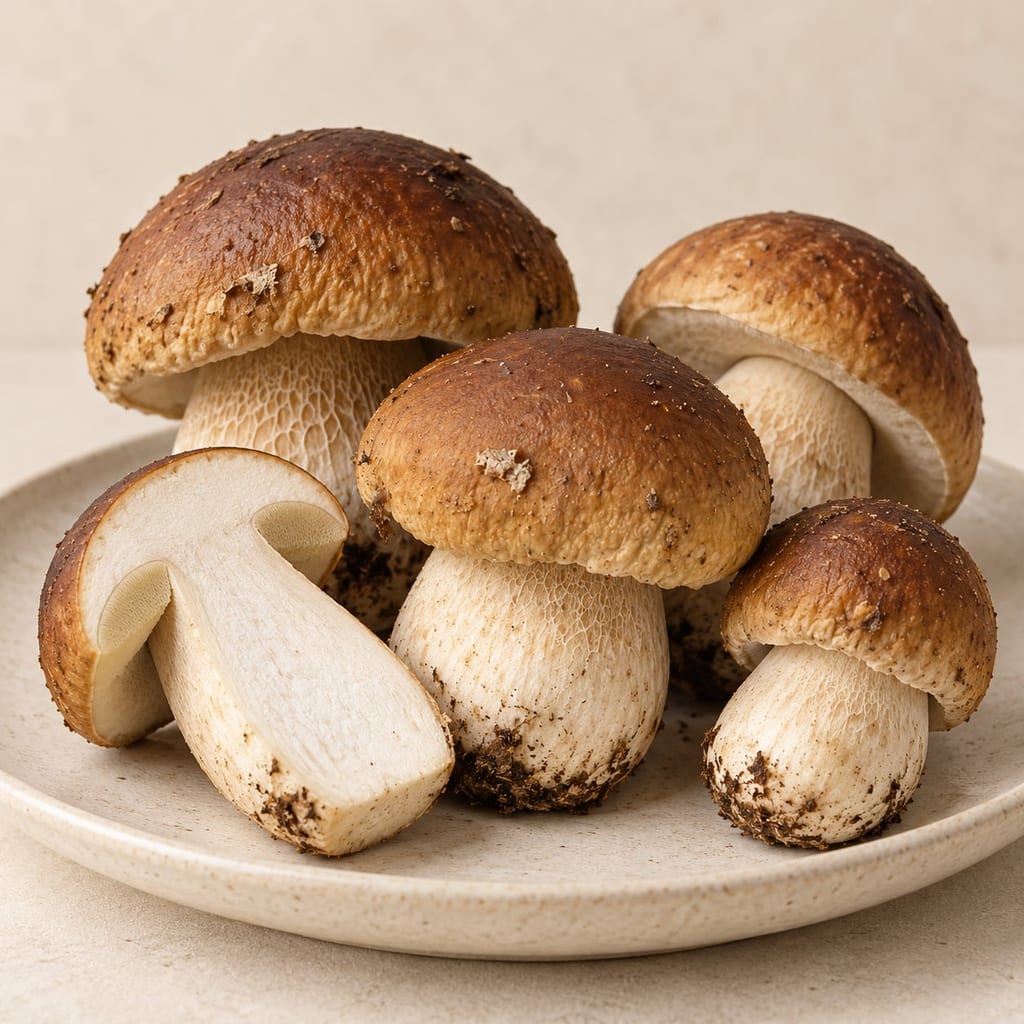
Porcini are prized wild ectomycorrhizal mushrooms from several closely related Boletus species, harvested chiefly from forests and sold fresh, dried or frozen for their firm texture and concentrated savoury aroma.
Tuber panzhihuanense is a truffle described in 2012 from southwestern China. A 2026 Chinese species catalogue lists it as edible, but its culinary use, host association and safety are not established by the sources reviewed.
No community contributions have been published for this entry yet.
Sign in to contribute. Published comments and photos are free to read.
WikipediaTaxonomy · Geography · Host · Food use
Naematelia sinensisAccepted name and 2024 authority; host Stereum hirsutum; obligate parasite; yellow to orange gelatinous fruiting body; wild habitat 1800 to 2600 m on dead wood; commercial cultivation in China; edible and medicinal importance.
Cited in: What it is; Growth and its host; Food and medicine; Genome and mating; Identification and safety
Frontiers in MicrobiologyTaxonomy · Genome · Food use · Cultivation
Chromosome-scale genome assembly of Naematelia sinensis (Jin Er mushroom) offers new insights into the distinct mating-type genomes feature and genome evolutionEarlier names Tremella mesenterica, Tremella aurantialba, Naematelia aurantialba; tetrapolar mating; genome sizes and gene counts; genus divergence estimate; rare edible and medicinal fungus; obstacle of no high-quality genome for cultivation research.
Cited in: What it is; Names and taxonomy; Growth and its host; Cultivation; Food and medicine; Genome and mating
Journal of Fungi (MDPI)Taxonomy
Supplied catalogue source for the Naematelia aurantialba complex revision (doi 10.3390/jof10120845)2024 revision of the complex in southwestern China; cultivated species assigned to N. sinensis.
Cited in: Names and taxonomy; Identification and safety
CAST journal archive (Chinese)Food use · Cultivation
Supplied catalogue source for Naematelia sinensisCultivated golden ear, jiner; regional cultivation in southwestern China; industrial-scale cultivation on wood-based substrates (supplied record; primary text not reopened here).
Cited in: Names and taxonomy; Cultivation