Overview
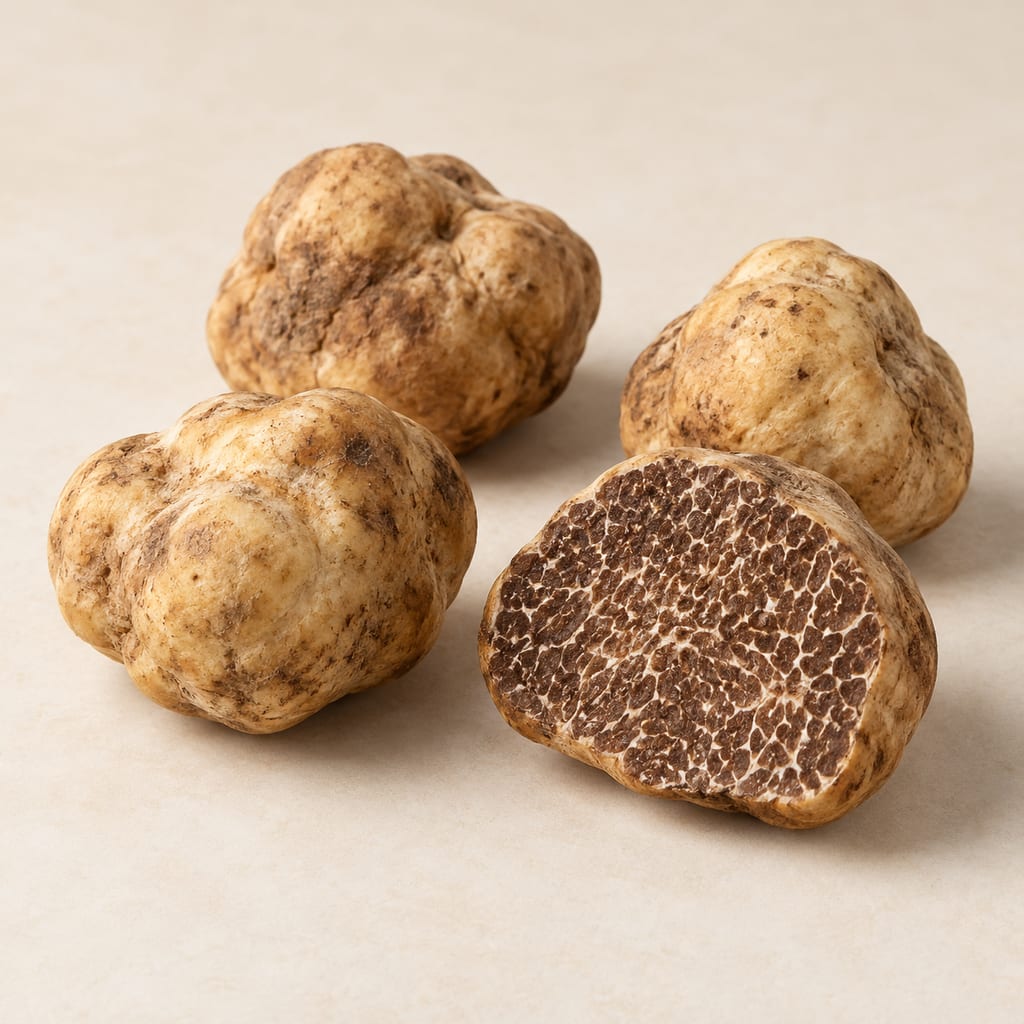
The bianchetto truffle, Tuber borchii, is a truffle that forms underground in a mycorrhizal partnership with the roots of trees. Its flesh is pale, and the catalogue describes it as a pungent truffle used as a seasoning. It is valued for a strong aroma rather than the rarity that gives Tuber magnatum its price, and the two are kept apart in the catalogue record.
Older texts sometimes used the name Tuber albidum for this fungus, and the catalogue records that alias. Growers and researchers now treat the bianchetto as a species of its own.
Sources for this section
Cultivation in Italy
Cultivation of this truffle has become established in Italy over the last decade, and it has been introduced to other countries, including New Zealand. A 2015 review by Zambonelli, Iotti and Hall reports good results for the cultivation of Tuber melanosporum, Tuber aestivum and Tuber borchii, and notes that Tuber magnatum has not yet been successfully cultivated.
Field results from a coastal trial at Marina di Ravenna are recorded in the research. Pine seedlings inoculated with the fungus began producing in 1994, and over the following four years the trial averaged 7 kg of truffles per hectare. The same work reports that the bianchetto fruits early, at about four years in pines, and that it grows with a wide range of host trees, including holm oak, hazel, poplar and pine. Its broad ecological tolerance is the reason growers cite for planting it in areas unsuited to the more valuable truffles.
Sources for this section
Harvest and season
A grower guide gives the harvest period in Italy as January 15 to April 30, which is the winter to spring season. That guide is commercial rather than peer-reviewed, so the dates are recorded as a grower's figure. The sources reviewed give no storage method or shelf life, and none is recorded here.
Sources for this section
Use and identification
The catalogue records its use as a pungent seasoning, a role that fits its strong aroma. The sources reviewed do not describe the dishes it is used in, so no dish is given here.
The catalogue notes that the bianchetto is distinct from the costly Tuber magnatum, and that distinction matters for the species named on a label. This page does not describe how to find or identify wild truffles.
Sources for this section
Open questions
The sources reviewed do not give a regional food tradition for the wild bianchetto, a measured aroma profile or a safety assessment. Those are the next questions for a fuller account.
Sources for this section
Places
Italy
Modern adaptation · Country evidenceCultivation and field trials are recorded in Italy; the country entry does not establish a historical food tradition.
New Zealand
Modern adaptation · Country evidenceThe sources record successful introduction of cultivation; no local food use is recorded.