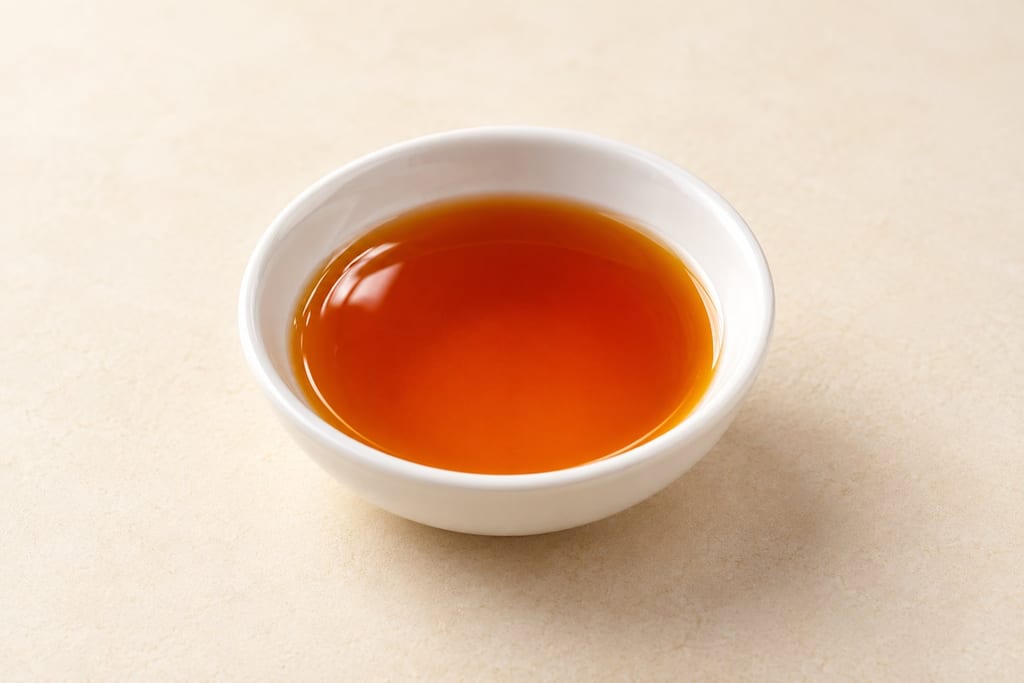
Fish sauce
Fish sauce is a clear, salty seasoning made by maturing fish with salt and drawing off the liquid. The broad family includes distinct regional sauces rather than one interchangeable method.
 FermenteaWhere food goes to change
Traditional method
총각김치 (chonggak-kimchi)
Small ponytail radishes keep their greens attached and ferment in a flour-and-chile seasoning paste.
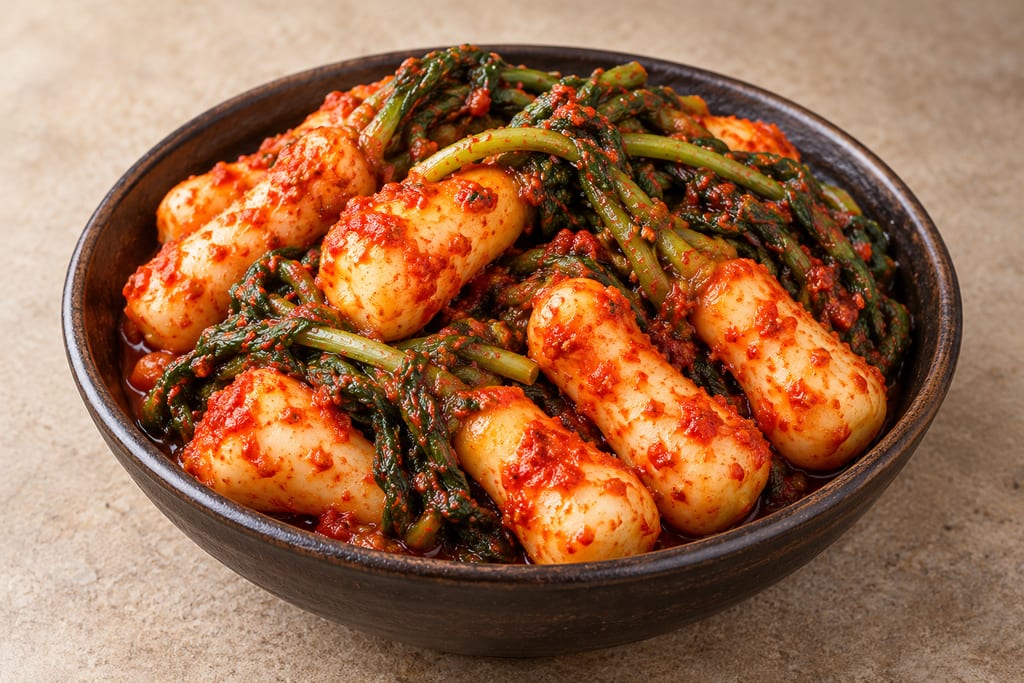
Chonggak-kimchi is a Korean kimchi made from small radishes with their leafy green tops left attached.
It is commonly translated as ponytail radish kimchi because the greens resemble a ponytail extending from the radish bulb.
The defining character of this preparation is the contrast between the firm, crunchy radish and its softer, fermented leaves.
Unlike radish kimchi made from cubes or shredded pieces, chonggak-kimchi preserves the plant's recognisable shape.
The radishes are salted, coated in a chilli-based seasoning paste and left to ferment.
The paste contains garlic, onion, Korean chilli flakes, fish sauce, green onions and a cooked flour mixture.
The result is a strongly flavoured kimchi in which the white radish absorbs the seasoning while the greens become coated and gradually soften.
The dish is associated with Korean home cooking and the wider tradition of preserving vegetables through salting and fermentation.
Different types of kimchi are prepared according to the vegetable available and the desired eating texture.
Chonggakmu is especially valued for its small, firm root and edible greens.
The recipe is not a generic daikon pickle.
Large daikon or ordinary Korean radish can be used in other preparations, but the shape and tissue structure of chonggakmu give this dish its characteristic presentation.
The documented household recipe also illustrates the personal importance of kimchi in family meals.
The original recipe writer describes her father's preference for the dish, particularly the crunchy sound of the radish while eating it.
This is a useful contemporary cultural detail, although it does not establish a historical invention date.
The research does not provide sufficient evidence to assign the dish to a specific dynasty or century.
Chonggakmu radishes with greens — 2 kg
Kosher salt — ½ cup
Flour — ¼ cup
Water — 2 cups
Sugar — 2 tablespoons
Garlic — 12 cloves
Onion — ½ cup, minced
Green onions — 5 stalks
Gochugaru, Korean chilli flakes — 1 cup
Fish sauce — ¼ cup
The original recipe identifies flour, not specifically rice flour.
The imported record described the mixture as a rice-flour paste in its summary, but the actual ingredient list gives ordinary flour.
That distinction should be retained rather than silently changing the ingredient.
Fish sauce is part of this recipe. It is therefore not vegetarian.
Chonggakmu radishes are relatively small, with an elongated or rounded bulb and attached greens.
The recorded method describes good specimens as firm and not more than approximately 4 inches long.
The greens should be fresh rather than extensively wilted or yellowed.
Very small radishes may remain whole.
Larger radishes are divided lengthwise.
The greens are retained because they are part of the finished food.
The botanical species is Raphanus sativus, but the particular cultivated type determines size, shape and texture.
The root stores carbohydrates and other nutrients that support plant growth.
These compounds also influence fermentation.
Remove the thin tail and any damaged leaves.
Peel or clean the radish surface as required by the original preparation.
Keep the greens attached to the root.
If the radish is large, split it lengthwise and divide the greens.
Small radishes approximately 2 inches long may remain whole.
Wash thoroughly to remove soil.
Root vegetables are exposed to the soil microbiome during growth, so cleaning is especially important.
Wet the radishes briefly in cold water and drain.
Sprinkle over ½ cup kosher salt.
Mix so the salt contacts the vegetables.
Leave for 30 minutes.
Turn the radishes.
Leave for another 30 minutes.
The total documented salting period is 1 hour.
During this period, salt draws some water from the radish tissues and begins softening the greens.
Wash the radishes thoroughly, removing excess salt and remaining dirt.
The original recipe recommends rinsing several times.
Allow the radishes to drain in a colander.
The aim is to retain a salted and prepared vegetable without leaving excessive crystals on the surface.
Mix ¼ cup flour with 2 cups water in a saucepan.
Heat over medium heat, stirring continuously.
As the mixture thickens and begins bubbling, add 2 tablespoons sugar.
Continue stirring for 1 minute.
Remove from the heat.
Allow the porridge to cool before adding it to the seasoning mixture.
The recorded method does not give a numeric cooling temperature.
Mince 12 garlic cloves.
Mince ½ cup onion.
Chop 5 green onion stalks.
Have 1 cup Korean chilli flakes and ¼ cup fish sauce ready.
Use gochugaru rather than assuming any ground red chilli will produce the same flavour or colour.
Combine the cooled flour porridge with the garlic, onion, green onion, chilli flakes and fish sauce.
Mix thoroughly.
The porridge helps form a paste that adheres to the radish and greens.
The seasoning should be distributed throughout rather than leaving dry pockets of chilli powder.
Add the prepared chonggakmu.
Mix until the bulbs and greens are evenly coated.
The roots should remain recognisable rather than being crushed or chopped into small pieces.
Food-safe gloves can make handling the chilli mixture more comfortable.
Transfer to a suitable glass or food-grade plastic container.
Pack sufficiently to reduce unnecessary air spaces.
Retain the vegetable juices and seasoning paste.
The original recipe does not specify a measured packing density or headspace.
Leave at room temperature for approximately two days.
The original description says a couple of days and does not establish a precise upper limit.
The radish greens may become olive-green, and the paste may develop a sour aroma.
As liquid accumulates, spoon some of it over the upper vegetable layer to help keep it moist.
These changes are consistent with fermentation but are not definitive proof of safety.
After appropriate fermentation, refrigerate.
The finished kimchi can be served with rice and other Korean dishes.
The recorded method does not provide a laboratory-validated storage period.
The flour-and-water mixture is a significant part of the preparation.
When heated with water, starch granules absorb moisture and swell.
As heating continues, the starch gelatinises, producing a thickened mixture.
This helps bind the chilli flakes and aromatics into a paste.
The paste can adhere more readily to the curved radish bulbs and leafy tops than a thin liquid seasoning.
The sugar also provides sweetness and an accessible carbohydrate source.
However, the purpose is not simply to feed microorganisms.
The porridge has an important physical function in coating the vegetables.
Cooling before mixing reduces the risk of exposing raw vegetable microorganisms to unnecessarily high temperatures.
Rice flour is used in some kimchi recipes, and a glutinous-rice paste is familiar in several preparations.
This particular documented version specifies flour without identifying a rice variety.
Substituting glutinous rice flour may produce a different texture because starch composition affects gelatinisation and viscosity.
It is therefore better to preserve the original ingredient description than invent a more specific flour.
Radish contains fermentable carbohydrates, water, fibre and sulphur-containing compounds.
The latter contribute to its distinctive peppery and sometimes sharp flavour.
As with mustard greens and cabbage, radish belongs to the brassica family.
Enzymatic reactions involving glucosinolates can produce pungent compounds, including isothiocyanates.
Fermentation changes the chemical environment and can alter the perception of these compounds.
Lactic-acid bacteria convert available carbohydrates into organic acids.
As acidity increases, the kimchi develops its characteristic sourness.
Salt treatment influences which organisms can compete.
The added fish sauce introduces salt and fermented seafood flavour compounds, as well as changing the overall chemical composition.
Its presence does not mean the kimchi requires seafood microorganisms to ferment successfully.
Kimchi fermentation commonly involves several groups of lactic-acid bacteria.
The genera Leuconostoc and Weissella are frequently important during early fermentation.
Organisms belonging to Lactiplantibacillus and related genera can become more significant as conditions change.
However, the exact sequence varies.
Fermentation temperature, salt concentration, ingredient composition and the microorganisms present at the start affect the final community.
Research specifically examining cabbage and radish kimchi confirms that production methods can significantly influence microbial succession.
This is why two households using similar radishes may obtain different rates of souring.
The recipe's two-day room-temperature period must not be interpreted as a universal microbial endpoint.
The radish root and its leaves are physiologically different plant tissues.
The root is a storage organ with firm structure and substantial water content.
The greens are thinner, more delicate tissues.
During salting, the leaves lose turgor and soften more quickly.
During fermentation, the greens may change colour and texture while the root retains a substantial crunch.
The contrast is central to the dish.
A chonggak-kimchi made entirely from chopped radish would not provide the same eating experience.
The intact shape also affects how the seasoning paste coats the vegetable.
Some households use different amounts of chilli, garlic or fish sauce.
Others incorporate fermented shrimp or alternative seasoning mixtures.
The root size affects whether it is split or preserved whole.
The paste may vary in thickness.
These are culinary variations within the same family.
However, replacing fish sauce with a plant-based seasoning changes both flavour and ingredient composition.
For a vegetarian adaptation, such a change should be identified explicitly, and its fermentation behaviour should not be assumed identical without evaluation.
A preparation made from ordinary large daikon also differs structurally from one using genuine chonggakmu.
The name should not be applied indiscriminately to every radish kimchi.
Chonggak-kimchi accompanies steamed rice and a wide range of Korean dishes.
Its firm texture is particularly attractive alongside soft rice.
The greens add a different mouthfeel from the root.
The dish can be served as part of a shared collection of side dishes, or banchan.
It is also useful alongside soups and stews.
The strong chilli-garlic seasoning means it can provide much of the flavour contrast in an otherwise simple meal.
As the kimchi matures, the acidity becomes more pronounced.
A young batch may taste more like salted, seasoned radish, while a mature batch develops a stronger fermented character.
Bulbs remain very firm: This is characteristic of the vegetable and not necessarily a problem.
Leaves soften rapidly: Expected because they are thinner.
Greens become olive-coloured: Can occur during fermentation.
Paste seems too thick: The porridge may have concentrated differently during cooking. The original formula does not provide a target viscosity.
Very little liquid appears: Vegetable condition and salting influence water release.
The kimchi develops excessive slime: Reject the batch.
Mould is visible: Discard the batch.
There is no sourness after the expected period: Monitor acidity and process conditions rather than relying on time or aroma alone.
The recipe contains fish sauce and is not suitable for people avoiding fish ingredients.
The documented room-temperature fermentation period is approximate.
No numeric temperature range or independently validated final pH is provided.
Use clean food-grade equipment, maintain suitable moisture coverage and refrigerate after appropriate fermentation.
The author identifies chonggak-kimchi as a Korean dish made with chonggakmu and describes a family food association.
Scaling: source batch only
Contaminated equipment or uncontrolled fermentation can compromise the batch; the recipe is not professionally validated.
Hazard sourceUse clean food-grade equipment and follow the source method. Recipe-specific validated limits are not supplied; do not treat taste or appearance as proof of safety.
Control sourceThe source names chonggakmu and identifies this as a Korean radish kimchi.
Fish sauce is a clear, salty seasoning made by maturing fish with salt and drawing off the liquid. The broad family includes distinct regional sauces rather than one interchangeable method.
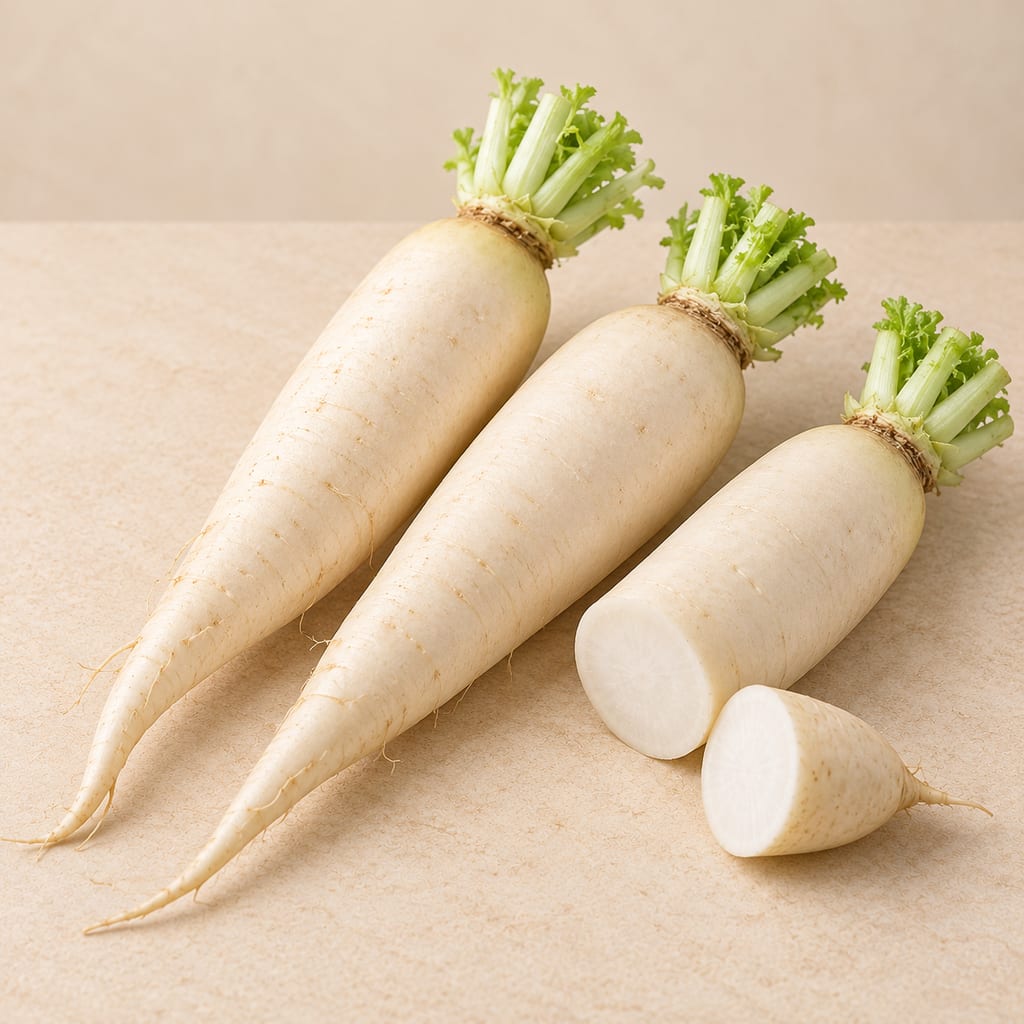
Radish and daikon are the crisp, peppery roots, leaves and seed pods of Raphanus sativus, fermented as kimchi, takuan and sinki and eaten raw across Asia and Europe.
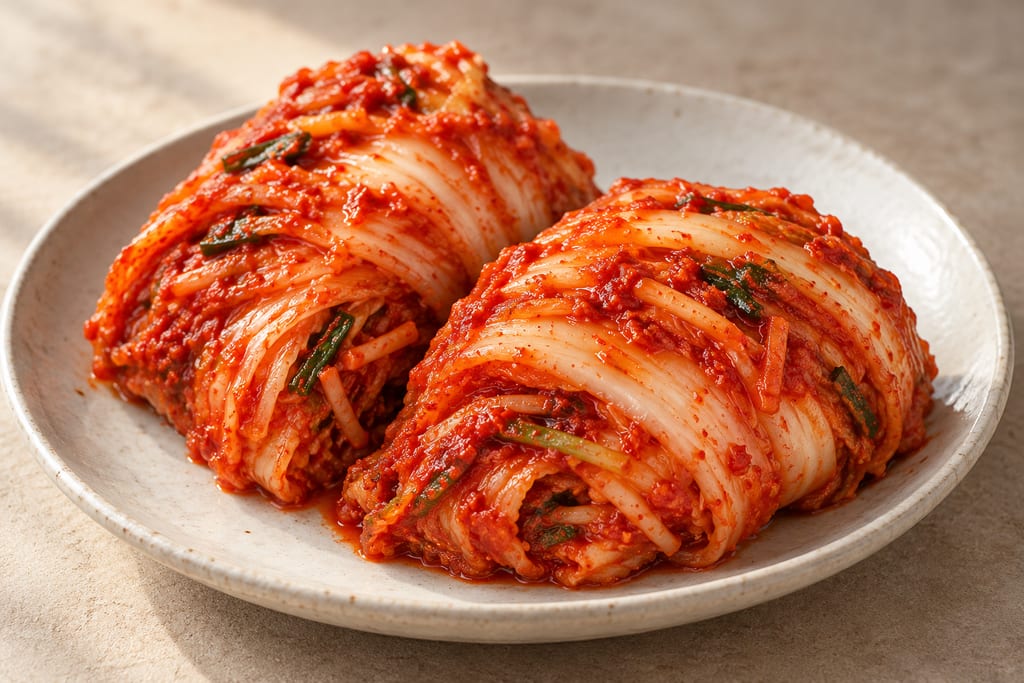
Napa cabbage salted, seasoned with a paste of gochugaru, garlic, ginger and salted seafood, and left to sour through lactic fermentation; Korea's everyday winter preserve.
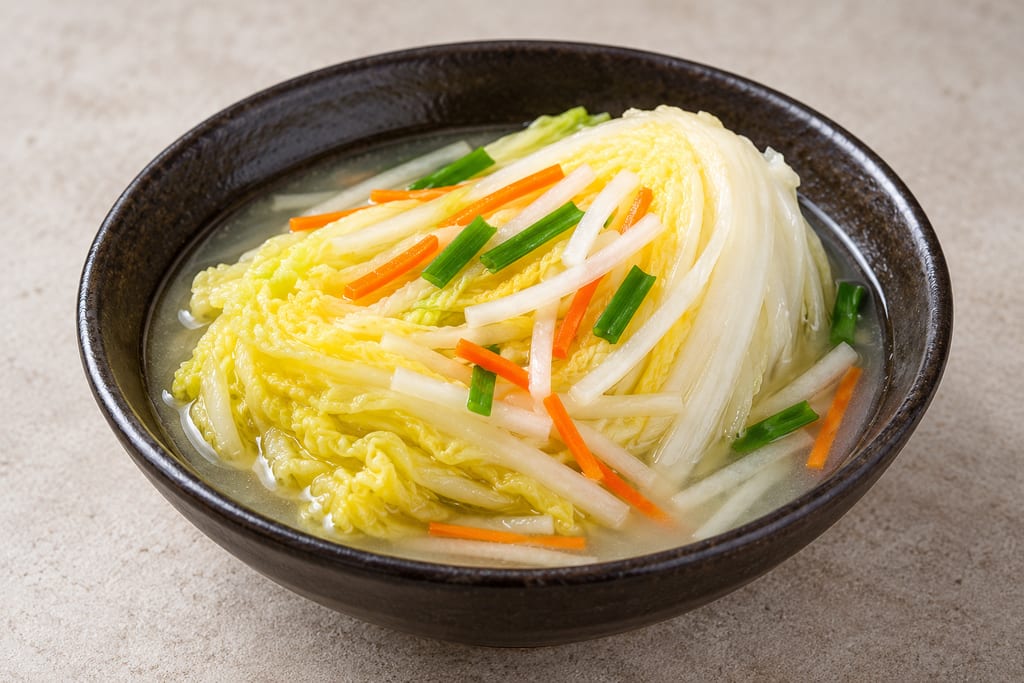
Napa cabbage is brined and filled with pear, radish, alliums, chives and fruit; this Korean kimchi omits red pepper flakes.
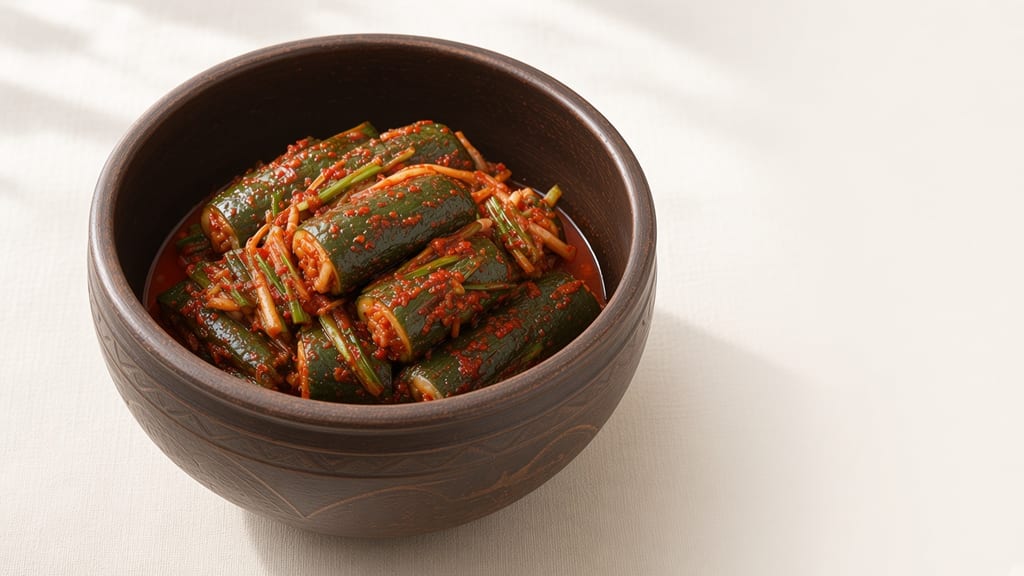
Hwanggwa damjeo is a cucumber kimchi from Yu Jung-rim's Jeungbo sallim gyeongje of 1766. Slit cucumbers are packed with chilli powder and garlic, scalded with hot salted water and sealed overnight.
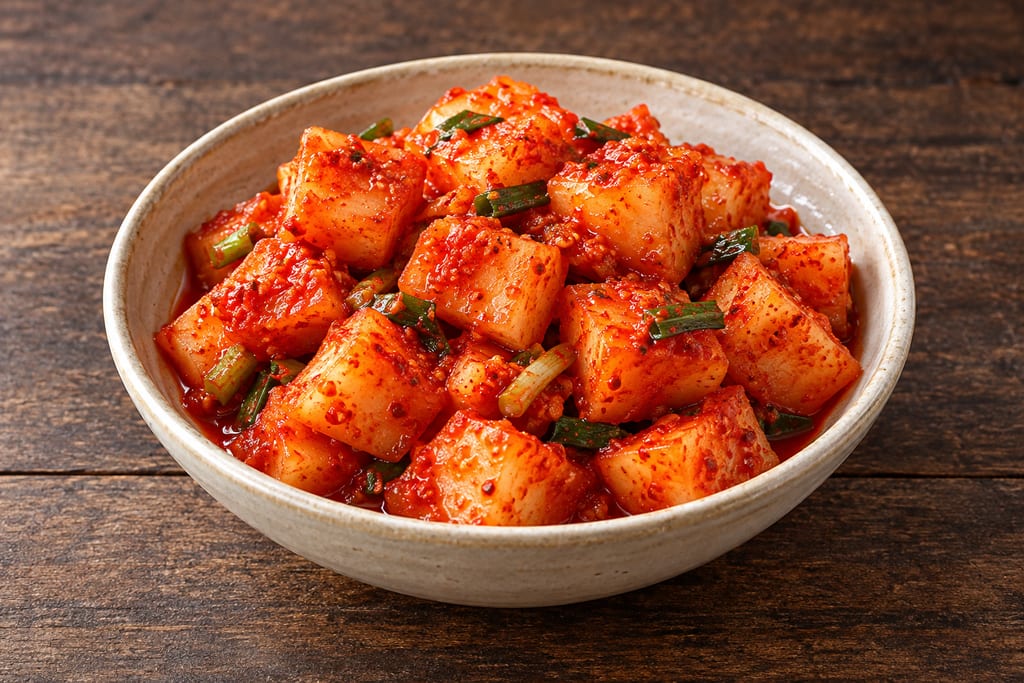
A radish kimchi cut into cubes and seasoned with gochugaru, fish sauce, garlic and ginger, eaten fresh or fermented a few days at room temperature.
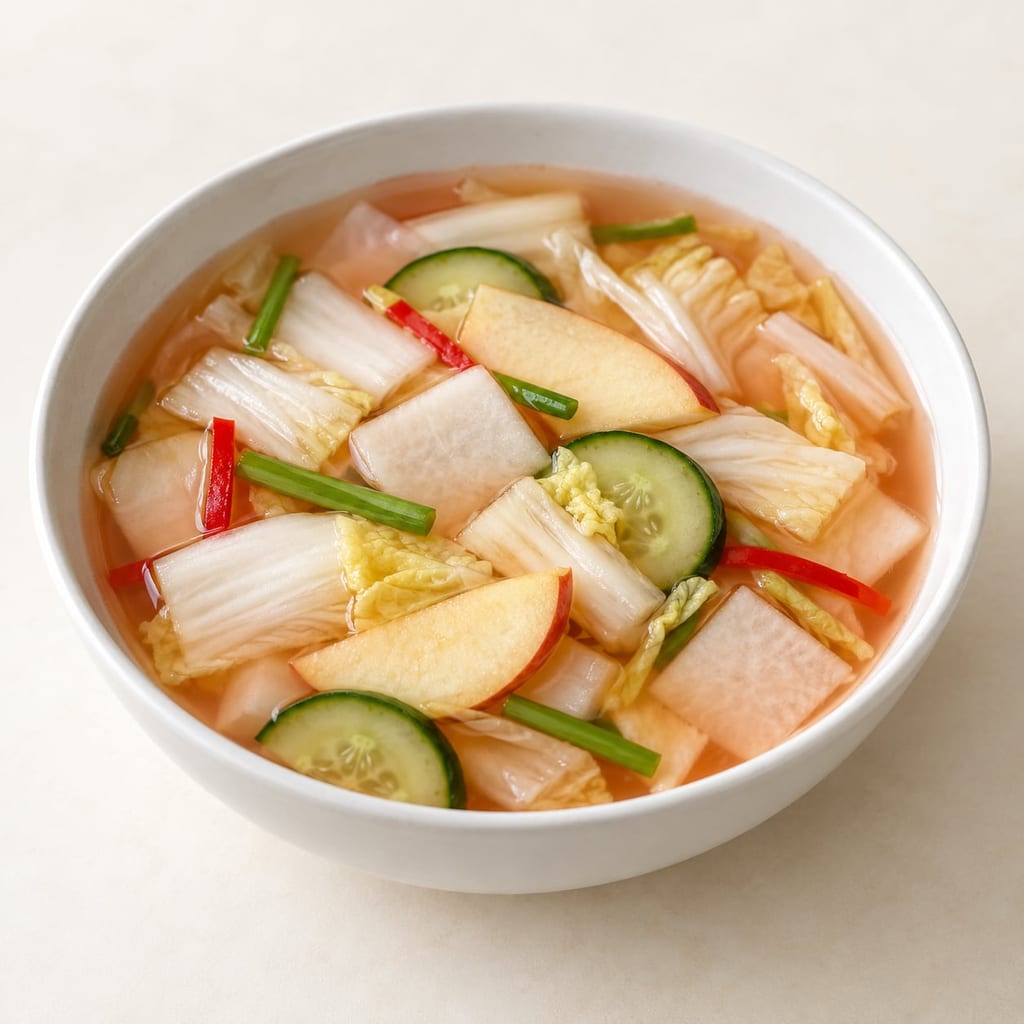
Napa cabbage and radish ferment in a rose-coloured broth with cucumber, apple, pear, alliums and chile.
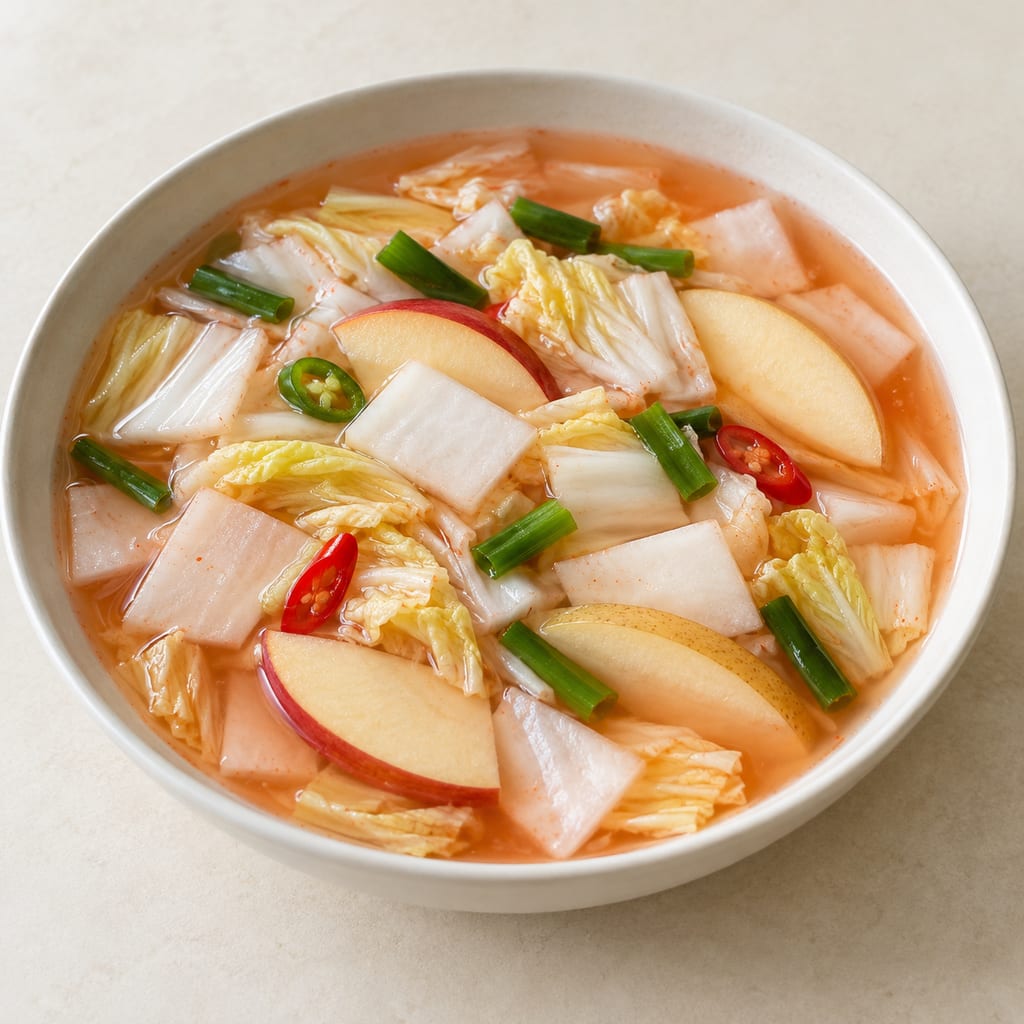
Cabbage-and-radish water kimchi with pear, apple and strained chili broth, following one Korean creator’s batch.
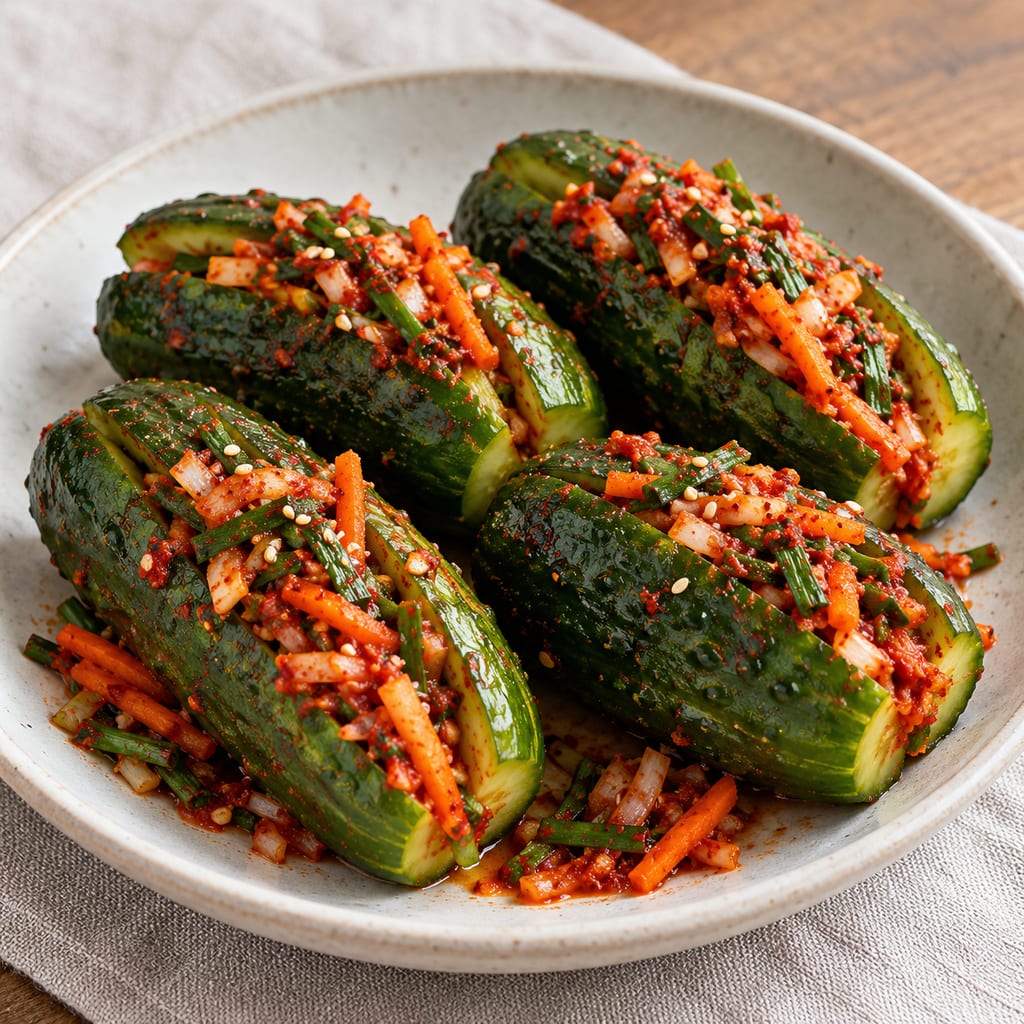
Oi-sobagi is a Korean stuffed cucumber kimchi: salted cucumbers slit and filled with a chive-and-chilli seasoning, eaten fresh or left to ferment.
Kimchi of salted napa cabbage and daikon with garlic, green onion and red pepper, kept at room temperature one to four days, then refrigerated.
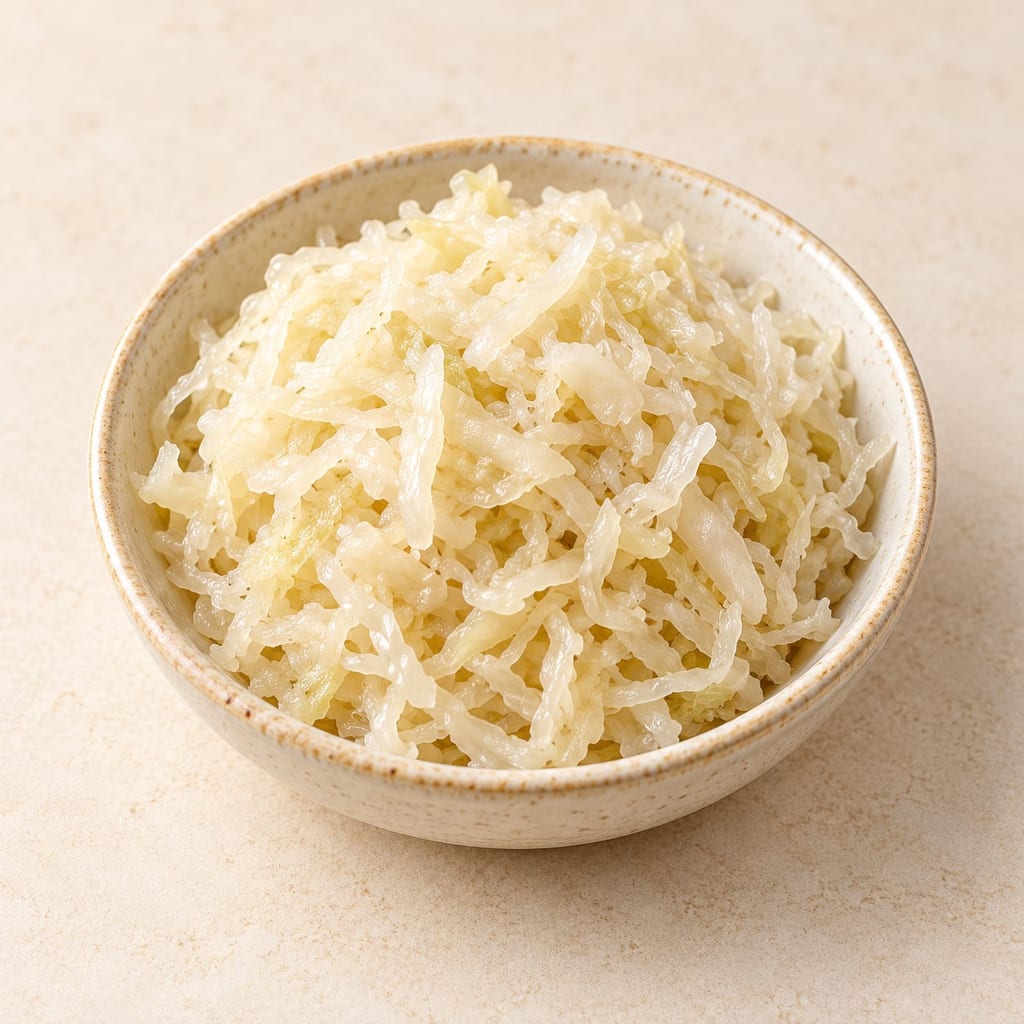
Finely cut cabbage fermented with salt in vats by natural lactic fermentation, a protected Alsatian product sold raw or cooked after fermentation.
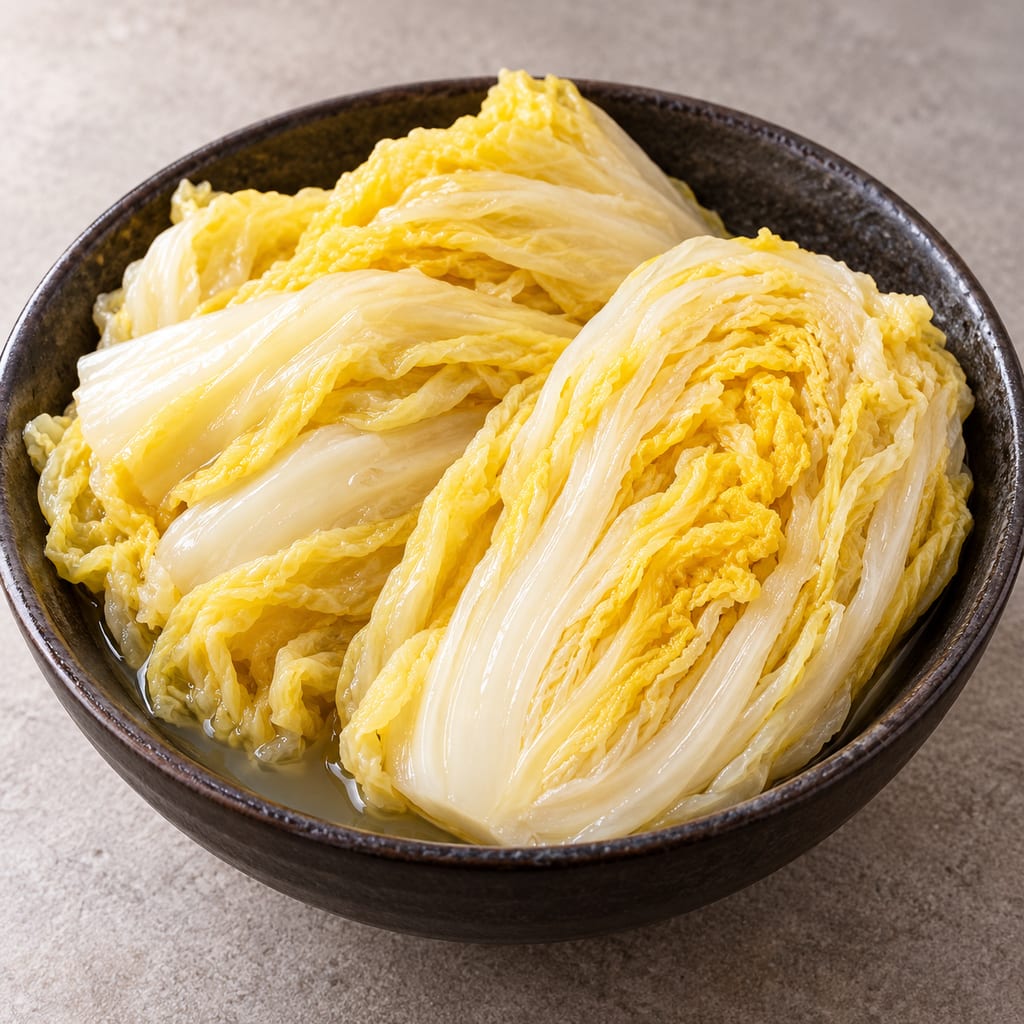
Napa cabbage fermented in a salt brine in Northeast China, traditionally in large ceramic or glass jars, until it turns sour.
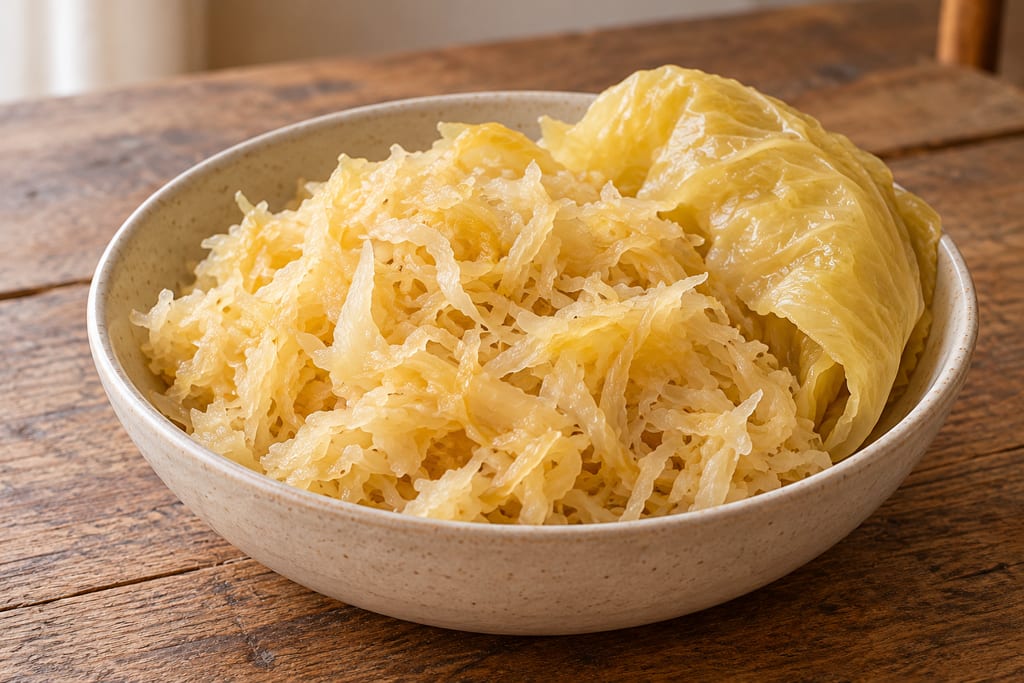
Serbian sour cabbage from the Futog area, made from the autochthonous Futoški cabbage population and registered as a protected product in 2008. It is a subset of general Serbian kiseli kupus.
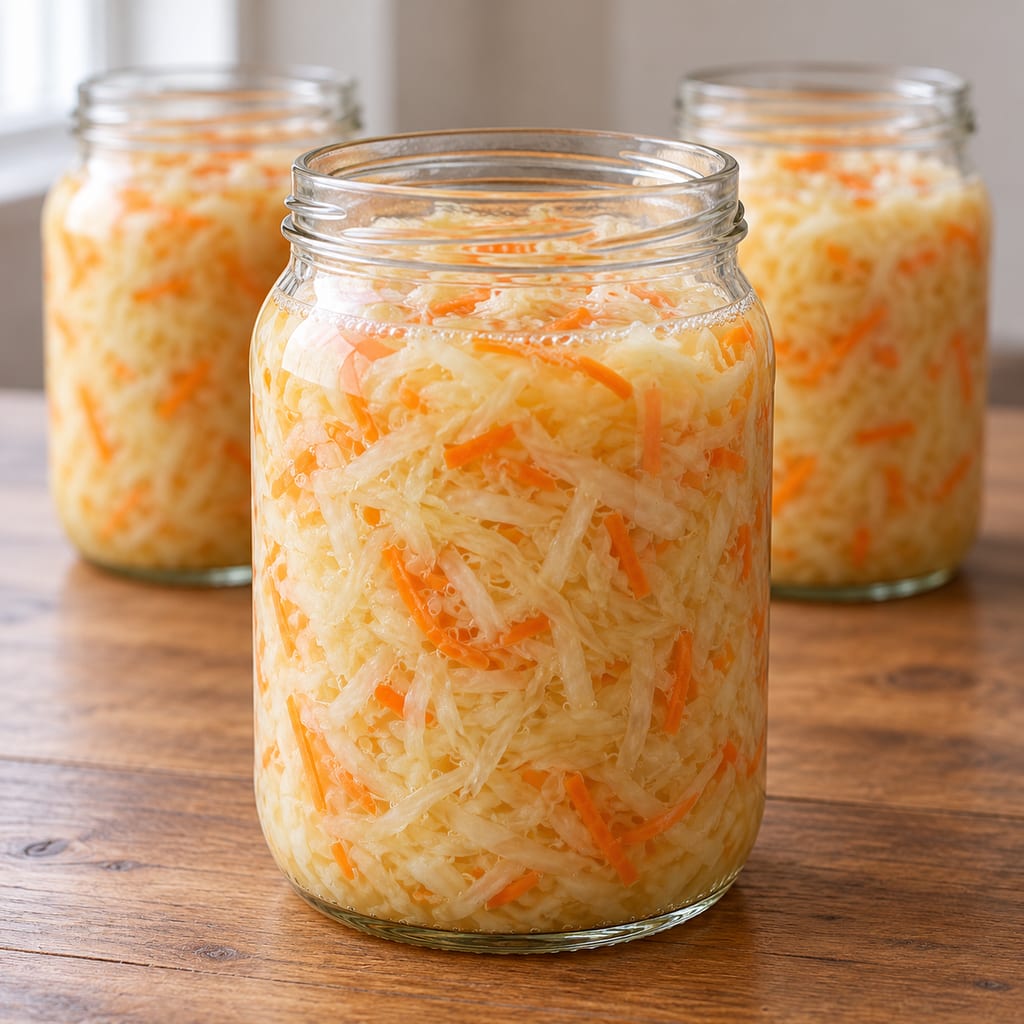
Shredded cabbage and grated carrot are salted to 20 g/kg, rested, packed into three jars and monitored during a creator-reported eight-day fermentation; measured temperature is not given.
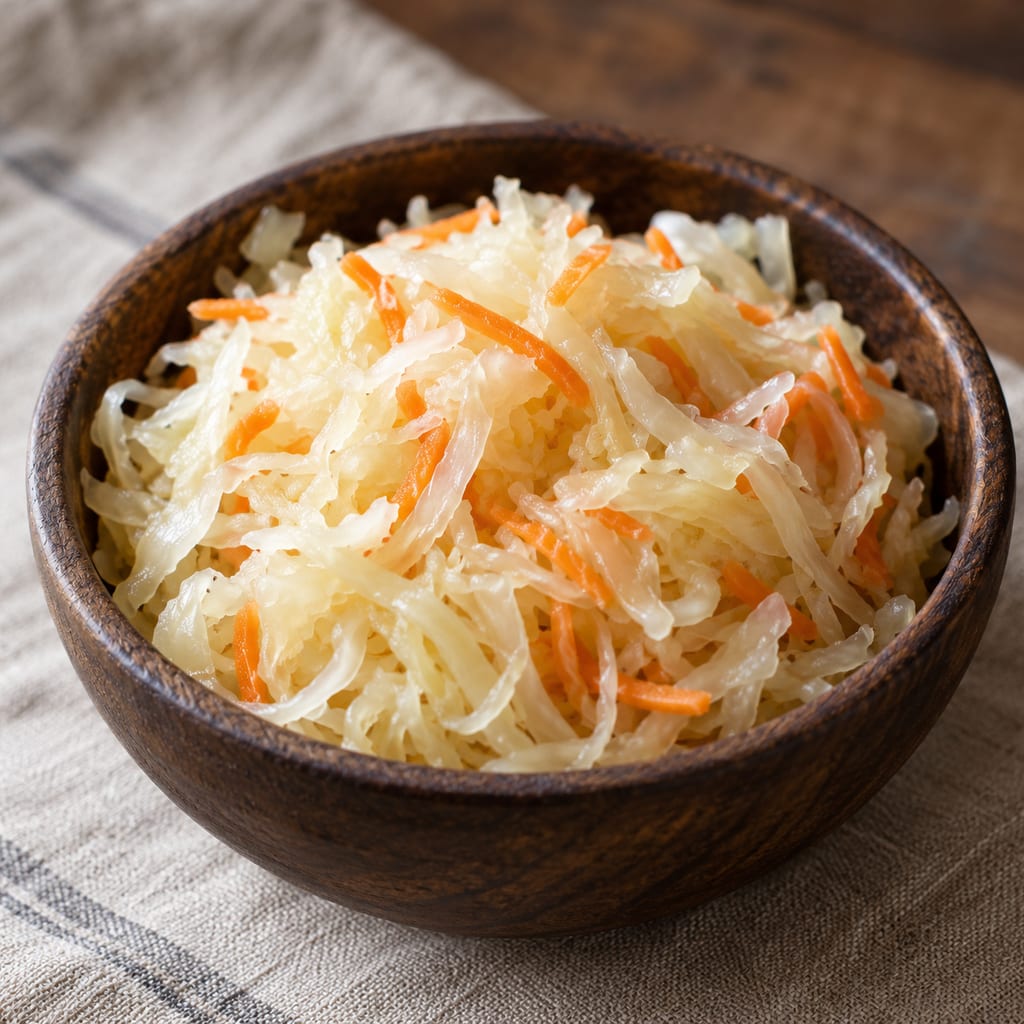
Kapusta kiszona z beczki is barrel-fermented cabbage from the Kołobrzeg area, entered on Poland’s List of Traditional Products in 2008. It is salted and fermented, with raw grated carrot added after souring.
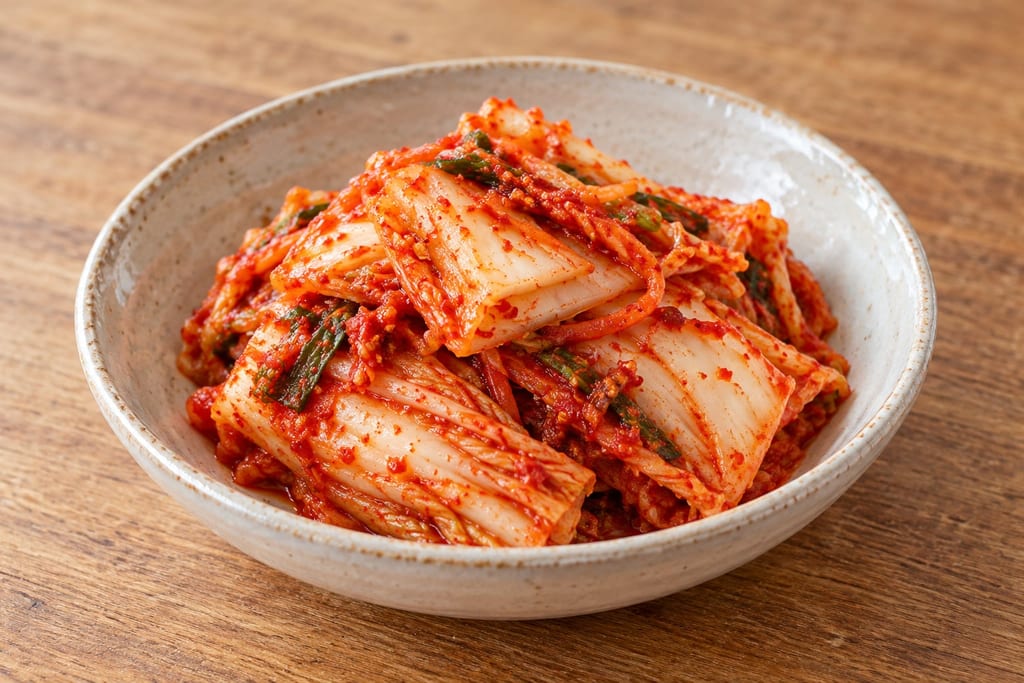
Kimchi is a Korean preserved vegetable food, most often cabbage, salted and seasoned, then fermented by the lactic acid bacteria that arrive with the vegetables. Some studies test added starter cultures, but a home jar is usually spontaneous.
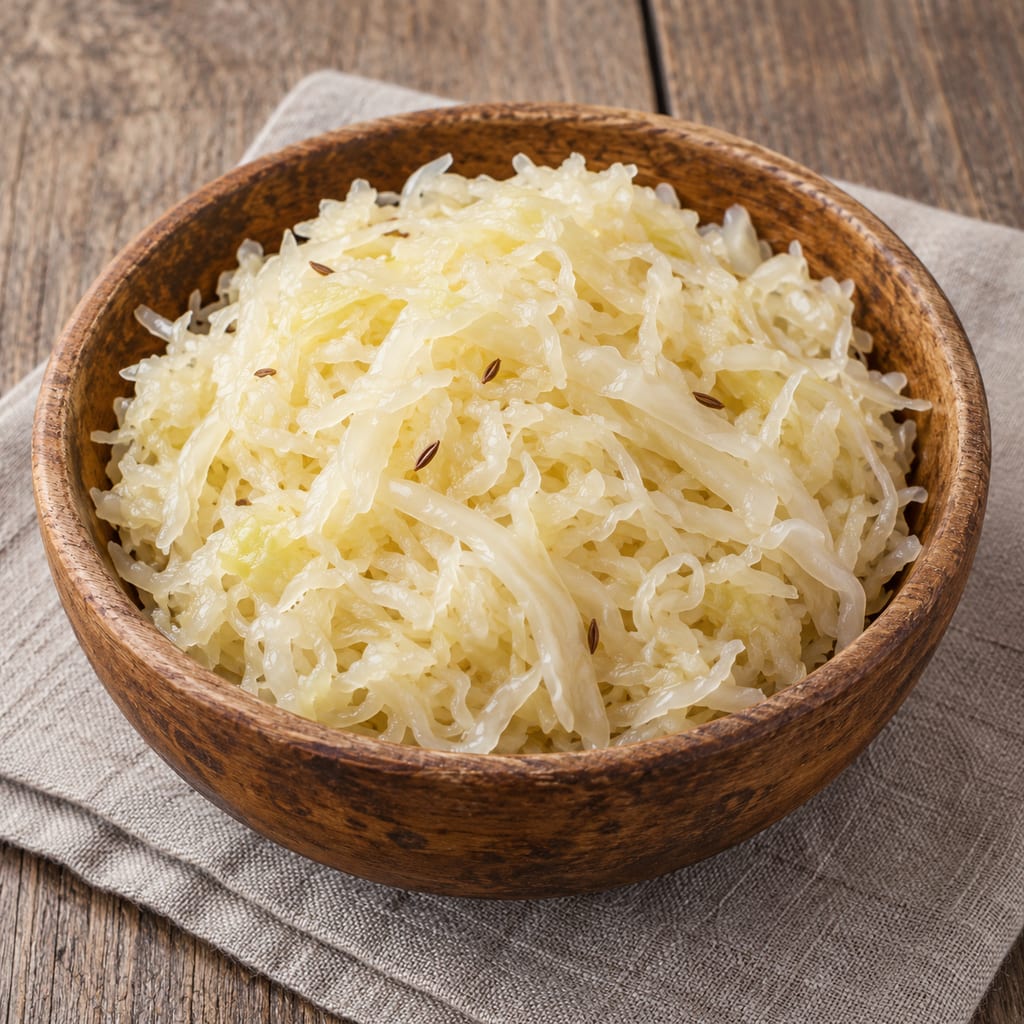
Kysané zeľí is Czech sour cabbage: shredded cabbage layered with salt and caraway and pressed in a wooden barrel. The regional account is descriptive and gives no validated salt ratio or endpoint.
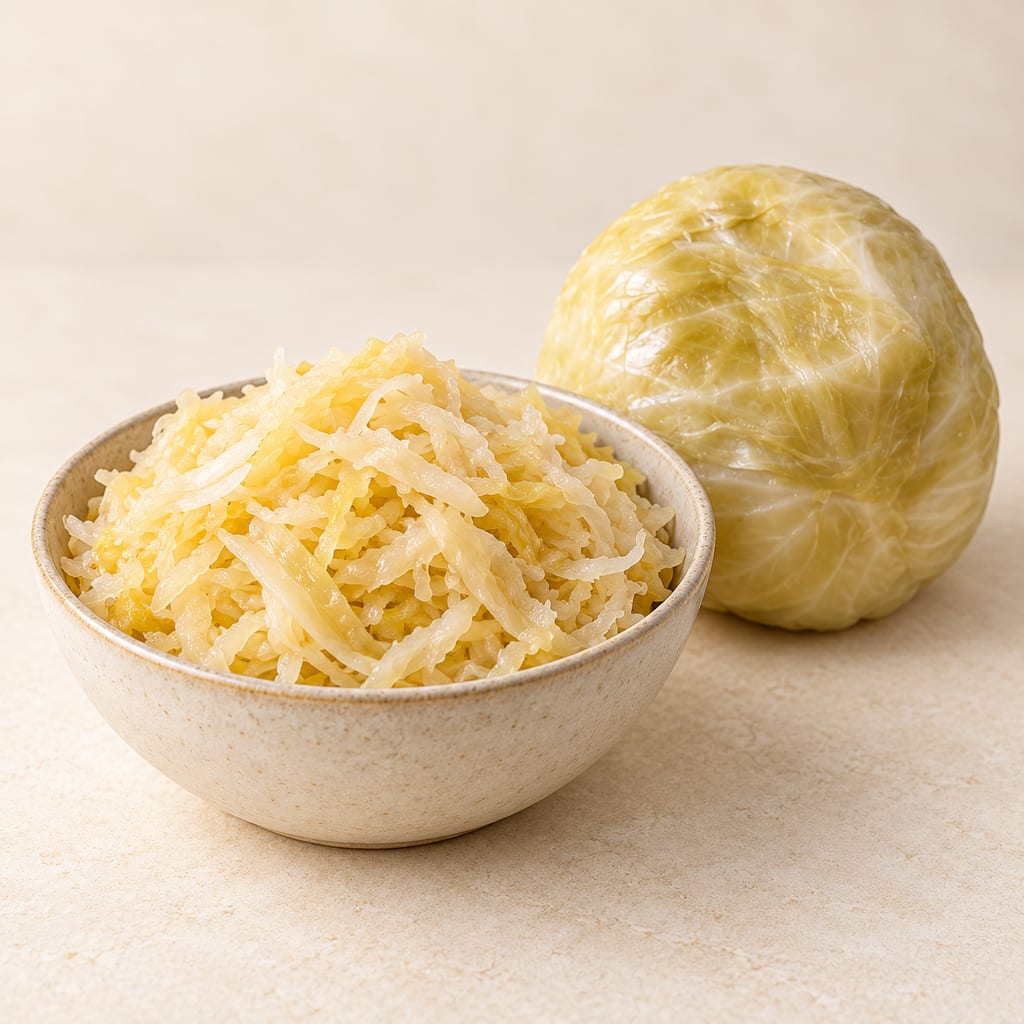
Protected Croatian sauerkraut from the Ogulin area: fresh white cabbage naturally lactic-fermented without preservatives, sold whole or shredded, from registered establishments.
No community contributions have been published for this entry yet.
Sign in to contribute. Published comments and photos are free to read.
MaangchiInspiration · Geography
Ponytail kimchi (Chonggak-kimchi)Korean dish context, radish quantity, salt schedule, paste formula and room-temperature step.
Cited in: What is chonggak-kimchi?; Ingredients; Choosing chonggakmu; Stage 1 — Trim and clean; Stage 2 — Salt the radishes; Stage 3 — Rinse and drain; Stage 4 — Make the flour porridge; Stage 5 — Prepare the seasonings; Stage 6 — Make the paste; Stage 7 — Coat the radishes; Stage 8 — Pack; Stage 9 — Ferment; Stage 10 — Refrigerate; Microbial succession; Variations; How chonggak-kimchi is eaten
University of Minnesota ExtensionSafety
Preserving food at home: FermentationGeneral advice on equipment, brine coverage and acidity monitoring; not validation of this recipe.
Cited in: Ingredients; Stage 1 — Trim and clean; Stage 2 — Salt the radishes; Stage 3 — Rinse and drain; Stage 4 — Make the flour porridge; Stage 5 — Prepare the seasonings; Stage 6 — Make the paste; Stage 7 — Coat the radishes; Stage 8 — Pack; Stage 9 — Ferment; Stage 10 — Refrigerate; Variations; How chonggak-kimchi is eaten; Troubleshooting; Safety
pubmed.ncbi.nlm.nih.govReference
Microbial Communities in Korean Fermented FoodsPubMed
Cited in: Why the flour porridge matters; Why the flour type should not be assumed; The chemistry of radish fermentation; Why the greens and bulbs behave differently
pmc.ncbi.nlm.nih.govReference
Kimchi Fermentation ReviewCited by the written account of this record.
Cited in: The name and cultural setting; Ingredients; Stage 1 — Trim and clean; Stage 2 — Salt the radishes; Stage 3 — Rinse and drain; Stage 4 — Make the flour porridge; Stage 5 — Prepare the seasonings; Stage 6 — Make the paste; Stage 7 — Coat the radishes; Stage 8 — Pack; Stage 9 — Ferment; Stage 10 — Refrigerate; Why the flour porridge matters; Why the flour type should not be assumed; The chemistry of radish fermentation; Why the greens and bulbs behave differently; Variations; How chonggak-kimchi is eaten; Troubleshooting; Safety