Yonaguni awamori
A Yonaguni rice spirit made with two-day koji, a nineteen-day moromi stage and direct-fire pot distillation, followed by filtration and tank maturation.
 FermenteaWhere food goes to change
Cultures
Awamori yeast ferments sugar released from rice koji in the Okinawan spirit’s mash. Sakimoto names the ingredient but gives no strain, form, supplier or dose.
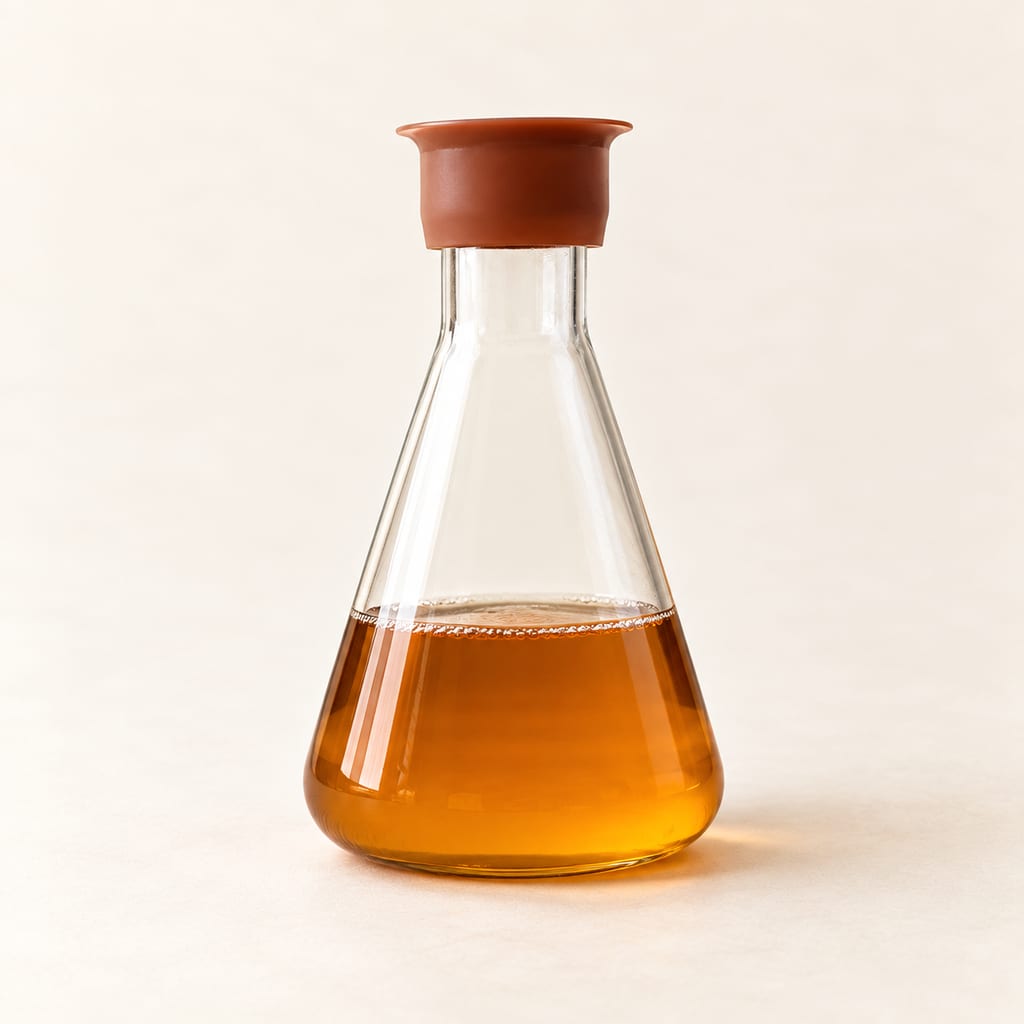
Awamori yeast is the fermenting culture added to Okinawa’s rice-koji mash before it becomes a spirit. On Sakimoto Shuzo’s Yonaguni production page it appears simply as awamori kōbo. The maker combines it with water and rice koji, then lets the moromi ferment and mature for nineteen days. The page gives no strain number, supplier, cell count or dose. That broad process name is enough to distinguish the yeast’s place from the two days spent growing koji on steamed Thai indica rice. Yeast enters only after that mold-covered grain is ready.
The word yeast is easy to let swallow too much of this process. Steamed rice contains starch, and the black-koji mold grown on it makes enzymes that release smaller sugars. Yeast then ferments available sugar to ethanol and other compounds in the wet mash. Koji and yeast are different organisms with different jobs. Distillation follows fermentation and produces the spirit from the matured mash. A culture identified for awamori is consequently not interchangeable on the evidence here with a baker's yeast, the black starter used to seed rice koji, or the koji-covered rice. Each describes a different material at a different point in the production chain.
Awamori yeast has never meant only one strain. Distillers once carried fermenting mash between batches; later researchers selected numbered cultures, and still later work developed variants and sought new isolates. Awamori Number 101 is well documented and widely used in the sources cited here. Sakimoto’s process page, however, leaves its own yeast unnamed. Its nineteen-day fermentation can therefore be described without borrowing Number 101’s measured properties or a supplier’s handling directions. This distinction keeps a real distillery account in view while allowing the history of selected yeasts to explain the ingredient category.
Before a numbered starter was distributed, an awamori brewery could add seed moromi from an earlier fermentation to a new batch. Tamaki’s 1982 account describes the practice in the all-koji, one-stage mash: water and a portion of actively fermenting moromi went into the koji. A starter’s condition affected the next batch. Tamaki reported undesirable aromas and spoiled ferments, especially in summer, which gave the Okinawa tax office a practical reason to select and distribute a more consistent culture. The account describes the conditions of its period; it does not imply that all house-fermented awamori had the same defects.
The same author places the start of practical selection work in 1976. His account recalls a 1901 identification of a principal awamori fermenting organism under the historical name Saccharomyces awamori. That is evidence of scientific attention to the drink, not proof that the organism described in 1901 was the numbered starter later sold to distillers. Names, laboratory methods and production practice changed. Keeping those layers apart lets the story show how a living, locally carried fermentation became a reproducible commercial input without pretending the earlier culture vanished overnight.
In 1981, Okinawa researchers described an unusually concrete search. They examined thirty-nine yeast isolates from the moromi of established awamori breweries, comparing growth and fermentation traits, alcohol formation and aroma in brewing trials. They selected isolate G-2 and named it Awamori Number 1. Trials at fifteen production sites compared that culture with the resident yeasts and recorded improved product quality and yield. These are observations about the isolates and trials the researchers tested. They cannot tell us the behavior of every yeast ever called awamori yeast, but they show why a numbered culture could be attractive to working distilleries.
Tamaki's subsequent practical paper explains the technological setting: an all-koji mash, water and a starter in a warm island climate. The selection criteria included the ability to grow in a warm, acidic, alcohol-producing fermentation and to give a desirable aroma in the process studied. The authors also explored how the selected yeast could be supplied across Okinawa's islands. A propagated liquid starter and a centrifuged solid form were discussed as distribution options. Thus strain choice was partly a matter of making production more predictable and moving a usable culture between places, not merely a search for a different taste.
Awamori Number 101 grew from the Number 1 line. A 2021 genome report identifies AW101 as Saccharomyces cerevisiae and says it arose as a spontaneous-mutation variant of Awamori Number 1. Its authors describe high alcohol productivity and favorable sensory properties as reasons for its commercial use. Neither that report nor the Sakimoto process page identifies Sakimoto’s yeast as AW101. The lineage explains why the two numbers are related, while leaving room for the many yeasts that a distiller could call awamori yeast.
The 2021 authors describe 101 as commonly used across awamori production. An Okinawa Industrial Technology Center study from fiscal 2011 likewise treats it as the prevailing point of comparison when searching for new awamori yeasts. Both statements belong to their dates. They are useful evidence of a widely adopted culture, not a live census of every producer today. AW101 is one named strain within a broader practice, and an awamori producer may describe its yeast without disclosing which strain or supply form it has chosen.
The Okinawa study also shows why one yeast label need not imply one species. Researchers tested stored isolates from older brewery moromi, fresh brewery samples and environmental sources, including sugarcane and brewery surfaces. They estimated three selected pilot candidates to belong to Pichia, rather than the Saccharomyces species of AW101. In a plant test, sugarcane-derived isolate 7031 gave about eight times the 4-vinyl guaiacol of the 101 comparison in the distillate. The study proposed mixed cultures and scale-up as future work. Its experimental result offers a route to a different aroma profile, but gives no basis for identifying Sakimoto’s culture or substituting 7031 in that producer’s mash.
Selection has continued after AW101 became familiar. NAIST describes 101H, selected from the 101 parent in 2016 and later used in a commercial awamori, and a separate yeast lineage originating from Okinawan island-banana stems. These examples show two different paths toward a fruity profile: changing a known brewing line and isolating from another plant source. They are commercial examples from named collaborations, not aliases for Sakimoto’s unnamed yeast. A strain name carries a lineage and a specific experiment; the generic ingredient term does not.
In Sakimoto's sequence, washed rice is hydrated and steamed; seed koji grows on the steamed grain for about two days under attention to temperature and moisture. Water and awamori yeast are then added to rice koji for the moromi stage. The rice gives the system its starch-rich material, the mold-covered koji makes much of that starch accessible as sugar, and the yeast consumes fermentable sugar in the liquid mash. The nineteen days named by the maker describe this production account. They are not a universal yeast activation period or a number a reader can transfer to an unrelated ferment.
The biological division of labor also explains why a jar labelled yeast cannot replace koji. The AW101 genome paper describes enzymes released by Aspergillus luchuensis mycelia on steamed rice breaking rice starch down to glucose. The Saccharomyces yeast then converts that sugar chiefly to ethanol, with smaller amounts of other metabolites. In an all-koji awamori mash, the prepared rice is both the starch source and the surface on which the enzyme-producing mold has grown. The yeast is a partner in the system, not an enzyme packet that makes uncooked rice immediately fermentable.
Yeast affects more than the alcohol concentration. Cells growing in the mash form volatile compounds whose balance can change the aroma carried through distillation. The Number 1 selection paper compared aroma and yield under particular brewing conditions; those results explain why a distiller might care about strain choice as much as vigorous fermentation. Yet a strain's laboratory result has to stay attached to its experiment. A culture may behave differently with another rice, koji preparation, mash temperature or distillation practice, and Sakimoto does not publish those strain measurements for its current yeast.
A 2019 experimental study separates two aroma pathways that are easily muddled in a general story of awamori. It examined a hibiscus-isolated Saccharomyces strain and its mutant against a conventional 101-related comparator. The authors discuss fruity compounds such as isoamyl acetate and isoamyl alcohol in relation to yeast metabolism. They also describe 4-vinyl guaiacol, a precursor relevant to a vanilla-like note in aged awamori, as arising largely through a pathway involving the koji mold and ferulic acid. The conventional yeast examined had a nonfunctional FDC1 gene and did not itself make that precursor in the experiment. It would be inaccurate to say that the yeast alone creates every mature aroma. Rice, koji, the chosen yeast, distillation and aging all have distinct places in the account.
An awamori yeast culture is a living production input. A supplier’s strain, carrier and viable-cell count would determine how a particular package should be stored, propagated and pitched. Sakimoto names no such package or amount. Its public method establishes only the moment of addition: rice koji and water are already present, the yeast enters the moromi, and fermentation precedes distillation. The page thus teaches the sequence without turning a research culture or a present-day commercial yeast into an invented ingredient measure.
Tamaki’s 1982 paper shows why the physical form of a starter mattered. A brewery could expand Number 1 yeast in a koji-derived liquid culture, but the resulting density and purity were difficult to check at each site. Tamaki therefore tested cells grown in a defined medium and concentrated by centrifugation into a solid yeast mass. In plant-scale comparisons, the liquid starter and concentrated form gave little difference within the same distillery in the measured mash components, production yields or tasting results. Concentration also made shipment among Okinawa’s islands more practical. In a separate storage observation of the koji-extract culture, viable cells at about 3°C fell to roughly one-quarter or one-fifth of their starting count after seven days; losses at 30°C were greater. These are measurements of that period’s Number 1 preparations, not a shelf-life instruction for AW101 or Sakimoto’s unidentified culture.
Number 1 and AW101 are useful names precisely because they point to documented cultures. Number 1 was compared with house yeasts at fifteen breweries; AW101 is a later variant whose genome was reported in 2021. The 2011 Okinawa study used 101 as its prevailing comparison while searching for candidates with different aromatic results. Those studies describe growth, alcohol formation and aroma under their own conditions. A producer who gives only the broad term awamori yeast leaves the exact strain open, however widespread a numbered culture may be elsewhere.
In the finished spirit, this culture is encountered through what it helped make rather than as a food served on its own. During fermentation it works alongside rice koji: mold-derived enzymes release sugar, and yeast converts available sugar to alcohol while contributing other metabolites. The fermented moromi is then distilled. That collaboration is central to Sakimoto’s Yonaguni account and to the wider history of selected awamori starters. It explains both why the culture matters to aroma and yield and why it cannot simply be exchanged with seed koji, which starts mold growth on steamed rice at an earlier stage.
This locates Sakimoto’s documented use, not the origin or identity of its exact yeast supply.
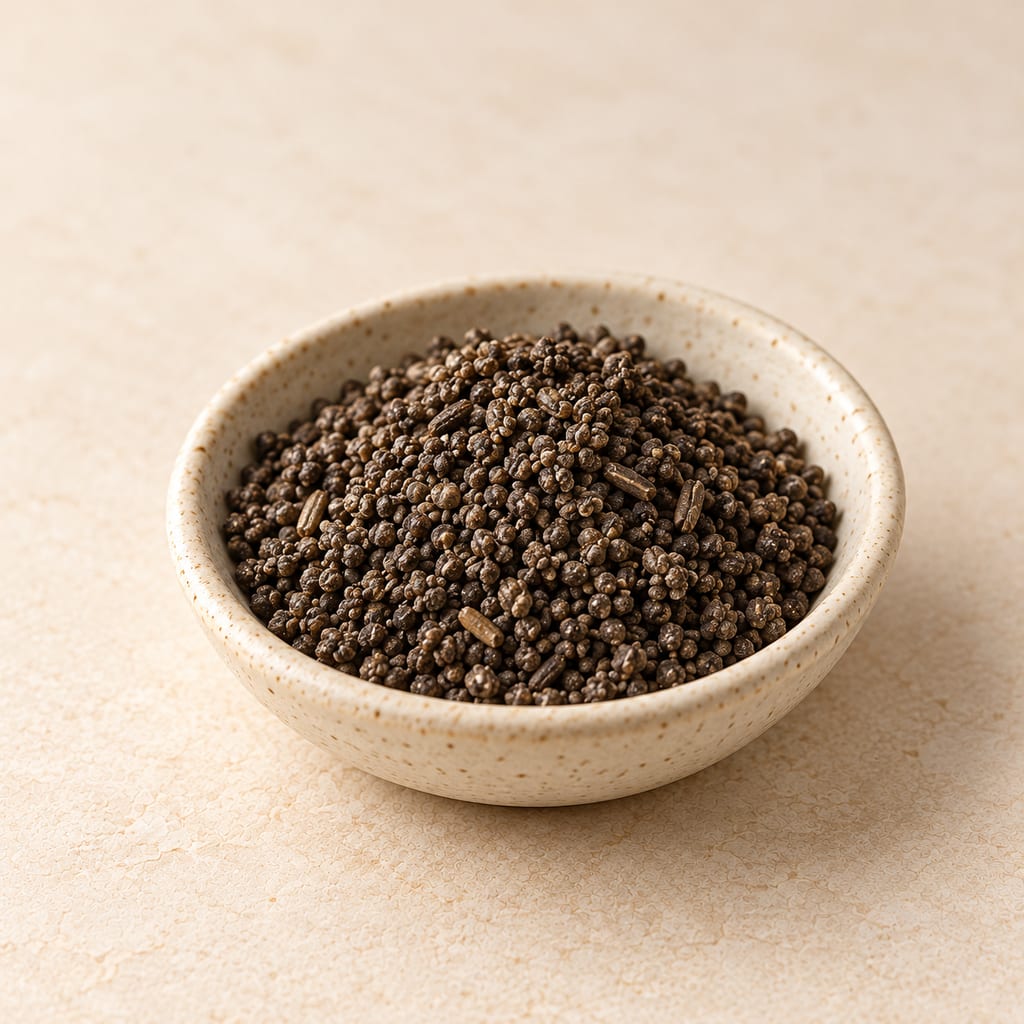
Tane-koji is the mold inoculum Sakimoto plants on steamed rice to make rice koji for Yonaguni awamori; its exact strain and supplier are unpublished.
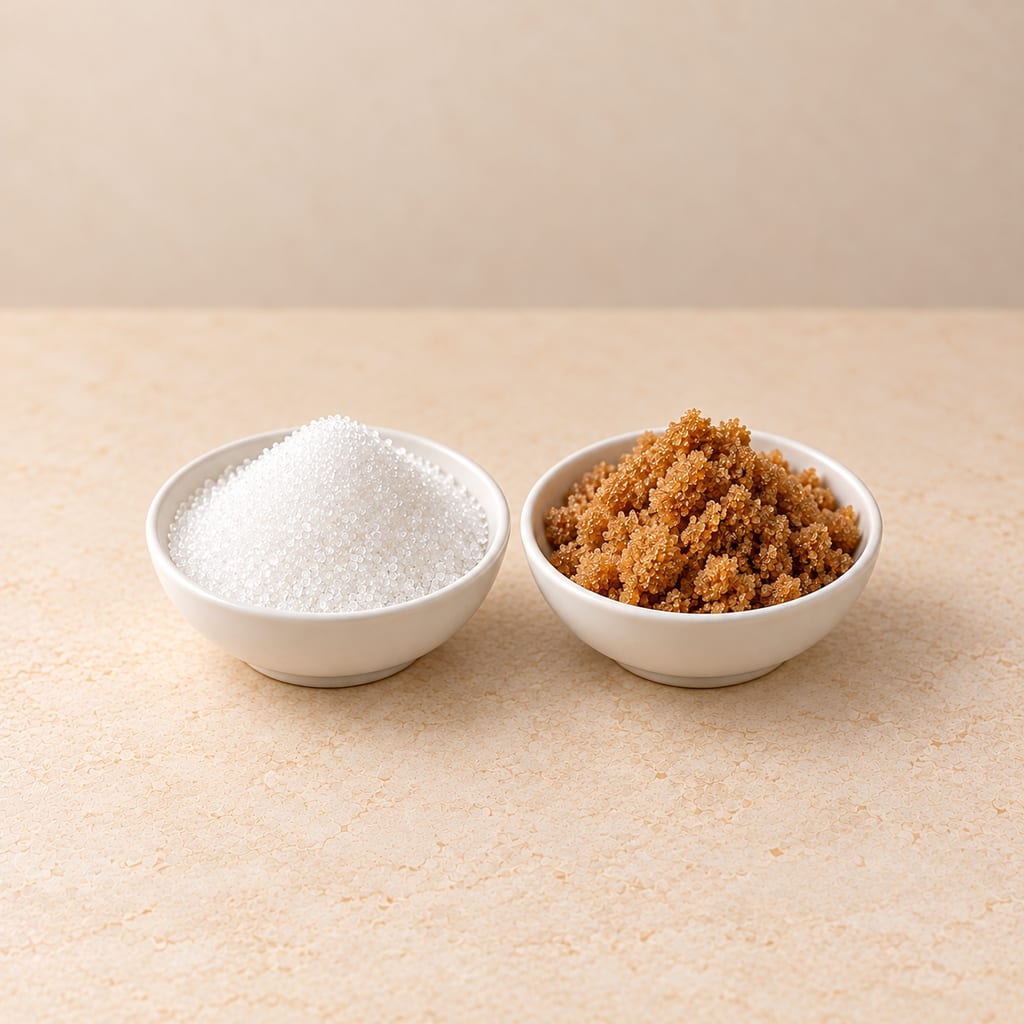
White sugar is refined sucrose, almost pure; brown sugar is sucrose with molasses, left in or added back. Molasses makes brown sugar moister, darker and more strongly flavoured.
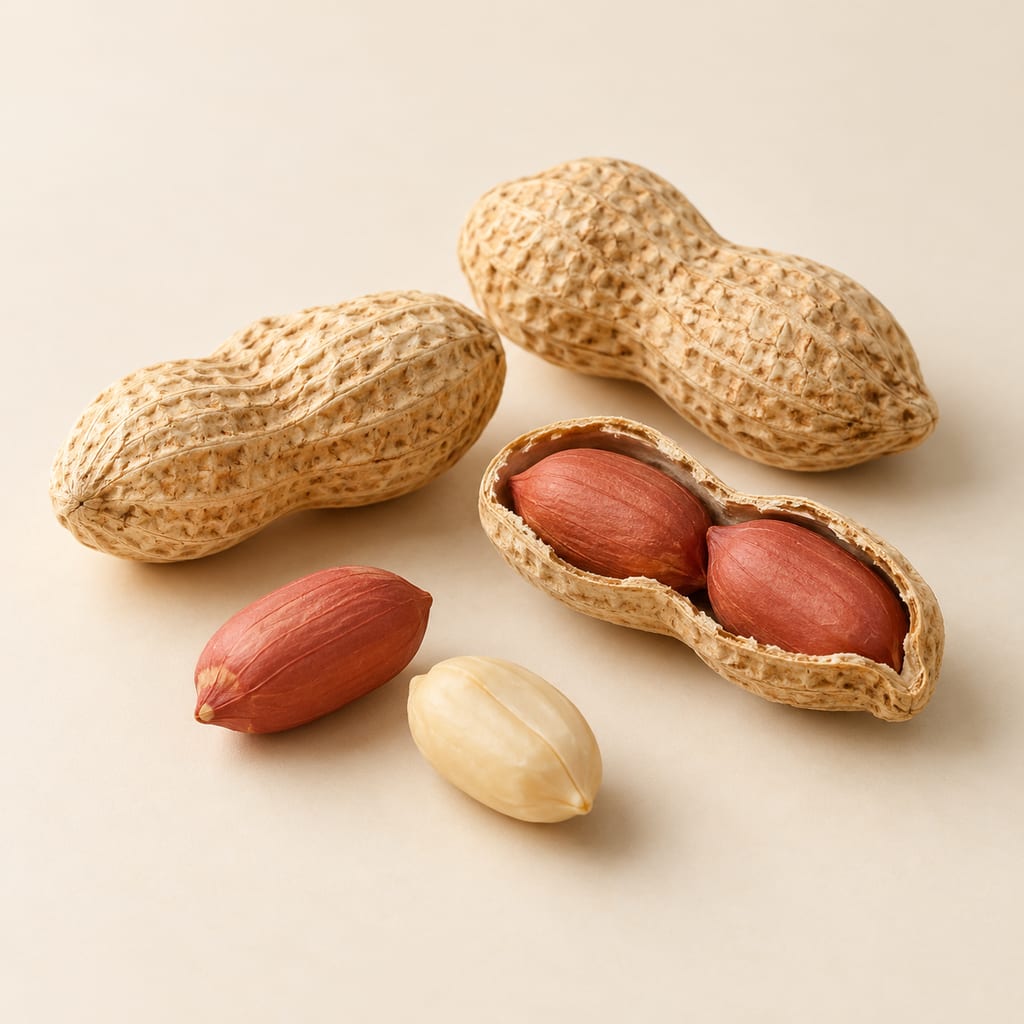
Peanuts are the edible seeds of Arachis hypogaea, a cultivated legume. They are eaten whole, roasted and ground, and peanut oil-press cake is a separate byproduct used in some fermentations.
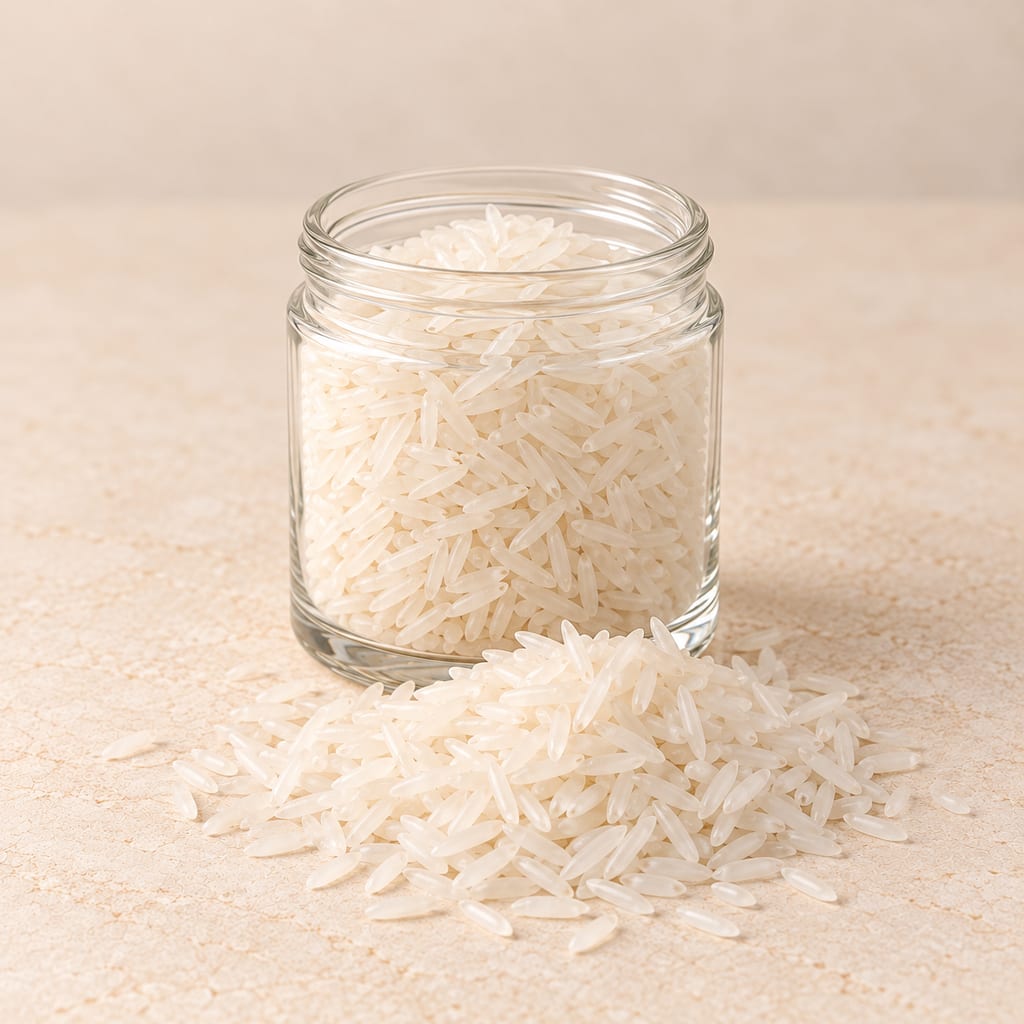
Thai indica rice is the starch-bearing grain Sakimoto steams for Yonaguni awamori koji. The producer names its origin and rice group, but no cultivar, lot or grain grade.
No community contributions have been published for this entry yet.
Sign in to contribute. Published comments and photos are free to read.
Sakimoto ShuzoIngredient · Process
泡盛 製造行程 [Awamori production process]Names awamori yeast added with water to rice koji; nineteen-day Yonaguni moromi; no strain or dose.
Cited in: A yeast with a place in awamori; What happens in the moromi; The culture as a material to choose and handle
日本釀造協會雜誌 [Journal of the Society of Brewing, Japan]History · Science
優良な泡盛酵母の分離選抜 [Isolation and selection of excellent awamori yeast]1981 primary selection: thirty-nine isolates, G-2 named Awamori Number 1, fifteen distillery comparisons.
Cited in: From house yeast to a selected starter; Number 101 and the limits of a standard
日本釀造協會雜誌 [Journal of the Society of Brewing, Japan]History · Science · Process
泡盛1号酵母の性質とその実用化 [Characteristics and practical application of Awamori No. 1 yeast]1982 four-page practical account: earlier seed-moromi, all-koji mash, selection work, culture distribution and historical storage observations.
Cited in: A yeast with a place in awamori; From house yeast to a selected starter; What happens in the moromi; The culture as a material to choose and handle
Microbiology Resource AnnouncementsIdentity · Science · History
Draft Genome Sequence of Saccharomyces cerevisiae Strain Awamori Number 101, Commonly Used to Make Awamori, a Traditional Spirit, in Okinawa, JapanAW101 identified as S. cerevisiae and spontaneous-mutation variant of No. 1; koji mold enzymes release glucose and yeast ferments it.
Cited in: A yeast with a place in awamori; From house yeast to a selected starter; Number 101 and the limits of a standard; What happens in the moromi; The culture as a material to choose and handle
Okinawa Prefectural Industrial Technology CenterHistory · Science
新たな泡盛用酵母の探索に関する調査 [Survey on the search for new awamori yeasts]FY2011 study treats 101 as prevailing comparator and examines additional yeast isolates, including experimental Pichia candidates.
Cited in: Number 101 and the limits of a standard; The culture as a material to choose and handle
Frontiers in GeneticsScience
Characterization of a New Saccharomyces cerevisiae Isolated From Hibiscus Flower and Its Mutant With L-Leucine Accumulation for Awamori Brewing2019 strain experiment separates yeast aroma metabolites and koji-related 4-vinyl-guaiacol pathway.
Cited in: What happens in the moromi
Nara Institute of Science and TechnologyHistory · Culture
Achievements: Cases of commercializationInstitutional commercialization descriptions of 101H and banana-associated awamori yeast projects, not Sakimoto strain evidence.
Cited in: Number 101 and the limits of a standard