
Agar / kanten
A gelling polysaccharide extracted from red seaweeds, sold as kanten strips or powder; it sets firm at a low concentration and stays solid until about 85 °C.
 FermenteaWhere food goes to change
Mushrooms
Calvatia boninensis is a large puffball described from the Bonin (Ogasawara) Islands of Japan, reported as edible in some catalogues and local accounts, with no species-specific safety or preparation study.
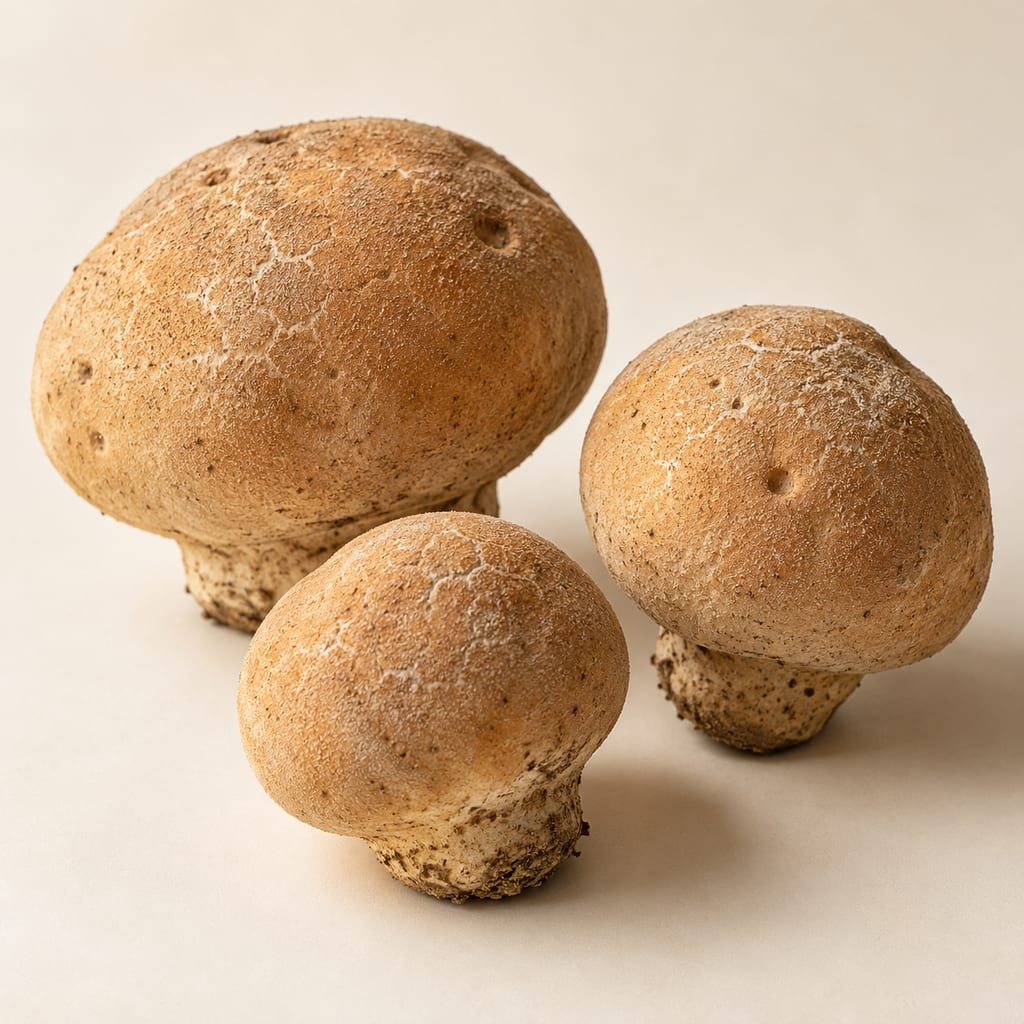
Calvatia boninensis is a puffball, a fungus whose spores develop inside a closed fruit body instead of on gills under an open cap. The original 1939 description by S. Ito and S. Imai gives a large, ovoid to head-shaped fruit body up to about 14 cm across, with a broad sterile base shaped like an inverted cone, a very thin outer skin that is nearly smooth and wrinkles at the base, and brown tones. Inside, a spongy sterile layer called the subgleba can be separated from the darker spore-bearing gleba. The spores are ellipsoid to oblong and finely roughened.
A later Chiba taxonomic account gives a wider size range, 50 to 160 mm high and 30 to 170 mm broad. It describes a thin papery outer layer that darkens and sloughs away, a shiny inner layer that breaks into fragments, a gleba that is white when young and becomes ochre with age, and a well-developed spongy base. The same account separates the species from the similar Calvatia craniiformis by spore shape: ellipsoid to cylindrical spores here, globose to subglobose in that species. Field identification is difficult for that reason, because the two can look alike before the spores are examined.
Calvatia boninensis S. Ito & S. Imai is an accepted name in the Species Fungorum and GBIF backbone records. Global databases place the genus in the Lycoperdaceae, while the 2026 Chinese edible-fungi catalogue uses the Agaricaceae for the family section that contains the entry. The original paper records that an earlier Japanese collection had been treated as Calvatia craniiformis var. gardneri. Current nomenclature routes that variety to C. gardneri, not to C. boninensis, so the names should not be merged.
The Japanese, Chinese and Thai names do not settle the identity. The Thai popular page that carries a local name gives spore characters that conflict with the primary taxonomic description, so its identification cannot be taken as proof for the Ogasawara taxon.
The species is terrestrial and grows in woodland on rich soil or humus. Its genus is saprotrophic, feeding on dead organic matter, and no particular host tree is documented for it. The Kyoto Prefecture Red Data Book describes growth on leaf litter and humus at several central and western Japanese sites.
The strongest verified records come from the Ogasawara Islands. A 2018 National Museum of Nature and Science survey reports 64 voucher specimens from Chichi-jima, Haha-jima and Ani-jima, with collection sites and dates. Its authors treat the species as a candidate Ogasawara endemic. Earlier Japanese literature reported it from Honshu, but those authors noted differences in mainland specimens and did not accept those records as conspecific. The 2006 Chiba paper, by contrast, cites reports across tropical, subtropical and warm-temperate eastern Asia. These accounts disagree, and the reported range should not be presented as settled.
Chinese observations filed under the name on iNaturalist are community identifications, some marked research grade on a single identification. They are leads for the range question, not confirmed records.
The original type was collected on 5 November 1936. The 2018 Ogasawara survey lists fruiting bodies collected from May through November, including June and July collections on Chichi-jima and Ani-jima and November collections on Chichi-jima and Haha-jima. These are collection dates from a voucher list, not a controlled study of fruiting. The Kyoto Red Data Book gives July to October for its mainland records, whose identity the 2018 authors dispute. The sources support a range from spring to late autumn in the Ogasawara specimens and do not establish a narrower or universal season.
The 2026 Chinese catalogue lists the species as edible, and a 2019 review of edible and medicinal mushrooms in China marks it edible on the strength of older Chinese and Japanese references. Those are classifications in food catalogues. Neither records a preparation, a cooking method or a tested safety result for this species.
Thai local accounts under the name เห็ดตาปู้ describe eating the young mushroom, sometimes in a curry. A 2023 field survey at Ubon Ratchathani University says that a Thai handbook lists young specimens as edible, but the people it interviewed locally did not eat it. The accounts are anecdotal, and no species-specific toxicology or clinical assessment was found in the sources consulted. No medicinal use is established for this species.
Nothing on this page is an instruction to collect, identify or eat this fungus. The sources give no species-specific safety verdict. A food listing or a local account does not establish that a wild specimen is safe, and a white interior, cooking or a picture does not prove identity or safety.
Puffball-like fruit bodies can be confused with the young button stage of Amanita species,. The Michigan State University Extension warning and the U.S. Food and Drug Administration's Bad Bug Book both note this risk for the wider group. Those are general warnings and do not describe this species. Calvatia boninensis is separated from C. craniiformis by its spores, which requires microscopic examination.
Type locality on Chichi-jima and voucher-backed records from Chichi-jima, Haha-jima and Ani-jima. The 2018 authors treat the species as a candidate Ogasawara endemic. These are collection records, not food-use records.
A 2006 prefectural survey identified the species from Chiba. The 2018 Ogasawara authors question whether mainland Japanese records are the same taxon.
Local accounts under the name เห็ดตาปู้ describe eating the young mushroom, sometimes in a curry. The evidence is anecdotal, and a 2023 university survey found local people did not eat it.
Listed as edible in the 2026 Chinese catalogue of edible and medicinal fungi. The catalogue gives no specimen locality for the Chinese records.
A gelling polysaccharide extracted from red seaweeds, sold as kanten strips or powder; it sets firm at a low concentration and stays solid until about 85 °C.

Akahatsu, Lactarius akahatsu, is a wild milkcap of East Asian pine and mixed forests that is sold in Yunnan markets, with its edibility and identity still needing species-level review.

The almond mushroom, Agaricus subrufescens, was cultivated in eastern North America in the 1800s, lost its market, and returned as a cultivated mushroom from Brazil, where it is grown under several names.
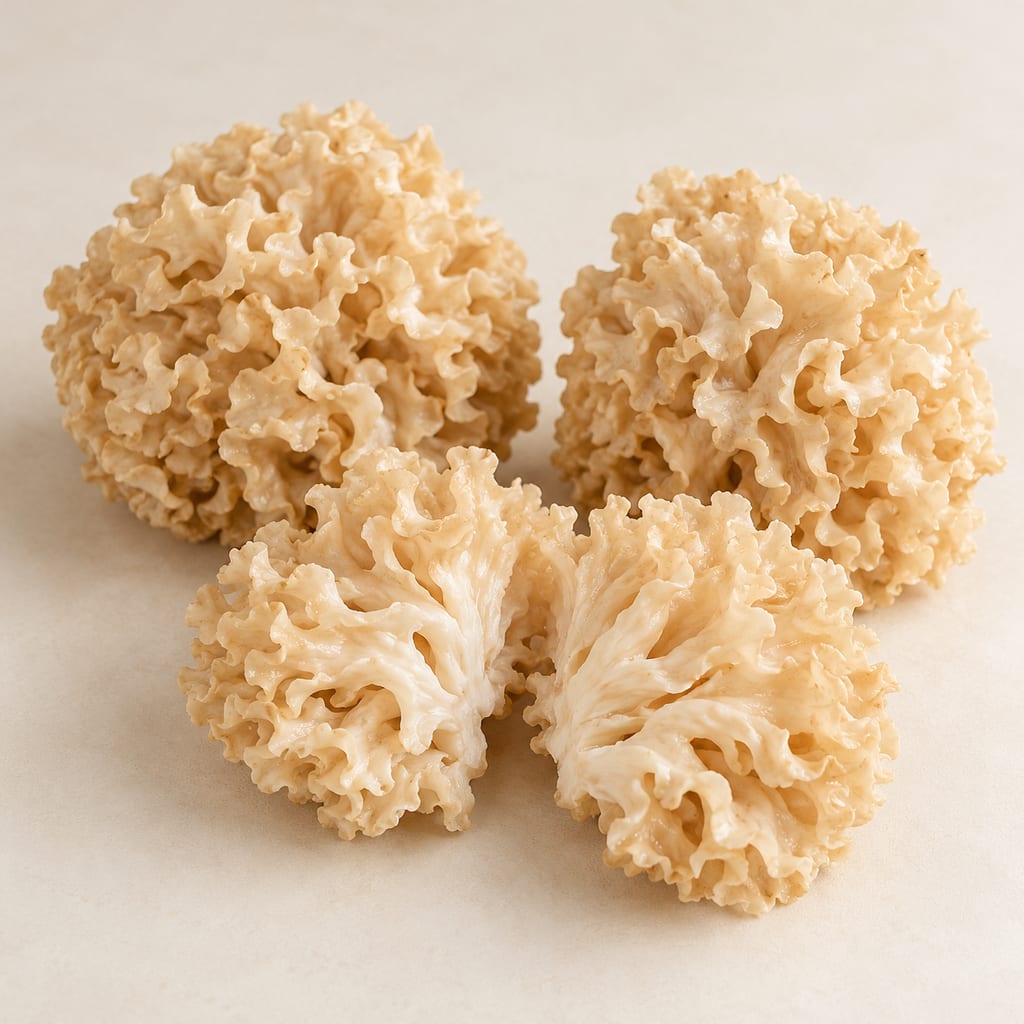
The Asian cauliflower mushroom, Sparassis latifolia, is a cultivated fungus with a frilled, fronded form that is eaten in China, Japan and Korea. Many Asian records under the name Sparassis crispa refer to this species.
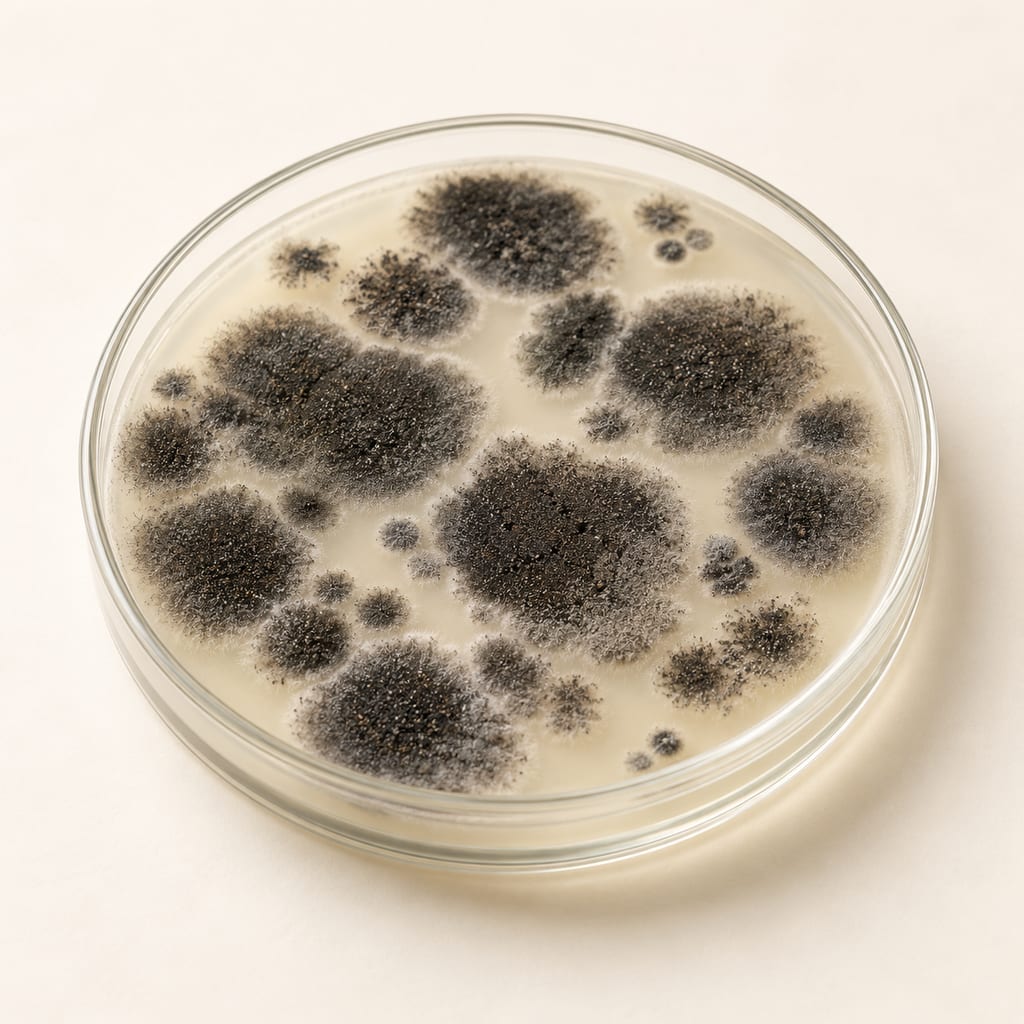
Aspergillus luchuensis is the black koji mould used in Japanese shochu and awamori, valued for the citric acid it makes alongside the starch-converting enzymes of koji.
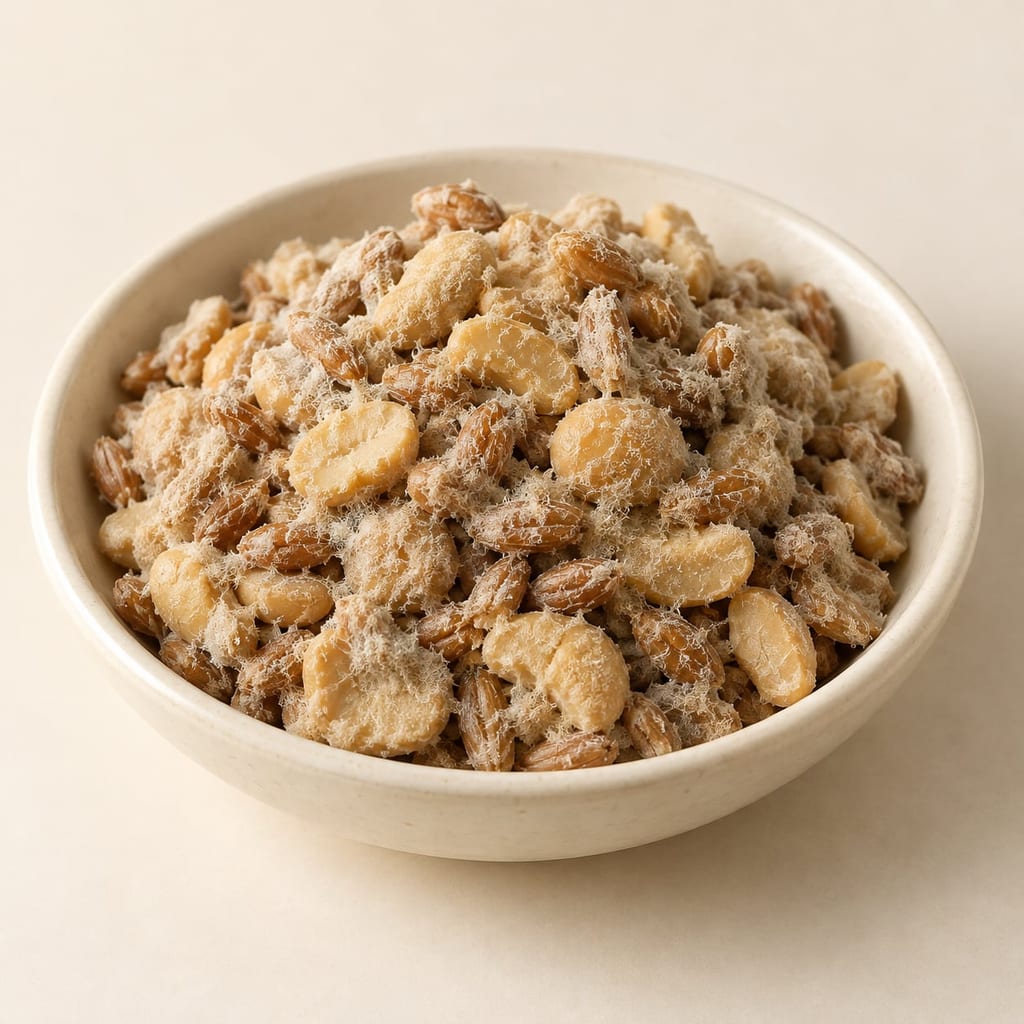
Aspergillus sojae is a koji mould of the Aspergillus flavus group, closely related to A. oryzae, used as a starter in soybean fermentations such as Korean meju, doenjang and ganjang.
Awamori yeast ferments sugar released from rice koji in the Okinawan spirit’s mash. Sakimoto names the ingredient but gives no strain, form, supplier or dose.

Bamboo shoots are the young culms of many bamboo species, eaten after boiling or leaching in Asia, and fermented into sour and preserved foods in the Himalayas, northeast India and Burma.
No community contributions have been published for this entry yet.
Sign in to contribute. Published comments and photos are free to read.
Transactions of the Sapporo Natural History SocietyIdentity · Taxonomy · Morphology · Distribution
Fungi of the Bonin Islands. IIIOriginal description and 1939 name; fruit body size and form; spore shape; type locality on Chichi-jima and the 1936 collection date.
Cited in: A large puffball from the Bonin Islands
Natural History ResearchIdentity · Morphology · Distribution
Fungal Flora in Chiba Pref., Central Japan (V). Gasteromycetes 2Size range, outer and inner layer description, gleba colour; spore difference from C. craniiformis; Chiba record. Broader regional range claims require caution.
Cited in: A large puffball from the Bonin Islands; Where it grows, and where the records disagree
Memoirs of the National Museum of Nature and ScienceDistribution · Season · Taxonomy
Distribution Data of Some Mushroom Species Distributed in and Around the Ogasawara Islands, Japan64 voucher specimens from Chichi-jima, Haha-jima and Ani-jima; collection months; treatment as a candidate Ogasawara endemic.
Cited in: Where it grows, and where the records disagree; Season
Kyoto PrefectureHabitat · Season · Distribution
Kyoto Prefectural Red Data Book 2015, Calvatia boninensisGrowth on leaf litter and humus; July to October; mainland Japanese records, whose identity is disputed.
Cited in: Where it grows, and where the records disagree; Season
MycosystemaFood use · Taxonomy
Species cataloging of edible and medicinal fungi in ChinaListed as edible; family placement in the catalogue. A food-category entry, not a range or safety record.
Cited in: Food use: listed as edible, not tested
Fungal DiversityFood use
Ethnomycology of edible and medicinal mushrooms in ChinaReview-table edible classification and its cited references; not a species-specific preparation source.
Cited in: Food use: listed as edible, not tested
Isan Roi Paet local culture and food accountFood use · Identification
เห็ดตาปู้Local name; young mushroom eaten, sometimes in a curry; spore description conflicts with primary taxonomy.
Cited in: A name with a disputed edge; Food use: listed as edible, not tested
Journal of Science & Science EducationFood use · Survey
Species Diversity of Mushrooms in Faculty of Science, Ubon Ratchathani UniversityA Thai guidebook lists young specimens as edible; local people interviewed did not eat it.
Cited in: Food use: listed as edible, not tested
Species FungorumTaxonomy
Calvatia accepted namesAccepted name of C. boninensis; status of C. craniiformis var. gardneri.
Cited in: A name with a disputed edge
GBIF Backbone TaxonomyTaxonomy
Calvatia boninensisAccepted-name record, authorship and classification.
Cited in: A name with a disputed edge
Michigan State University ExtensionSafety
Don't Pick Poison: When Gathering Mushrooms for Food in MichiganGeneral warning that immature Amanita buttons can be mistaken for puffballs. Not a species assessment.
Cited in: Safety and look-alikes
U.S. Food and Drug AdministrationSafety
Bad Bug Book, mushroom chapterYoung button-stage Amanita muscaria can be confused with puffballs. General hazard context only.
Cited in: Safety and look-alikes