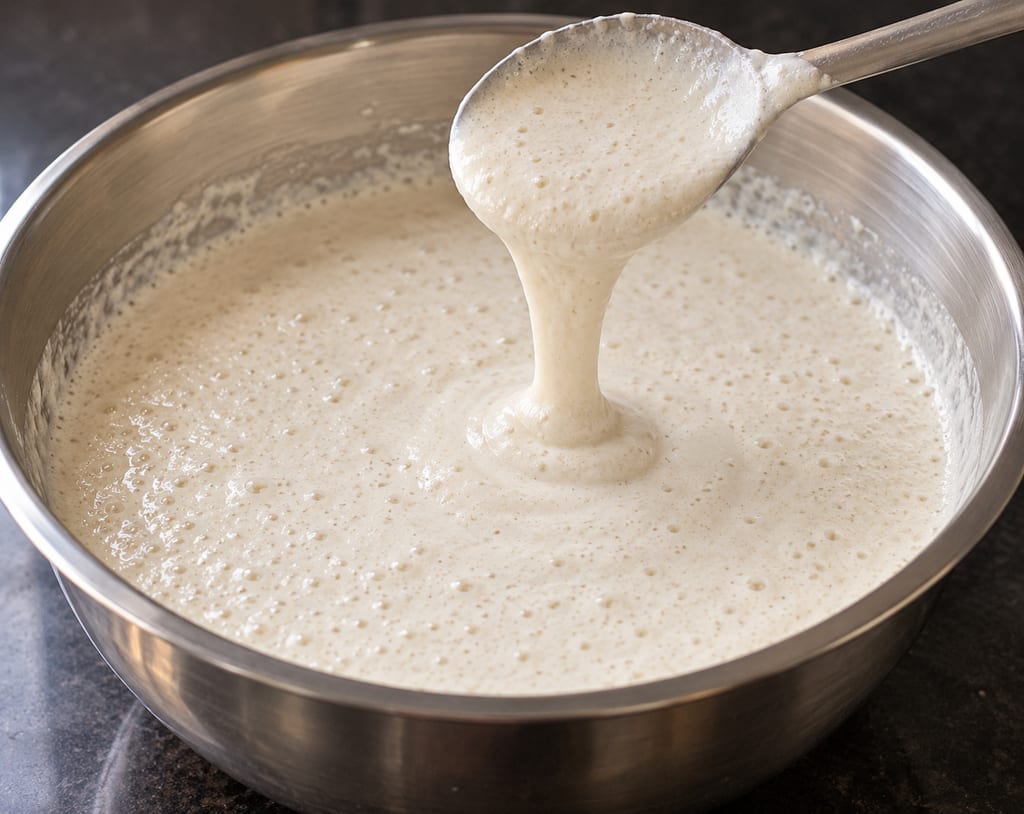
Dosa batter
A naturally fermented South Indian rice-and-urad batter, ground fine and spread thin on a hot griddle. Fermentation lightens the batter and develops its gentle tang.
 FermenteaWhere food goes to change
Substrates
Black gram, or urad, is a South Asian pulse whose whole dark seeds and dehulled white dal make distinct cooked and fermented foods.
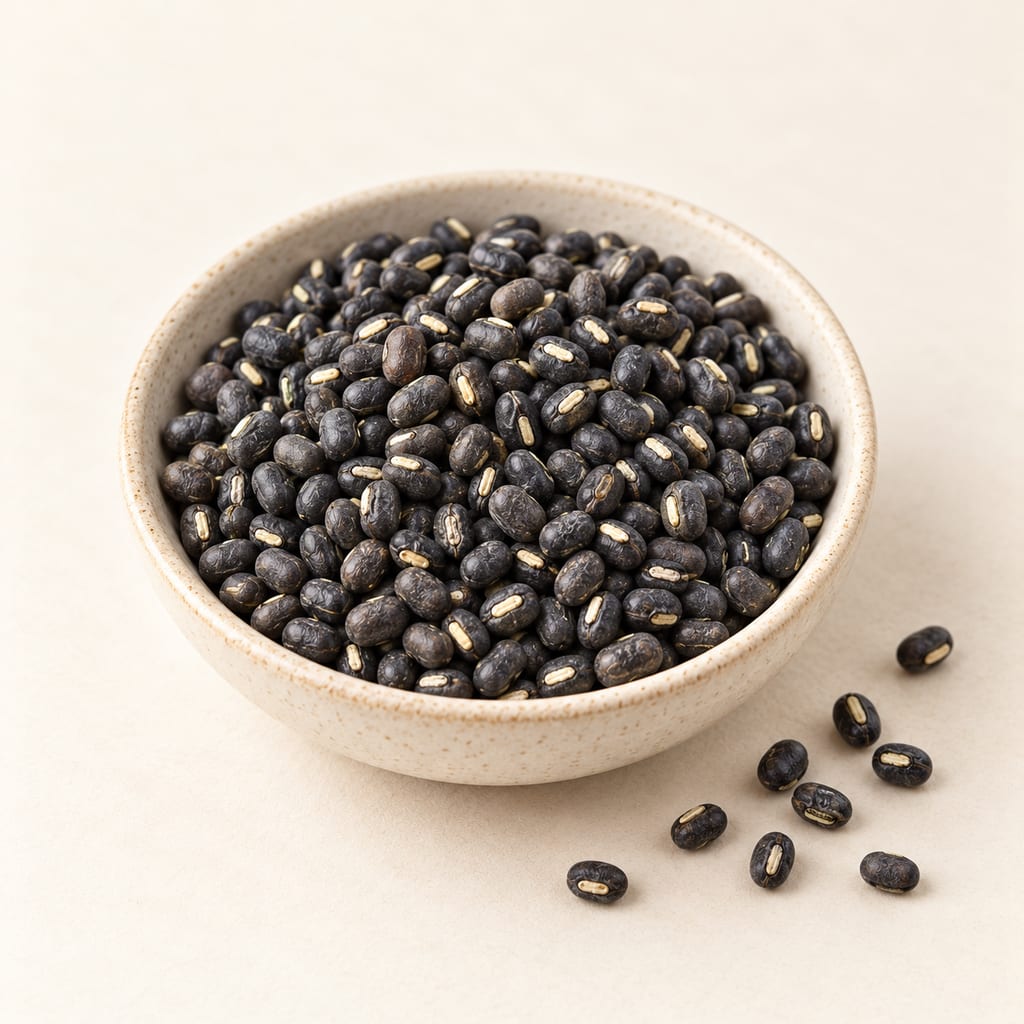
Black gram is the dark, hard-seeded pulse sold in South Asia as urad, urid, mash, udid and related regional names. Botanically it is *Vigna mungo* (L.) Hepper, a scrambling annual legume in the family Fabaceae. Its mature seed is usually black or very dark brown, with a pale interior; the plant itself is a softly hairy herb with trifoliate leaves and narrow pods. Cooked whole, it becomes soft and creamy while often retaining its dark skin. Split and skinned, the same seed becomes ivory-white dal that disperses more readily and gives a smoother batter. This contrast explains a common market confusion: white urad is not a different white bean, and black gram is not green gram or mung bean, which is *Vigna radiata*. The two are close relatives with overlapping old names and trade descriptions, but they are separate accepted species.
Names change with language and whether a speaker means the seed, its split form or a cooked dish. Commonly recorded Indian names include Hindi urad or urd (उरद / उर्द), Bengali mash-kalai (মাষকলাই), Gujarati adad (અડદ), Kannada uddu (ಉದ್ದು), Malayalam ulunnu, Marathi udid (उडीद), Tamil uluntu (உழுந்து), and Telugu minumu (మినుము) or uddulu (ఉద్దులు). These spellings represent several languages and do not reduce to one romanization. Sanskrit masha (माष) is commonly associated with black gram in lexicons, while Sanskrit mudga is generally associated with mung or green gram. Thus a bag labelled “black mung bean” deserves a closer look: the cooking difference between black gram and mung bean is more substantial than that loose English name suggests. “Black matpe” and “black gram” are other trade names for this pulse.
Kew treats *Vigna mungo* as an accepted species and a cultigen from the Indian subcontinent. The domestication story rests on more than a resemblance to today's dark-seeded crop. In a direct comparison of seed proteins, leaf chemistry and plant form, Chandel, Lester and Starling distinguished cultivated black gram from mung bean and identified *Vigna mungo* var. *silvestris* as the wild lineage of black gram. The work identifies a botanical relationship, while excavated seeds document later cultivation and use; neither alone fixes one original field or year.
At Hallur, a possibly late Neolithic layer has yielded black-gram remains; the pulse also appears at Iron Age Veerapuram. Those finds place it in the long history of southern Indian farming, where grain and pulse could be grown and eaten together. They locate ancient use without turning either excavated settlement into the crop's birthplace. The seed's durable place in South Asian food is easier to see in its many surviving forms than in a single origin story.
Black gram’s continuing place in rice-growing regions also helps explain its place beside rice on the plate. Odisha’s crop guide describes black gram grown in rainy, winter and summer seasons, including fields left after the rice harvest. The guide even distinguishes upland and rice-fallow seed rates, because the soil and water left by the previous crop are different. A pulse sown into the stubble of the rice harvest ties the two crops together in the field as well as on the plate.
The cultivated plant is an annual, hairy, branching legume. Narrow pods develop after flowering, holding the small seeds that will be dried for the pulse market. FAO’s Ecocrop profile gives a broad 75–130-day span to mature dry beans; weather, cultivar and growing season affect the actual interval. Odisha’s guide recommends a well-drained loam and describes harvest when most pods have darkened. The pod is a practical sign for the grower: wait too little and the grain is immature, while uneven ripening calls for more than one harvest round. The guide then describes threshing and drying the cleaned seed before storage. That hard, dried pulse can travel and be sold well beyond its harvest season. Water later reverses part of that dryness in the kitchen, softening the cotyledons for a pot of dal or for grinding. The cycle from dry pod to wet paste helps explain why one field crop can enter both a slow-simmered dish and a fresh batter.
The Odisha guide shows how finely the crop is tuned to season. Kharif black gram is sown from mid-June to the first week of July at 12–15 kg of seed per hectare, in rows 30–45 cm apart. Rabi sowing falls in the second fortnight of October on uplands and the second fortnight of November in rice-fallow fields, at 18–20 kg per hectare and 40 kg per hectare respectively; summer sowing runs from the third week of February to the first week of April at 20–25 kg. The plants are weeded at least twice, at 20–25 and 40–45 days after sowing, and given three or four irrigations, the first at 20–25 days. Harvest comes when 70–80 per cent of the pods are mature and black, in two rounds to limit losses from shattering. The seed is threshed by beating with a stick, trampling by bullocks or a pulse thresher, then sun-dried for three to four days to 8–10 per cent moisture and stored in painted pots, airtight bags or hermetic bags. The same page lists the whole, split, husked and dehusked pulse among its products, and notes that the plant also serves as green manure and fodder.
Once dried, the seed can go through different milling paths. Dehulling removes the dark seed coat, and splitting exposes the pale cotyledons. Those actions change surface area and how quickly water reaches the interior. They also decide whether the coat remains visible in the food. The mill therefore makes distinct cooking materials from one crop, before the cook has added water or heat.
For a batter, rice and urad are often soaked separately, then ground and combined. The separate bowls allow different grinding choices: the rice can retain some grain while the urad becomes a creamy paste. Water added during grinding changes how readily that paste spreads and how the mixture holds air. A steamed idli and a thin griddled dosa start from related ingredients but ask different things of the finished batter. The practical importance of milling is felt at this point: a hull left on the pulse changes the look and feel of the paste, while dehulled urad lets the cook build a paler, smoother body around the rice.
Urad is more than a flavoring portion in a rice batter. Its ground cotyledons make a thick, creamy paste that blends with the grittier ground rice, while microbes arriving with the ingredients and their surroundings participate in fermentation. In an idli-batter experiment, the mixed batter grew in volume and became less dense as it acidified. Its softer, aerated structure helps explain the lightness of the steamed cake. The result depends on grinding, hydration, temperature and the particular rice-to-pulse mix; a laboratory formula cannot supply an ideal ratio for every household.
Microbes are already present on ingredients and in the surrounding food environment; the batter is not simply a yeast dough. A laboratory investigation of idli batter found a changing community dominated by lactic-acid bacteria, with *Weissella* emerging as a major genus in its samples. Separate inoculation experiments showed selected *Weissella* isolates could drive acidification and volume increase in the study’s sterile batter. The result explains one documented fermentation system, not every household’s resident organisms or a universal starter culture. The everyday outcome is a batter that acidifies and expands, producing the characteristic tang and a softer, aerated steamed cake.
The pulse’s behavior can be examined outside a complete idli recipe. Wani, Sogi and Gill dispersed flour from three black-gram cultivars in water and measured how much foam formed after mixing and how long it lasted. Both capacity and stability changed with acidity; the tests show that the flour can help hold air in a liquid medium. They do not make a home batter identical to a stirred laboratory suspension. A cook works with hydrated grain, varying particle size, water and beating, then cooks the mixture. In dosa, fermented batter spreads over a hot plate and dries toward a browned, often crisp edge. Idli batter is steamed into a soft cake. Medu vada/ulundu vadai is worked into an aerated mass, shaped and fried. The same pulse contributes to these distinct textures through grain chemistry joined to different cooking methods.
Archaeological black-gram remains show that this pulse was cultivated in southern India long before any surviving recipe. A pulse that grows alongside grain may be boiled with rice, ground to help a batter rise, or toasted in a small amount for a nutty accent, and each of these is a distinct culinary choice.
In southern cuisines, urad joins rice in idli and dosa batters; it is ground alone for vada and used in other fried or steamed foods. A small handful of split urad can also be toasted in a tempering for nutty flavor and a brief crunch against softer food. A documented Tamil ulundhu saadam cooks split black gram with rice, garlic and coconut and serves it with a coriander chutney that also contains white urad. The pulse plays two roles in that meal: substantial partner to the rice and smaller accent in its accompaniment. Its uses range from a main body of the dish to a few toasted seeds that announce themselves at the first bite.
North Indian and Himalayan cooking includes slow-cooked whole-urad preparations; a Government of India tourism account describes Dogri madra as a yogurt-based preparation that can use urad as well as kidney beans. There, the whole pulse takes on the flavor of the seasoned dairy sauce while staying recognizable as a bean. That is a very different use from batter, where grinding largely removes each seed's individual shape. These foods invite comparison by ingredient while retaining their own methods and textures.
Choose a bag whose label identifies black gram or urad and, where possible, *Vigna mungo*. A “black mung” label can be ambiguous because mung bean is another species. Look through a clear package for reasonably uniform, dry seeds without visible insect damage, damp clumps or foreign matter. The most useful purchase is the milling form the dish actually requires: a slow-cooked bean and a fine batter call for different starting material. Store the identity and form with the bag after opening, because a pale split pulse can be hard to identify later by sight alone.
Store dried beans sealed in a cool, dry cupboard, away from moisture and pests. Packaging and humidity affect keeping quality, so no single shelf life fits every bag. For cooking, rinse and inspect, then follow the chosen dish's hydration and cooking directions. Dry pulse should be cooked thoroughly until tender. General bean guidance discusses lectins in undercooked beans without giving a black-gram-specific home time-temperature endpoint. A fermenting batter's sour smell and bubbles show change, not safety.
Black gram contains proteins capable of provoking allergy in some people. A clinical study of selected asthma and rhinitis patients confirmed a small number of reactions and found that measured black-gram IgE reactivity could remain after boiling. Those findings neither establish a population allergy rate nor make cooking an allergy safeguard. A person with a known reaction needs to treat urad in dal, batter and flour as the same underlying pulse.
At the table black gram can be quietly sustaining or conspicuously textural. In a rice-and-urad meal, the pulse adds its own protein and body to the grain; in a tempering, a small toasted measure contributes aroma and crunch. Odisha’s guide notes that its high lysine content makes it a good complement to rice in balanced diets.
black gram
Hallur and Veerapuram are reported crop-presence sites; neither is established as a first domestication site.
A naturally fermented South Indian rice-and-urad batter, ground fine and spread thin on a hot griddle. Fermentation lightens the batter and develops its gentle tang.
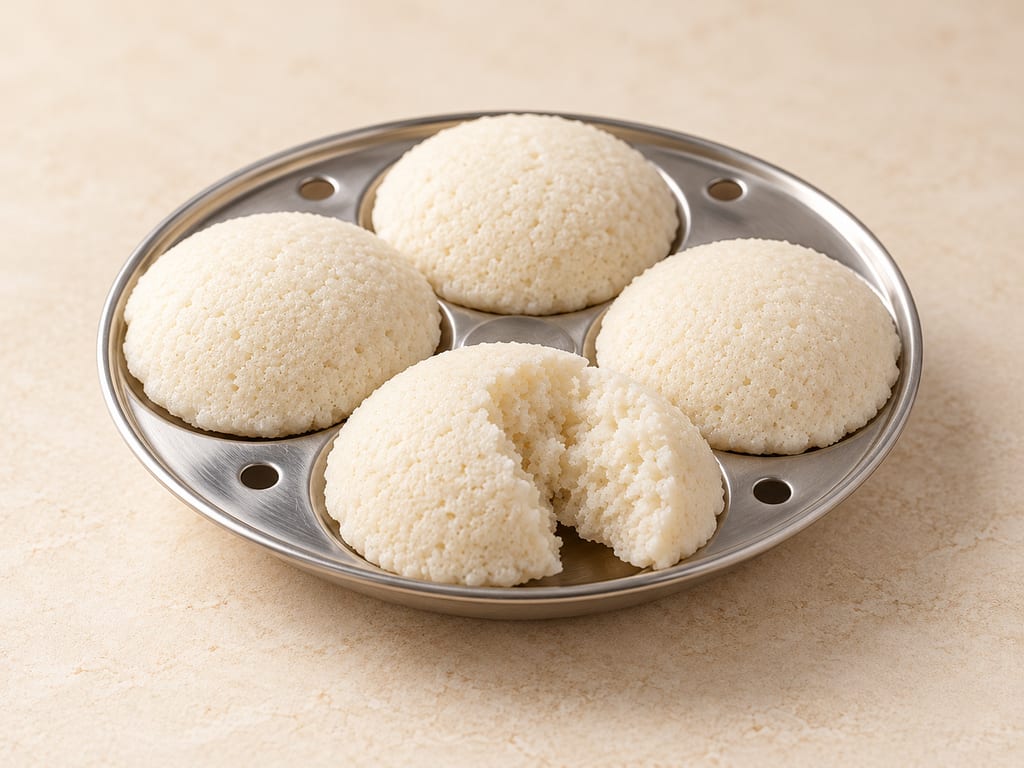
Rice and black gram are soaked separately, ground, salted and fermented into a thick batter for idli. The batter is portioned into moulds and steamed into soft savoury cakes.
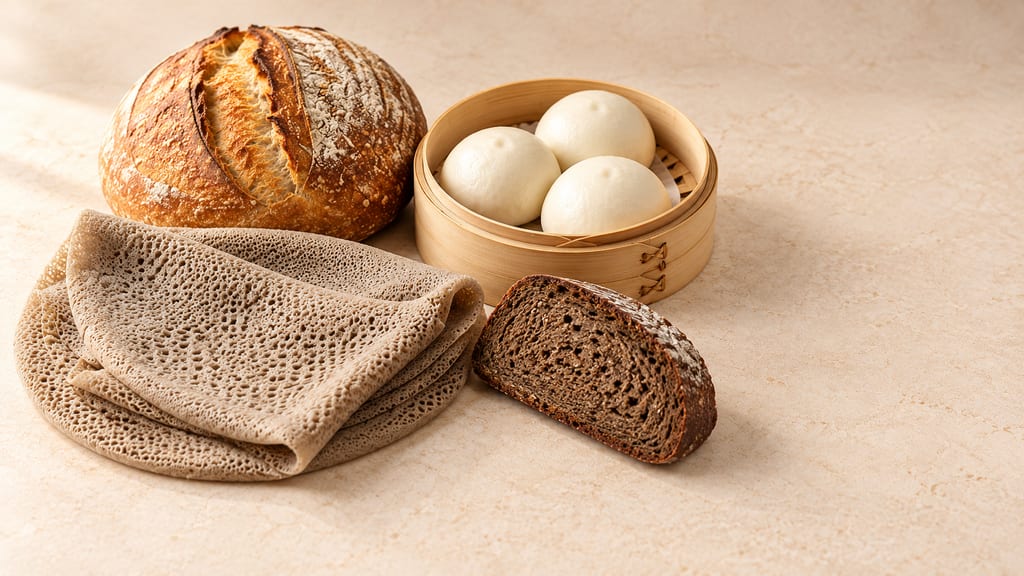
From the baguette and the steamed bun to injera, titiyas, Finnish rye and cassava bread: how grain, microbes and heat answer the question of what bread is for.

A gelling polysaccharide extracted from red seaweeds, sold as kanten strips or powder; it sets firm at a low concentration and stays solid until about 85 °C.
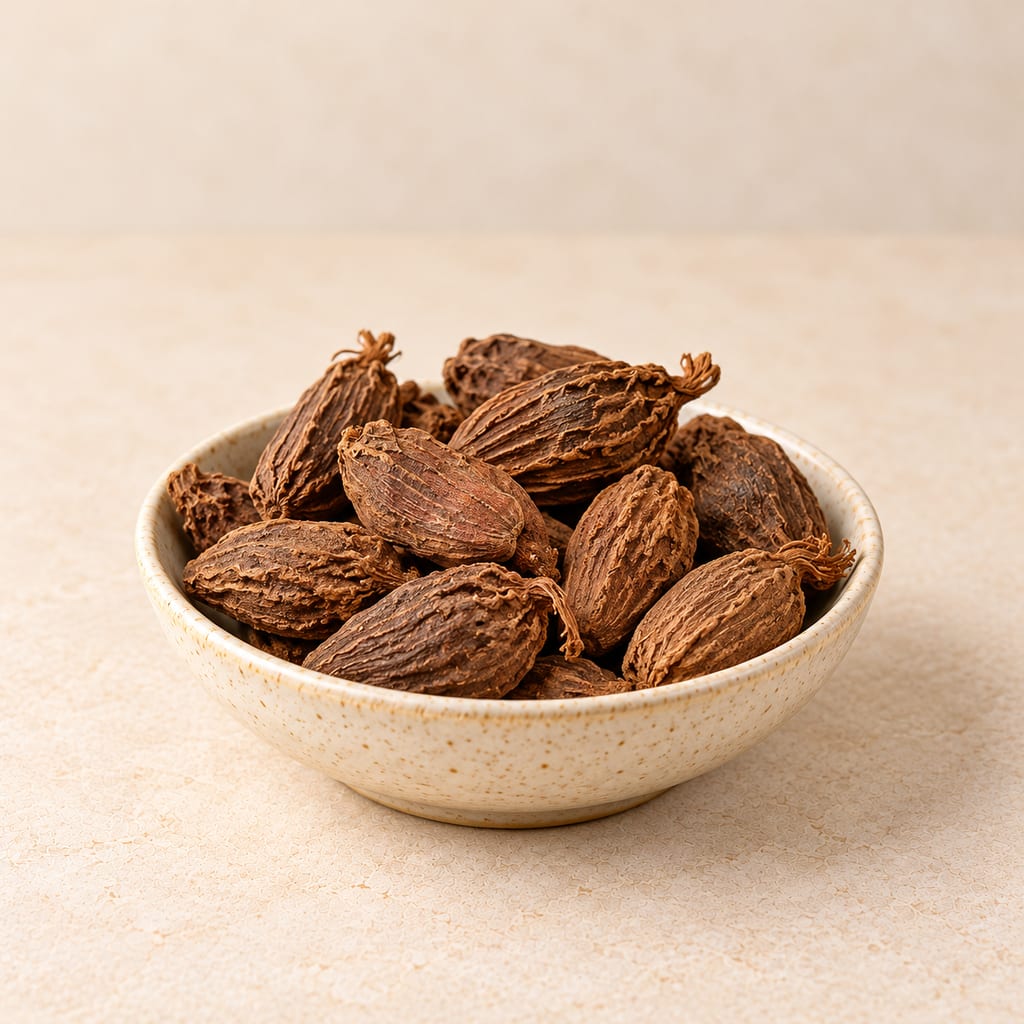
Alainchi is the large or black cardamom of the eastern Himalaya, the dark, smoke-dried pods of Amomum subulatum. Its camphor-cool, smoky seeds season Himalayan and North Indian cooking and a sweet Nepali lapsi achar.
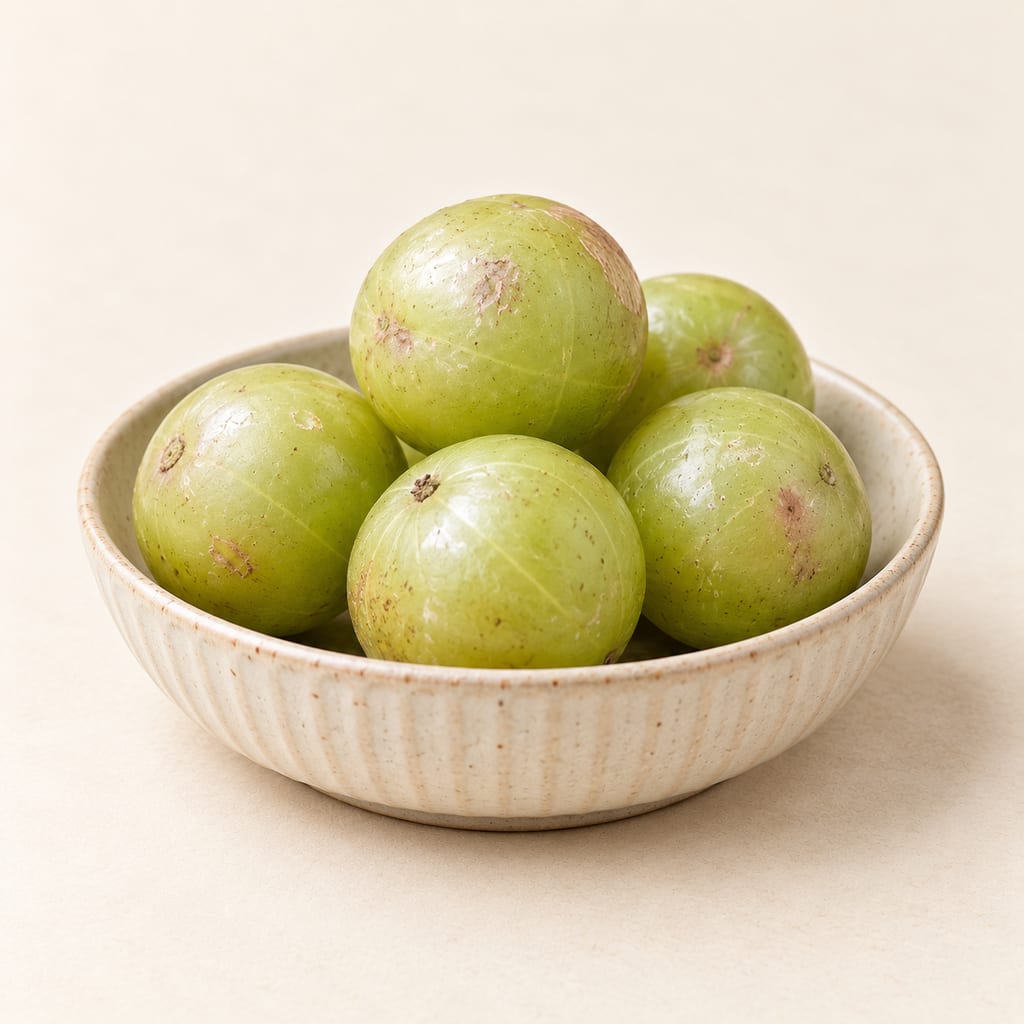
Amla is the firm, sharply sour fruit of Phyllanthus emblica. Cooks transform it into murabba, pickles, chutneys, drinks and dried snacks.
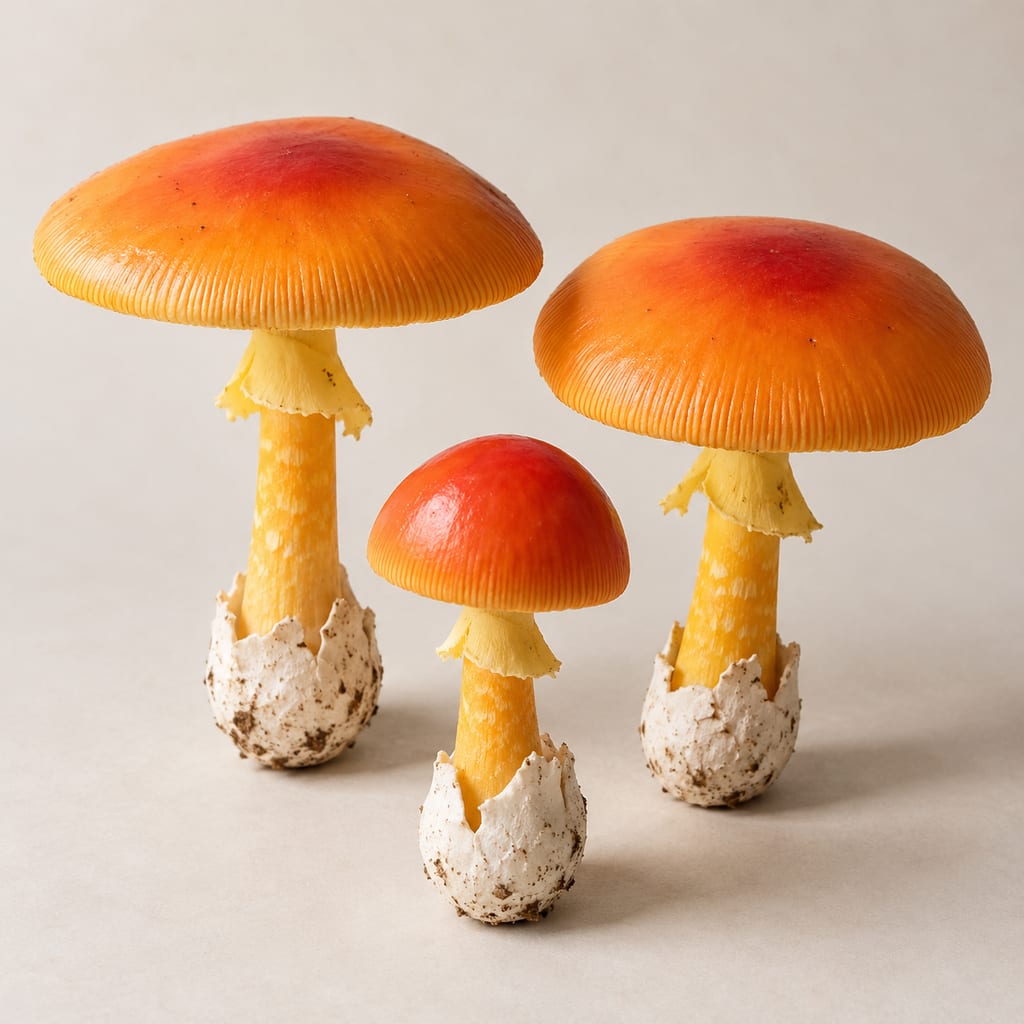
A wild Asian Amanita reported as food in regional literature and listed in China’s edible-fungi catalogue. Lookalikes include lethal species; this record is not a guide to identifying wild mushrooms.
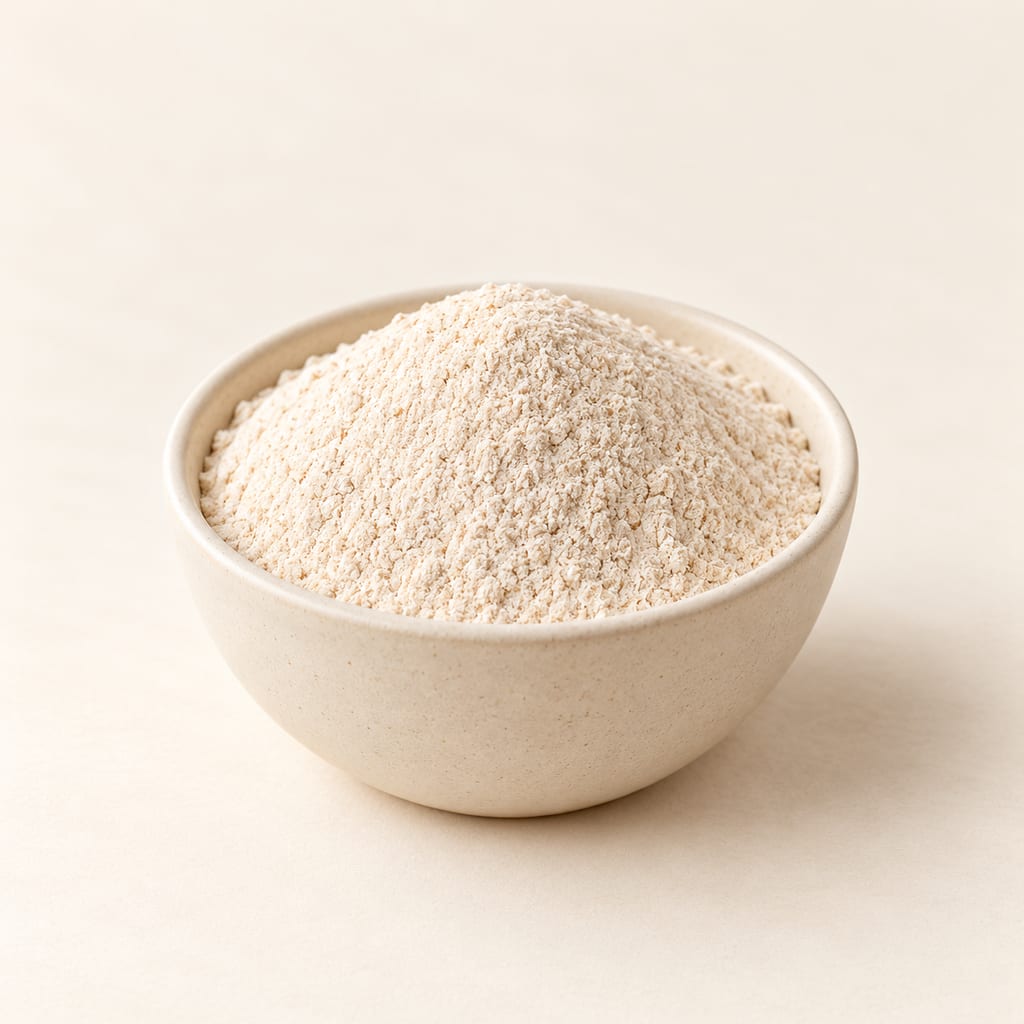
Atta is wheat flour used across South Asian bread traditions. Indian standards distinguish wheat flour (atta) from resultant atta; milling route and particle size shape its behavior in chapati dough.

Bamboo shoots are the young culms of many bamboo species, eaten after boiling or leaching in Asia, and fermented into sour and preserved foods in the Himalayas, northeast India and Burma.
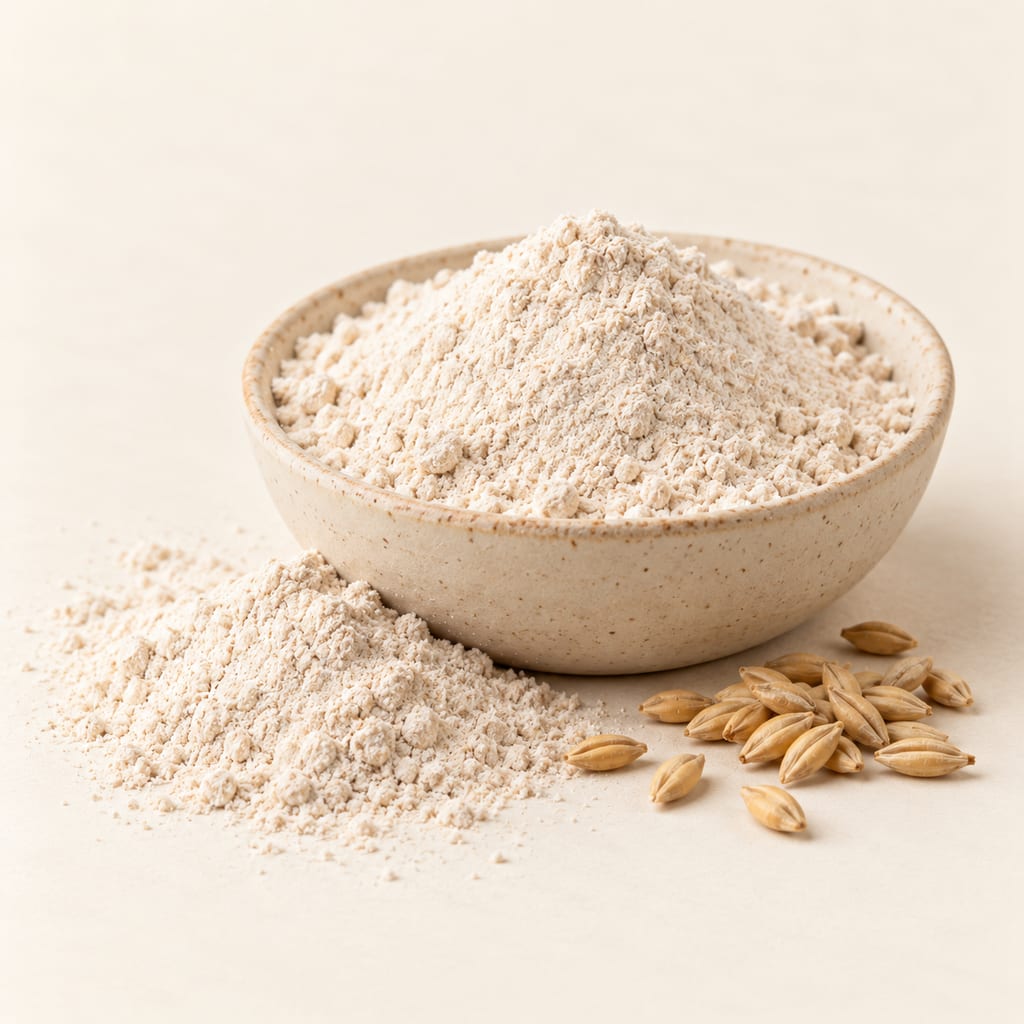
Barley flour is ground barley grain; whether it comes from pearled or hulless kernels, its milling and limited wheat-like gluten-forming ability shape the doughs and foods it can make.

Black carrot is the anthocyanin-pigmented Eastern carrot (Daucus carota var. atrorubens), the purple root that preceded orange types and still colours kanji and şalgam.

At North Abydos in Egypt, a fixed early Dynastic brewery comprised parallel semi-subterranean installations with rows of ceramic mash vats; excavation reports revise their number, scale and estimated batch capacity.

Ají amarillo is the orange-yellow Peruvian chilli cultivar group of Capsicum baccatum, used to colour and season huancaína sauce and ají de gallina. Published heat estimates do not establish one range for the named cultivar.

Toasted almonds are whole sweet almond kernels dry-roasted until golden to brown. Heat replaces their marzipan note with a roasted, nutty one; they thicken and flavour romesco.

Kodiak salmon, halibut and cod cut as seg'aq and hung on an initaq rack to become tamuuq, with kac'amaasaq and kupcuunaq named as different results.

Aniseed is the dried ripe fruit of Pimpinella anisum, an aromatic Apiaceae spice commonly called a seed. It adds a sweet, warm aroma to breads such as Moroccan krachel and South African mosbolletjies, and is distinct from star anise.

A fixed Late Chalcolithic installation in Areni-1 cave combined a shallow clay pressing basin with a large jar set into the cave floor and storage vessels nearby.

Ripe avocado flesh is the soft, buttery, fat-rich pulp of Persea americana, eaten raw. It is low in acid, so it is a fresh ingredient that needs care in chilled dishes.

A portable dome and pan used over a hearth, with embers on the lid and heat from below. Regional peka and saç forms share this principle while differing in materials, pan shape and how the food is cooked.
No community contributions have been published for this entry yet.
Sign in to contribute. Published comments and photos are free to read.
Royal Botanic Gardens, KewEditorial
Vigna mungo (L.) HepperAccepted name and Indian-subcontinent cultigen range
Cited in: A small black seed, several different foods; A South Asian domesticate; Choosing, preparing and keeping the pulse
eFlora of IndiaEditorial
Vigna mungoRegional names and morphological cross-check
Cited in: A small black seed, several different foods
INFLIBNET; chapter by Ravi KorisettarEditorial
Southern Neolithic of IndiaHallur and Veerapuram crop-presence synthesis
Cited in: A South Asian domesticate; A long culinary record with careful boundaries
International Rice Research Institute (IRRI), Odisha HubEditorial
Black GramThe Odisha black-gram guide distinguishes kharif, rabi upland, rabi rice-fallow and summer sowing windows and recommends well-drained loam.
Sowing windows, seed rates, weeding, irrigation, harvest at 70-80% mature black pods, threshing, sun-drying to 8-10% moisture, storage and uses.
Cited in: A South Asian domesticate; How farmers grow it and mills change it; Choosing, preparing and keeping the pulse
FAO EcocropEditorial
Vigna mungoCrop growth descriptor and variable season
Cited in: How farmers grow it and mills change it
Ghosh and Chattopadhyay / Journal of Food Science and TechnologyEditorial
Preparation of idli batter, its properties and nutritional improvement during fermentationIn the authors' experimental rice-and-black-gram idli batter, fermentation acidified and expanded the batter and changed its physical properties.
Cited in: How farmers grow it and mills change it; Why urad behaves differently in batter
Mandhania et al. / Applied and Environmental MicrobiologyEditorial
Diversity and Succession of Microbiota during Fermentation of IdliLaboratory idli microbial succession and Weissella inoculation results
Cited in: Why urad behaves differently in batter
BC Centre for Disease ControlEditorial
Fermented Food Guidance 3.4: Dosa and IdliSeparate rice/black gram preparation and distinct dosa/idli cooking
Cited in: Why urad behaves differently in batter; A long culinary record with careful boundaries; Choosing, preparing and keeping the pulse
Canara Bank staff magazineEditorial
Recipe Corner: Ulundhu Saadam and Dhaniya TovayalOne contemporary Tamil black-gram and rice dish
Cited in: A long culinary record with careful boundaries
Ministry of Tourism, IndiaEditorial
Food and Cuisine: JammuRegional madra can use urad
Cited in: A long culinary record with careful boundaries
Kumari et al. / AllergyEditorial
Sensitization to blackgram in patients with bronchial asthma and rhinitis: clinical evaluation and characterization of allergensClinic-cohort black-gram allergy counts and retained reactivity after boiling
Cited in: Choosing, preparing and keeping the pulse
European Food Safety AuthorityEditorial
Lectins in food: undercooked beans pose health riskEFSA advises thorough cooking of dry beans to reduce lectin risk; its news summary does not state a black-gram-specific endpoint.
Cited in: Choosing, preparing and keeping the pulse
Botanical Journal of the Linnean Society 89(1):85–96 (1984)Wild progenitor evidence
The wild ancestors of urid and mung beans (Vigna mungo (L.) Hepper and V. radiata (L.) Wilczek)A comparative study of seed proteins, leaf chemistry, vegetative traits and seed coats identifies Vigna mungo var. silvestris as the wild lineage of cultivated black gram, separate from the mung-bean lineage.
Cited in: A South Asian domesticate
International Journal of Food Science & Technology 48(4):771–777 (2013)Laboratory flour foaming
Physicochemical and functional properties of flours from three Black gram (Phaseolus mungo L.) cultivarsThe authors tested 2% aqueous flour dispersions from three black-gram cultivars at several pH values and measured foam formation and stability over time; those results are specific to bench dispersions.
Cited in: Why urad behaves differently in batter