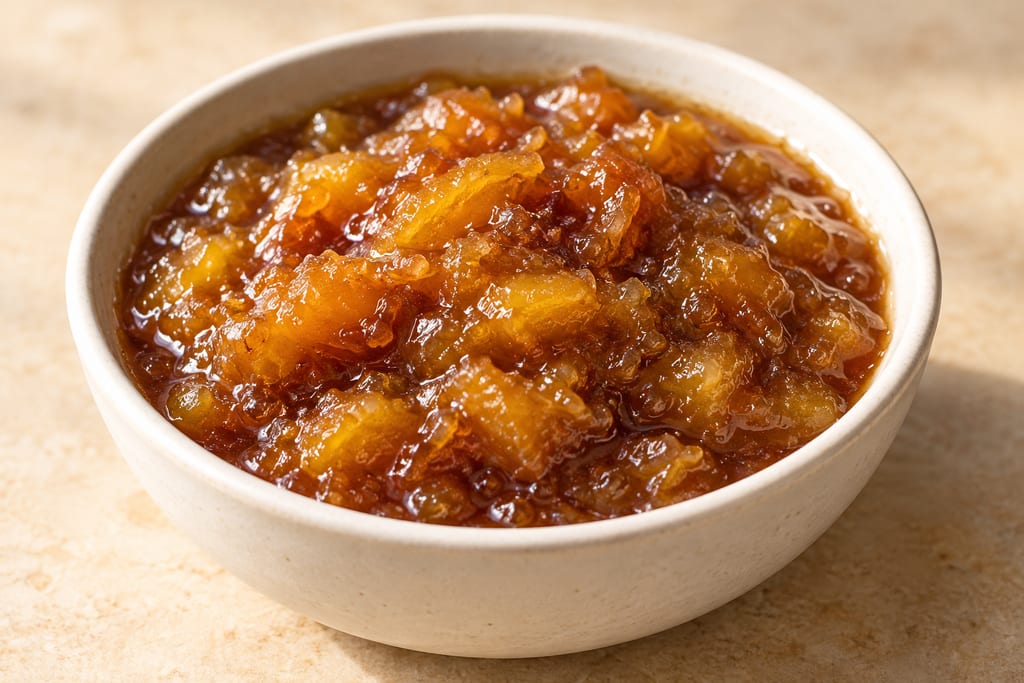
Lapsi ko achar, Suryabinayak pulp method
A Suryabinayak municipal recipe cooks ripe lapsi pulp in sugar syrup with cloves, cardamom, cinnamon, sukumel and ginger juice to make a sweet Nepali achar.
 FermenteaWhere food goes to change
Spices and aromatics
Alainchi is the large or black cardamom of the eastern Himalaya, the dark, smoke-dried pods of Amomum subulatum. Its camphor-cool, smoky seeds season Himalayan and North Indian cooking and a sweet Nepali lapsi achar.
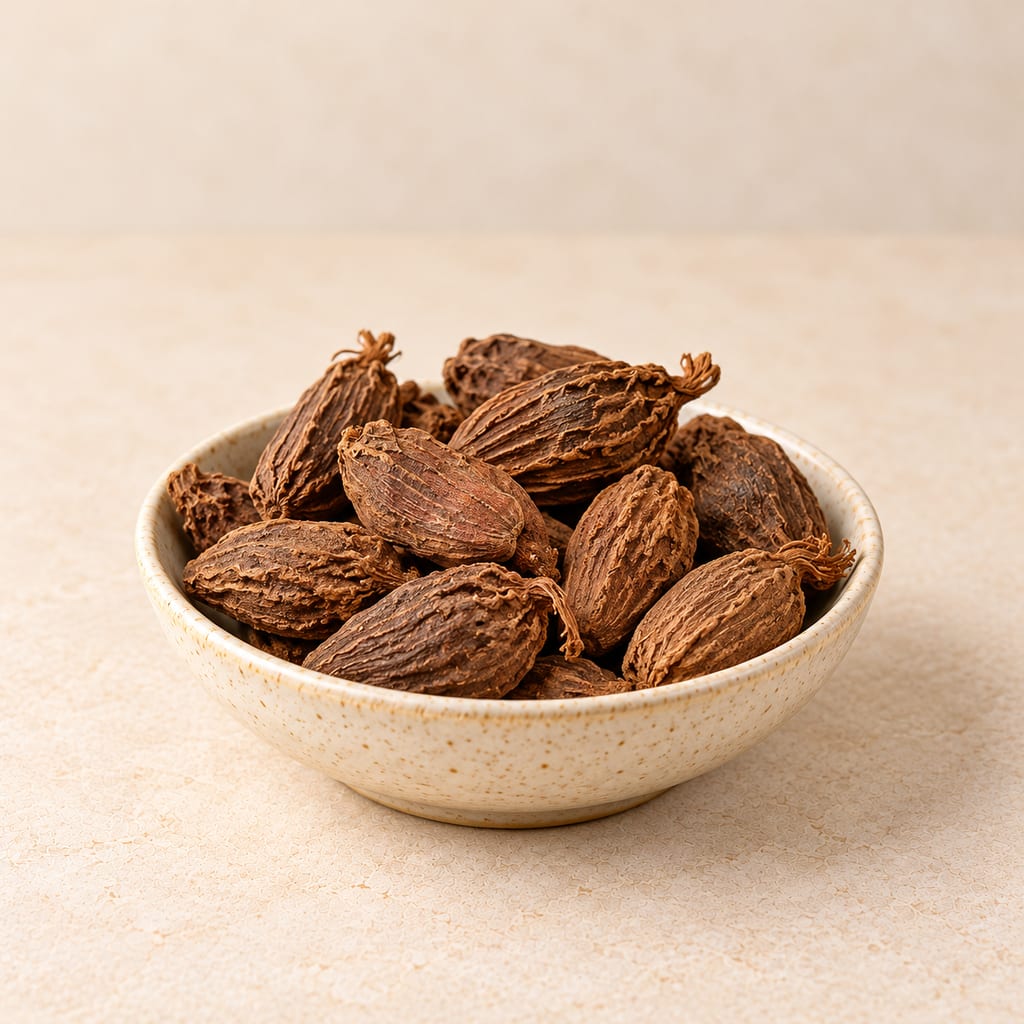
Alainchi is the Nepali name for the dried fruits of Amomum subulatum Roxb., a member of the ginger family, Zingiberaceae. English names for it include large cardamom, big cardamom, black cardamom, brown cardamom, Nepal cardamom, Bengal cardamom, greater cardamom and hill cardamom. It is called अलैंची (alaichi) or ठूलो सुकुमेल (thulo sukumel, big sukumel) in Nepali, यला (yala) or ऐलां (elam) in Newari, बड़ी इलायची (bari ilaichi) or काली इलायची (kali ilaichi) in Hindi, বড়ো এলাচ (boro elach) in Bengali, بڑی الائچی (bari elaichi) in Urdu and ཀ་ཀོ་ལ་ in Tibetan, and its Sanskrit names are upakunchika and brihatupakunchika.
The plant is a tall, clumping evergreen with red stems and glossy, slim leaves; stems reach about 5 feet and the leaves are 1 to 2 feet long. The flower spikes rise from the rhizome and carry ivory flowers with yellow borders and pink or blue-violet stripes. The pods grow in clusters at the base of the stem with the dried flower still attached. A young capsule is light green, under an inch long, with 10 to 15 wings, and it ripens dark brown with a rough, papery skin and 40 to 50 purple, dark brown or red-brown seeds in a sugary pulp. The species name is thought to refer to the awl-shaped, pointed leaves. In a study of 41 plantations in Sikkim the capsules averaged 23.4 mm long and 16.9 mm wide, and commercial pods measure about 2 to 3 cm.
Two other spices cause confusion. Green cardamom, Elettaria cardamomum, belongs to a different genus, and Mughal cooking prefers it for its subtle sweet fragrances. A second spice sold as black cardamom is Lanxangia tsaoko, once Amomum tsao-ko, whose pods in China run to more than 5 cm. Alainchi is the smaller Himalayan pod. A related African spice group, Aframomum, tastes similar and appears now and then in Western markets.
Large cardamom is native to the eastern Himalaya, where Sikkim and Nepal share its slopes; the plant's recorded range runs from Nepal to central China and includes Assam, Bangladesh, Myanmar and Tibet. It is counted among the most ancient spices. The Lepcha, the indigenous people of Sikkim, were the first to domesticate it, and it then passed to the neighbouring Darjeeling district of West Bengal, to southern Bhutan and to eastern Nepal. It is also described as the third most expensive spice after saffron and vanilla, a claim of one research paper and not a market figure. No dated record of the first harvest of alainchi is known.
The crop is a perennial shrub with several tillers, each a pseudo-stem carrying leaves on its upper part, while the flower spike arises from the rhizome; it is typically cross-pollinated but capable of self-pollination. Amomum species as a group are distributed across the mountains from the Himalaya to southern China. The plant grows as a shade-loving understory crop, traditionally in a mixed agroforestry system under the Himalayan alder, Alnus nepalensis. It wants dappled to deep shade and rich, acidic soil, with a pH below 6, that drains well but never dries out. A plantation is started either by dividing rhizomes, which bear fruit sooner but pass on disease more readily, or from seed, which germinates poorly but gives plants more resistant to viral disease. Fruit may take up to four years to appear, matures about five months after flowering, and is picked by hand in late autumn. Aphids, mealybugs, scale, thrips and stem borers trouble the plant. The Government of India guide gives its natural habitat as the humid subtropical semi-evergreen forests of the sub-Himalaya, at 600 to 2,000 m with 2,000 to 3,500 mm of rain a year spread over about 200 days, and temperatures that range from 6 degrees Celsius in December and January to 30 in June and July. Plants go dormant in severe winter and can stand down to 2 degrees, but frost and hail injure them. Continuous rain during flowering keeps pollinating bees from working, which leaves poor capsule set and barren spikes. Aphids matter more as carriers of the viral diseases foorkey and chirke than as pests in their own right, and diseased plants are uprooted and buried.
About 18 cultivars of large cardamom are grown across India, Nepal and Bhutan. Six dominate the fields: Dzongu Golsey, Sawney, Seremna, Ramsey, Ramla and Varlangey. Seremna was developed by the Limboo community of Hee-Bermiok in West Sikkim, Dzongu Golsey by the Lepcha of Dzongu in North Sikkim, and the Indian Cardamom Research Institute at Tadong released two high-yielding varieties, ICRI Sikkim 1 and 2, in 2004 by selection from Sawney. Each cultivar suits an elevation band: Seremna below 975 m, Dzongu Golsey up to 1,300 m, Sawney and Varlangey from the middle band of 975 to 1,515 m upward, and Ramsey above 1,515 m.
Sikkim contributes about 80% of India's large cardamom. The crop was the main driver of the Sikkim farm economy before 1997, supplying half of household income, but its share fell to 29% by 2016 as productivity dropped in more than half of the cultivated area. Over the past decade area and yield have declined sharply because of climate change, disease, pests and pressure from people, which has cut the income of marginal growers across the eastern Himalaya. Large cardamom is nevertheless a high-value, low-volume, non-perishable perennial cash crop, and growers call it a currency crop.
The 2020 and 2021 field survey found cultivars on the move. Seremna, long grown below 975 m, now grows at sites from 975 to 2,069 m, and Dzongu Golsey, once confined to the low elevations up to 1,300 m, was found between 1,100 and 1,842 m, while Ramsey, which belongs above 1,515 m, turned up between 1,209 and 1,783 m. The authors suggest farmers are shuffling cultivars between elevations, mixing cultivars in one field and applying organic manure to improve yield, and that warming in the mountains may push low-elevation cultivars higher. Sites in the survey had an average annual rainfall of 3,045 mm and temperatures between 11.4 and 18.1 degrees Celsius.
The cultivars differ in their capsules. Varlangey was the tallest at 2.19 m, with the most capsules per spike, 13, and the longest capsules, 25 mm; Dzongu Golsey was shortest at 1.45 m. Seremna gave the highest dry seed weight, 11.4 g, and Sawney the lowest at 7.3 g. The authors note that the genetic diversity of the crop has barely been used in breeding for resistance to disease and climate stress. The survey sites lie in the Khangchendzonga landscape of the Eastern Himalaya, a biodiversity hotspot, in a state where agriculture supports more than 64% of the population; the climate is monsoonal, with a summer from March to May, rains from June to October and a winter from November to February.
Harvest begins when the seeds in the topmost capsules of a spike turn brown. The tillers that carry the spikes are cut 30 to 40 cm above the ground and left another 10 to 15 days to finish ripening, and the spikes are cut with a special knife called the elaichi chhuri. Timing depends on cultivar and altitude: Ramsey and Ramla are cut in October, Sawney in September and October and into November at high altitudes, Varlangey in October and November, Seremna in October and Dzongu Golsey in September and October. Harvest starts in August and September at low altitudes and runs as late as November and December at high ones. Average yields range from 100 to 400 kg per hectare, according to the Government of India guide.
The fresh capsules are fleshy, about 85% moisture, and perishable. Farmers cure them to 10 to 12% moisture, measured on dry weight, in a wood-fired furnace. The traditional furnace is the bhatti, a cheap, locally made structure of stone and mud in which the capsules are dried by direct heat. It is crude and moderately efficient, it causes considerable loss of quality characteristics, and it is still common across the cardamom belt. Direct heat and smoke turn the capsules black. The smoky, slightly camphor-like flavour that distinguishes alainchi, and the dark brown colour, come from flame-curing over pits, and pyrazines from the curing are the source of the smoky aroma.
The volatile flavour compounds are easily lost to direct heat or high temperature, so indirect heating at 50 to 55 degrees Celsius with rapid air circulation and exhaust of moist air is recommended. The Indian Cardamom Research Institute at Tadong built a flue-type bhatti on that principle in 200 kg and 400 kg capacities for fresh capsules, which the Spices Board promoted through a subsidy scheme. Curing is finished when the moisture is 10 to 12% and the capsules give a metallic sound when shuffled. The cured capsules are then rubbed over wire mesh to clean them and remove the calyx, or tail. One reference work adds that only the Nepal variety is smoked; Indian accounts describe flame-curing without that distinction.
The seeds hold 2 to 3% essential oil, dominated by 1,8-cineole at 75 to 85%, with alpha-bisabolene at 3 to 6%, terpinene at 4 to 8% and alpha-terpineol plus alpha-terpinyl acetate at 3 to 6%. Cineole contributes the pungency and terpinyl acetate the pleasant aroma. Older analyses put the seed oil at about 3%, with 1,8-cineole at typically about 70% and smaller amounts of alpha-terpinyl acetate, limonene, terpinene, terpineol and sabinene. The pericarp holds only about 0.2% oil, with much less cineole and a few percent of sesquiterpenoids such as spathulenol, germacrene D and beta-selinene, and about 0.1% anthocyanins, which supply the brown colour.
The percentages differ between sources and lots. A 2023 laboratory comparison of A. subulatum seeds and fruit walls measured protein at about 235 mg per gram dry weight in the seed and 227 in the fruit wall, found more lipid than protein in the fruit wall, and reported an essential-oil profile that differs markedly from the cineole-dominated figures. The fresh spice is aromatic with a discernible camphor note, and flame-curing adds a strong smoky flavour.
Farmers rarely grade large cardamom. In practice traders speak of chota dana, small seed, and bada dana, big seed, and sort by sieves that are not uniform. The Indian Cardamom Research Institute standardised five grades by sieve size: bada dana above 1.5 cm, medium bada dana or goldana from 1.3 to 1.5 cm, chhota dana from 1.2 to 1.3 cm, and a pan grade below 1.2 cm. Traders also cut the tails and polish the capsules by machine to raise the price. Properly dried capsules are cooled and packed in polythene-lined jute bags, stored on wooden platforms away from the wall so they do not absorb moisture and grow mould.
Marketing is controlled by traders and sits in the unorganised sector, with an average of three to five intermediaries between producer and consumer. Spices Board made trader licences mandatory and opened auction centres at Singtam and Kalimpong. There are 45 dealers across Sikkim and Darjeeling, and the local market centres are Singtam, Gangtok, Rongli, Mangan, Jorethang, Naya Bazar, Gyalshing, Rabangla, Sukhiapokhri, Bijanbari and Simana, with Siliguri as the main trade centre for Indian, Nepalese and Bhutanese produce. Delhi, Amritsar, Kanpur, Mumbai, Calcutta and Hyderabad are the principal marketing centres, and around 10% of the crop is exported, mainly to Pakistan and the Middle East.
In India alainchi seasons spicy and rustic dishes: soups, stews, lentils, rice, curries and meat, and whole pods go into biryani and rice dishes, the ground spice into masala and garam masala, and it also flavours meat curries and Mughlai cuisine. Green and black cardamom are often interchangeable in Indian cooking, although the Mughal imperial kitchen prefers green cardamom for its subtle sweet fragrance. Black cardamom can be used fairly generously, up to a few pods per person, slightly crushed before use. It does not dominate a dish so much as intensify the other ingredients. Like other whole spices, it needs time to give up its aroma, so braised North Indian dishes such as kormas taste best when made hours or a day ahead.
In China black cardamom goes into long-simmered meat stews, especially beef in Sichuan, and is a component of the xiang liao (香料) spice blends. In central and southern China the ground seeds are an optional ingredient in five-spice powder. The larger Lanxangia tsaoko is the other spice sold as black cardamom, so the two overlap in Chinese usage.
Nepal gives alainchi a place in a sweet preserve. A recipe from the Suryabinayak municipal agriculture centre makes lapsi achar by cooking 1 kg of ripe lapsi pulp for 10 to 15 minutes in a syrup of 1 kg of sugar and 500 mL of water, with cloves, alainchi, cinnamon, sukumel and ginger juice. The four spices are listed with a quantity of two over two grams that cannot be allocated, so how much alainchi goes in is unknown. The recipe lists alainchi and sukumel as separate spices; the big cardamom also has the Nepali name thulo sukumel.
North Carolina State's plant profile lists uses beyond the spice. The leaves can be cooked as greens, the roots boiled like potatoes and the flowers used as a garnish. The same page puts about 60% of the crop in food and 40% in pharmaceuticals, cosmetics and perfume, without naming the source of the split. Outside its home range the plant can be grown in warm, humid, shaded places, in USDA zones 9 to 11, and in cooler climates in containers that move indoors when temperatures fall below 50 degrees Fahrenheit.
Alainchi is sold whole, and pods are slightly crushed before use. Ask which species is meant, because black cardamom can name two spices: the Himalayan Amomum subulatum with a smoky, camphor-like character, and the larger Lanxangia tsaoko.
No allergen, toxin or dietary restriction is recorded for the pod used as a culinary spice. Traditional medicine credits the seeds with properties as a cardiac stimulant, diuretic, carminative, stomachic and anthelmintic; these are traditional claims and not food facts.
No dated record of the first use of alainchi is known beyond the statement that it appears in Ayurvedic preparations as early as the sixth century BC, which does not say which text or plant is meant. Accounts differ on the size of the commercial pod, about 2 cm or about 3 cm; on the leading producer, Nepal or India, which is said to produce more than 50% of the world harvest; and on the oil, with cineole at about 70% or 75 to 85%. Shelf life and storage conditions are not documented. The quantity of alainchi in the lapsi recipe is unresolved.
The Lepcha people of Sikkim are credited with first domesticating large cardamom; the page does not claim an exact site.
Eastern Nepal is a principal production region.
Large cardamom is a cash crop of southern Bhutan.
Cultivation passed from Sikkim to Darjeeling, according to the review cited.
A Suryabinayak municipal recipe cooks ripe lapsi pulp in sugar syrup with cloves, cardamom, cinnamon, sukumel and ginger juice to make a sweet Nepali achar.
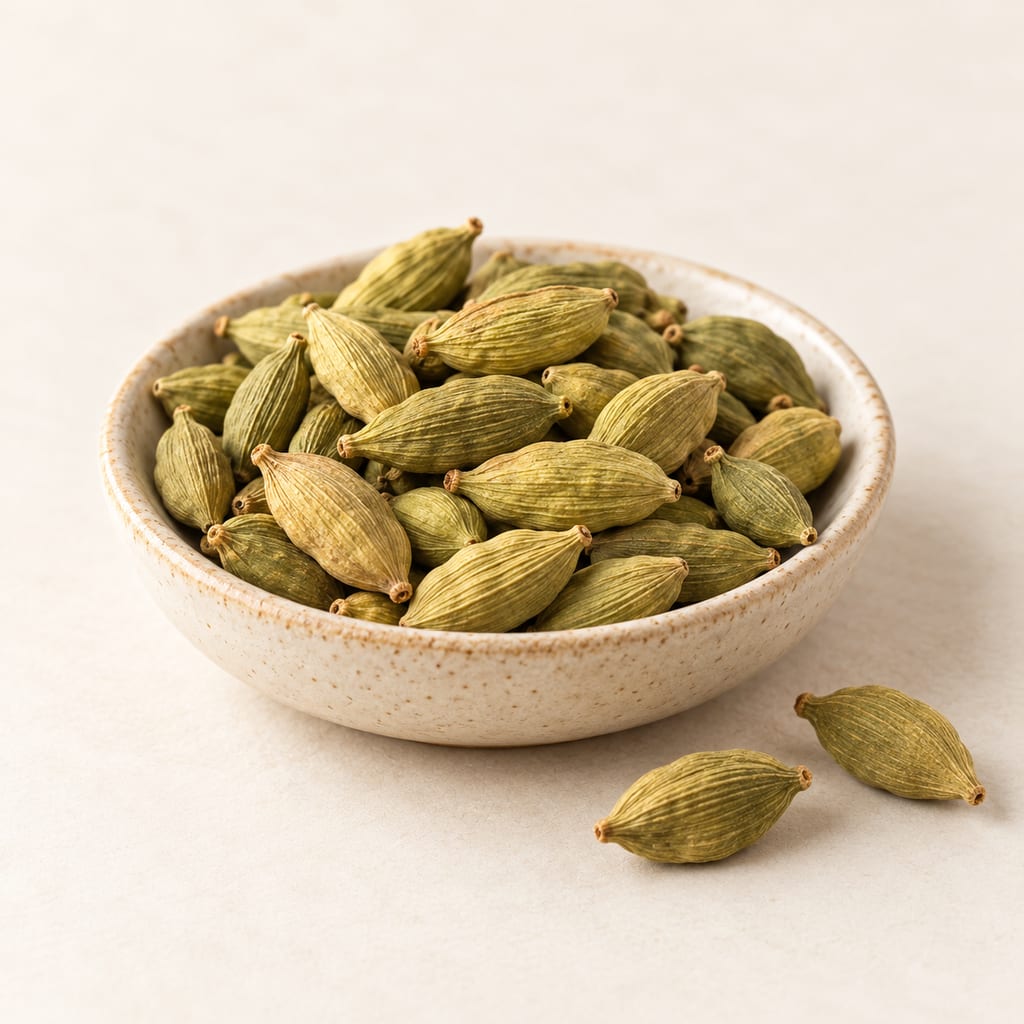
Green cardamom is the cured capsule of Elettaria cardamomum, valued for aromatic seeds used whole or ground in sweet and savory dishes.
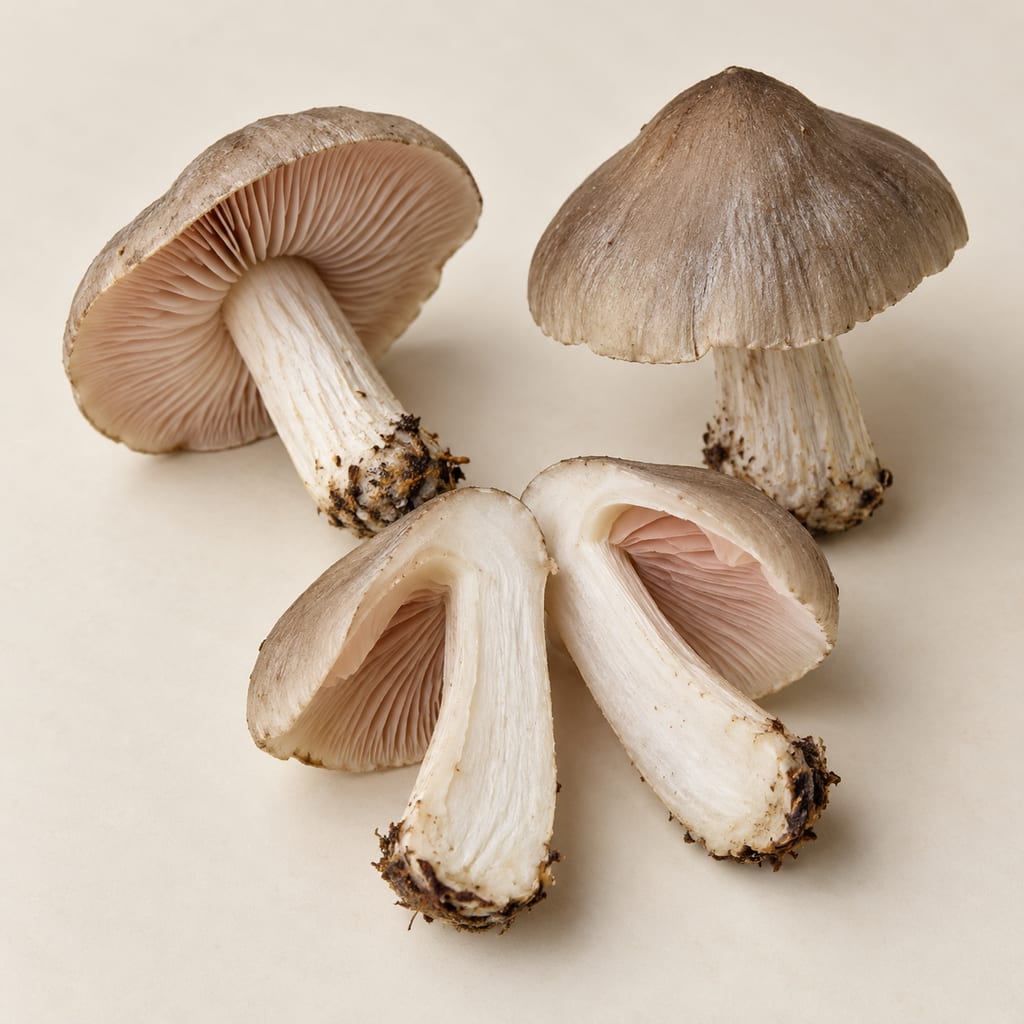
A woodland pinkgill reported as local food in Sikkim and parts of Italy, but difficult to identify and subject to strong regional warnings about confusion with toxic Entoloma species.
No community contributions have been published for this entry yet.
Sign in to contribute. Published comments and photos are free to read.
Scientific Reports (Lepcha, Gaira, Pandey and colleagues, 2023)History · Cultivation · Geography
Elevation determines the productivity of large cardamom (Amomum subulatum Roxb.) cultivars in Sikkim HimalayaNative to the eastern Himalaya and first domesticated by the Lepcha of Sikkim; main producers Sikkim, West Bengal, eastern Nepal and southern Bhutan; Sikkim about 80% of Indian output; 18 cultivars and six popular ones; elevational ranges; shade-loving crop grown with Himalayan alder; seeds hold about 3% essential oil rich in cineole; half of Sikkim household income before 1997, 29% by 2016; decline from climate change, disease and pests; capsule measurements from 41 sites
Cited in: The Lepcha crop; A crop under pressure; More than a pod; Notes and open questions
Gernot Katzer's Spice PagesIdentity · Chemistry · Use · Names
Black cardamom (Amomum subulatum Roxb.)Names in many languages with scripts; pods in clusters at the stem base; Nepal variety smoked over open flames; seed oil about 3% with 1,8-cineole about 70%; pericarp oil 0.2% and anthocyanins 0.1%; use in India and China; resting of braised dishes; green and black cardamom often interchangeable in India; main production in eastern Nepal, Sikkim and Bhutan
Cited in: Large cardamom of the eastern Himalaya; Harvest and the bhatti; Camphor and cineole; In Himalayan and North Indian kitchens; Choosing, keeping and cautions; Notes and open questions
North Carolina State University Extension Plant ToolboxBotany · Cultivation
Big Cardamon (Amomum subulatum)Common names; plant and fruit description; native range from Nepal to central China; shade and soil needs; propagation by rhizome division or poorly germinating seed; fruit up to four years after planting, matures five months after flowering, harvested by hand in late fall; pests
Cited in: Large cardamom of the eastern Himalaya; The Lepcha crop; In Himalayan and North Indian kitchens; More than a pod; Choosing, keeping and cautions
Directorate of Arecanut and Spices Development, Ministry of Agriculture and Farmers Welfare, Government of India (editors A. B. Remashree and A. K. Vijayan)Cultivation · Curing · Chemistry · Trade · History
Large Cardamom GuideLarge cardamom among the oldest spices, with references in Ayurvedic preparations as early as the 6th century BC; botany, climate of 600-2000 m with 2000-3500 mm rain, soils pH 5.0-5.5; six popular cultivars and their traits; harvest signs, timing and yields of 100-400 kg/ha; oil composition with 1,8-cineole 75-85%; fresh capsules about 85% moisture cured to 10-12%; traditional bhatti with direct heat and smoke versus indirect curing at 50-55 C; grades by size; packing and storage; trade centres and about 10% exported
Cited in: The Lepcha crop; Harvest and the bhatti; Camphor and cineole; Grades and the cardamom trade; Notes and open questions
ICAR-Indian Institute of Spices ResearchIdentity · Use
Large Cardamom - Amomum subulatum Roxb.Perennial herb 1.5-2.5 m tall; grown at 800-2000 m under alder shade in Sikkim, Darjeeling and Arunachal Pradesh; capsules flame-cured over pits for a dark brown colour and a strong, smoky, slightly camphoraceous flavour; 1,8-cineole the major oil component; used whole in biryani and rice dishes, ground in masala and garam masala, and in meat curries and Mughlai cuisine
Cited in: Harvest and the bhatti
Frontiers in Plant Science (Alruhaili and colleagues, 2023)Chemistry
Insight into the phytochemical profile and antimicrobial activities of Amomum subulatum and Amomum xanthioides: an in vitro and in silico studySeeds and fruit of A. subulatum analysed by GC-MS and HPLC; total protein 235.03 and 227.49 mg/g dry weight in seed and fruit; fruit of A. subulatum holds more lipid than protein; essential-oil profile differs from older cineole-dominated figures
Cited in: Camphor and cineole
Suryabinayak Municipality Agriculture Knowledge Centre, NepalUse
Lapsi ko achar, Suryabinayak pulp method (recipe record)A recipe for lapsi achar lists cloves, alainchi, cinnamon and sukumel as four spices beside ripe lapsi pulp, sugar syrup and ginger juice; the spice quantity line reads 2/2 gram and is ambiguous