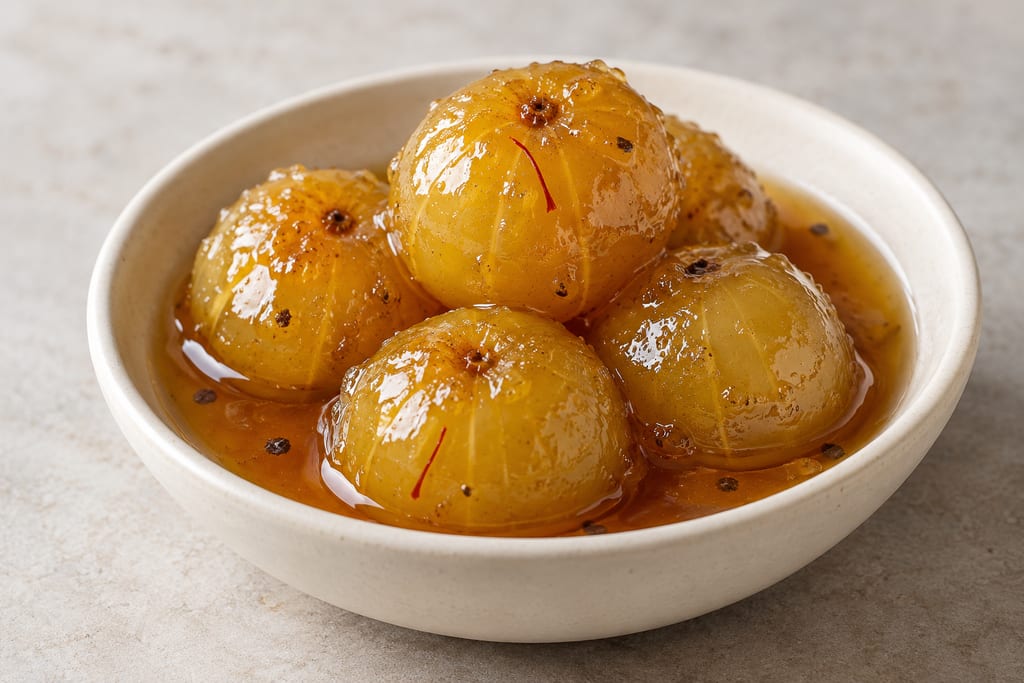
Amla murabba
Amla murabba preserves whole Indian gooseberries in a heavy sugar syrup scented with cardamom and sharpened with pepper and black salt. This household method soaks the fruit before cooking.
 FermenteaWhere food goes to change
Spices and aromatics
Green cardamom is the cured capsule of Elettaria cardamomum, valued for aromatic seeds used whole or ground in sweet and savory dishes.
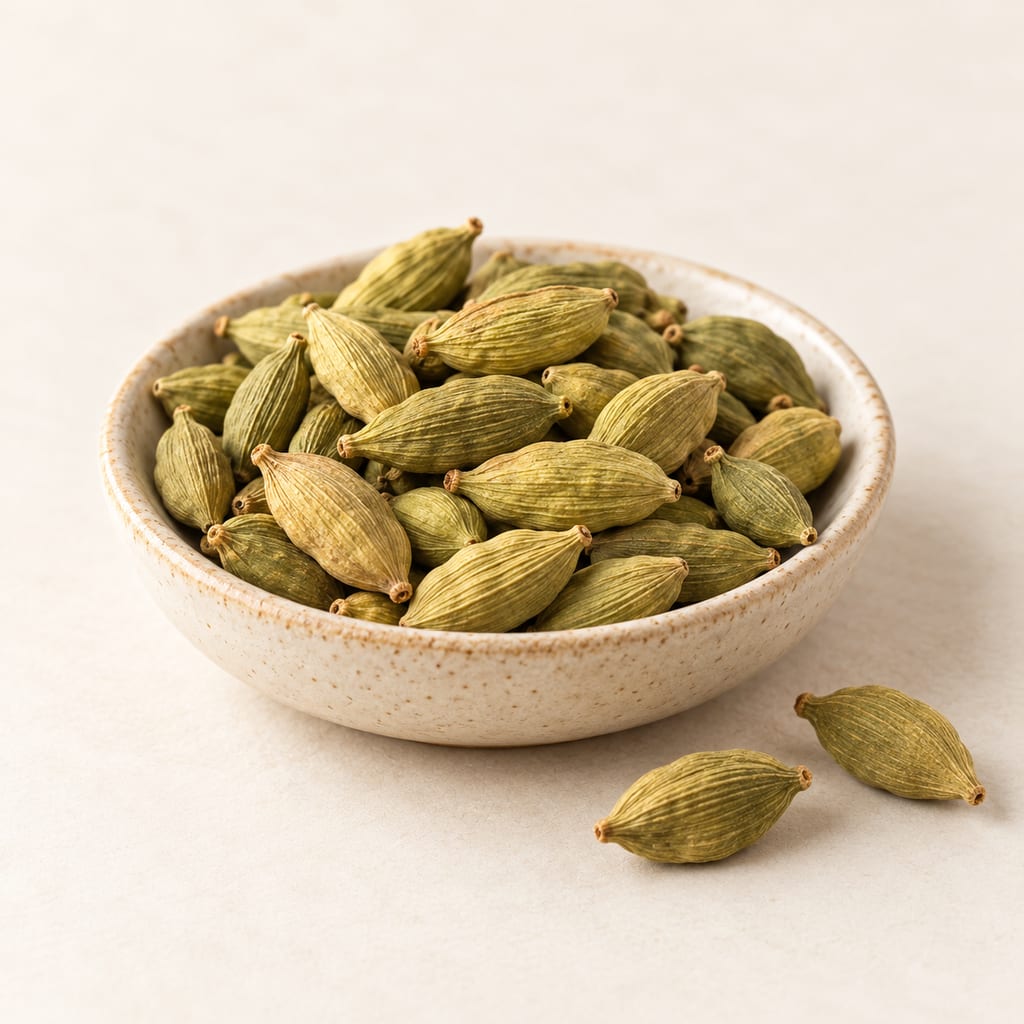
Green cardamom is the dried fruit of *Elettaria cardamomum*, a member of the ginger family, Zingiberaceae. Kew’s Plants of the World Online accepts that botanical name, records its native range as southwestern India, and notes that it was first published under the current name in 1811. In the kitchen, “pod” is the everyday name for its small, ribbed, three-sided fruit capsule; botanically it is a capsule containing several dark, angular seeds. The seeds carry the characteristic aroma. The papery green husk protects them during storage and can contribute flavor when crushed and steeped, but it is the seeds that cooks usually crack, grind or chew.
That distinction helps sort a crowded market vocabulary. “Green cardamom,” “true cardamom,” “small cardamom,” “Malabar cardamom” and “chhoti elaichi” normally refer to *Elettaria cardamomum*. Large or black cardamom is generally *Amomum subulatum*, a different species with larger, dark, often smoke-cured capsules and a more resinous, camphor-like profile. The shared English word “cardamom” is a family resemblance, not a guarantee of interchangeable flavor. The historical record is even less tidy: Encyclopaedia Iranica explains that several genera supplied cardamom-like spices and that older Arabic and Persian labels do not always map neatly onto modern botanical species. A medieval mention of cardamom cannot automatically be assigned to today’s green pod.
Regional names are useful when shopping, but spelling varies with language and transliteration. Hindi “chhoti elaichi” or “hari elaichi” and Malayalam “elakka” are names associated with small/green cardamom. Nepali horticultural and academic sources commonly distinguish green cardamom, *Elettaria cardamomum*, as sukumel (also written sukmel), from large or black cardamom, *Amomum subulatum*, as alainchi. Older word lists sometimes give a broader or overlapping cardamom vocabulary, so a spelling alone is not a reliable botanical identification. “Sukumel” resembles the Sanskrit-derived name Sūkṣmailā found in materia-medica vocabularies; it is a name, not a separate variety. Keep green-cardamom and alainchi-cardamom as separate ingredient identities, and use the exact species or culinary context where names overlap.
The plant is a perennial herb with thick underground rhizomes and leafy shoots. Its true flowers and fruiting stems emerge close to the ground, unlike a tree crop whose fruit hangs from branches. The capsule is usually harvested while still green and before it opens; if it splits, the loose seeds are more exposed to loss and weather. Kew describes the species as native to southwestern India. The Muséum national d’Histoire naturelle places its origin on the Malabar coast, while FAO’s crop profile situates wild cardamom in the evergreen monsoon forests of the Western Ghats of southern India and Sri Lanka. These descriptions refer to a regional native range and long cultivation history, not proof that every modern market pod grew there.
Cardamom likes a warm, wet, shaded environment. The FAO profile describes Indian cultivation in the hills, commonly at 600–1,500 metres, with the most productive range in its cited data at roughly 1,000–1,500 metres. Those figures are ecological guidance from a crop database, not a universal boundary: local cultivar, slope, rainfall, shade and management all matter. The plant’s flowers do not set a single even crop. FAO reports flowering in India from April to July, capsules ripening irregularly about 120–160 days after flowering, and repeated pickings—typically five or six in a year. This staggered fruiting explains why harvest is selective and labor-intensive rather than a one-time sweep through a field. [Source: FAO EcoCrop]
India’s commercial crop includes named selections and distinct morphotypes. Indian Institute of Spices Research lists improved small-cardamom varieties such as IISR-Vijetha and IISR-Avinash, and a named Kodagu selection, Suvasini. A variety name can matter to growers in yield, disease response or adaptation; it does not promise a simple flavor ranking at the market. Most retail labels do not identify cultivar, harvest elevation or curing method. The useful shopper’s distinction is usually intact, aromatic capsules versus stale, broken or already-ground spice.
The green capsule sold as spice is harvested immature in color but developed enough to contain dark seeds. ICAR–Indian Institute of Spices Research’s 2022 cardamom manual gives a specific harvest and curing protocol: pick at dark-green rind with black seeds, then dry capsules from about 80% moisture down to 10–12%. It describes drying at 40–45°C, with 50–55°C during the final two hours. These are the manual’s stated parameters for its curing process, not a kitchen instruction or a claim that every origin uses one temperature schedule. Drying removes water that would otherwise encourage spoilage, while keeping the capsule intact retains its green appearance and shields its aromatic seeds. [Source: ICAR-IISR, *Cardamom* manual (2022), p. 23]
Curing choices affect the spice’s look and aroma. Sun drying, heated curing rooms and other commercial systems do not expose capsules to identical conditions; color can fade or bleach, and heat and time can change volatile compounds. The aim of the green-cardamom trade is generally to dry the capsule while preserving an attractive green husk and a full seed aroma. Bleached white cardamom may be a processed form of the same species, but it is not simply a naturally pale cultivar. A name like “green” therefore describes the expected commercial appearance and style as well as the plant’s botanical identity.
Cardamom aroma is a blend, not a single magic molecule. In one chemical analysis of South Indian material, seed oil contained α-terpinyl acetate as its largest reported constituent, followed by 1,8-cineole; the fruit coat also contained both compounds, though in different proportions. Another study of green-cardamom essential oil reported α-terpinyl acetate and 1,8-cineole as major components, alongside linalool acetate, sabinene and linalool. These percentages describe extracted oils under particular methods and samples, not the amount of each compound in a pinch of ground spice. Cultivar, origin, maturity, storage and extraction all shift the profile.
In sensory language, cooks often describe cardamom as sweet, fresh, floral, citrusy, eucalyptus-like or gently camphoraceous. Those are useful impressions rather than exact translations of individual compounds. The aromatic oils are volatile: crushing releases them rapidly, and prolonged heat or open storage can dull the bright top notes. Whole capsules therefore work well when a dish needs a gentle infusion over time; cracking them exposes the seeds and gives a stronger, faster release. Grinding seeds immediately before use gives the most direct perfume, while pre-ground cardamom is convenient but loses its lift more quickly once its protective capsule is gone.
This is why cardamom can bridge sweet and savory cooking. Its fragrant, almost cooling freshness cuts through richness in milk pudding, pastry or coffee; in a meat or rice dish, it can add a lifted aromatic note beside warm spices without supplying chili heat. It is potent enough that a small amount can be conspicuous. The exact balance is personal and depends on whether a recipe uses whole pods, lightly crushed pods, seeds alone or powder.
A whole pod perfumes liquid slowly and can be removed before serving. Lightly crush it with the flat of a knife to open the seams; this gives hot milk, tea, syrup, rice water or a braise access to the seeds without scattering them through every bite. If the pod stays whole, its husk still acts as a container, but the infusion may be milder and slower. For a stronger aroma, split it and add both husk and seeds. In a pilaf or biryani, whole pods can be warmed briefly in oil or ghee with other whole spices, then left in the rice as an aromatic marker for diners to avoid chewing. This technique relies on infusion and release into fat and steam, not on a fixed rule that pods must always be removed.
For a more immediate, even distribution, use the seeds. Open the capsule, tip out the seeds and grind them in a mortar immediately before adding to dough, spice mixtures, porridge or a sauce. Grinding the entire pod is possible, particularly in recipes that call for cardamom powder, but it brings the fibrous husk into the mixture and produces a different texture and intensity. The husk is not waste: steep empty pods in tea, milk or syrup, or add them to a simmering pot where their flavor can be extracted and the pieces strained away. Their aroma is weaker than fresh seeds, so use them as a background note rather than expecting a fresh-ground result.
In Indian tea, lightly crushed green pods may simmer with water, tea and milk; the spice contributes fragrance to the brew, while the other ingredients determine sweetness and body. In parts of the Middle East, cardamom is an established coffee flavoring: crushed capsules or seeds are brewed with or added to coffee, so each cup carries a pronounced perfume. The Muséum national d’Histoire naturelle also records use in tea and coffee across the Middle East. In Scandinavia, ground cardamom appears in sweet baked goods, including the knotted Swedish kardemummabulle; the seeds are mixed through dough, yielding aroma in each bite rather than a removable whole pod.
Cardamom also belongs in preserves and fruit sweets, where its perfume can make a familiar fruit taste more layered. A few cracked pods or freshly ground seeds complement the tart, tannic character of amla in murabba, a fruit preserve in which pieces are cooked in syrup. A Government of India CBSE food-preservation textbook gives one recipe with ground cardamom among the seasonings; published recipes differ, so cardamom is a documented option rather than a universal formula. It contributes aroma, not the preservation system: safe keeping depends on the tested recipe and its sugar, acidity, heat treatment and storage directions. Add it in a way that suits the texture—whole pods can be steeped and lifted out, or seeds ground for an even, visible presence.
A research team has tested a modern drink that combines cardamom tea with organic apple juice, evaluating acidity, volatile compounds and sensory acceptance in several proportions. Its preferred formulation in that study contained 70% apple juice and 30% cardamom tea. That is evidence of one experimentally formulated beverage, not an inherited tradition or a recommendation for preserving juice. The example illustrates how cardamom’s floral, resinous aroma can sit beside fruit aromas without turning the spice into the dominant flavor. [Source: *Food Science and Technology* (2020), DOI 10.1590/fst.35419]
Choose capsules that are plump, intact and strongly fragrant when rubbed or lightly pressed. Green color is a useful sign of the commercial style, but hue alone cannot measure freshness: handling and curing influence color, and some good cardamom is paler. Avoid pods that are mostly split, crushed, dusty or faint-smelling. If you can compare them, a capsule that feels full rather than papery is more likely to hold seeds; a quick squeeze should reveal a firm case, not an empty shell. For a recipe where cardamom is central, buy whole pods and grind as needed. For baking or a spice blend requiring powder, purchase smaller quantities and refresh them more often.
Store dry capsules in a tightly closed container, away from steam, direct sun, heat and damp cupboards. Whole pods protect their seeds better than opened or ground spice, and grinding just before cooking preserves the volatile aroma. Do not keep a spoon in the jar over a steaming pan; condensation can soften the capsules and encourage deterioration. If pods have absorbed moisture, are moldy or smell musty, discard them. An intact capsule is convenient to carry in a spice tin, but once opened, transfer any unused seeds back to an airtight container. Practical spice-storage references recommend moisture-proof, light-protective storage; exact shelf life varies by harvest, curing and package, so use aroma as a quality check rather than relying on one universal date.
To open a capsule, press it gently with the flat of a knife or the bottom of a cup until the seams split. Keep the seeds for grinding and the husks for infusions. If a recipe gives a count of pods, remember that capsule size and seed fill vary, so a count is an approximation; where precision matters, weigh the seeds or follow the tested formula. Add ground cardamom toward the end of cooking when its fragrance should remain vivid; for a long infusion, add whole or cracked pods earlier, then taste and remove them when the perfume is where you want it.
Green cardamom’s character comes from a simple physical arrangement: aromatic seeds held inside a harvestable, dryable capsule. That arrangement lets the cook choose a slow background infusion, a burst of freshly crushed seed, or the soft perfume of powder dispersed through a whole dish. It also explains why a green pod and a black pod should not be treated as interchangeable simply because both are sold as cardamom. Learn the capsule, protect the aroma, and use the spice in proportion to the food around it.
ICAR-IISR documents Indian cardamom harvest and curing for the culinary spice.
Amla murabba preserves whole Indian gooseberries in a heavy sugar syrup scented with cardamom and sharpened with pepper and black salt. This household method soaks the fruit before cooking.
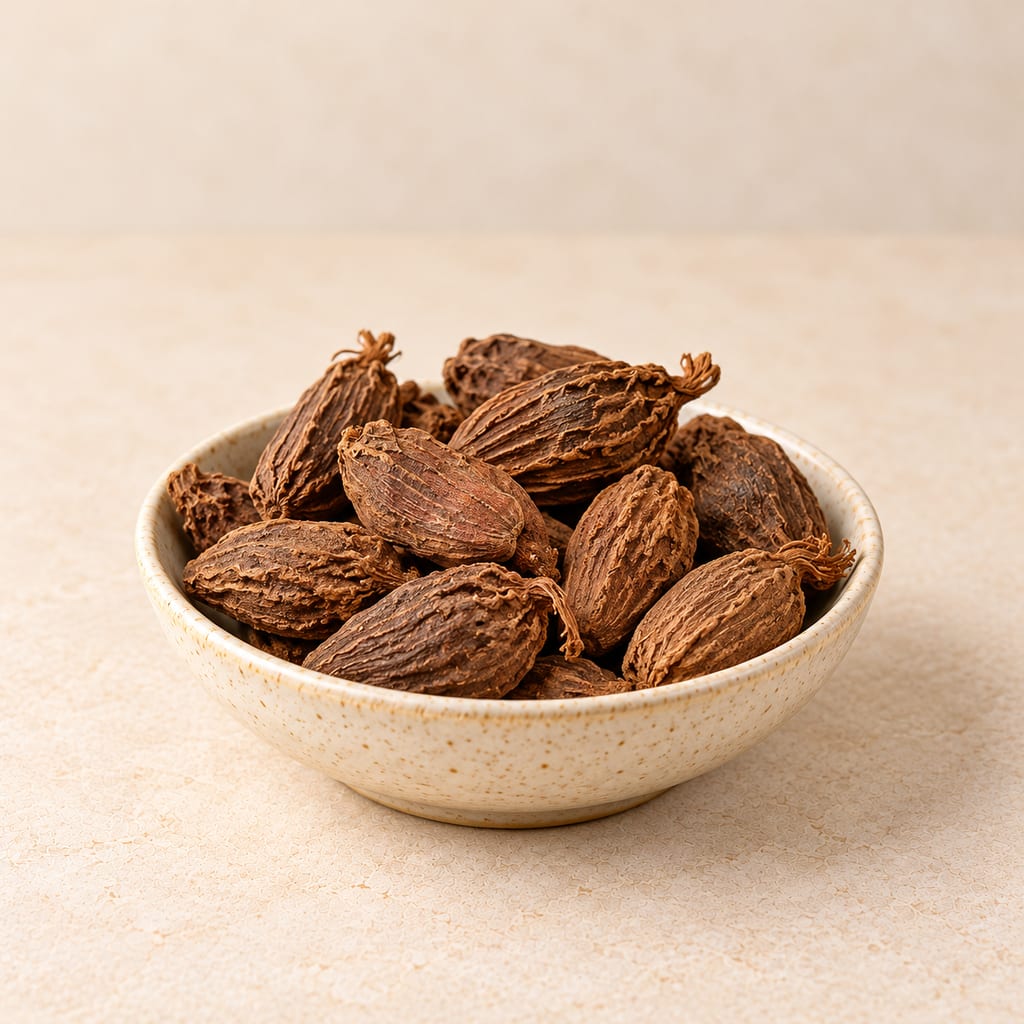
Alainchi is the large or black cardamom of the eastern Himalaya, the dark, smoke-dried pods of Amomum subulatum. Its camphor-cool, smoky seeds season Himalayan and North Indian cooking and a sweet Nepali lapsi achar.

A gelling polysaccharide extracted from red seaweeds, sold as kanten strips or powder; it sets firm at a low concentration and stays solid until about 85 °C.
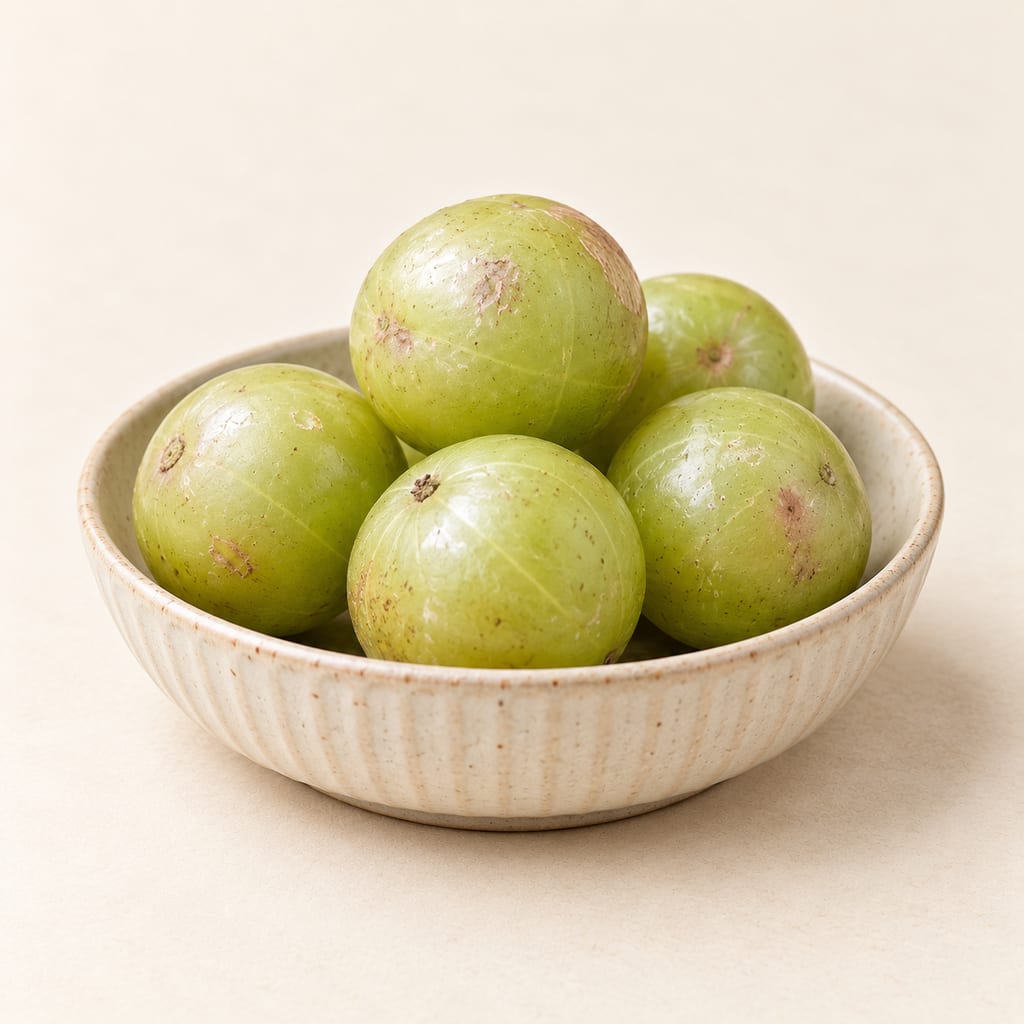
Amla is the firm, sharply sour fruit of Phyllanthus emblica. Cooks transform it into murabba, pickles, chutneys, drinks and dried snacks.
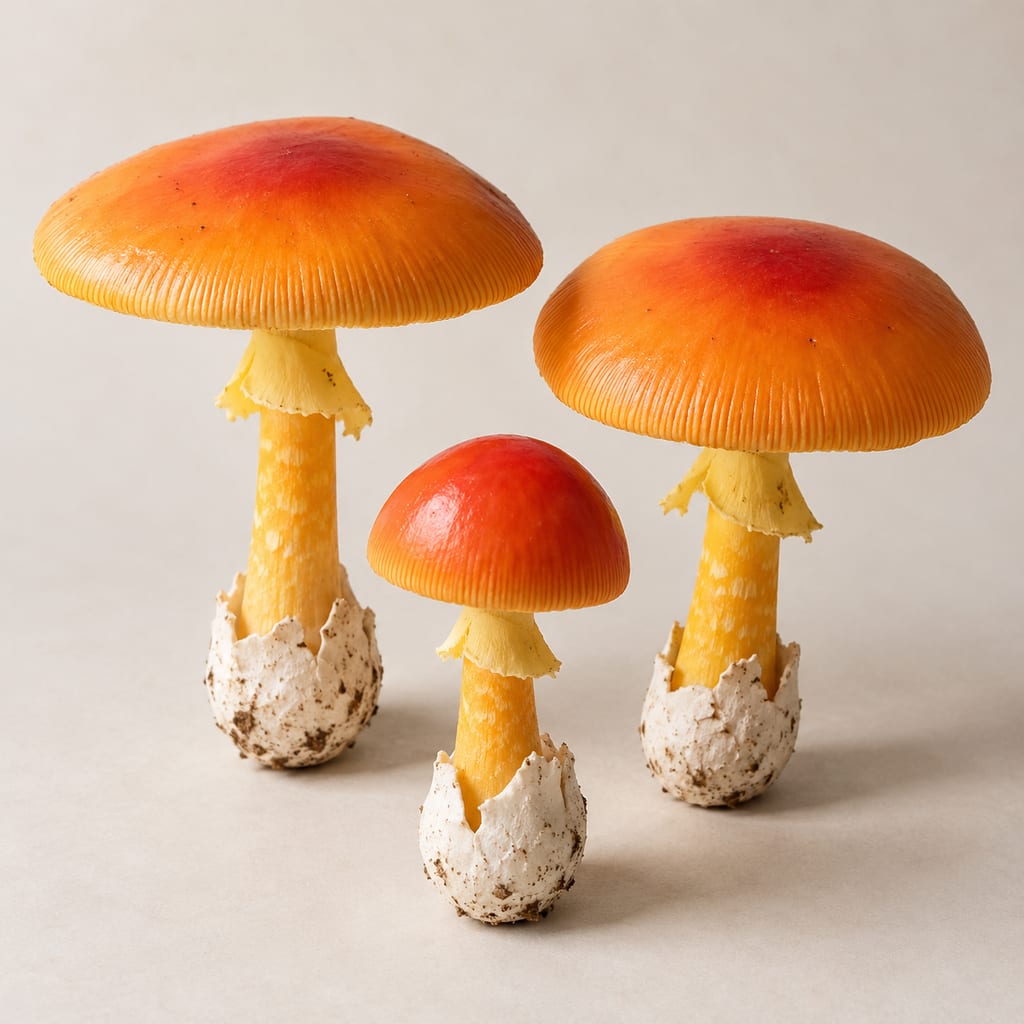
A wild Asian Amanita reported as food in regional literature and listed in China’s edible-fungi catalogue. Lookalikes include lethal species; this record is not a guide to identifying wild mushrooms.
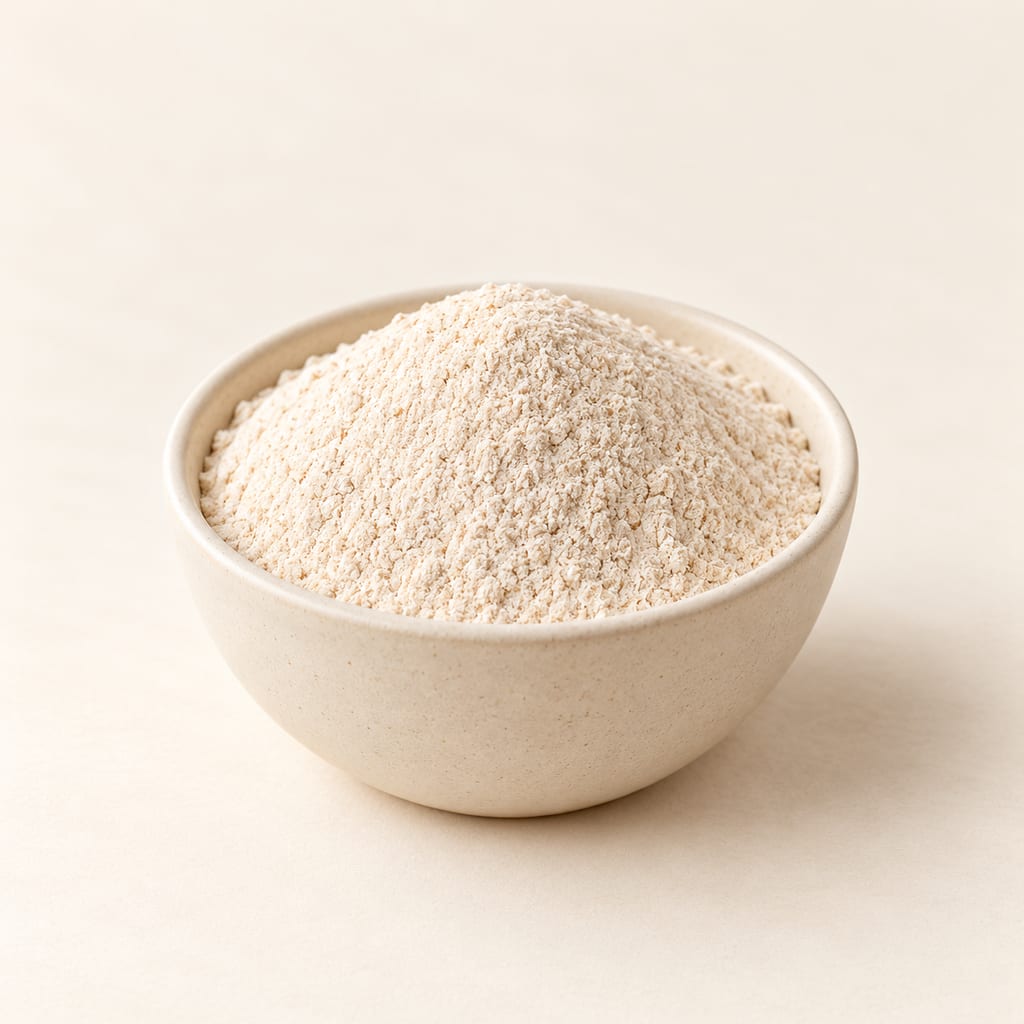
Atta is wheat flour used across South Asian bread traditions. Indian standards distinguish wheat flour (atta) from resultant atta; milling route and particle size shape its behavior in chapati dough.
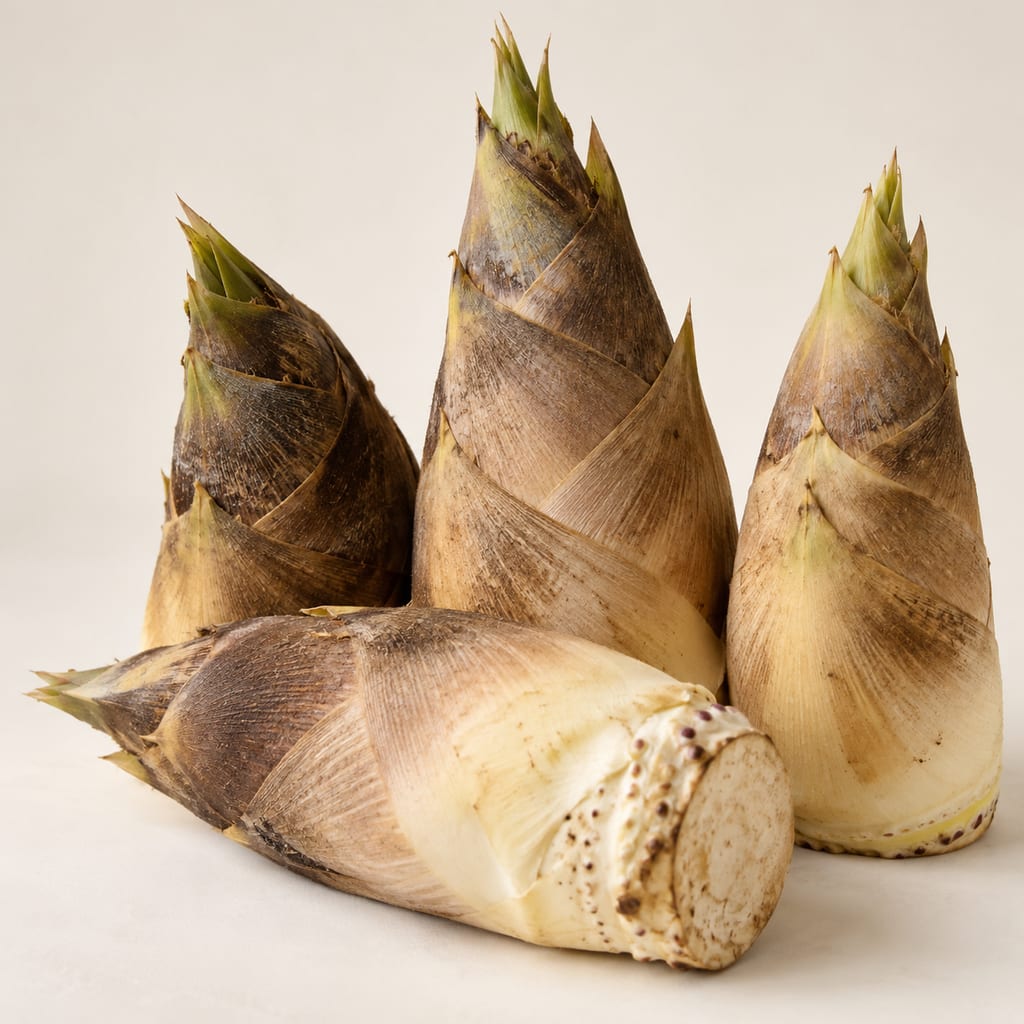
Bamboo shoots are the young culms of many bamboo species, eaten after boiling or leaching in Asia, and fermented into sour and preserved foods in the Himalayas, northeast India and Burma.
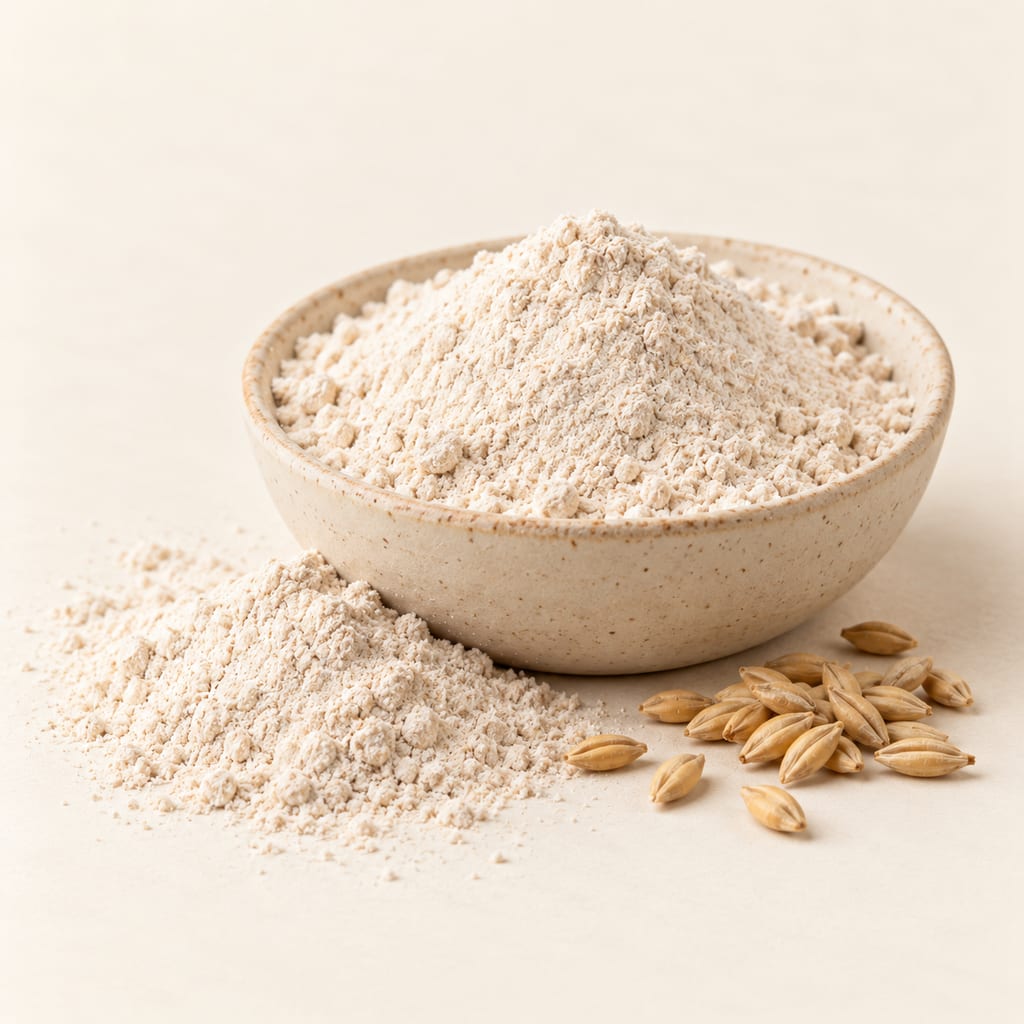
Barley flour is ground barley grain; whether it comes from pearled or hulless kernels, its milling and limited wheat-like gluten-forming ability shape the doughs and foods it can make.
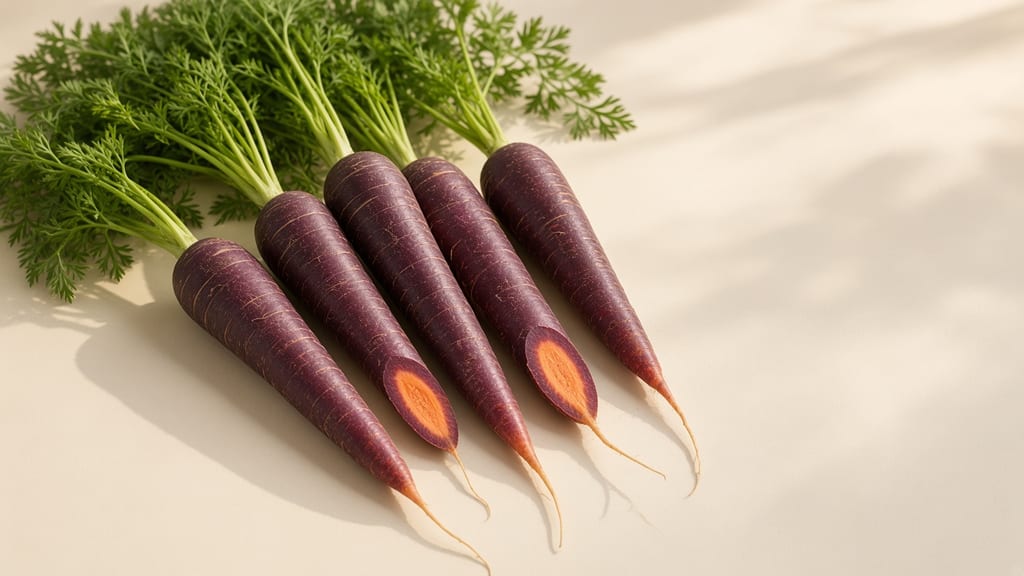
Black carrot is the anthocyanin-pigmented Eastern carrot (Daucus carota var. atrorubens), the purple root that preceded orange types and still colours kanji and şalgam.
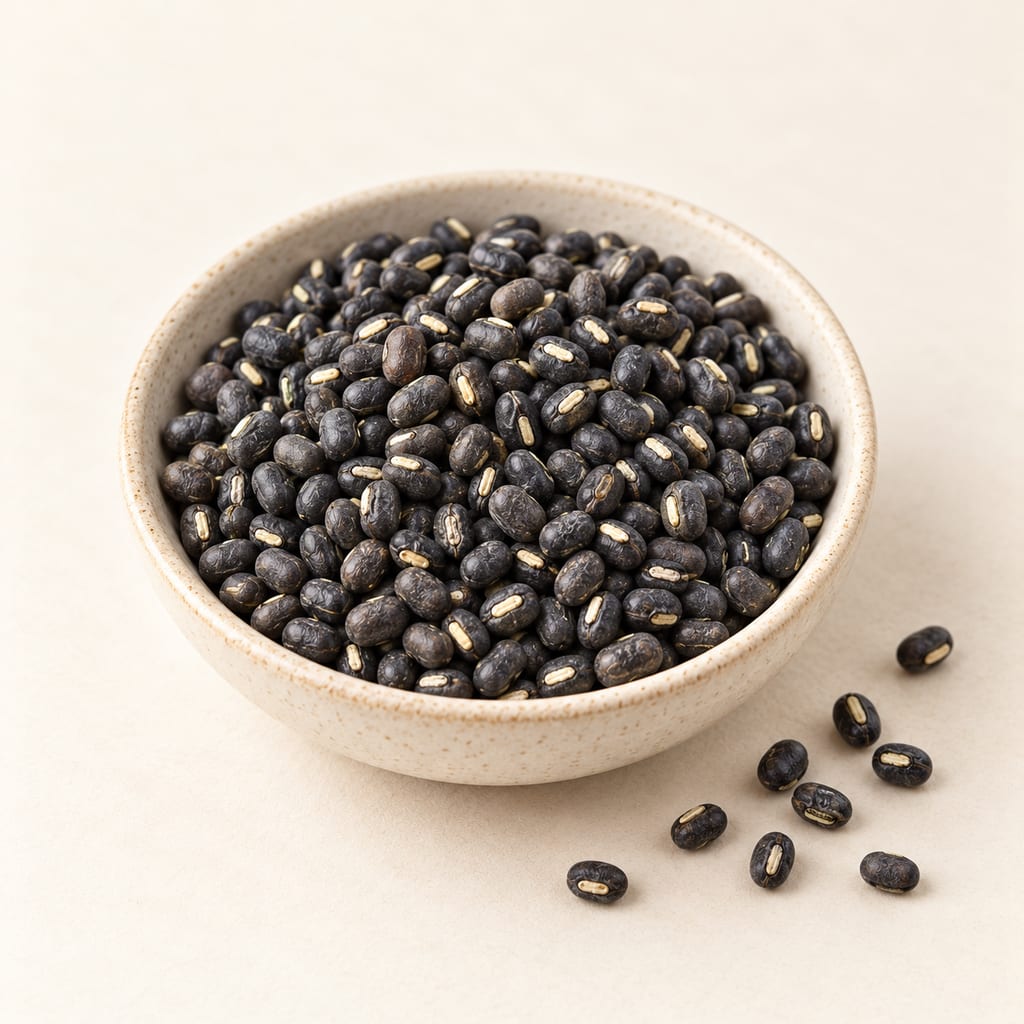
Black gram, or urad, is a South Asian pulse whose whole dark seeds and dehulled white dal make distinct cooked and fermented foods.
No community contributions have been published for this entry yet.
Sign in to contribute. Published comments and photos are free to read.
Kew Science, Plants of the World OnlineIdentity · Range · Taxonomy
Elettaria cardamomum (L.) MatonAccepted species; native SW India; rhizomatous geophyte; publication year 1811; family Zingiberaceae.
Cited in: A name for a particular spice; A forest ginger turned plantation crop
Muséum national d’Histoire naturelleBotany · Culinary use
Green cardamomCapsule morphology and brown aromatic seeds; plant size; Malabar origin; culinary uses in cooking, coffee, tea and hippocras.
Cited in: A name for a particular spice; A forest ginger turned plantation crop; What the seed smells like; Pods, seeds and the way a dish uses them
Encyclopaedia Iranica; Houshang AlamHistory · Nomenclature
CardamomMarket cardamoms span several genera; older labels do not map neatly onto modern taxa.
Cited in: A name for a particular spice
FAO EcoCropCultivation · Harvest · Names
Elettaria cardamomumCrop morphology, growing period, elevation and repeated-picking data; references older agronomic works.
Cited in: A name for a particular spice; A forest ginger turned plantation crop
Oxford University Herbaria, Plants 400Names · History
Elettaria cardamomumSecondary institutional profile; contextual corroboration, not precise chronology.
Cited in: A name for a particular spice
Central Council for Research in Ayurvedic Sciences, DravyaNomenclature
Elettaria cardamomumSanskrit-derived Sūkṣmailā and related materia-medica names.
Cited in: A name for a particular spice
ICAR–Indian Institute of Spices ResearchVarieties
Cardamom VarietiesLists named small-cardamom selections including IISR-Vijetha, IISR-Avinash and Kodagu Suvasini.
Cited in: A forest ginger turned plantation crop
ICAR–Indian Institute of Spices ResearchHarvest · Curing · Handling
Cardamomp. 23 harvest maturity and curing figures. Full PDF could not be extracted in this task; page-specific facts were supplied by the commissioning editor after checking the manual.
Cited in: Harvest and curing: protecting color and aroma; Pods, seeds and the way a dish uses them; Choosing, opening and keeping cardamom
Journal of Essential Oil Bearing Plants; Ajai Kumar et al.Chemistry
Essential Oil Composition of Seed and Fruit Coat of Elettaria cardamomum from South IndiaGC/GC-MS analyses of seed and fruit-coat oils; α-terpinyl acetate and 1,8-cineole among major constituents; abstract inspected.
Cited in: What the seed smells like
Journal of Food Science and Technology; M. Sultana et al.Chemistry
Evaluating the antimicrobial potential of green cardamom essential oil focusing on quorum sensing inhibition of Chromobacterium violaceumOne extracted oil sample GC-MS profile; method- and sample-specific; antimicrobial results excluded.
Cited in: What the seed smells like
Critical Reviews in Food Science and Nutrition; V. S. Govindarajan et al.Food uses · Chemistry · Processing
Cardamom—production, technology, chemistry, and qualityReview abstract notes uses in sweets, baked goods and coffee and discusses volatile chemistry; abstract inspected.
Cited in: What the seed smells like; Pods, seeds and the way a dish uses them
University of Nevada, Reno ExtensionCulinary context
Cardamom: The Queen of SpicesEducational summary of use in meats, vegetables, desserts and Scandinavian baking; secondary.
Cited in: What the seed smells like
The Guardian; Felicity CloakeCulinary context
How to make the perfect cardamom bunsSwedish kardemummabulle example and regional food context; secondary journalism.
Cited in: Pods, seeds and the way a dish uses them
Food Science and TechnologyCulinary application · Sensory study
Physicochemical characteristics and sensory acceptance of a mixed beverage based on organic apple juice and cardamom teaTested formulations; 70% apple juice/30% cardamom tea highest acceptance in reported study.
Cited in: Pods, seeds and the way a dish uses them
International Journal of Research in Chemistry and Environment; Jabbar & GhorbaniparvarCuring/color
Use of GC-MS Combined with Resolution Methods to Characterize and to Compare the Essential oil components of Green and Bleached CardamomReports green/bleached oil composition differences; not a universal processing standard.
Cited in: Harvest and curing: protecting color and aroma
Practical Action / ICIMOD repositoryStorage
Cardamom ProcessingMoisture-proof, light-protective storage recommendations for dried capsules.
Cited in: Choosing, opening and keeping cardamom
USDA Food Safety and Inspection ServiceStorage
Will spices used beyond their expiration date be safe?General spice freshness/storage guidance, not cardamom-specific.
Cited in: Choosing, opening and keeping cardamom
CBSE Academic, Government of IndiaCulinary application · Preserves
Food Preservation, 4.4: Amla MurabbaTextbook amla murabba recipe includes ground cardamom; supports one documented recipe variation, not a universal tradition.
Cited in: Pods, seeds and the way a dish uses them
Wikimedia Commons; author JonathunderImage candidate · Rights
File:Cardamom.JPGImage description says bowl of green cardamom pods for cooking; CC BY-SA 3.0 or GFDL 1.2 or later. Attribution/share-alike applies.
Nepal Horticulture SocietyNomenclature · Botanical distinction
Six Decades of Horticulture Development in Nepal, Table 1: List of spices commonly used in NepalTable explicitly lists Alainchi as large Amomum subulatum and Sukmel as small Elettaria cardamomum.
Cited in: A name for a particular spice
Agriculture and Forestry University, Nepal, AFU Pollination LibraryNomenclature · Botanical distinction
Large CardamomIdentifies Amomum subulatum as black/large cardamom and records Nepali alainchi.
Cited in: A name for a particular spice
Kathmandu University; Sushant AcharyaNomenclature · Botanical distinction
Women in High-Value Agriculture: Changing Gender Roles in Large Cardamom Value Chain in Eastern NepalThesis distinguishes large Amomum cardamom called alainchi from green Elettaria called sukumel.
Cited in: A name for a particular spice