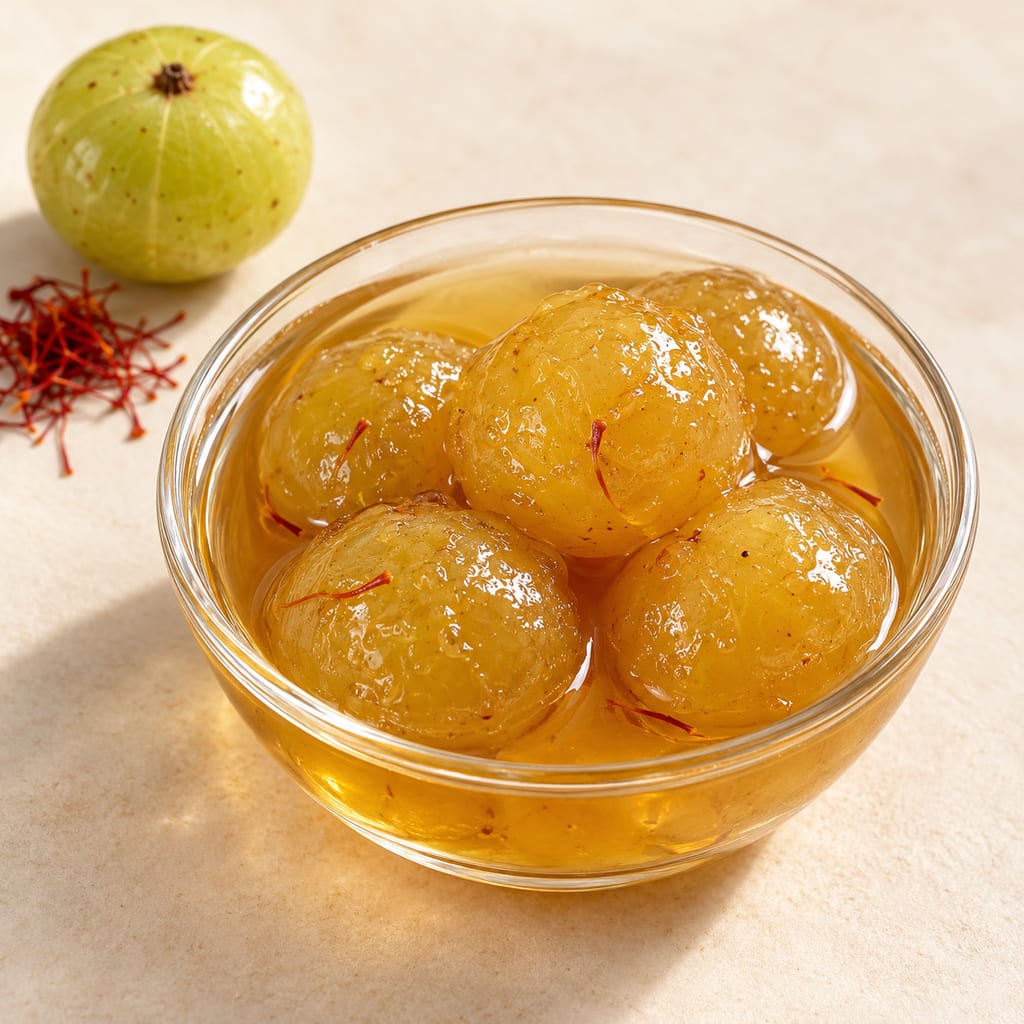
Amla murabba with saffron
Whole amla simmer in sugar syrup with saffron, black cardamom and pepper in this chef's version of the Indian fruit preserve. The fruit is soaked overnight before cooking.
 FermenteaWhere food goes to change
Substrates
Blanched almonds are sweet almond kernels with the brown seed coat removed. A documented amla murabba cooks ten optional slivered kernels into the finishing syrup with spices and saffron.
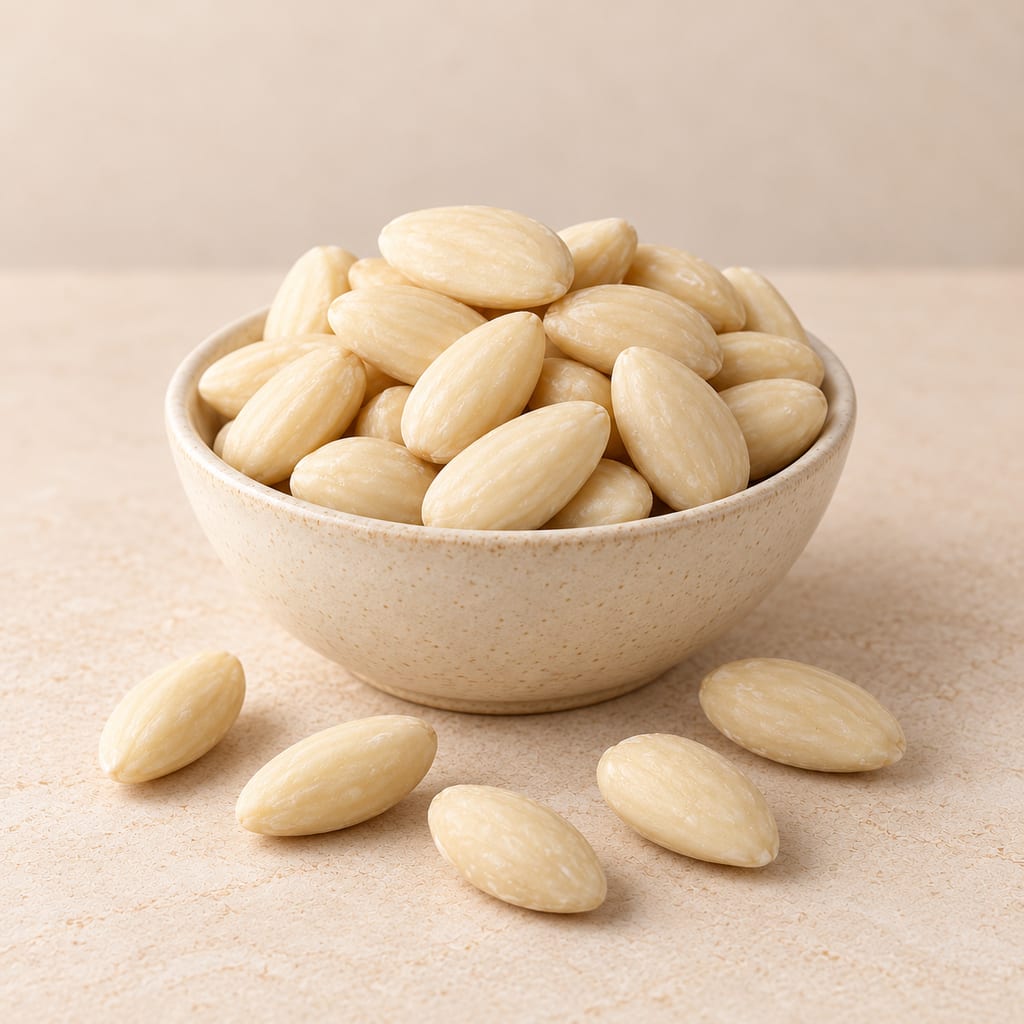
A blanched almond is the pale kernel of a sweet almond with its thin brown seed coat removed. In Reetu Uday Kugaji’s 2018 amla murabba, ten blanched almonds are slivered and added as an optional inclusion while the fruit finishes cooking in syrup. The recipe does not say where the almonds came from or what they are meant to contribute, and they are cooked in a preserve rather than fermented.
The almond tree belongs to the rose family, Rosaceae, and to the genus Prunus, the same genus as peach, plum, apricot and cherry. The Royal Botanic Gardens, Victoria, describes the fruit as a drupe: an ovoid-oblong, grey-green, velvety fruit 35 to 60 millimetres long whose flesh is dry, around a strongly flattened, pitted, keeled stone. The part people eat is the seed inside that stone. A study of kernel bitterness names the tissues of the developing fruit as exocarp (the skin of the fruit), mesocarp (the flesh), endocarp (the stone) and kernel. By botanical definition, then, the almond is a stone-fruit seed and not a true nut.
Two scientific names are in circulation. Kew’s Plants of the World Online treats Prunus amygdalus Batsch as the accepted name and lists Prunus dulcis (Mill.) D.A.Webb as a synonym, while much of the food-science and regional-flora literature uses Prunus dulcis. Both refer to the familiar cultivated almond.
The brown skin that blanching removes is the seed coat, or tegument. It carries the colour of a natural almond and some of its roughness: the Portuguese sensory panels described below scored raw kernels for skin colour and skin roughness as separate attributes. The same coat is also a working part of the seed’s chemistry. In a 2008 study of bitter and sweet almond genotypes, radiolabelled phenylalanine showed that the tegument is where prunasin, the precursor of the bitter compound amygdalin, is made, in sweet and bitter types alike. A kernel with the coat removed is therefore not only paler; it has lost the layer in which that chemistry begins.
Removing the coat also changes how the nut behaves in a dish. A blanched kernel is cream-coloured and smooth, it grinds to a paler paste and it adds no brown flecks to a syrup or a sauce. Blanching tells you nothing else about the nut: a blanched almond may be raw or roasted, whole, split or slivered, and the skin’s absence says nothing about whether it has been salted or flavoured.
Almond domestication is not a story with one agreed date and place. A 2025 population-genetics study compared 209 cultivated and wild samples using 23 microsatellite markers. Its results support a single domestication in the Middle East, with later gene flow from other wild almond relatives, but the authors describe the history as complex and the competing geographic models as unresolved. Its sample groups (Turkey, the Caucasus and Central Asia, southern Spain, and Europe and North America) also show how widely cultivation and breeding have since spread.
What separates a food almond from a wild one is, above all, the absence of bitterness. Bitter kernels accumulate amygdalin, a cyanogenic glucoside: when the tissue is crushed, enzymes release hydrogen cyanide from it, which is a defence against being eaten. The 2008 study reports that sweet kernel is a single-gene trait in almond, that the bitter condition is recessive, and that sweet kernel remains the main target for breeders and growers. In the sweet genotypes studied, amygdalin never builds up: the prunasin made in the seed coat is broken down by a glucosidase-rich layer of the coat as it passes toward the kernel, whereas in bitter genotypes it reaches the kernel and is converted to amygdalin there. The same paper notes that Pliny the Elder, in his Natural History finished shortly after his death in 79 AD, says the Romans were proud of knowing how to remove bitterness from almond kernels, so bitterness was already a recognised problem two thousand years ago.
Modern almonds still vary by cultivar in size, skin, texture and flavour. A 2020 Portuguese processing study, for example, examined the cultivars Casanova, Molar, Pegarinhos and Refêgo, grown in Portugal, alongside the French Ferragnès and the Spanish Glorieta. Its trained panel found that bitter almond flavour and bitter taste were more associated with Molar and Pegarinhos than with the others, and that skin colour was darker in the two foreign cultivars. Those results describe the tested cultivars, not almonds in general.
In South Asia, Persian and Central Asian connections run through the history. P. K. Gode’s 1961 survey of Indian references finds the Sanskrit name vātāma in the early medical texts attributed to Caraka and Suśruta and in the Aṣṭāṅgahṛdaya of Vāgbhaṭa, which one chronology dates to about 850 AD. Commentators from about 1050 to 1260 AD say the vātāma belongs to the northern region, Uttarapatha. The Persian word bādām, from which Marathi and Hindi badam derive, is the one that took over in later texts. Gode cites Ibn Battuta’s fourteenth-century account of presenting raisins and almonds to the governor of Multan, remarking that they do not grow there and are imported from Khurasan. He also cites the Ain-i-Akbari, compiled around 1590, which says that skilled fruit growers had come from Persia and Tartary, and that almonds, among other fruits, had been introduced into Hindustan; it lists almonds in the shell and shelled among the Tartarian fruits, with prices per seer. From this Gode infers that almonds were not grown in India before Akbar’s reign and that the dried-fruit trade with Persia is very old, though he is explicit that he has found no non-medical Sanskrit reference to the almond. The evidence supports exchange and courtly horticulture; it does not fix when almonds first reached India, nor does it show a continuous local culinary tradition from antiquity.
Blanching is a short exposure to hot water that loosens the seed coat so that it can be rubbed off. The Almond Board of California’s guidance for processors describes the commercial version as a thermal process with two linked parts. In scalding, the kernels travel through a tube of hot or steam-injected water for a controlled time. They then pass through a series of rubber rollers in the blanching chamber, which strip the loosened skins; the blanched kernels fall onto a shaking table, where free skins are drawn away by air and the kernels are rinsed with sprayed water, and a dryer finishes the job. The guidance adds that the same scalding settings can be used for blanched products sold whole, whole and broken, as pieces or as cutting inputs for slivers and slices, and that the right time and temperature depend on the variety and on how much moisture the kernels hold.
Scalding is also a heat treatment. The same document records that a technical panel concluded that at least two minutes in water at 190°F (about 88°C) or hotter gives a reduction of at least five logs of Salmonella, and that the US Food and Drug Administration acknowledged this as a pasteurisation process, so products made that way may be labelled pasteurised. It explains why a mandatory treatment for almonds sold in the United States can be met by blanching. It also warns that the wet, warm blanching chamber, rinsing table and conveyors can let heat-tolerant bacteria that survived scalding multiply, so cleaning those areas is part of the control.
In a laboratory setting the method is far gentler. In the Portuguese study, kernels were dipped in boiling water for 30 seconds and the skins were removed by hand; the skinless kernels were left to dry at room temperature and then roasted at 138°C for 33 minutes, so the study’s “blanched” samples were also roasted and its results cannot separate the effect of skin removal from that of roasting. Within that design, levels of bioactive compounds and antioxidant activity generally rose with roasting and fell with blanching, which is consistent with a phenol-rich coat being discarded. A trained panel also found cultivar differences in textural traits, and the authors report that blanching changed texture for the cultivars Refêgo and Pegarinhos. These results describe the tested cultivars and processing sequence. They do not describe all blanched almonds, and they do not describe almonds simmered in syrup.
Cutting changes the bite again. A 2014 abstract in the Journal of Food Science compared whole, sliced and slivered almonds at different moisture levels and reports that sliced and slivered almonds were less hard and crunchy than whole kernels, and that more moisture reduced crispness and crunch. A thin sliver spreads the almond through a dish in small pieces; in a wet environment such as a syrup, moisture is exactly the variable that study links to lost crunch. The study did not test the amla preserve itself.
Across food histories, removing the skin often precedes grinding. A mid-fifteenth-century Bavarian blanc-manger recipe in a manuscript transcription peels and grinds almonds with water, then strains the liquid to make almond milk. Rice, chopped chicken breast, lard and sugar turn that milk into a soft, enriched dish. Here the almond is a liquid base as well as a flavour: grinding breaks the seed into fine particles, and straining separates a smooth milk from the remaining solids.
The late-fifteenth-century Ni‘matnāma, a Persian-language court cookbook written for the sultans of Mandu, gives another way to turn almonds into food. In the accessible English translation, one recipe boils almond flour with dūgh, white sugar, cardamom and cloves. Elsewhere the translated text uses almond oil for a rice-and-pulse dish and offers almond flour as one of several options for a milk-based preparation. These recipes place the nut in different roles: ground into a sweet spiced liquid, pressed for oil or used as a flour. The manuscript is available here through a later translation, so its wording does not establish that any of these dishes used blanched kernels or resemble a modern murabba.
An English family recipe book associated with Elizabeth Fairfax, dated 1694/1795 in its catalog record, shows blanched almonds in a confection called “Almond Pufs.” The almonds are beaten with orange-flower water, combined with sugar, lemon peel and whipped egg whites, then baked. Jane Loraine’s late-seventeenth-century recipe collection records almond creams and several “almond butter” preparations: some use blanched almonds ground with rosewater and strained into a cloth, while another combines beaten almonds with butter and sugar. In one method, rosewater keeps the nut paste from “oiling,” a period kitchen observation about the mixture’s texture. These recipes show that blanching was not merely decorative; a skinless kernel could be pounded into smooth pastes and creams or left in pieces as garnish.
Persian food writing describes a wide range of almond uses. In early spring, when the nut is young and tender, fresh fuzzy green almonds, called čaḡāla-bādām, are crunchy and edible. Street vendors sell them dipped in salted water, and they are also cooked into a stewed lamb dish, ḵorešt-e čaḡāla-bādām, with finely chopped mint and parsley and flavoured with sour-grape juice; it is an infrequent delicacy because the almonds are edible in this form for only a very short time each year.
Dried almonds are served between meals, roasted and salted, mixed with hazelnuts, pistachios and pumpkin and watermelon seeds in a mixture called ājīl. They embellish and flavour rice dishes: a variation of ʿadas-polow, lentil pilaf, calls for slivered almonds and currants or raisins, jewel-studded moraṣṣaʿ-polow takes its name from the nuts that decorate it, and šīrīn-polow, sweet pilaf, is often made with slivered almonds and pistachios sprinkled through the rice together with sweetened orange-peel slivers and chunks of cooked chicken. Ground almonds go into nān-e bādāmī, a cookie of beaten egg whites, sugar and cardamom, and into the almond filling of deep-fried qoṭṭāb; coarsely ground almonds, or almonds and pistachios, fill bāqlavā. Almonds are sometimes scented by being kept in a tightly covered tin with narcissus petals that are replaced daily for several days. Sowhān-e ʿasalī, a confection of slivered almonds with sugar, honey and butter, is flavoured with saffron.
Gode’s survey adds the Indian side of the picture: in his words, almonds are used largely in Indian confectionery and cookery, and are taken daily by gymnasts for their strength-giving reputation, and physicians prescribe almond preparations to patients recovering from serious illness. These are uses documented in Persian and Indian food traditions. They are not proof that the amla murabba’s almonds were prepared for any of the same purposes.
Kugaji’s amla murabba is a sweet preserve of Indian gooseberries, cooked in sugar syrup with saffron and cardamom. The recipe is built on one kilogram of amla and 1.5 kilograms of sugar, flavoured with 0.75 teaspoon of crushed black cardamom seeds, half a teaspoon of freshly ground black pepper, half a gram of saffron and a pinch of rock salt. Ten blanched almonds, slivered, are listed as optional, and the recipe counts the kernels before they are cut, not the slivers afterwards.
The order of work explains the almond’s small but visible place. The amla is soaked overnight and pierced with a fork, then cooked gently for about 15 minutes until tender, and the cooking water is kept. The syrup is made from the sugar and water, including the reserved fruit liquid, brought to the one-string consistency, then a little lemon juice is added, the froth skimmed and the syrup strained through muslin. Only when the fruit returns to the clear syrup are the cardamom, pepper, saffron and the optional slivered almonds added. The uncovered final cook takes the syrup to the two-string stage, rock salt is stirred in, and the preserve is cooled and packed into dry glass jars.
The slivers therefore spend the whole finish among intact gooseberries and spiced syrup, not sitting on top as a dry roasted garnish added at serving. Nothing in the recipe is fermented. A reader following the method should keep the ingredient as stated, blanched and slivered, and not substitute whole or roasted almonds without noticing the change.
Blanched almonds should look pale and clean, with no visible brown skin. Slivers are fragile and have more exposed surface than whole kernels. Moisture softens their crisp texture; oxygen, warmth and light can gradually dull flavour in a high-fat seed. Almond Board storage guidance for dry commercial kernels recommends cool, dry conditions and moisture below six percent, while noting that shelf life depends on packaging and handling. Those commercial specifications are not a household guarantee and do not establish how long slivered almonds remain good after opening. Keep the product sealed and dry, follow its package directions, and do not use these dry-kernel storage figures to infer the safety or shelf life of a jar of amla murabba.
Almond is a tree-nut allergen. In the United States, food-allergen guidance requires the particular tree nut to be named on packaged food labels; other countries set their own rules, and a declared almond ingredient is enough to flag a tree-nut allergy. Bitter almonds present a separate natural-toxin concern, because amygdalin can generate cyanide during digestion, and the FDA lists them among natural toxins in food. Choosing ordinary food-grade sweet almonds avoids confusing the two.
almond
Court cookbook almond preparations in translation; not evidence of this modern murabba’s origin.
Published Indian amla-murabba recipe with optional blanched slivers; exact locality and almond provenance not specified.
Whole amla simmer in sugar syrup with saffron, black cardamom and pepper in this chef's version of the Indian fruit preserve. The fruit is soaked overnight before cooking.

A gelling polysaccharide extracted from red seaweeds, sold as kanten strips or powder; it sets firm at a low concentration and stays solid until about 85 °C.
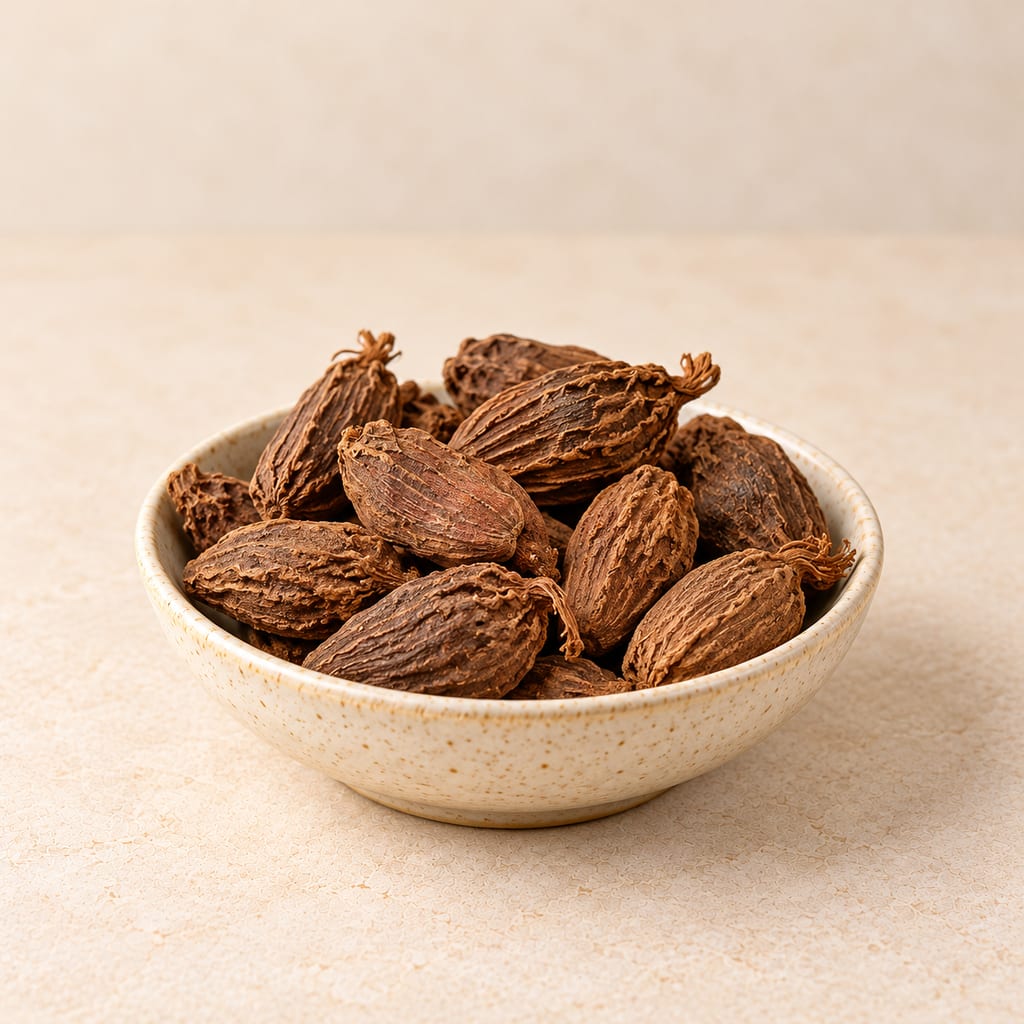
Alainchi is the large or black cardamom of the eastern Himalaya, the dark, smoke-dried pods of Amomum subulatum. Its camphor-cool, smoky seeds season Himalayan and North Indian cooking and a sweet Nepali lapsi achar.
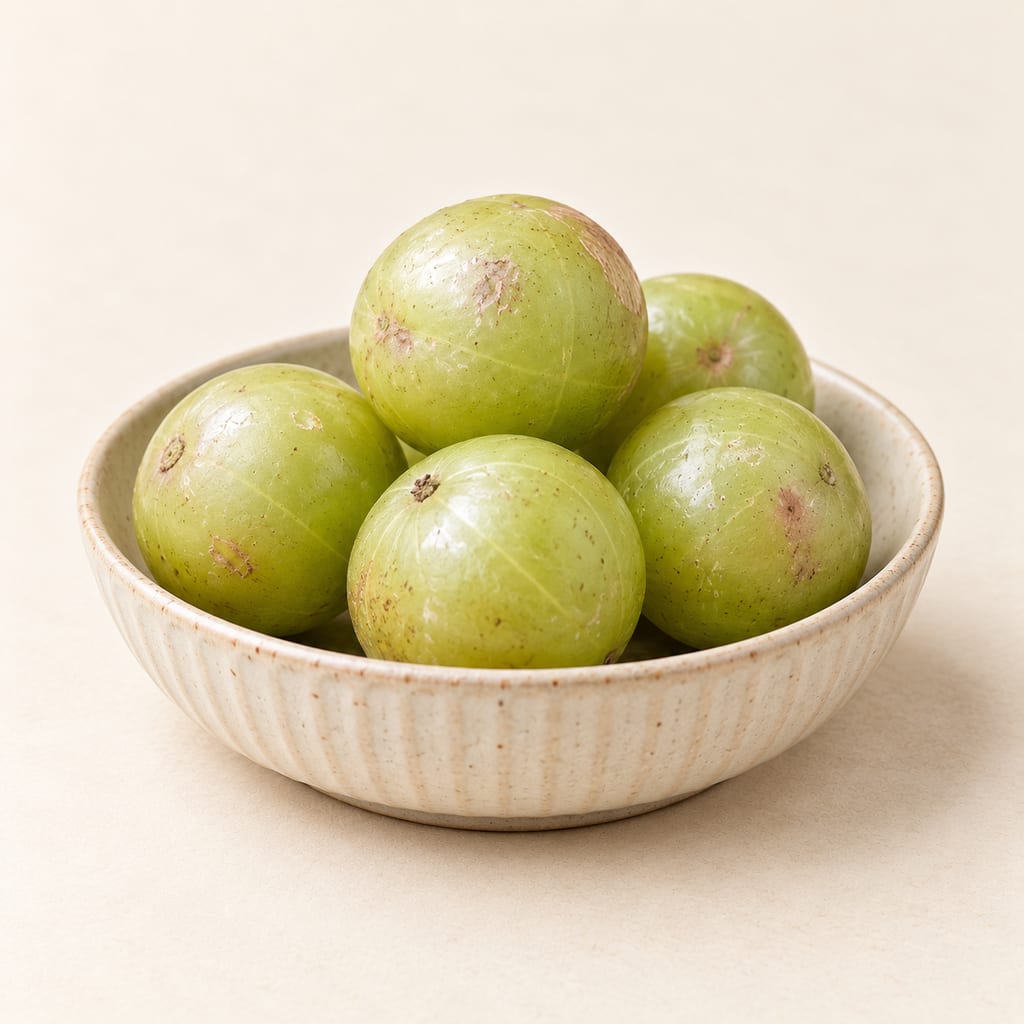
Amla is the firm, sharply sour fruit of Phyllanthus emblica. Cooks transform it into murabba, pickles, chutneys, drinks and dried snacks.
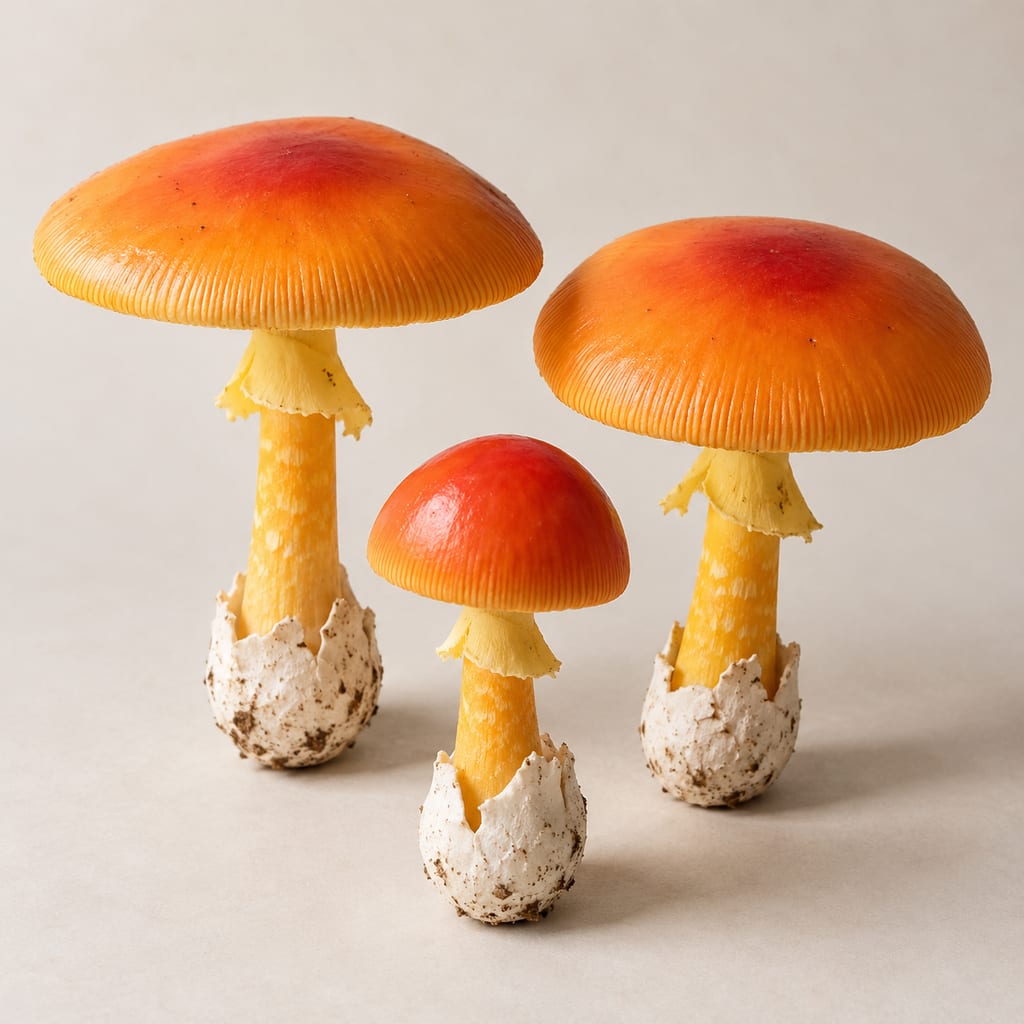
A wild Asian Amanita reported as food in regional literature and listed in China’s edible-fungi catalogue. Lookalikes include lethal species; this record is not a guide to identifying wild mushrooms.
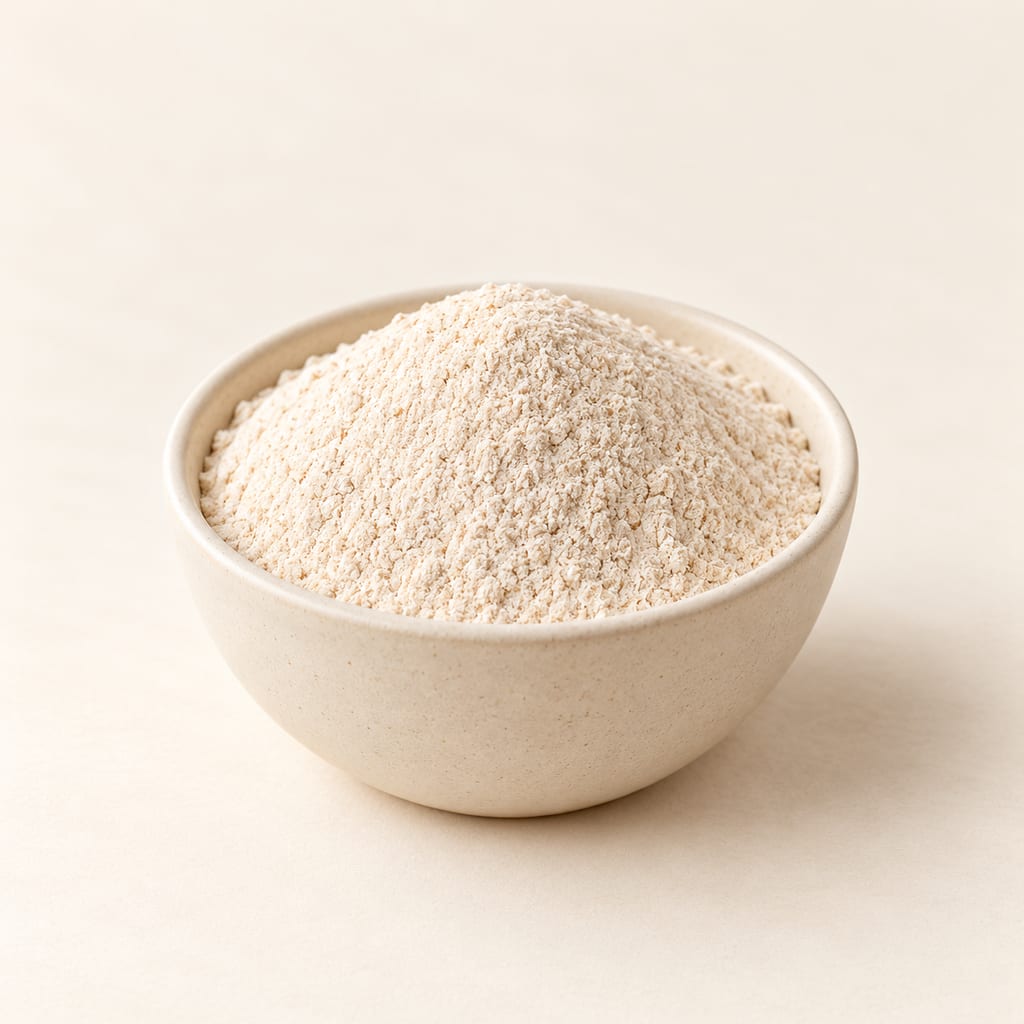
Atta is wheat flour used across South Asian bread traditions. Indian standards distinguish wheat flour (atta) from resultant atta; milling route and particle size shape its behavior in chapati dough.

Bamboo shoots are the young culms of many bamboo species, eaten after boiling or leaching in Asia, and fermented into sour and preserved foods in the Himalayas, northeast India and Burma.
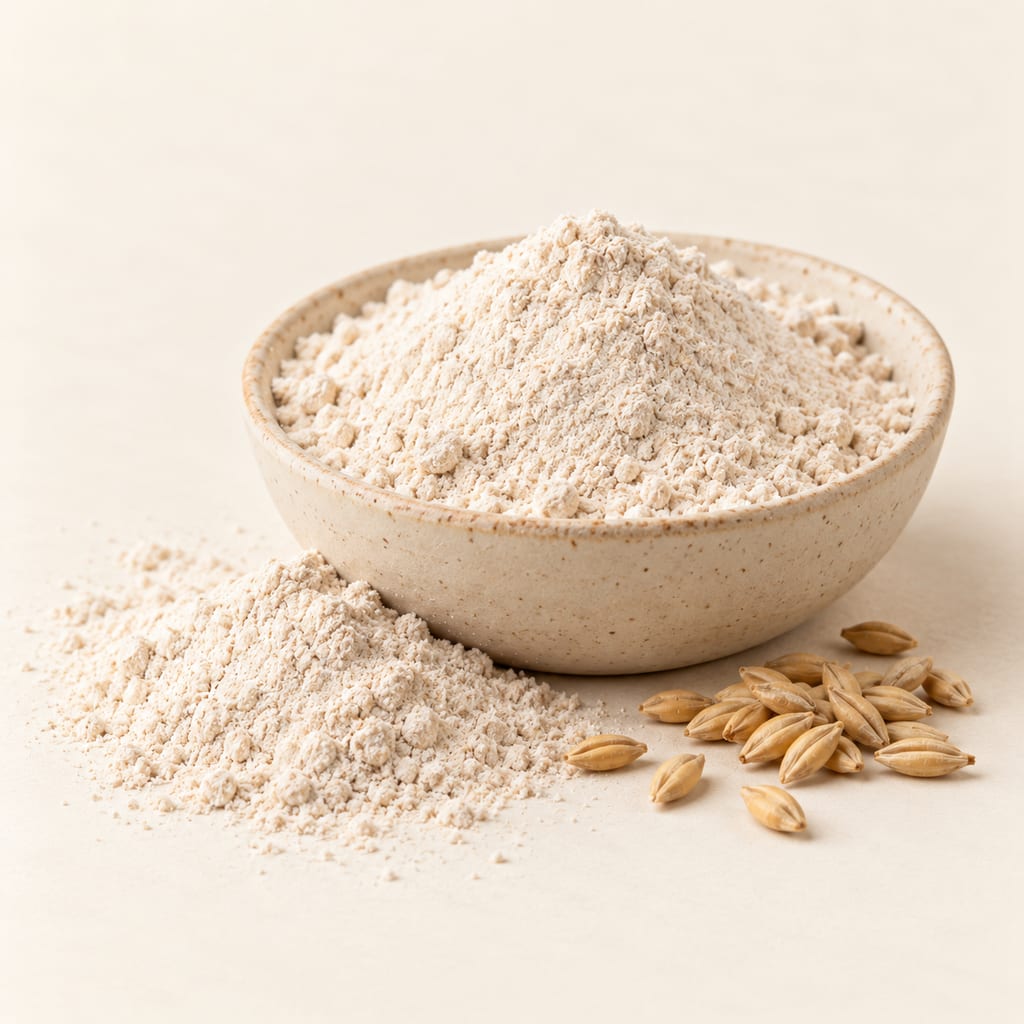
Barley flour is ground barley grain; whether it comes from pearled or hulless kernels, its milling and limited wheat-like gluten-forming ability shape the doughs and foods it can make.

Black carrot is the anthocyanin-pigmented Eastern carrot (Daucus carota var. atrorubens), the purple root that preceded orange types and still colours kanji and şalgam.

Protected Italian vinegar made only from cooked grape must, fermented and aged in a battery of wooden barrels for at least 12 years: sweet, sharp and syrupy.
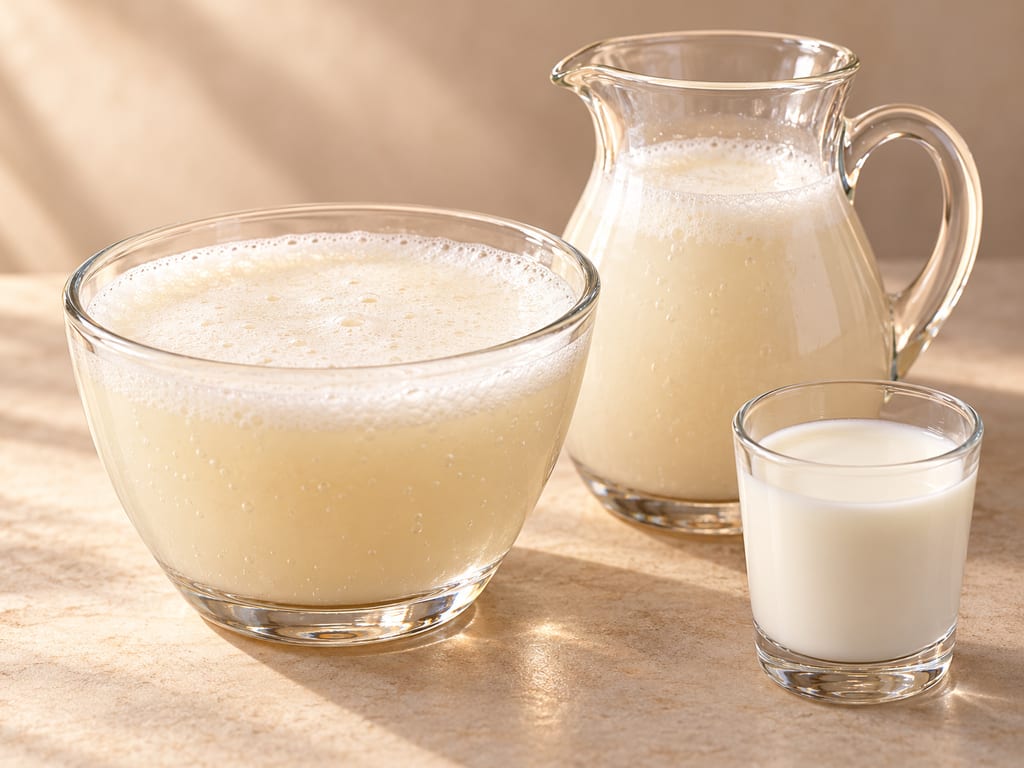
Airag is Mongolia’s fermented mare’s-milk drink, traditionally churned with saved starter in a reusable cowhide khokhuur.

Appam, or hoppers, are South Indian and Sri Lankan rice pancakes made from a fermented coconut-and-rice batter and cooked in a curved pan to a crisp lacy rim and a soft, spongy centre.
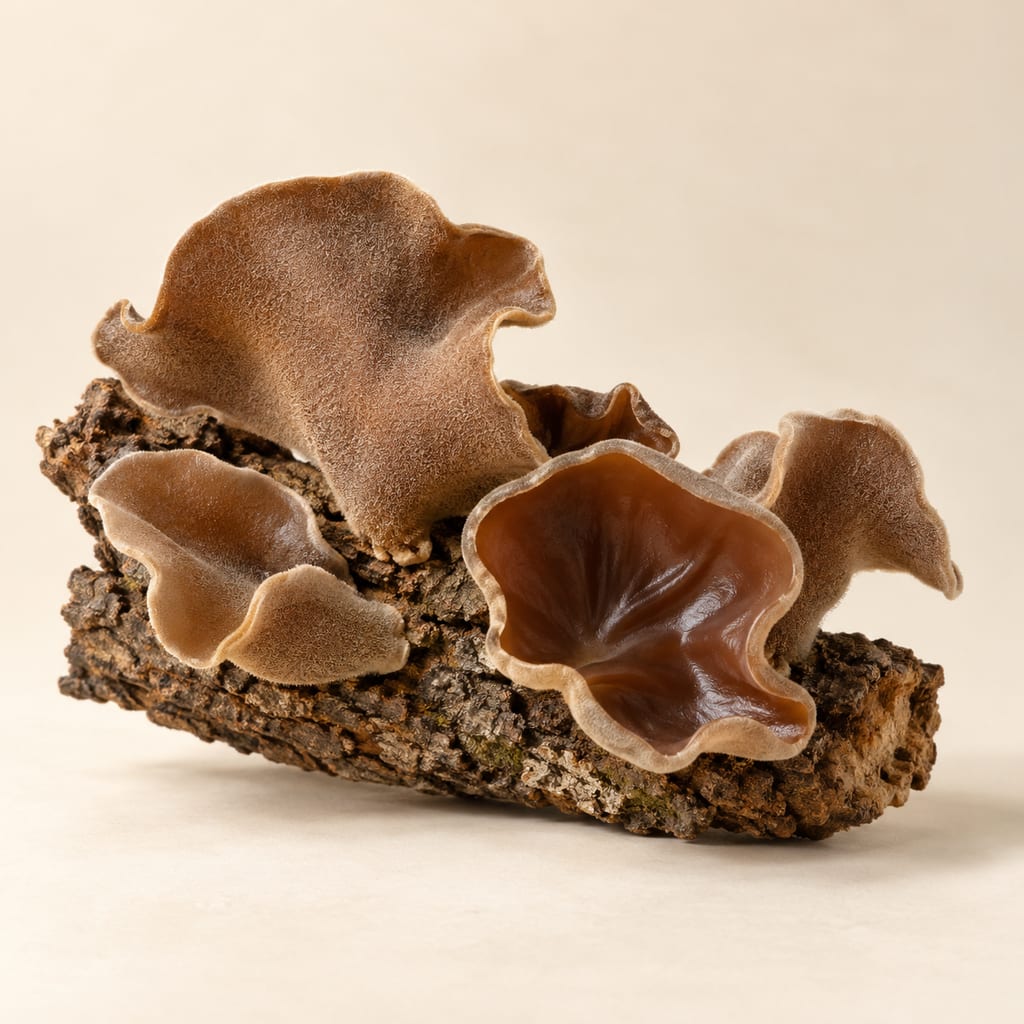
Auricularia tremellosa is a wood ear fungus of the genus that supplies most dried wood ear sold in China; its own food record is thin, and the culinary practice described here comes from the closely related wood ear species.
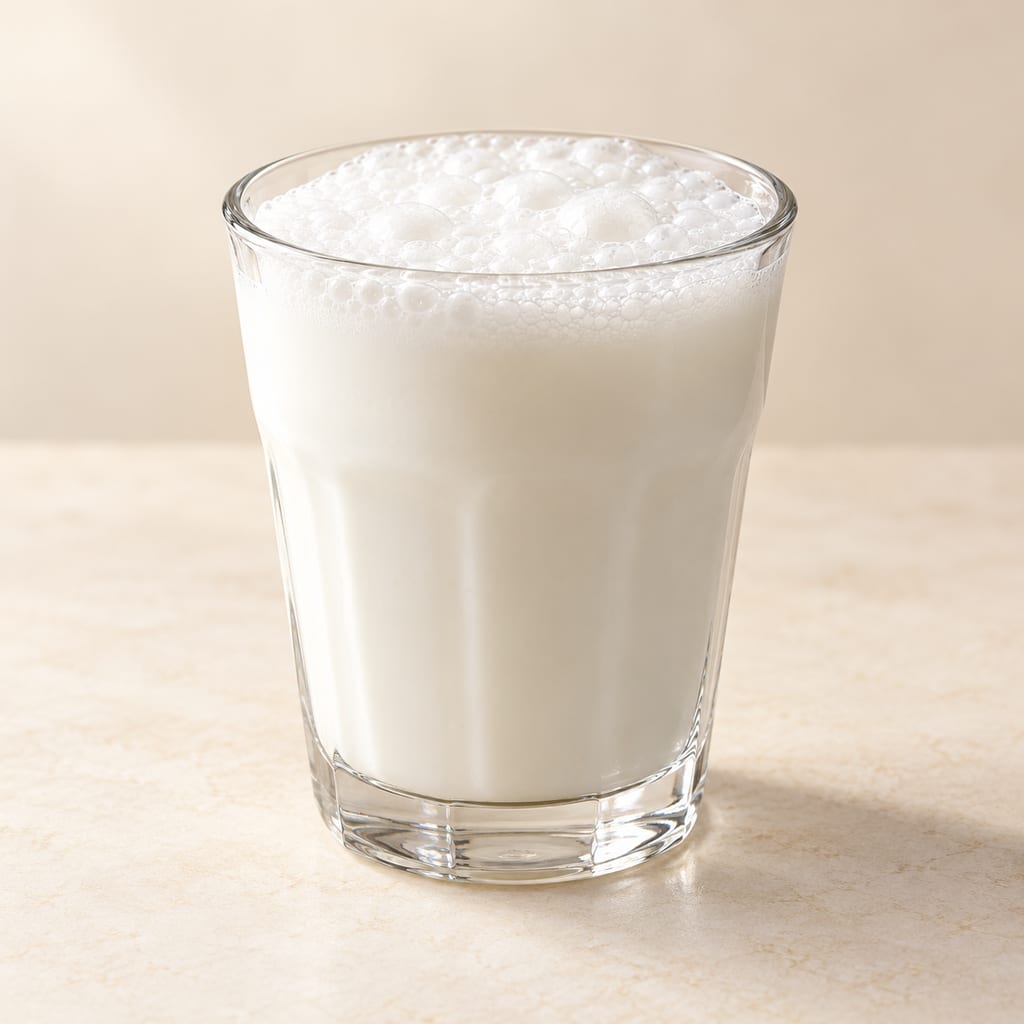
Ayran is Turkey’s cold, savoury yogurt drink: plain yogurt is loosened with water and lightly salted, then whisked smooth or aerated into a soft cap of foam.
A thin stone griddle used over an open hearth. Norwegian archaeology documents the established tradition from the early Middle Ages; a Viking-period origin is only a cautious suggestion linked to Shetland.

Crushed or milled barley cooked in water until the starch softens and the mixture thickens, the plainest way a northern household turned stored grain into a meal, here with apple and hazelnut.
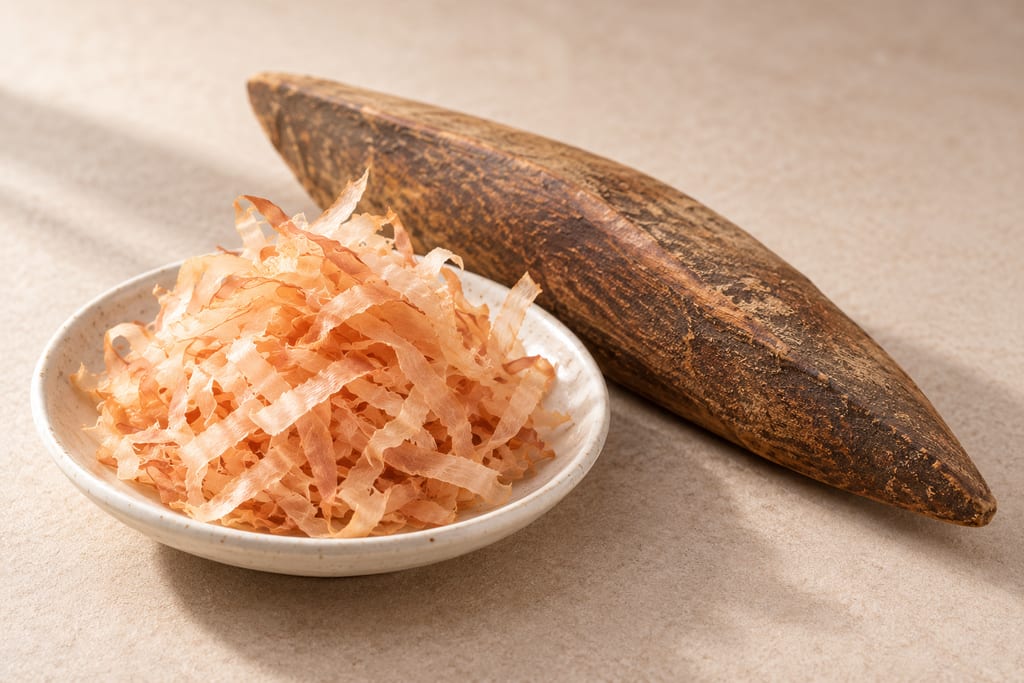
Katsuobushi is skipjack tuna cooked, smoked and dried into a hard block that is shaved into flakes for dashi and toppings. Some styles stop at the smoke-dried stage; others receive carefully managed mold maturation.
No community contributions have been published for this entry yet.
Sign in to contribute. Published comments and photos are free to read.
Royal Botanic Gardens, KewBotanical identity
Prunus amygdalus BatschAccepted name and cultivated almond taxon; crop range is not the murabba kernel’s provenance
Cited in: A seed inside a stone fruit
Royal Botanic Gardens, KewBotanical synonym
Prunus dulcis (Mill.) D.A.WebbP. dulcis is treated as a synonym under accepted P. amygdalus
Cited in: A seed inside a stone fruit
Evolutionary Applications / WileyOriginal crop genetics study
Insights Into the Almond Domestication History209 wild and cultivated samples, 23 microsatellite markers, Middle Eastern single-domestication support with later gene flow; authors note uncertainty
Cited in: Sweet and bitter: from wild relatives to cultivated crop
P. K. Gode, Studies in Indian Cultural HistoryOriginal 1961 historical survey
Some Notes on the History of the Almond (Badam) in IndiaGode surveys Sanskrit almond names, the fourteenth-century Khurasan import account attributed to Ibn Battuta, and Persian/Tartary horticultural specialists in the Ain-i-Akbari.
Cited in: Sweet and bitter: from wild relatives to cultivated crop; Almonds in Persian and Indian cooking
Plants / MDPIOriginal processing study
Effects of Different Processing Treatments on Almond (Prunus dulcis) Bioactive Compounds, Antioxidant Activities, Fatty Acids, and Sensorial CharacteristicsSix 2019 Portuguese-grown cultivars; 30-second boiling-water skin removal followed by 138°C roasting for 33 minutes; results cannot isolate blanching from roasting
Cited in: A seed inside a stone fruit; Sweet and bitter: from wild relatives to cultivated crop; What blanching changes
Journal of Food Science abstract / NLMOriginal study abstract
Impact of almond form and moisture content on texture attributes and acceptabilityPublished abstract reports that sliced and slivered almonds were less hard and crunchy than whole kernels, and that greater moisture reduced crispness.
Cited in: What blanching changes
Plant PhysiologyOriginal biochemical study
Bitterness in AlmondsAmygdalin underlies bitter almond cyanogenic potential; sweet and bitter forms differ
Cited in: A seed inside a stone fruit; Sweet and bitter: from wild relatives to cultivated crop
U.S. Food and Drug AdministrationU.S. allergen guidance
Food AllergiesTree nuts are major U.S. allergens and packaged labels identify the specific tree nut
Cited in: Choosing and keeping almonds
U.S. Food and Drug AdministrationFood safety source
Natural Toxins in FoodBitter almonds have cyanogenic amygdalin risk; not a murabba shelf-life source
Cited in: Choosing and keeping almonds
Almond Board of CaliforniaCommercial dry kernel storage
Shelf Stability and Shelf LifeCool dry storage and moisture below six percent apply to dry commercial almonds, not syrup preserve
Cited in: Choosing and keeping almonds
University of Graz CoReMAMedieval manuscript transcription
Blanc manger, manuscript B4 recipe 122Mid-15th-century Bavarian-language recipe peels and grinds almonds with water, strains almond milk, then cooks it with rice/chicken/lard/sugar
Cited in: Almonds as paste, milk and confection
RoutledgeCurzon / Norah M. Titley translationTranslated primary court cookbook preview
The Ni‘matnāma Manuscript of the Sultans of ManduThe late-fifteenth-century Mandu translation includes almond flour boiled with dūgh, white sugar, cardamom and cloves; other recipes use almond oil or flour.
Cited in: Almonds as paste, milk and confection
George Mason University LibrariesHistoric manuscript transcription
Almond Pufs, Fairfax-Spencer Family Recipe BookCatalog date 1694/1795; blanched pounded almonds with orange-flower water, sugar, lemon peel and egg whites
Cited in: Almonds as paste, milk and confection
Newcastle UniversityHistoric manuscript edition
Jane Loraine’s Recipe Bookc.1684 English household recipes grind/strain blanched almonds for creams and butter-like preparations
Cited in: Almonds as paste, milk and confection
Encyclopaedia Iranica / Nesta RamazaniScholarly food culture account
Bādām ii. As foodNamed Persian uses include green almonds with lamb and herbs, slivered almonds in pilafs, and almond sweets
Cited in: Almonds in Persian and Indian cooking
NDTV Food / recipe by Reetu Uday KugajiDirect modern recipe
How To Make Amle Ka Murabba At Home2018 murabba recipe lists 10 optional blanched slivered almonds added during syrup finishing with spices and saffron; 1 kg amla and 1.5 kg sugar
Cited in: A seed inside a stone fruit; The murabba’s optional slivers
Royal Botanic Gardens Victoria, VicFloraIdentity
Prunus dulcis (Mill.) D.A.Webb: AlmondFamily Rosaceae, genus Prunus; the fruit is a drupe, ovoid-oblong, 35 to 60 mm, grey-green, tomentose, flesh dry; the stone is ellipsoid, strongly flattened, pitted and keeled
Cited in: A seed inside a stone fruit
Almond Board of CaliforniaMethod · Safety
Guidelines for Validation of Blanching Processes (April 2007)Commercial blanching: scalding in hot or steam-injected water, loosened skins removed by rubber rollers, shaking table with aspiration and water rinse, then drying
At least 2.0 minutes in water at 190 F or above gives a 5-log or greater reduction of Salmonella; FDA letter of determination; wet blanching areas need sanitation
Same scalding parameters can serve whole, whole and broken, pieces and cutting inputs
Cited in: What blanching changes