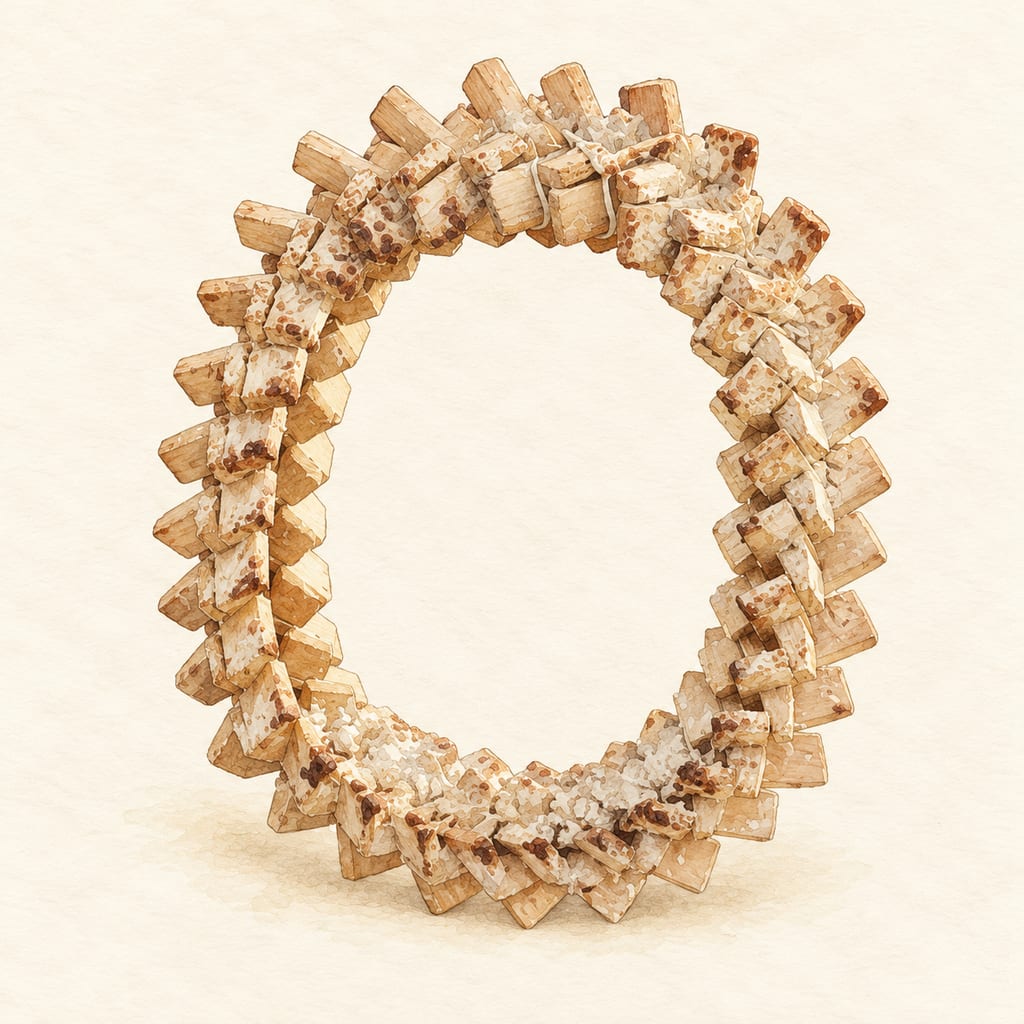
Yeast ring
A yeast ring (Norwegian gjærkrans) is an open wooden carrier that holds yeast from a previous brew while it dries for reuse. Lars Marius Garshol documented a linked-block ring in use at a farmhouse brewery in Vestbygda outside Voss.
 FermenteaWhere food goes to change
Equipment · Yeast culture carriers
kveikstokk · Norwegian yeast log · gjærstokk
A carved wooden carrier used in Norwegian farmhouse brewing to dry and keep yeast-rich material between batches; its holes and hanging loop distinguish it from a linked wooden yeast ring.
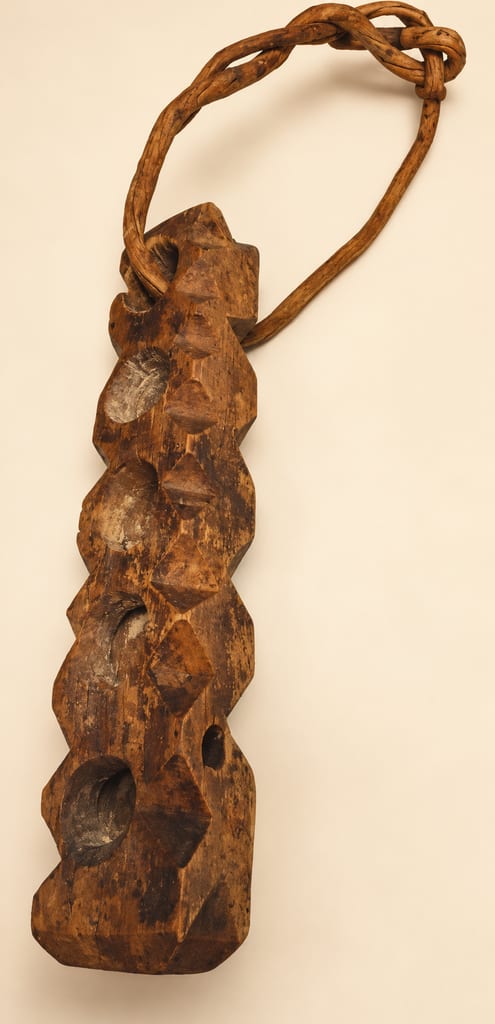
A yeast log is a deliberately worked wooden carrier for preserving brewing yeast. Norwegian names include gjærstokk and kveikstokk. Surviving forms vary: many are elongated, with round, square or faceted outlines; numerous examples have holes or recesses that retain yeast, and a hanging fixture is common. The Store norske leksikon photograph from Bud shows a deeply carved log with a loop at one end. These are documented variations, not a single standardized design.
The log is exposed to yeast-rich material during brewing, then dried and stored so the culture can be reused. Store norske leksikon describes two ways to load it: a brewer may apply foam skimmed from the early fermentation, or place the log in the emptied brewing vessel to contact yeast-rich sediment. It is then hung to dry. The implement supports preservation of an existing culture; the wood itself does not create yeast. Preiss and colleagues place kveik within a Norwegian farmhouse-brewing tradition in which cultures were passed down and reused.
A yeast log and a yeast ring share a purpose and can use similar harvesting and drying methods, but they are not the same object. The log is a carved block or short length of wood, commonly perforated or recessed. A gjærkrans is an open ring assembled from linked short wooden pieces. Store norske leksikon describes both as ways to retain and dry brewing yeast. The related page on the yeast ring documents its linked construction; the ring is not a log with a hole through its middle.
Kveikstokk use is particularly associated with western Norway, where kveik was a common brewing yeast. Preserved examples are held by Norwegian museums, including a spruce log at Hardanger Folk Museum; birch is also reported as a common wood. Preiss et al. cite a specialized yeast log dated to 1621. That date establishes an early surviving example, not the invention of the practice: the researchers infer that yeast reuse likely preceded specialized storage implements. They do not date the origin of yeast logs.
The cited descriptions do not provide a standard size, capacity, maker, cleaning procedure, or reliable storage-life figure. Wood species and shape vary. The account explains traditional drying and reuse, but it does not establish that every old wooden object carries a viable or desirable brewing culture, or that a carrier alone guarantees fermentation. Those details should be treated as unknown rather than supplied by analogy.
Preiss et al. cite a yeast log made specifically for storing kveik and dated to 1621. That is an early dated example, not the start of the practice; the researchers infer that yeast reuse probably predates specialized storage technology. Eivind Falk's account reports a recent rise in interest in kveik, but does not establish whether yeast logs remain in use.
The log retains yeast-rich brewing material; it does not generate yeast or independently turn arbitrary liquid into beer.
Source →The sources do not specify a standard capacity, dimensions, cleaning method, or guaranteed storage life.
Source →The sources identify yeast logs with Norwegian farmhouse brewing; no national distribution claim beyond the documented tradition.
Store norske leksikon says logs were particularly common in western Norway because kveik was used there; this is a regional association, not evidence of uniform use across the region.
A yeast ring (Norwegian gjærkrans) is an open wooden carrier that holds yeast from a previous brew while it dries for reuse. Lars Marius Garshol documented a linked-block ring in use at a farmhouse brewery in Vestbygda outside Voss.
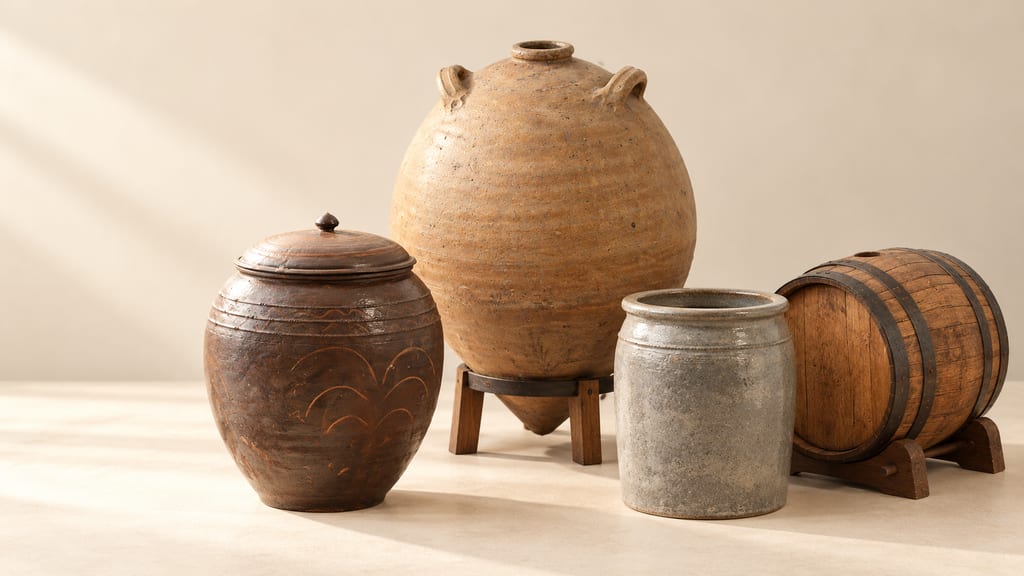
Jars, barrels, skins, leaves, pits and whole rooms decide much of what happens to fermented and cured food. This is how a container works on its contents, and how people in different places chose theirs.
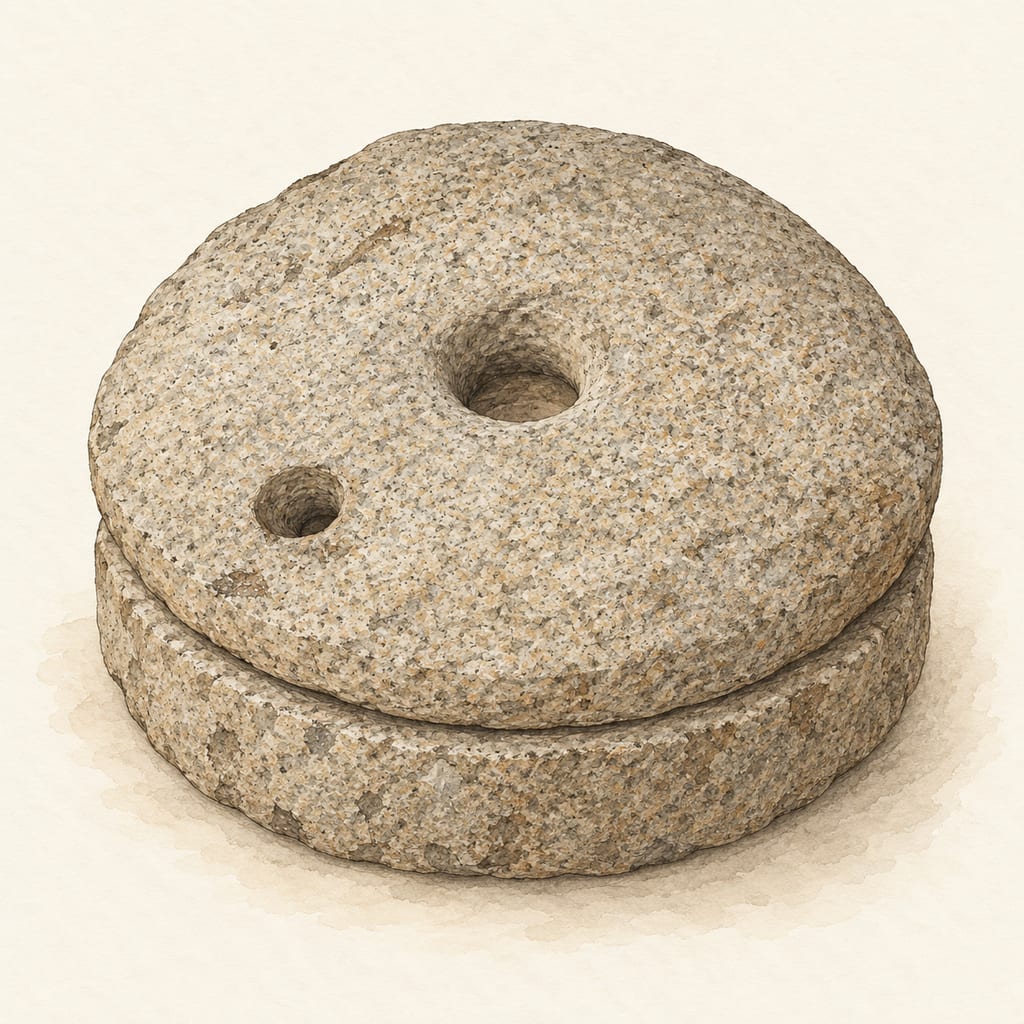
A rotary quern is a hand-operated mill with a runner turning over a fixed bedstone to grind grain. Scandinavian household use of rotary querns increased around the beginning of the Viking Age.

A gelling polysaccharide extracted from red seaweeds, sold as kanten strips or powder; it sets firm at a low concentration and stays solid until about 85 °C.

A Dominican table and seasoning condiment of sour orange juice, mixed with lime and salt and bottled raw; garlic, oregano or a hot pepper may be added for meat or a spicier bottle.

Cicerbita alpina is an alpine perennial whose tender shoots and leaves have been eaten raw or cooked. Sámi milk preparations and modern Carnian dishes are distinct uses, with serious identification and preservation limits.

Japanese skipjack tuna cooked, then repeatedly smoked and dried over a wood fire by the hand-fired tebiyama method into a hard block for shaving into dashi: the first stage of katsuobushi.

A Swedish-style spirit vinegar made by fermenting neutral alcohol with live vinegar bacteria, with a separate guide to commercial ättika strengths.

A yeast-raised wheat ring shaped from a firm dough, briefly boiled and baked. This source-batch formula gives a gently malted crust and a chewy crumb.

A warm dip of garlic, anchovy and olive oil, often enriched with butter, that Piedmont serves over a flame with raw and cooked vegetables and bread.

Bechamel is a white sauce of milk thickened with a butter and flour roux, one of the French mother sauces, and the base from which Mornay and other cheese and cream sauces are made.
No community contributions have been published for this entry yet.
Sign in to contribute. Published comments and photos are free to read.
Store norske leksikon / Norsk håndverksinstituttForm · Names · Materials · Use · Geography · Image reference
gjærstokkA wood carrier coated with brewing yeast is hung to dry for later use.
Shapes vary; many are elongated, have holes, and include hanging fixtures.
Birch is reported as common, spruce also used; preserved examples are especially found in western Norway.
Top foam or bottom sediment can inoculate the log; it is dried and stored.
A spruce example is at Hardanger Folk Museum; the Bud photograph is credited to Atle Ove Martinussen.
SNL describes the log and yeast ring as distinct forms used in similar ways.
Cited in: Form and name; Keeping yeast between brews; How it differs from a yeast ring; Norwegian context and historical evidence; What the record does not establish
Store norske leksikon / Norsk håndverksinstituttComparison
gjærkransA yeast ring is assembled from short linked wooden pieces and is distinct from a yeast log.
The page describes yeast harvesting and drying use for rings.
Cited in: How it differs from a yeast ring
Frontiers in MicrobiologyHistory · Context
Traditional Norwegian Kveik Are a Genetically Distinct Group of Domesticated Saccharomyces cerevisiae Brewing YeastsDescribes kveik as a Norwegian farmhouse brewing culture passed down across generations.
Cites purpose-built yeast logs for kveik storage dated at least to 1621.
Interprets that date as evidence that yeast reuse probably predates specialized storage technology; it does not state the log's exact origin date.
Cited in: Keeping yeast between brews; Norwegian context and historical evidence; What the record does not establish