
Barley and oat porridge (Viking Age)
Crushed or milled barley cooked in water until the starch softens and the mixture thickens, the plainest way a northern household turned stored grain into a meal, here with apple and hazelnut.
 FermenteaWhere food goes to change
Equipment · Kettles, coppers and boilers
A Viking Age cooking pot carved from soapstone, exemplified by a partly reconstructed Birka grave find with iron handle fittings. Similar vessels were used across Scandinavia, but their forms and later handles changed over time.
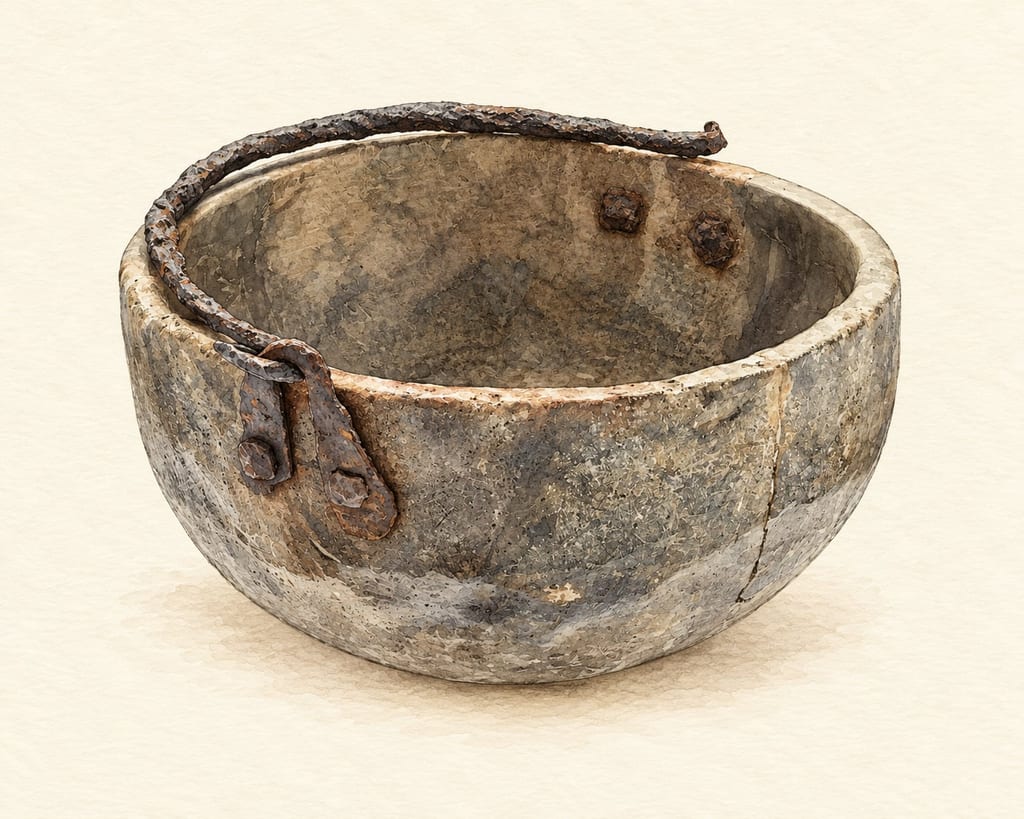
Soapstone cooking vessels were carved from a naturally occurring rock rather than shaped from clay and fired. Archaeological and historical evidence covers more than one form. Irene Baug distinguishes three Viking Age types: bowl-shaped vessels, trough-shaped vessels and vessels with handles. Bowl-shaped pots were the most common in her account; the typical bowl form had an iron handle attached by cramp irons, allowing it to hang over a hearth. This typology helps explain why the phrase “soapstone pot” does not name one standard silhouette.
A particularly well-documented example is the Swedish History Museum’s pot from grave Bj 879 at Birka, on Björkö in Uppland. The museum dates it to 800–1100 and records a weight of 3,896 grams, a diameter of 235 millimetres and a height of 130 millimetres. It describes a round-bottomed soapstone vessel with iron handle and handle fittings, partly reconstructed. Those details belong to this specimen; they should not be treated as measurements or construction rules for every Viking Age pot.
The Birka vessel joins a carved stone body to iron suspension hardware. Its museum record lists West Scandinavia as its manufacturing place. The associated display notes soapstone deposits in northern Bohuslän, extending into Norway, and in Jämtland, and says the material was quarried in both regions during the Viking Age. That establishes a regional supply landscape, not the source of the stone in this particular pot.
The object is incomplete and reconstructed in part. Its present appearance therefore represents the museum’s reconstruction of surviving material, not an untouched pot recovered whole. The iron handle and fittings survive as part of the described form, but neither the collection page nor the broader study establishes exactly how this vessel was suspended during a particular meal. Its grave context documents an object placed in a burial; it does not by itself prove the meal or cooking event in which the pot had been used.
The use evidence comes from the broader category of cooking vessels. The Swedish History Museum’s Viking display says pots of ceramic, iron and soapstone could stand among coals or hang above the fire. Baug’s study explains that the iron handles on common bowl-shaped soapstone pots could suspend them above a hearth. Together, these accounts show two ways the vessel could be heated, while leaving the use of the individual Birka find open.
Kringom’s account of the Viking Age farm at Ytre Moa in western Norway adds a separate archaeological setting: fragments of soapstone vessels were found among kitchen equipment, beside evidence for hearths and other cooking tools. It notes that the quarry source of those fragments is unknown. The page also describes porridge and gruel as probable staples and reports that soapstone vessels were used for such foods into fairly recent times. That regional account supports a long-lived cooking role, but it does not identify the Birka vessel as a porridge pot or establish one recipe for all households.
Soapstone-vessel production and design did not remain fixed. Baug places increased Norwegian production around the transition to the Viking Age, about 800, and says it continued through the Viking Age and into the Middle Ages. In her account, vessel types begin changing from the twelfth century: bowl-shaped forms remain common, while another form has straighter sides and a more distinct turn toward the base. From the thirteenth century, pots are generally smaller than Viking Age examples. Baug interprets these shifts as evidence of changing use, rather than a simple uninterrupted standard.
That sequence is a useful caution when comparing surviving objects. A later soapstone vessel with carved handles or straighter walls need not represent the Birka pot’s original arrangement. Conversely, the Birka specimen’s iron fittings should not be copied into every reconstruction or modern cooking vessel without evidence. The object’s date, its partial reconstruction and the broader typology each answer different questions.
Birka gives this page a precise Swedish archaeological location; Ytre Moa provides a distinct Norwegian site where related fragments were recovered. The broader manufacture label “West Scandinavia” is the museum’s classification for the Birka specimen, not a more precise workshop address. Quarry evidence in Bohuslän and Jämtland, and Baug’s account of Norwegian production, show several relevant regions without identifying the potter or quarry behind this particular object.
The record gives no capacity, maker, price, current supplier, maintenance routine or modern food-safety standard. The dimensions above describe a museum object, not a recommended working capacity. Historical evidence shows soapstone vessels used in cooking; it does not certify every newly made stone vessel for present-day food contact or direct flame. No cleaning, seasoning or storage instruction is supplied here because the inspected sources do not document one.
Crushed or milled barley cooked in water until the starch softens and the mixture thickens, the plainest way a northern household turned stored grain into a meal, here with apple and hazelnut.
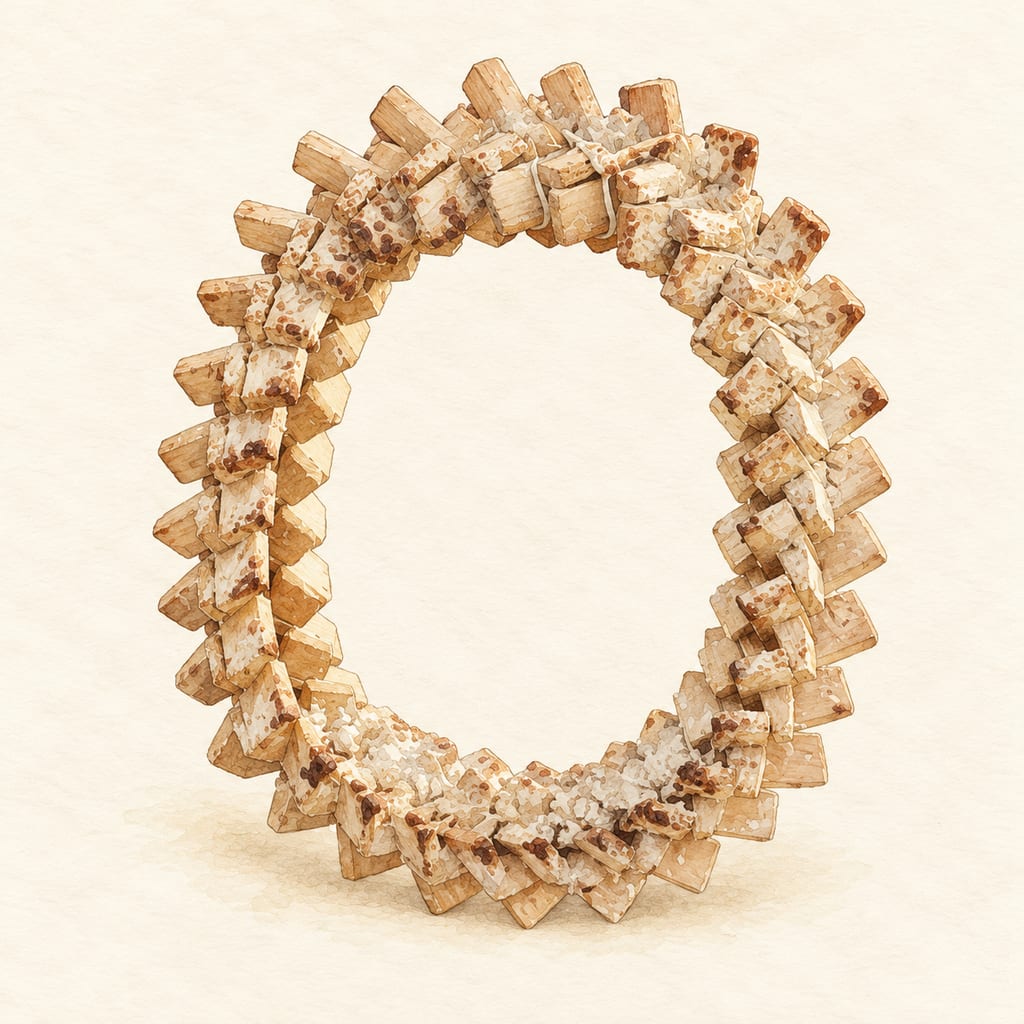
A yeast ring (Norwegian gjærkrans) is an open wooden carrier that holds yeast from a previous brew while it dries for reuse. Lars Marius Garshol documented a linked-block ring in use at a farmhouse brewery in Vestbygda outside Voss.

Protected Italian vinegar made only from cooked grape must, fermented and aged in a battery of wooden barrels for at least 12 years: sweet, sharp and syrupy.

Airag is Mongolia’s fermented mare’s-milk drink, traditionally churned with saved starter in a reusable cowhide khokhuur.

Appam, or hoppers, are South Indian and Sri Lankan rice pancakes made from a fermented coconut-and-rice batter and cooked in a curved pan to a crisp lacy rim and a soft, spongy centre.

Auricularia tremellosa is a wood ear fungus of the genus that supplies most dried wood ear sold in China; its own food record is thin, and the culinary practice described here comes from the closely related wood ear species.

Ayran is Turkey’s cold, savoury yogurt drink: plain yogurt is loosened with water and lightly salted, then whisked smooth or aerated into a soft cap of foam.
A thin stone griddle used over an open hearth. Norwegian archaeology documents the established tradition from the early Middle Ages; a Viking-period origin is only a cautious suggestion linked to Shetland.

Black carrot is the anthocyanin-pigmented Eastern carrot (Daucus carota var. atrorubens), the purple root that preceded orange types and still colours kanji and şalgam.
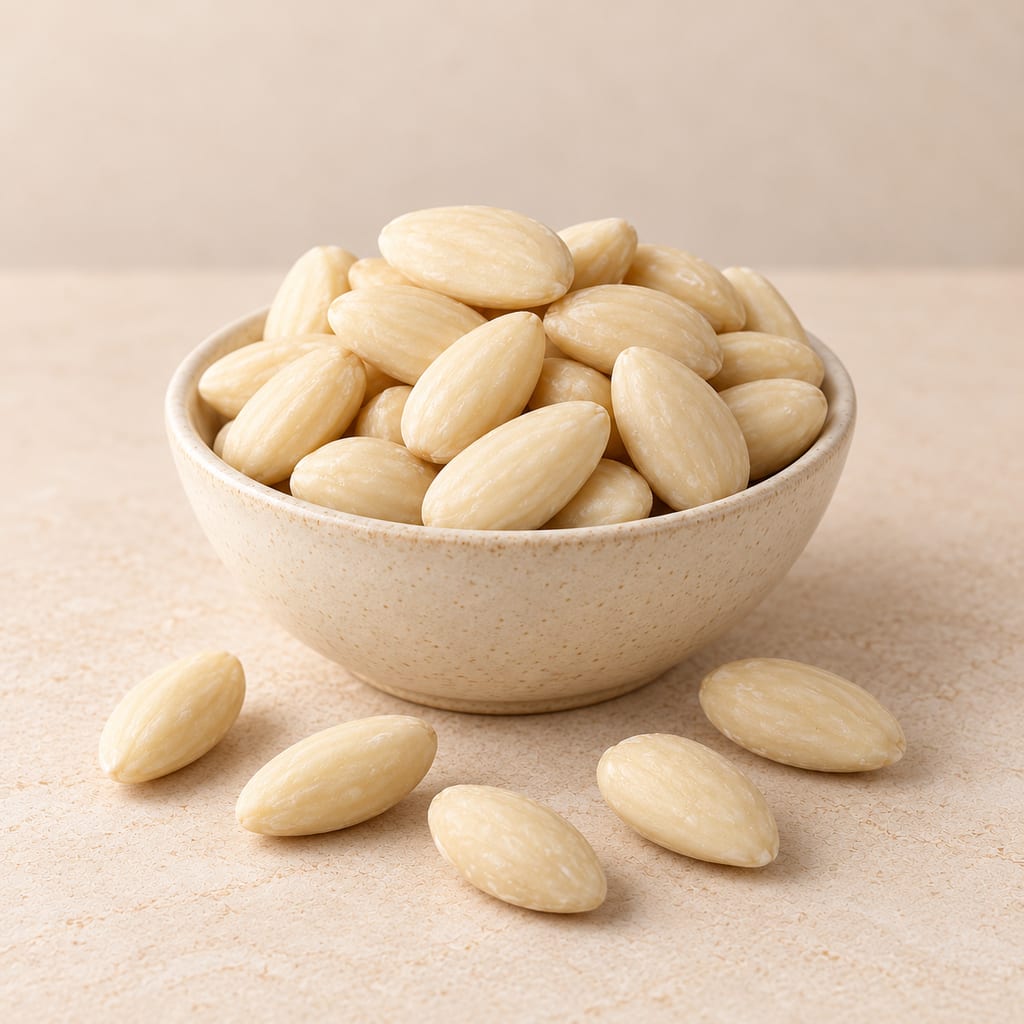
Blanched almonds are sweet almond kernels with the brown seed coat removed. A documented amla murabba cooks ten optional slivered kernels into the finishing syrup with spices and saffron.
No community contributions have been published for this entry yet.
Sign in to contribute. Published comments and photos are free to read.
Swedish History Museum / Statens historiska museerObject record · Form · Materials · Dimensions · Dating · Geography
Gryta (524820_HST)A partly reconstructed round-bottomed soapstone pot with iron handle and fittings from Birka grave Bj 879, Björkö, Uppland; dated 800–1100; recorded as 3,896 g, 235 mm diameter and 130 mm high; manufacturing place listed as West Scandinavia.
The object record states soapstone occurs in northern Bohuslän and Jämtland and was quarried in both regions during the Viking Age; it does not link this specific pot to either quarry.
Cited in: A cooking pot, not a single universal shape; Stone, fittings and the limits of the object record; Changing forms through the Middle Ages; Places and practical unknowns
Swedish History MuseumForm · Historical use
The Viking World — Soap-stone pot: 524820_HSTThe museum describes the round-bottomed pot as partially reconstructed, with an iron handle and fittings; its display says soapstone occurred in northern Bohuslän and Jämtland and was quarried there in the Viking Age.
Cited in: A cooking pot, not a single universal shape; Stone, fittings and the limits of the object record; Cooking over the hearth
University of Bergen Archaeological SeriesTypology · History · Use
Stones for Bread: The Use of Querns, Millstones and Baking Stones in the Viking Age and the Middle AgesBaug describes three Viking Age soapstone vessel types: bowl-shaped, trough-shaped and handled; the bowl-shaped type is most common and typically had an iron handle attached with cramp irons for suspension over a hearth.
Baug identifies increased Norwegian vessel production from around the transition to the Viking Age, continuing through the Viking Age and Middle Ages; from the 12th century forms change and from the 13th century vessels are generally smaller.
Cited in: A cooking pot, not a single universal shape; Cooking over the hearth; Changing forms through the Middle Ages; Places and practical unknowns
KringomRegional archaeology · Historical use
Kitchen utensils and cookingYtre Moa, a Viking Age farm site, yielded soapstone vessel fragments; the source says similar vessels were common in the Viking Age and that quarry origin for the Ytre Moa vessel is unknown.
Kringom describes porridge and gruel as probable staples, with water porridge for ordinary days and milk on special occasions as a possibility; it reports use of soapstone vessels for porridge and gruel into fairly recent times, without exact end dates.
Cited in: Cooking over the hearth; Places and practical unknowns