A stave-built vessel made to be seen
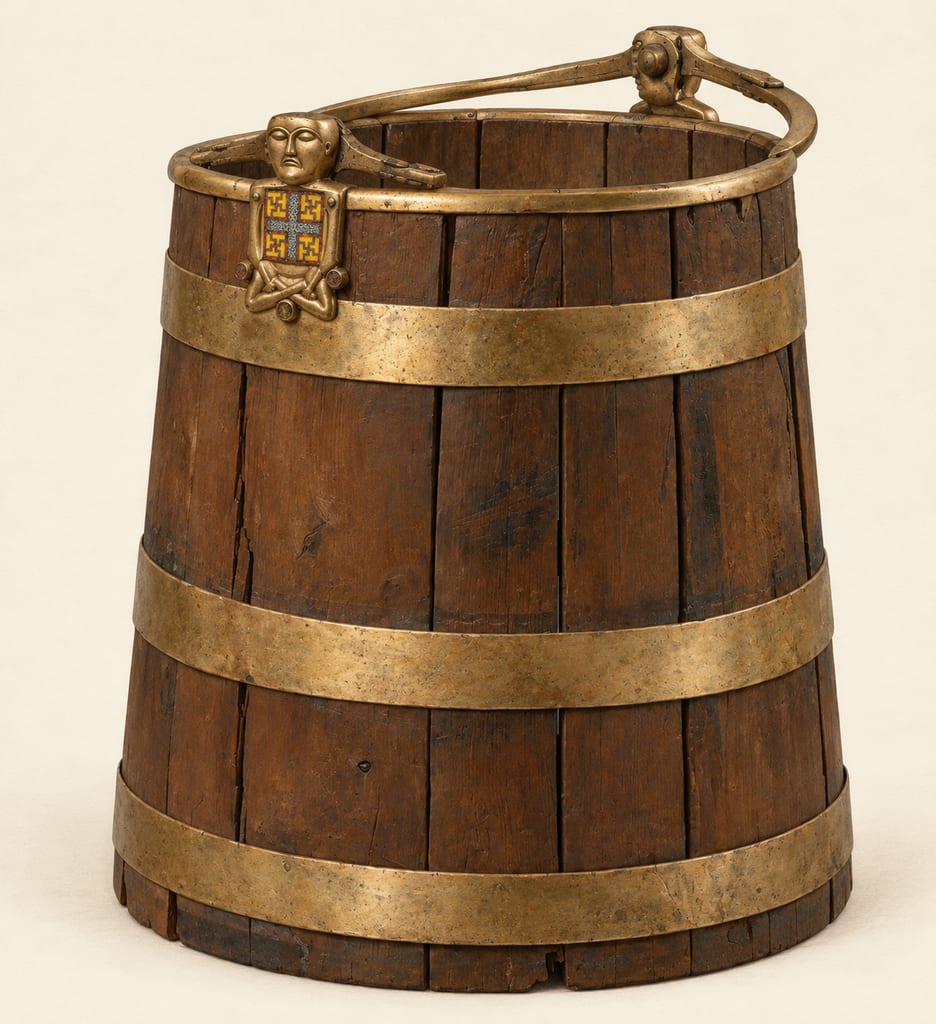
The Oseberg bucket is a portable wooden vessel, not a cauldron. Its body is assembled from thirteen upright staves of European yew and held by bronze bands, with a separate bronze fitting around the rim. At 36 centimetres high, the proportions are those of a substantial handled container. Stave construction joins narrow wooden boards into a curved wall; the museum notes that this vessel type is particularly suited to holding liquids. The source does not publish a capacity or diameter, so neither can be supplied here.
Its fittings distinguish it from an ordinary household pail. At the handle attachments are small enamelled figures. The face and seated pose first led to the familiar nickname “Buddha bucket,” but the Museum of the Viking Age explicitly rejects a Buddhist identification and describes the figure as Celtic, resembling other Celtic depictions of the dead. The main enamel panel is divided by a blue-and-white equal-armed cross, with red and yellow sections between its arms. The museum describes millefiori work in the cross and champlevé enamelling in the metalwork; thin bronze strips separate the coloured fields.
Sources for this section
An object from an elite burial
The bucket was found in the Oseberg burial mound in Vestfold, Norway. The ship was used as a burial vessel for two women in 834, accompanied by abundant furnishings, textiles, food, animals and kitchen equipment. The excavated assemblage includes several buckets as well as cooking vessels, ladles, whisks, a milk strainer, wooden bowls and grain-processing tools. That context shows why the bucket belongs in the story of food and hospitality, but it does not make this richly decorated object a representative farmhouse utensil.
The museum places the bucket's origin in Ireland or the British Isles before its arrival in Vestfold. An archaeologist interviewed by Science Norway likewise associates the figure and its workmanship with the British Isles, while stressing that the exact origin and route cannot be settled. A raid, exchange, political relationship or gift may explain how it travelled, but none is documented as the actual route. The elaborate metal and enamel work, together with its placement in a richly furnished ship burial, points to an object of exceptional value rather than a routine container.
Sources for this section
Possible serving role, with an important limit
The museum suggests that the bucket may have been displayed in a ceremonial hall and perhaps used to serve distinguished guests; mead is offered as one possible drink. These are interpretations, not a recorded use. A separate account by Science Norway reports the assessment of archaeologist Hanne Lovise Aannestad that this particular bucket was empty when buried and that yew is toxic, making it unsuitable for storing food or water. The sources therefore leave its precise role unresolved. The safe reading is that it is evidence of exceptional craft and long-distance connections in an elite setting—not a practical pattern to copy for serving or fermenting food.
The object is a useful contrast to ordinary kitchen equipment found in the same burial. Pots heated food; buckets and wooden containers held or carried things; this bucket's unusual fittings made it conspicuous. The surviving evidence cannot tell us whether it held a drink during life, stood as a display piece, or acquired a symbolic role in the burial. Its form and decoration are documented more securely than its everyday use.
Sources for this section
History
The bucket is regarded as older than its burial context, with its figure linked to Celtic work of the 8th century. It was recovered with the Oseberg ship burial, where two women were interred in 834. Its route to Vestfold is unknown: raiding, trade, political exchange or a gift remain possibilities, not proven histories.
Equipment details
Size36 cm tall The Museum of the Viking Age reports height; the examined source gives no diameter.
PowerNo power A portable, hand-carried vessel; no powered mechanism is documented.
How you get oneNot obtainable today This specific archaeological object is a grave find, not a contemporary product offered for purchase.
Made of
- European yew — Thirteen vertical staves forming the vessel body
Museum identification. - Bronze — Bands, rim fitting, handle fittings and enamel-bearing mount
The sources describe bronze bands and rim; enamelled decorations are set into metal fittings.
Limits
The yew vessel is not suitable for storing food or water; an archaeologist cited in the source identifies yew as toxic.
Source →Places
Oseberg, Vestfold, Norway
Historical attestation · Locality evidenceArchaeological find and burial context; this does not establish manufacture in Norway.
Ireland or the British Isles
Manufacture · Region evidenceAn insular origin is proposed, but exact place and route are not established.