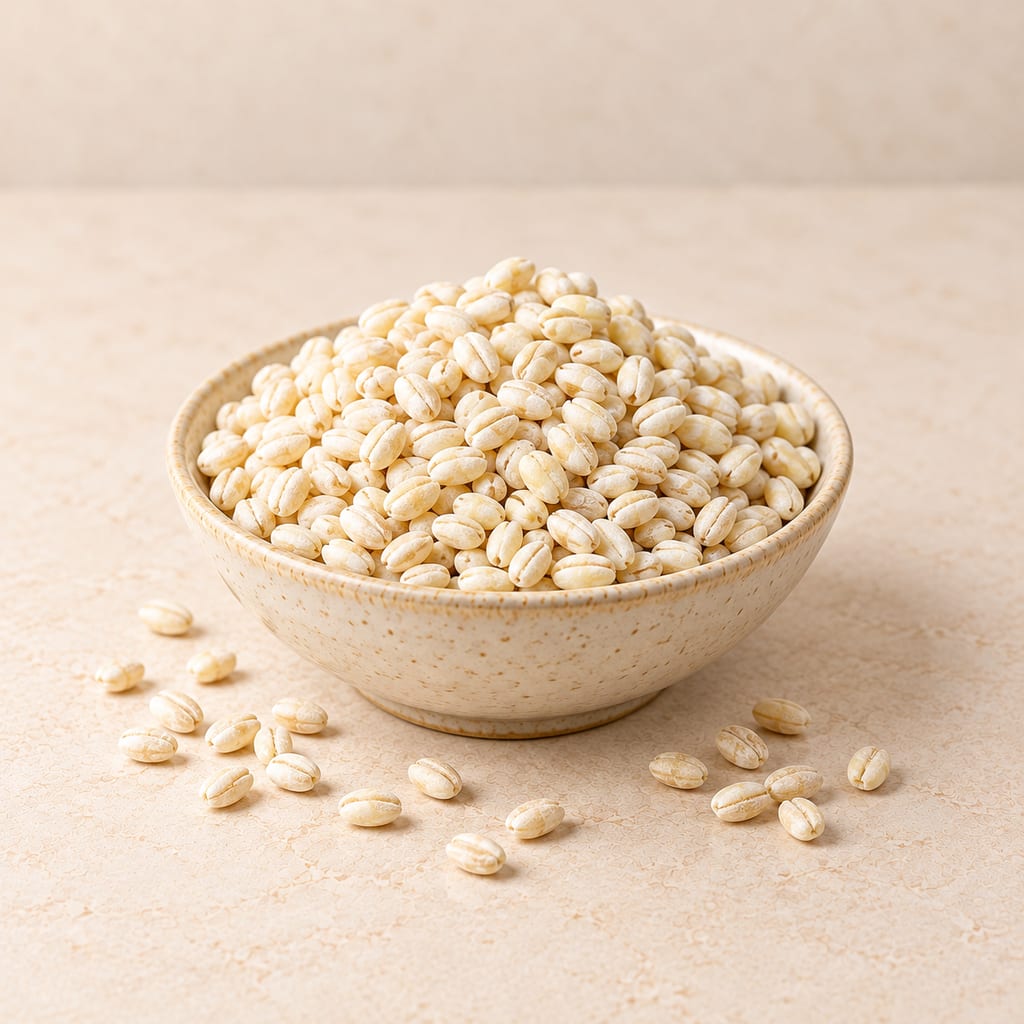
Barley
Barley is a hardy cereal, domesticated in the Middle East over 10,000 years ago, eaten whole, pearled or milled, malted for brewing, and grown with koji mold for barley miso.
 FermenteaWhere food goes to change
Built structures · Place · Pits and cavities
Neolithic underground grain-storage pits in Egypt's Fayum, identified through basketry linings and remains of emmer and hulled barley.
The Upper K pits are archaeological grain stores from Egypt’s Fayum depression. Their distinguishing feature is basketry lining: woven material separated the stored crop from the surrounding pit walls. Remains of emmer and hulled barley were recovered in association with these features. The evidence supports a practical arrangement for keeping grain below ground, but it does not supply a complete construction plan or a modern storage specification.
The Upper K storage features are distinguished in the research from the nearby Kom K and Kom W occupation sites. That distinction matters: crop remains from the pits should not be treated as proof that the people who used them lived permanently in a village at the storage location. The source discusses the Fayum Neolithic broadly, in the sixth to fifth millennia BCE, while cautioning that individual features need their own dates. This record therefore does not assign a specific date to each pit.
The reported contents are plant foods stored dry. No evidence in this account establishes fermentation, controlled moisture, a sealed anaerobic environment or a particular preservation duration. Basketry lining is directly reported, but its plant material, weave, thickness, construction sequence and condition are not specified. Pit dimensions, lids, access arrangements and exact coordinates are also absent. These limits keep the archaeological description separate from a reconstructed how-to.
The Upper K features are treated as storage pits because their interiors had basketry linings and contained crop remains. The research distinguishes them from nearby Kom K and Kom W occupation sites, so the crops do not by themselves establish a permanently settled village. The record describes dry grain storage; it does not claim fermentation.
A build is made where it stands: moving it means building it again.
The article identifies Upper K pits north of Kom K in the Fayum; this locality-level association does not assert exact coordinates or date any individual pit.
Barley is a hardy cereal, domesticated in the Middle East over 10,000 years ago, eaten whole, pearled or milled, malted for brewing, and grown with koji mold for barley miso.
Wheat is the edible seed of grasses in the Triticum genus, a diverse family of grain crops used whole, cracked and milled. The page covers the raw grain; flour grades and blends have separate pages.

At North Abydos in Egypt, a fixed early Dynastic brewery comprised parallel semi-subterranean installations with rows of ceramic mash vats; excavation reports revise their number, scale and estimated batch capacity.
No community contributions have been published for this entry yet.
Sign in to contribute. Published comments and photos are free to read.
Quaternary InternationalIdentity · Materials · History · Geography
Basket use, raw materials and arguments on early and Middle Holocene mobility in the Fayum, EgyptUpper K pits in the Fayum contained basketry linings and remains of emmer and hulled barley.
The storage features are distinguished from neighbouring Kom K and Kom W occupation sites; crop evidence does not by itself establish a permanently settled village.
The source treats the evidence as Fayum Neolithic but cautions that individual features require their own dating.
Cited in: Basket-lined storage in the Fayum