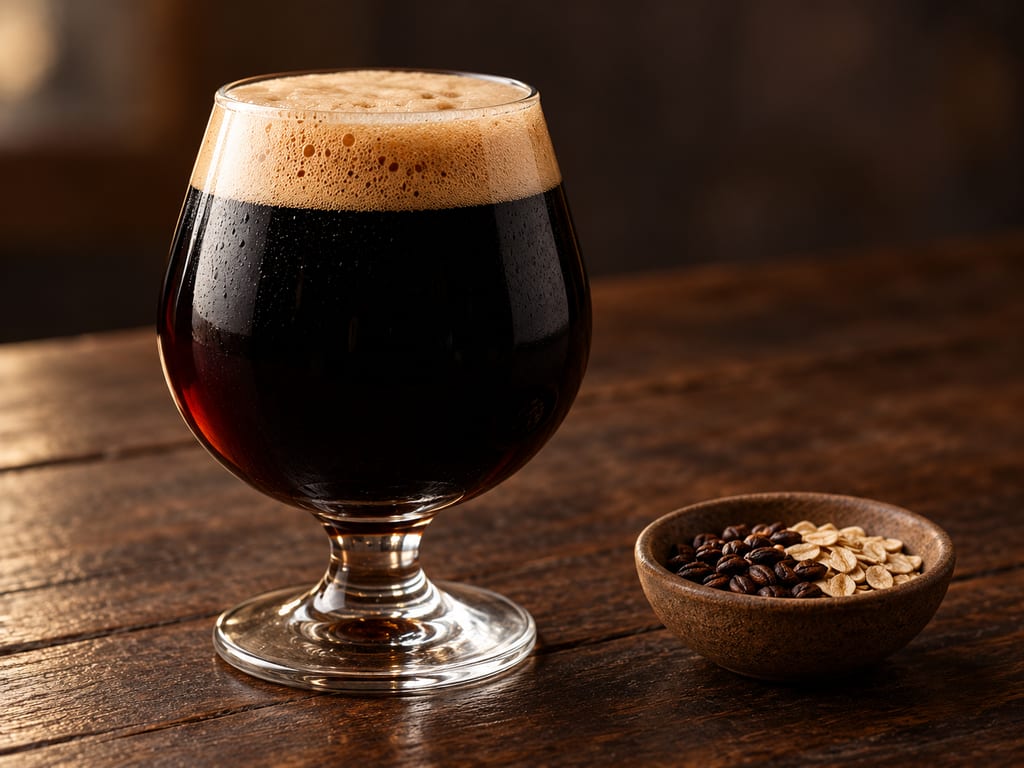
Dark Cellar imperial stout
An all-grain imperial stout with pale malt, roasted barley, dark malts and oats, fermented with an American ale-yeast starter.
 FermenteaWhere food goes to change
Substrates
Dark-roasted unmalted barley used for colour and a dry roasted edge in stout, with other roast grades used in grain infusions and foods.
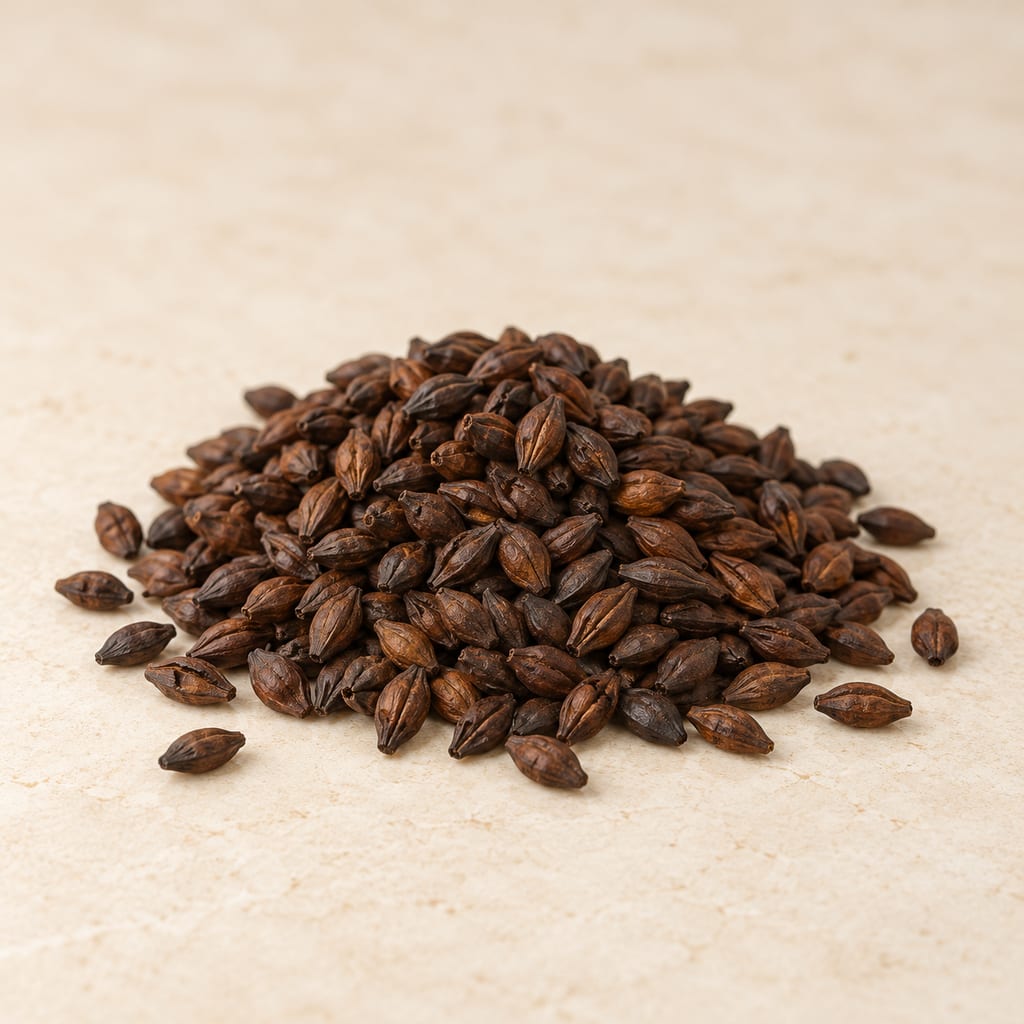
Roasted barley carries the shape of a cereal kernel and the colour of a much darker food. Depending on its roast, the grain can be deep brown to nearly black, with aromas described as coffee-like, smoky or burnt-grain. In brewing it supplies an emphatic roasted edge and dark colour. Its identity is easy to blur on a maltster's catalogue: the familiar brewing ingredient is made from unmalted barley, even when a shop groups it beside roasted malts.
Roasting barley has a history much wider than stout. A Sumerian lexical tablet excavated at Nippur includes a term translated as flour made from roasted barley. The tablet belongs to the Old Babylonian period, approximately 1900–1600 BCE, and is now held by Penn Museum. The entry preserves the existence of a named grain food within an ancient vocabulary. It does not describe a dark brewing roast or establish a continuous recipe leading from that flour to modern beer.
That distinction makes the history more interesting. The same broad operation—heating grain until its aroma and colour change—can prepare a flour ingredient, a drink infusion or a brewing adjunct. Japanese 麦茶, mugi-cha, is made by extracting roasted barley in water and is often served chilled in summer. Modern stout makers use a dark roasted grain within a much larger fermented grain mixture. Roasted barley belongs to both stories, but the roasting choices and the later preparation determine the food or drink that emerges.
Barley is Hordeum vulgare, a cereal grass grown in many temperate agricultural regions. Its kernel contains a germ, a starch-rich endosperm and outer tissues, including the aleurone layer; covered forms also carry a hull. These parts are not merely a container for one uniform powder. Their different constituents help explain why grain selection and processing influence the material available for heat reactions and for extraction in a mash.
Barley crops vary by species background, cultivar, growing conditions and intended market. Two-row and six-row forms describe the arrangement of fertile spikelets on the head, while covered and hull-less forms concern the grain's outer covering. Those distinctions do not identify a particular bag of roasted barley unless the supplier states them. A recipe's separate reference to American two-row pale malt, for example, identifies its base malt rather than the cultivar or origin of every other barley-derived ingredient in the grist.
Malting barley is selected for its ability to perform through controlled processing. Grain quality includes sound kernels, suitable physical and chemical characteristics, and predictable handling. For a roasted ingredient, the producer also needs material that can take the intended roast consistently. The finished purchase should therefore be identified by its own product description and specification. A crop's suitability for malting does not mean it has already been malted before it reaches the roasting drum.
Conventional malting begins by steeping grain, allowing controlled germination and then drying it. During germination, the developing seed's enzyme system changes the endosperm: cell walls and part of its protein and starch are broken down. Drying stops further growth and produces a stable malt. These operations prepare a brewing material whose enzymes can continue working when ground malt is mixed with water in a mash.
The familiar roasted-barley ingredient takes a different route. Simpsons describes its product as unmalted barley entering the roasting drum without those conventional malting steps. Black malt, by contrast, has been malted before its final dark roast. The two can occupy a similar colour range while differing in the starting grain and in their flavour contribution. Calling either one simply dark grain conceals a useful production distinction.
Maltsters may still place roasted barley in a roasted-malt range because brewers buy and use the products together. That merchandising category should not replace the process description. The useful question is whether the grain was germinated through malting before roasting. Chocolate malt, black malt, caramel malt and unmalted roasted barley are related brewing materials, but each reaches its final state through a different combination of biological preparation, moisture conditions and heat.
The roasting stage creates much of the ingredient's defining aroma and colour. It is a thermal transformation of grain constituents. In a 1968 investigation, Pao-Shui Wang and Yosito Sakurai observed aroma formation and browning developing together during their experimental barley roasts. They also measured carbon dioxide formation and detected carbonyl and sulphur-containing compounds. The gas in that experiment was generated during heating, rather than being evidence of a yeast fermentation.
Their work found flavour precursors especially abundant in the aleurone fraction. This gives a reason to think about the kernel as a set of chemically different tissues. Heat acts on compounds already present in the grain, producing a changing mixture of volatile aromas and coloured material. Stronger roast is not simply more of an unchanged barley flavour. The balance shifts as reactions proceed and as existing compounds are transformed or lost.
Wider roasted-malt research identifies Maillard chemistry, caramelization and thermal decomposition among the processes responsible for colour and aroma development. These are non-enzymatic reactions, influenced by temperature, duration, moisture and the available sugars and amino compounds. A production schedule therefore controls more than the darkness visible on the outside. The maltster is shaping a combination of coloured material and aroma as the grain heats, with the starting kernel and its moisture helping determine the course of the roast.
A maltster's colour specification is a useful product description, but it is not a complete account of flavour. Simpsons describes roasted barley as sharper and more intensely roasted than its similarly coloured black malt, with coffee-like and burnt-grain notes and a dry finish. Viking likewise emphasizes strong colour, dryness and a harsher roasted character in its product profile. These maker descriptions help explain a brewer's choice between ingredients that can look alike in a handful.
The words coffee and smoke describe sensory impressions here. They do not establish added coffee beans or a smoke-drying stage. The dark roast itself can create those associations. Likewise, a dry flavour impression does not provide a measurement of a beer's remaining sugar. A strong stout can contain substantial residual extract while still having an assertive dry roasted edge. Ingredient character and finished-beer analysis answer different questions.
Roast intensity, kernel condition and the rest of the formulation determine how prominent that edge becomes. A dark grain bill may combine several roast products, each contributing a different emphasis. Matching a replacement only by colour can therefore change the beer's balance. Check the intended grain identity and the producer's flavour description together; a black-malt substitute is a formulation change rather than a correction to the name roasted barley.
Roasted barley supplies grain material for extraction alongside its colour and aroma. It is not a brewing culture, and its dark appearance does not imply that it has already fermented. In an all-grain mash, malt enzymes act on accessible grain starch to produce smaller carbohydrates, including sugars that brewing yeast can use. The active base malt and the roast grain can therefore serve different purposes within the same vessel.
An unmalted roasted ingredient should not be assumed to provide the enzyme capacity of a pale base malt. Its route through production lacks the conventional controlled germination used to prepare that base malt, and intense heating changes the grain further. A brewer designs the mash around the whole grist's conversion needs. The amount and nature of extract obtained from the roast grain depend on the product and the extraction process, rather than on its colour alone.
After separation of the grain, the resulting wort carries dissolved material into the kettle and fermenter. Brewing yeast ferments the sugars it can use, producing alcohol and carbon dioxide. This later biological stage is distinct from the roast reactions that formed the grain's aroma. Some roasted character travels into the beer while fermentation, hops and the rest of the malt bill shape the final balance. No single dark ingredient accounts for the complete flavour of a finished stout.
The linked Dark Cellar imperial stout uses roasted barley as one part of an unusually substantial grain bill. The published formulation lists 2 pounds of roast barley alongside 25 pounds of American two-row pale malt. Chocolate malt, Carafa III, caramel 60, coffee malt, oats and black patent malt are separate entries. Keeping those names separate preserves the brewer's chosen combination of roast, malt and adjunct character.
Joel McGormley's beer won its category in the 2024 National Homebrew Competition final round, and the formulation appears in the American Homebrewers Association's 2026 Big Brew publication. Its brewing notes give a mash followed by a boil and fermentation with an American ale yeast. The roasted barley belongs to that grain formulation; it is not an ingredient added as a culture or a finished barley-tea extract.
The publication also gives an extract version that replaces the pale malt with pale malt extract while retaining the other grains for milling and steeping. This shows another role for the purchased roast grain: its character can be extracted into water while a prepared malt extract supplies the main wort base. The two versions have different brewing arrangements. Neither turns roasted barley into a self-contained source for every part of the beer or establishes a universal steeping method for other recipes.
Roasted barley can also be used where the intended result is an infusion rather than a fermented drink. Japan's official food-composition entry describes mugi-cha as roasted hulled barley extracted with hot or cold water. It records both loose roasted seeds and teabag products, as well as ready-to-drink bottled forms. A chilled summer drink and a dark stout thus share a grain treatment while differing in nearly every stage that follows it.
The infusion depends on water taking up soluble and dispersible material from roasted grain. It does not require yeast to create its characteristic roasted aroma. Milling the grain into flour creates yet another physical form. The ancient vocabulary names that ground material, while a modern brewing purchase commonly arrives as whole kernels or crushed grain. Flour, an infusion and a beer all begin with treated cereal, but the degree of grinding and the later use of water give each a different physical form.
Choose a product intended for the preparation being made. A barley sold for a relatively gentle beverage roast need not match an intensely roasted brewing grade, and a maker's dark-beer recommendation does not establish the flavour of a traditional tea. Names such as roasted barley identify a broad treatment; product descriptions and the actual recipe narrow that treatment into a useful culinary choice.
Buy the whole or milled form needed by the method, with a clear description of whether the grain is unmalted and how the producer characterizes its roast. Whole kernels and crushed grain are different physical forms of the same ingredient, not different cultures. Milling exposes the interior for extraction, while also changing how the product handles and how easily fine dust can become airborne. Avoid breathing grain dust when transferring or crushing it.
Keep the purchased grain protected from moisture and foreign odours and follow the package's storage directions. Viking's roasted-barley profile calls for a cool, dry, odour-free environment and warns against hot surfaces and inhaling dust. A closed, dry grain store protects the roasted material between purchase and brewing. Whole or crushed form, packaging and the conditions in the store are part of caring for the ingredient's aroma and handling quality.
Barley contains gluten, and roasted barley remains a barley ingredient in beer or an infusion. Check the package for other ingredient and cross-contact declarations when choosing a product for dietary needs. Dark Cellar names no roasted-barley supplier or cultivar; the ancient flour entry also leaves the exact roast and subsequent preparation unspecified. Storage periods belong to the actual purchased product and its stated conditions.
barley (gluten)
Dark Cellar source gives no roasted-barley grower, maltster or production place. Ancient Nippur flour, Japanese infusion culture and individual producer locations are separate contextual associations.
An all-grain imperial stout with pale malt, roasted barley, dark malts and oats, fermented with an American ale-yeast starter.
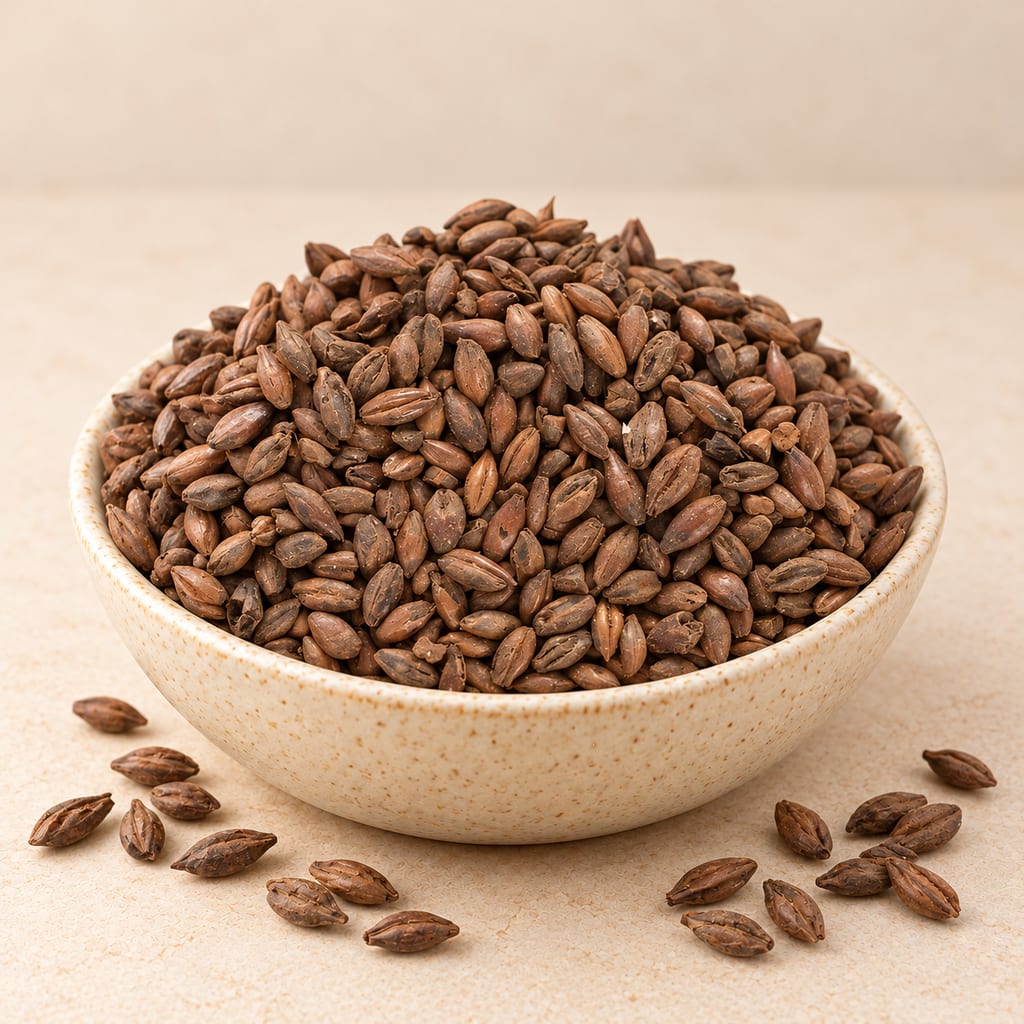
Chocolate malt is barley that has been malted and then roasted to a dark brown, used in porters, stouts and brown ales for colour and a bitter-cocoa, roasted-coffee flavour. It contains no cocoa.
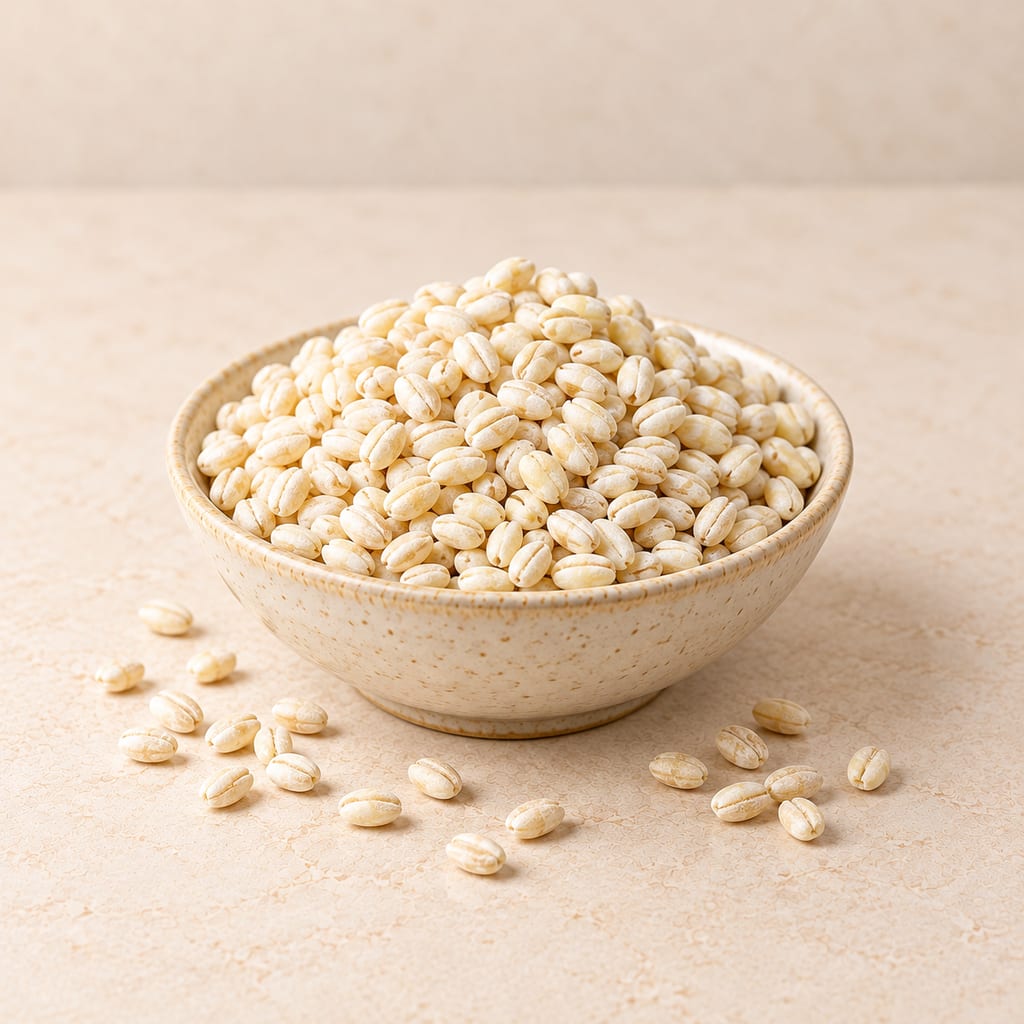
Barley is a hardy cereal, domesticated in the Middle East over 10,000 years ago, eaten whole, pearled or milled, malted for brewing, and grown with koji mold for barley miso.
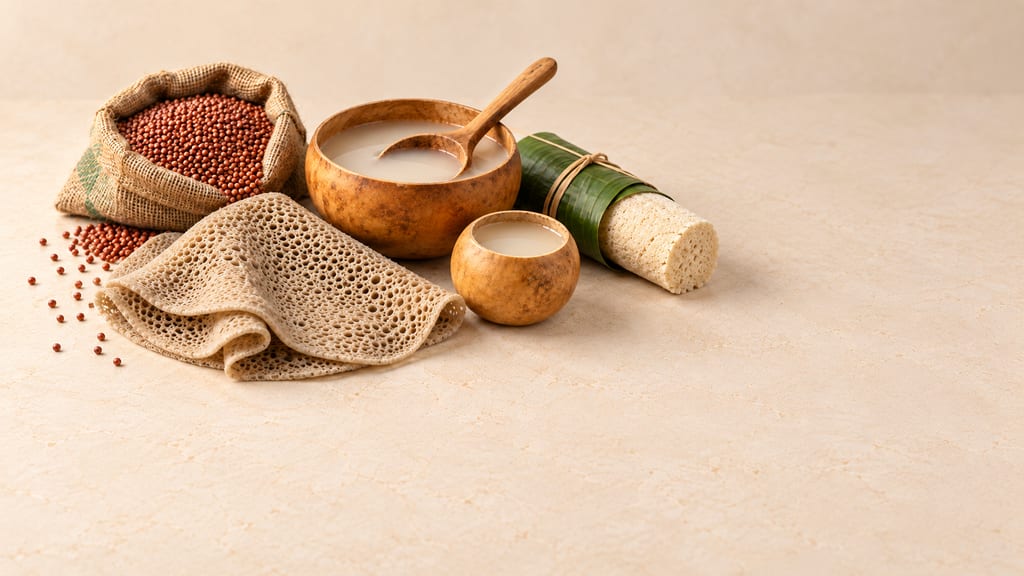
From sour breads and milk to savoury seeds, cassava staples and living beers, African fermentation follows the crop, the community and the work of transformation.
No community contributions have been published for this entry yet.
Sign in to contribute. Published comments and photos are free to read.
Cuneiform Digital Library Initiative; Penn MuseumIngredient context
OIP 011,016 (P229352): Old Babylonian lexical tabletA lexical tablet from Nippur, dated to the Old Babylonian period, approximately 1900–1600 BCE, names flour made from roasted barley. This documents a historical grain-food term, not a modern dark brewing roast.
Cited in: A grain transformed by fire; Beyond the stout glass; Keeping a dry grain in good condition
Simpsons MaltIngredient context
Roasted BarleyRoasted barley made from unmalted grain, its drum-roasting treatment, whole and milled forms, and the producer’s sensory comparison with black malt.
Cited in: A grain transformed by fire; Roasted barley and roasted malt; Colour, bitterness and the choice of roast; Its work in a mash; Keeping a dry grain in good condition
Viking MaltIngredient context
Craft Portfolio: Viking Roasted Barley, printed p36The producer’s roasted-barley identity, roast and flavour profile, production context and cool, dry, odour-free storage. Handling guidance includes grain dust and hot surfaces.
Cited in: Colour, bitterness and the choice of roast; Keeping a dry grain in good condition
Pao-Shui Wang and Yosito Sakurai; Nippon Shokuhin Kogyo Gakkaishi,1968Ingredient context
Studies on Flavor Components of Roasted Barley. Part I: The production of flavor substancesWang and Sakurai’s 1968 experiment connects barley browning with aroma development and reports carbon dioxide, carbonyl and sulphur-containing products during heating. Experimental roast conditions describe that study.
Cited in: What the roast does
Jasmina Lukinac and Marko Jukić; Plants,2022Ingredient context
Barley in the Production of Cereal-Based ProductsBarley identity, Hordeum vulgare, kernel anatomy, row and hull classifications, and changes during malting. The article synthesizes cereal research rather than identifying the cultivar in Dark Cellar.
Cited in: Barley before the roasting drum
University of Minnesota ExtensionIngredient context
Understanding grain qualityBarley quality and malting: cleaning, steeping, germination, modification, drying and the role of enzymes in mash starch conversion.
Cited in: Barley before the roasting drum; Roasted barley and roasted malt; Its work in a mash
Rūtelė Marčiulionytė et al.; Journal of the American Society of Brewing Chemists,2022Ingredient context
Roasted Malt for Distilling: Impact on Malt Whisky New Make Spirit Production and Aroma Volatile DevelopmentGeneral roasted-malt chemistry: Maillard reactions, caramelization, thermal breakdown, colour and aroma development. The original study concerns distilling malt; it does not measure the named recipe ingredient.
Cited in: What the roast does
Ministry of Education,Culture,Sports,Science and Technology,JapanIngredient context
Food16055: Mugi-cha (roasted barley tea), infusionJapanese mugi-cha: roasted hulled barley extracted in hot or cold water, including loose grain, teabags and ready-to-drink forms, with chilled summer use.
Cited in: A grain transformed by fire; Beyond the stout glass
American Homebrewers Association; Joel McGormleyIngredient context
2026 Official Big Brew Recipes: Dark Cellar Imperial Stout, p3Dark Cellar in the 2026 Big Brew publication:2 lb roasted barley,25 lb American two-row pale malt, separate specialty grains and all-grain/extract alternatives. The beer won gold in 2024; its roasted-barley producer and cultivar are unnamed.
Cited in: Barley before the roasting drum; Colour, bitterness and the choice of roast; Its work in a mash; A substantial addition to Dark Cellar; Keeping a dry grain in good condition
U.S.Food and Drug AdministrationIngredient context
Gluten and Food LabelingBarley is a gluten-containing cereal; the guidance explains gluten-related food labeling.
Cited in: Keeping a dry grain in good condition