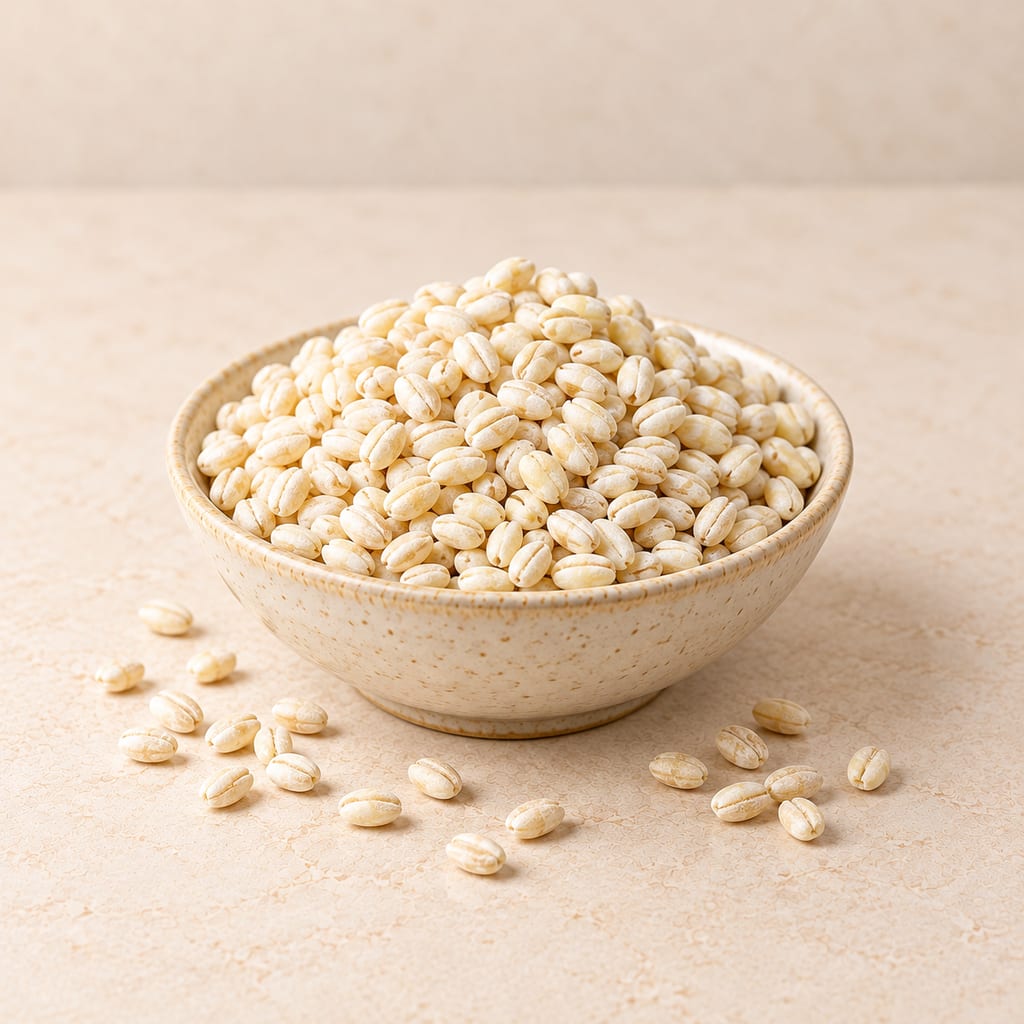
Barley
Barley is a hardy cereal, domesticated in the Middle East over 10,000 years ago, eaten whole, pearled or milled, malted for brewing, and grown with koji mold for barley miso.
 FermenteaWhere food goes to change
Built structures · Pits and cavities
underground grain silo · grain-storage pit · Iron Age grain silo
An underground grain-storage pit is a dug cavity for keeping dry grain, distinct from raised granaries and portable silos. Iron Age British examples are archaeological interpretations; experimental forms and results varied.
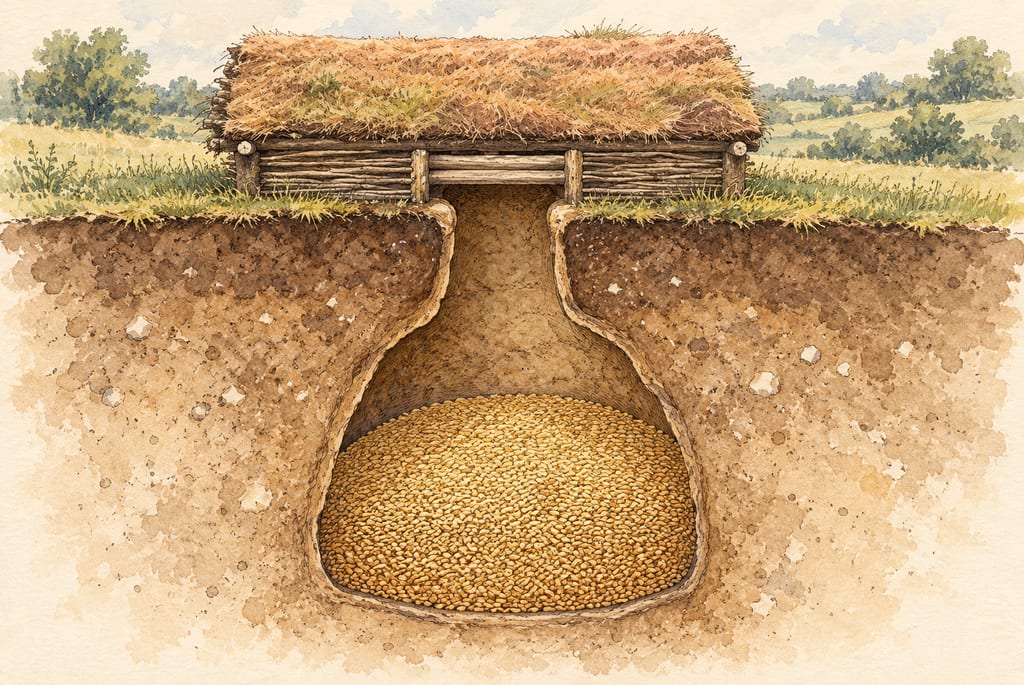
An underground grain-storage pit is a cavity excavated where it will be used. In Iron Age Britain, some settlement pits are interpreted as long-term stores for processed grain. Archaeologists distinguish these from four-post structures: raised stores could ventilate grain and keep it above ground, while deeper pits offered a different kind of bulk storage. The interpretation is strongest when a pit's form, context and finds fit together; not every archaeological pit was a silo.
The British evidence sits within a wider history of underground grain storage. Classical writers described pit or silo-like stores in other regions, but those accounts do not establish one design used across Britain and the Mediterranean. This page focuses on the British archaeological interpretation and the experiments that tested it.
At Butser Ancient Farm in Hampshire, researchers dug experimental pits to test whether grain could be kept underground. Hill, Lacey and Reynolds compared cylindrical and beehive-shaped examples, different sizes and internal treatments over four storage seasons. The study included pits with hazel basketwork or clay linings alongside unlined examples. Those are documented trial variants, not a recipe that every Iron Age pit followed.
Rainfall changed the result. Grain generally stored through winter when moisture stayed controlled, but wet seasons brought severe deterioration in some pits; grain near the pit edge could become much wetter and heat spontaneously. The study's result is not that a pit is automatically reliable: rain entry and damp grain could turn a promising store into a failure.
A separate Butser summary reports continuous successive reuse of experimental pits for seventeen years, with the final season's stored cereal still showing germination above 95 percent. Reynolds interpreted this as evidence that underground pits could serve as seed stores. It documents an experimental run at Little Butser, not an ancient service life or a guarantee for a modern pit.
Many British examples are described as narrowing at the mouth and widening lower down, sometimes called beehive-shaped. A narrower opening can make a closure easier, while a larger body holds grain below the exposed surface. But the experiments also tested cylindrical pits, and they do not show that one shape was necessary everywhere. Later comparative archaeology repeats Butser dimensions as experimental examples; those measurements belong to those trials, not to a standard Iron Age capacity.
The purpose was dry storage, not souring or fermenting grain. The pit was closed to limit rain and outside air. The source record does not establish one universal lining, sealing material, depth, capacity, or opening routine. It is safer to describe the operating principle than to invent a transferable construction design.
Because a pit is dug into one place, it belongs among builds rather than portable equipment. It is distinct from a household metal silo, which can be moved, and from an above-ground communal granary, which is a building with access spaces and storage compartments. Barley is linked as one documented storage use; the link does not claim every pit held barley.
These records are archaeological and experimental, not do-it-yourself guidance. Soil type, water movement, collapse and safe access depend on the site. The Butser trials document how rainfall affected grain in their pits; they do not establish a safe modern excavation or entry procedure.
A build is made where it stands: moving it means building it again.
An underground excavation is not a safe place to enter based on a historical description; confined-space atmospheres can be hazardous.
Hazard sourceDo not enter or excavate from this historical account; obtain site-specific assessment from competent professionals.
Control sourceThis entry is archaeological and experimental description, not a modern excavation plan.
Some British Iron Age settlement pits are interpreted as underground grain stores; this does not claim every pit had that use.
Experimental reconstructions in Hampshire tested an Iron Age storage hypothesis; they are modern trials, not ancient pits.
Barley is a hardy cereal, domesticated in the Middle East over 10,000 years ago, eaten whole, pearled or milled, malted for brewing, and grown with koji mold for barley miso.
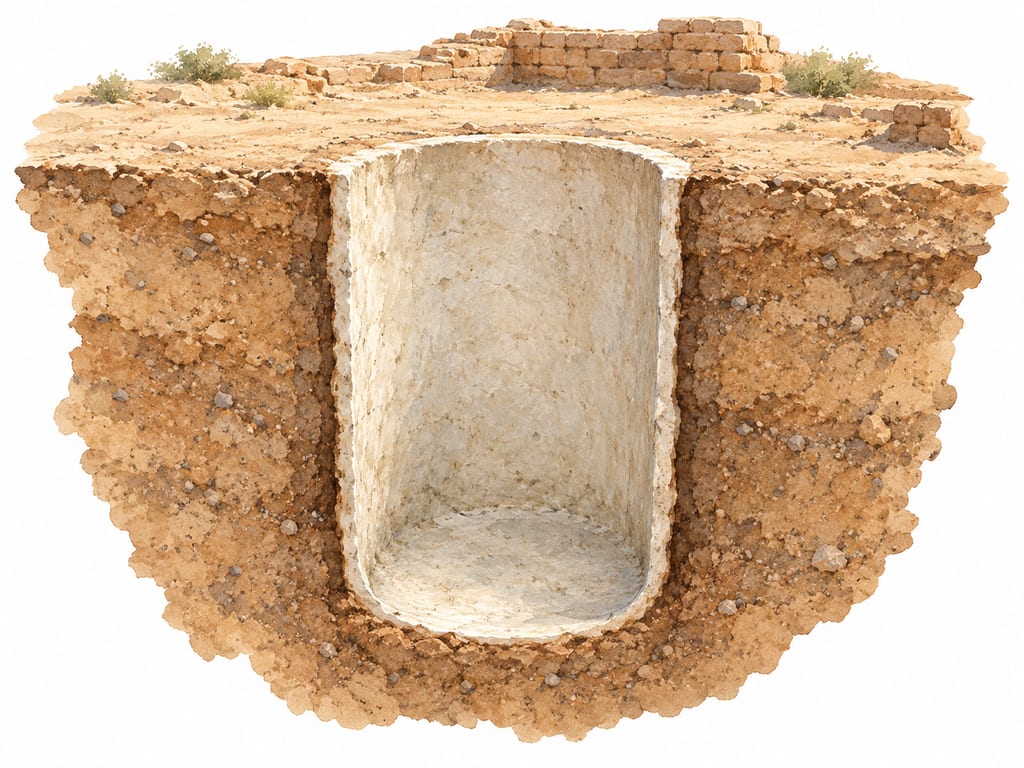
Kalibangan Period I preserves distinct lime-plastered pits and underground ovens. Grain storage is one interpretation of the pits; an earlier excavation account suggests water storage.
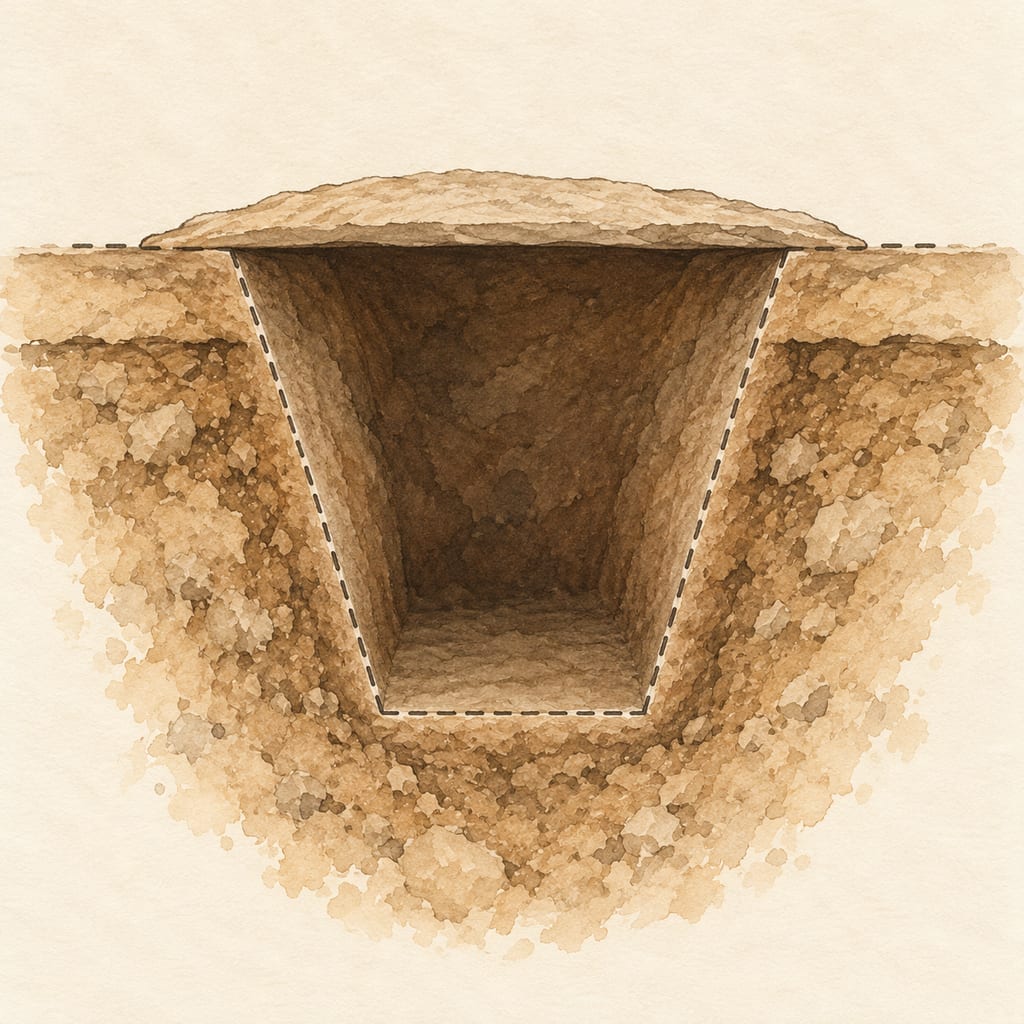
A madfan is a covered underground grain chamber documented in Yemen, excavated in rock or firm earth. Sources do not establish one universal shape, locality or performance.
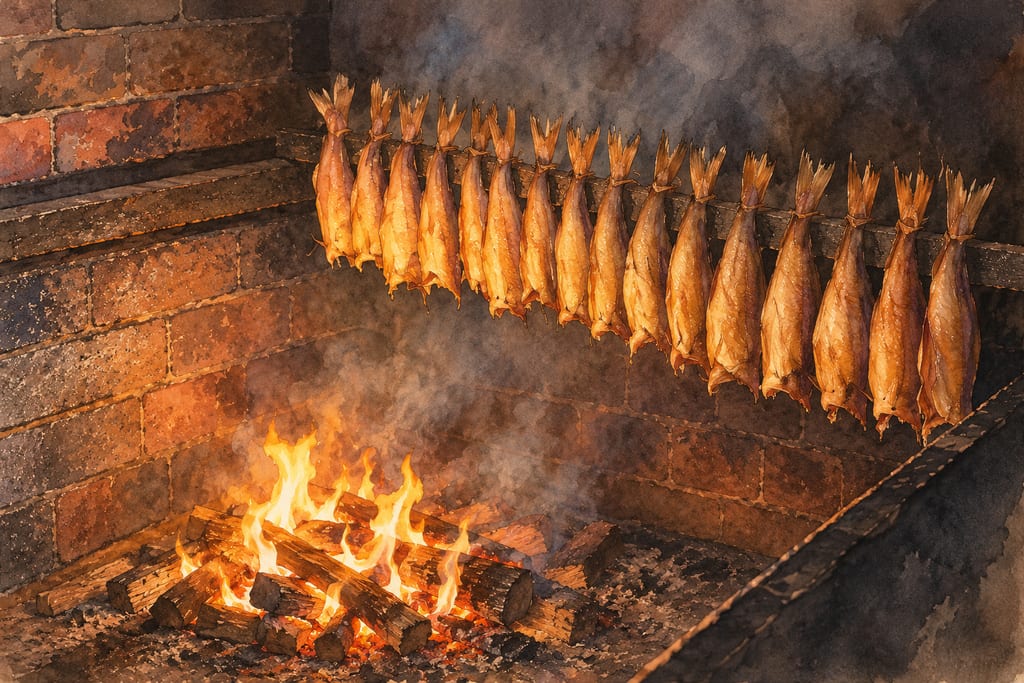
The Arbroath “barrel” is a hardwood-fired smoking pit with triangular rails and a cover. Its documented form belongs to the traditional hot-smoking of haddock around Arbroath and Auchmithie, Scotland.
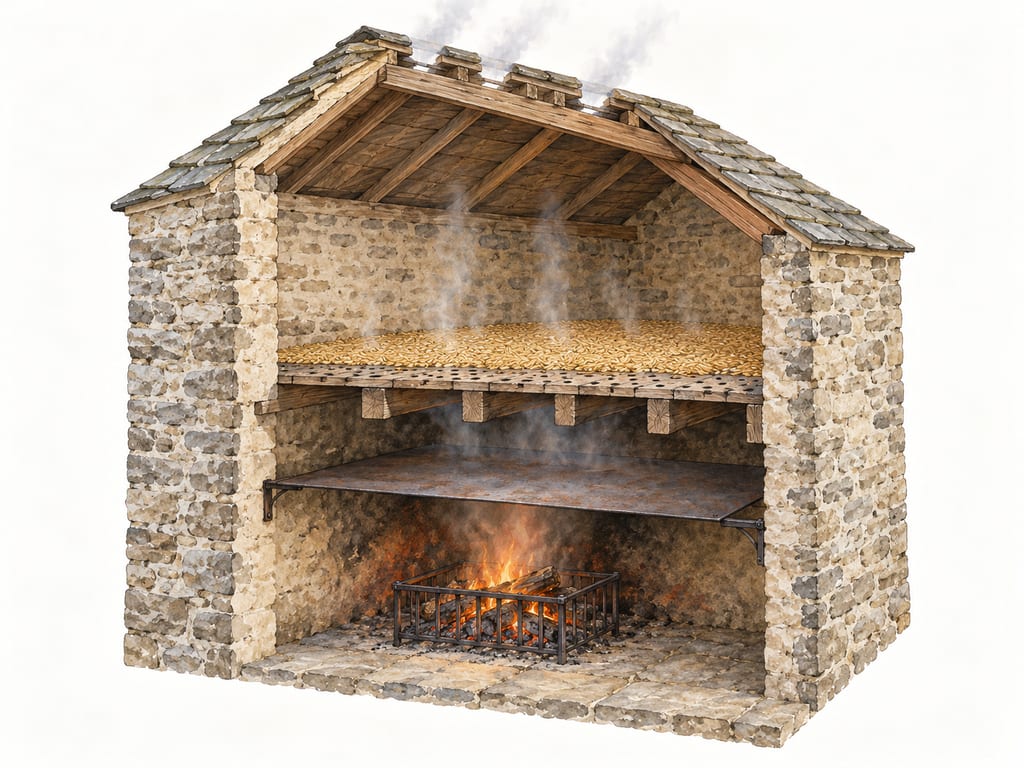
A reconstructed two-level grain-drying kiln at Acorn Bank Watermill in Temple Sowerby, Cumbria. A lower fire grate warms oats on a raised perforated floor; a baffle spreads heat, while smoke historically escaped through the roof ridge.
A surviving nineteenth-century stone smokehouse at Craster, Northumberland. Its tall, narrow rooms, hanging racks and roof vents belong to a commercial herring-curing works; the evidence describes this listed building, not a universal smoke
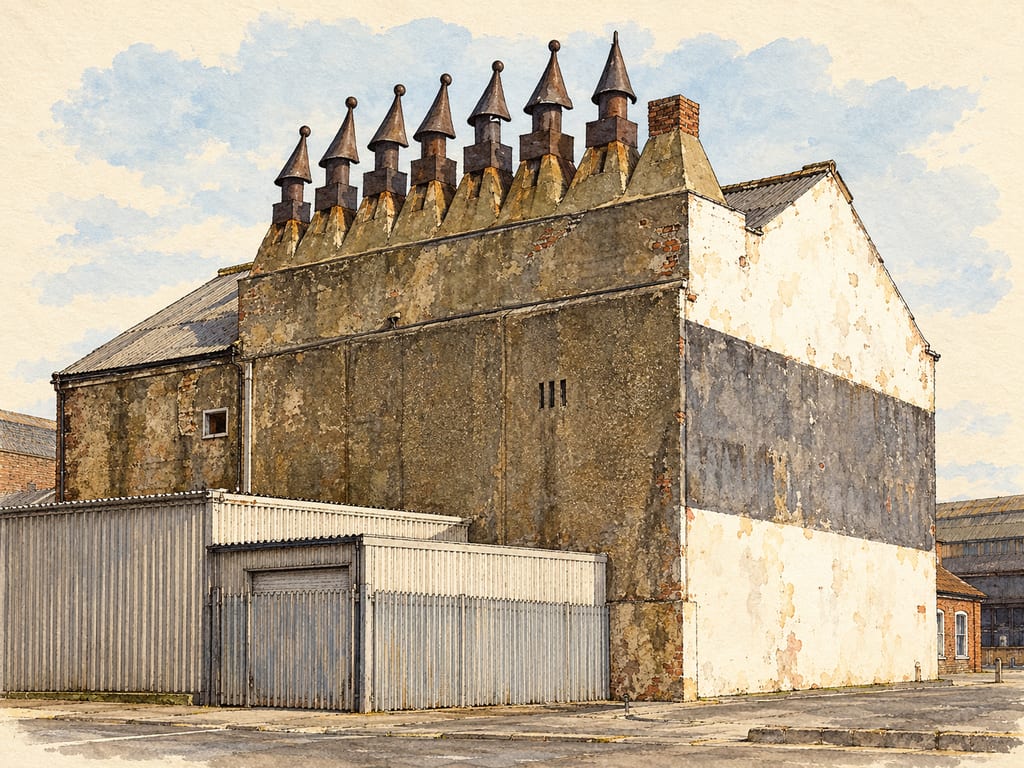
A brick chimney smokehouse associated with Grimsby's traditional fish-curing trade. Individual buildings varied; one working Alfred Enderby example documents tall chimney bays with smoke pits and speats for hanging fish.
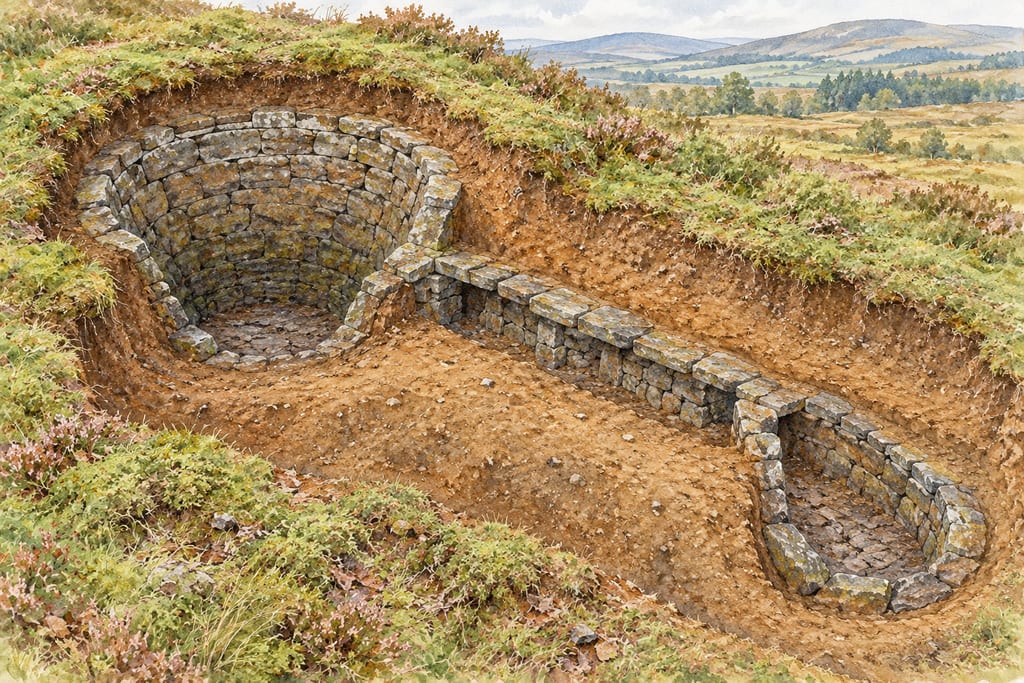
An excavated Scottish grain-drying kiln at Lockerbie Academy, with a deep stone-lined bowl connected by a flue to a separate firepit.
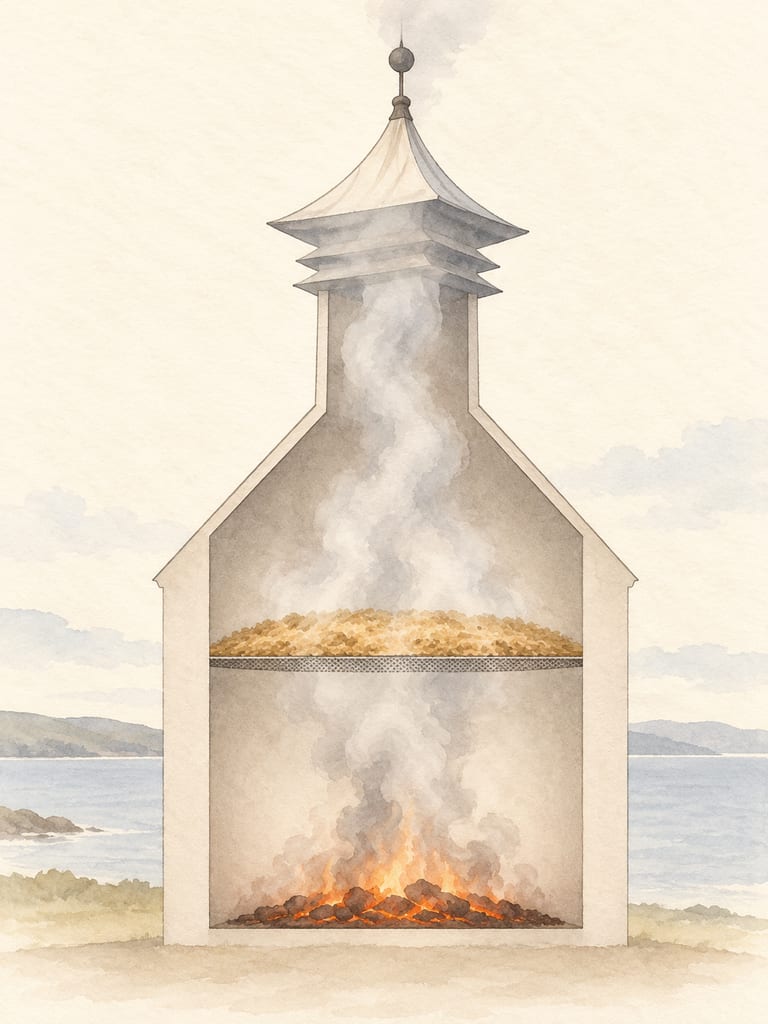
A fixed malt-drying kiln at Laphroaig on Islay, where peat smoke passes through damp malt before it is fully dried.
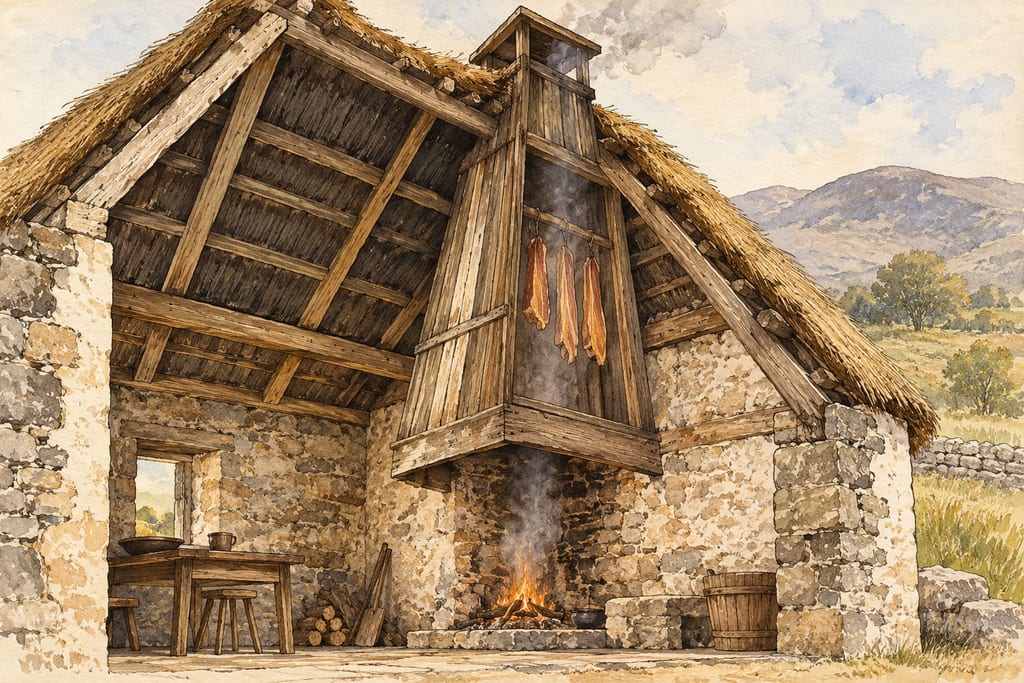
A domestic hearth chimney used to smoke cured meat in historical Scottish practice. It was part of the house, not a freestanding smokehouse, and the surviving chimney forms were varied.
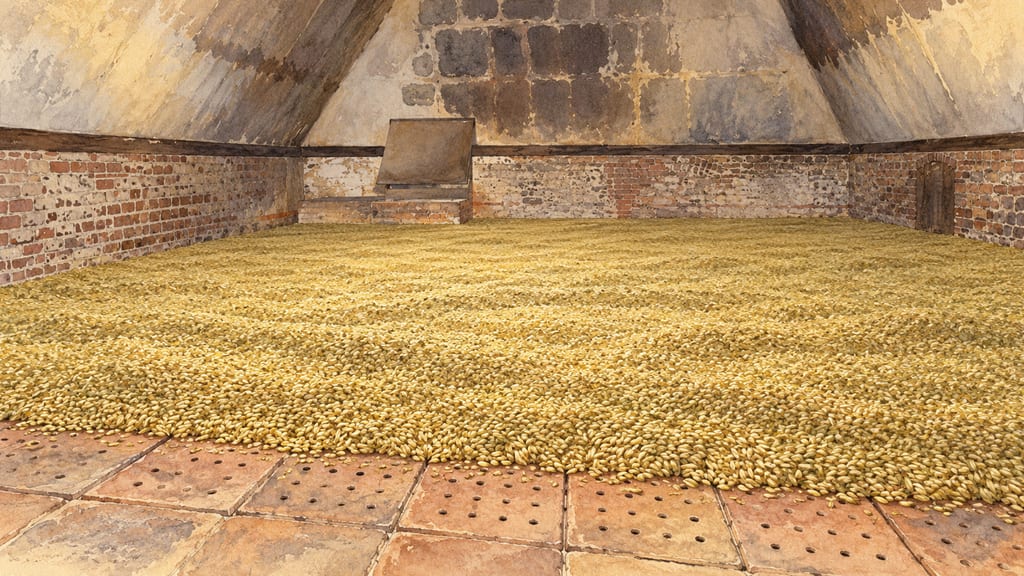
A Tuckers Maltings kiln floor in Newton Abbot: the 1900 complex grew from two kilns to four. A 2010 photo shows wire mesh; the original floor used perforated ceramic blocks.

Crisp battered white fish in warm corn tortillas with shredded cabbage, lime and fresh salsa. This home version draws on the Ensenada style without claiming to be a definitive historic formula.

Baked milk is an Eastern European preparation of milk held at high heat for hours until it turns cream-coloured with a cooked, mildly sweet flavour, without any fermentation.

A coarse South African farmhouse sausage of beef with pork or mutton fat, defined by its coriander seasoning and cooked fresh over coals rather than preserved.
A flood-season pit store described for Omagua communities along the Amazon: manioc tubers were buried before inundation and recovered as waters receded. Its shape and lining are not recorded.
A temporary, in-place earthen oven used to cook camas with heat retained by fire-heated stones. The dimensions described here belong to one Kalispel-supervised reconstruction, not a universal form.

Chuño negro is a source-documented Andean potato-preservation practice. This entry records producer tradition; it is not a validated household process for making potentially toxic bitter potatoes safe.

Cinavu is a Paiwan leaf-wrapped parcel built around millet or taro, meat and locally gathered leaves. It belongs to a food culture of harvest, hospitality and shared work, with village recipes differing in both filling and cooking time.

A coconut chutney whose ground base is finished with a separate oil tempering of mustard, urad dal, curry leaves and spices; the author pairs it with South Indian breakfast foods and snacks.

At North Abydos in Egypt, a fixed early Dynastic brewery comprised parallel semi-subterranean installations with rows of ceramic mash vats; excavation reports revise their number, scale and estimated batch capacity.

Ají amarillo is the orange-yellow Peruvian chilli cultivar group of Capsicum baccatum, used to colour and season huancaína sauce and ají de gallina. Published heat estimates do not establish one range for the named cultivar.

Toasted almonds are whole sweet almond kernels dry-roasted until golden to brown. Heat replaces their marzipan note with a roasted, nutty one; they thicken and flavour romesco.

Kodiak salmon, halibut and cod cut as seg'aq and hung on an initaq rack to become tamuuq, with kac'amaasaq and kupcuunaq named as different results.

Aniseed is the dried ripe fruit of Pimpinella anisum, an aromatic Apiaceae spice commonly called a seed. It adds a sweet, warm aroma to breads such as Moroccan krachel and South African mosbolletjies, and is distinct from star anise.

A fixed Late Chalcolithic installation in Areni-1 cave combined a shallow clay pressing basin with a large jar set into the cave floor and storage vessels nearby.

Ripe avocado flesh is the soft, buttery, fat-rich pulp of Persea americana, eaten raw. It is low in acid, so it is a fresh ingredient that needs care in chilled dishes.

A portable dome and pan used over a hearth, with embers on the lid and heat from below. Regional peka and saç forms share this principle while differing in materials, pan shape and how the food is cooked.
No community contributions have been published for this entry yet.
Sign in to contribute. Published comments and photos are free to read.
Journal of Stored Products Research, 19(4), 163–171Experimental study · Storage conditions · Pit shape · Materials
Storage of Barley Grain in Iron Age Type Underground PitsFour-season study of experimental underground grain pits at Butser Ancient Farm in Hampshire.
Compared cylindrical and beehive-shaped pits, sizes, linings and surface treatments.
Rain-driven moisture increase caused poor storage outcomes in some wet trials; results do not establish a universal pit design.
Cited in: A store made below ground; What the experiments tested; Shape, closure and uncertainty; A fixed structure, not a portable silo
Butser Ancient Farm Archive 1973–2007Experimental history · Reuse · Germination
Grain Storage: Storage of Grain in Underground SilosThe archive summary reports seventeen years of continuous successive use of experimental pits and germination above 95 percent in the final year.
The seed-store interpretation is attributed to Peter Reynolds.
Cited in: What the experiments tested; A fixed structure, not a portable silo
Butser Ancient Farm Archive 1973–2007Image reference · Experimental context
The Demonstration SiteThe page identifies an image of an experimental underground grain pit with roof protection and distinguishes it from a separate haystack example.
The archive does not state the photograph's exact photographer or reuse licence.
Journal of Field Archaeology, 46(4), 210–222Comparative archaeology · Dimensions
Voluminous Evidence for an Elusive Period: Storage Pits and Surplus from Middle Chalcolithic AnatoliaThe paper discusses challenges of identifying storage pits and repeats Butser trial dimensions as experimental measurements, not universal ancient specifications.
Cited in: Shape, closure and uncertainty
LacusCurtius, University of ChicagoArchaeology · Historical context
Grain Storage in Iron Age BritainDistinguishes four-post elevated granaries from underground pits interpreted as long-term grain storage in Iron Age Britain.
Explains that pit function is archaeological interpretation supported by context and examples such as Danebury.
Cited in: A store made below ground; Shape, closure and uncertainty
UK Health and Safety ExecutiveSafety
Confined spaces: IntroductionHSE identifies hazardous atmospheres, including oxygen deficiency, among confined-space risks; cited only for a general caution against treating a historical pit as safe to enter.
Cited in: A fixed structure, not a portable silo