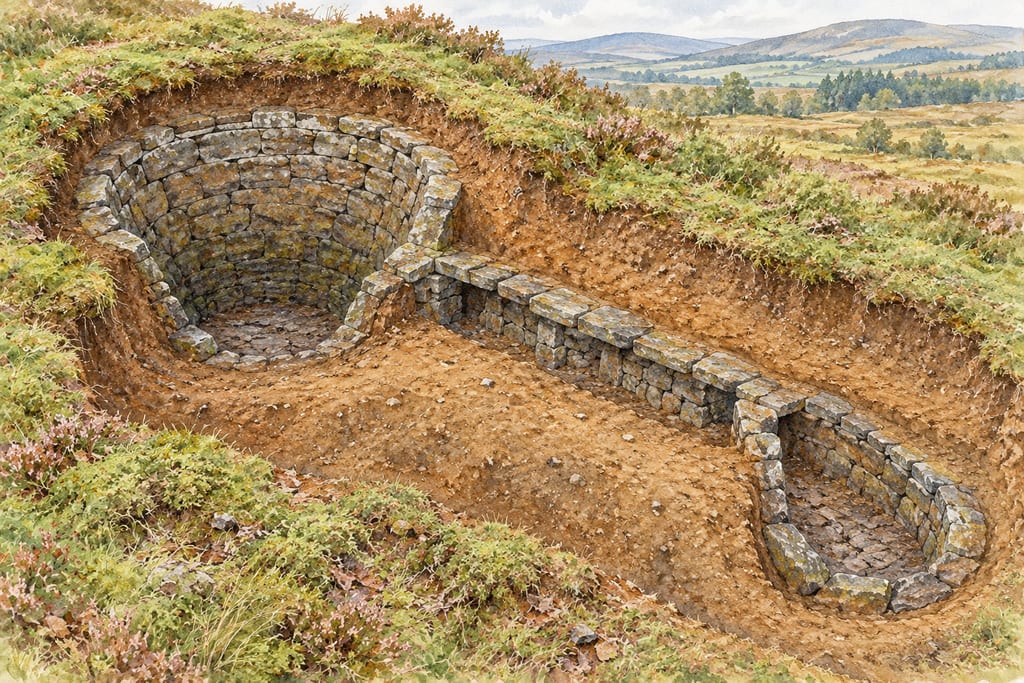
Lockerbie Academy corn-drying kiln
An excavated Scottish grain-drying kiln at Lockerbie Academy, with a deep stone-lined bowl connected by a flue to a separate firepit.
 FermenteaWhere food goes to change
Built structures · Place · Drying kilns and dryers
A reconstructed two-level grain-drying kiln at Acorn Bank Watermill in Temple Sowerby, Cumbria. A lower fire grate warms oats on a raised perforated floor; a baffle spreads heat, while smoke historically escaped through the roof ridge.
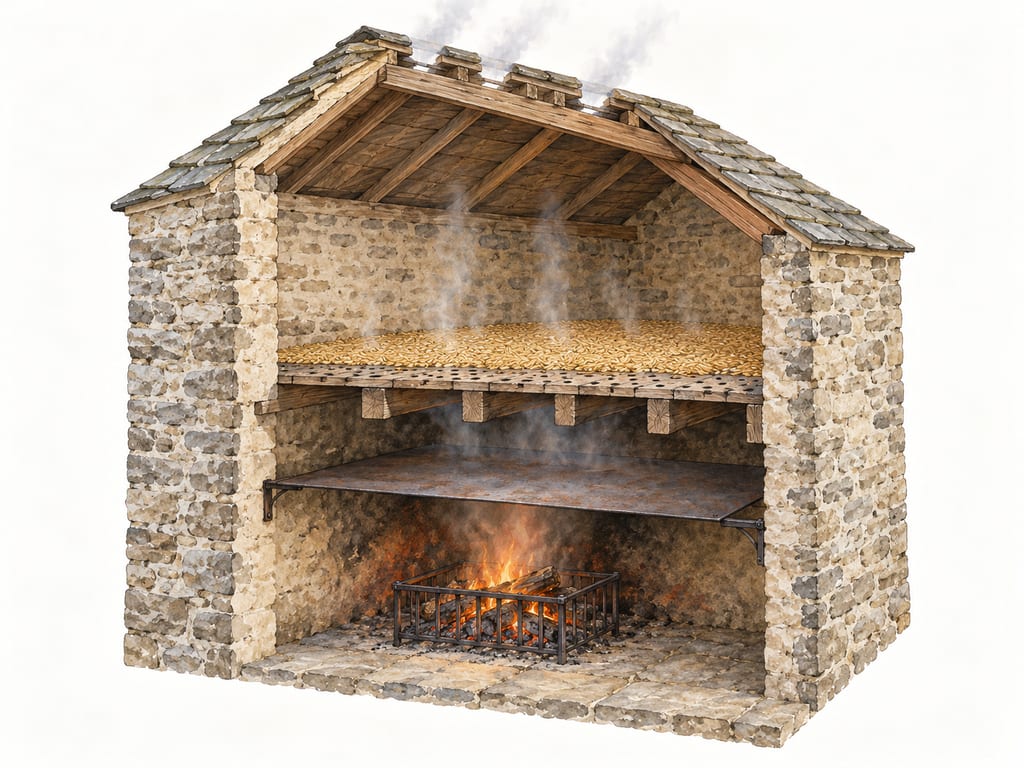
Acorn Bank Watermill Trust describes a reconstructed two-storey kiln: a fire grate on the lower level and a drying floor above. A baffle plate hangs over the fire to spread heat and prevent a hot spot. There was no chimney; smoke left through openings in the roof ridge. The upper floor was made from perforated tiles, supported on crossbeams. The Trust describes the supports as stone and slate, later iron, and notes that clay tiles were also superseded by iron ones at Acorn Bank.
The source gives an approximate tile size of 12 inches (about 30 cm) square. It says early clay tiles had holes large enough that horsehair cloth was needed to keep grain from falling through; later holes were small enough to omit the cloth.
The Acorn Bank account places the kiln in a mill setting where oats could arrive damp and need drying before milling. Oats were spread a few inches deep across the floor and regularly turned to even the drying and avoid scorching the grain below. The miller checked dryness by biting a kernel; the dried oats were then swept off the floor for milling.
This is a grain-drying account. It does not describe freekeh's field-fire roasting of cut green wheat, nor does it document a universal grain-roasting kiln or a household construction plan.
The documented example stands at Acorn Bank Watermill, at Temple Sowerby near Penrith in Cumbria, England. The Trust says the kiln was reconstructed to its original plan using new materials where needed. Its page does not date the original kiln or describe its foundations, overall footprint, full building materials, construction sequence or fire-safety controls.
Scottish archaeological corn-drying kilns are related by purpose but show distinct forms: excavated examples at Abercairny and Capo include round bowls, short flues and hillside siting. Their details should not be transferred to the Acorn Bank reconstruction.
This page describes the Acorn Bank Watermill Trust's reconstructed kiln and its reported drying practice. It is not a design, building or operating specification. No exact capacity, foundation detail, load rating, fuel choice or safety control is supplied by the cited account.
Acorn Bank Watermill Trust says the kiln was reconstructed to its original plan using new materials where needed, but supplies no date for its original construction. The Scottish archaeological examples cited separately do not date this Cumbria kiln.
A build is made where it stands: moving it means building it again.
The documented kiln has a lower-level fire grate beneath its drying floor; the source supplies no fire-control design.
Hazard sourceDescriptive heritage account only; the cited source provides no construction specification or fire-safety instructions.
Coordinates identify the mill complex to approximately 10 metres; the kiln is attached to the mill and is not separately surveyed here.
An excavated Scottish grain-drying kiln at Lockerbie Academy, with a deep stone-lined bowl connected by a flue to a separate firepit.
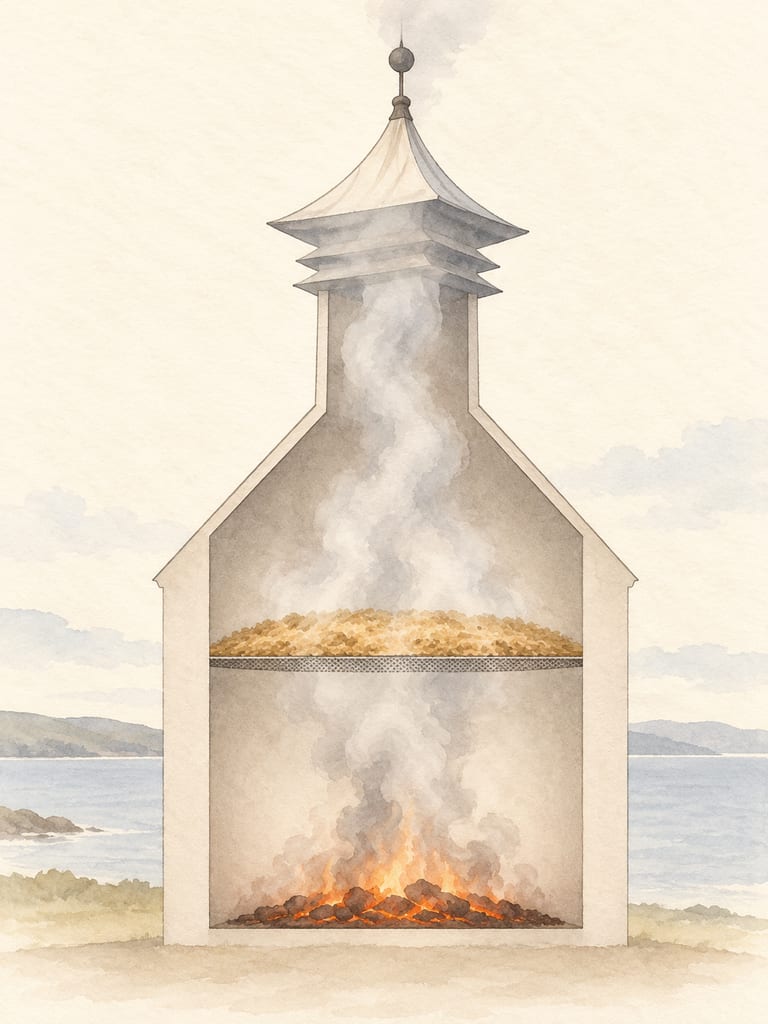
A fixed malt-drying kiln at Laphroaig on Islay, where peat smoke passes through damp malt before it is fully dried.
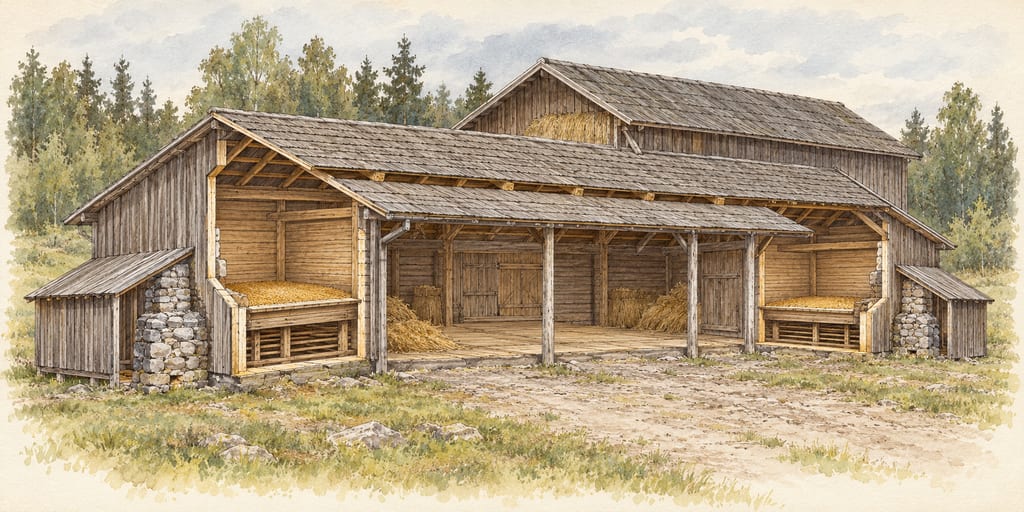
Ypäjä’s 1896 paired riihi has two grain-drying rooms flanking a central threshing room, with each stone stove heated from outside the building.
A surviving nineteenth-century stone smokehouse at Craster, Northumberland. Its tall, narrow rooms, hanging racks and roof vents belong to a commercial herring-curing works; the evidence describes this listed building, not a universal smoke
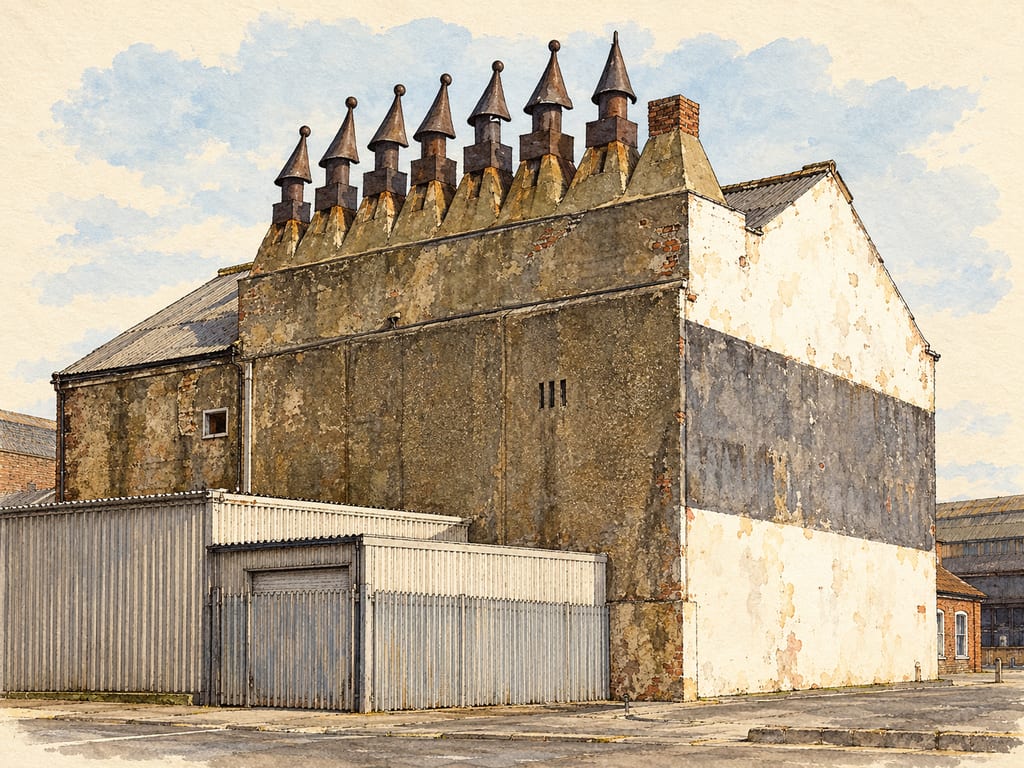
A brick chimney smokehouse associated with Grimsby's traditional fish-curing trade. Individual buildings varied; one working Alfred Enderby example documents tall chimney bays with smoke pits and speats for hanging fish.
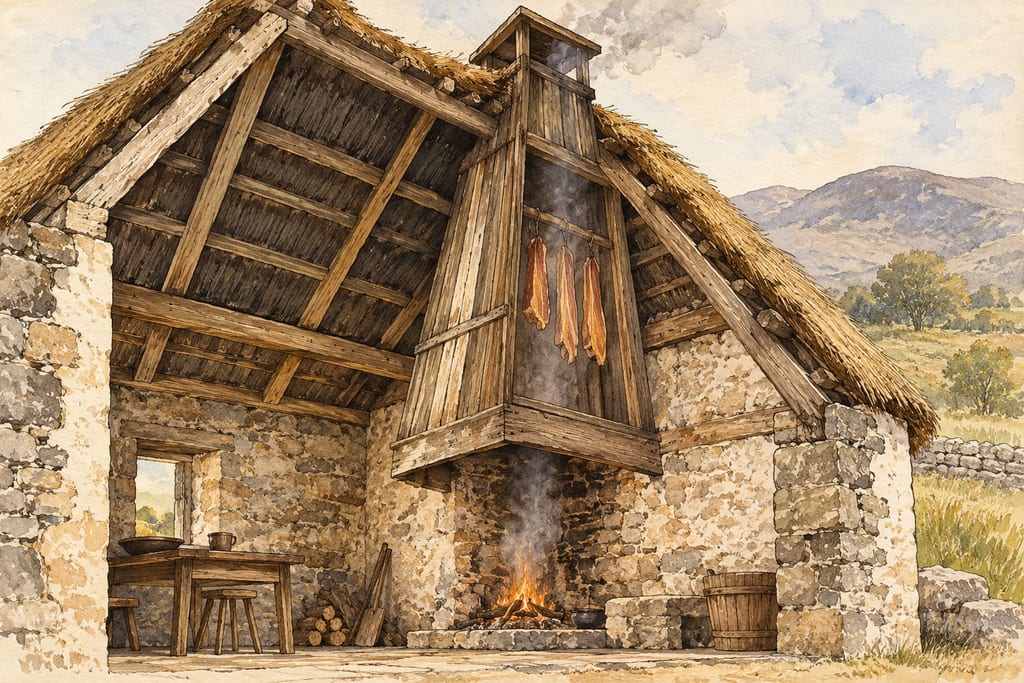
A domestic hearth chimney used to smoke cured meat in historical Scottish practice. It was part of the house, not a freestanding smokehouse, and the surviving chimney forms were varied.
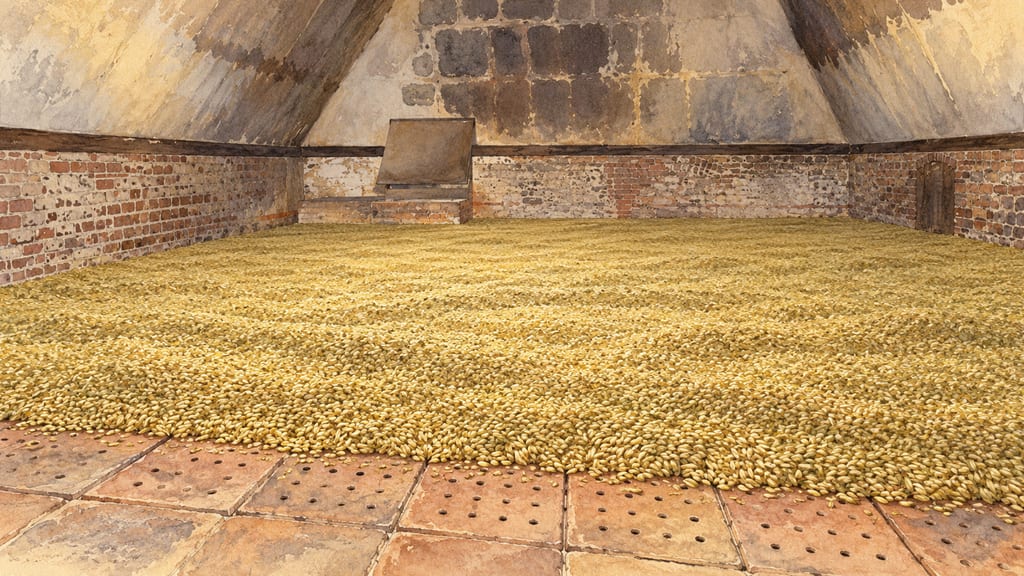
A Tuckers Maltings kiln floor in Newton Abbot: the 1900 complex grew from two kilns to four. A 2010 photo shows wire mesh; the original floor used perforated ceramic blocks.
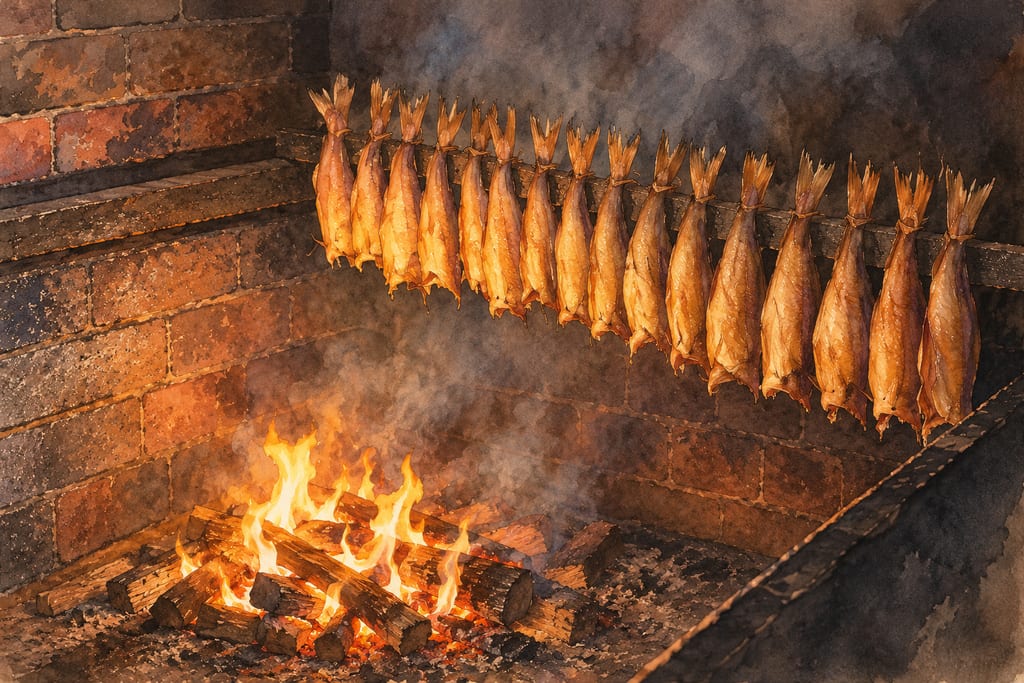
The Arbroath “barrel” is a hardwood-fired smoking pit with triangular rails and a cover. Its documented form belongs to the traditional hot-smoking of haddock around Arbroath and Auchmithie, Scotland.
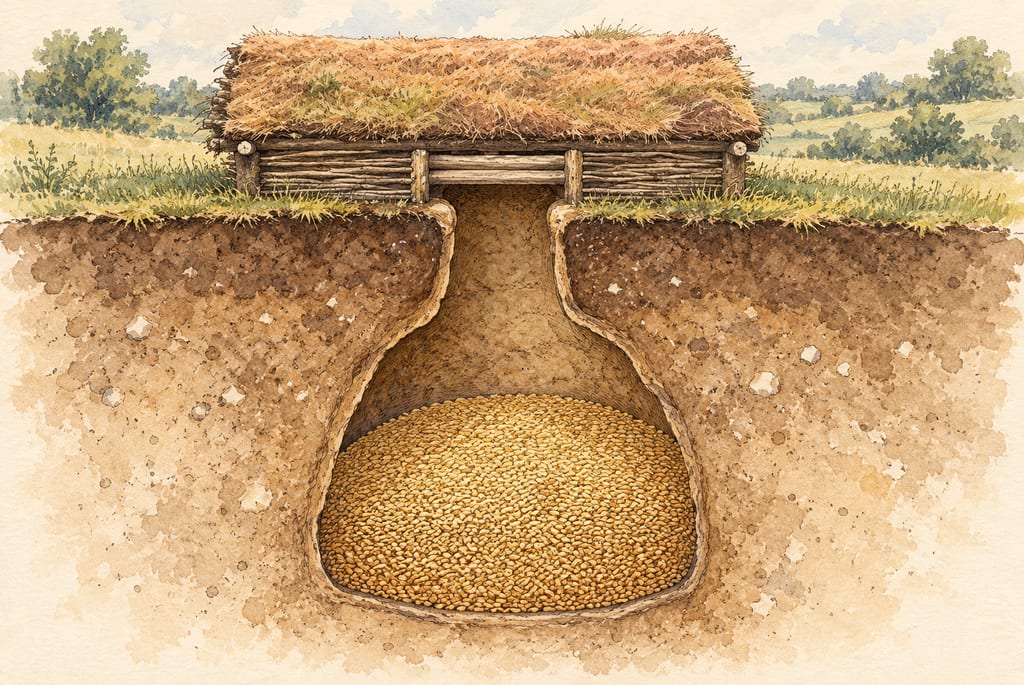
An underground grain-storage pit is a dug cavity for keeping dry grain, distinct from raised granaries and portable silos. Iron Age British examples are archaeological interpretations; experimental forms and results varied.
No community contributions have been published for this entry yet.
Sign in to contribute. Published comments and photos are free to read.
Acorn Bank Watermill TrustStructure · Process · Materials
Drying KilnAcorn Bank's kiln is reconstructed to its original plan using new materials where needed.
The kiln is a two-storey building with a lower fire grate and an upper drying floor; heat is spread by a baffle and smoke historically left through roof-ridge openings, not a chimney.
The floor used perforated tiles supported on stone and slate crossbeams, later iron; early clay tiles had larger holes, later iron tiles were also used at Acorn Bank.
Damp oats were spread a few inches deep, turned regularly, judged dry by biting and swept from the floor for milling.
Cited in: A two-level kiln at Acorn Bank; Drying oats before milling; A site-specific reconstruction; Limits of this account
National TrustGeography
Acorn BankThe National Trust gives the Acorn Bank address as Temple Sowerby, near Penrith, Cumbria, CA10 1SP.
Cited in: A site-specific reconstruction
Proceedings of the Society of Antiquaries of ScotlandComparative form · History
Medieval corn-drying kilns at Capo, Kincardineshire and Abercairny, PerthshireThe excavated Scottish examples at Abercairny and Capo were separate round kiln-bowls with short flues sunk into hillsides.
Grain-drying used heat conducted from a fire through a flue to a raised floor; the article reports dated examples at Abercairny and Capo but does not date the Acorn Bank kiln.
Cited in: A site-specific reconstruction
The Traditional Cornmillers GuildSite context
Acorn Bank WatermillThe Guild identifies the mill as an 1820s country mill and describes a partially restored drying kiln; the mill date is not assigned to the kiln in this page.
LaphroaigComparison
How to Make Whisky: Step-by-Step GuideLaphroaig documents peat smoke passing upward through a perforated drying floor for malt; this is a structural comparison only, not the Acorn Bank kiln's crop, fuel, location or date.
Historic EnglandGeography
Acorn Bank Mill with associated weirThe listed mill and attached kiln are at Acorn Bank; the mill listing gives national grid reference NY6143728363.
Geograph Britain and IrelandGeography
Acorn Bank Mill - along the launderA photograph identifies Acorn Bank Mill at 54.64886, -2.59909 to 10 m grid precision; this is the mill complex, not a surveyed point within the kiln.