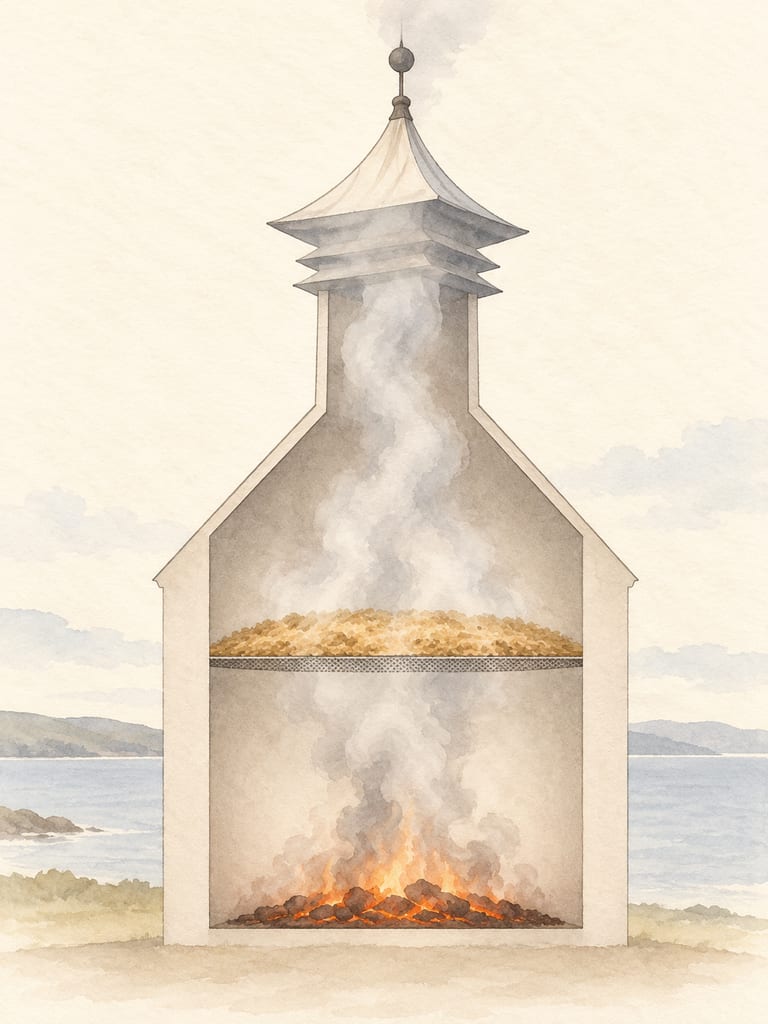
Peat-fired malt kiln
A fixed malt-drying kiln at Laphroaig on Islay, where peat smoke passes through damp malt before it is fully dried.
 FermenteaWhere food goes to change
Built structures · Smokehouses and smoke rooms
household bacon chimney · hanging chimney · hanging lumb · hingin' lum
A domestic hearth chimney used to smoke cured meat in historical Scottish practice. It was part of the house, not a freestanding smokehouse, and the surviving chimney forms were varied.
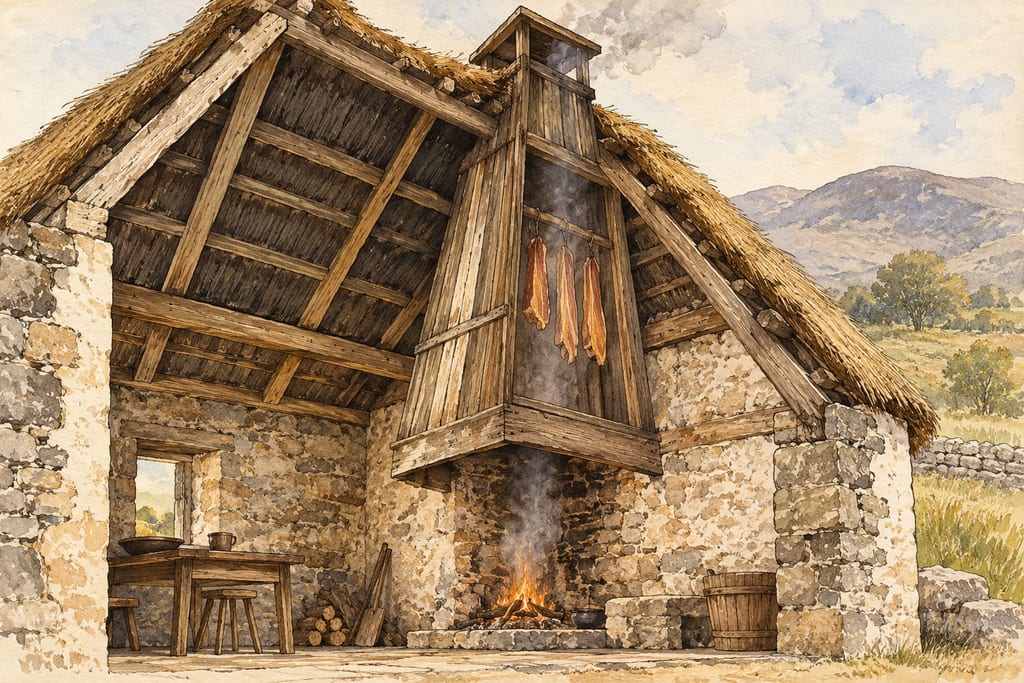
This build is a household chimney used as part of meat preservation, rather than a separate smokehouse designed only for curing. Scottish building historian Bruce Walker reproduces an early-eighteenth-century bacon recipe that calls for a large chimney, a top arranged to let smoke out while keeping rain off, and meat hung high with space around each piece. The recipe describes the use of a chimney; it is not an architectural plan, and it does not establish that every domestic chimney was suitable for smoking.
Walker also recounts Robert Henderson, a Dumfriesshire farmer who carried flitches and hams to farmhouses and hung them in their chimneys to dry. He found the arrangement commercially troublesome when meat remained hanging while awaiting orders and became over-dry. Walker reports that Henderson had set up smoke rooms before the end of the eighteenth century, while other curers still used farm chimneys in 1811. These details show the chimney's place in a changing household and small-scale curing economy, without making every account the same process.
The Scottish term “lum” means chimney. Historic Environment Scotland describes a hanging lumb in some eighteenth-century rural properties as a flue built against a masonry wall in timber and clay. Walker's survey records broader variation among canopy chimneys: timber frames, wattle and straw mat with a finish of cow sharn, clay or lime, and structures made entirely of timber with planked sides. His article discusses different support arrangements rather than a single standard design.
The sources therefore support a family of domestic smoke paths, not one universal bacon chimney. Walker cautions that not all canopy chimneys necessarily had provision for hanging meat or fish. This page uses “hanging chimney” as a useful related name while keeping the specific evidence—the chimney smoking of bacon—separate from assumptions about the structure of any one surviving example. No measured footprint, height, capacity or complete build sequence is supplied.
The National Trust for Scotland says the hanging lum in Hugh Miller's early-eighteenth-century birthplace cottage at Cromarty was once used to smoke and preserve fish. That is direct evidence for another food use in a particular household, not proof that this cottage followed the bacon recipe. A licensed photograph by Nigel Corby shows a close view of the hanging lum at Auchtavan in Aberdeenshire: timber boards form the visible canopy beside the masonry. The photograph documents that chimney's form, but not bacon smoking there.
Taken together, the sources place the documented practice in Scotland and show how an ordinary hearth could connect cooking, heating and smoke-based preservation. The examples come from distinct houses and evidence types; no single cross-section should be read as the universal form.
The historical recipe is evidence of past practice, not a present-day guide. It supplies no validated modern food-safety controls and does not justify smoking food in an ordinary household flue. Historic Environment Scotland advises that an in-use original fireplace flue be swept at least once a year to help reduce chimney-fire risk. The sources give no universal dimensions, fuel specification or construction instructions for recreating this build. No complete construction tool inventory is identified in the historical building survey.
Bruce Walker traces the early documentary evidence to a bacon recipe in Lady Strathmore's Recipes, a collection dated 1692–1746. He also records Robert Henderson, a Dumfriesshire farmer and bacon curer, describing his late-eighteenth-century practice of taking flitches and hams to farmhouses to hang in their chimneys; Walker reports that other curers still did so in 1811. The record documents use over time, not a single standard chimney design.
A build is made where it stands: moving it means building it again.
Historic Environment Scotland says in-use original flues should be swept at least annually to help reduce chimney-fire risk.
Hazard sourceFor an in-use original fireplace, follow Historic Environment Scotland's advice to have the flue swept at least once a year.
Control sourceThe historical smoking account is not an instruction for using a modern household flue to smoke food.
Walker documents Scottish meat curers using household chimneys; Historic Environment Scotland and the National Trust for Scotland describe distinct Scottish hanging-lumb examples. No single site is claimed for the bacon recipe.
A fixed malt-drying kiln at Laphroaig on Islay, where peat smoke passes through damp malt before it is fully dried.
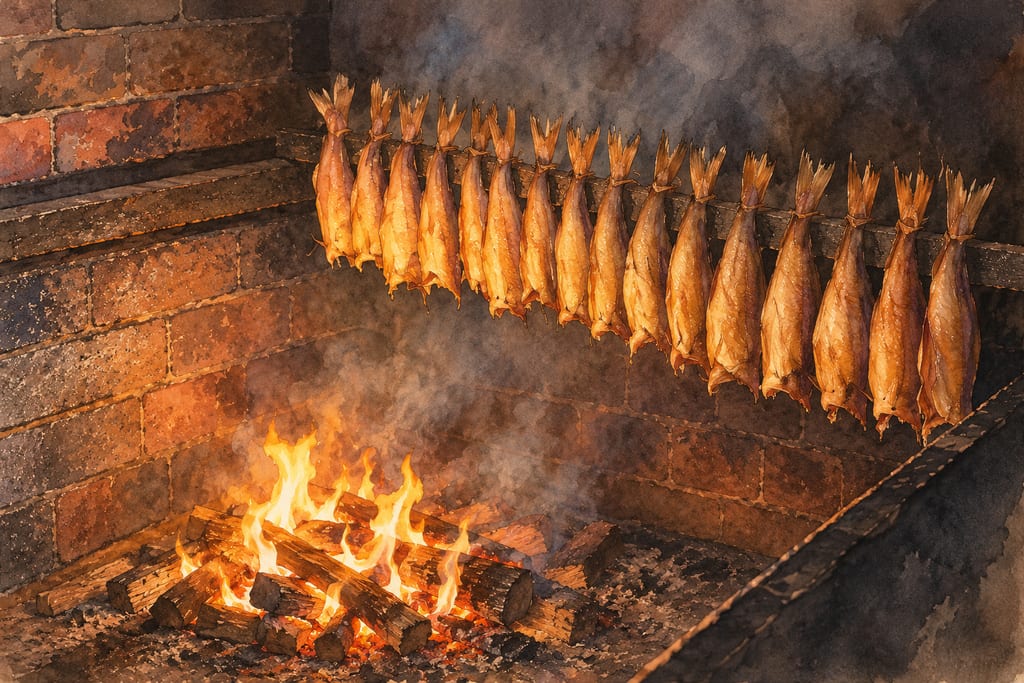
The Arbroath “barrel” is a hardwood-fired smoking pit with triangular rails and a cover. Its documented form belongs to the traditional hot-smoking of haddock around Arbroath and Auchmithie, Scotland.

A gelling polysaccharide extracted from red seaweeds, sold as kanten strips or powder; it sets firm at a low concentration and stays solid until about 85 °C.

A Dominican table and seasoning condiment of sour orange juice, mixed with lime and salt and bottled raw; garlic, oregano or a hot pepper may be added for meat or a spicier bottle.

Cicerbita alpina is an alpine perennial whose tender shoots and leaves have been eaten raw or cooked. Sámi milk preparations and modern Carnian dishes are distinct uses, with serious identification and preservation limits.

Japanese skipjack tuna cooked, then repeatedly smoked and dried over a wood fire by the hand-fired tebiyama method into a hard block for shaving into dashi: the first stage of katsuobushi.

A Swedish-style spirit vinegar made by fermenting neutral alcohol with live vinegar bacteria, with a separate guide to commercial ättika strengths.

A yeast-raised wheat ring shaped from a firm dough, briefly boiled and baked. This source-batch formula gives a gently malted crust and a chewy crumb.

A warm dip of garlic, anchovy and olive oil, often enriched with butter, that Piedmont serves over a flame with raw and cooked vegetables and bread.

Bechamel is a white sauce of milk thickened with a butter and flour roux, one of the French mother sauces, and the base from which Mornay and other cheese and cream sauces are made.
No community contributions have been published for this entry yet.
Sign in to contribute. Published comments and photos are free to read.
Scottish Vernacular Buildings Working GroupHistory · Form · Method · Construction
The hanging chimney in Scottish meat preservation, Vernacular Building 9 (1985), pp. 40–53Walker reproduces a recipe in Lady Strathmore's Recipes (1692–1746) for smoking bacon in a large chimney, with the opening protected from rain and meat hung high with smoke circulation around it.
Walker describes several canopy-chimney forms and construction materials, and cautions that not every canopy chimney necessarily had provision for hanging meat or fish.
Walker recounts Robert Henderson's late-eighteenth-century Dumfriesshire bacon-curing practice of hanging meat in farm chimneys and reports continuing use by other curers in 1811.
Cited in: A chimney used for curing; The hanging lum and its varied forms; Limits and care
Historic Environment Scotland, Engine ShedForm · Materials · Safety
Chimneys and fluesSmall eighteenth-century rural properties often had a hanging lumb whose flue was built against a masonry wall in timber and clay.
Historic Environment Scotland advises annual sweeping of an in-use original flue to reduce chimney-fire risk.
Cited in: The hanging lum and its varied forms; Scottish examples, not one recipe; Limits and care
National Trust for ScotlandHistory · Use
Fossils and forefathers (geology rocks!)The early-eighteenth-century Hugh Miller Birthplace Cottage at Cromarty has a hanging lum once used to smoke and preserve fish.
Cited in: Scottish examples, not one recipe
Wikimedia Commons, from GeographVisual reference · Form · Materials
Interior of the cottage at Auchtavan - 2 - Geograph Britain and Ireland - 1466981.jpgThe photograph, taken in 2009, is a close view of the hanging lum at Auchtavan cottage in Aberdeenshire; it shows a tall timber-boarded canopy against the cottage masonry.
The photograph is licensed CC BY-SA 2.0; it is an example of a related surviving hanging-lum form, not evidence that bacon was smoked at this cottage.
Cited in: Scottish examples, not one recipe