← Equipment

Built structures · Pits and cavities

Yemeni Madfan: Underground Grain Store

madāfin · Yemeni underground grain pit · Yemeni grain chamber

Loading ratings…

A madfan is a covered underground grain chamber documented in Yemen, excavated in rock or firm earth. Sources do not establish one universal shape, locality or performance.

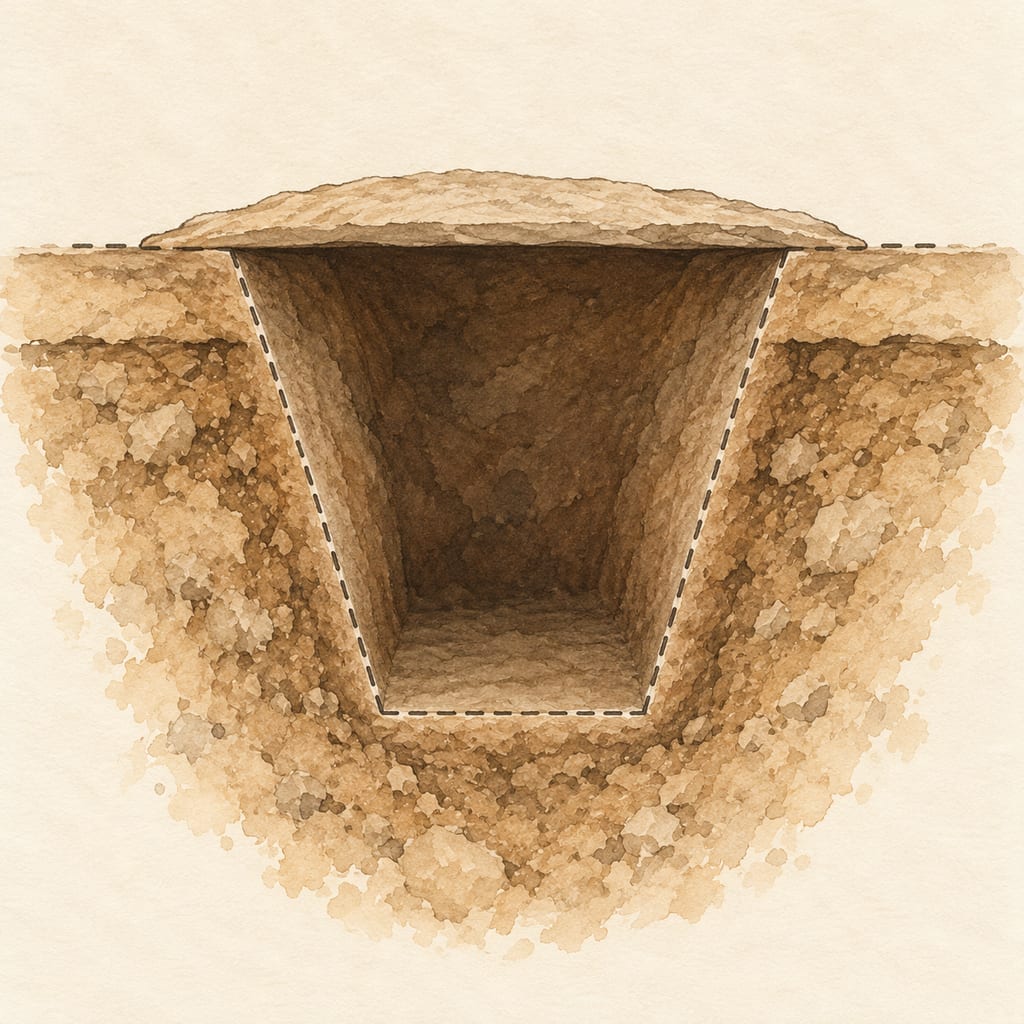
Comparative cutaway illustration of a Yemeni madfan with an intentionally broken outline; the shared Somalia-and-Yemen profile is not a universal plan.

A grain store beneath the ground

Madfan (plural madāfin) names a Yemeni underground grain chamber. A recent Yemen agriculture report records chambers cut into rock or firm earth and closed with a cover. It describes the cover as protection against weather and pests, and associates the form with keeping grain for years. That is a report of a traditional storage practice, not a measured guarantee for every chamber or crop.

The word belongs to a Yemeni context. It should not be used as a general name for every underground silo. An archaeological or agricultural description from another region can help compare how people used subsurface pits, but it cannot establish the precise appearance or use of a particular Yemeni structure.

Sources for this section

Form and materials

The available descriptions support a simple outline: an excavated chamber below ground, formed in rock or firm earth, with a cover at its opening. They do not establish a single standard profile, lining, closure material, depth, capacity or arrangement of access. A detailed drawing that assigns those features to all madāfin would overstate the evidence.

Comparative research on underground grain stores discusses Yemeni pits alongside examples from other regions. Some underground-storage literature describes internal treatments such as lime or ash for particular contexts; those details should not be transferred to every madfan without a Yemen-specific source. This entry therefore leaves the exact construction and dimensions open.

Sources for this section

Storage purpose and limits

The structure is for grain storage rather than fermentation. The Yemen-focused account presents the covering as a barrier against weather and pests. A separate scholarly review discusses how sealed underground pits can develop a changed internal atmosphere. That mechanism does not by itself prove how well a given madfan stored food, nor does it make a closed chamber safe to enter.

No safe construction plan, food-safety validation, opening procedure or universal shelf life follows from these sources. Groundwater, drainage, structural stability, grain condition and access would all need evidence specific to a site. The historical record supports describing the structure and its stated purpose, not recommending that it be built or entered.

Sources for this section

Yemen and comparative grain pits

The supported place association is Yemen at country level. The sources consulted do not justify assigning this record to one named governorate or village. The term is therefore retained without a more specific location.

The Iron Age British grain-storage pit linked here is a comparison of the broad subsurface grain-storage method. Its archaeological context, dimensions and experimental findings are distinct from the Yemeni madfan evidence.

Sources for this section

How it is built

Risks and precautions · Standard risk
Underground and confined-space hazards

A sealed underground chamber can have unsafe access and atmosphere conditions; comparative research on sealed pits is not a safety assessment.

Hazard source

Do not infer safe entry or construction procedures from this historical description.

Control source

Descriptive history only; no construction, food-safety or entry procedure is validated here.

Materials

  • Rock or firm earth — The chamber is excavated into rock or firm earth; sources do not provide a single construction specification.
  • Cover — A cover closes the underground chamber; accounts identify weather and pest protection as its purpose.
  • Stored grain — Grain is the stored product, not a fermentation ingredient.
  1. A madfan is a fixed underground grain-storage structure, rather than a portable vessel.
  2. Yemen-focused documentation describes chambers made in rock or firm earth and closed with a cover.
  3. Comparative scholarship discusses the Yemeni examples among underground grain pits and describes variation; it does not establish one plan for every community.
  4. The sources are descriptive, not a construction manual or validation of present-day storage performance.

Places

Yemen

Traditional use · Country evidence

Country-level association only; the consulted sources do not support a single locality or a universal plan.

Related

Community

No community contributions have been published for this entry yet.

Share what you made

Sign in to contribute. Published comments and photos are free to read.

Sources