
Barley
Barley is a hardy cereal, domesticated in the Middle East over 10,000 years ago, eaten whole, pearled or milled, malted for brewing, and grown with koji mold for barley miso.
 FermenteaWhere food goes to change
Built structures · collective-granary
agadir · igoudar · agadir granary · Amazigh collective granary
An agadir (plural igoudar) is a fixed Amazigh communal storehouse in Morocco for harvests and other valuables. Layout, materials and community rules vary by site; no single plan describes every granary.
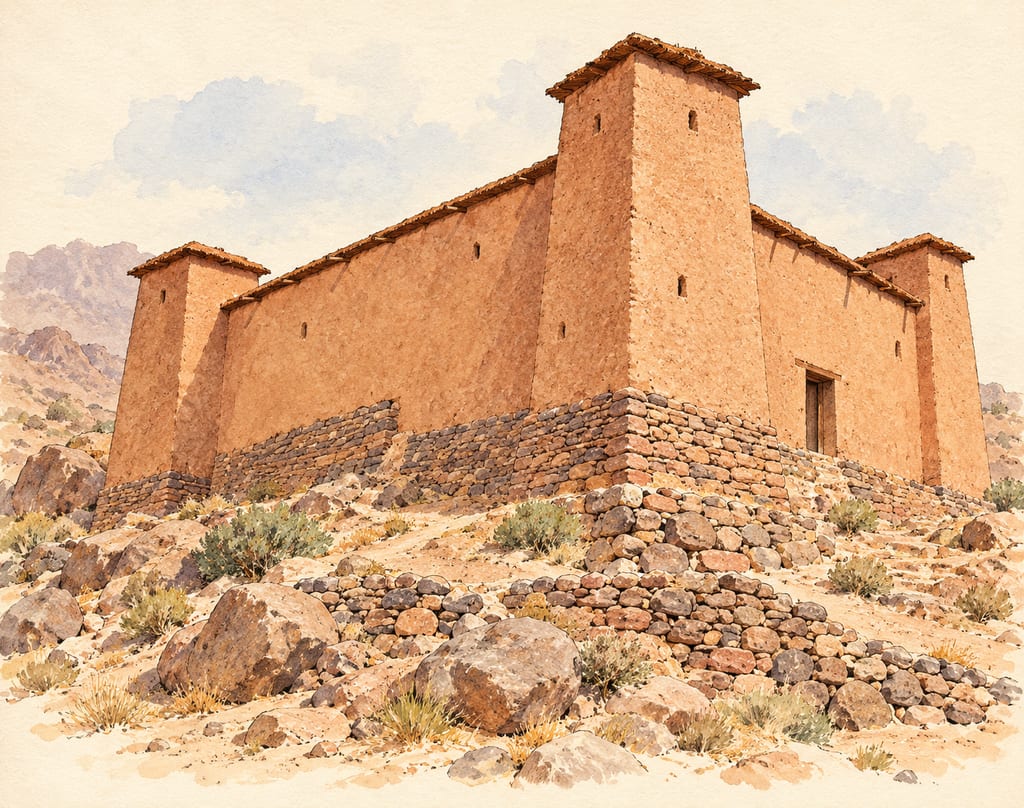
Agadir is used for the singular building; igoudar is its plural. These are fixed communal storehouses associated especially with Amazigh communities in southern Morocco. The collective institution matters as much as the walls: households held rights to designated compartments while community rules governed access, maintenance and shared responsibilities.
The Moroccan heritage dossier separates several forms, including elevated or hilltop granaries, village granaries serving everyday cereal needs, and smaller family granaries. Their position, scale and internal arrangement differ. Some are fortified and perched on defensible terrain; others sit within villages. It would be misleading to treat every agadir as a hilltop citadel with the same entrance, courtyard, number of rooms or governing body.
A granary is a build because it is made where it stands and depends on the surrounding site. The building type is documented in the Souss, Anti-Atlas and wider Atlas regions, but its ground and materials are local. In the Amtoudi case study, the medieval granary was anchored directly to an irregular rocky promontory. Researchers identified local stone, soil-rich mortar and wood elements; this is evidence for that one building, not a recipe for constructing every igoudar.
The Amtoudi study found interlocking stonework, with some sections using mortar, and recorded argan and palm timber in ceilings, lintels and carpentry. It also assessed weathering and structural vulnerabilities at the site. Building stability depends on geology, wall condition, water exposure and the form of the roof and supports. The study’s engineering assessment concerns Amtoudi; its dimensions and recommendations must not be copied as a general modern design.
These buildings store food and other valuables together. The official Moroccan dossier describes cereal storage in village granaries and family compartments in related forms. Research on Atlas igoudar also records grain storage and links some active granaries to wider community and ritual networks. Such accounts help explain the storage institution without reducing it to a food container: control of access, shared upkeep and the distribution or safeguarding of goods were part of its function.
For food preservation, a protected compartment can keep harvests together and limit exposure to theft, rain and pests. Drying and security are described as complementary purposes in the supplied regional research. The sources do not establish one universal humidity, temperature, capacity or shelf life, nor do they show that every stored food was treated in the same way. This is a historical and architectural record, not instructions for a modern food store.
Salima Naji’s Atlas research distinguishes active, disused and ruined granaries, and reports active examples across the Central Atlas, High Atlas and Anti-Atlas. The article also describes agadir as a collective institution tied in some places to regional ritual networks. These findings caution against presenting the form as uniformly extinct, or assuming that every building shares the same sacred role.
The 2021 Moroccan ministry report counted more than 550 collective igoudars nationally and described them as part of Amazigh culture and local resource management. That is a dated ministry report, not a current count of active buildings. Restoration and access concern living communities as well as masonry: a visitor, researcher or builder should follow local permissions and conservation guidance. No measurements or construction specification for a new granary are established here.
A build is made where it stands: moving it means building it again.
Collective granary forms are documented in the Souss; no single site or plan is implied.
Agadir/igoudar forms are documented across the Anti-Atlas; materials and condition vary by site.
The Atlas study reports active granaries in the High Atlas, among other Atlas regions.
The archaeological and structural study concerns this one granary.
Barley is a hardy cereal, domesticated in the Middle East over 10,000 years ago, eaten whole, pearled or milled, malted for brewing, and grown with koji mold for barley miso.
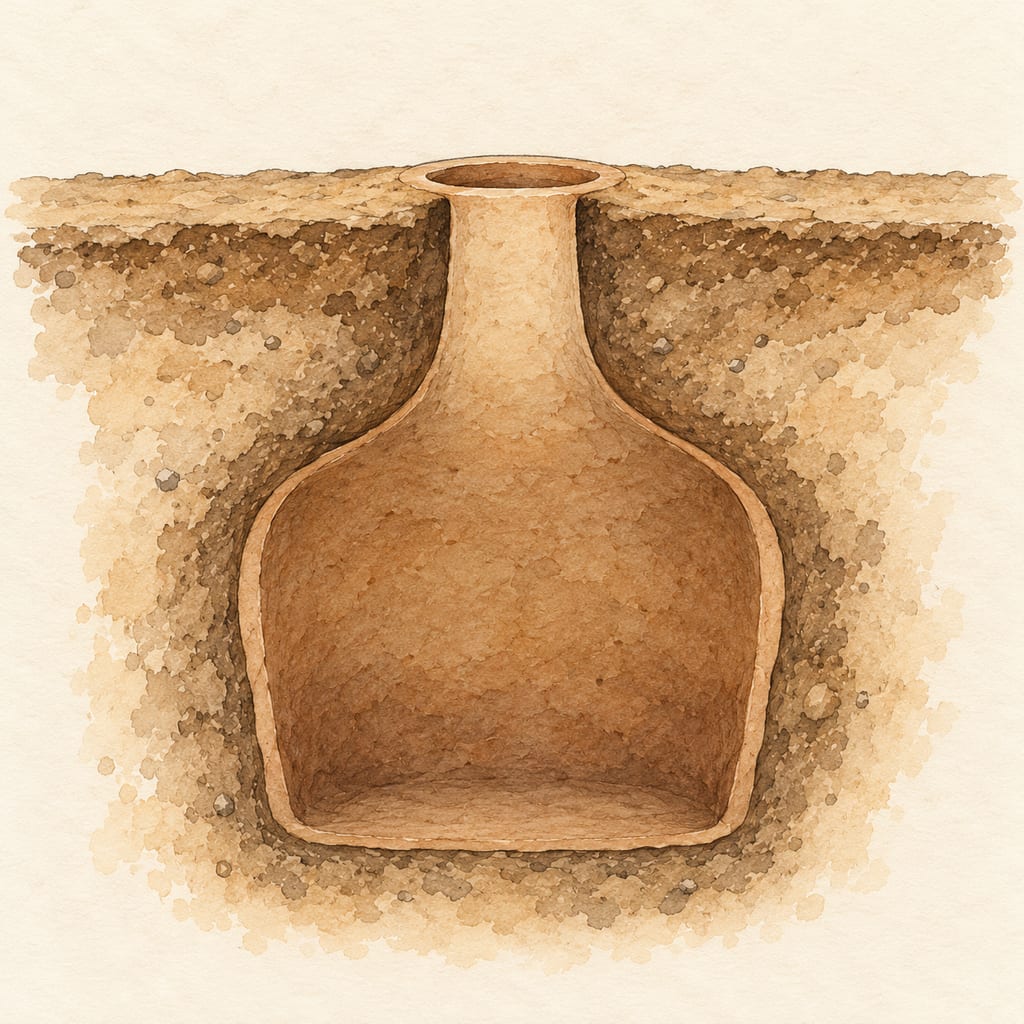
A Moroccan small-farm underground grain store, described as a matmora: a pit generally dug near the house for household grain or seed.
No community contributions have been published for this entry yet.
Sign in to contribute. Published comments and photos are free to read.
Ministry of Youth, Culture and Communication, MoroccoTypology · Heritage · Use
Projet d’inscription des greniers collectifs au patrimoine mondial de l’UNESCOThe official dossier distinguishes hilltop, village and family granaries rather than treating one layout as universal.
Village granaries are described as serving daily cereal needs; the dossier also records family compartments and shared governance.
Cited in: A shared storehouse, not a single floor plan; Protecting harvests within community rules
Journal of Traditional Building, Architecture and UrbanismHistory · Social organization · Geography · Use
Networks of the Sacred in the Atlas: Igudar and Zawaya, Intercessory Repositories of pre-Saharan MoroccoNaji reports research identifying active, disused and ruined granaries, and more than a hundred active examples across the Central Atlas, High Atlas and Anti-Atlas.
The article describes the agadir as a collective institution and discusses its role in community identity and regional ritual networks.
Cited in: A shared storehouse, not a single floor plan; Protecting harvests within community rules; Living heritage and careful description
University of Urbino institutional repositoryConstruction · Materials · Site · Conservation
Archaeometric study of a typical medieval fortified granary (Amtoudi Agadir, Anti-Atlas Chain, southern Morocco): a key case for the maintenance and restoration of historical monumentsThe Amtoudi study documents a granary on a rocky promontory, with local stone, mortar and timber elements, and evaluates stability and deterioration at that specific site.
Cited in: A building made for its place
Ministry of Youth, Culture and Communication, MoroccoHeritage · Geography
El Ferdaous: le Maroc dispose de plus de 550 greniers collectifs « Igoudars »In 2021 the ministry reported more than 550 collective igoudars in Morocco and described them as reflecting Amazigh culture and local resource management.
Cited in: Living heritage and careful description