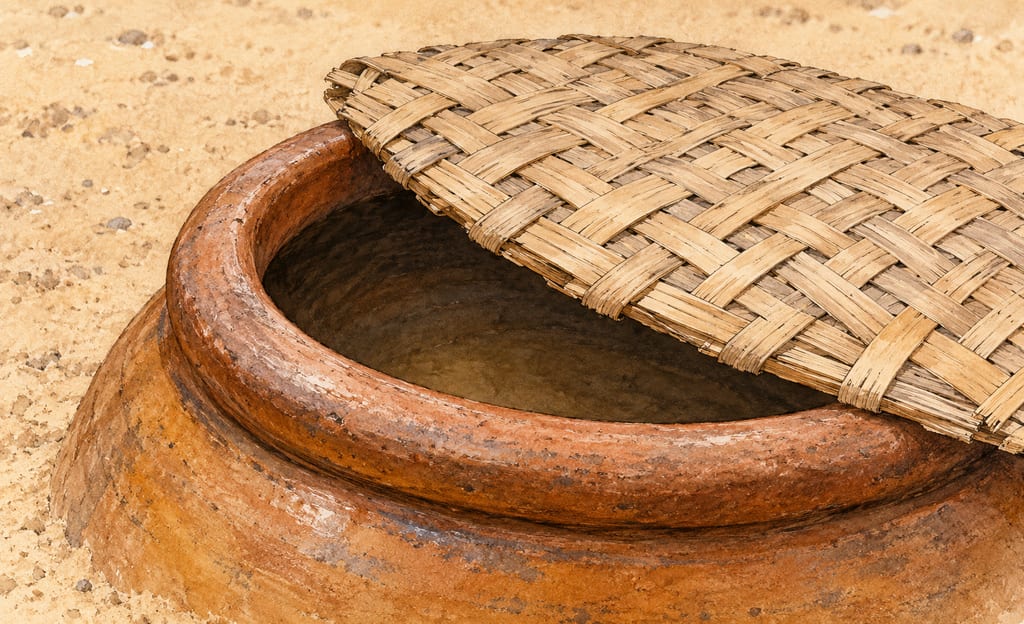
Budu earthen jar
Earthenware jars hold salted fish while budu matures. Southern Thai accounts document bamboo mat, plastic and aluminum, and wood-board covers in different production settings.
 FermenteaWhere food goes to change
Equipment · Jars, pots and crocks
ไตปลา โอ่งหมัก · Tai-plaa jar
A closed earthen jar documented for fermenting tai-plaa, the salted fish-viscera product of southern Thailand. The sources do not establish one standard jar shape, capacity, lid, or date of first use.
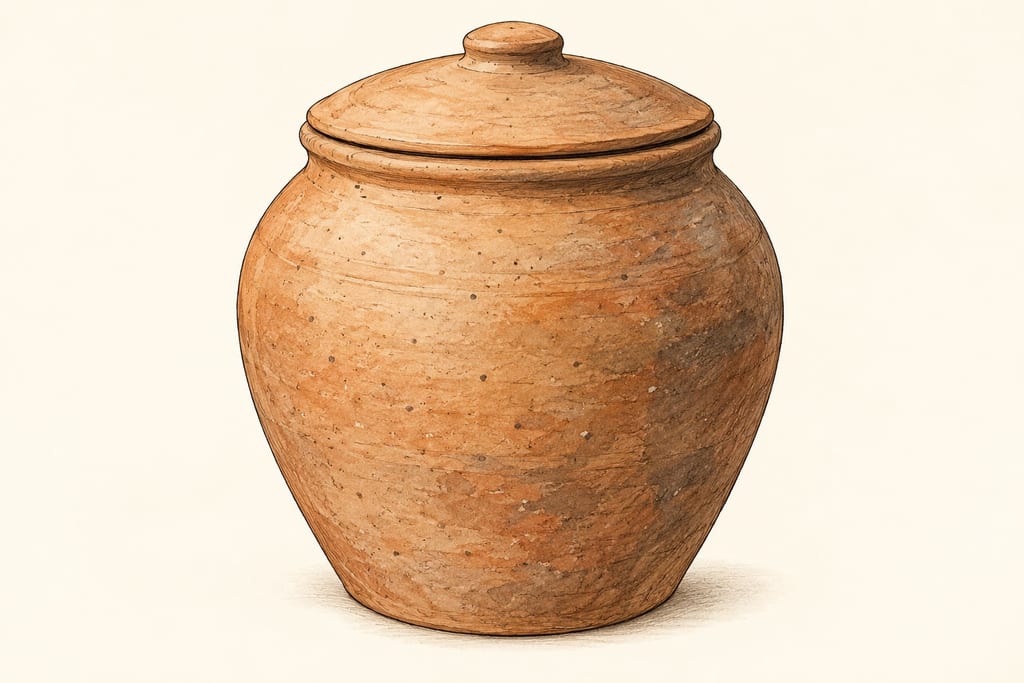
Tai-plaa is the Southern Thai fermented fish-viscera product also known by the Thai name ไตปลา. JIRCAS describes it as a salty, semi-solid food whose colour ranges from red to dark brown. In its account of the process, salted marine-fish viscera are packed into closed containers, with earthen jars given as one example. This makes the jar a practical container for a filled, covered fermentation rather than an open vat. The source does not identify one standard profile or say that every producer uses pottery.
The jar’s name here describes its documented use, not a separately named pottery tradition with a known workshop or canonical silhouette. JIRCAS does not give a capacity, mouth width, wall thickness, lid material, or closure design. The item should therefore be understood as a class of closed earthen jars used for tai-plaa, not as a reconstruction of one particular vessel.
JIRCAS records that the ingredients are packed into closed containers such as earthen jars and that the jars are left in the sun during fermentation. It gives a fermentation period of 10–20 days for the method described. Those details place the vessel within a process that uses both closure and outdoor exposure; they do not establish that the jar is buried, sealed with a particular material, or exposed in the same way in every locality.
The page describes a semi-solid, salty product rather than a clear sauce. That description helps distinguish tai-plaa from other salted-fish products that may use pottery with a similar broad purpose. The catalogue’s equipment link connects this jar to the Tai-plaa preparation record; it does not imply that the product is made only in this kind of vessel or that one vessel geometry defines the food.
Southern Thailand has documented pottery traditions, including Baan Ma Ying in Tha Sala, Nakhon Si Thammarat. Walailak University’s local-information archive and the Thailand Cultural Encyclopedia describe household pottery and regional production there. These sources make fired-clay vessels a grounded regional reference, but neither identifies a Baan Ma Ying pot as the jar used for tai-plaa. The exact jar’s maker and locality remain unspecified.
The consulted sources do not establish a standard capacity, dimensions, acquisition route, cleaning routine, or earliest date for this equipment use. The JIRCAS database cites a 1995 reference for tai-plaa, which is an attestation in the literature, not proof that the vessel or practice began then. Any illustration should consequently show a restrained earthen jar interpretation and avoid presenting its details as a measured archaeological or ethnographic record.
JIRCAS describes tai-plaa as a famous southern dish and records closed earthen jars among its fermentation containers; this does not identify one province or pottery workshop.
Earthenware jars hold salted fish while budu matures. Southern Thai accounts document bamboo mat, plastic and aluminum, and wood-board covers in different production settings.
No community contributions have been published for this entry yet.
Sign in to contribute. Published comments and photos are free to read.
Japan International Research Center for Agricultural Sciences (JIRCAS)Equipment use · Product description · Method · Regional context
Tai-plaaJIRCAS identifies tai-plaa as fermented fish viscera, made from marine-fish viscera and sea salt, with a semi-solid, salty product ranging from red to dark brown.
The entry says the ingredients are packed in closed containers such as earthen jars; the jars are left in the sun and fermentation takes 10–20 days.
The entry identifies tai-plaa as a famous southern dish and cites The traditional fermented foods of Thailand (1995).
Cited in: A closed earthen jar for tai-plaa; The container in the documented process; Southern Thai pottery context and limits
Walailak University Local Information ArchiveRegional pottery context · Visual reference
ปั้นดินสู่ดาว : เครื่องปั้นดินเผาบ้านมะยิง [Pottery of Baan Ma Ying]The article documents pottery-making at Baan Ma Ying in Tha Sala, Nakhon Si Thammarat, including household vessels and a continuing local craft tradition.
It describes contemporary changes in materials and forms; it does not identify a Baan Ma Ying jar as a tai-plaa vessel.
Cited in: Southern Thai pottery context and limits
Thailand Cultural Encyclopedia, Princess Maha Chakri Sirindhorn Anthropology CentreRegional pottery context
เครื่องปั้นดินเผาและเตาเผาพื้นเมือง : ในภาคใต้ [Indigenous pottery and kilns in Southern Thailand]The entry documents traditional pottery centres in Southern Thailand, including Baan Ma Ying, and discusses local production practices surveyed through 1996.
The entry supplies regional craft context, not evidence of the particular shape or provenance of a tai-plaa jar.
Cited in: Southern Thai pottery context and limits