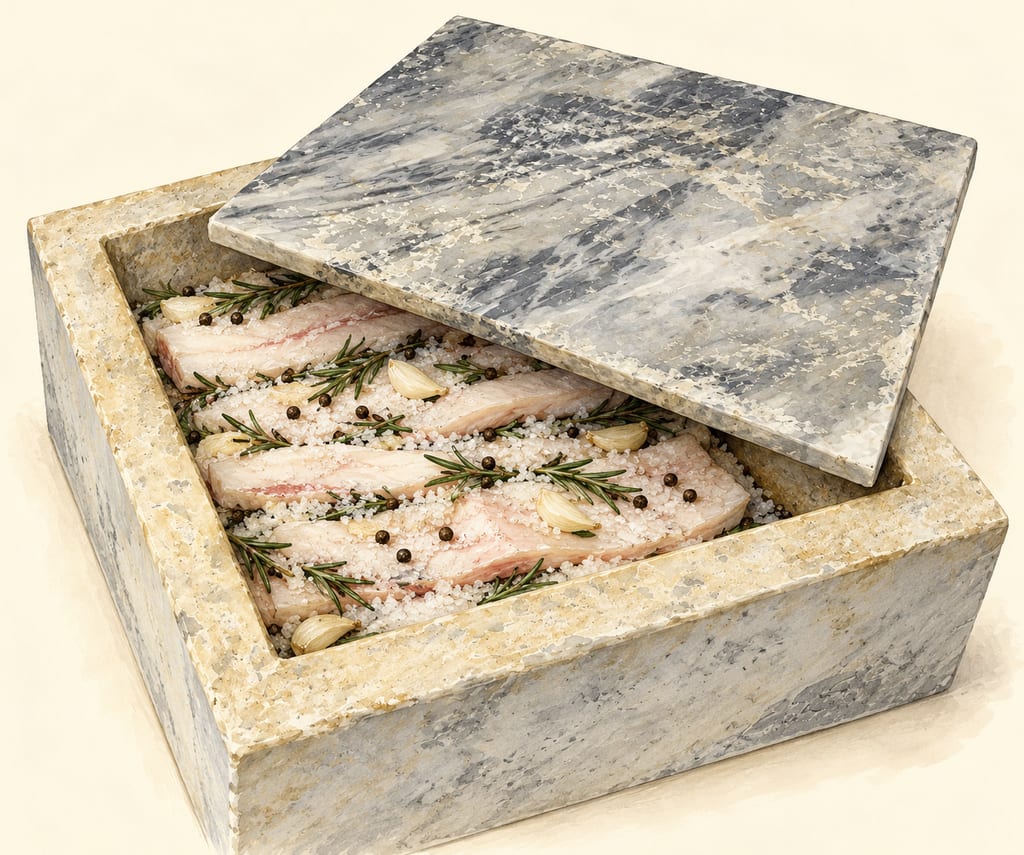
Marble conca
A conca is a thick-walled marble basin used in Colonnata, Tuscany, to salt-cure and mature lardo. Its local white marble and close-fitting stone lid form the documented vessel for Lardo di Colonnata IGP.
 FermenteaWhere food goes to change
Equipment · Terracotta baking dishes
testi · testo · testi · testello · testelli
Small, shallow terracotta dishes called testi or testelli are heated over a fire and stacked with panigacci batter between them. Each hot dish bakes one side of a small bread while serving as the lid for the next.
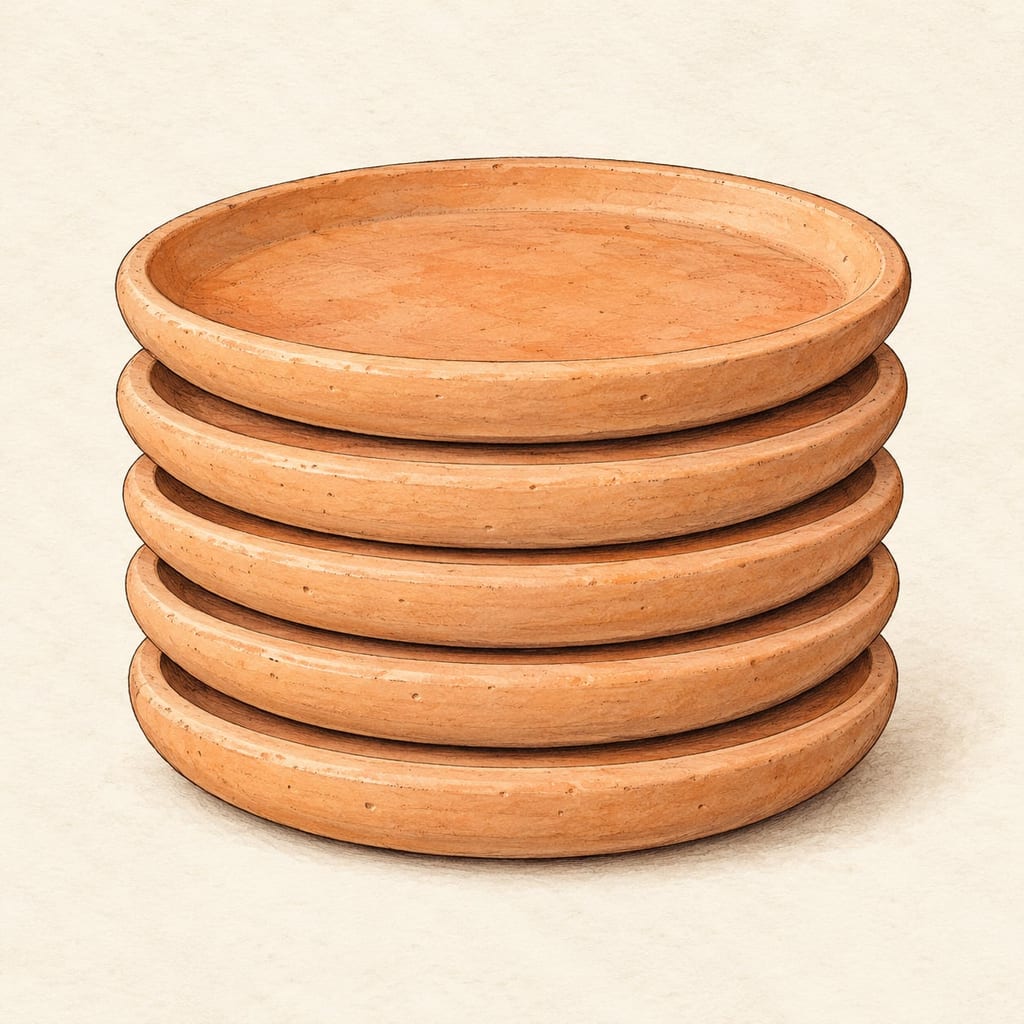
The Podenzana panigacci tool is a shallow round terracotta dish called a testo; testello or testelli also appears in descriptions of the smaller dishes. It is a portable object made by a potter, not an oven, griddle, or structure built into a hearth. The local tourism association says these handmade dishes are produced by a small workshop using clay from a nearby mountain. It explicitly distinguishes the Podenzana panigacci dishes from the Pontremolese version of the testo, so this record stays with the small stacked panigacci form.
The panigacci themselves are small, unleavened rounds. The regional product account gives a bread diameter of about 15 cm; another account reports 12–15 cm for the small testelli, but no standardized dish measurement is established here. The images show a shallow saucer-like profile and a raised rim. Neither those proportions nor the bread size should be generalized to every Lunigiana testo.
Each terracotta dish is heated separately over a fire. A portion of flour-and-water batter is placed on a hot testo, then another hot dish is set above it. The bottom dish supports one panigaccio while the dish above acts as its lid and cooking surface; another portion can be placed on that upper dish as the stack grows. Repeating the arrangement creates several paired hot surfaces in one vertical stack. Heat from the clay sets and browns both sides of each round without turning it like a single-surface griddle.
The equipment and the food work as a system: the shallow form holds a small portion of batter, the broad clay face contacts the dough, and the next preheated dish closes the pair. Sources describe the dishes heated until very hot or pale from the fire and the panigacci cooked quickly, but they do not give a measured dish temperature, a standardized stack height, or a universal firing schedule. The heat sequence should therefore be understood from the documented practice, not converted into a numeric operating guide.
The documented local production connects the cooking tool to its place: the tourism association describes a small Podenzana workshop working nearby clay into terracotta testelli. It does not identify clay minerals, temper, wall thickness, glaze, kiln design, or firing temperature, so none is specified here. The inspected sources also give no reliable cleaning or repair instructions and no food-contact certification for a contemporary replacement.
Purpose-made dishes intended for this heating method matter. The supplied heat-processing research cautions that decorative terracotta is not a substitute for heat-rated testi. A general decorative bowl may look similar while lacking documentation for fire use; the sources offer no safe conversion procedure. If sourcing one today, the evidence supports seeking a maker's dish specifically made for panigacci rather than assuming all terracotta can take the same heat.
The sources place this apparatus with panigacci of Podenzana in Lunigiana, in the province of Massa-Carrara, Tuscany. The regional account describes the small stacked terracotta dishes as an active local practice and points to the close relationship between the bread and its specific cooking method. Panigacci may be eaten warm with local cured meats and cheeses; they may also be briefly softened in hot water and served with pesto, olive oil and cheese, or mushroom sauce. Those are uses of the bread, not additional functions of the equipment.
The chronology of the small testi remains open. Descriptions call panigacci and their cooking method ancient or traditional, but the inspected accounts do not provide a dated first reference for this particular dish form. The larger Pontremolese testo has its own history and construction, and dates attached to that wider apparatus should not be transferred to these small panigacci plates.
Regional tourism sources describe the terracotta testelli as a traditional part of Podenzana panigacci cooking, but the inspected evidence does not date the first appearance of this specific small dish form. Wider claims about the age of panigacci or other Lunigiana testi do not establish the chronology of these particular dishes.
This account does not establish a safe heating temperature, an oven rating, or a validated handling procedure.
The method depends on purpose-made terracotta dishes intended for heating. Decorative terracotta dishes are not an evidenced substitute for fire-heated testi.
Source →The source places local handmade testi production in a small workshop near Podenzana; it does not identify the workshop or claim that all dishes are made there.
This row locates the documented panigacci cooking equipment and does not identify the origin of every related testo form.
A conca is a thick-walled marble basin used in Colonnata, Tuscany, to salt-cure and mature lardo. Its local white marble and close-fitting stone lid form the documented vessel for Lardo di Colonnata IGP.
No community contributions have been published for this entry yet.
Sign in to contribute. Published comments and photos are free to read.
Associazione Operatori Turistici Lunigianesi (VisitLunigiana)Form · Materials · Manufacture · Geography · Use
I Panigacci di PodenzanaDescribes the panigacci texts as handmade terracotta dishes, made by a small local workshop from clay sourced near Podenzana.
Describes the dishes heated over a fire and stacked with batter between them to cook both sides.
Distinguishes the Podenzana panigacci testi from the Pontremolese version.
Cited in: Small terracotta dishes, not the larger testo; A stack makes paired hot surfaces; Local clay and the limits of the record; A named local practice
Vetrina Toscana, Regione ToscanaForm · Use · Geography
Panigaccio di PodenzanaIdentifies the panigaccio as an unleavened food of Lunigiana, Massa-Carrara, cooked in a special terracotta testo heated over a live fire or wood oven.
Describes terracotta testi stacked during cooking and distinguishes bread diameter from the dimensions of the cooking dishes.
Cited in: Small terracotta dishes, not the larger testo; A stack makes paired hot surfaces; Local clay and the limits of the record; A named local practice
TuttatoscanaForm · Terminology · Use · Image attribution
I Panigacci della LunigianaExplains testo/testello names and describes shallow terracotta dishes used in stacks for panigacci.
The page reports a 12–15 cm diameter for the small testelli, but the record does not treat this as a verified standard dimension.
Provides the linked photograph of stacked terracotta testelli; its photographer is not named on the page.
Cited in: Small terracotta dishes, not the larger testo; A stack makes paired hot surfaces