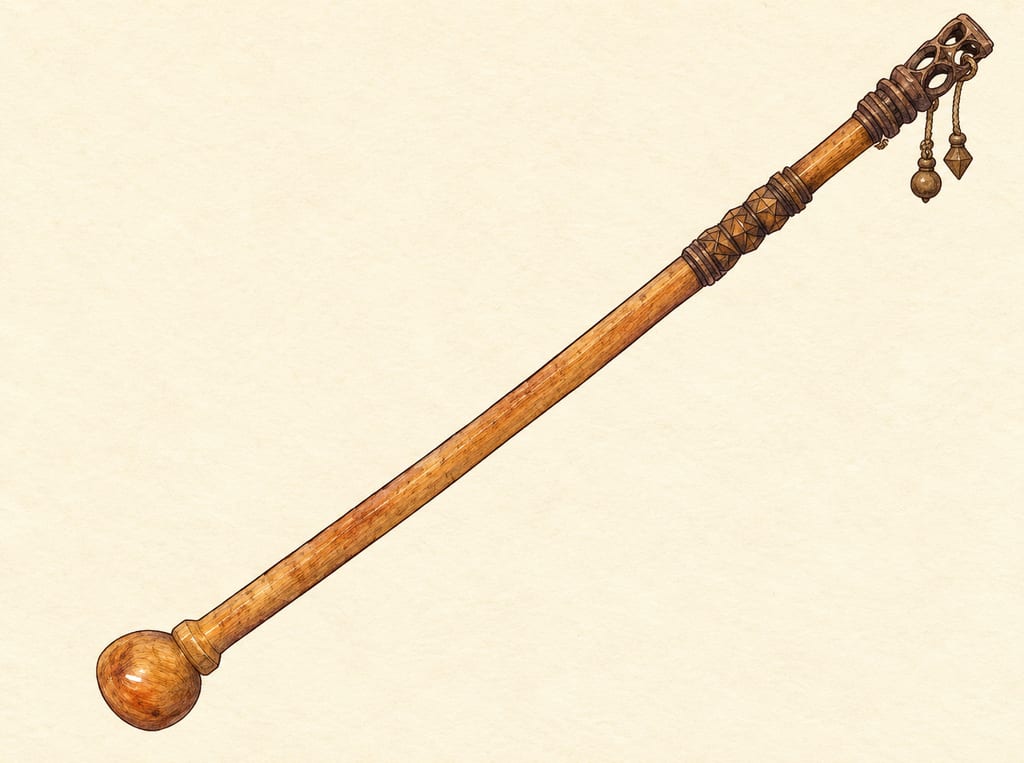
Hamnatar (Sakha kumys agitation whisk)
The Sakha hamnatar (хамнатар), also called bülüür (бүлүүр), is a two-part wooden implement for agitating kumys: a carved handle joined to an openwork cap, used through a funnel into the vessel.
 FermenteaWhere food goes to change
Equipment · Handheld mixing and whipping tools
ытык · Wooden whisk (kuorchekh) · ytyk · mutovka · мутовка · kuorchekh whisk
The Sakha ytyk (ытык) is a flat, round wooden whisk with small notches around its head, used to aerate kuorchekh and other cream preparations. Its exact dimensions and historical origin are not established by the sources here.
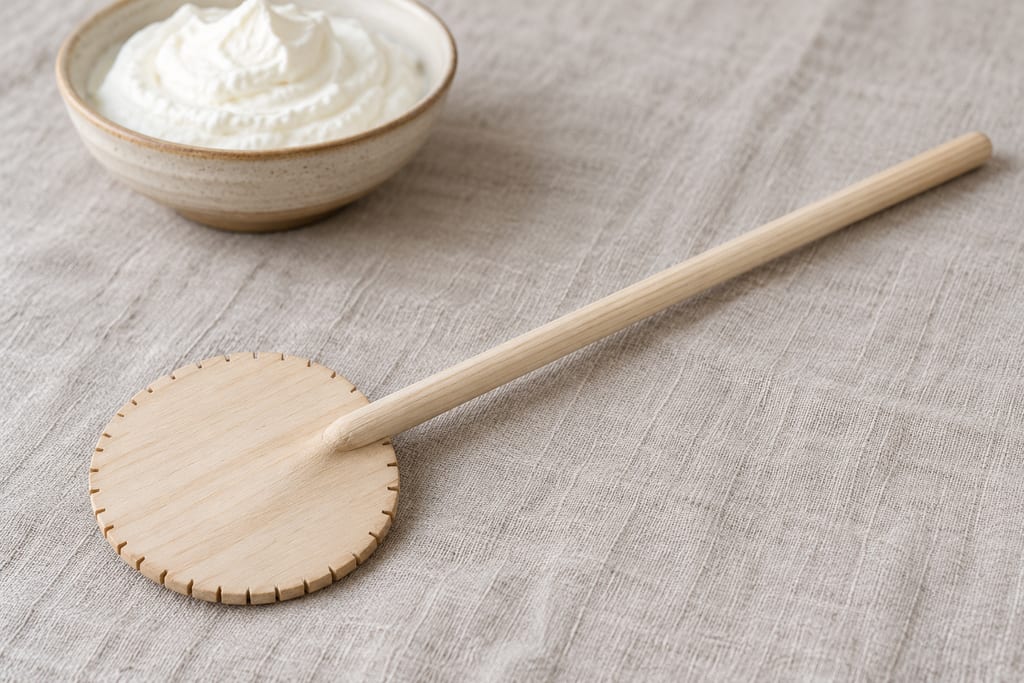
The ytyk (ытык), also called a mutovka in Russian-language descriptions, is a handheld wooden whisk associated with kuorchekh, the Sakha dish of whipped cream or rich sour cream. A Sakha school cooking lesson describes it as a wooden, flat, round beater with small notches and a handle. A contemporary Yakut maker's page gives a more particular example: a round wooden disk with a toothed rim and a smooth handle. The shared identifying shape is a broad flat head rather than a cage of wire loops; the sources do not establish one standardized size or exact notch pattern.
The utensil belongs in the equipment account for kuorchekh because the action it supports is aeration. In the dish's documented method, chilled rich dairy is vigorously beaten until thick and fluffy. The handheld ytyk moves through the cream to incorporate air; it is not a fermentation vessel and does not by itself culture the dairy. The cream or sour cream supplies the food's character, while the whisk is the implement used to create its airy texture.
The flat circular head gives the user a broad surface to move through a bowl of cream. The small notches around its edge are part of the documented shape; the sources do not explain their exact mechanical effect, so it would be speculation to assign them a particular aeration advantage. The long handle keeps the hand above the bowl while the head is worked briskly through the dairy. Elley's recipe describes vigorous whisking with a special flat, round wooden mutovka until the cream becomes thick and fluffy, tying this implement's form to a specific practical task.
A modern Sakha maker identifies one material combination: a birch disk with a toothed edge and a larch handle. This is useful evidence for a present-day handcrafted example, not proof that all historical or regional ytyk used those species. The 2016 educational account only says wood. No cited source gives a standard head-to-handle proportion or construction joinery, so those details should be read from the individual implement rather than assumed.
Kuorchekh is served fresh as an aerated dairy preparation. The Elley household recipe begins with chilled sour cream or a richer cream mixture and says to beat it briskly. It cautions that additions such as milk or other liquid should be restrained so the foam does not become runny; the recipe is prepared shortly before serving rather than treated as a long-held whipped product. Those directions explain why the utensil appears alongside a bowl in the local lesson: the bowl holds the dairy while the whisk supplies repeated movement and air incorporation.
The ytyk is therefore linked to kuorchekh as equipment for a named preparation, while the recipe remains responsible for its ingredients, quantities and serving practice. One contemporary maker also lists cream whipping and preparation of sour cream or butter among the whisk's uses. Those extra uses belong to that maker's product description; this page does not imply a single universal method for all dairy preparations or a microbiological role for the wooden tool.
Sakha dairy practice includes other wooden implements whose names and shapes can be confused in broad English descriptions. The Yakut State Museum describes a ceremonial whisk for kumys called hamnatar, also named bülüür in the museum account. It is a two-part object with a decorated handle and a cap pierced with openings, used through a vessel funnel to agitate kumys. That is different from the ytyk's flat, round, notched head used to whip cream. Keeping the tools distinct preserves the difference between kuorchekh aeration and kumys agitation instead of flattening them into one generic “traditional whisk.”
The sources establish a traditional Sakha use and a contemporary Yakutsk craft example, but not an invention date or historical map of the utensil's distribution. The 2016 lesson is a dated record of teaching kuorchekh preparation; it should not be mistaken for the utensil's first appearance. Likewise, the maker's birch-and-larch construction is one current product specification, not a universal rule for the region.
The contemporary marketplace identifies a round ytyk as made to order, but its stock notice does not support a promise that it is available now. The pages consulted also do not provide care or cleaning instructions. For a working utensil, the maker's own advice is the relevant source; no particular soaking, oiling or sanitation regimen can be attributed to these records. The page therefore stays with what is documented: a wooden round notched whisk, an aerating role in kuorchekh, and distinct materials in one current handmade example.
The 2016 Sakha school lesson documents the ytyk as a traditional utensil for making kuorchekh but does not date its origin or establish its earliest attestation. A current Yakutsk maker documents a contemporary craft example.
The ytyk's flat round head and notched rim distinguish it from the ceremonial kumys whisk described by the Yakut State Museum, a separate two-part implement with an ornamented handle and perforated cap.
Source →These sources associate the whisk with Sakha kuorchekh preparation; they do not establish exclusive distribution or date of origin.
Marketplace identifies a Yakutsk maker; this is a current example, not evidence all ytyk are made there.
The Sakha hamnatar (хамнатар), also called bülüür (бүлүүр), is a two-part wooden implement for agitating kumys: a carved handle joined to an openwork cap, used through a funnel into the vessel.
No community contributions have been published for this entry yet.
Sign in to contribute. Published comments and photos are free to read.
Proceedings of the VII International Correspondence Scientific-Practical Conference, Expert-Methodological Centre / Articulus-InfoTraditional form · Local use
Методическая разработка урока кулинарии для учащихся 6 класса «Молочные продукты из национальной кухни» (Cooking lesson plan: Milk products of national cuisine)A school cooking lesson in Amga ulus, Sakha Republic, teaches kuorchekh and lists a bowl, spoon and mutovka (ytyk).
The utensil is described as a wooden, flat, round beater with small notches and a handle; the source does not provide dimensions or an origin date.
Cited in: A flat wooden whisk for an aerated Sakha dairy dish; How its head and handle work; Kuorchekh and the whisking task; Not the kumys whisk; Documented limits and present-day making
ElleyDocumented use · Preparation context
Поделимся с вами рецептом КЕРЧЭХ (A kerchekh recipe)A Yakut household recipe describes whisking chilled sour cream or cream vigorously with a special flat, round wooden mutovka with small notches until thick and fluffy.
Liquid additions are restrained so the foam does not become runny; the dish is prepared shortly before serving. This supports the use context, not a general equipment dimension or care instruction.
Cited in: A flat wooden whisk for an aerated Sakha dairy dish; How its head and handle work; Kuorchekh and the whisking task
Made in Yakutia marketplaceModern maker · Material example
ЫТЫК — brand pageThe brand identifies Yakut craft master Ivan Ippatevich Ermolaev as a maker of traditional Sakha ytyk utensils.
The page describes a birch wooden disk with toothed rim and a smooth larch handle, used for whipping cream and preparing sour cream or butter. This is the maker's current example, not a universal historical material specification.
Cited in: How its head and handle work; Kuorchekh and the whisking task; Documented limits and present-day making
Made in Yakutia marketplaceModern example · Product image
Ытык (мутовка круглая) средняяA current listing names a round mutovka/ytyk and lists wood and made-to-order production; current stock is not asserted.
Product photograph supplies a present-day visual reference for form; the listing states no photo reuse license.
Cited in: How its head and handle work; Documented limits and present-day making
Yakut State Museum of History and Culture of the Peoples of the NorthDistinction from kumys whisk
Изучение кумысных сосудов на примере работ якутских и зарубежных исследователей (Study of kumys vessels through Yakut and foreign research)The museum describes the ceremonial kumys whisk hamnatar/bülüür as a separate two-part implement with an ornamented handle and a perforated cap, inserted through a vessel funnel.
That described implement differs in form and use from the flat round notched ytyk used for whipping cream.
Cited in: Not the kumys whisk