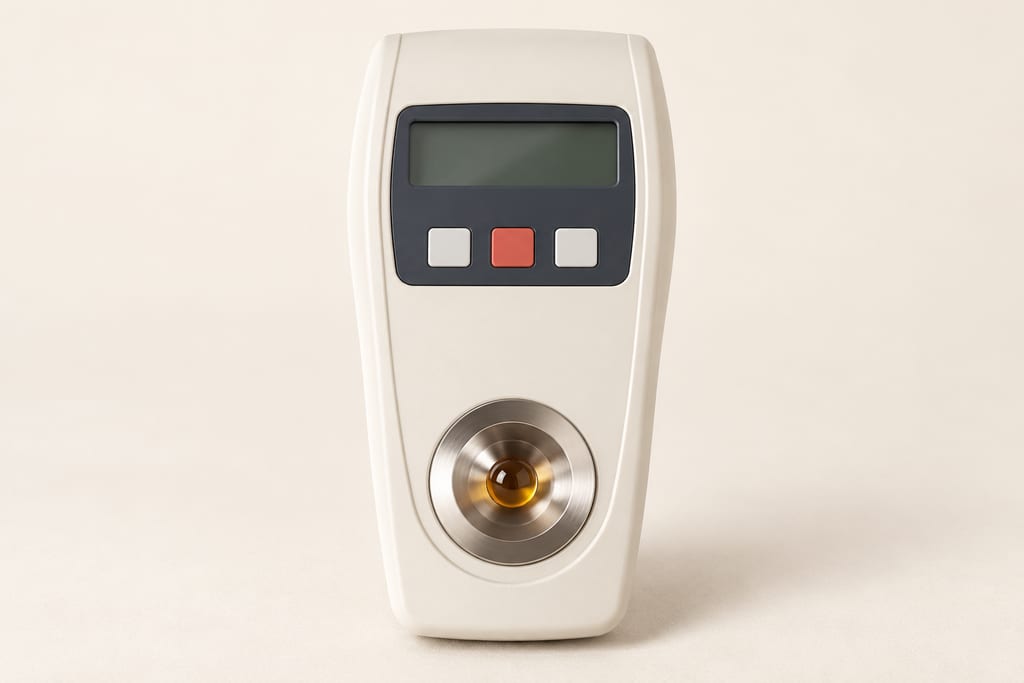
Refractometer
A manufactured optical instrument for measuring refractive index or a derived soluble-solids scale. °Brix helps compare suitable syrups and preserves, but in mixed foods it is not a direct measure of added sugar or a safety test.
 FermenteaWhere food goes to change
Equipment · Instruments
aw meter · water activity analyzer · water activity analyser
A water-activity meter measures the equilibrium water vapour above a food sample and reports how available its water is. A reading describes that specimen under stated test conditions; it does not certify the food as safe.
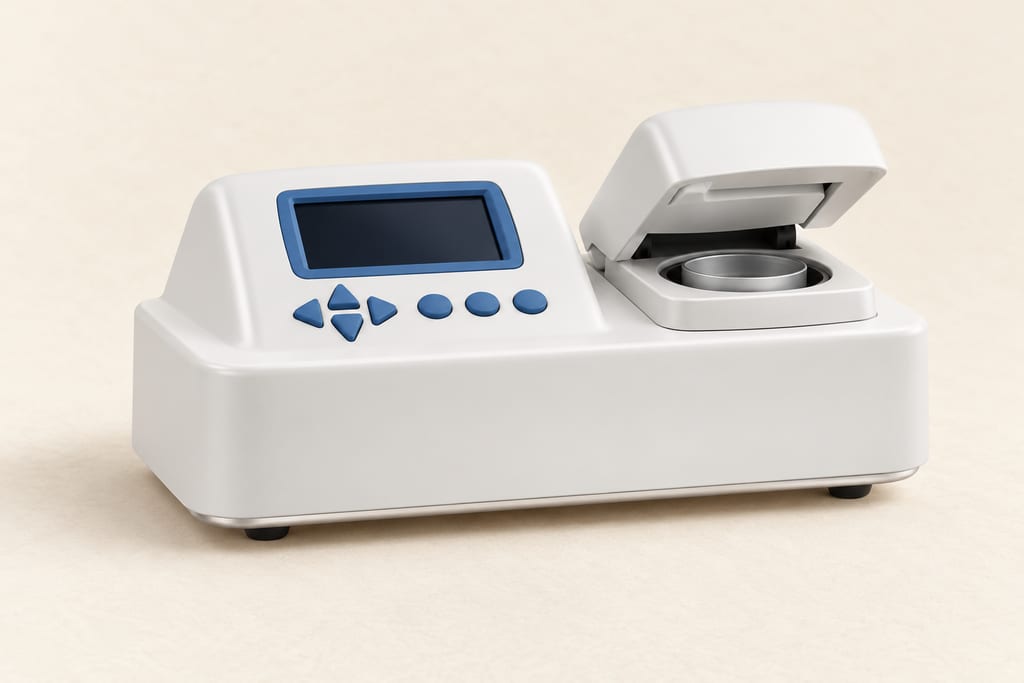
Water activity (aw) describes how available water is in a food. It is related to, but different from, the food's total moisture percentage: water can be bound by sugars, salts, proteins and other components. A meter places a sample in a small sealed chamber and measures the water vapour that comes to equilibrium above it. Depending on the model, the sensor may use a chilled mirror to find dew point, or another humidity-sensing method. ISO 18787:2017 covers dew-point, electrolyte-conductivity and polymer-permittivity methods.
This is laboratory equipment for testing samples, not a process that changes food. It helps characterize a specified product under controlled measurement conditions. An AquaLab 4TE is one example: its manufacturer specifies a chilled-mirror dew-point sensor with infrared temperature measurement, an aw range of 0.030–1.000, resolution of 0.0001 and accuracy of ±0.003 aw. Those figures belong to that model and method; other meters have different sensors and specifications.
Before relying on a result, identify the instrument's measurement principle and follow its manual for calibration, verification standards and service. The United States Pharmacopeia's general chapter on water activity treats qualification, calibration and use as parts of accurate measurement. Manufacturers distinguish verification against known standards from calibration or adjustment: for example, METER's AquaLab 4 guide recommends checking the instrument against supplied salt standards, while Rotronic's HygroLab instructions use reference humidity standards and allow multiple calibration points.
Temperature and equilibration matter. FDA's technical guide notes that water activity changes with temperature and that a temperature difference between the sample and air above it can shift a result. A laboratory method must let the sample and chamber reach the conditions required by that instrument. For a heterogeneous product, Virginia Tech Extension recommends accurate testing by a specialized meter and describes laboratory evaluation; University of Minnesota Extension's cottage-food guidance stresses taking samples from different parts, including the moistest area. One convenient scoop may not represent a whole batch.
A water-activity reading is evidence about one tested sample. It is not a pathogen test, and it does not prove that heating, fermentation, drying, packaging or storage has controlled every hazard. The often-cited 0.85 value appears in particular United States regulatory definitions and state cottage-food rules; it is not a universal threshold that makes any food safe. Virginia Tech Extension recommends product-specific evaluation and retesting after a formulation or process change, and encourages periodic checks even without a reported change.
ISO 18787:2017 does not apply to samples measured below their freezing point or to water-in-fat emulsions; it also warns that volatile products may need adapted equipment. The operator must choose a suitable method and interpretation for the actual food. If a result will support a safety or regulatory decision, seek an appropriately qualified laboratory or process authority and keep the tested product, method, temperature, calibration record and decision criteria together.
Water activity describes available water in the tested specimen; process safety also depends on the product, other hurdles, treatment, package and storage.
Hazard sourceUse a suitable, verified instrument and representative samples at the method's specified temperature; have the full product and process evaluated when a regulatory or safety determination depends on the result.
Control sourceA single reading does not prove that a food is safe or shelf-stable. A regulatory threshold in one product category is not a universal safe-water-activity limit.
The reading is water activity, not moisture percentage, weight loss, or a direct count of pathogens.
Source →Water activity depends on temperature; the sample and instrument need suitable temperature stability and equilibrium for the selected method.
Source →Method applicability depends on the sample. ISO 18787 excludes products below freezing and water-in-fat emulsions and notes that volatile compounds may require adaptations.
Source →Accuracy, range, repeatability and calibration procedure vary by model and sensing method; the AquaLab 4TE's ±0.003 aw is a specification for that model only.
Source →A measured water-activity value alone does not validate a recipe, lethality treatment, package or shelf life. Use product-specific process evidence and qualified laboratory or process review when a safety decision depends on it.
Source →The record describes a generic class of laboratory instruments. The sources establish international methods and examples of manufactured models, but do not establish one birthplace or a location association appropriate to the class.
A manufactured optical instrument for measuring refractive index or a derived soluble-solids scale. °Brix helps compare suitable syrups and preserves, but in mixed foods it is not a direct measure of added sugar or a safety test.
No community contributions have been published for this entry yet.
Sign in to contribute. Published comments and photos are free to read.
U.S. Food and Drug Administration, Inspection Technical Guide 39Measurement principle · Temperature · Food safety limits
Water Activity (aw) in FoodsDefines aw as the ratio of food vapour pressure to pure water at the same conditions.
States that aw increases with temperature and describes sample-headspace equilibration measurement.
Describes 0.85 as a regulatory definition point in particular US canned-food regulations; this is not a universal safety guarantee.
Cited in: Reading the water held in a food; Verification, calibration and repeatable results; What the number can and cannot establish
International Organization for StandardizationMeasurement methods · Scope and limits
ISO 18787:2017 — Foodstuffs — Determination of water activityStandard establishes principles and requirements for food aw methods from 0 to 1.
Names dew-point, electrolyte-conductivity and polymer-permittivity methods.
Excludes below-freezing samples and water-in-fat emulsions; volatile compounds may require adapted equipment.
Cited in: Reading the water held in a food; What the number can and cannot establish
Virginia Cooperative Extension, Virginia Tech, publication FST-485NPLaboratory use · Interpretation · Safety limits
Interpreting Water Activity Lab Results for Food ProducersExplains that accurate determination requires a specialized meter and offers laboratory testing.
Explains that recipe/process changes and periodic checks affect ongoing product evaluation.
Separates results from a guarantee of food safety.
Cited in: Verification, calibration and repeatable results; What the number can and cannot establish
United States PharmacopeiaQualification · Calibration · Use
General Chapter <922> Water ActivityThe official preview states the chapter covers methods to qualify, calibrate and use water-activity meters.
Cited in: Verification, calibration and repeatable results
METER Group (formerly Decagon Devices)Model specification · Materials · Accuracy
Water Activity Meter — AquaLab 4TE specificationsFor AquaLab 4TE only, gives chilled-mirror dew-point and infrared temperature sensors, ±0.003 aw accuracy, 0.0001 aw resolution, ±0.001 aw repeatability, sample temperature control and housing materials.
Explains sample-headspace equilibrium measurement and chamber cleaning.
Cited in: Reading the water held in a food
METER GroupModel specific verification
AquaLab Series 3 and 3TE Water Activity Meter ManualModel manual instructs verification with standards that bracket the intended measurement range; this procedure applies only to the named AquaLab models.
Cited in: Verification, calibration and repeatable results
RotronicModel specific calibration
Calibration / Adjustment — HygroLabHygroLab instructions describe using reference humidity salt standards and allow multiple calibration points for that product.
Cited in: Verification, calibration and repeatable results
University of Minnesota ExtensionSampling · Test interpretation
Testing water activity in cottage foodsRecommends sampling multiple areas, including the moistest portion, and describes sample preparation for the named low-cost humidity-probe kit.
Its page says that kit cannot be calibrated directly like a pH meter and its result is indicative, with final recipes recommended for certified-laboratory testing.
Cited in: Verification, calibration and repeatable results; What the number can and cannot establish
International Organization for StandardizationStandard
ISO 18787:2017Duplicate canonical standards record for ISO 18787:2017; use the committee preview URL in section citations.