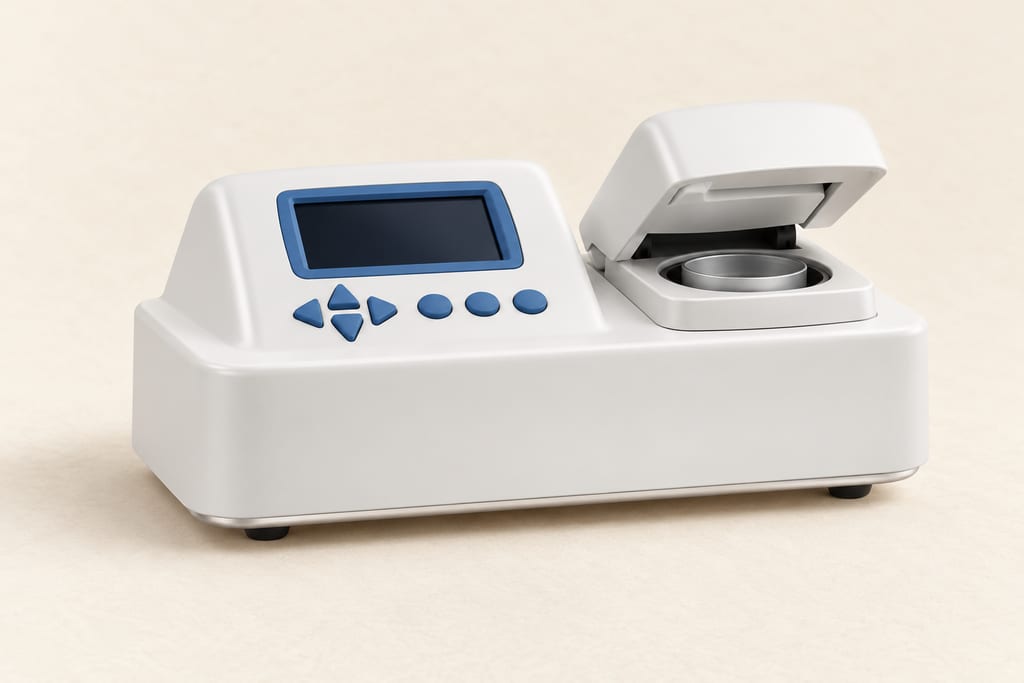
Water-activity meter
A water-activity meter measures the equilibrium water vapour above a food sample and reports how available its water is. A reading describes that specimen under stated test conditions; it does not certify the food as safe.
 FermenteaWhere food goes to change
Equipment · Instruments
A manufactured optical instrument for measuring refractive index or a derived soluble-solids scale. °Brix helps compare suitable syrups and preserves, but in mixed foods it is not a direct measure of added sugar or a safety test.
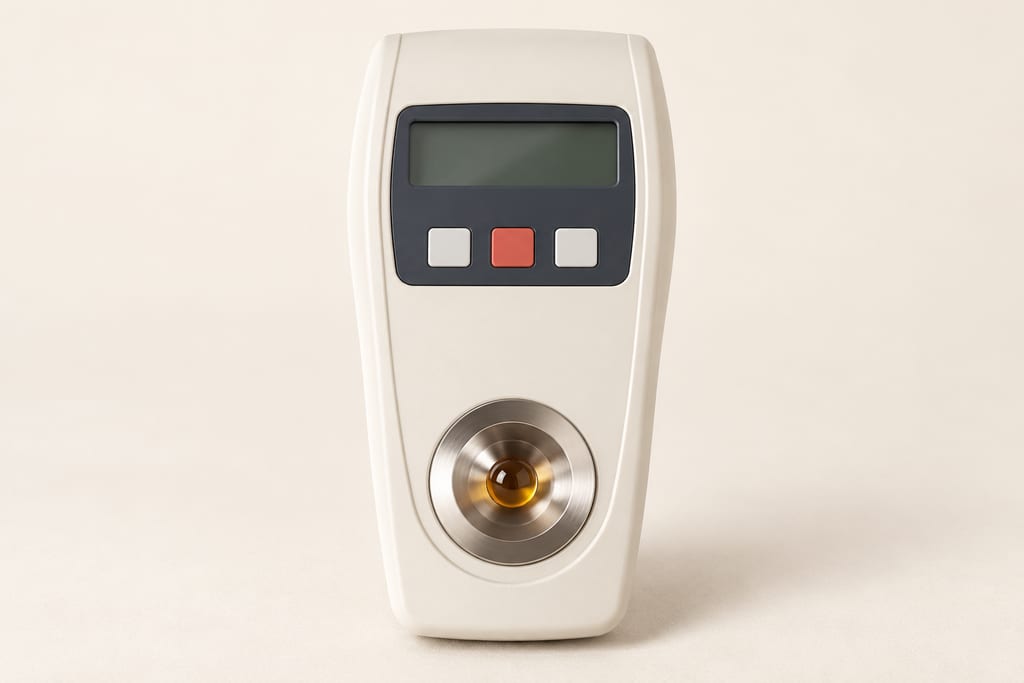
A refractometer measures how light changes direction as it passes through a sample, then displays either refractive index or a concentration scale derived from it. Food instruments commonly offer a °Brix scale. On the sucrose scale, °Brix is calibrated against sucrose solutions; it is a convenient way to compare soluble-solids readings when the product and method are suitable.
The instrument comes in different forms. The ATAGO PAL-1 is a pocket digital model with a small sample prism, a display, and separate start and zero controls. The Reichert AR200 is a larger digital handheld model with a stainless-steel sample well around a sapphire prism, a keypad and multiple display channels. Manual optical instruments form another product type. These examples show why the correct range, scale, temperature handling and instructions belong to a particular model rather than to every refractometer.
For a syrup or preserve, a refractometer can help check whether a sample is near a chosen soluble-solids specification and can make repeat measurements more consistent. The supplied food-preservation atlas names syrups and preserves as applications, while research on candied orange peel shows why dissolved-solids composition matters to product state and storage behavior. The instrument does not measure every property that determines how a food behaves.
A °Brix display should not be read as the percentage of sugar deliberately added to a mixed recipe. Refractive index responds to the dissolved material in the sample. Sugars contribute, but so can dissolved acids, mineral salts and other solids. In ketchup or a fruit preserve, the reading therefore combines ingredients rather than isolating added sugar. The NIST reference on refractometric estimation describes refractive index as an indication of total solids, including solutions with mineral-salt impurities. The condiments research records the same practical limitation for mixed sauces.
Temperature matters because refractive index changes with temperature. Instruments may measure or compensate for temperature, but the correction is tied to the selected scale and instrument design. The AR200 manual specifies its own temperature-compensation range for the sucrose Brix channel; the ATAGO PAL-1 is a distinct pocket model with its own specifications. A displayed correction is not a universal correction for every mixture. For meaningful comparisons, use one suitable model and follow its directions for sample application, calibration, temperature and cleaning.
The AR200 manual says to clean its prism and well after each sample, keep the well clean and dry, and calibrate routinely. It also cautions against strong acids or bases on that model's prism surface. These are model-specific instructions, not a universal cleaning recipe for all instruments. Check that the chosen model's scale and range suit the food; prevent carryover between samples; and use the manual's calibration procedure rather than assuming that a clean-looking prism or stable display proves accuracy.
A refractometer answers a narrow measurement question. A Brix reading cannot replace pH or water-activity measurement, and none of these readings on its own establishes microbiological safety. Treat it as a process-consistency instrument for an appropriate sample, not as validation of a preservation process or shelf-stability claim. Keep the formulation and tested process intact, and consult the method's own instructions when a measurement is used as a control point.
The supplied preservation inventory identifies a refractometer for syrup and preserve soluble-solids checks. The separate condiments research adds the interpretive caveat that °Brix in mixed foods includes dissolved materials beyond added sugar. These are measurement uses, not a dated origin history.
A sucrose-calibrated °Brix scale reports a sucrose-equivalent soluble-solids reading; in a mixed food, dissolved acids, salts and other solids contribute, so it is not a direct percentage of added sugar.
Source →A °Brix reading is not a substitute for measuring pH, water activity or microbiological safety.
Source →The cited NIST and ATAGO sources describe specific instruments and uses but do not establish the geographic origin, manufacture or exclusive distribution of the refractometer class.
A water-activity meter measures the equilibrium water vapour above a food sample and reports how available its water is. A reading describes that specimen under stated test conditions; it does not certify the food as safe.
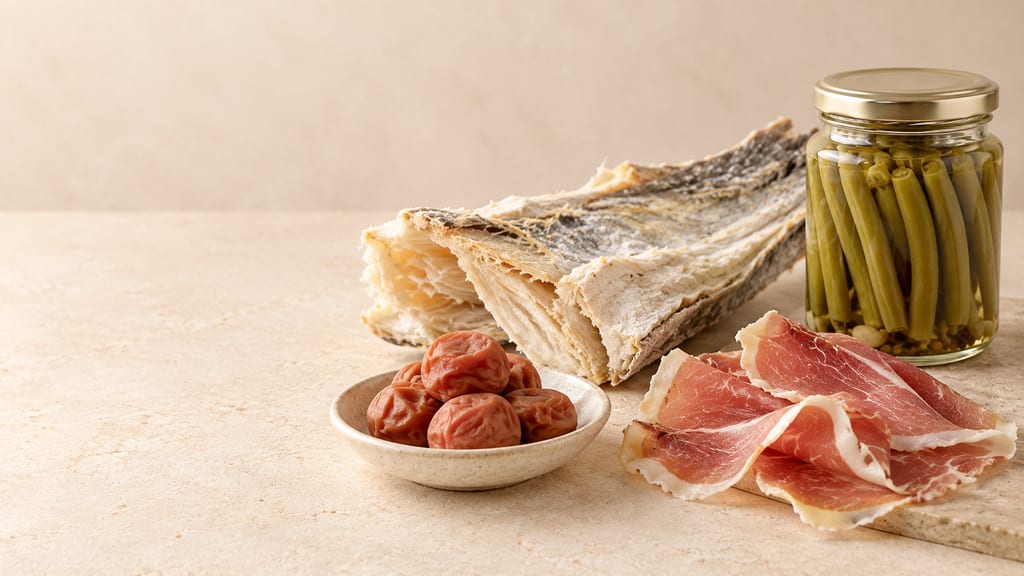
Every preserved food is a stack of barriers against microbes, enzymes, air and time. This is how they work, what a recipe's numbers measure, and how cooks worldwide build them.
No community contributions have been published for this entry yet.
Sign in to contribute. Published comments and photos are free to read.
National Institute of Standards and TechnologyEquipment description · Modern laboratory use
AR200 Refractometer meterNIST documents a Reichert AR200 digital handheld refractometer in its sample-characterization laboratory.
The model measures refractive index and sucrose-scale Brix solids.
National Institute of Standards and TechnologyOperation · Care · Measurement limits
Reichert AR200 Instruction Manual: User's GuideThe manual identifies the sample well, sapphire prism, stainless-steel assembly, model-specific Brix and refractive-index ranges, temperature compensation, cleaning and calibration instructions.
Cited in: What the instrument measures; Temperature, calibration and care
ATAGO Co., Ltd.Equipment description · Food applications · Product image
PAL-1 Pocket RefractometerATAGO describes a PAL-1 pocket refractometer and shows its form and sample-reading display.
The manufacturer lists fruit juice, beverages, soups, sauces and seasonings among possible sample applications.
Cited in: What the instrument measures; Temperature, calibration and care
ATAGO Co., Ltd.Modern reach · Equipment variation
Pocket Refractometer PAL SeriesThe manufacturer's multilingual product site presents multiple pocket refractometer models and specialist scales.
Cited in: Reading °Brix in syrups and preserves
National Bureau of StandardsMeasurement interpretation
Circular of the Bureau of Standards No. 44, 2nd edition: Polarimetry, Saccharimetry and the SugarsThe refractometric-estimation section explains refractive index as an indication of total dissolved solids, including solutions containing mineral-salt impurities.
Cited in: Reading °Brix in syrups and preserves; Temperature, calibration and care
Journal of Food Engineering, volume 212Preservation context
State diagrams of candied orange peel obtained using different hypertonic solutionsThe study describes how syrup composition and water content relate to state transitions and storage behavior in candied orange peel; it is context for why a soluble-solids reading is not a complete preservation assessment.
Cited in: Reading °Brix in syrups and preserves; Temperature, calibration and care