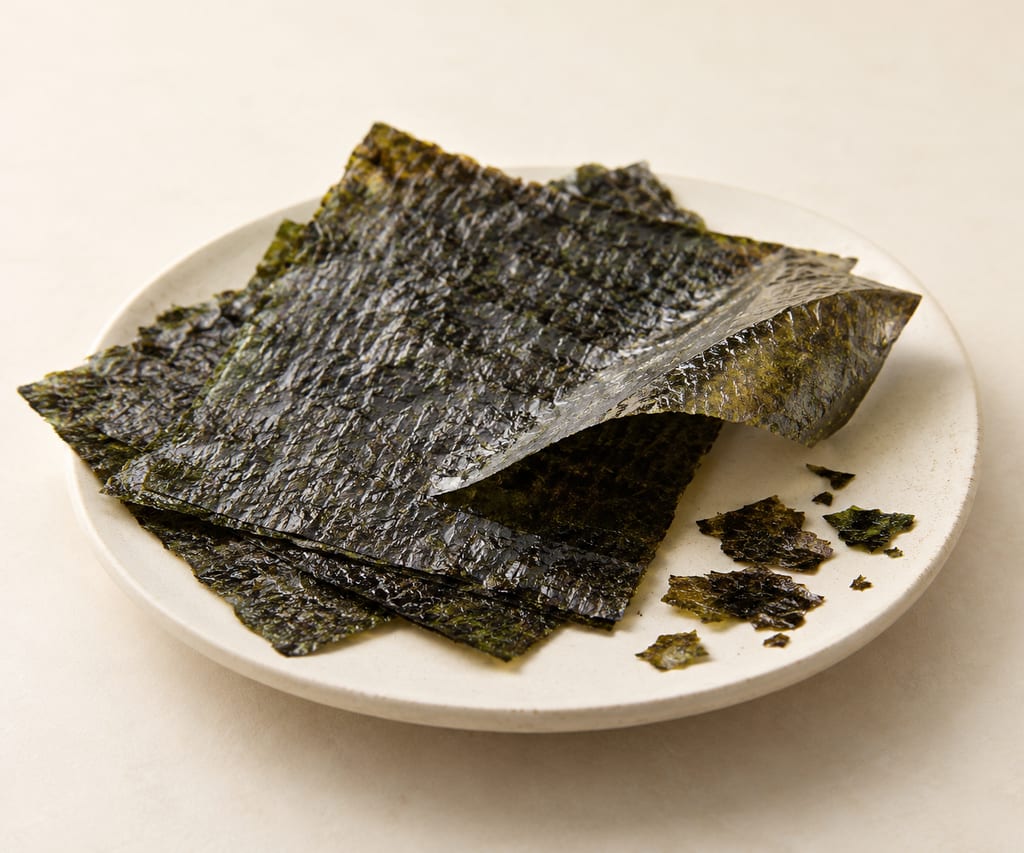
Nori
Nori is a red seaweed farmed in East Asia and dried into thin sheets, prized for its savoury flavour and crisp texture when roasted and used with rice, in soups and as a seasoning.
 FermenteaWhere food goes to change
Mushrooms
A yellow Caesar’s amanita now recognized as Amanita kitamagotake, a distinct species documented in Japan and China. Scientific catalogues list it as edible, while field identification is complicated by close relatives and lethal lookalikes.
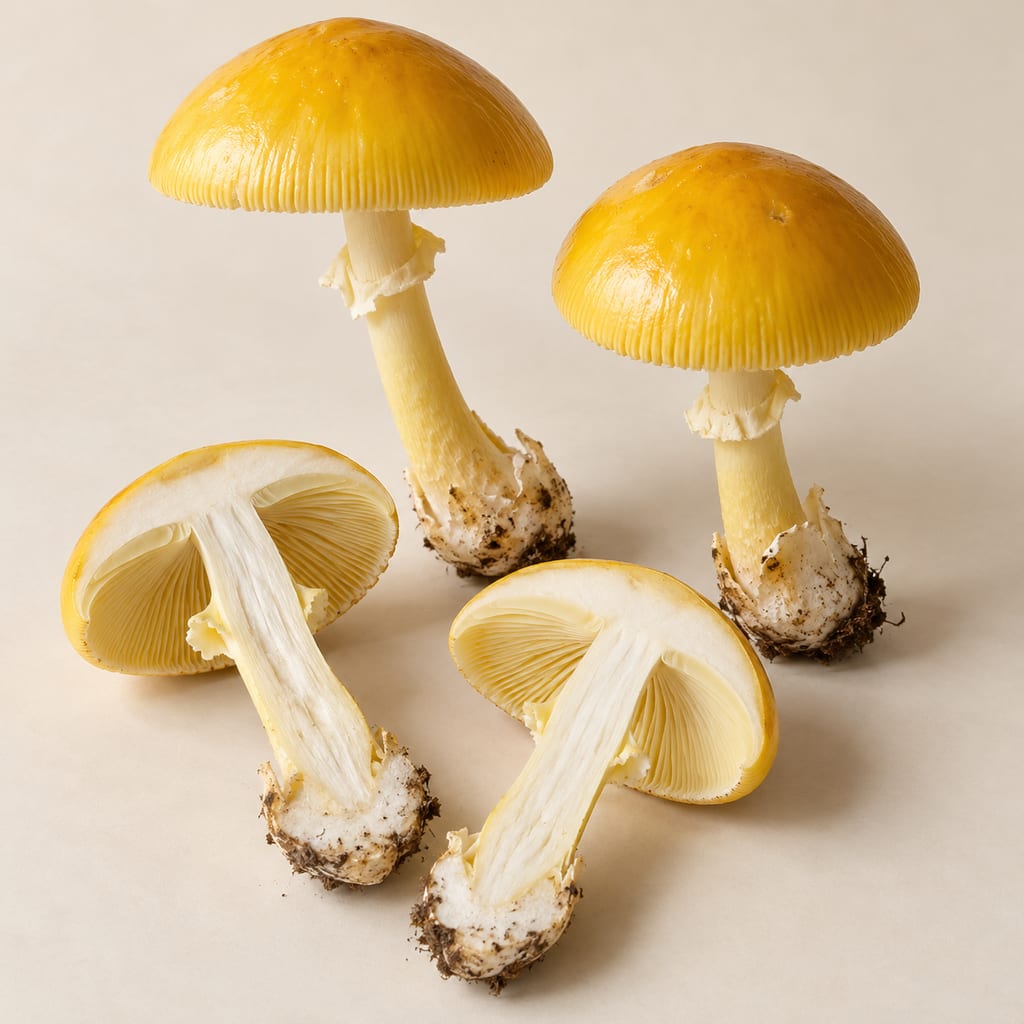
Kitamagotake is the Japanese name キタマゴタケ for Amanita kitamagotake, a member of Amanitaceae in the genus Amanita. It belongs to section Caesareae, the group that includes the familiar yellow, orange and red Caesar’s mushrooms. The name is relatively recent: a 2017 taxonomic study separated Japanese mushrooms called kitamagotake from the Southeast Asian species A. javanica, which earlier books had used for them. The authors compared visible and microscopic structures and used several DNA regions to show that the Japanese material represented a distinct species.
That taxonomic correction matters in practice. The old name A. javanica in Japanese field guides may refer to kitamagotake, but the names are not interchangeable everywhere: A. javanica sensu stricto is a separate tropical species. Other yellow or yellow-centered amanitas in the Caesar’s-mushroom group can also resemble one another. The species name should therefore be kept attached to the documented Japanese and Chinese records, rather than extended to every yellow egg-shaped Amanita. NCBI records the accepted name and holotype TNS-F 70004; the Tottori culture catalogue also notes that its isolate was first received as A. cf. javanica before the new name was published.
Amanita kitamagotake is an ectomycorrhizal fungus. Its mycelium forms a close nutrient-exchange partnership with tree roots; it is not a decomposer cultivated on compost like button mushrooms. The formal taxonomic description associates the species with deciduous and evergreen oak forests in cool to warm temperate regions. A university culture record gives a specific Japanese example: the basidioma source was collected from soil in a forest of Quercus myrsinifolia in Tama, Tokyo. A study of Chinese specimens records the fungus beneath trees in Fagaceae and Pinaceae, and notes the associated regions Jiangxi and Yunnan.
These are documented habitats and collection records, not a recipe for cultivation. The fact that a culture was isolated and deposited at a university does not mean the mushroom can be commercially farmed or that a fruiting method is established. Its dependence on living tree roots makes the biology different from mushrooms grown on prepared agricultural substrate. The sources here do not establish a production method, yield, or commercial supply chain.
The peer-reviewed species description places A. kitamagotake in cool to warm temperate Japan and China, while cautioning that records from neighboring countries need further study. Japan has well-documented taxonomic specimens and a September 2015 culture collection from Tama in Tokyo. The Chinese records include molecularly identified specimens from Jiangxi and Yunnan. These locations support a country-level range across Japan and China plus the named localities; they do not imply that the species is common throughout either country.
Regional accounts in Japan describe summer-to-autumn fruiting. Collection data include July and September records, which fit that broad window, but the sources do not establish a precise or universal season. Temperature, rainfall, elevation, forest type and year can affect when visible fruit bodies appear. A broad season note is more defensible than a calendar promise, and the collected specimens are not evidence that the mushroom will fruit in every locality each year.
A 2026 scientific catalogue of China’s edible and medicinal fungi lists A. kitamagotake as edible. A Japanese regional nature account likewise labels it edible and cites a Japanese mushroom field guide. This is meaningful evidence that the species has been classified as a food mushroom in those sources. It is not, by itself, a record of how often people eat it, how it is prepared, or what toxicological tests have been done on authenticated specimens. No specific culinary method, preservation method or fermentation use is established in the sources reviewed here.
The safest account keeps that distinction visible: the species appears in scientific edible lists and Japanese mushroom references, but this record does not recommend wild collection or consumption. Amanita identification is especially consequential because toxic species can resemble edible ones. No amount, preparation temperature, detoxification method or fermentation process should be inferred from a general edible classification. There is no evidence that fermentation makes a misidentified or unsafe Amanita safe.
The mushroom is described as uniformly bright yellow, with yellow gills and stem, and a volva at the stem base. Taxonomic authors distinguish related species by a combination of cap color, marginal striation, spore dimensions and other microscopic details, supported by DNA evidence. Color alone is weak evidence: the same species group contains yellow variants, and related taxa may have color forms that overlap. A photograph usually cannot show all the structures needed for a confident species-level determination.
The Japanese Ministry of Health warns that the highly poisonous A. subjunquillea can be confused with kitamagotake. Its risk profile describes amatoxin poisoning with delayed severe gastrointestinal illness, liver injury and possible death. That is not a theoretical lookalike concern; it is a public-health hazard. The account therefore keeps the species’ food classification separate from field identification advice and does not give a visual checklist as a way to decide whether a wild specimen is edible. A reader should not eat a wild Amanita identified from a webpage or image.
The research reviewed describes kitamagotake as a wild ectomycorrhizal mushroom and as a listed edible species. It does not document its use as a fermentation starter, a substrate for a named fermentation, or an ingredient in a traditional fermented food. A food use in a cooked dish, where reported, would not establish that it can be fermented safely or that fermentation changes its risks.
For that reason this account does not offer a brine, acidification target, cooking instruction, storage life or preservation schedule. Those details need evidence for this species and a verified identification. The absence of a demonstrated fermentation practice is useful information for a fermentation reference: the organism is currently documented here as a wild food mushroom, not as a fermenting culture or validated fermentation ingredient.
The strongest evidence is taxonomic: peer-reviewed DNA and morphology work defines the Japanese species, and later molecular specimens support its presence in China. The university culture catalogue anchors one specimen in a named Tokyo locality and forest habitat. The Chinese scientific catalogue and Japanese nature account give edible classifications, while the Ministry of Health profile documents the danger of one close lookalike. These sources answer different questions and should not be collapsed into one broad assurance.
For an ingredient page, the useful summary is narrow. Kitamagotake is a distinct Amanita associated with temperate forests in Japan and China, fruiting seasonally in summer and autumn in Japanese accounts. Scientific and regional sources list it as edible, but there is no preparation or fermentation instruction here, and dangerous confusion with A. subjunquillea makes casual identification unsafe. A species-level name in a checklist does not validate a specimen in a basket.
Before the 2017 revision, Japanese specimens called kitamagotake were often placed under Amanita javanica. The name became unstable when researchers compared Japanese material with specimens from Southeast Asia. The Japanese yellow-capped entity was genetically distinct from A. javanica sensu stricto, so the authors named it A. kitamagotake. Their study used ITS, nrLSU and tef-1 sequence regions alongside cap, gill, stem and microscopic characters. The name therefore denotes a taxonomic conclusion supported by several kinds of evidence, not simply a yellow color form.
This distinction explains why older records should be read with care. A field guide published before the revision may use A. javanica for Japanese kitamagotake, while the same Latin name in a modern account can refer to the tropical species. A regional name can remain stable as the scientific name changes, but not every older image or edible-use report can automatically be reassigned to the current species. The strongest evidence is a specimen that can be re-examined, ideally with molecular data. NCBI and current taxonomic catalogues index the newly described name; that does not retroactively resolve every legacy occurrence.
Amanita kitamagotake’s association with oak woodland and Chinese collections beneath Fagaceae and Pinaceae places it among fungi whose visible fruiting bodies emerge from a larger below-ground partnership. Ectomycorrhizal fungi grow around fine tree roots and exchange mineral nutrients and water for compounds made by the plant. That general relationship helps explain why a jar culture is not the same as a dependable crop: preserving an isolate is not equivalent to reproducing the tree-root environment that supports fruiting. The TUFC deposit demonstrates that fungal material was maintained for research, but its record does not describe commercial cultivation.
The species-level evidence names forests and soil rather than a narrow substrate. It should not be described as growing on straw, sawdust, manure or other mushroom-farm substrates without evidence. Nor do the recorded localities imply that the species can be moved or propagated safely outside its native ecosystem. A wild association with local trees is ecological context, not a cultivation protocol. The literature reviewed here gives no yield, inoculation method or evidence of cultivated edible crops.
The Chinese 2026 catalogue describes a dataset assembled from research published during 2019–2025 and says species names and statuses were reviewed against current diversity and phylogenetic work. Its list classifies A. kitamagotake as edible. This strengthens the supplied index entry beyond an unattributed checklist, but it remains a classification in a national catalogue. The article does not in its species entry document a meal, preparation, a portion size or a local market chain. Those are different kinds of evidence.
A Japanese regional nature foundation also calls kitamagotake edible and cites a standard mushroom guide. It offers no species-specific handling or cooking procedure and immediately warns that a poisonous species resembles it. The sources do not establish how the mushroom is selected, sold or prepared across China and Japan, and they do not justify a broad cultural story. It is more accurate to say it is classified as edible in these sources than to claim a long or widespread tradition of consumption.
Kitamagotake is one of several yellow to orange-yellow Amanita in section Caesareae. The taxonomic paper describes its bright, uniformly yellow cap and uses microscopic and DNA evidence to distinguish it from similar taxa. A Japanese field account says related chatamagotake can also have a yellow variant, making cap color alone a poor discriminator. This is a naming and identification problem even before toxic species are considered: similar-looking mushrooms can be different species, and older Latin names may have covered different taxa.
A more serious confusion is with Amanita subjunquillea. The Japanese Ministry of Health’s toxin profile identifies kitamagotake as a mushroom that can be mistaken for this amatoxin-containing species. A. subjunquillea poisoning may progress from delayed gastrointestinal illness to severe liver injury and death. The profile’s public-health purpose is to prevent poisoning; its mention of distinguishing features should not be repackaged here as a field test. A web photograph, inherited caption or one visible feature cannot establish safe identification. This page does not provide foraging instructions.
No species-specific sensory study or cooking experiment was located in the reviewed sources. They support an edible classification and a regional edible claim; they do not establish flavor, nutritional value, preparation, shelf life or portion guidance for authenticated kitamagotake. Results for another Caesar’s amanita cannot fill these gaps because different species can differ in chemistry, texture and risks. General mushroom advice is not evidence about this species.
The distinction is important in a fermentation reference. Fermentation is not a generic safety treatment: salt, acidity, heating, organism, time and storage conditions depend on the food and process. No source reviewed documents kitamagotake as a starter, fermented substrate or traditional fermented ingredient. There is consequently no defensible fermentation schedule or safety claim to provide. A catalogue classification should not be interpreted as permission to experiment with wild material or as evidence that fermentation neutralizes a toxin.
Tottori University catalogue records the voucher-backed basidioma source from this locality in Quercus myrsinifolia woodland; this does not claim local consumption.
The 2017 taxonomic paper and NCBI record establish the species in Japan; listed edible use is separate from occurrence and no preparation is documented here.
Molecularly identified Chinese specimens are reported from Yunnan; the source documents specimens/ecology, not food consumption.
Molecularly identified Chinese specimens are reported from Jiangxi; the source documents specimens/ecology, not food consumption.
The 2026 national scientific catalogue classifies the species as edible but does not, in the cited entry, document an actual meal or preparation; this row is not a traditional-use claim.
Nori is a red seaweed farmed in East Asia and dried into thin sheets, prized for its savoury flavour and crisp texture when roasted and used with rice, in soups and as a seasoning.
No community contributions have been published for this entry yet.
Sign in to contribute. Published comments and photos are free to read.
MycoscienceIdentity · Taxonomy · Ecology · Geography · Season
Reevaluation of Japanese Amanita section Caesareae species with yellow and brown pileus with descriptions of Amanita kitamagotake and A. chatamagotake spp. nov.The 2017 paper described A. kitamagotake as a distinct species based on morphology and ITS, nrLSU and tef-1 phylogenetic analyses.
The species is characterized by a uniformly bright-yellow cap and occurs in cool to warm temperate Japan and China.
Its specimens were formerly misidentified under A. javanica; related yellow cap species make exact identification complex.
Cited in: The yellow name and the species behind it; A woodland partner, not a compost mushroom; Range and fruiting season; Why identification needs more than a yellow cap; No established fermentation role; Reading the evidence responsibly; A changing taxonomic map; Forest ecology and cultivation limits; Close relatives and dangerous lookalikes; What remains unknown about food and fermentation
MycosystemaUse · Taxonomy
Species cataloging of edible and medicinal fungi in ChinaThe 2026 Chinese species catalogue includes A. kitamagotake in its edible fungi list.
The authors describe a 2019–2025 update based on taxonomic research; an edible-list entry is a classification, not a report of consumption or preparation.
Cited in: What the edible listing does and does not tell us; No established fermentation role; Reading the evidence responsibly; Reading the food classification carefully; What remains unknown about food and fermentation
IMA FungusTaxonomy · Ecology · Geography
Squamanitaceae and three new species of Squamanita parasitic on Amanita basidiomesMolecularly identified Chinese A. kitamagotake specimens are recorded from Jiangxi and Yunnan; associated collections were found on soil under Fagaceae and Pinaceae.
The study documents collection/specimen records and ecology, not human use.
Cited in: A woodland partner, not a compost mushroom; Range and fruiting season; Reading the evidence responsibly; Forest ecology and cultivation limits
Tottori University Fungus/Mushroom Resource Research CenterIdentity · Geography · Season · Ecology
TUFC culture record 101076A basidioma collected on 11 September 2015 at Tama-chuo Park, Tama, Tokyo, was identified as A. kitamagotake and deposited as culture TUFC 101076.
The recorded habitat is soil in a Quercus myrsinifolia forest; an earlier reception name was A. cf. javanica.
Cited in: The yellow name and the species behind it; A woodland partner, not a compost mushroom; Range and fruiting season; Forest ecology and cultivation limits
Japan Ministry of Health, Labour and WelfareSafety · Lookalikes
Natural toxin risk profile: Amanita subjunquilleaJapan’s public-health profile reports A. subjunquillea as amatoxin-containing and potentially fatal, and identifies yellow kitamagotake as a mushroom it can be confused with.
The profile documents severe, potentially fatal poisoning and underscores that visual similarity is a serious risk.
Cited in: What the edible listing does and does not tell us; Why identification needs more than a yellow cap; Reading the evidence responsibly; Close relatives and dangerous lookalikes; What remains unknown about food and fermentation
Machida Eco-Life Promotion FoundationUse · Season · Ecology
Kitamagotake species accountA regional Japanese species account describes summer-to-autumn fruiting in coniferous and broadleaf woodland and labels it edible, while warning of a poisonous lookalike.
The account attributes its food-use statement to a Japanese mushroom guide; it does not provide preparation or independent toxicology evidence.
Cited in: Range and fruiting season; What the edible listing does and does not tell us; Reading the food classification carefully; Close relatives and dangerous lookalikes
NCBIIdentity · Taxonomy
Taxonomy Browser: Amanita kitamagotakeNCBI recognizes A. kitamagotake N. Endo & A. Yamada, 2017, places it in Amanitaceae, and lists holotype TNS-F 70004.
Cited in: The yellow name and the species behind it; A changing taxonomic map