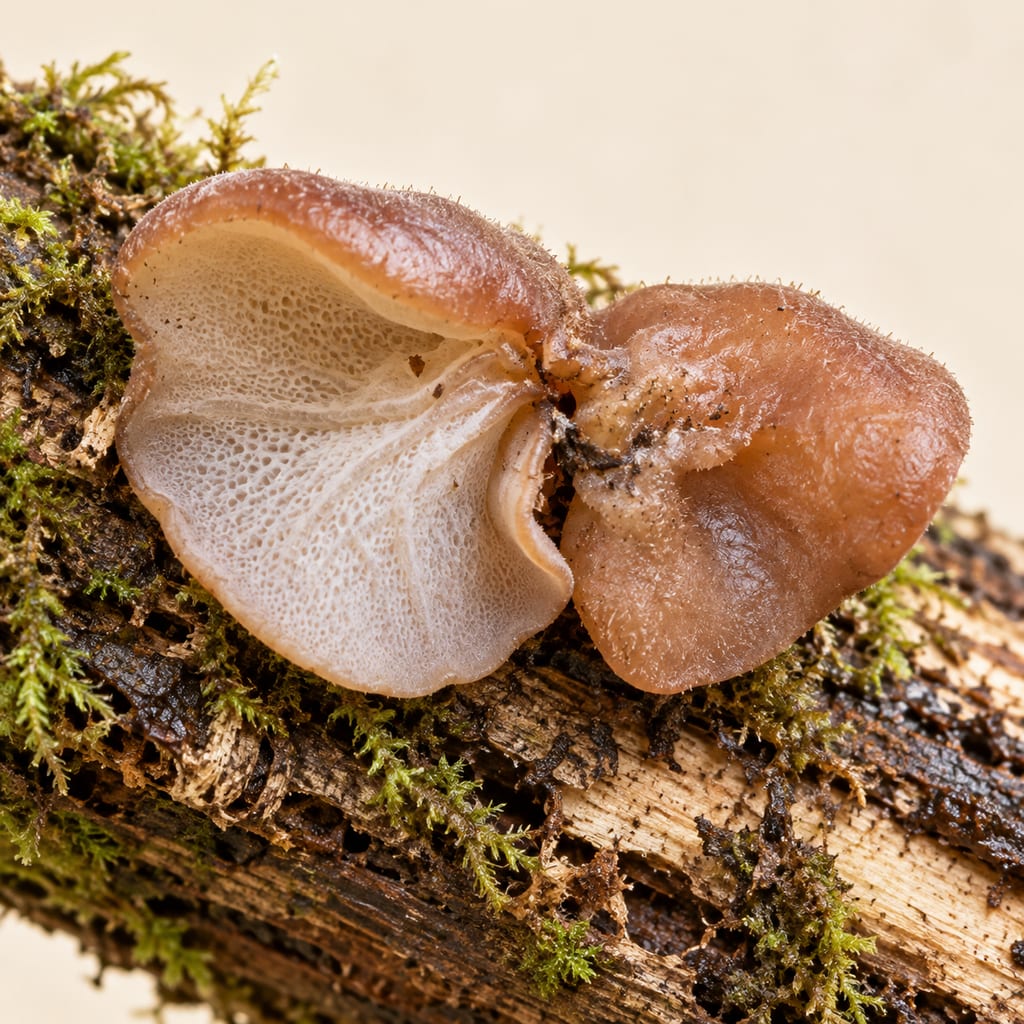
Auricularia lateralis
A gelatinous wood-ear fungus described from Yunnan, China, in 2021 and listed as edible in a 2026 Chinese catalogue. Documented food use, preparation and safety are absent.
 FermenteaWhere food goes to change
Mushrooms
Laccaria vinaceoavellanea is a small ectomycorrhizal mushroom sold as food in Yunnan and Sichuan, and it accumulates arsenic in its caps, which the sources treat as a main safety caveat.
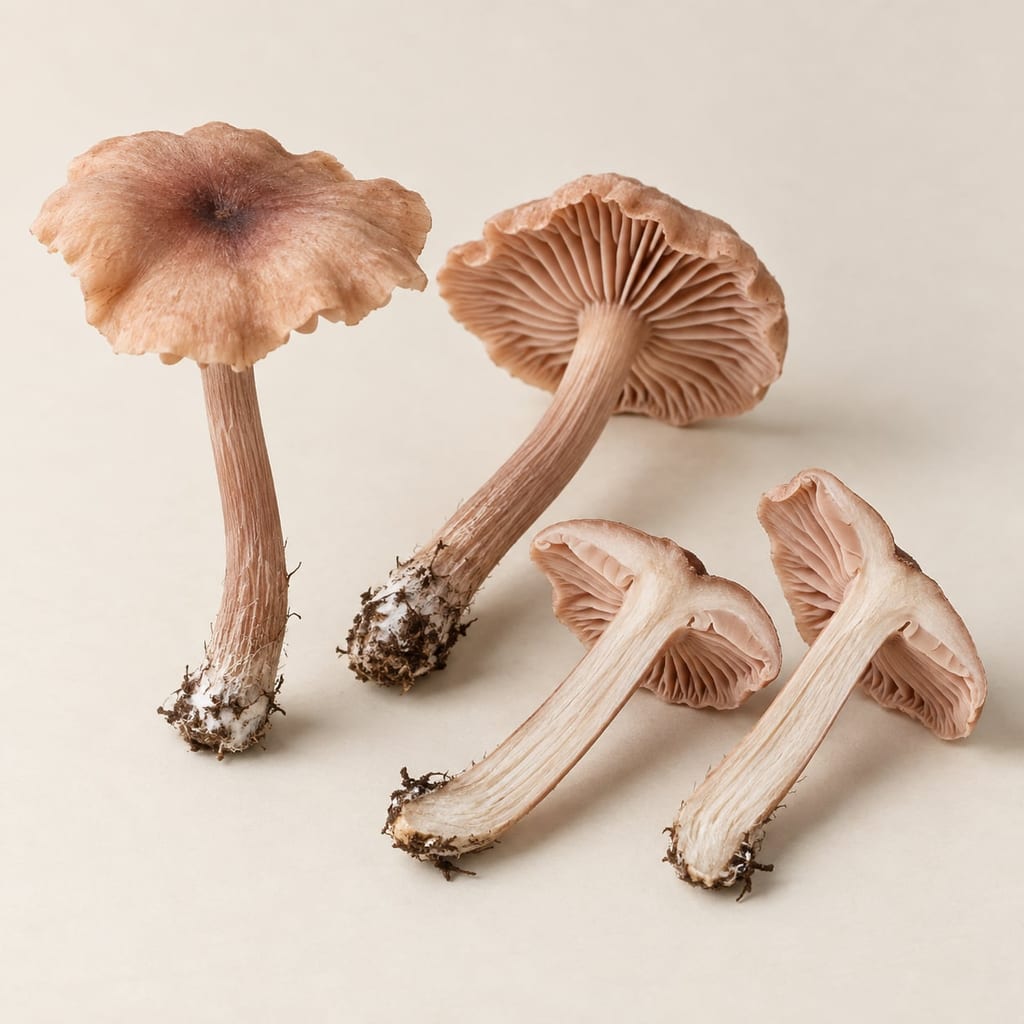
Laccaria vinaceoavellanea is a species of the genus Laccaria, whose type species is L. laccata, known as the deceiver. The genus table on Wikipedia gives the 1971 authority Hongo. The catalogue records the common name Asian deceiver; the sources reviewed did not use that name, so it is recorded here as a catalogue label only.
A 2025 study describes four new Laccaria species from Yunnan with morphological and molecular data. It is a separate study and does not revise this species, so its status is not settled by that paper.
The catalogue describes the species as an ectomycorrhizal forest fungus, sold as a small wild mushroom. Cultivation is not recorded.
A review cited in the search results lists L. vinaceoavellanea among the commercial mushrooms of Sichuan Province, and the catalogue records it as sold as food in Yunnan. A Dali University taxonomic paper states that all currently known Laccaria species are considered edible. The sources do not give a preparation for this species.
A 2014 study found high arsenic in this species. Caps contained a mean of 130 to 163 mg per kg dry weight, and the authors describe the species as an arsenic accumulator. They estimated that one 300 g fresh-weight meal eaten once a week could give an arsenic exposure of 3.9 to 4.9 mg.
Identification and safety: a name, a photograph or one regional guide does not confirm that a wild specimen is this species. This page is not a collection key. Edibility statements refer to the named species as understood by each source, not any particular specimen. Because of the arsenic finding, the sources do not support treating this species as a routine food, and no quantity or frequency is advised here.
Sold as food in Yunnan according to the catalogue; the sources do not give a market scale for this species.
Treated as a commercial mushroom in Sichuan according to a review cited in the search results.
A gelatinous wood-ear fungus described from Yunnan, China, in 2021 and listed as edible in a 2026 Chinese catalogue. Documented food use, preparation and safety are absent.
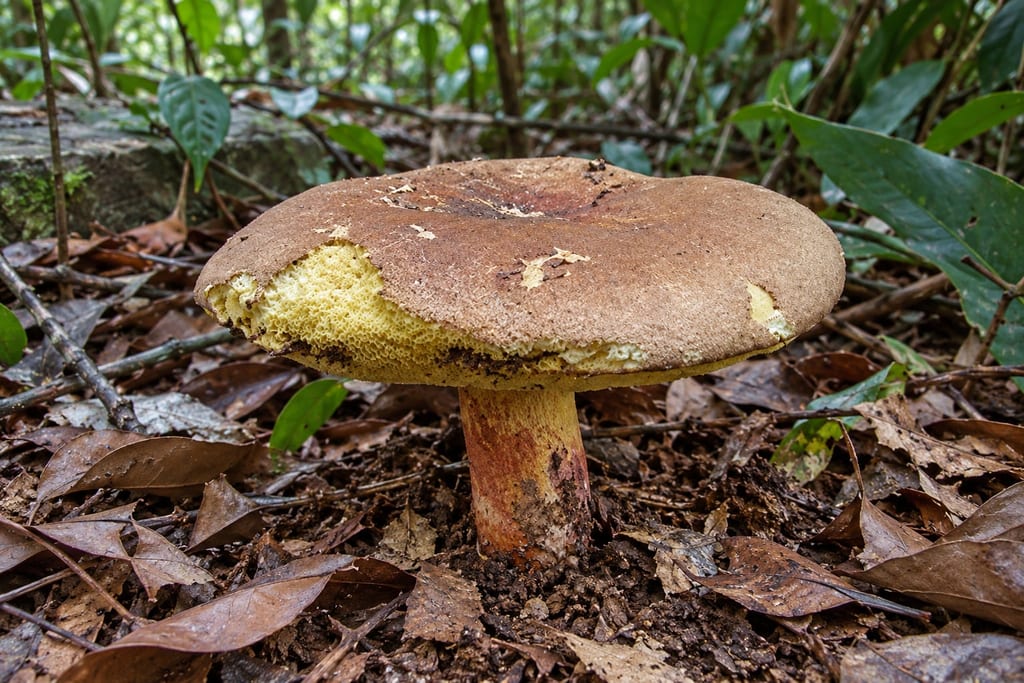
Butyriboletus huangnianlaii is a Chinese butter bolete described from Fujian and later found at market in Pu’er, Yunnan. The local edible label is limited evidence; recurring season and preparation remain unestablished.
No community contributions have been published for this entry yet.
Sign in to contribute. Published comments and photos are free to read.
WikipediaTaxonomy · Names
LaccariaGenus type species L. laccata; L. vinaceoavellanea listed with 1971 authority Hongo.
Cited in: Identity and name
PubMed CentralTaxonomy · Food status
Species Diversity of Edible Mushrooms I: Four New Laccaria Species from Yunnan Province, China (2025)Four new Laccaria species from Yunnan; separate from L. vinaceoavellanea.
Cited in: Identity and name; Habitat and supply; Market and food use; Arsenic and safety
Biological Trace Element Research (Springer)Safety · Chemistry
Arsenic in edible Laccaria mushrooms (2014)Caps mean 130 to 163 mg/kg dw arsenic; 300 g fresh weekly meal estimate 3.9 to 4.9 mg.
Cited in: Market and food use; Arsenic and safety