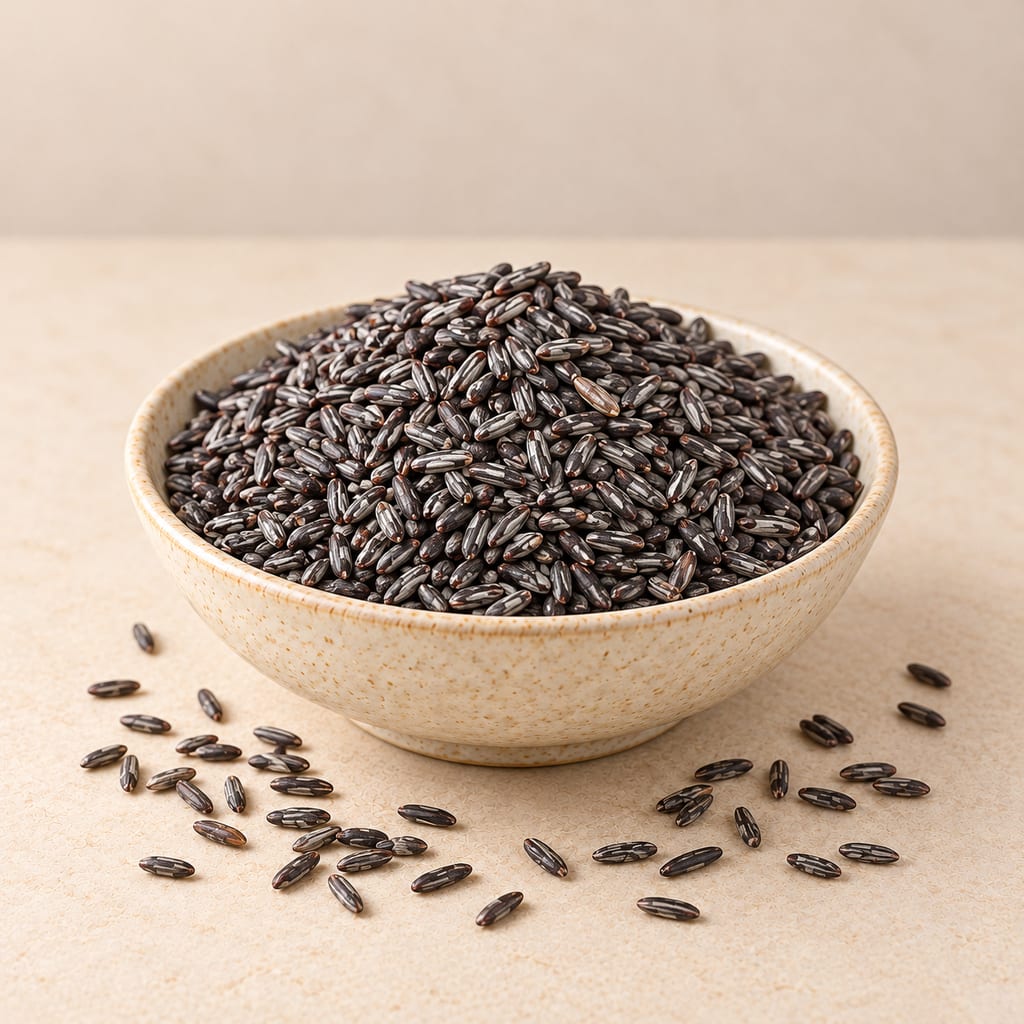
Dahyangheukmi pigmented rice
Dahyangheukmi (다향흑미) is a registered Korean black-rice cultivar with an aromatic, non-glutinous grain. It has been used to make rice-flour nuruk, yakju and gochujang in published studies.
 FermenteaWhere food goes to change
Mushrooms
A small wood-decaying jelly fungus recognized as a distinct East Asian species. A Chinese edible-fungi catalogue lists it as edible, but species-specific preparation and safety evidence remain limited.
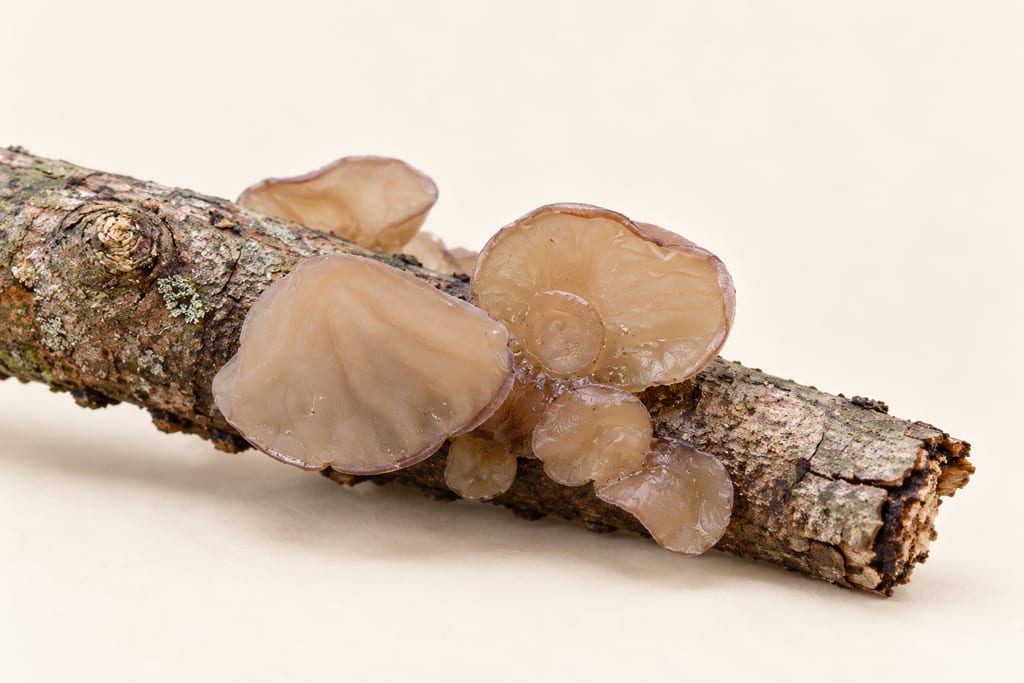
*Auricularia minutissima* Y.C. Dai, F. Wu & Malysheva is a named species of jelly fungus in Auriculariaceae. It was described from East Asia as part of the taxonomic reassessment of the *A. auricula-judae* complex. Molecular phylogeny and morphological comparison distinguish it from species with which it had been confused or that resemble it, including *A. heimuer* and *A. minor*. The distinction matters because familiar names such as “wood ear” have been applied to more than one species in regional and cultivation literature. A catalogue entry for *A. minutissima* should not silently combine those records or borrow their uses.
The account here follows the species concept used in the cited sequence-based treatments. The name is accepted in Species Fungorum. As with other fungi, acceptance of a scientific name does not certify a photograph or a field observation bearing that name. Evidence is strongest when a specimen is examined with appropriate microscopic characters and, in difficult cases, DNA data. Published treatments describe contrasting forms within the taxon but place them in the same supported lineage; that combination of variation and close lookalikes cautions against assigning a name from general appearance alone.
This entry is about the fungus and what the literature actually says. It is not a field-identification key, a foraging guide, or an endorsement of eating wild mushrooms. The word “edible” appears in a published Chinese catalogue and in a local survey, but the evidence assembled here does not include a validated preparation protocol or a species-specific safety study. The scope of the catalogue classification and the limits of that evidence are therefore kept explicit below.
The 2021 global phylogenetic treatment describes fresh fruit bodies as gelatinous, with colours ranging from vinaceous grey and fuscous to clay-buff or pinkish-buff. The fruit bodies may be solitary or clustered, sessile, and discoid or ear-shaped; lobing can be present. The upper surface is hairy, while the lower fertile surface may be smooth or folded. Those terms describe the studied material and do not imply that every specimen displays every feature. Colour and shape vary, and neither is a stand-alone identification test.
The same treatment reports more than one fruit-body form within the species. The authors retained them in *A. minutissima* because the morphological observations were consistent with their molecular results. This is a useful reminder that visible differences can occur within a named fungal species, while similar-looking forms can also belong to different species. Microscopic characters, including spore measurements used in comparisons with *A. heimuer* and *A. minor*, and molecular evidence underlie the taxonomic distinctions.
The reported substrate is dead broadleaf wood. The 2021 paper includes Chinese collections from rotten *Acer* branches and fallen *Quercus* branches, and Russian Far East material from fallen trunks. These observations support describing the species as a wood-decaying fungus. They do not establish a preference for every hardwood, a host-specific ecological relationship, or the frequency with which the fungus occurs. The sources provide specimen records rather than a comprehensive ecological survey for this species.
An iNaturalist observation from Fukushima, Japan, shows small gelatinous fruit bodies on wood and supplies five separately licensed image views. It is useful as visual documentation, but it remains a community-identified observation rather than a sequenced voucher. The photographs illustrate the reported general form; they do not replace the laboratory evidence needed to confirm a difficult identification. Image attribution and licensing are documented in the research dossier.
The available dates are voucher-collection dates, not a complete fruiting calendar. The Korean molecular-taxonomy study reports re-identified collections from 11 May to 28 June, at Suncheon and Shinan in Jeollanam-do and Ulleung in Gyeongsangbuk-do. The 2021 global treatment reports Chinese specimens collected in July, August and November and Russian material from July, August, September and October. Together these records show that documented collections span several months and regions. They do not show the start or end of fruiting in each region, typical annual timing, or peak abundance.
Localities named in the taxonomic literature include Kongtongshan, Pingliang, Gansu, China, where a collection was made on 3 August 2015 on a rotten *Acer* branch; and Yesanpo Nature Reserve, Laishui County, Hebei, China, where the holotype was collected on 18 November 2014 from a fallen *Quercus* branch. The 2021 paper also lists Kedrovaya Pad Reserve in Primorye Territory, Russia, with a specimen dated 10 October 1994. The Korean paper adds the three collection areas noted above, with dates in May and June.
Japanese taxonomic research has also reported *A. minutissima* in reassessments of collections previously assigned to broader names. One photographed Mushroom Observer collection from Tsukuba, Ibaraki, dated 10 March 2016, is represented by Wikimedia Commons pages whose captions and stated licences are included in the research file. The image pages provide a useful provenance lead; their CC BY-SA terms are distinct from the CC BY terms attached to the five iNaturalist views.
These localities document biological occurrence and taxonomic work. They do not show that residents of those places traditionally eat the species, that it is commercially cultivated there, or that every local fungus previously called “wood ear” is *A. minutissima*. The structured place notes should preserve that distinction. No cultural-use or food-market map should be inferred from a specimen locality alone.
Fang Wu and co-authors' 2025 catalogue of edible and medicinal fungi in China lists *A. minutissima* as edible. A 2022 macrofungal survey from Mount Huangshan likewise categorizes the species among edible saprotrophic fungi. These two sources justify reporting that an edible classification exists in published Chinese literature. They do not, on the evidence reviewed here, establish the extent of use, the communities or markets involved, or how a species-verified specimen is prepared.
The 2025 work is a national species catalogue. Its classification should be represented as a catalogue statement, rather than expanded into a recipe or an assurance that a particular collection is safe. The 2022 survey is a local biodiversity study whose edible category is a second literature reference, but it is not a controlled feeding study or a species-specific toxicology paper. Neither source in this dossier provides a tested recipe, preparation time, cooking temperature, or assessment of adverse effects for *A. minutissima*.
The evidence also does not establish that this species is commercially cultivated or sold as a distinct product. The existence of commercial cultivation and culinary traditions for other Auricularia species cannot be transferred to *A. minutissima* without a source that identifies the species itself. In particular, *A. heimuer* has a separate taxonomic identity and extensive cultivation literature; those records are not evidence that *A. minutissima* shares the same supply chain or processing.
A published edible classification exists, but the food-use evidence behind it is missing. Readers should not collect an ear-shaped fungus, identify it from a page, or prepare a wild specimen. The photographs come from one community-identified observation and are not a substitute for expert confirmation.
The principal practical limitation is uncertainty at the point of identification. Several Auricularia species can share gelatinous, ear-like fruit bodies, and the taxonomic sources distinguish them using more than field appearance. The published research evaluates morphological and molecular characters, including microscopic traits. A catalogue listing has no power to verify an individual specimen. A photograph, common name, observation record, or visual match should not be treated as proof that an unknown mushroom is *A. minutissima*.
No species-specific toxicological evaluation, adverse-event account, or validated safe preparation procedure was located in the sources used for this dossier. The absence of such a result in this search is not evidence that no hazard exists. Nor does the word “edible” in the cited catalogue resolve the risks of collecting, identifying, handling, or preparing a wild fungus. For these reasons, this account supplies no consumption instructions and makes no recommendation to forage.
Food safety claims about other wood-ear species should remain attached to those species and to the sources that studied them. This page does not import general guidance about soaking, drying, cooking, storage or trade from *A. heimuer*, *A. auricula-judae*, or undifferentiated commercial “wood ear”. If a future source documents a preparation practice specifically for *A. minutissima*, it should be assessed separately for identity, provenance, preparation details and scope before being added.
The safe editorial statement is narrow: a Chinese edible-fungi catalogue and a regional survey categorize *A. minutissima* as edible, while this research did not identify a species-specific tested preparation or toxicological assessment. Keep the taxonomic uncertainty, food-use evidence and safety gaps in the same view so readers do not mistake a literature label for practical advice.
The name has a relatively recent, evidence-based meaning in the literature cited here. Work on the *A. auricula-judae* complex reassessed collections that had been grouped under broad or historically applied names. A record bearing an older name is therefore not automatically a record of *A. minutissima*. Authors have to compare specimens against the revised concepts, and later papers may re-identify material when sequence data or improved comparisons become available. This is why a distribution summary should be based on named, traceable collections rather than an unfiltered search for the common name “wood ear”.
The distinction also affects food-use research. A statement about a species in a catalogue applies to the taxon as understood by that catalogue, while older culinary or cultivation accounts may have used a name more broadly. Unless the underlying material is identified under a modern concept, those accounts cannot be confidently assigned to *A. minutissima*. The 2025 catalogue is the direct food-use source retained here; the account does not inflate that entry with practices reported for other species. A future revision could add stronger evidence if a publication documents the actual taxon, location, preparation, and scope of use.
The same caution applies to maps and dates. A voucher documents an occurrence at a stated place and time. It does not show that the fungus is abundant, that it fruits every year, or that the collection was used as food. Dates from separate countries and years are useful evidence that the species has been collected in multiple seasons, but they cannot be converted into one universal harvest window. Local climate, substrate availability, observer effort and the limits of the published collections all affect what appears in a record set. The current evidence is too narrow to infer exact regional peaks.
Collection records from China, Russia and Korea, together with Japanese taxonomic material, document occurrence in East Asia. They do not show traditional use in those places.
Collection from rotten Acer branch; occurrence record only, not a documented food-use site.
Holotype collected on fallen Quercus branch; occurrence record only.
Voucher locality; no food use is established.
Sequence-supported Korean collection; occurrence only.
Sequence-supported Korean collection; occurrence only.
Sequence-supported Korean collection; occurrence only.
Dahyangheukmi (다향흑미) is a registered Korean black-rice cultivar with an aromatic, non-glutinous grain. It has been used to make rice-flour nuruk, yakju and gochujang in published studies.
No community contributions have been published for this entry yet.
Sign in to contribute. Published comments and photos are free to read.
Mycological ProgressTaxonomy
Global diversity and taxonomy of the Auricularia auricula-judae complexDNA- and morphology-based distinction of A. minutissima and related species.
Cited in: Identity and scope; Documented form and habitat; What food-use sources establish; Identification and safety limits; Interpreting the records
Journal of FungiTaxonomy · Ecology · Geography · Season
Global Diversity and Updated Phylogeny of AuriculariaAccepted species treatment, morphology, substrates, and China/Russia voucher localities and dates.
Cited in: Identity and scope; Documented form and habitat; Season and geographic records; Interpreting the records
Korean Journal of MycologyTaxonomy · Geography · Season
Current Taxonomical Status of Korean Auricularia SpeciesSequence-supported Korean re-identifications, localities and dates.
Cited in: Season and geographic records; Interpreting the records
Transactions of the Mycological Society of JapanTaxonomy · Geography
Taxonomic study of Japanese Auricularia auricula-judae and A. polytricha based on molecular phylogeny and morphological comparisonJapanese taxonomic work including A. minutissima in reassessments of material formerly assigned to broader names.
Cited in: Season and geographic records; Interpreting the records
MycosystemaFood use
Species cataloging of edible and medicinal fungi in ChinaCatalogue lists A. minutissima as edible; this does not establish preparation or toxicology.
Cited in: Identity and scope; What food-use sources establish; Identification and safety limits; Interpreting the records
Journal of FungiFood use
Macrofungal diversity of Mount HuangshanSurvey categorizes A. minutissima among edible saprotrophic fungi.
Cited in: What food-use sources establish; Identification and safety limits
iNaturalistImage reference
Auricularia minutissima observation 284194119Observation metadata and attribution for five separately licensed views from one community-identified record.
Cited in: Documented form and habitat